Mahi-mahi
Fish · Last reviewed 2026-08-10
The fastest-growing large fish an angler is likely to meet — brilliantly coloured, mature within months, and gathered around anything floating in the open ocean.
Safety: hooks and barbs — can cause injury needing treatment. 5 more points apply here.
How this was identified, and who took it
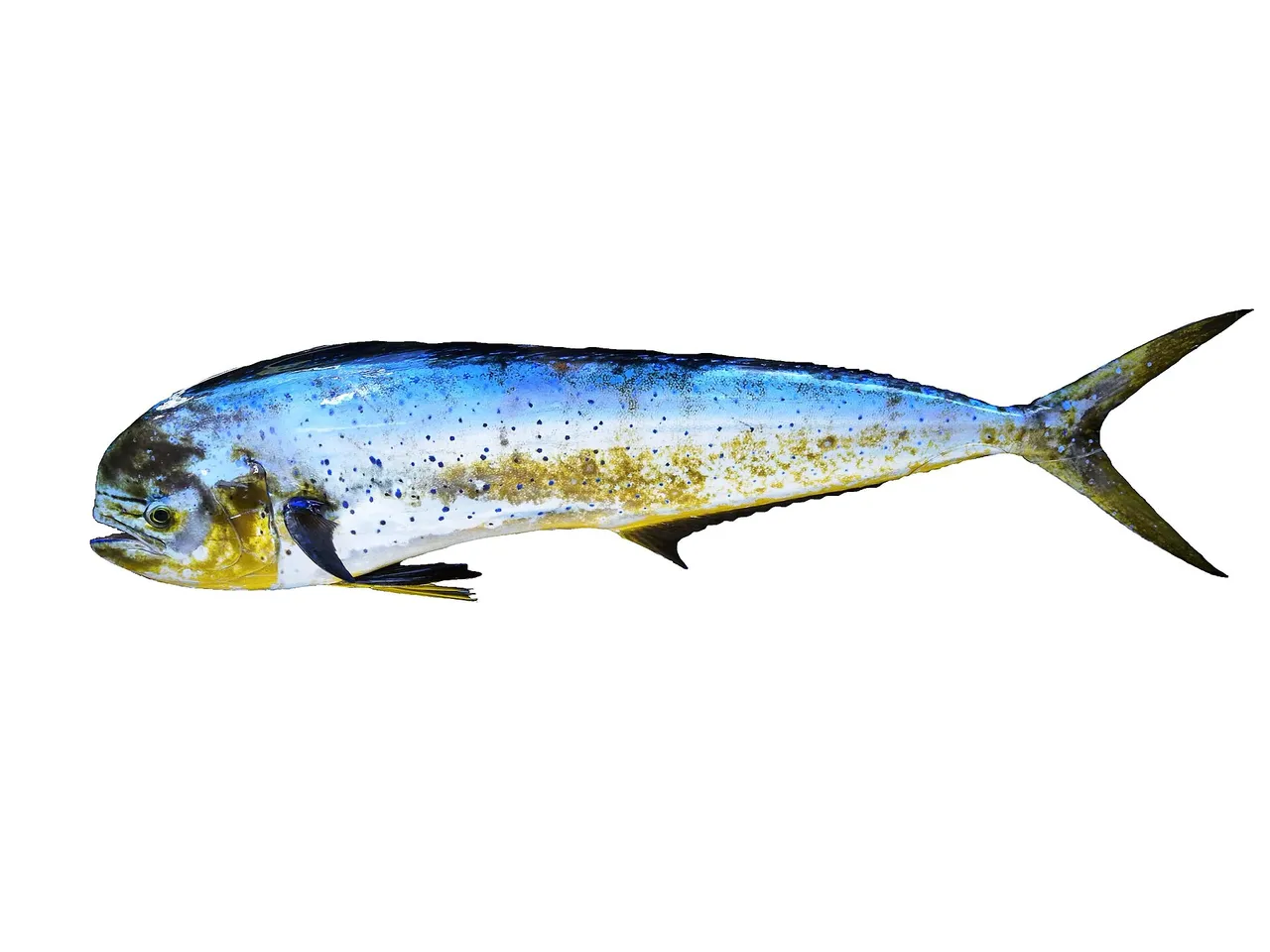
Identified by: Cut-out specimen in full lateral view. The single dorsal fin running almost the whole length of the back, the deeply forked tail and the blue spotting over gold are unmistakable. Blunt head, so not a mature male.Hugues Evano (IFREMER, Délégation océan Indien (DOI), Département Ressources Biologiques et Environnement (RBE), F-97420 Le Port, France) — CC BY 4.0, via Wikimedia Commons — source, licence_(Ifremer_00763-87546).jpg)
Catching Mahi-mahi
Everything here on fishing for it. Each entry opens the page behind it.
- Ground
- When
- Jun–Oct — months recorded at the places that document it, not a season for the whole range.
- Where
- 3 places FishingHQ documents — strongest claim anywhere: seasonal · From a boat, On a charter
The mahi-mahi is a fish that lives at speed in every sense. It grows faster than almost any other large marine fish, reaching sexual maturity within four to five months of hatching and rarely living longer than four years, with a generation time of around a year. A fish of ten kilograms may be barely more than twelve months old.
That life history changes how it should be thought about. A slow-growing, late-maturing fish is fragile because it cannot replace what is removed; a mahi-mahi replaces itself almost immediately. It is one of the few large, heavily fished marine species where the population dynamics genuinely favour the fishery, and that is worth stating plainly in a guide that is usually delivering the opposite news.
It is also spectacular to look at and to catch. Live fish are electric blue and green above with brilliant gold flanks, colours that pulse and shift while the fish is excited and fade almost completely within minutes of death — which is why photographs of dead mahi-mahi never look like the fish anyone remembers.
And the practical key to finding them is that they gather under floating objects. Weed lines, logs, debris, buoys, anything at all — small life collects beneath, bait follows, and mahi-mahi follow the bait. The behaviour is so reliable that entire commercial fisheries are built on deliberately deployed floating aggregating devices, and for an angler it means the search is for objects rather than for fish.
How it is caught
Where Mahi-mahi is documented
Places where public sources describe this species as fished, with how it is fished and how strongly the evidence supports it. This is not a range map and it is not a recommendation — it is what has been written down about a fishery rather than a record of any individual catch, and being listed is never permission to fish.
Canary Islands
1 documented place
Sea area
Seasonal
From a boat · On a charter
Around Jul, Aug, Sept, Oct
What these strengths mean
- Recorded here
- At least one credible public account of this species being caught here. That is all it means.
- Seasonal
- Well supported, and concentrated in part of the year rather than spread through it.
Identification
- Scientific name
- Coryphaena hippurus
- Family
- Coryphaenidae
- Water
- Saltwater, Brackish
- Conservation status
- Least Concern
- Regions
- Global, Caribbean, Mediterranean, Indo-Pacific, North America, Central & South America, Australia, Pacific Islands
- A single very long dorsal fin running from just behind the head almost to the tail — unmistakable and shared with no other fish an angler is likely to encounter.
- Adult males develop a steep, blunt, almost vertical forehead; females keep a rounded profile, which is the reliable way to sex the fish.
- Brilliant blue-green above with golden flanks and dark spots while alive; colours fade rapidly after death.
- Body strongly compressed and tapering sharply to a deeply forked tail.
- Small scales and a long-based anal fin; the whole outline is distinctive enough that confusion is unlikely.
Size
- Typical
- 3–8 kg (6.5–18 lb)
- Large
- 12–18 kg (26–40 lb)
Exceptional: Over 25 kg (55 lb); maximum published weight 40 kg
A fish that will not stop moving, on a deck full of hooks
Mahi-mahi are not dangerous in the way a wahoo or a barracuda is — the teeth are small and abrasive rather than cutting — and they injure a great many people anyway. The mechanism is movement and hooks.
WHAT HAPPENS. A dolphinfish landed green does not settle. It thrashes continuously, violently and unpredictably around a deck, frequently with a trolling lure carrying two large trebles or a hook and a stinger still attached. The injuries in this fishery are hooks driven into hands, arms and legs, and they are common.
SO THE HANDLING IS ABOUT CONTROL AND SPEED. Fish that are being kept should be gaffed, brought straight into a fish box or a bag with the lid closed, and dispatched immediately. Fish being released are best released in the water. A green dolphinfish loose on an open deck is the situation to avoid entirely.
THE SCHOOL BEHAVIOUR MAKES IT WORSE, because dolphinfish are caught in numbers quickly, and a deck with several green fish, several rigged lines and several trebles is where the accidents happen. Deal with each fish completely before the next comes aboard.
THE FISH'S SIDE. Mahi-mahi grow extremely fast, mature early and are relatively resilient as a population, which is why this is more of a retention fishery than most pelagics. That does not license careless handling of released fish: they exhaust quickly, they are caught in hot conditions, and a fish returned after five minutes on a hot deck will not survive.
AND THE COLOURS FADE AS THE FISH DIES. It is the most photographed thing about the species and it is a description of the animal's condition.
What experienced anglers do — why, and the sources (2)
Widely and independently recommended by experienced anglers and specialist sources. This is real angling knowledge, not proof: controlled evidence for it is limited, and FishingHQ records it as convention rather than as a demonstrated effect.
- FishBase: a global information system on fishes — Froese, R. and D. Pauly, eds. — FishBase Consortium (Scientific institute)Relied on for: Dentition, fin and spine morphology, body form, air-breathing capability and distribution for the species, which are the anatomical facts the handling practice below follows from.States this directlyPassage read and verified
- General angling website restatements of established technique — Various (Credible secondary source)Relied on for: Widely restated angling practice for handling this species, recorded as practitioner consensus rather than as tested fact.Background and mechanism onlyCitation checked — the work exists and is described correctly
Live fast, spawn constantly: the strategy that makes a stock resilient
Mahi-mahi are the clearest example on FishingHQ of a life history built entirely around speed, and it produces a conclusion that runs against the usual direction of fisheries concern.
EVERYTHING ABOUT THE ANIMAL IS FAST. Mahi-mahi grow at a rate that is remarkable even among tropical pelagics, mature within months rather than years, and live only a few years in total. A fish that would be a juvenile in most species is a spawning adult here.
AND THEY SPAWN REPEATEDLY. Rather than a single annual event, females spawn many times through the warm months, releasing batches of eggs over an extended period. That combination — very early maturity, repeated spawning, high fecundity — means a population's reproductive output is enormous relative to its standing biomass, and it means the stock rebuilds fast.
WHICH INVERTS THE USUAL RISK PICTURE. The species FishingHQ worries about most are the slow ones: halibut, sturgeon, grouper, wrasse — late-maturing, long-lived animals whose removed individuals take decades to replace. Mahi-mahi are the opposite, and a mahi-mahi population that is fished hard recovers on a timescale of a year or two rather than a generation. That is a genuine biological difference and it is why the species is generally regarded as among the more resilient large pelagics.
THE VULNERABILITY IS ELSEWHERE, AND IT IS THE FLOATING STRUCTURE. Larvae and juveniles associate with floating material — weed lines, drifting debris, sargassum — from an early stage, and adults do the same thing, which is why the whole fishery is conducted around floating objects. That association means recruitment depends on the presence of drifting structure in the right places, and it is also why fish-aggregating devices work so well and why they concentrate fishing effort so effectively. The risk to this species is not that it reproduces too slowly; it is that a behaviour built into every life stage makes it findable.
THE PRACTICAL POINT FOR AN ANGLER is that the weed line holding fish is also the nursery habitat, and that a large mahi-mahi is a young fish that got there quickly rather than an old one that survived.
Backed by research — why, and the sources (2)
Supported by peer-reviewed research or fisheries science. The sources are listed and can be checked.
- FishBase: a global information system on fishes — Froese, R. and D. Pauly, eds. — FishBase Consortium (Scientific institute)Relied on for: Reproductive mode, spawning season, fecundity, parental care, sex-change pattern and larval development recorded for the species.States this directlyPassage read and verified
- The IUCN Red List of Threatened Species — International Union for Conservation of Nature (Conservation authority)Relied on for: Assessment, population trend, and the life-history traits — age at maturity, longevity, reproductive strategy — that determine sensitivity to exploitation.States this directlyCitation checked — the work exists and is described correctly
Habitat that floats: why a species lives on drifting objects
Mahi-mahi occupy the open ocean, which sounds like an absence of habitat, and the interesting thing about them is that they have found structure in it.
THE OPEN OCEAN IS MOSTLY EMPTY. Blue water offshore is low in nutrients, low in productivity and has no bottom within reach — an animal there has nothing to hide behind, nothing to ambush from, and prey spread very thin. Most of it supports very little.
SO ANYTHING FLOATING BECOMES AN ECOSYSTEM. A weed line, a drifting log, a patch of sargassum, a lost net, a palm frond: each accumulates a community that assembles in a predictable order. Fouling organisms colonise the object; small invertebrates graze them; juvenile fish shelter beneath; larger fish come for the juveniles; and pelagic predators come for those. A single drifting object in featureless blue water becomes a concentrated food web with a defined location.
MAHI-MAHI LIVE ON THAT ASSOCIATION AT EVERY LIFE STAGE. Larvae and juveniles associate with floating material from very early on, and adults do the same thing — which is why the whole fishery is conducted by finding floating structure and working it, and why weed lines, current edges and debris are the objects searched for rather than depth contours or marks.
CURRENT EDGES AND CONVERGENCES ARE THE OTHER STRUCTURE, and they are invisible from the surface except by their effects. Where water masses meet, floating material accumulates in lines, temperature and colour change abruptly, and productivity concentrates. Those fronts are habitat in exactly the sense a reef is: a persistent physical feature that concentrates life.
THE THERMAL REQUIREMENT SETS THE RANGE. Mahi-mahi are warm-water fish, circumtropical and subtropical, moving poleward in summer as water warms and retreating as it cools, so their distribution shifts seasonally with the isotherms rather than with any fixed boundary.
AND THE ASSOCIATION IS ALSO THE VULNERABILITY. A behaviour that reliably brings a species to floating objects is a behaviour that brings it to fish-aggregating devices, which is why FADs are so effective and why they concentrate effort so thoroughly on a species that would otherwise be dispersed across an ocean.
Backed by research — why, and the sources (2)
Supported by peer-reviewed research or fisheries science. The sources are listed and can be checked.
- FishBase: a global information system on fishes — Froese, R. and D. Pauly, eds. — FishBase Consortium (Scientific institute)Relied on for: Depth range, oceanic habitat association, temperature preference and vertical distribution recorded for the species.States this directlyPassage read and verified
- IGFA International Angling Rules and World Record Requirements — International Game Fish Association (Angling or fisheries organisation)Relied on for: Recognition of the species as an oceanic sport fish and the water types its recognised fisheries operate in.Background and mechanism onlyPassage read and verified
A fish that lives about as long as a season, and follows warm water rather than a calendar
Mahi-mahi seasonality is unlike almost anything else on FishingHQ because the animal's entire life is roughly the length of a temperate fishing season, and the population is therefore effectively rebuilt every year.
GROWTH IS EXTREMELY FAST AND LIFE IS VERY SHORT. Mahi-mahi mature within months, spawn repeatedly, and rarely live more than a few years. The consequence is that the fish available in any given season are largely that season's production, and abundance responds to conditions within a single year rather than accumulating over many. A good year and a poor year can follow each other with no long-term trend involved.
DISTRIBUTION FOLLOWS WATER TEMPERATURE AS A MOVING BOUNDARY. Mahi are a warm-water pelagic species, and their poleward extent expands as surface water warms through the season and contracts as it cools. At the edges of the range they are a summer and autumn fish whose arrival is a temperature event, and in the tropical core they are present year-round. So the 'season' at the range edge is really the annual advance and retreat of a body of warm water.
STRUCTURE IN OPEN WATER CONCENTRATES THEM AND IT IS SEASONAL TOO. Mahi associate strongly with floating objects — weed lines, sargassum rafts, debris, buoys and fish-aggregating structure — because those objects hold the small fish and invertebrates they eat. The abundance and distribution of drifting weed is itself seasonal and current-driven, so a season's fishing depends heavily on where the weed is and how much of it there is.
CURRENT FEATURES MATTER MORE THAN LOCATIONS. Temperature breaks, current edges and eddies concentrate both weed and bait, and mahi concentrate on them. The productive ground moves between weeks, which is why mahi fishing is a searching activity rather than a mark-based one.
SPAWNING RUNS THROUGH THE WARM MONTHS AND IS REPEATED at intervals across an extended season, which fits the fast-living strategy: many small reproductive events rather than one large one.
AND BECAUSE THE STOCK RENEWS ANNUALLY, seasonal management for this species is a different proposition from managing a long-lived fish. What restrictions apply, where, and when is a matter for the competent authority and varies widely between jurisdictions.
Backed by research — why, and the sources (2)
Supported by peer-reviewed research or fisheries science. The sources are listed and can be checked.
- IGFA International Angling Rules and World Record Requirements — International Game Fish Association (Angling or fisheries organisation)Relied on for: Recognition of the species as a recognised game fish and the seasonal pattern of the recreational fisheries that target it.Background and mechanism onlyPassage read and verified
- FishBase: a global information system on fishes — Froese, R. and D. Pauly, eds. — FishBase Consortium (Scientific institute)Relied on for: Spawning season, temperature preference, migratory behaviour and seasonal distribution for the species.States this directlyPassage read and verified
Lifecycle and reproduction
Extraordinarily fast. Sexual maturity is reached at four to five months, maximum reported age is four years, and generation time is around 1.1 years. Growth in the first year is very rapid. That combination — early maturity, fast growth, short life — makes the species resilient to fishing pressure in a way that almost none of the other large pelagic fish on FishingHQ are, and it is the single most important biological fact about it.
Spawns repeatedly through the warmer months in open water, with females capable of multiple spawnings in a season. High fecundity combined with very early maturity means populations rebuild quickly. Larvae and juveniles associate with floating material from an early stage, which is the same behaviour that defines the adults.
Feeding and senses
Feeds on almost all forms of fish and zooplankton, and takes crustaceans and squid. Flying fish and the small species that shelter under floating debris are staples. Feeding is fast, visual and opportunistic, and a school will strip a bait ball or a weed line and move on — which is why the fishing is frequently frantic for a few minutes and then over.
Sight-dominant in the clear blue water it inhabits, hunting visually at speed near the surface. The association with floating objects is partly visual — the fish are attracted to the structure itself as well as to what shelters under it — which is why a trolled lure passing a weed line works and the same lure a hundred metres away does not.
Through the year
Highly migratory, occurring from about 50 degrees north to 40 degrees south and following warm water. Local seasons are defined by when warm water and the associated bait arrive rather than by a calendar, which means the timing is genuinely opposite between hemispheres. Within a day, the search is for surface structure — weed, debris, current lines — rather than for a place.
Distribution
Circumglobal in tropical and subtropical waters of the Atlantic, Indian and Pacific oceans, from roughly 50 degrees north to 40 degrees south. A highly migratory pelagic-neritic species of the upper water column, usually in the top five to ten metres and recorded to about 85 m.
This is a biological range — where the species occurs, not a prediction that you will catch one. To browse the fishing geography FishingHQ holds, start at fishing places.
Why anglers care
A major offshore sport species worldwide, taken by trolling lures and baits, by casting to fish holding under floating objects, and on fly. Excellent eating and widely retained, which — unusually among large pelagic sport fish — is defensible given the species' growth rate and early maturity. The fishery is built around locating floating structure rather than known ground.
Handling and returning
A fast, strong fish that thrashes violently at boatside with hooks in it, and a green mahi-mahi loose in a boat is a genuine hazard to people and gear. Control it before bringing it aboard. If retaining, dispatch and bleed immediately — the flesh quality difference is substantial. If releasing, support the fish horizontally and revive it in the water.
Going further
- What does mahi-mahi eat? — feeding biology, kept separate from what anglers infer from it.
Safety
Hooks and barbs — Can cause injury needing treatment
Trolling lures carry large hooks, and a green mahi-mahi thrashing at boatside or loose on deck drives them into whatever is nearby, including people.
What reduces it: Control the fish before it comes aboard. Use a gaff or net properly rather than swinging the fish in. Keep the deck clear during the endgame and de-hook with a tool rather than fingers.
Sun, dehydration and fatigue — Can cause injury needing treatment
Offshore days combine strong sun, water glare, motion and heat, and dehydration and fatigue degrade judgement before producing obvious symptoms.
What reduces it: Cover up rather than relying on sunscreen alone, wear polarised glasses, and drink steadily through the day.
Precautions that always apply here
- Wear a buoyancy aid or lifejacket. Cold water incapacitates strong swimmers within a minute, long before swimming ability matters.
- If a hook goes past the barb into a person, cut the line, leave the hook where it is, and get medical help. Pulling it back out does far more damage than pushing it through under proper care.
- Tell somebody where you are going and when you expect to be back.
- Carry a charged phone in a waterproof case, or another means of calling for help.
Where to go next
Similar and related fish
Where it lives
Where you will find it
- Balearic IslandsLlampuga, taken seasonally in late summer and autumn around floating structure, and the subject of a distinct traditional fishery and festival calendar in Mallorca.
- Cape VerdeFound around floating debris and weed lines offshore, and one of the more reliable warm-season captures on a trolling trip when the larger fish do not appear.
- Fiji and MelanesiaOccurs in the deep water beyond the reefs, close enough for small boats to reach from a village.
- FloridaOccurs in the Gulf Stream water that runs close to the Atlantic coast, putting blue-water fishing within a short run of shore.
- HawaiiOccurs in the blue water that the absence of any shelf puts within a short run of harbour.
- The Humboldt CurrentOccurs at the warm northern margin of the system and is taken by both artisanal and sport fisheries there.
- The MaldivesOccurs in the open water beyond the atolls and is taken by trolling along the drop-off and around floating structure.
- The Ryukyu IslandsOccurs in the blue water immediately beyond the drop-off, which the narrow shelf puts within a short run of harbour.
Understanding this fish
- Cephalopods as preySquid are a regular part of the diet, taken in open water and around floating objects.
- How histamine forms in a fish, and why the enzyme is the problemNamed specifically in the association: a warm-water fish with dark muscle, taken in high air temperatures, and one of the species most often implicated in reported cases.
- What actually happens to a released fishThe rare case where retention is straightforwardly defensible: mature at four to five months, maximum age four years, generation time about a year. A mahi-mahi replaces itself almost immediately.
Sources and evidence
- FishBase: a global information system on fishes — Froese, R. and D. Pauly, eds. — FishBase Consortium (Scientific institute)Relied on for: Scientific name, family placement in the Coryphaenidae, maximum length of 210 cm and maximum published weight of 40 kg, circumglobal tropical and subtropical distribution from 50 degrees north to 40 degrees south as a highly migratory species, marine and brackish pelagic-neritic habitat at 0 to 85 m and typically 5 to 10 m in water of 21 to 30 degrees.States this directlyPassage read and verified
- FishBase: a global information system on fishes — Froese, R. and D. Pauly, eds. — FishBase Consortium (Scientific institute)Relied on for: The IUCN Red List category — Least Concern, assessed 17 September 2010 — is taken from FishBase's republication.States this directlyPassage read and verified
Why the 17 connections on this page are here, and the sources
Similar and related fish
Backed by research — 1 connection
Supported by peer-reviewed research or fisheries science. The sources are listed and can be checked.
Ballyhoo
Recorded diet evidence identifies Hemiramphus brasiliensis as a food item of this predator at species level. The edge is written at that granularity and no further.
- FishBase: a global information system on fishes — Froese, R. and D. Pauly, eds. — FishBase Consortium (Scientific institute)Relied on for: Food items recorded for this predator, including Hemiramphus brasiliensis.States this directlyPassage read and verified
- FAO Species Identification Guides for Fishery Purposes and the FAO Species Catalogues — Food and Agriculture Organization of the United Nations (Scientific institute)Relied on for: Species account describing the diet of this predator in the region where Hemiramphus brasiliensis occurs.Background and mechanism onlyCitation checked — the work exists and is described correctly
How it is caught
What experienced anglers do — 3 connections
Widely and independently recommended by experienced anglers and specialist sources. This is real angling knowledge, not proof: controlled evidence for it is limited, and FishingHQ records it as convention rather than as a demonstrated effect.
Saltwater fly fishing
The page names fly among the ways it is taken. A dorado held under a weed line is a sighted fish at close range, which is the condition saltwater fly fishing needs.
- IGFA International Angling Rules and World Record Requirements — International Game Fish Association (Angling or fisheries organisation)Relied on for: Documents which fishery and which technique takes this species.States this directlyPassage read and verified
- FishBase: a global information system on fishes — Froese, R. and D. Pauly, eds. — FishBase Consortium (Scientific institute)Relied on for: Independently corroborates the species' recreational capture and range.Background and mechanism onlyPassage read and verified
Spinning
The page names casting to fish holding under floating objects as a technique in its own right. It follows the trolling rather than replacing it, and it is the part of the fishery anglers describe.
- IGFA International Angling Rules and World Record Requirements — International Game Fish Association (Angling or fisheries organisation)Relied on for: Documents which fishery and which technique takes this species.States this directlyPassage read and verified
- FishBase: a global information system on fishes — Froese, R. and D. Pauly, eds. — FishBase Consortium (Scientific institute)Relied on for: Independently corroborates the species' recreational capture and range.Background and mechanism onlyPassage read and verified
Trolling
The record states the fishery is built around locating floating structure rather than known ground. Trolling is how that structure is searched for and how the fish holding under it are first met.
- IGFA International Angling Rules and World Record Requirements — International Game Fish Association (Angling or fisheries organisation)Relied on for: Documents which fishery and which technique takes this species.States this directlyPassage read and verified
- FishBase: a global information system on fishes — Froese, R. and D. Pauly, eds. — FishBase Consortium (Scientific institute)Relied on for: Independently corroborates the species' recreational capture and range.Background and mechanism onlyPassage read and verified
Gear for this fish
What experienced anglers do — 1 connection
Widely and independently recommended by experienced anglers and specialist sources. This is real angling knowledge, not proof: controlled evidence for it is limited, and FishingHQ records it as convention rather than as a demonstrated effect.
Saltwater lures
A practitioner claim about which lure family answers this species' feeding or holding behaviour.
- IGFA International Angling Rules and World Record Requirements — International Game Fish Association (Angling or fisheries organisation)Relied on for: Recognition of the species as an established sport fish taken on artificial lures, and the line and tackle classes used for it.States this directlyPassage read and verified
- General angling website restatements of established technique — Various (Credible secondary source)Relied on for: Widely restated lure practice for this species.Background and mechanism onlyCitation checked — the work exists and is described correctly
Where it lives
Backed by research — 1 connection
Supported by peer-reviewed research or fisheries science. The sources are listed and can be checked.
Open ocean
A behavioural claim with direct practical consequence, verified rather than assumed because the entire method depends on it.
- FishBase: a global information system on fishes — Froese, R. and D. Pauly, eds. — FishBase Consortium (Scientific institute)Relied on for: That Coryphaena hippurus is a pelagic-neritic species of the open ocean, and that floating attracting devices such as bundles of bamboo reeds or cork planks are used to concentrate the species before nets are set.States this directlyPassage read and verified
Where you will find it
Backed by research — 8 connections
Supported by peer-reviewed research or fisheries science. The sources are listed and can be checked.
Balearic Islands
Occurrence of the species in these waters: a statement about the animal's distribution, not a venue recommendation.
- The Fishes of the British Isles and North-West Europe — Macmillan, 1969 (Reference work)Relied on for: Distribution and habitat association of fishes in north-west European and eastern Atlantic waters.States this directlyCitation checked — the work exists and is described correctly
- FishBase: a global information system on fishes — Froese, R. and D. Pauly, eds. — FishBase Consortium (Scientific institute)Relied on for: Distribution, depth range and habitat association recorded for the species.States this directlyPassage read and verified
Cape Verde
A distribution edge resting on published regional identification and distribution references, written where the species is genuinely characteristic of the destination's fishing rather than merely recorded from its waters.
- FAO Species Identification Guides for Fishery Purposes and the FAO Species Catalogues — Food and Agriculture Organization of the United Nations (Scientific institute)Relied on for: Distribution, habitat association and biology of the fishes of the eastern central Atlantic and the Mediterranean, from the regional identification guides prepared for fishery purposes.States this directlyCitation checked — the work exists and is described correctly
- FishBase: a global information system on fishes — Froese, R. and D. Pauly, eds. — FishBase Consortium (Scientific institute)Relied on for: Recorded environment, depth range, distribution and biology of the species named.States this directlyPassage read and verified
Fiji and Melanesia
A distribution association between an animal and a kind of water, rather than a claim about any named mark.
- FAO Species Identification Guides for Fishery Purposes and the FAO Species Catalogues — Food and Agriculture Organization of the United Nations (Scientific institute)Relied on for: Distribution, habitat, depth and fishery accounts for the species in the FAO regional identification guides for the ocean area concerned.States this directlyCitation checked — the work exists and is described correctly
- FishBase: a global information system on fishes — Froese, R. and D. Pauly, eds. — FishBase Consortium (Scientific institute)Relied on for: Distribution, habitat association and depth range recorded for the species.States this directlyPassage read and verified
Florida
A distribution association between an animal and a kind of water, rather than a claim about any named mark.
- NOAA National Ocean Service education on estuaries and the National Estuarine Research Reserve System — National Oceanic and Atmospheric Administration, United States (Government fisheries body)Relied on for: Estuarine, seagrass and coastal habitat function in North American waters, and the nursery role of shallow habitat for the species concerned.Background and mechanism onlyCitation checked — the work exists and is described correctly
- FishBase: a global information system on fishes — Froese, R. and D. Pauly, eds. — FishBase Consortium (Scientific institute)Relied on for: Distribution, habitat association, depth range and life history recorded for the species.States this directlyPassage read and verified
Hawaii
A distribution association between an animal and a kind of water, rather than a claim about any named mark.
- FAO Species Identification Guides for Fishery Purposes and the FAO Species Catalogues — Food and Agriculture Organization of the United Nations (Scientific institute)Relied on for: Distribution, habitat, depth and fishery accounts for the species in the FAO regional identification guides for the ocean area concerned.States this directlyCitation checked — the work exists and is described correctly
- FishBase: a global information system on fishes — Froese, R. and D. Pauly, eds. — FishBase Consortium (Scientific institute)Relied on for: Distribution, habitat association and depth range recorded for the species.States this directlyPassage read and verified
The Humboldt Current
A distribution association between an animal and a kind of water, rather than a claim about any named mark.
- FishBase: a global information system on fishes — Froese, R. and D. Pauly, eds. — FishBase Consortium (Scientific institute)Relied on for: Distribution, habitat association and depth range recorded for the species, including its occurrence in the water body concerned.States this directlyPassage read and verified
- The IUCN Red List of Threatened Species — International Union for Conservation of Nature (Conservation authority)Relied on for: Assessment and range account for the species, including the systems and coasts it occupies.Background and mechanism onlyCitation checked — the work exists and is described correctly
The Maldives
A distribution association between an animal and a kind of water, rather than a claim about any named mark.
- FAO Species Identification Guides for Fishery Purposes and the FAO Species Catalogues — Food and Agriculture Organization of the United Nations (Scientific institute)Relied on for: Distribution, habitat, depth and fishery accounts for the species in the FAO regional identification guides for the ocean area concerned.States this directlyCitation checked — the work exists and is described correctly
- FishBase: a global information system on fishes — Froese, R. and D. Pauly, eds. — FishBase Consortium (Scientific institute)Relied on for: Distribution, habitat association and depth range recorded for the species.States this directlyPassage read and verified
The Ryukyu Islands
A distribution association between an animal and a kind of water, rather than a claim about any named mark.
- FAO Species Identification Guides for Fishery Purposes and the FAO Species Catalogues — Food and Agriculture Organization of the United Nations (Scientific institute)Relied on for: Distribution, habitat, depth and fishery accounts for the species in the FAO regional identification guides for the ocean area concerned.States this directlyCitation checked — the work exists and is described correctly
- FishBase: a global information system on fishes — Froese, R. and D. Pauly, eds. — FishBase Consortium (Scientific institute)Relied on for: Distribution, habitat association and depth range recorded for the species.States this directlyPassage read and verified
Understanding this fish
Backed by research — 2 connections
Supported by peer-reviewed research or fisheries science. The sources are listed and can be checked.
Cephalopods as prey
Recorded diet evidence identifies cephalopods as a food item of this predator at group level rather than to species. The edge points at the taxon record for that reason, and encoding it as a species-level claim would assert something the source does not.
- FishBase: a global information system on fishes — Froese, R. and D. Pauly, eds. — FishBase Consortium (Scientific institute)Relied on for: Food items recorded for this predator, given as cephalopods.States this directlyPassage read and verified
- FAO Species Identification Guides for Fishery Purposes and the FAO Species Catalogues — Food and Agriculture Organization of the United Nations (Scientific institute)Relied on for: Species account describing this predator's diet, recorded at the level of cephalopods.Background and mechanism onlyCitation checked — the work exists and is described correctly
What actually happens to a released fish
A population-dynamics claim held to a scientific standard, because it is the one place on FishingHQ where the conservation argument points toward taking fish rather than away from it.
- FishBase: a global information system on fishes — Froese, R. and D. Pauly, eds. — FishBase Consortium (Scientific institute)Relied on for: That Coryphaena hippurus reaches sexual maturity in four to five months, has a maximum reported age of four years, and a generation time of approximately 1.1 years.States this directlyPassage read and verified
- Good Fish Guide — Marine Conservation Society (Conservation authority)Relied on for: That growth rate, age at maturity and generation time are components of whether a stock can sustain harvest.States this directlyCitation checked — the work exists and is described correctly
Official guidance — 1 connection
Stated by a fisheries authority, scientific institute or recognised angling body. Authoritative, but summarising rather than demonstrating.
How histamine forms in a fish, and why the enzyme is the problem
A claim that a species belongs to the group in which histamine formation is a recognised hazard. That is a statement about the fish's muscle chemistry and about a named regulatory guidance's own species listing, not about angling practice, so it rests on the guidance rather than on report.
- Fish and Fishery Products Hazards and Controls Guidance — US Food and Drug Administration, Center for Food Safety and Applied Nutrition, 2022 (Standards body)Relied on for: Hazards and controls for fish and fishery products: scombrotoxin formation and the species groups associated with it, seafood parasites, and natural toxins.States this directlyPassage read and verified
How FishingHQ labels evidence is explained in the evidence policy.