Open ocean
Habitat · Last reviewed 2026-08-10
Water with no bottom in reach and no structure in sight, where fish are found by reading currents, fronts and birds rather than ground.
Safety: boat safety — can cause serious injury or death. 5 more points apply here.
- Water
- Saltwater
The open ocean is the largest habitat on the planet and the emptiest. Away from the shelf, productivity is low, life is thinly spread, and the great majority of the volume holds very little.
What that means for fishing is that ground, in the sense the rest of FishingHQ uses the word, does not exist. There is no bank to cast to and no reef to sit over. Instead the structure is in the water itself: temperature fronts where two water masses meet, current edges, upwellings that bring nutrients up from depth, weed lines and floating debris that concentrate small life, and seamounts far below that push water upward.
Finding fish therefore means finding those features, and the practical indicators are indirect — a colour change on the surface, a temperature break, working birds, bait showing on a sounder. Birds in particular are the oldest and still one of the best: they are visible for miles and they are looking for the same thing the angler is.
It is also an environment where distance from help is the defining safety fact. Everything else scales from that.
What characterises it
The pelagic zone beyond the continental shelf, where the seabed is far below any fishing depth and there is no fixed physical structure. The features that matter are hydrographic rather than geological: thermal fronts, current boundaries, upwelling zones, eddies, weed lines and floating objects. All of them move, so the same coordinates hold nothing next week.
What lives there
Low productivity per unit volume but very high mobility. Life concentrates sharply where physical processes concentrate nutrients or bait — which is why a front or an upwelling can hold enormous activity a few hundred metres from empty water. Food chains are short and fast: plankton, small pelagic fish, then large predators. Floating objects of any kind accumulate an associated community remarkably quickly, which is why a drifting log can hold more than a square mile of open water.
Through the year
Driven by water temperature and current systems rather than by calendar seasons, and therefore genuinely different in each hemisphere and each ocean basin. Many pelagic species undertake long migrations tracking thermal ranges, so a species present for months in one region is passing through in another. Local knowledge here is knowledge of a current system, not of a place.
Some of what lives here
Fish recorded here that FishingHQ holds a reviewed photograph of. It is not a complete list of what Open ocean holds, and it is not a prediction that you will catch any of them — it is a way in to the ones we can show you.
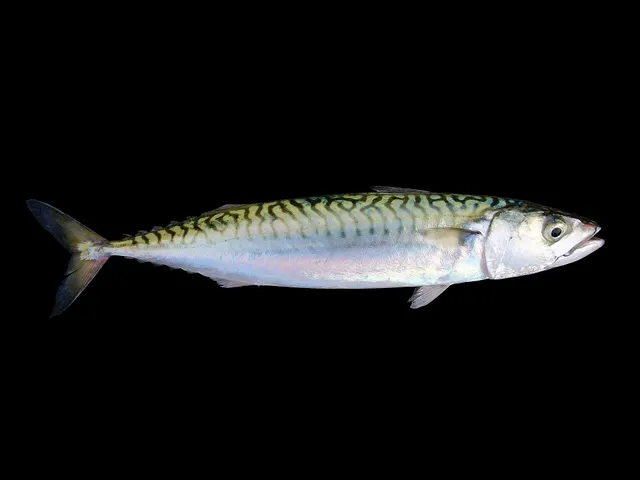 Atlantic mackerelA fast, schooling, obligate-swimming pelagic fish that arrives inshore in summer in enormous numbers, and the species most sea anglers catch first.
Hans Hillewaert — CC BY-SA 4.0, via Wikimedia Commons
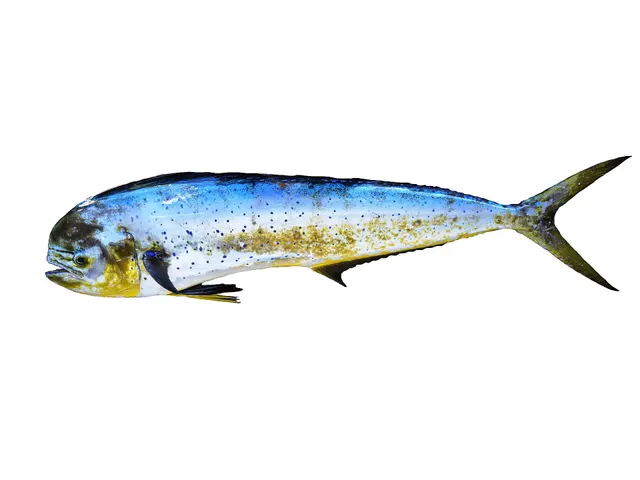 Mahi-mahiThe fastest-growing large fish an angler is likely to meet — brilliantly coloured, mature within months, and gathered around anything floating in the open ocean.
Hugues Evano (IFREMER, Délégation océan Indien (DOI), Département Ressources Biologiques et Environnement (RBE), F-97420 Le Port, France) — CC BY 4.0, via Wikimedia Commons
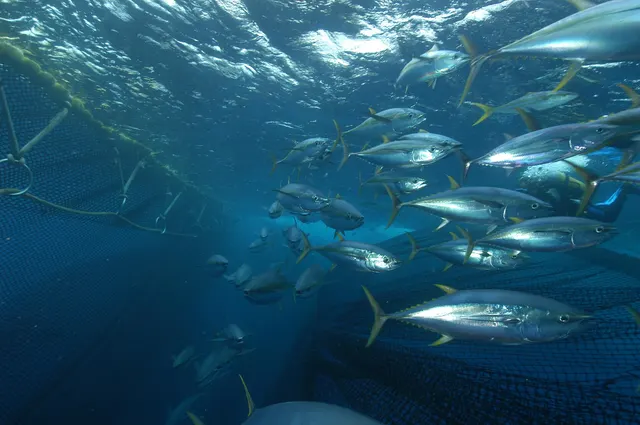 Yellowfin tunaA warm-blooded, high-speed oceanic predator that schools with dolphins and under floating debris, and one of the most commercially important fish in the world.
Marc Taquet — CC BY 4.0, via Wikimedia Commons
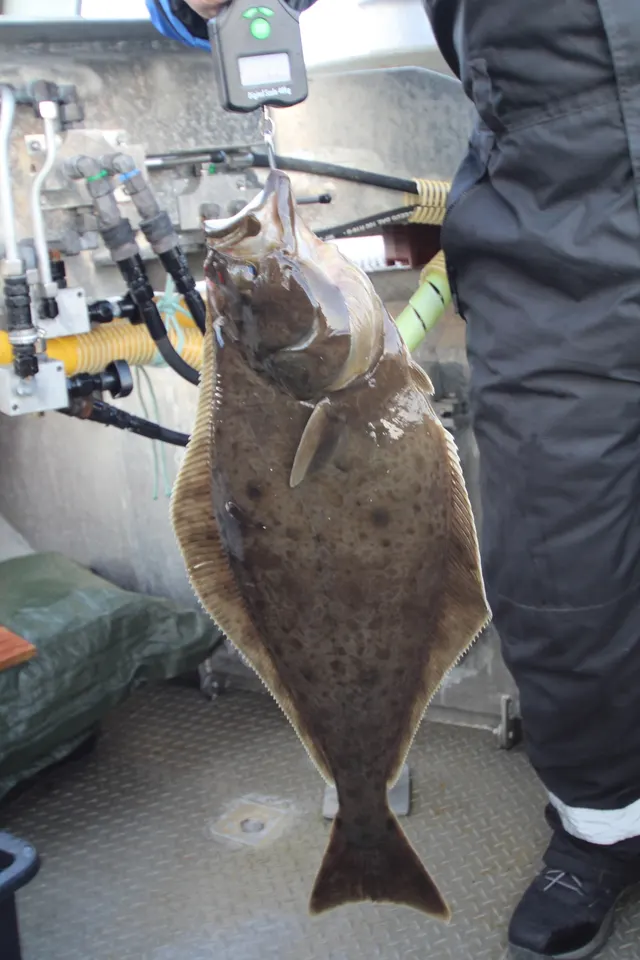 Atlantic halibutThe largest flatfish in the world, reaching over four metres, and a species whose commercial collapse made it one of the clearest cautionary tales in North Atlantic fisheries.
portulaca — CC BY, via iNaturalist
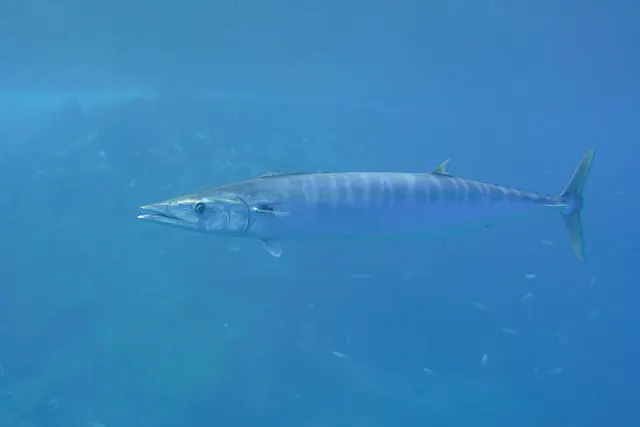 WahooAn extremely fast blue-water mackerel with razor teeth and a long slender body, taken by high-speed trolling and almost always fished on wire.
Bommerer — CC BY 4.0, via Wikimedia Commons
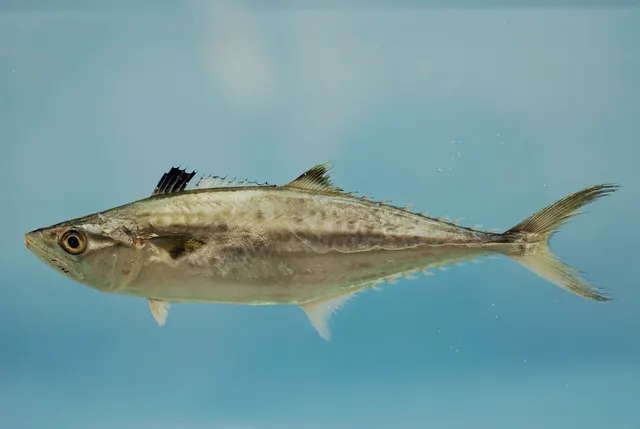 King mackerelA fast, toothy, migratory Atlantic mackerel taken by slow-trolling live bait and by pier fishing, known for a vertical strike that cuts baits in half.
NOAA Fisheries, SEFSC Pascagoula Laboratory, public domain, via Wikimedia Commons
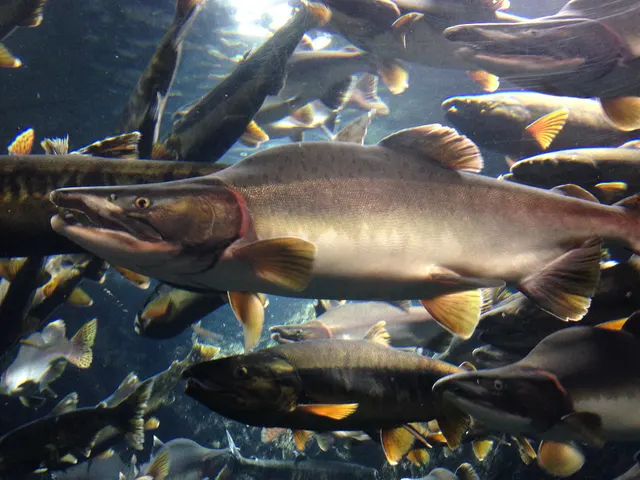 Pink salmonThe smallest and most abundant Pacific salmon, running on a strict two-year cycle, and the male developing a pronounced hump at spawning.
Totti — CC BY-SA 4.0, via Wikimedia Commons
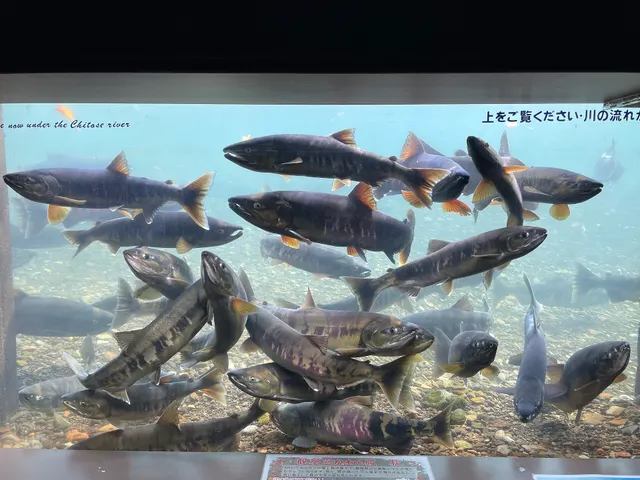 Chum salmonA large Pacific salmon without body spotting, developing striking purple calico bars and enlarged canine teeth at spawning, and the widest-ranging of its genus.
Totti — CC BY-SA 4.0, via Wikimedia Commons
Safety
Boat safety — Can cause serious injury or death
Offshore, help is hours away and may be unreachable. A mechanical failure, a person overboard or a medical emergency that would be minor inshore becomes serious, and weather can deteriorate faster than a vessel can return.
What reduces it: This is skippered activity requiring proper vessel preparation, communications, and a competent crew. Check the forecast for the whole window rather than the departure. File a plan with somebody ashore. Carry the means to call for help, and know that a lifejacket worn is worth more than one stowed.
Sun, dehydration and fatigue — Can cause injury needing treatment
Long offshore days combine sun, glare off water, wind, motion and physical effort. Dehydration and fatigue degrade judgement, and seasickness compounds both by preventing fluid intake.
What reduces it: Cover up, drink steadily rather than when thirsty, and treat seasickness prevention as a safety measure rather than a comfort one.
Line under tension — Can cause injury needing treatment
Big-game tackle carries drag pressures that will cause serious injury if something parts or if a hand, finger or limb is caught between line and rod, or line and reel.
What reduces it: Keep hands clear of running line and of the line-to-reel path. Nobody stands in line with a loaded rod. Wear gloves for handling heavy leaders and understand that a leader is where most injuries happen.
Precautions that always apply here
- Wear a buoyancy aid or lifejacket. Cold water incapacitates strong swimmers within a minute, long before swimming ability matters.
- Tell somebody where you are going and when you expect to be back.
- Carry a charged phone in a waterproof case, or another means of calling for help.
Further safety reading
- Boat safety for anglers — Distance from shore is what makes a failure consequential.
- Weather, lightning and open water — Offshore fishing removes the option of leaving quickly.
Where to go next
Fish found here
- Almaco jackDeeper reef and the water over it — which on Madeira starts at the wall.
- Atlantic blue marlinFollows warm water and prey across the whole atlantic basin.
- Atlantic chub mackerelPelagic-neritic: shelf water, shoaling.
- Atlantic halibutThe largest flatfish in the world, hunting actively in the water column rather than lying in ambush — which is why baits and lures fished off the bottom work.
- Atlantic mackerelMackerel are pelagic — they live in the water column rather than on ground — and spend much of the year well offshore before moving inshore in summer.
- BarracoutaShoaling through the water column in cool southern seas.
- Blackspot seabream150 to 300 m as an adult. Juveniles are the fish an angler meets inshore.
- Blonde rayOffshore banks and shelf ground down to around 150 m, with seasonal movement onto shallower ground as water warms.
23 more
- Blue jack mackerel Fish
- Blue shark Fish
- Bluenose warehou Fish
- Chum salmon Fish
- Cobia Fish
- Flapper skate Fish
- Greater forkbeard Fish
- Grey gurnard Fish
- Indian mackerel Fish
- Japanese amberjack Fish
- John Dory Fish
- King mackerel Fish
- Large-eye dentex Fish
- Longtail tuna Fish
- Madeiran sardinella Fish
- Mahi-mahi Fish
- Pink salmon Fish
- Spurdog Fish
- Swordfish Fish
- Tope Fish
- Wahoo Fish
- Wreckfish Fish
- Yellowfin tuna Fish
Reading this water
- Inshore and offshore: what actually changesOffshore the structure is made of water rather than ground — temperature breaks, colour changes, current edges and floating objects — which is the largest single change in how fish are found.
- Schooling behaviour, seen from insideShared vigilance, the confusion effect and dilution are why open water holds fish in groups at all.
Sources and evidence
- RNLI water safety guidance: cold water shock and Float to Live — Royal National Lifeboat Institution (Water-safety or diver-training authority)Relied on for: Lifejacket use, filing a plan ashore and carrying a means of calling for help.FishingHQ's interpretation of what it saysPassage read and verified
- IGFA International Angling Rules and World Record Requirements — International Game Fish Association (Angling or fisheries organisation)Relied on for: The characterisation of offshore big-game angling and the tackle classes used in it.Background and mechanism onlyPassage read and verified
Why the 35 connections on this page are here, and the sources
Fish found here
Backed by research — 31 connections
Supported by peer-reviewed research or fisheries science. The sources are listed and can be checked.
Almaco jack
Recorded as reef-associated from 5 to 245 m and usually 30 to 35 m, circumglobal in subtropical seas. FishBase states that its distribution in the eastern Atlantic is NOT well established, which is carried as the open question it is.
- FishBase: a global information system on fishes — Froese, R. and D. Pauly, eds. — FishBase Consortium (Scientific institute)Relied on for: Environment, depth range, habitat association and distribution for Seriola rivoliana.States this directlyPassage read and verified
Atlantic blue marlin
A habitat association for Makaira nigricans taken from the environment and distribution data on its FishBase summary.
- FishBase: a global information system on fishes — Froese, R. and D. Pauly, eds. — FishBase Consortium (Scientific institute)Relied on for: The environment, depth range and habitat description recorded for Makaira nigricans.States this directlyPassage read and verified
Atlantic chub mackerel
Recorded as pelagic-neritic in warm Atlantic water on both coasts including the Mediterranean and southern Black Sea.
- FishBase: a global information system on fishes — Froese, R. and D. Pauly, eds. — FishBase Consortium (Scientific institute)Relied on for: Environment, depth range, habitat association and distribution for Scomber colias.States this directlyPassage read and verified
Atlantic halibut
A habitat and behavioural claim held to a scientific standard.
- FishBase: a global information system on fishes — Froese, R. and D. Pauly, eds. — FishBase Consortium (Scientific institute)Relied on for: That Hippoglossus hippoglossus is a marine demersal species of the North Atlantic continental shelf and slope.States this directlyPassage read and verified
Atlantic mackerel
A habitat claim held to a scientific standard.
- ICES Advice on fishing opportunities, catch and effort — International Council for the Exploration of the Sea (Scientific institute)Relied on for: The pelagic distribution and seasonal migration of North East Atlantic mackerel.States this directlyCitation checked — the work exists and is described correctly
- FishBase: a global information system on fishes — Froese, R. and D. Pauly, eds. — FishBase Consortium (Scientific institute)Relied on for: Recorded habitat for Scomber scombrus.States this directlyPassage read and verified
Barracouta
Recorded as benthopelagic and oceanodromous over a depth range of 0 to 550 m and usually 100 to 500 m, in water of roughly 13 to 18 °C right around the southern oceans.
- FishBase: a global information system on fishes — Froese, R. and D. Pauly, eds. — FishBase Consortium (Scientific institute)Relied on for: Environment, depth range, habitat association and distribution for Thyrsites atun.States this directlyPassage read and verified
Blackspot seabream
Recorded as benthopelagic over a depth range of 150 to 700 m and usually 150 to 300 m, from Norway to Mauritania including Madeira and the Canaries. The very large eye is the low-light adaptation of a fish that lives there.
- FishBase: a global information system on fishes — Froese, R. and D. Pauly, eds. — FishBase Consortium (Scientific institute)Relied on for: Environment, depth range, habitat association and distribution for Pagellus bogaraveo.States this directlyPassage read and verified
Blonde ray
A distributional claim about where a species is found, which rests on the standard regional reference works rather than on angling report.
- The Fishes of the British Isles and North-West Europe — Macmillan, 1969 (Reference work)Relied on for: Distribution, habitat association, identification and biology of the sharks, skates and rays of the British Isles and north-west Europe.States this directlyCitation checked — the work exists and is described correctly
- FAO Species Identification Guides for Fishery Purposes and the FAO Species Catalogues — Food and Agriculture Organization of the United Nations (Scientific institute)Relied on for: Diagnostic characters, habitat and depth range as set out in the FAO species identification sheets for the eastern Atlantic and Mediterranean.States this directlyCitation checked — the work exists and is described correctly
Blue jack mackerel
Recorded over a depth range of 170 to 370 m from the southern Bay of Biscay to southern Morocco including the Azores, Madeira, the Canaries, Tristan da Cunha and Gough Islands.
- FishBase: a global information system on fishes — Froese, R. and D. Pauly, eds. — FishBase Consortium (Scientific institute)Relied on for: Environment, depth range, habitat association and distribution for Trachurus picturatus.States this directlyPassage read and verified
Blue shark
A distributional claim about where a species is found, resting on the standard regional reference works rather than on angling report.
- The Fishes of the British Isles and North-West Europe — Macmillan, 1969 (Reference work)Relied on for: Distribution, habitat association, identification and biology of the fishes and inshore fauna of the British Isles and north-west Europe.States this directlyCitation checked — the work exists and is described correctly
- FAO Species Identification Guides for Fishery Purposes and the FAO Species Catalogues — Food and Agriculture Organization of the United Nations (Scientific institute)Relied on for: Diagnostic characters, family placement, habitat and depth range as set out in the FAO species identification sheets for the eastern Atlantic and Mediterranean.States this directlyCitation checked — the work exists and is described correctly
Bluenose warehou
Recorded as benthopelagic over a depth range of 40 to 1500 m and usually 260 to 490 m, concentrating on deep structure across the southern hemisphere.
- FishBase: a global information system on fishes — Froese, R. and D. Pauly, eds. — FishBase Consortium (Scientific institute)Relied on for: Environment, depth range, habitat association and distribution for Hyperoglyphe antarctica.States this directlyPassage read and verified
Chum salmon
A habitat association for Oncorhynchus keta taken from the environment and distribution data on its FishBase summary.
- FishBase: a global information system on fishes — Froese, R. and D. Pauly, eds. — FishBase Consortium (Scientific institute)Relied on for: The environment, depth range and habitat description recorded for Oncorhynchus keta.States this directlyPassage read and verified
Cobia
A habitat association for Rachycentron canadum taken from the environment and distribution data on its FishBase summary.
- FishBase: a global information system on fishes — Froese, R. and D. Pauly, eds. — FishBase Consortium (Scientific institute)Relied on for: The environment, depth range and habitat description recorded for Rachycentron canadum.States this directlyPassage read and verified
Flapper skate
A distributional claim about where a species is found, which rests on the standard regional reference works rather than on angling report.
- The Fishes of the British Isles and North-West Europe — Macmillan, 1969 (Reference work)Relied on for: Distribution, habitat association, identification and biology of the sharks, skates and rays of the British Isles and north-west Europe.States this directlyCitation checked — the work exists and is described correctly
- FAO Species Identification Guides for Fishery Purposes and the FAO Species Catalogues — Food and Agriculture Organization of the United Nations (Scientific institute)Relied on for: Diagnostic characters, habitat and depth range as set out in the FAO species identification sheets for the eastern Atlantic and Mediterranean.States this directlyCitation checked — the work exists and is described correctly
Greater forkbeard
Recorded as benthopelagic and oceanodromous over a depth range of 10 to 1,351 m and usually 100 to 450 m from Norway and Iceland to Cape Blanc and through the Mediterranean. That range has a genuinely shallow edge and the Atlantic islands are where it shows.
- FishBase: a global information system on fishes — Froese, R. and D. Pauly, eds. — FishBase Consortium (Scientific institute)Relied on for: Environment, depth range, habitat association and distribution for Phycis blennoides.States this directlyPassage read and verified
Grey gurnard
A distributional claim about where a species is found, which is a claim about the world and rests on the standard regional reference works rather than on angling report.
- The Fishes of the British Isles and North-West Europe — Macmillan, 1969 (Reference work)Relied on for: Distribution, habitat association, identification and biology of the fishes of the British Isles and north-west Europe.States this directlyCitation checked — the work exists and is described correctly
- FAO Species Identification Guides for Fishery Purposes and the FAO Species Catalogues — Food and Agriculture Organization of the United Nations (Scientific institute)Relied on for: Diagnostic characters, habitat and depth range as set out in the FAO species identification sheets for the eastern Atlantic and Mediterranean.States this directlyCitation checked — the work exists and is described correctly
Indian mackerel
Pelagic-neritic and oceanodromous over a depth range of 20 to 90 m in water above about 17 °C, from East Africa to Samoa and into the eastern Mediterranean through the Suez Canal.
- FishBase: a global information system on fishes — Froese, R. and D. Pauly, eds. — FishBase Consortium (Scientific institute)Relied on for: Environment, depth range, habitat association and distribution for Rastrelliger kanagurta.States this directlyPassage read and verified
Japanese amberjack
A habitat association for Seriola quinqueradiata taken from the environment and distribution data on its FishBase summary.
- FishBase: a global information system on fishes — Froese, R. and D. Pauly, eds. — FishBase Consortium (Scientific institute)Relied on for: The environment, depth range and habitat description recorded for Seriola quinqueradiata.States this directlyPassage read and verified
John Dory
A distributional claim about where a species is found, which is a claim about the world and rests on the standard regional reference works rather than on angling report.
- The Fishes of the British Isles and North-West Europe — Macmillan, 1969 (Reference work)Relied on for: Distribution, habitat association, identification and biology of the fishes of the British Isles and north-west Europe.States this directlyCitation checked — the work exists and is described correctly
- FAO Species Identification Guides for Fishery Purposes and the FAO Species Catalogues — Food and Agriculture Organization of the United Nations (Scientific institute)Relied on for: Diagnostic characters, habitat and depth range as set out in the FAO species identification sheets for the eastern Atlantic and Mediterranean.States this directlyCitation checked — the work exists and is described correctly
King mackerel
A habitat association for Scomberomorus cavalla taken from the environment and distribution data on its FishBase summary.
- FishBase: a global information system on fishes — Froese, R. and D. Pauly, eds. — FishBase Consortium (Scientific institute)Relied on for: The environment, depth range and habitat description recorded for Scomberomorus cavalla.States this directlyPassage read and verified
Large-eye dentex
Recorded as benthopelagic and oceanodromous over a depth range of 30 to 500 m. The enlarged eye is the adaptation of an animal living where there is very little light, and it is a check on any claim that puts this fish in shallow water.
- FishBase: a global information system on fishes — Froese, R. and D. Pauly, eds. — FishBase Consortium (Scientific institute)Relied on for: Environment, depth range, habitat association and distribution for Dentex macrophthalmus.States this directlyPassage read and verified
Longtail tuna
A habitat association for Thunnus tonggol taken from the environment and distribution data on its FishBase summary.
- FishBase: a global information system on fishes — Froese, R. and D. Pauly, eds. — FishBase Consortium (Scientific institute)Relied on for: The environment, depth range and habitat description recorded for Thunnus tonggol.States this directlyPassage read and verified
Madeiran sardinella
Recorded as pelagic-neritic and oceanodromous from the surface to 80 m in marine and brackish water, from Gibraltar south to Angola and in the southern and eastern Mediterranean. Madeira is not in that range, which is why its single appearance in a Madeiran catch table is held rather than carried.
- FishBase: a global information system on fishes — Froese, R. and D. Pauly, eds. — FishBase Consortium (Scientific institute)Relied on for: Environment, depth range, habitat association and distribution for Sardinella maderensis.States this directlyPassage read and verified
Mahi-mahi
A behavioural claim with direct practical consequence, verified rather than assumed because the entire method depends on it.
- FishBase: a global information system on fishes — Froese, R. and D. Pauly, eds. — FishBase Consortium (Scientific institute)Relied on for: That Coryphaena hippurus is a pelagic-neritic species of the open ocean, and that floating attracting devices such as bundles of bamboo reeds or cork planks are used to concentrate the species before nets are set.States this directlyPassage read and verified
Pink salmon
A habitat association for Oncorhynchus gorbuscha taken from the environment and distribution data on its FishBase summary.
- FishBase: a global information system on fishes — Froese, R. and D. Pauly, eds. — FishBase Consortium (Scientific institute)Relied on for: The environment, depth range and habitat description recorded for Oncorhynchus gorbuscha.States this directlyPassage read and verified
Spurdog
A distributional claim about where a species is found, which rests on the standard regional reference works rather than on angling report.
- The Fishes of the British Isles and North-West Europe — Macmillan, 1969 (Reference work)Relied on for: Distribution, habitat association, identification and biology of the sharks, skates and rays of the British Isles and north-west Europe.States this directlyCitation checked — the work exists and is described correctly
- FAO Species Identification Guides for Fishery Purposes and the FAO Species Catalogues — Food and Agriculture Organization of the United Nations (Scientific institute)Relied on for: Diagnostic characters, habitat and depth range as set out in the FAO species identification sheets for the eastern Atlantic and Mediterranean.States this directlyCitation checked — the work exists and is described correctly
Swordfish
A habitat association for Xiphias gladius taken from the environment and distribution data on its FishBase summary.
- FishBase: a global information system on fishes — Froese, R. and D. Pauly, eds. — FishBase Consortium (Scientific institute)Relied on for: The environment, depth range and habitat description recorded for Xiphias gladius.States this directlyPassage read and verified
Tope
A distributional claim about where a species is found, which rests on the standard regional reference works rather than on angling report.
- The Fishes of the British Isles and North-West Europe — Macmillan, 1969 (Reference work)Relied on for: Distribution, habitat association, identification and biology of the sharks, skates and rays of the British Isles and north-west Europe.States this directlyCitation checked — the work exists and is described correctly
- FAO Species Identification Guides for Fishery Purposes and the FAO Species Catalogues — Food and Agriculture Organization of the United Nations (Scientific institute)Relied on for: Diagnostic characters, habitat and depth range as set out in the FAO species identification sheets for the eastern Atlantic and Mediterranean.States this directlyCitation checked — the work exists and is described correctly
Wahoo
A habitat association for Acanthocybium solandri taken from the environment and distribution data on its FishBase summary.
- FishBase: a global information system on fishes — Froese, R. and D. Pauly, eds. — FishBase Consortium (Scientific institute)Relied on for: The environment, depth range and habitat description recorded for Acanthocybium solandri.States this directlyPassage read and verified
Wreckfish
Polyprion americanus is recorded with a prolonged pelagic juvenile phase associated with floating objects, which is where the English name comes from and is a completely different habitat from the adult's.
- FishBase: a global information system on fishes — Froese, R. and D. Pauly, eds. — FishBase Consortium (Scientific institute)Relied on for: Environment, depth range, habitat association and distribution for Polyprion americanus.States this directlyPassage read and verified
Yellowfin tuna
A habitat and behaviour claim held to a scientific standard.
- FishBase: a global information system on fishes — Froese, R. and D. Pauly, eds. — FishBase Consortium (Scientific institute)Relied on for: That Thunnus albacares is an oceanic pelagic highly migratory species occurring worldwide in tropical and subtropical seas but absent from the Mediterranean, and that schooling occurs primarily by size with larger fish frequently schooling with porpoises and the species associating with floating debris and other objects.States this directlyPassage read and verified
Reading this water
What experienced anglers do — 1 connection
Widely and independently recommended by experienced anglers and specialist sources. This is real angling knowledge, not proof: controlled evidence for it is limited, and FishingHQ records it as convention rather than as a demonstrated effect.
Inshore and offshore: what actually changes
Finding fish on water features rather than seabed features is the defining offshore skill.
- Sea Angler — Bauer Media (Specialist angling publication)Relied on for: Sea angling practice on shore and boat fishing in tidal conditions.States this directlyCitation checked — the work exists and is described correctly
- Freshwater Fishing — Macdonald & Jane's, 1975 (Specialist angling publication)Relied on for: Comparable reasoning about reading moving water and presenting bait in it, independently arrived at in the freshwater tradition.Background and mechanism onlyCitation checked — the work exists and is described correctly
Backed by research — 1 connection
Supported by peer-reviewed research or fisheries science. The sources are listed and can be checked.
Schooling behaviour, seen from inside
The habitat record and the grouping behaviour that defines life in it.
- Functions of shoaling behaviour in teleosts — In: Pitcher TJ (ed.) Behaviour of Teleost Fishes, 2nd edn. Chapman & Hall, London, 1993 (Scientific literature)Relied on for: The established anti-predator and foraging functions of shoaling in teleosts, including shared vigilance, the confusion effect and dilution.States this directlyCitation checked — the work exists and is described correctly
Safety reading
Official guidance — 2 connections
Stated by a fisheries authority, scientific institute or recognised angling body. Authoritative, but summarising rather than demonstrating.
Boat safety for anglers
Distance from shore is what makes a failure consequential.
- RNLI water safety guidance: cold water shock and Float to Live — Royal National Lifeboat Institution (Water-safety or diver-training authority)Relied on for: Water-safety guidance underlying this connection. Distance from shore is what makes a failure consequential.States this directlyPassage read and verified
Weather, lightning and open water
Offshore fishing removes the option of leaving quickly.
- RNLI water safety guidance: cold water shock and Float to Live — Royal National Lifeboat Institution (Water-safety or diver-training authority)Relied on for: Water-safety guidance underlying this connection. Offshore fishing removes the option of leaving quickly.States this directlyPassage read and verified
How FishingHQ labels evidence is explained in the evidence policy.