Atlantic mackerel
Fish · Last reviewed 2026-08-10
A fast, schooling, obligate-swimming pelagic fish that arrives inshore in summer in enormous numbers, and the species most sea anglers catch first.
Safety: standing precautions apply on this water.
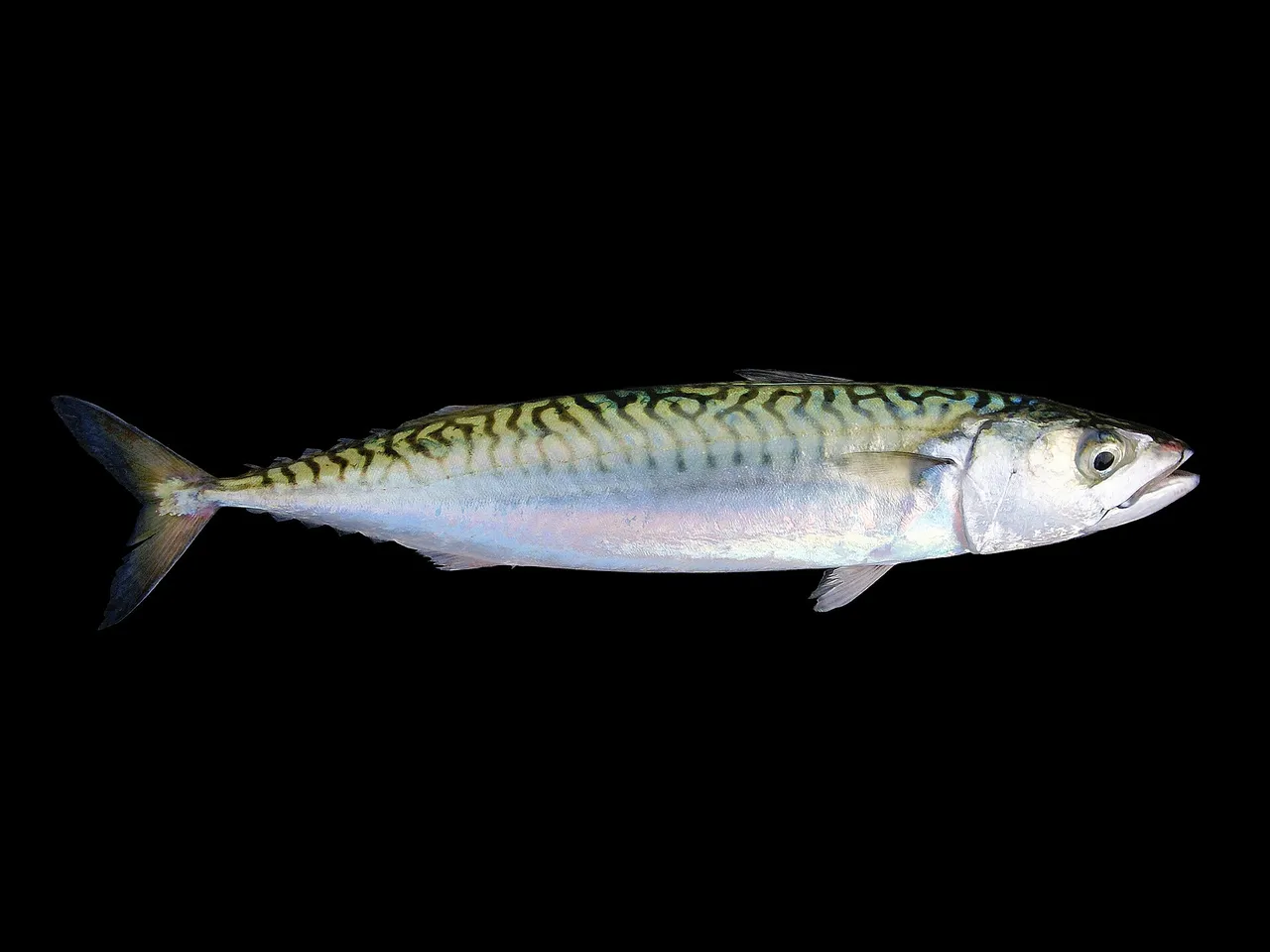
How this was identified, and who took it
Identified by: Specimen photograph on black. The wavy dark bars over the green back, the finlets between second dorsal and tail, and the whole body outline are all clear, and the fish is fresh enough that the back colour has not yet gone.Hans Hillewaert — CC BY-SA 4.0, via Wikimedia Commons — source, licence
Catching Atlantic mackerel
Everything here on fishing for it. Each entry opens the page behind it.
- Ground
- When
- May–Sept — months recorded at the places that document it, not a season for the whole range.
- Where
- 208 places FishingHQ documents — strongest claim anywhere: regular local target · From the shore, From a kayak, From a boat
Mackerel are built entirely for continuous swimming. They have no swimbladder, so they sink if they stop; they have a series of small finlets behind the dorsal and anal fins that reduce turbulence at speed; and their body is a smooth, muscular spindle from nose to a deeply forked tail. They never stop moving, and they must swim to breathe.
That design produces the behaviour anglers meet: enormous, fast-moving schools that appear inshore in summer, drive baitfish to the surface, and can be caught in numbers on almost anything shiny. Mackerel are the species that introduces most people to sea angling, and they are also the standard fresh bait for almost everything larger.
That abundance carries an obligation that this page states plainly. Mackerel are extremely easy to catch in quantity and extremely easy to waste. Taking more than will be used, and killing a string of six at a time out of momentum, is the commonest avoidable waste in recreational sea angling.
Straight answers
For somebody who is already standing on the mark. Everything below this expands on it.
- Are they likely to be here?
- If it is summer, the water is not freezing cold, and there is deep water within casting range, it is worth twenty minutes. Mackerel move constantly, so an empty mark at eight can be full at nine.
- Where should I look?
- At anything that concentrates small fish: a harbour mouth, the end of a wall, a tide race off a headland, the edge of moving water against still water. And at birds.
- What should I cast?
- Something small, bright and heavy enough to reach and to sink. A 20-40 g metal covers most shore situations; feathers cover the case where you want to search several depths at once.
- How deep?
- Unknown until you find out. Count the lure down — one, two, three — and change the count every cast until something takes it. That single habit outfishes lure choice.
- What signs matter?
- Diving birds first. Then bait showering at the surface, fish breaking, and any line where moving water meets slack water.
- Why am I catching nothing?
- Most often because you are fishing one dead patch of water at one depth. Mackerel are somewhere else, or deeper. Move, or change the countdown.
Where you are fishing from
The same fish, and genuinely different fishing. Open the one you are standing on.
Harbour
Enclosed water, walls and moored structure
Enclosed, sheltered and often surprisingly deep — the easiest place to start and the easiest place to fish badly.
- At the surface
- Upper water
- Mid water
Methods: Spinning, Feathering and multi-lure traces, Float fishing
How this mark actually fishes
Why fish are here
A harbour is a funnel. Water moves in and out through a restricted entrance, and anything carried with it is concentrated on the way through. Moored boats, pontoons and walls hold weed, shelter small fish and create edges. Mackerel come in on the flood behind small fish that are themselves feeding on what the tide brings.
Harbours are also frequently deeper than they look, particularly against the wall of a working quay dredged to take vessels alongside.
How to fish it
Fish the entrance and the deep edge rather than the middle of the basin. Cast along the wall rather than out from it, so the lure spends the retrieve in the strip of water where fish are patrolling. Count the lure down; in a dredged harbour there may be five or six metres under your feet and fish anywhere in it.
Work along the structure rather than staying put. Twenty casts from six positions beats a hundred and twenty from one.
What to look at on arrival
- The colour change where a dredged channel meets shallower water — an edge fish follow.
- Small fish flicking against the wall or around moored boats.
- Whether the tide is actually moving. Slack water in an enclosed basin can kill the fishing entirely.
What goes wrong here
- Casting as far as possible. The fish are frequently along the wall you are standing on, and a long cast fishes the least productive water.
- Fishing one depth all session in water deep enough to hold fish at three different ones.
- Standing still. A harbour rewards walking more than almost any other mark.
Harbour walls are frequently unfenced and often greasy with weed and fish slime below the high-water line. Look at what you are standing on before you look at the water.
What experienced anglers do — why, and the sources (1)
Widely and independently recommended by experienced anglers and specialist sources. This is real angling knowledge, not proof: controlled evidence for it is limited, and FishingHQ records it as convention rather than as a demonstrated effect.
How harbour marks fish for this species, from the evidence named here.
- Fishing for mackerel: three great methods — Sea Angler magazine (Specialist angling publication)Relied on for: Harbours and walls as principal shore venues for mackerel in the UK.Background and mechanism onlyCitation checked — the work exists and is described correctly
Pier and jetty
Deep water without a boat
Deep water without a boat, which is exactly why it is the classic mackerel mark.
- At the surface
- Upper water
- Mid water
- Deep water
Methods: Feathering and multi-lure traces, Spinning, Float fishing
How this mark actually fishes
Why fish are here
A pier delivers an angler to water they could not otherwise reach: often several metres deep at the end, over ground that shelves away, with structure the whole length. The piles themselves hold weed and small fish, and the whole construction creates current shadows on the down-tide side where prey collects.
Mackerel patrol past piers rather than living under them, which is why pier fishing is so strongly a matter of being there when the shoal comes through.
How to fish it
The end is not automatically the best place. The down-tide side, and the corner where the structure turns, are frequently better because they hold the current edge. Fish a metal on a count-down, or a feather trace worked up from near the bottom in stages, so the retrieve searches several depths in one cast.
When fish are showing on the surface, cast past them and bring the lure back through. When nothing shows, systematically increase the countdown by a few seconds each cast until you find them.
What to look at on arrival
- Which side of the pier the current is running on, and where it eddies behind the structure.
- Bait shoals holding among the piles.
- Other anglers' rods — a shoal working along a pier is visible as a wave of bent rods.
What goes wrong here
- Crowding to the very end when the fish are coming past the middle.
- Retrieving immediately on landing, which fishes only the top half-metre of ten metres of water.
- Swinging a loaded multi-hook trace over other people. A five-hook feather rig with three fish on it is genuinely dangerous in a crowd.
Landing a fish up a high pier wall on light line loses fish and drops hooks on people below. A drop net is the right tool and most piers that need one have somewhere to keep one.
What experienced anglers do — why, and the sources (1)
Widely and independently recommended by experienced anglers and specialist sources. This is real angling knowledge, not proof: controlled evidence for it is limited, and FishingHQ records it as convention rather than as a demonstrated effect.
How pier and jetty marks fish for this species, from the evidence named here.
- Fishing with feathers and daylights — British Sea Fishing (Specialist angling publication)Relied on for: Feather and multi-lure traces as the standard pier method for mackerel.Background and mechanism onlyCitation checked — the work exists and is described correctly
Rock marks
Depth close in, and the edge fish hunt along
Depth close in and a hunting edge fish actually use — the best shore mackerel fishing there is, and the one that demands most care.
- At the surface
- Upper water
- Mid water
- Deep water
Methods: Spinning, Light rock fishing, Feathering and multi-lure traces
How this mark actually fishes
Why fish are here
A rock mark on a headland or a steep coast puts deep water within a short cast, and puts it over broken ground with current running past. Headlands accelerate tidal flow and generate races and eddies; those features concentrate prey exactly as a breakwater does but on a larger scale.
Mackerel hunt the boundary between the fast water off the point and the slower water in its lee. That boundary moves through the tide, which is why a rock mark can fish superbly for ninety minutes and be dead either side.
How to fish it
Read the water before casting. Find the seam — the line where the fast water shears past the slack — and fish across it, letting the lure swing naturally in the flow rather than dragging it against the current.
Weight matters more here than anywhere else on the shore. Too light and the flow lifts the lure to the surface and holds it there; too heavy and it grinds through the kelp. Carry a range and change it as the tide builds.
What to look at on arrival
- The tide race off the point building and slackening — the fishing usually follows it.
- Standing waves and boils, which mark where deep structure is deflecting flow upwards.
- The state of the swell against your exit route, not just against your casting platform.
What goes wrong here
- Fishing a single lure weight through a whole tide, so the presentation is wrong for two-thirds of it.
- Casting into the fast water rather than across its edge.
- Committing to a low ledge on a rising tide because the fishing is good.
Rock marks strand people. Know your exit, know the state of the tide when you arrive, and treat a building swell as a reason to leave rather than a reason to move up a metre.
What experienced anglers do — why, and the sources
Widely and independently recommended by experienced anglers and specialist sources. This is real angling knowledge, not proof: controlled evidence for it is limited, and FishingHQ records it as convention rather than as a demonstrated effect.
How rock marks marks fish for this species, from the evidence named here.
Beach
Open sand and shingle, and the question of range
The venue where mackerel are least reliable and most rewarding, because the whole question is whether they are within reach.
- At the surface
- Upper water
- Mid water
Methods: Spinning, Surfcasting
How this mark actually fishes
Why fish are here
Mackerel come to a beach when the water there is deep enough and the bait has been pushed inshore. That is why a steep shingle beach with three or four metres close in can fish well for mackerel while a shallow sand beach two miles away never does: on the shallow beach the fish simply never come within casting range.
The other mechanism is wind and swell pushing small fish towards the shore, and a flooding tide carrying them along it. This is also why a beach that produced fish in one evening's conditions can look completely empty the next.
How to fish it
Choose the beach for its profile before choosing the tactics. Steep-to shingle, a beach with a defined trough or a scour beside a groyne, or a beach with a river or stream mouth all bring deeper water and concentrated prey within range.
Range matters more here than at any other shore venue, which pushes lure weight up. A 30-45 g metal on a light beachcaster or a heavy spinning rod puts a lure where the fish actually are; a 15 g spinner does not.
What to look at on arrival
- Where the beach shelves — the colour change offshore, or the line where waves stop breaking.
- Groynes, scours, and the mouths of streams, all of which cut deeper water close in.
- Whether fish are showing within reach at all. On a shallow beach they frequently are not.
What goes wrong here
- Fishing a shallow beach because it is convenient, and concluding there are no mackerel on that coast.
- Using a lure too light to reach the deeper water and calling the mark empty.
- Ignoring the tide. On many beaches the fishable window is the top of the flood and nothing else.
What experienced anglers do — why, and the sources
Widely and independently recommended by experienced anglers and specialist sources. This is real angling knowledge, not proof: controlled evidence for it is limited, and FishingHQ records it as convention rather than as a demonstrated effect.
How beach marks fish for this species, from the evidence named here.
Boat
Your own hull, and the freedom to move
The venue where you stop waiting for the shoal to arrive and go and find it instead.
- At the surface
- Upper water
- Mid water
- Deep water
- On or near the bottom
Methods: Feathering and multi-lure traces, Jigging, Drift fishing
How this mark actually fishes
Why fish are here
Nothing about the fish changes; what changes is that you can search. From a boat the whole problem becomes tractable — you can cover ground until you find bait or birds, hold over a shoal instead of hoping it passes, and fish vertically through the entire water column rather than through the slice a cast reaches.
A sounder turns the depth question from guesswork into observation: bait shows as a cloud, and the depth it is holding at is the depth to fish.
How to fish it
Look before you fish. Run until you find birds, surface activity or bait on the sounder, then approach without driving through it. Drift across or alongside rather than anchoring on top of a moving shoal.
Fish vertically: drop to the bottom or to the marked depth, then work the lure or trace upwards in stages, pausing at each. That searches the column properly and tells you where the fish are holding, which is information the next drift can use.
What to look at on arrival
- Bait clouds on the sounder, and the depth they are sitting at.
- Birds working, which is visible from much further away than surface activity.
- Whether the drift is taking you off the fish — a shoal is small and a drift is not.
What goes wrong here
- Motoring straight through surface activity, which puts the whole shoal down.
- Fishing one depth because that is where the first fish came from, when the shoal has moved up or down.
- Taking far more fish than can be used, because a boat over a shoal makes it easy.
What experienced anglers do — why, and the sources (1)
Widely and independently recommended by experienced anglers and specialist sources. This is real angling knowledge, not proof: controlled evidence for it is limited, and FishingHQ records it as convention rather than as a demonstrated effect.
How boat marks fish for this species, from the evidence named here.
- Fishing for mackerel: three great methods — Sea Angler magazine (Specialist angling publication)Relied on for: Boat feathering and vertical presentation as principal mackerel methods.Background and mechanism onlyCitation checked — the work exists and is described correctly
Charter boat
A skipper who already knows where the fish are
Somebody who already knows where the shoals were yesterday, which is most of the problem solved.
- Upper water
- Mid water
- Deep water
Methods: Feathering and multi-lure traces, Jigging
How this mark actually fishes
Why fish are here
A skipper working the same water daily has information no visiting angler can assemble: which marks have held fish this week, how the shoals have moved with the tides, and where the bait is. For mackerel specifically that knowledge is worth more than tackle, because location is the whole difficulty.
Mackerel are also frequently caught on charter trips as bait for something else, which is worth knowing before booking if catching them is the point of the day rather than a preliminary.
How to fish it
Ask what the trip is actually for. A general bottom-fishing trip that stops for twenty minutes of mackerel is a different day from a trip out to find feeding shoals.
On board, do what the skipper says about depth. A skipper watching a sounder knows where the fish are; a passenger guessing does not.
What to look at on arrival
- Whether mackerel are the target or the bait supply for the day.
- What the skipper is watching on the sounder, and what depth they call.
What goes wrong here
- Bringing tackle far heavier than the fishing needs because it is a boat trip.
- Filling a box because the fishing is easy. A shoal over a wreck can produce far more fish than anybody on board will eat.
What experienced anglers do — why, and the sources
Widely and independently recommended by experienced anglers and specialist sources. This is real angling knowledge, not proof: controlled evidence for it is limited, and FishingHQ records it as convention rather than as a demonstrated effect.
How charter boat marks fish for this species, from the evidence named here.
Kayak
Mobility, silence, and very little room
Boat mobility at walking pace, with a metre of usable space and no room for mistakes with hooks.
- Upper water
- Mid water
- Deep water
Methods: Kayak fishing, Jigging, Spinning
How this mark actually fishes
Why fish are here
The fish are where they are for boat reasons. What a kayak adds is access to water a shore angler cannot reach and a boat angler often cannot bother with — the close-in ground off a headland, the back of a reef, the edge of a race — combined with near silence.
What it removes is space, stability and the ability to deal calmly with several hooks and several fish at once.
How to fish it
Fish vertically or on short casts. A jig or a single metal worked up from depth is the natural kayak presentation because it needs no room and can be managed one-handed.
Use fewer hooks than you would from a pier. A three-hook trace is manageable in a kayak; a six-hook trace with four mackerel on it, in a seat, over your legs, is not.
What to look at on arrival
- Birds and surface activity, which a kayak can reach quietly without spooking.
- Wind against tide, which builds a short steep sea faster than it looks from shore.
- Where you are relative to your launch as the tide turns.
What goes wrong here
- Carrying a shore-length multi-hook trace into a kayak.
- Drifting further offshore chasing a shoal without watching the return journey.
A hooked fish thrashing on a multi-hook trace in a kayak puts loose hooks near your hands and your buoyancy aid. Cut hooks down in number before you launch rather than dealing with it afloat.
What experienced anglers do — why, and the sources
Widely and independently recommended by experienced anglers and specialist sources. This is real angling knowledge, not proof: controlled evidence for it is limited, and FishingHQ records it as convention rather than as a demonstrated effect.
How kayak marks fish for this species, from the evidence named here.
Why mackerel come inshore
Each of these is a piece of biology or hydrography, what it looks like from where you are standing, and what you can try as a result.
A fish that cannot stop, and what that means for where it is
- What you may see
- A mark that produced fish for forty minutes and then produces nothing, with no change in tide, light or weather. The shoal has moved on rather than gone off the feed.
- What to try
- Treat a blank spell as information about location rather than about presentation. Give it ten more minutes at a different depth, then move along the wall or the ledge rather than continuing to cast at the same water.
- Where this breaks down
- This is a statement about mackerel as a shoaling pelagic, not a promise that fish will return. Some evenings the shoal leaves the bay entirely.
Why this happens
Mackerel have no swimbladder. Nothing holds them up, so they must swim continuously to avoid sinking, and they must pass water over their gills by moving forward through it. The consequence is a fish with an unusually high energy cost of simply existing, which has to be paid for by feeding almost continuously through the summer — the Icelandic stomach work found only 2 to 22 per cent of stomachs empty, which is a fish that is essentially always eating.
A fish that cannot stop is also a fish that cannot hold station in a current the way a bass or a pollack does behind a rock. Mackerel deal with moving water by moving with it, which is why they arrive and leave rather than sitting.
Backed by research — why, and the sources (1)
Supported by peer-reviewed research or fisheries science. The sources are listed and can be checked.
The mechanism above, and what it rests on.
- Diet and feeding strategy of Northeast Atlantic mackerel (Scomber scombrus) in Icelandic waters — PLOS ONE, 2019 (Scientific literature)Relied on for: Continuous, intense summer feeding, evidenced by a vacuity index of only 2-22 per cent of stomachs empty.States this directlyPassage read and verified
Why a wall, a headland or a harbour mouth concentrates fish
- What you may see
- A tide line: a band of smoother or rougher water, often with a line of foam, weed or debris along it, running off the end of a wall or a point. Sometimes gulls sitting on it rather than diving.
- What to try
- Fish the EDGE rather than the middle. Cast so the lure crosses the boundary between moving and slack water, and pay attention to takes on the crossing rather than on the retrieve as a whole.
Why this happens
Mackerel hunt by sight and by speed in open water, which is an inefficient way to catch anything unless the prey is already concentrated. Coastal structure does the concentrating for them. A breakwater, a headland or a harbour entrance forces moving water through a narrower gap, and anything drifting or weakly swimming in that water is funnelled with it. Small schooling fish pushed against a solid edge have nowhere lateral to go.
The same structure creates a shear line — a visible boundary between water moving fast and water moving slowly — and prey accumulates along it. A predator that patrols such a line is feeding on a conveyor rather than searching a volume.
What experienced anglers do — why, and the sources (1)
Widely and independently recommended by experienced anglers and specialist sources. This is real angling knowledge, not proof: controlled evidence for it is limited, and FishingHQ records it as convention rather than as a demonstrated effect.
The mechanism above, and what it rests on.
- Fishing for mackerel: three great methods — Sea Angler magazine (Specialist angling publication)Relied on for: Structure and current features as the places UK anglers fish for mackerel from the shore.Background and mechanism onlyCitation checked — the work exists and is described correctly
What mackerel are really eating, and why it changes what a lure is
- What you may see
- Mackerel present but uninterested: fish topping quietly, or showing on a sounder, with no bait scattering and no takes on a fast retrieve.
- What to try
- Drop lure size, slow down, and search deeper. If that fails, accept that a plankton-feeding shoal may not be catchable and spend the time finding a different one rather than changing lure colour.
- Where this breaks down
- The quantitative figures are from Icelandic waters. No equivalent study for mackerel feeding inshore around Britain was found, and inshore summer feeding may skew further towards fish than these numbers suggest.
Why this happens
The bulk of a mackerel's diet is calanoid copepods — planktonic crustaceans a few millimetres long — which dominated at 48.7 to 86.6 per cent of prey-specific importance across study years in Icelandic waters, with Calanus finmarchicus alone about 70 per cent of the copepod biomass. Euphausiids, amphipods and larger crustaceans make up most of the rest. Fish accounted for 0.5 to 2.0 per cent, and only mackerel of 39 cm and above ate significantly more of them.
So a metal lure is not imitating a mackerel's normal meal. It is triggering a fast visual predator into attacking a small, bright, fleeing object — a reflex, not a feeding decision. That explains a great deal that folklore struggles with: why an unpainted lump of chrome outfishes carefully finished lures, why retrieve speed matters more than pattern, and why a shoal visibly present can ignore everything you throw because it is grazing plankton rather than chasing fish.
Backed by research — why, and the sources (1)
Supported by peer-reviewed research or fisheries science. The sources are listed and can be checked.
The mechanism above, and what it rests on.
- Diet and feeding strategy of Northeast Atlantic mackerel (Scomber scombrus) in Icelandic waters — PLOS ONE, 2019 (Scientific literature)Relied on for: Copepod dominance at 48.7-86.6 per cent PSIRI, fish prey at 0.5-2.0 per cent, and the significant increase in fish prey only above 39 cm.States this directlyPassage read and verified
Why the biggest mackerel behave least like the shoal
- What you may see
- A run of uniform small mackerel, and occasional heavier, slower takes that feel different on the rod.
- What to try
- If size rather than numbers is the object, fish one larger lure rather than a multi-hook rig, work it deeper, and slow the retrieve. Expect fewer takes.
Why this happens
The one prey category that changed significantly with body size in the Icelandic work was fish: mackerel of 39 cm and over ate substantially more of it. A large mackerel is therefore closer to a piscivorous predator than the shoal average, and behaves like one — hunting individual prey rather than grazing, and taking a larger presentation more readily.
This is the mechanism behind an experience many anglers have and few explain: a string of small fish on small feathers, and then the one much bigger fish that comes to a single larger metal fished slower and deeper.
Backed by research — why, and the sources (1)
Supported by peer-reviewed research or fisheries science. The sources are listed and can be checked.
The mechanism above, and what it rests on.
- Diet and feeding strategy of Northeast Atlantic mackerel (Scomber scombrus) in Icelandic waters — PLOS ONE, 2019 (Scientific literature)Relied on for: Fish was the only prey category showing a significant size-related difference, with mackerel of 39 cm and above eating significantly more of it.States this directlyPassage read and verified
Why they are inshore in summer and gone in winter
- What you may see
- The first fish of the year are reported from the deepest, most southerly and westerly marks; the last fish of the autumn hang on longest in the same places.
- What to try
- Do not plan by calendar. Check what is actually being caught locally, and expect the season to open and close at different dates on different coasts.
Why this happens
The inshore mackerel of a British summer are on a feeding migration, not a spawning one. Having spawned in spring in deeper water further offshore, they spread into shelf and coastal waters to feed through the productive months, following the plankton bloom and the small fish that follow it. As the water cools and productivity falls, they withdraw to deeper water and feed far less.
That is why the season is a temperature-and-productivity season rather than a date. It arrives earlier in a warm spring and in the south-west, later in the north and east, and it is not the same six weeks everywhere.
What experienced anglers do — why, and the sources
Widely and independently recommended by experienced anglers and specialist sources. This is real angling knowledge, not proof: controlled evidence for it is limited, and FishingHQ records it as convention rather than as a demonstrated effect.
The mechanism above, and what it rests on.
Finding them
What to look for, what it means, and how much it is worth. None of these guarantees a fish — the third column says how far each one is worth trusting.
7 things to look for
Birds diving
Usually worth acting onTerns, gulls or gannets hitting the water repeatedly in one area almost always means small fish forced to the surface, and something underneath doing the forcing. It is the most reliable visual cue in inshore sea angling.
What to do: Get a lure into or just beyond the edge of the activity, not into the middle of it. Fish pushed to the surface are being attacked from below, so a lure that sinks past the commotion often does better than one retrieved across the top.
What experienced anglers do — why, and the sources
Widely and independently recommended by experienced anglers and specialist sources. This is real angling knowledge, not proof: controlled evidence for it is limited, and FishingHQ records it as convention rather than as a demonstrated effect.
What this sign rests on.
Bait showering at the surface
Usually worth acting onSmall fish breaking the surface in a scatter, like rain falling upwards, are escaping a predator. If it happens repeatedly in the same area the predators are holding there.
What to do: Cast beyond the scatter and retrieve through it. Do not cast directly into it repeatedly — a lure landing on their heads pushes the bait shoal down and the feeding stops.
What experienced anglers do — why, and the sources
Widely and independently recommended by experienced anglers and specialist sources. This is real angling knowledge, not proof: controlled evidence for it is limited, and FishingHQ records it as convention rather than as a demonstrated effect.
What this sign rests on.
Fish breaking or swirling
Usually worth acting onMackerel themselves showing at the surface. Distinct from bait: heavier, more purposeful boils rather than a fine scatter.
What to do: Fish immediately and fast. Surface activity from mackerel is often brief — minutes rather than hours — and the shoal moves.
What experienced anglers do — why, and the sources
Widely and independently recommended by experienced anglers and specialist sources. This is real angling knowledge, not proof: controlled evidence for it is limited, and FishingHQ records it as convention rather than as a demonstrated effect.
What this sign rests on.
A tide line or current seam
Often worth acting onA visible boundary between water moving at different speeds, usually marked by foam, weed or a change in surface texture. Prey concentrates along it.
What to do: Fish along and across the line rather than parallel to the shore. Let the lure swing through the boundary on the retrieve.
What experienced anglers do — why, and the sources
Widely and independently recommended by experienced anglers and specialist sources. This is real angling knowledge, not proof: controlled evidence for it is limited, and FishingHQ records it as convention rather than as a demonstrated effect.
What this sign rests on.
Other anglers bending into fish along a wall
Often worth acting onA shoal moving along a structure, being intercepted successively. It tells you both that fish are present and which way they are travelling.
What to do: Move to where the fish will be rather than to where they were. If the takes are progressing along the wall, get ahead of them.
What experienced anglers do — why, and the sources
Widely and independently recommended by experienced anglers and specialist sources. This is real angling knowledge, not proof: controlled evidence for it is limited, and FishingHQ records it as convention rather than as a demonstrated effect.
What this sign rests on.
Sudden slack after a run of fish
Often worth acting onUsually the shoal has moved rather than stopped feeding. Mackerel cannot hold station, so they pass through.
What to do: Change depth first — the shoal may have dropped rather than left. If two or three different counts produce nothing, move.
What experienced anglers do — why, and the sources
Widely and independently recommended by experienced anglers and specialist sources. This is real angling knowledge, not proof: controlled evidence for it is limited, and FishingHQ records it as convention rather than as a demonstrated effect.
What this sign rests on.
Water clouded with plankton, or a strong green tinge
Sometimes means fishA plankton bloom. Mackerel may be present in numbers and feeding on copepods rather than on anything a lure resembles.
What to do: Try smaller and slower, but be prepared to conclude the fish are not catchable here and spend the time looking elsewhere.
Backed by research — why, and the sources (1)
Supported by peer-reviewed research or fisheries science. The sources are listed and can be checked.
What this sign rests on.
- Diet and feeding strategy of Northeast Atlantic mackerel (Scomber scombrus) in Icelandic waters — PLOS ONE, 2019 (Scientific literature)Relied on for: Copepods as the overwhelmingly dominant prey, which is what a feeding shoal is most often eating.FishingHQ's interpretation of what it saysPassage read and verified
How to fish for them
Spinning a single metal
When: Any shore mark with enough depth to be worth casting into, and the default approach when fish are showing or when you want to search water quickly.
- Harbour
- Pier and jetty
- Rock marks
- Beach
- Open shore
- Breakwater
- Kayak
- At the surface
- Upper water
- Mid water
- Deep water
Why it works, how to do it, and what it will not do
Why it works
One lure on the line is the most controllable presentation available from the shore. It casts furthest for its weight, sinks predictably so a countdown means something, and can be worked at any speed through any layer. It also lands one fish at a time, which is the difference between a manageable session and a tangle.
The mechanism is reflex rather than imitation: a small bright object moving fast triggers a visual predator built for exactly that pursuit.
How to fish it
Cast, then count as it sinks — out loud at first, because the habit is the point. Retrieve at a brisk, steady speed. If nothing takes, add three or four seconds to the count on the next cast and repeat until you find the depth or hit bottom.
Once you find the depth, fish it. Once it stops producing, start searching again rather than assuming the fish have gone.
Tackle
A 9-10 ft spinning rod rated for roughly 15-40 g, a 3000-4000 size fixed spool, and 15-20 lb braid or 12-15 lb mono with a short heavier leader. Nothing heavier is needed and heavier tackle casts light metals badly.
What it will not do
- Searches one depth per cast, so finding fish takes longer than with a multi-lure trace.
- Light metals will not reach the deeper water off a shallow beach.
- In a strong tide race a single light lure is swept to the surface and stays there.
What experienced anglers do — why, and the sources (1)
Widely and independently recommended by experienced anglers and specialist sources. This is real angling knowledge, not proof: controlled evidence for it is limited, and FishingHQ records it as convention rather than as a demonstrated effect.
What this account of the method rests on.
- Fishing for mackerel: three great methods — Sea Angler magazine (Specialist angling publication)Relied on for: Spinning with small metals as one of the principal UK mackerel methods.Background and mechanism onlyCitation checked — the work exists and is described correctly
Feathers and multi-lure traces
When: When you want to search several depths at once, when the shoal is dense, and above all from a boat. Also the standard pier approach.
- Pier and jetty
- Breakwater
- Boat
- Charter boat
- Harbour
- Rock marks
- Upper water
- Mid water
- Deep water
- On or near the bottom
Why it works, how to do it, and what it will not do
Why it works
A trace of several small lures spaced up the line fishes a slice of the water column simultaneously rather than a point in it. That is a genuine advantage when you do not know the depth, and it is why the method finds fish faster than a single lure.
The lures themselves are doing the same reflex-triggering job as a metal, at smaller scale and in numbers, which resembles a small scattering shoal.
How to fish it
Lower or cast, let the trace sink to the bottom or to a counted depth, then retrieve in stages — wind a few turns, pause, wind again — so the lures rise through the layers with a jigging motion. Takes are usually unmistakable.
When fish come consistently at one point in the retrieve, that is the depth; fish it deliberately on subsequent drops.
Tackle
The same rod as for spinning will handle a light trace with a 30-60 g lead. Boat work uses a shorter, stiffer rod. Match the lead to the depth and tide rather than to habit.
What it will not do
- Several hooks and several fish at once is difficult to handle safely on a crowded pier and worse in a kayak.
- Traces with many hooks make it very easy to take far more fish than will be used.
- Fish deeply hooked on small trebles or several hooks are harder to release unharmed, so it is a poor choice if returning fish is the intention.
- Tangles badly in strong cross-tides.
What experienced anglers do — why, and the sources (2)
Widely and independently recommended by experienced anglers and specialist sources. This is real angling knowledge, not proof: controlled evidence for it is limited, and FishingHQ records it as convention rather than as a demonstrated effect.
What this account of the method rests on.
- Fishing with feathers and daylights — British Sea Fishing (Specialist angling publication)Relied on for: How a feather or daylight trace is worked through the water column.Background and mechanism onlyCitation checked — the work exists and is described correctly
- Fishing for mackerel: three great methods — Sea Angler magazine (Specialist angling publication)Relied on for: Feathering as one of the principal mackerel methods.Background and mechanism onlyCitation checked — the work exists and is described correctly
Float fishing with bait or a small strip
When: From piers, harbour walls and rock marks where the water is deep close in, and particularly when fish are present but ignoring fast-moving lures.
- Pier and jetty
- Harbour
- Rock marks
- Breakwater
- At the surface
- Upper water
- Mid water
Why it works, how to do it, and what it will not do
Why it works
A float holds a bait at a chosen, constant depth and lets it move naturally with the current — which is the opposite of what a retrieved lure does, and sometimes exactly what a shoal grazing rather than chasing will take.
It is also the method that lets an angler fish patiently in one productive spot rather than searching, which suits a wall where fish pass regularly.
How to fish it
Set the float so the bait sits in the upper or middle water rather than near the bottom. A thin strip of mackerel flesh, a small piece of fish or a sandeel section is enough. Let it trot along the wall or out with the tide, and re-cast to cover the same line repeatedly.
Adjust depth rather than bait when takes stop.
Tackle
A float rod or the same spinning rod, a sliding or fixed float matched to the depth, light line and a single hook. Deliberately light: this is a finesse presentation and heavy gear defeats it.
What it will not do
- Covers far less water than a lure, so it is a poor way to locate fish.
- Needs bait, which usually means catching a mackerel first or bringing some.
- Ineffective in strong wind against tide, which drags the float unnaturally.
What experienced anglers do — why, and the sources (1)
Widely and independently recommended by experienced anglers and specialist sources. This is real angling knowledge, not proof: controlled evidence for it is limited, and FishingHQ records it as convention rather than as a demonstrated effect.
What this account of the method rests on.
- Fishing for mackerel: three great methods — Sea Angler magazine (Specialist angling publication)Relied on for: Float fishing as one of the three principal mackerel methods.Background and mechanism onlyCitation checked — the work exists and is described correctly
Vertical jigging from a boat or kayak
When: Over marked fish or bait, in water too deep to search efficiently by casting.
- Boat
- Charter boat
- Kayak
- Mid water
- Deep water
- On or near the bottom
Why it works, how to do it, and what it will not do
Why it works
Vertical presentation removes the geometry problem. A cast searches a shallow diagonal through the water; a jig dropped straight down searches the whole column beneath the boat and can be held at a known depth over a shoal that a sounder has already located.
It is the most information-efficient way to fish for a species whose main variable is depth.
How to fish it
Drop to the bottom or to the marked depth, then lift and drop the rod tip while winding slowly upwards, so the jig climbs through the layers in a series of darts. Note the depth at which takes come and repeat it.
Tackle
A short boat or jigging rod, a reel with a reliable drag, braid for direct contact and depth sensitivity, and jigs heavy enough to hold a vertical line in the tide — usually considerably heavier than a shore lure.
What it will not do
- Needs a boat or kayak.
- Requires enough weight to stay vertical; in a strong tide the line sweeps and the method stops working.
- Poor way to fish for a shoal that is high in the water and visible at the surface, where casting is better.
What experienced anglers do — why, and the sources
Widely and independently recommended by experienced anglers and specialist sources. This is real angling knowledge, not proof: controlled evidence for it is limited, and FishingHQ records it as convention rather than as a demonstrated effect.
What this account of the method rests on.
Lures
Chosen by weight, sink rate, depth and retrieve, because those are what decide whether a lure is in front of a fish. There is no best one, and no best colour.
Casting metal
A slim, dense, usually chrome or silver bar. Small in profile for its weight, which is the whole point.
- Weight
- 20-45 g for shore work; 15-25 g where range is not needed
- Depth it fishes
- Any layer, decided by the countdown rather than by the lure
- Sink rate
- Fast and predictable — roughly a metre per second for a slim metal, which is what makes a countdown meaningful
- Retrieve
- Brisk and steady, or steady with occasional sharp accelerations. Speed is a more useful variable than pattern.
When it works, and when it does not
The default shore lure, and the right answer whenever range or depth control matters. Its density lets it reach water a lighter lure cannot, hold a line in moving water, and sink at a rate an angler can count.
Because the mechanism is reflex rather than imitation, an unpainted metal of the right size and weight will usually do everything a more elaborate one does.
Limitation: Sinks fast enough to snag on shallow, rough or weedy ground, and offers nothing to a shoal that is grazing plankton rather than chasing.
- Pier and jetty
- Rock marks
- Beach
- Harbour
- Breakwater
- Open shore
- Kayak
What experienced anglers do — why, and the sources
Widely and independently recommended by experienced anglers and specialist sources. This is real angling knowledge, not proof: controlled evidence for it is limited, and FishingHQ records it as convention rather than as a demonstrated effect.
What this lure guidance rests on.
Spoon
A curved, flashing blade with a wide wobbling action and more water resistance than a bar metal.
- Weight
- 15-30 g
- Depth it fishes
- Upper and middle water
- Sink rate
- Slower than a bar metal of the same weight, and less predictable, because the blade planes
- Retrieve
- Steady and moderate — fast enough to keep the blade working, slow enough that it does not spin.
When it works, and when it does not
In shallower harbours and over ground where a fast-sinking metal snags, and when fish are high in the water. The broad flash is visible further in coloured water than a slim bar.
Limitation: Casts poorly into wind for its weight, and planes upwards on a fast retrieve, which makes depth hard to control.
- Harbour
- Pier and jetty
- Beach
- Estuary
What experienced anglers do — why, and the sources
Widely and independently recommended by experienced anglers and specialist sources. This is real angling knowledge, not proof: controlled evidence for it is limited, and FishingHQ records it as convention rather than as a demonstrated effect.
What this lure guidance rests on.
Feather and daylight lures
Small dressed hooks — feather, tinsel or luminous tubing — on a multi-hook trace above a lead.
- Weight
- Lure weight negligible; the 30-100 g lead does the casting and sinking
- Depth it fishes
- Whatever the lead reaches, searched in stages on the retrieve
- Retrieve
- Wind-and-pause in stages from the bottom upwards, so the trace climbs through the layers.
When it works, and when it does not
When the depth is unknown and finding fish quickly matters, and from a boat over a located shoal. Several small lures moving together resemble a scattering group rather than one fleeing individual.
Limitation: Multiple hooks make handling, unhooking and releasing fish harder, and make it very easy to take more fish than will be eaten.
- Pier and jetty
- Boat
- Charter boat
- Breakwater
What experienced anglers do — why, and the sources (1)
Widely and independently recommended by experienced anglers and specialist sources. This is real angling knowledge, not proof: controlled evidence for it is limited, and FishingHQ records it as convention rather than as a demonstrated effect.
What this lure guidance rests on.
- Fishing with feathers and daylights — British Sea Fishing (Specialist angling publication)Relied on for: The construction and working of feather and daylight traces.Background and mechanism onlyCitation checked — the work exists and is described correctly
Small plug or shallow diver
A fish-shaped body with a diving lip, working at a fixed depth on the retrieve.
- Weight
- 10-25 g
- Depth it fishes
- Fixed by the lip — usually the top metre or two
- Retrieve
- Steady, at the speed that keeps the lip working.
When it works, and when it does not
When fish are feeding visibly at the surface on small fish, which is the minority of mackerel feeding but the most exciting part of it. A plug stays in the productive layer for the whole retrieve rather than passing through it.
Limitation: Casts poorly for its weight, cannot be counted down, and is useless when fish are deep — which is most of the time.
- Harbour
- Pier and jetty
- Rock marks
- Estuary
- Kayak
What experienced anglers do — why, and the sources
Widely and independently recommended by experienced anglers and specialist sources. This is real angling knowledge, not proof: controlled evidence for it is limited, and FishingHQ records it as convention rather than as a demonstrated effect.
What this lure guidance rests on.
Small soft plastic on a jig head
A slim 5-8 cm soft body on a weighted head, with a subtler action than a metal.
- Weight
- 7-25 g of head weight
- Depth it fishes
- Any, controlled by head weight and countdown
- Sink rate
- Slower than a metal of the same weight, and adjustable by changing the head
- Retrieve
- Steady, or with small lifts and drops.
When it works, and when it does not
When fish are present but refusing hard, fast metal — a smaller, softer, slower presentation sometimes converts a shoal that has ignored everything else. Also the presentation of choice on light rock-fishing tackle.
Limitation: Destroyed quickly by mackerel teeth, casts less far than a metal of the same weight, and is more expensive per fish.
- Harbour
- Pier and jetty
- Rock marks
- Estuary
- Kayak
What experienced anglers do — why, and the sources
Widely and independently recommended by experienced anglers and specialist sources. This is real angling knowledge, not proof: controlled evidence for it is limited, and FishingHQ records it as convention rather than as a demonstrated effect.
What this lure guidance rests on.
Baits
Mackerel strip
Why it works, and how to present it
A thin strip cut from the flank of a mackerel is bright, oily and mobile in the water, and it is free once you have caught one. Its movement in the current does the work a retrieve would otherwise do, which is why it suits float fishing and static presentations where a lure has nothing to offer.
It is also the honest answer to what a mackerel will actually eat that an angler can obtain: larger mackerel do take fish prey, and a strip is fish.
Presentation: A thin tapering strip two to five centimetres long, hooked once through the thick end so the rest streams freely. Renew it as soon as it goes pale and limp — the movement is most of the attraction and a washed-out strip has none.
Limitation: Requires catching a fish first, and is much slower at locating fish than a lure because it covers almost no water.
- Pier and jetty
- Harbour
- Rock marks
- Breakwater
- Boat
What experienced anglers do — why, and the sources
Widely and independently recommended by experienced anglers and specialist sources. This is real angling knowledge, not proof: controlled evidence for it is limited, and FishingHQ records it as convention rather than as a demonstrated effect.
What this bait guidance rests on.
Sandeel
Why it works, and how to present it
Sandeel is genuine mackerel prey — it appears in the fish fraction of the diet, which matters most to larger individuals — and it presents as a slim, silver, high-value item rather than as a reflex trigger.
Where sandeel are locally abundant and the shoal is actively hunting fish rather than plankton, it is a more convincing offering than a strip.
Presentation: A whole small sandeel or a section, on a single hook under a float or drifted in the tide. Keep it straight; a bait that spins in the current looks wrong and twists the line.
Limitation: Has to be bought or collected, and is wasted on a shoal feeding on plankton, which is the more common state.
- Pier and jetty
- Rock marks
- Boat
- Harbour
Backed by research — why, and the sources (1)
Supported by peer-reviewed research or fisheries science. The sources are listed and can be checked.
What this bait guidance rests on.
- Diet and feeding strategy of Northeast Atlantic mackerel (Scomber scombrus) in Icelandic waters — PLOS ONE, 2019 (Scientific literature)Relied on for: Fish as a real but minority component of mackerel diet, becoming significant only in larger individuals.FishingHQ's interpretation of what it saysPassage read and verified
Conditions
What each of these changes, why that matters to the fish, and what it is worth trying. None of it is a rule — fishing does not have any.
6 conditions, and what each one changes
Stage of tide
Water starts or stops moving. At slack water the current features that concentrate prey — races, seams, eddies — briefly stop existing.
Why it matters, and what to try
Almost every mechanism that puts mackerel within reach of the shore depends on moving water: prey funnelled through a harbour mouth, a shear line off a headland, bait pushed along a wall. When the tide stops, the conveyor stops, and the fish disperse or stop patrolling the edge.
This is a statement about why fishing often improves when the tide runs, not a rule about a particular hour.
What to try: Fish the moving water either side of slack rather than slack itself, and expect a mark's productive window to be a phase of the tide rather than the whole session. Which phase differs from mark to mark.
What experienced anglers do — why, and the sources
Widely and independently recommended by experienced anglers and specialist sources. This is real angling knowledge, not proof: controlled evidence for it is limited, and FishingHQ records it as convention rather than as a demonstrated effect.
What this rests on.
Light
Dawn and dusk change how visible prey is and how visible a predator is to it.
Why it matters, and what to try
Mackerel are visual hunters, and low light shifts the balance between a predator that can still see and prey that increasingly cannot. It is also when many small fish move, which brings the hunters with them.
That said, mackerel feed heavily through the day, and bright midday sessions produce plenty of fish. Low light is a tilt, not a requirement.
What to try: If the choice is available, fish the first and last two hours of light. Do not conclude a midday trip is pointless — mackerel feed almost continuously in summer.
Backed by research — why, and the sources (1)
Supported by peer-reviewed research or fisheries science. The sources are listed and can be checked.
What this rests on.
- Diet and feeding strategy of Northeast Atlantic mackerel (Scomber scombrus) in Icelandic waters — PLOS ONE, 2019 (Scientific literature)Relied on for: Continuous intense summer feeding, with only 2-22 per cent of stomachs empty, which argues against treating daylight as a closed period.FishingHQ's interpretation of what it saysPassage read and verified
Water clarity
Suspended sediment after a blow, or a plankton bloom, reduces how far a fish can see a lure.
Why it matters, and what to try
A reflex-triggered visual predator needs to see the trigger. In heavily coloured water the effective radius of a small metal shrinks, so fewer fish encounter it even if the same number are present.
A green plankton bloom is a different problem: it usually means the water is full of exactly the food mackerel prefer, which is a competition problem rather than a visibility one.
What to try: In sediment-coloured water use a broader, flashier lure and fish it slower and closer. In plankton-green water, try smaller and slower — and be willing to conclude the fish are not catchable and go elsewhere.
What experienced anglers do — why, and the sources
Widely and independently recommended by experienced anglers and specialist sources. This is real angling knowledge, not proof: controlled evidence for it is limited, and FishingHQ records it as convention rather than as a demonstrated effect.
What this rests on.
Swell and sea state
Surf and swell stir the water, push small fish inshore, and make some marks unfishable and some dangerous.
Why it matters, and what to try
A moderate sea can genuinely improve beach and rock mackerel fishing by bringing bait within range. A large one removes the mark from use, and on rock ledges the difference between the two is not always obvious from a car park.
What to try: Treat a moderate swell as an opportunity on a beach and as a reason for caution on rocks. If the swell is building, leave a low ledge before it matters rather than after.
What experienced anglers do — why, and the sources
Widely and independently recommended by experienced anglers and specialist sources. This is real angling knowledge, not proof: controlled evidence for it is limited, and FishingHQ records it as convention rather than as a demonstrated effect.
What this rests on.
What the fish are feeding on
What the shoal is eating: plankton, or small fish. The two produce completely different fishing.
Why it matters, and what to try
This is the single largest determinant of whether mackerel present are mackerel catchable. A shoal grazing copepods — the statistically normal state — will frequently ignore a lure entirely. A shoal hunting small fish will attack almost anything of the right size at the right depth.
It is also why the same mark on the same tide can be extraordinary one evening and dead the next with no visible difference.
What to try: Read the surface. Scattering bait and diving birds mean fish-hunting and a lure will work. Quiet topping fish in green water mean plankton, and a smaller, slower presentation is the only thing worth trying before moving on.
Backed by research — why, and the sources (1)
Supported by peer-reviewed research or fisheries science. The sources are listed and can be checked.
What this rests on.
- Diet and feeding strategy of Northeast Atlantic mackerel (Scomber scombrus) in Icelandic waters — PLOS ONE, 2019 (Scientific literature)Relied on for: Copepods as the dominant prey at 48.7-86.6 per cent PSIRI with fish at 0.5-2.0 per cent, establishing plankton-grazing as the normal feeding state.States this directlyPassage read and verified
Season
Whether the fish are inshore at all. Outside the feeding season they are in deeper water and effectively out of reach from the shore.
Why it matters, and what to try
There is no presentation that compensates for the fish not being there. Season is the only condition on this list that can make a mark completely unfishable for mackerel regardless of everything else.
What to try: Check what is being caught locally rather than working from a remembered date. See the season windows below, which differ by coast.
What experienced anglers do — why, and the sources
Widely and independently recommended by experienced anglers and specialist sources. This is real angling knowledge, not proof: controlled evidence for it is limited, and FishingHQ records it as convention rather than as a demonstrated effect.
What this rests on.
Tackle
Each of these says why it is the size it is. Where a heavier outfit is suggested it is almost always about casting range or holding bottom, not about the strength needed to land the fish.
3 outfits, and why each is the size it is
General shore spinning outfit
- Harbour
- Pier and jetty
- Rock marks
- Breakwater
- Open shore
- Rod
- 9-10 ft spinning rod rated roughly 15-40 g
- Reel
- 3000-4000 size fixed spool with a smooth drag
- Line
- 15-20 lb braid, or 12-15 lb monofilament
- Leader
- A rod-length of 20-25 lb fluorocarbon or mono, mainly for abrasion against structure
- Terminal
- A single link or a small swivel and a clip. Nothing else is needed for a single metal.
This is deliberately light for sea fishing, and the reason is casting rather than fish size: a mackerel is a small fish, and a rod rated for 100 g will not cast a 25 g metal far enough to reach anything. Range and lure control are the constraints, not strength.
What experienced anglers do — why, and the sources
Widely and independently recommended by experienced anglers and specialist sources. This is real angling knowledge, not proof: controlled evidence for it is limited, and FishingHQ records it as convention rather than as a demonstrated effect.
What this tackle guidance rests on.
Beach outfit where range is the problem
- Beach
- Open shore
- Rod
- 11-12 ft light beachcaster or heavy spinning rod rated to about 60-80 g
- Reel
- 4000-6000 size fixed spool
- Line
- 20-30 lb braid, or 15 lb mono with a shock leader if casting heavy
- Leader
- Shock leader where the lure weight requires one; otherwise a short abrasion leader
- Terminal
- Single metal of 30-45 g, or a short two-hook trace above a lead
Heavier than the general outfit for one reason only: on a shelving beach the fish are frequently beyond the range of a 25 g lure, and no amount of technique compensates for a lure that lands short of the fish. Nothing here is about the strength needed to land a mackerel.
What experienced anglers do — why, and the sources
Widely and independently recommended by experienced anglers and specialist sources. This is real angling knowledge, not proof: controlled evidence for it is limited, and FishingHQ records it as convention rather than as a demonstrated effect.
What this tackle guidance rests on.
Boat and kayak outfit
- Boat
- Charter boat
- Kayak
- Rod
- 6-8 ft boat or jigging rod
- Reel
- Small multiplier or 4000 size fixed spool
- Line
- 20-30 lb braid for depth sensitivity and direct contact
- Leader
- A short heavier trace section
- Terminal
- A jig heavy enough to hold vertical in the tide, or a short trace of three lures maximum in a kayak
Short because there is no casting to do and no room to swing a long rod, and braided because feeling a take at fifteen metres through stretchy line is guesswork. Hook count is kept low in a kayak for handling reasons rather than for catch rate.
What experienced anglers do — why, and the sources
Widely and independently recommended by experienced anglers and specialist sources. This is real angling knowledge, not proof: controlled evidence for it is limited, and FishingHQ records it as convention rather than as a demonstrated effect.
What this tackle guidance rests on.
Things that actually help
8 things that actually help
Count the lure down, out loud, and change the count every cast
The commonest reason for blanking with mackerel present is fishing the wrong depth, and the commonest reason for that is retrieving as soon as the lure lands. Counting turns depth from a guess into a variable you are deliberately testing, and saying it out loud stops you forgetting what you did on the cast that worked.
What experienced anglers do — why, and the sources
Widely and independently recommended by experienced anglers and specialist sources. This is real angling knowledge, not proof: controlled evidence for it is limited, and FishingHQ records it as convention rather than as a demonstrated effect.
What this rests on.
Watch the birds before you watch the water
Birds see feeding fish from far higher up than you can, and diving birds are the strongest single indicator of small fish being driven to the surface. They are also visible from a mile away, which makes them the only sign that tells you about water you are not standing next to.
What experienced anglers do — why, and the sources
Widely and independently recommended by experienced anglers and specialist sources. This is real angling knowledge, not proof: controlled evidence for it is limited, and FishingHQ records it as convention rather than as a demonstrated effect.
What this rests on.
Cast past surface activity, not into it
A lure landing on top of a bait shoal scatters it and puts the feeding down. Casting beyond and retrieving through means the lure arrives from the same direction the predators are working in, and keeps the shoal intact so the feeding continues.
What experienced anglers do — why, and the sources
Widely and independently recommended by experienced anglers and specialist sources. This is real angling knowledge, not proof: controlled evidence for it is limited, and FishingHQ records it as convention rather than as a demonstrated effect.
What this rests on.
Move after twenty fishless minutes rather than changing lure
Mackerel cannot hold station, so their absence is nearly always about location rather than about your lure. Twenty casts from a new position tests a genuinely different piece of water; twenty more from the same spot with a different colour tests almost nothing.
What experienced anglers do — why, and the sources
Widely and independently recommended by experienced anglers and specialist sources. This is real angling knowledge, not proof: controlled evidence for it is limited, and FishingHQ records it as convention rather than as a demonstrated effect.
What this rests on.
Go heavier to reach, not to hold
The reason to increase lure weight is almost always range or sink rate, not fish size. A mackerel is a small fish and will never need heavy gear; a 40 g metal exists so that it lands where the fish are and gets down to them in a tide, which a 15 g lure cannot do.
What experienced anglers do — why, and the sources
Widely and independently recommended by experienced anglers and specialist sources. This is real angling knowledge, not proof: controlled evidence for it is limited, and FishingHQ records it as convention rather than as a demonstrated effect.
What this rests on.
Reduce the hook count on a trace before you think you need to
A five-hook trace with three fish on it is difficult to unhook, dangerous to swing on a crowded pier, and almost impossible to manage in a kayak. Three hooks catch nearly as many fish per session and turn a chaotic landing into a routine one.
What experienced anglers do — why, and the sources
Widely and independently recommended by experienced anglers and specialist sources. This is real angling knowledge, not proof: controlled evidence for it is limited, and FishingHQ records it as convention rather than as a demonstrated effect.
What this rests on.
Bleed and cool fish you intend to eat, immediately
Mackerel are among the fastest-spoiling fish there are — oily, warm-blooded-active, and quick to go soft in a sunny bucket. A fish killed, bled and put in a cool bag within a minute is a different food from the same fish left in a carrier bag on a hot wall for two hours.
What experienced anglers do — why, and the sources
Widely and independently recommended by experienced anglers and specialist sources. This is real angling knowledge, not proof: controlled evidence for it is limited, and FishingHQ records it as convention rather than as a demonstrated effect.
What this rests on.
Take what you will actually eat, and stop
A shoal under a pier makes it trivially easy to catch fifty fish, and the great majority of fish caught that way are wasted. Nothing about the ease of catching them makes it a sustainable or defensible thing to do, and a bag of twelve is a genuinely large amount of mackerel to eat.
What experienced anglers do — why, and the sources
Widely and independently recommended by experienced anglers and specialist sources. This is real angling knowledge, not proof: controlled evidence for it is limited, and FishingHQ records it as convention rather than as a demonstrated effect.
What this rests on.
What they are feeding on
What the evidence says they eat, and — separately — what that does or does not imply for what you tie on. Some of the most important prey has no angling consequence at all.
5 prey items, and what each implies
Calanoid copepods
The staple. Calanoid copepods dominated the diet at 48.7-86.6 per cent of prey-specific importance across study years in Icelandic waters, with Calanus finmarchicus alone making up around 70 per cent of the copepod biomass. These are planktonic crustaceans a few millimetres long.
What that means for fishing: Nothing imitates a copepod, and nothing should try. The consequence is negative and important: a shoal feeding on plankton is often uncatchable, and recognising that saves an evening better spent finding a shoal that is hunting fish.
Backed by research — why, and the sources (1)
Supported by peer-reviewed research or fisheries science. The sources are listed and can be checked.
What this rests on.
- Diet and feeding strategy of Northeast Atlantic mackerel (Scomber scombrus) in Icelandic waters — PLOS ONE, 2019 (Scientific literature)Relied on for: Copepod dominance at 48.7-86.6 per cent PSIRI, and Calanus finmarchicus at about 70 per cent of copepod biomass.States this directlyPassage read and verified
Euphausiids and amphipods
Krill and related crustaceans, at 1.4-5.8 per cent and 1.1-6.2 per cent of prey-specific importance respectively. Larger than copepods and taken opportunistically where abundant.
What that means for fishing: Where these dominate, mackerel are taking small, slow, translucent items. A small soft plastic fished slowly is closer to that than a fast chrome bar, which is one reason downsizing sometimes converts a refusing shoal.
Backed by research — why, and the sources (1)
Supported by peer-reviewed research or fisheries science. The sources are listed and can be checked.
What this rests on.
- Diet and feeding strategy of Northeast Atlantic mackerel (Scomber scombrus) in Icelandic waters — PLOS ONE, 2019 (Scientific literature)Relied on for: Euphausiids at 1.4-5.8 per cent PSIRI and amphipods at 1.1-6.2 per cent.States this directlyPassage read and verified
Lesser sandeel
Sandeel are part of the fish fraction of the diet. Fish overall accounted for 0.5-2.0 per cent of prey-specific importance, and were eaten significantly more by mackerel of 39 cm and above.
What that means for fishing: The prey most worth imitating, because it is the one a lure can resemble and the one associated with visible surface feeding. A slim silver metal of roughly sandeel size and profile is the closest most anglers get to matching the hatch for mackerel.
Backed by research — why, and the sources (1)
Supported by peer-reviewed research or fisheries science. The sources are listed and can be checked.
What this rests on.
- Diet and feeding strategy of Northeast Atlantic mackerel (Scomber scombrus) in Icelandic waters — PLOS ONE, 2019 (Scientific literature)Relied on for: Fish at 0.5-2.0 per cent PSIRI, with a significant increase in fish prey in mackerel of 39 cm and above.FishingHQ's interpretation of what it saysPassage read and verified
European sprat
A small schooling clupeid abundant in inshore waters and part of the small-fish prey field mackerel exploit when hunting fish rather than plankton.
What that means for fishing: Where sprat shoals are present — visible as dense dark clouds under a pier or on a sounder — mackerel are likely to be in fish-hunting mode, which is when lure fishing works best.
What experienced anglers do — why, and the sources
Widely and independently recommended by experienced anglers and specialist sources. This is real angling knowledge, not proof: controlled evidence for it is limited, and FishingHQ records it as convention rather than as a demonstrated effect.
What this rests on.
Larger crustaceans and crab larvae
Large crustaceans reached 0.01-14.7 per cent of prey-specific importance depending on year, and megalopa larvae of crabs and shrimp were notably abundant in some study years.
What that means for fishing: No direct angling consequence. Recorded because it demonstrates how opportunistic the species is: the diet tracks whatever the local plankton community is producing that year.
Backed by research — why, and the sources (1)
Supported by peer-reviewed research or fisheries science. The sources are listed and can be checked.
What this rests on.
- Diet and feeding strategy of Northeast Atlantic mackerel (Scomber scombrus) in Icelandic waters — PLOS ONE, 2019 (Scientific literature)Relied on for: Large crustaceans at 0.01-14.7 per cent PSIRI, with megalopa larvae abundant in 2010-2012.States this directlyPassage read and verified
When, and where
Not one season. These are different coasts with genuinely different windows, and the boundaries move between years — they follow water temperature rather than the calendar.
| Where | JJan | FFeb | MMar | AApr | MMay | JJun | JJul | AAug | SSep | OOct | NNov | DDec |
|---|---|---|---|---|---|---|---|---|---|---|---|---|
| South-west England and the western Channel | Jan: not expected | Feb: not expected | Mar: not expected | Apr: not expected | May: present inshore | Jun: present inshore | Jul: present inshore | Aug: present inshore | Sep: present inshore | Oct: present inshore | Nov: not expected | Dec: not expected |
| Southern and eastern England | Jan: not expected | Feb: not expected | Mar: not expected | Apr: not expected | May: not expected | Jun: present inshore | Jul: present inshore | Aug: present inshore | Sep: present inshore | Oct: not expected | Nov: not expected | Dec: not expected |
| Wales and the Irish Sea | Jan: not expected | Feb: not expected | Mar: not expected | Apr: not expected | May: not expected | Jun: present inshore | Jul: present inshore | Aug: present inshore | Sep: present inshore | Oct: not expected | Nov: not expected | Dec: not expected |
| Ireland | Jan: not expected | Feb: not expected | Mar: not expected | Apr: not expected | May: not expected | Jun: present inshore | Jul: present inshore | Aug: present inshore | Sep: present inshore | Oct: present inshore | Nov: not expected | Dec: not expected |
| Scotland and the northern isles | Jan: not expected | Feb: not expected | Mar: not expected | Apr: not expected | May: not expected | Jun: present inshore | Jul: present inshore | Aug: present inshore | Sep: present inshore | Oct: not expected | Nov: not expected | Dec: not expected |
| Norway | Jan: not expected | Feb: not expected | Mar: not expected | Apr: not expected | May: not expected | Jun: present inshore | Jul: present inshore | Aug: present inshore | Sep: present inshore | Oct: not expected | Nov: not expected | Dec: not expected |
| Iceland | Jan: not expected | Feb: not expected | Mar: not expected | Apr: not expected | May: not expected | Jun: not expected | Jul: present inshore | Aug: present inshore | Sep: present inshore | Oct: not expected | Nov: not expected | Dec: not expected |
| Atlantic France, Spain and Portugal | Jan: not expected | Feb: not expected | Mar: present inshore | Apr: present inshore | May: present inshore | Jun: present inshore | Jul: present inshore | Aug: present inshore | Sep: present inshore | Oct: present inshore | Nov: present inshore | Dec: not expected |
What each of these 8 regions actually looks like
South-west England and the western Channel
The earliest and longest inshore mackerel season in Britain. Deep water close to shore along much of the coast means fish are within reach of rock and pier marks for longer at both ends of the season than further east.
Peak: Most consistent inshore fishing from late June to early September.
What experienced anglers do — why, and the sources
Widely and independently recommended by experienced anglers and specialist sources. This is real angling knowledge, not proof: controlled evidence for it is limited, and FishingHQ records it as convention rather than as a demonstrated effect.
What this seasonal window rests on.
Southern and eastern England
A shorter window than the south-west, and more dependent on finding marks with depth close in. Shallow eastern beaches frequently never bring fish within casting range at all.
Peak: July and August are the reliable months.
What experienced anglers do — why, and the sources
Widely and independently recommended by experienced anglers and specialist sources. This is real angling knowledge, not proof: controlled evidence for it is limited, and FishingHQ records it as convention rather than as a demonstrated effect.
What this seasonal window rests on.
Wales and the Irish Sea
Broadly a midsummer fishery, with the western headlands and deeper rock marks producing first and holding fish longest.
What experienced anglers do — why, and the sources
Widely and independently recommended by experienced anglers and specialist sources. This is real angling knowledge, not proof: controlled evidence for it is limited, and FishingHQ records it as convention rather than as a demonstrated effect.
What this seasonal window rests on.
Ireland
A long season on the south and west coasts, where deep Atlantic water comes close inshore and mackerel are accessible from rock marks and piers well into the autumn.
What experienced anglers do — why, and the sources
Widely and independently recommended by experienced anglers and specialist sources. This is real angling knowledge, not proof: controlled evidence for it is limited, and FishingHQ records it as convention rather than as a demonstrated effect.
What this seasonal window rests on.
Scotland and the northern isles
The season arrives later and ends earlier than in the south-west, and is more variable between years. Deep west-coast sea lochs and northern piers can produce excellent short bursts of fishing.
Peak: Often a compressed but intense July-to-August window.
What experienced anglers do — why, and the sources
Widely and independently recommended by experienced anglers and specialist sources. This is real angling knowledge, not proof: controlled evidence for it is limited, and FishingHQ records it as convention rather than as a demonstrated effect.
What this seasonal window rests on.
Norway
Mackerel push far north along the Norwegian coast on the summer feeding migration, reaching areas that hold no mackerel at all for the rest of the year. The northern limit of useful fishing moves between years with water conditions.
Backed by research — why, and the sources (1)
Supported by peer-reviewed research or fisheries science. The sources are listed and can be checked.
What this seasonal window rests on.
- Diet and feeding strategy of Northeast Atlantic mackerel (Scomber scombrus) in Icelandic waters — PLOS ONE, 2019 (Scientific literature)Relied on for: Northeast Atlantic mackerel undertaking an extensive summer feeding migration into northern waters, evidenced by their presence and intense feeding in Icelandic waters.FishingHQ's interpretation of what it saysPassage read and verified
Iceland
A relatively recent and well-documented summer feeding presence, which is where the quantitative diet evidence used throughout this profile comes from. Not a traditional inshore angling fishery in the British sense.
Backed by research — why, and the sources (1)
Supported by peer-reviewed research or fisheries science. The sources are listed and can be checked.
What this seasonal window rests on.
- Diet and feeding strategy of Northeast Atlantic mackerel (Scomber scombrus) in Icelandic waters — PLOS ONE, 2019 (Scientific literature)Relied on for: Mackerel feeding intensively in Icelandic waters through the summer, with a vacuity index of only 2-22 per cent.States this directlyPassage read and verified
Atlantic France, Spain and Portugal
A longer and earlier season than Britain, reflecting warmer water and the proximity of spawning grounds. The seasonal shape is different rather than simply shifted: mackerel are present over much more of the year and the summer concentration is less pronounced.
What experienced anglers do — why, and the sources
Widely and independently recommended by experienced anglers and specialist sources. This is real angling knowledge, not proof: controlled evidence for it is limited, and FishingHQ records it as convention rather than as a demonstrated effect.
What this seasonal window rests on.
Why people blank
5 common mistakes, and what to do instead
Retrieving the moment the lure lands
It fishes the top half-metre of water that may be ten metres deep. If the shoal is at four metres, nothing you do to the lure or the retrieve will matter, and the mark will seem empty.
Instead: Count the lure down before every retrieve, and change the count until something takes. Treat depth as the first variable and everything else as the second.
What experienced anglers do — why, and the sources
Widely and independently recommended by experienced anglers and specialist sources. This is real angling knowledge, not proof: controlled evidence for it is limited, and FishingHQ records it as convention rather than as a demonstrated effect.
What this rests on.
Changing lure colour when nothing is happening
The mechanism is a reflex response to a small bright fast object, not a feeding decision about a pattern. Colour is the most discussed and least evidenced variable in mackerel fishing, and swapping it consumes the time better spent testing depth or position.
Instead: Change depth, then speed, then position. Change lure last.
What experienced anglers do — why, and the sources
Widely and independently recommended by experienced anglers and specialist sources. This is real angling knowledge, not proof: controlled evidence for it is limited, and FishingHQ records it as convention rather than as a demonstrated effect.
What this rests on.
Fishing a shallow beach and concluding the coast is empty
On a shallow beach mackerel may never come within casting range regardless of how many are in the bay. The mark, not the fish, is the problem.
Instead: Pick marks for depth close in: steep shingle, piers, harbour entrances, rock platforms on headlands. On a beach, look for a trough, a scour beside a groyne or a stream mouth.
What experienced anglers do — why, and the sources
Widely and independently recommended by experienced anglers and specialist sources. This is real angling knowledge, not proof: controlled evidence for it is limited, and FishingHQ records it as convention rather than as a demonstrated effect.
What this rests on.
Filling a bag because the fishing is easy
A shoal under a pier or over a wreck will keep producing long after anybody has caught what they can use, and mackerel spoil fast — so most of a large catch is wasted rather than eaten.
Instead: Decide how many you will eat before you start, and stop there. If you want to keep fishing, switch to single lures and return what you catch.
What experienced anglers do — why, and the sources
Widely and independently recommended by experienced anglers and specialist sources. This is real angling knowledge, not proof: controlled evidence for it is limited, and FishingHQ records it as convention rather than as a demonstrated effect.
What this rests on.
Treating the season as a set of dates
The inshore season is driven by water temperature and plankton productivity, so it opens and closes weeks apart on different coasts and differs between years. A remembered date is a poor guide.
Instead: Check what is actually being caught locally now, and use the geographic season windows on this page as a starting expectation rather than a schedule.
What experienced anglers do — why, and the sources
Widely and independently recommended by experienced anglers and specialist sources. This is real angling knowledge, not proof: controlled evidence for it is limited, and FishingHQ records it as convention rather than as a demonstrated effect.
What this rests on.
How it is caught
- Feathering and multi-lure tracesThe method most mackerel in Britain and Ireland are caught by, and the way most people catch their first sea fish.
- Float fishingA strip of mackerel or a small livebait fished at a set depth from pier or rock, which finds fish holding below the surface layer.
- Kayak fishingMackerel shoals inshore in summer are within easy reach of a launch and provide both a target and bait, which is why they are what most kayak anglers meet first.
- Saltwater fly fishingThe most accessible saltwater fly-fishing target in Britain and the one most people catch first, on any small flashy pattern where a shoal is within reach of the shore.
- SpinningA single metal lure retrieved through a shoal, which is more selective than a trace and takes better-conditioned individual fish.
- TrollingLures drawn behind a slow-moving boat, which covers water to locate shoals that are not showing at the surface.
Gear for this fish
- Metal jigsA small casting metal covers the distance to a passing shoal and sinks fast enough to reach it before it moves. Mackerel hunt by sight in the upper water and take a fast, flashing retrieve because that is what fleeing sandeel and sprat look like.
- SpinnersA small bar spinner is the traditional single-fish alternative to a string of feathers, and it is the honest choice when the intention is to take one or two fish rather than a shoal.
Where Atlantic mackerel is documented
Places where public sources describe this species as fished, with how it is fished and how strongly the evidence supports it. This is not a range map and it is not a recommendation — it is what has been written down about a fishery rather than a record of any individual catch, and being listed is never permission to fish.
The Donegal coast and its sea loughs
10 documented places
Headland
Regular local target
From the shore
Around Jun, Jul, Aug, Sept
Harbour wall
Regular local target
From the shore
Around Jun, Jul, Aug, Sept
Headland
Regular local target
From the shore
Around Jun, Jul, Aug, Sept
Pier
Regular local target
From the shore
Around Jun, Jul, Aug, Sept
Headland
Regular local target
From the shore
Around Jun, Jul, Aug, Sept
Beach
Regular local target
From the shore
Around Jun, Jul, Aug, Sept
Beach
Regular local target
From the shore
Around Jun, Jul, Aug, Sept
Pier
Regular local target
From the shore
Around Jun, Jul, Aug, Sept
Beach
Regular local target
From the shore
Around Jun, Jul, Aug, Sept
West Cork
8 documented places
Bay
Regular local target
From the shore
Around Jun, Jul, Aug, Sept
Harbour wall
Regular local target
From the shore
Around Jun, Jul, Aug, Sept
Harbour wall
Recorded here
From the shore
Sound or strait
Regular local target
From the shore
Around Jun, Jul, Aug, Sept
Pier
Regular local target
From the shore
Around Jun, Jul, Aug, Sept
Harbour wall
Recorded here
From the shore
Estuary
Regular local target
From the shore
Around Jun, Jul, Aug, Sept
Headland
Regular local target
From the shore
Around Jun, Jul, Aug, Sept
Clew Bay and Achill
7 documented places
Bay
Regular local target
From the shore
Around Jun, Jul, Aug, Sept
Sea loch
Regular local target
From the shore
Around May, Jun, Jul, Aug, Sept
Pier
Regular local target
From the shore
Around Jun, Jul, Aug, Sept
Beach
Regular local target
From the shore
Around Jun, Jul, Aug, Sept
Pier
Regular local target
From the shore
Around Jun, Jul, Aug, Sept
Headland
Regular local target
From the shore
Around Jun, Jul, Aug, Sept
Harbour wall
Regular local target
From the shore
Around Jun, Jul, Aug, Sept
Dublin Bay and the Wicklow coast
6 documented places
Headland
Regular local target
From the shore
Around Jun, Jul, Aug, Sept
The Great South Wall, Dublin Bay
Breakwater
Regular local target
From the shore
Around Jun, Jul, Aug, Sept
Pier
Regular local target
From the shore
Around Jun, Jul, Aug, Sept
Pier
Regular local target
From the shore
Around Jun, Jul, Aug, Sept
Rock mark
Regular local target
From the shore
Around Jul, Aug, Sept
Pier
Regular local target
From the shore
Around Jun, Jul, Aug, Sept
The Kerry coast
5 documented places
Headland
Regular local target
From the shore
Around Jun, Jul, Aug, Sept
Headland
Recorded here
From the shore
Harbour wall
Recorded here
From the shore
Rock mark
Recorded here
From the shore
Pier
Regular local target
From the shore
Around Jun, Jul, Aug, Sept
Lanzarote
4 documented places
Harbour wall
Recorded here
From the shore
Around May
Puerto del Carmen harbour, Lanzarote
Harbour wall
Regular local target
From the shore
Cove
Repeatedly reported
From the shore
Around May, Jun, Jul, Aug, Sept
The Costa Teguise shore, Lanzarote
Rock platform
Recorded here
From the shore
The Clare coast and the Shannon estuary
4 documented places
Rock platform
Regular local target
From the shore
Around Jun, Jul, Aug, Sept
Pier
Regular local target
From the shore
Around Jun, Jul, Aug, Sept
Rock platform
Regular local target
From the shore
Around Jun, Jul, Aug, Sept
Pier
Regular local target
From the shore
Around Jun, Jul, Aug, Sept
Connemara and Galway Bay
3 documented places
Bay
Regular local target
From the shore
Around Jun, Jul, Aug, Sept
Pier
Regular local target
From the shore
Around Jun, Jul, Aug, Sept
Headland
Regular local target
From the shore
Around Jun, Jul, Aug, Sept
Also documented on 41 more coasts
Fewer places each, or less strongly supported. Each one names its own marks.
The Waterford coast (3) · The Wexford coast (3) · Cork Harbour and the east Cork coast (2) · The Sligo and Leitrim coast (2) · The Isles of Scilly (2) · The Louth and Meath coast (1) · The Cornish and Devon coasts (38) · The Causeway and Antrim coast (12) · East Lothian and the Firth of Forth coast (8) · The Yorkshire coast (7) · Anglesey (7) · Chesil Beach (5) · The Gower and Carmarthen Bay (5) · Belfast Lough and the north Down shore (5) · Cardigan Bay and the sarnau (5) · The Firth of Clyde (4) · Pembrokeshire and the south-west Wales coast (4) · The Norfolk and Suffolk sandbank coast (3) · The Moray Firth (3) · The Solway Firth (3) · The north-east England coast (3) · Brittany and the French Atlantic coast (3) · Outer Hebrides (3) · The Purbeck coast and Poole Bay (3) · Morecambe Bay and the north-west England coast (2) · Scottish sea lochs (2) · The Thames Estuary (2) · The East Antrim coast (2) · The Lecale coast and Dundrum Bay (2) · Weymouth Bay (2) · The Isle of Man (2) · Orkney (2) · Strangford Lough and the Ards coast (1) · The Welsh coast and Anglesey (1) · The Mourne coast and Carlingford Lough (1) · Skye and the Inner Hebrides (1) · The Fife, Angus and Mearns coast (1) · Portland Bill and the Portland Race (1) · Madeira (2) · Canary Islands (2) · The Solent and the Hampshire coast (1)
What these strengths mean
- Seasonal
- Well supported, and concentrated in part of the year rather than spread through it.
- Recorded here
- At least one credible public account of this species being caught here. That is all it means.
- Repeatedly reported
- Several independent public accounts. Enough to say it happens more than once; not enough to call it a fishery.
- Regular local target
- Fishing sources describe this as a normal local target here, not merely as caught.
When to fish for atlantic mackerel
Where the places here state a season for atlantic mackerel, it clusters in Jun–Sep. This is a count of how many documented places name each month — evidence about when people fish for it, not a prediction of what any particular day will produce.
| Jan | Feb | Mar | Apr | May | Jun | Jul | Aug | Sep | Oct | Nov | Dec |
|---|---|---|---|---|---|---|---|---|---|---|---|
| January: no place here names this month — no place names it. | February: no place here names this month — no place names it. | March: no place here names this month — no place names it. | April: no place here names this month — no place names it. | May: 4 places name this month — few places. | June: 188 places name this month — most places. | July: 188 places name this month — most places. | August: 190 places name this month — most places. | September: 188 places name this month — most places. | October: no place here names this month — no place names it. | November: no place here names this month — no place names it. | December: no place here names this month — no place names it. |
192 of the 208 places that record catches of atlantic mackerel state which months. The other 16 name no season, so they are counted in neither direction: the shape above is what the dated records say, not the whole picture. The dated records span 46 separate areas.
Identification
- Scientific name
- Scomber scombrus
- Family
- Scombridae
- Water
- Saltwater
- Conservation status
- Least Concern
- Regions
- Britain & Ireland, Northern Europe, Western Europe, Mediterranean, North America
- Iridescent blue-green back marked with dark, wavy vertical bars; silver-white below with no spots.
- A row of small separate finlets between the second dorsal fin and the tail, and again between the anal fin and the tail.
- Deeply forked tail on a very narrow wrist.
- Smooth, small-scaled, spindle-shaped body with no swimbladder.
- Distinguished from Spanish mackerel and chub mackerel by the unspotted silver belly.
Size
- Typical
- 25–35 cm and 200–500 g.
- Large
- Over 40 cm and 900 g.
Exceptional: Fish approaching 50 cm are recorded and are unusual anywhere in the range.
Taking only what you will use
Read this in full
Mackerel are the species where recreational angling most often produces avoidable waste, and it happens through momentum rather than intent. A string of feathers takes several fish at a time, the fishing is fast and exciting, and a bag of thirty fish is easy to accumulate in an hour and difficult to use.
The practical points are simple. Decide before you start how many you actually need — for eating, for bait, or both — and stop there. Kill fish immediately and chill them at once, because mackerel spoil faster than they can be carried home warm. Return the rest promptly and with wet hands. If fish are coming faster than you can deal with them properly, stop fishing rather than fishing on and sorting it out later.
This is not an argument against catching mackerel. It is the observation that a species which makes restraint difficult is the one where restraint counts.
What experienced anglers do — why, and the sources (2)
Widely and independently recommended by experienced anglers and specialist sources. This is real angling knowledge, not proof: controlled evidence for it is limited, and FishingHQ records it as convention rather than as a demonstrated effect.
- Sea Angler — Bauer Media (Specialist angling publication)Relied on for: That taking only what will be used, and immediate dispatch and chilling, are treated as standard practice in sea angling.States this directlyCitation checked — the work exists and is described correctly
- Angling Trust guidance for anglers — Angling Trust (Angling or fisheries organisation)Relied on for: Fish-care and responsible-take practice promoted independently of the angling press.States this directlyCitation checked — the work exists and is described correctly
A fish with nowhere to rest, and what that means for where it is
Read this in full
Mackerel occupy open water rather than ground, and that single difference explains why finding them is a different problem from finding almost anything else an inshore angler catches.
THEY CANNOT STOP. Mackerel have no swim bladder and are obligate ram ventilators — they must keep moving to force water over the gills and to avoid sinking. There is no holding station, no lie, no structure to sit behind. A mackerel is always travelling, and a shoal is a moving object rather than a resident population.
SO THE HABITAT IS DEFINED BY PREY AND TEMPERATURE, NOT BY BOTTOM. They occupy the upper water column wherever small fish and plankton concentrate, which inshore means tide races, harbour mouths, headlands, deep-water piers and any feature that concentrates baitfish. The ground beneath is largely irrelevant; what matters is whether food is being concentrated above it.
WHICH IS WHY MACKEREL FISHING IS ABOUT TIMING RATHER THAN POSITION. A pier that produced fish for two hours produces nothing an hour later, not because conditions changed but because the shoal moved on. Anglers who treat this as a failure of method are misreading a fish that never intended to stay.
THE VERTICAL DIMENSION IS REAL. Shoals sit at a depth and move up and down through the day, so a feathered trace worked at the wrong depth can pass through empty water above or below fish. Counting the lure down is the whole technique.
AND THE DISTRIBUTION IS SHIFTING. Mackerel are highly migratory and their distribution has changed markedly between regions over recent decades — a change with substantial fisheries-management consequences and one still being argued over internationally. Historical accounts of where and when mackerel appear should be read as a record of a period rather than as a fixed pattern.
Backed by research — why, and the sources (3)
Supported by peer-reviewed research or fisheries science. The sources are listed and can be checked.
- FishBase: a global information system on fishes — Froese, R. and D. Pauly, eds. — FishBase Consortium (Scientific institute)Relied on for: Depth range, habitat association, distribution, spawning mode and recorded maximum size for the species.States this directlyPassage read and verified
- The Fishes of the British Isles and North-West Europe — Macmillan, 1969 (Reference work)Relied on for: Habitat, life history and seasonal occurrence of the species in north-west European waters.States this directlyCitation checked — the work exists and is described correctly
- ICES Advice on fishing opportunities, catch and effort — International Council for the Exploration of the Sea (Scientific institute)Relied on for: That management advice for these species is issued per stock rather than per species, and that stock status differs between areas.Background and mechanism onlyCitation checked — the work exists and is described correctly
The mackerel summer, and why it is a feeding migration rather than a spawning one
Read this in full
The inshore mackerel season is the most reliable seasonal event in British and Irish sea angling, and it is frequently misunderstood as the fish coming in to breed. It is not.
WHAT ACTUALLY HAPPENS. Mackerel spawn offshore in open water in spring and summer. The inshore appearance is a FEEDING migration: the fish follow warming water and the small-fish and plankton production that comes with it, arriving as inshore water warms through late spring and remaining through summer and early autumn before moving offshore and deeper for winter.
THAT DISTINCTION MATTERS PRACTICALLY. Fish inshore are actively feeding, in good condition, and behaving as predators rather than as spawning adults, which is why they take a lure so freely and why the fishery is what it is.
TEMPERATURE SETS THE TIMING. The arrival tracks water warming rather than a date, so the season starts earlier in the south-west and later further north and east, and shifts from year to year. The transferable rule is the mechanism, not the month.
WITHIN A DAY, LIGHT AND TIDE DOMINATE. Dawn and dusk are consistently the most reliable inshore periods, and moving water over a feature concentrates prey. Mid-afternoon on slack water in bright conditions is the classic blank.
THE AUTUMN FISH ARE THE BEST ONES. Condition improves through the feeding season, so late-summer and autumn mackerel are heavier for their length and better eating than the first arrivals.
AND THE ONE STANDING CAUTION. Mackerel are extremely easy to catch in numbers with multi-hook traces, and the ease is the problem rather than a feature. Take what will be used and stop. A trace of six feathers worked repeatedly will kill far more fish than anybody eats, and that is the commonest avoidable waste in shore angling.
Backed by research — why, and the sources (3)
Supported by peer-reviewed research or fisheries science. The sources are listed and can be checked.
- FishBase: a global information system on fishes — Froese, R. and D. Pauly, eds. — FishBase Consortium (Scientific institute)Relied on for: Depth range, habitat association, distribution, spawning mode and recorded maximum size for the species.States this directlyPassage read and verified
- The Fishes of the British Isles and North-West Europe — Macmillan, 1969 (Reference work)Relied on for: Habitat, life history and seasonal occurrence of the species in north-west European waters.States this directlyCitation checked — the work exists and is described correctly
- ICES Advice on fishing opportunities, catch and effort — International Council for the Exploration of the Sea (Scientific institute)Relied on for: That management advice for these species is issued per stock rather than per species, and that stock status differs between areas.Background and mechanism onlyCitation checked — the work exists and is described correctly
How mackerel spawn, and why it happens in instalments
Read this in full
Mackerel reproduction differs from the pattern most anglers assume from other sea fish, and the difference is the reason the species can be as abundant as it is.
BATCH SPAWNING, NOT A SINGLE EVENT. A female mackerel does not release all her eggs at once. She spawns in successive batches over an extended period through spring and summer, and each batch is released into open water as pelagic eggs. That spreads the reproductive effort across weeks and across changing conditions.
WHY THAT IS AN ADVANTAGE. A single spawning event stakes the entire year class on the conditions of a few days. Batch spawning spreads the bet: some batches will meet good conditions for larval survival and some will not, and the strategy is robust to a bad week in a way a single release is not. It is a large part of why mackerel populations can sustain enormous fishing pressure and remain abundant.
SPAWNING IS OFFSHORE AND IN OPEN WATER, not on the inshore ground where anglers meet the fish. The eggs and larvae are planktonic and drift.
MATURITY IS EARLY AND GROWTH IS FAST relative to most of the species on FishingHQ, which is the other half of the resilience: a population that matures quickly replaces itself quickly.
BUT RESILIENT IS NOT INEXHAUSTIBLE. The mackerel stocks of the north-east Atlantic have been the subject of a long and unresolved international dispute about how the total catch should be divided, and agreed quotas have repeatedly been exceeded because the parties did not agree. That is a governance failure rather than a biological one, and it is the reason a fish with excellent biology can still be fished above scientific advice.
WHAT THIS SECTION DOES NOT DO. Describe where or when spawning concentrations may be found.
Backed by research — why, and the sources (3)
Supported by peer-reviewed research or fisheries science. The sources are listed and can be checked.
- FishBase: a global information system on fishes — Froese, R. and D. Pauly, eds. — FishBase Consortium (Scientific institute)Relied on for: Depth range, habitat association, distribution, spawning mode and recorded maximum size for the species.States this directlyPassage read and verified
- The Fishes of the British Isles and North-West Europe — Macmillan, 1969 (Reference work)Relied on for: Habitat, life history and seasonal occurrence of the species in north-west European waters.States this directlyCitation checked — the work exists and is described correctly
- ICES Advice on fishing opportunities, catch and effort — International Council for the Exploration of the Sea (Scientific institute)Relied on for: That management advice for these species is issued per stock rather than per species, and that stock status differs between areas.Background and mechanism onlyCitation checked — the work exists and is described correctly
Feathers, speed and a shoal: the simplest method in sea angling and why it works
Read this in full
Mackerel are caught by a method so simple it is frequently dismissed, and the mechanics behind it are worth setting out because they explain both why it works and when it fails.
THE MULTI-HOOK TRACE IS AN IMITATION OF A BAIT SHOAL. A string of feathered or tinselled hooks worked through the water presents several small flashing objects moving together, which is what a shoal of small fish looks like to a mackerel hunting by sight. The fish attacks individual targets within it, which is why multiple fish on one trace is normal rather than remarkable.
SPEED AND DEPTH ARE THE TWO VARIABLES THAT MATTER. Mackerel are fast pursuit predators and a trace worked too slowly is ignored; worked at pace it is attacked. Depth is the other half — mackerel shoal at a depth that changes through the day and with light and tide, and finding it by counting the trace down is the entire search. When mackerel are 'not there', they are very often three metres deeper than the trace is being worked.
WHICH MAKES THE METHOD A SEARCHING ONE rather than a static one, and it is why it belongs to piers, breakwaters, boats and rock marks where a trace can be cast and worked through water.
THE SHOAL IS THE THING BEING FOUND, NOT THE FISH. Mackerel are absent for hours and then present in numbers, and the shoal moves through. That is why the method is unproductive and then suddenly productive, and why fishing it patiently through a tide beats fishing it hard for twenty minutes.
BAIT AND LURE ALTERNATIVES EXIST AND SUIT DIFFERENT SITUATIONS. A single spinner or metal cast and retrieved is more selective and more sporting; a float-fished strip of mackerel takes fish that have gone off feathers; and a fly rod on a shoal in shallow water is a genuine and pleasant option.
AND THE ONE THING WORTH SAYING PLAINLY IS ABOUT QUANTITY. A multi-hook trace in a feeding shoal can take large numbers of fish very quickly, and mackerel spoil rapidly if not killed and chilled at once. Taking more than can be used properly is the commonest waste in shore angling. Where bag limits, hook-number restrictions or other measures apply, they are set by the competent authority and they do differ between areas.
What experienced anglers do — why, and the sources (2)
Widely and independently recommended by experienced anglers and specialist sources. This is real angling knowledge, not proof: controlled evidence for it is limited, and FishingHQ records it as convention rather than as a demonstrated effect.
- Sea Angler — Bauer Media (Specialist angling publication)Relied on for: Established shore and boat angling practice, including tackle selection and the reasoning behind it.States this directlyCitation checked — the work exists and is described correctly
- General angling website restatements of established technique — Various (Credible secondary source)Relied on for: The widely restated sea angling practice for this species, recorded as a consensus position rather than as an original observation.States this directlyCitation checked — the work exists and is described correctly
Lifecycle and reproduction
Mackerel grow quickly, mature at two to three years and commonly live to around ten to fifteen. They are a schooling pelagic species whose enormous biomass supports a very large commercial fishery, and whose distribution has shifted measurably in recent decades in ways linked to changing sea temperatures.
Mackerel spawn in spring and summer in open water, releasing batches of pelagic eggs over an extended period rather than in a single event. Spawning areas are offshore, and the inshore summer appearance is a feeding migration rather than a spawning one.
Feeding and senses
Mackerel feed on zooplankton, small crustaceans and small fish such as sandeel and sprat, hunting as a coordinated school and driving prey to the surface — which is what produces the visible feeding activity that gulls follow and anglers look for. Feeding is voracious and largely visual, which is why bare feathers and small shiny lures work as well as bait.
Vision dominates, consistent with a fast visual predator in open water. Schooling coordination relies heavily on the lateral line. Their speed and visual acuity are the reason a moving lure outfishes a static bait so decisively.
Through the year
Strongly seasonal inshore: mackerel arrive as water warms through late spring and remain through summer and early autumn, then move offshore and to deeper water for winter. Within a day, activity is strongly tide- and light-linked, with dawn and dusk producing the most reliable inshore feeding.
Distribution
North Atlantic on both sides, from the Mediterranean and north-west Africa to Iceland and Norway in the east, and off eastern North America in the west. Highly migratory, with distribution shifting between seasons and, over recent decades, between regions.
This is a biological range — where the species occurs, not a prediction that you will catch one. To browse the fishing geography FishingHQ holds, start at fishing places.
Why anglers care
The most commonly caught sea fish for shore and boat anglers in Britain and Ireland, and the standard fresh and frozen bait for a wide range of larger species. Its abundance makes it the usual entry point into sea angling, and its ease of capture makes restraint a genuine part of the technique.
Handling and returning
Mackerel deteriorate very rapidly once dead — faster than almost any other common species — so any fish intended for eating or for bait should be dispatched immediately and chilled straight away. Fish that are to be returned should be handled minimally and with wet hands; a mackerel that has been held for a photograph and dropped on a hot concrete pier will not survive. Take only what will actually be used.
A feather trace, and why depth decides more than the dressing does
A feather trace, and why depth decides more than the dressing does
Rig · Draft — not yet checked against an external reference
This drawing has not been checked against any reference outside FishingHQ. It shows how the components are arranged; it is not a certified tying sequence. Follow the written steps.
Describe this diagram in words
One feather trace drawn three times over the same band of baitfish, seen from the side. A shaded band across the middle of the figure is the bait, and therefore the fish. The first trace hangs above the band: mainline, three droppers standing off it, weight at the bottom. Nothing about it is wrong; it is simply not where the fish are. The second trace is the same tackle, the same dressings and the same dropper spacing, positioned so that all three droppers sit inside the band — and an arrow beside it shows the working motion, a lift followed by a drop, which is what gives the lures movement. The third trace is the same again, run down below the band towards the seabed, and it fails for the same reason as the first in the other direction. The comparison controls for everything except depth, which is the record's argument: what the lures imitate is a scatter of small fish, so dressing colour matters far less than practitioners claim and depth matters far more. A line at the foot of the figure carries the consequence the picture would otherwise hide — six hooks worked through a shoal kill fish faster than anybody can use them.
How this drawing was produced
Drawn in-repository from the standing visual vocabulary. Reviewed for internal consistency: the three traces are geometrically identical in dropper count and spacing and differ only in the vertical position of the whole assembly, so the comparison controls for everything except depth; each dropper leaves the mainline at a distinct point and each mainline terminates on its weight. No trace length, dropper spacing or depth is stated in units, because the feathering record states none of them. RENDERED AND LOOKED AT. The first draft drew the band of baitfish as a closed rectangle, which rendered as a dotted box and read as a container rather than as a depth; it is now two contours enclosing the band. Three panel labels sat on their own mainlines and were moved.
Going further
- What does atlantic mackerel eat? — feeding biology, kept separate from what anglers infer from it.
Safety
Precautions that always apply here
- Wet your hands before touching a fish. Dry hands strip the protective mucus layer that keeps infection out.
- Support the fish's weight along its body, keep it out of the water for as short a time as possible, and hold it over something soft.
Where to go next
Similar and related fish
- Atlantic chub mackerelThe pair `caballa` sits between. In the Canaries the word means this one.
- European sea bassSmall mackerel are taken by bass, which is part of why silver, mackerel-profile lures work inshore in summer.
- Lesser sandeelMackerel take sandeel as they grow beyond plankton feeding, which is the transition that brings them into range of shore anglers over sandy ground.
- TopeAn oily pelagic fish taken in open water, and the reason mackerel is the conventional tope bait — the bait works because it is genuinely the prey.
Where it lives
Where you will find it
- Chesil BeachComes within range from the steeper eastern sections in the warmer months as the pelagic shoals move inshore.
- Pembrokeshire and the south-west Wales coastInshore through the summer and concentrated hard by the races, where the stream stacks the small fish they are working on.
- Portland Bill and the Portland RaceDrawn to the concentrations of small fish the turbulence produces, and taken close in from the steeper ledges in the warmer months.
- ShetlandArrives inshore in the warmer months and is the forage base and bait supply for everything else.
- Skye and the Inner HebridesArrives inshore through the summer months and is the most accessible sea fish in the islands, taken from shore, pier and small boat.
- Strangford Lough and the Ards coastThrough the summer in the narrows and the outer lough, where the tidal stream concentrates food and the fish with it.
- The Atlantic coast of IrelandArrives inshore in summer in large numbers on a coast where deep water lies close to the rock, which is why it is taken from shore marks here that would require a boat elsewhere.
- The Black SeaEnters seasonally from the Mediterranean rather than being resident, which is characteristic of the basin's larger pelagic fish generally — the sea is too dilute for many of them to complete a life cycle in.
5 more
- The Causeway and Antrim coast Fishing regions
- The Channel shingle coasts Fishing regions
- The Donegal coast and its sea loughs Fishing regions
- The Firth of Clyde Fishing regions
- The north-east England coast Fishing regions
Understanding this fish
- How histamine forms in a fish, and why the enzyme is the problemThe species this hazard is named after in everything but Latin: a large proportion of histidine-rich dark muscle, caught in the warmest months, usually in numbers, and very often carried home in a bag. For a British or Irish angler this is the fish the whole subject is about.
- Krill and planktonic crustaceans as preyFor much of the year mackerel filter-feed on planktonic crustaceans, which is why shoals can be visibly present at the surface and completely uninterested in anything bait-sized.
- Saltwater fly fishing: what changesThe species that makes the point about line management. Mackerel arrive in numbers, feed at speed near the surface and are gone, so the difference between a stripping basket and loose line round your feet is the difference between fishing the shoal and untangling during it.
- Scombroid poisoning, and why some fish must be chilled immediatelyThe classic scombroid species and the one most likely to be caught in quantity, killed quickly and left in a warm bag — which is the exact sequence the hazard needs.
Sources and evidence
- FishBase: a global information system on fishes — Froese, R. and D. Pauly, eds. — FishBase Consortium (Scientific institute)Relied on for: Taxonomy, family, the absence of a swimbladder, size range and migratory distribution.States this directlyPassage read and verified
- ICES Advice on fishing opportunities, catch and effort — International Council for the Exploration of the Sea (Scientific institute)Relied on for: That mackerel are a highly migratory stock whose distribution has shifted measurably in recent decades.States this directlyCitation checked — the work exists and is described correctly
- The IUCN Red List of Threatened Species — International Union for Conservation of Nature (Conservation authority)Relied on for: The global conservation assessment. Re-checked via FishBase's republication of the current category, because the Red List's own pages could not be read.States this directlyCitation checked — the work exists and is described correctly
Why the 30 connections on this page are here, and the sources
Similar and related fish
Backed by research — 4 connections
Supported by peer-reviewed research or fisheries science. The sources are listed and can be checked.
Atlantic chub mackerel
Scomber colias has a markedly larger eye, dusky blotches on the flank below the lateral line, and a swim bladder; Scomber scombrus has a smaller eye, a plain silver belly and no swim bladder. The Canary fisheries directorate lists S. colias with a minimum size and does not list S. scombrus at all.
- FishBase: a global information system on fishes — Froese, R. and D. Pauly, eds. — FishBase Consortium (Scientific institute)Relied on for: The morphology, size, depth range and distribution that separate these two species from one another.States this directlyPassage read and verified
European sea bass
Bass diet includes small pelagic fish; mackerel are recorded among them.
- FishBase: a global information system on fishes — Froese, R. and D. Pauly, eds. — FishBase Consortium (Scientific institute)Relied on for: Diet composition records for Dicentrarchus labrax including small pelagic fish.States this directlyPassage read and verified
- Cefas science, advice and data on marine and freshwater environments — Centre for Environment, Fisheries and Aquaculture Science (Government fisheries body)Relied on for: Bass feeding ecology in inshore waters.FishingHQ's interpretation of what it saysCitation checked — the work exists and is described correctly
Lesser sandeel
Recorded diet evidence identifies Ammodytes marinus as a food item of this predator at species level. The edge is written at that granularity and no further.
- FishBase: a global information system on fishes — Froese, R. and D. Pauly, eds. — FishBase Consortium (Scientific institute)Relied on for: Food items recorded for this predator, including Ammodytes marinus.States this directlyPassage read and verified
- FAO Species Identification Guides for Fishery Purposes and the FAO Species Catalogues — Food and Agriculture Organization of the United Nations (Scientific institute)Relied on for: Species account describing the diet of this predator in the region where Ammodytes marinus occurs.Background and mechanism onlyCitation checked — the work exists and is described correctly
Tope
A dietary claim made at SPECIES level because the reference works identify the prey to species: the evidence is about Scomber scombrus specifically, which is what a preys_on edge against that record asserts.
- The Fishes of the British Isles and North-West Europe — Macmillan, 1969 (Reference work)Relied on for: The diet of the British sharks, skates and rays as set out in the species accounts, in which Scomber scombrus is identified to species among the recorded prey.States this directlyCitation checked — the work exists and is described correctly
- FAO Species Identification Guides for Fishery Purposes and the FAO Species Catalogues — Food and Agriculture Organization of the United Nations (Scientific institute)Relied on for: Feeding habits and prey composition for the eastern Atlantic elasmobranchs, including the occurrence of Scomber scombrus in the diet.States this directlyCitation checked — the work exists and is described correctly
How it is caught
What experienced anglers do — 6 connections
Widely and independently recommended by experienced anglers and specialist sources. This is real angling knowledge, not proof: controlled evidence for it is limited, and FishingHQ records it as convention rather than as a demonstrated effect.
Feathering and multi-lure traces
An established way this species is taken recreationally in north-west European waters.
- Sea Angler — Bauer Media (Specialist angling publication)Relied on for: Shore and boat practice in north-west European sea angling for the species and method described, presented across multiple independent contributors.States this directlyCitation checked — the work exists and is described correctly
- General angling website restatements of established technique — Various (Credible secondary source)Relied on for: Widely restated practice connecting this species to this method, recorded as practitioner consensus rather than as tested fact.Background and mechanism onlyCitation checked — the work exists and is described correctly
Float fishing
An established way this species is taken recreationally in north-west European waters.
- Sea Angler — Bauer Media (Specialist angling publication)Relied on for: Shore and boat practice in north-west European sea angling for the species and method described, presented across multiple independent contributors.States this directlyCitation checked — the work exists and is described correctly
- General angling website restatements of established technique — Various (Credible secondary source)Relied on for: Widely restated practice connecting this species to this method, recorded as practitioner consensus rather than as tested fact.Background and mechanism onlyCitation checked — the work exists and is described correctly
Kayak fishing
Established angling practice for this species, recorded as convention. The note states the property of the animal or its water that makes the method the answer.
- Sea Angler — Bauer Media (Specialist angling publication)Relied on for: Established sea-angling technique and its application to this species.States this directlyCitation checked — the work exists and is described correctly
- General angling website restatements of established technique — Various (Credible secondary source)Relied on for: Widely restated practice connecting this species and method.Background and mechanism onlyCitation checked — the work exists and is described correctly
Saltwater fly fishing
A statement about how a species is fished, which is angling convention rather than biology and is labelled as such.
- Still Water Fly-Fishing — Andre Deutsch, 1952 (Specialist angling publication)Relied on for: Fly-fishing practice from a practitioner tradition: line control, depth management, retrieve and the reading of water.States this directlyCitation checked — the work exists and is described correctly
- Sea Angler — Bauer Media (Specialist angling publication)Relied on for: Contemporary UK sea angling practice as reported by practitioners: ground, tackle, presentation and seasonal timing.States this directlyCitation checked — the work exists and is described correctly
Spinning
An established way this species is taken recreationally in north-west European waters.
- Sea Angler — Bauer Media (Specialist angling publication)Relied on for: Shore and boat practice in north-west European sea angling for the species and method described, presented across multiple independent contributors.States this directlyCitation checked — the work exists and is described correctly
- General angling website restatements of established technique — Various (Credible secondary source)Relied on for: Widely restated practice connecting this species to this method, recorded as practitioner consensus rather than as tested fact.Background and mechanism onlyCitation checked — the work exists and is described correctly
Trolling
An established way this species is taken recreationally in north-west European waters.
- Sea Angler — Bauer Media (Specialist angling publication)Relied on for: Shore and boat practice in north-west European sea angling for the species and method described, presented across multiple independent contributors.States this directlyCitation checked — the work exists and is described correctly
- General angling website restatements of established technique — Various (Credible secondary source)Relied on for: Widely restated practice connecting this species to this method, recorded as practitioner consensus rather than as tested fact.Background and mechanism onlyCitation checked — the work exists and is described correctly
Gear for this fish
What experienced anglers do — 2 connections
Widely and independently recommended by experienced anglers and specialist sources. This is real angling knowledge, not proof: controlled evidence for it is limited, and FishingHQ records it as convention rather than as a demonstrated effect.
Metal jigs
A practitioner claim about which lure family answers this species' feeding or holding behaviour.
- Sea Angler — Bauer Media (Specialist angling publication)Relied on for: Established shore and boat lure practice for the species in north-west European seas.States this directlyCitation checked — the work exists and is described correctly
- General angling website restatements of established technique — Various (Credible secondary source)Relied on for: Widely restated lure selection for this species, recorded as practitioner consensus rather than as tested fact.Background and mechanism onlyCitation checked — the work exists and is described correctly
Spinners
A practitioner claim about which lure family answers this species' feeding or holding behaviour.
- Sea Angler — Bauer Media (Specialist angling publication)Relied on for: Established shore and boat lure practice for the species in north-west European seas.States this directlyCitation checked — the work exists and is described correctly
- General angling website restatements of established technique — Various (Credible secondary source)Relied on for: Widely restated lure selection for this species, recorded as practitioner consensus rather than as tested fact.Background and mechanism onlyCitation checked — the work exists and is described correctly
Where it lives
Backed by research — 1 connection
Supported by peer-reviewed research or fisheries science. The sources are listed and can be checked.
Open ocean
A habitat claim held to a scientific standard.
- ICES Advice on fishing opportunities, catch and effort — International Council for the Exploration of the Sea (Scientific institute)Relied on for: The pelagic distribution and seasonal migration of North East Atlantic mackerel.States this directlyCitation checked — the work exists and is described correctly
- FishBase: a global information system on fishes — Froese, R. and D. Pauly, eds. — FishBase Consortium (Scientific institute)Relied on for: Recorded habitat for Scomber scombrus.States this directlyPassage read and verified
Where you will find it
Backed by research — 13 connections
Supported by peer-reviewed research or fisheries science. The sources are listed and can be checked.
Chesil Beach
A distribution association between an animal and a kind of water, rather than a claim about any named mark.
- The Fishes of the British Isles and North-West Europe — Macmillan, 1969 (Reference work)Relied on for: Distribution, habitat association, depth and ground preference of fishes in British and north-west European waters.States this directlyCitation checked — the work exists and is described correctly
- FishBase: a global information system on fishes — Froese, R. and D. Pauly, eds. — FishBase Consortium (Scientific institute)Relied on for: Distribution, habitat association and depth range recorded for the species.Background and mechanism onlyPassage read and verified
Pembrokeshire and the south-west Wales coast
A claim that a place contains the ground, water and seasonal conditions the species is associated with. It is a distributional statement about the world, it rests on the regional reference literature, and it deliberately asserts nothing about access, permission or catch.
- The Fishes of the British Isles and North-West Europe — Macmillan, 1969 (Reference work)Relied on for: Distribution and habitat association of the marine, estuarine and freshwater fishes of the British Isles, including which coasts and ground types a species occupies.States this directlyCitation checked — the work exists and is described correctly
- FishBase: a global information system on fishes — Froese, R. and D. Pauly, eds. — FishBase Consortium (Scientific institute)Relied on for: Recorded distribution, depth range and habitat association for the species named.States this directlyPassage read and verified
Portland Bill and the Portland Race
A distribution association between an animal and a kind of water, rather than a claim about any named mark.
- The Fishes of the British Isles and North-West Europe — Macmillan, 1969 (Reference work)Relied on for: Distribution, habitat association, depth and ground preference of fishes in British and north-west European waters.States this directlyCitation checked — the work exists and is described correctly
- FishBase: a global information system on fishes — Froese, R. and D. Pauly, eds. — FishBase Consortium (Scientific institute)Relied on for: Distribution, habitat association and depth range recorded for the species.Background and mechanism onlyPassage read and verified
Shetland
A distribution association between an animal and a kind of water, rather than a claim about any named mark.
- The Fishes of the British Isles and North-West Europe — Macmillan, 1969 (Reference work)Relied on for: Distribution, habitat association, depth and ground preference of fishes in British and north-west European waters.States this directlyCitation checked — the work exists and is described correctly
- FishBase: a global information system on fishes — Froese, R. and D. Pauly, eds. — FishBase Consortium (Scientific institute)Relied on for: Distribution, habitat association and depth range recorded for the species.Background and mechanism onlyPassage read and verified
Skye and the Inner Hebrides
A distribution association between an animal and a kind of water, rather than a claim about any named mark.
- The Fishes of the British Isles and North-West Europe — Macmillan, 1969 (Reference work)Relied on for: Distribution, habitat association and ground type of fishes in British and north-west European waters.States this directlyCitation checked — the work exists and is described correctly
- FishBase: a global information system on fishes — Froese, R. and D. Pauly, eds. — FishBase Consortium (Scientific institute)Relied on for: Distribution, habitat association and depth range recorded for the species.Background and mechanism onlyPassage read and verified
Strangford Lough and the Ards coast
A claim that a place contains the ground, water and seasonal conditions the species is associated with. It is a distributional statement about the world, it rests on the regional reference literature, and it deliberately asserts nothing about access, permission or catch.
- The Fishes of the British Isles and North-West Europe — Macmillan, 1969 (Reference work)Relied on for: Distribution and habitat association of the marine, estuarine and freshwater fishes of the British Isles, including which coasts, estuaries and ground types a species occupies.States this directlyCitation checked — the work exists and is described correctly
- FishBase: a global information system on fishes — Froese, R. and D. Pauly, eds. — FishBase Consortium (Scientific institute)Relied on for: Recorded distribution, depth range and habitat association for the species named.States this directlyPassage read and verified
The Atlantic coast of Ireland
A claim that a place contains the ground and conditions the species is associated with. It is a distributional statement about the world, it rests on the regional reference literature, and it deliberately asserts nothing about access, permission or catch.
- The Fishes of the British Isles and North-West Europe — Macmillan, 1969 (Reference work)Relied on for: Distribution and habitat association of the marine and estuarine fishes of the British Isles, including which coasts and ground types a species occupies.States this directlyCitation checked — the work exists and is described correctly
- FishBase: a global information system on fishes — Froese, R. and D. Pauly, eds. — FishBase Consortium (Scientific institute)Relied on for: Recorded distribution, depth range and habitat association for the species named.States this directlyPassage read and verified
The Black Sea
A distribution edge resting on published identification and distribution references rather than on angling report, written where the species is genuinely characteristic of the system rather than merely recorded in it once.
- FishBase: a global information system on fishes — Froese, R. and D. Pauly, eds. — FishBase Consortium (Scientific institute)Relied on for: Recorded environment, salinity tolerance, depth range, distribution and biology of the species named.States this directlyPassage read and verified
- FAO Species Identification Guides for Fishery Purposes and the FAO Species Catalogues — Food and Agriculture Organization of the United Nations (Scientific institute)Relied on for: Distribution, habitat association and identification of the fishes of the Mediterranean and Black Sea region.States this directlyCitation checked — the work exists and is described correctly
The Causeway and Antrim coast
A claim that a place contains the ground, water and seasonal conditions the species is associated with. It is a distributional statement about the world, it rests on the regional reference literature, and it deliberately asserts nothing about access, permission or catch.
- The Fishes of the British Isles and North-West Europe — Macmillan, 1969 (Reference work)Relied on for: Distribution and habitat association of the marine, estuarine and freshwater fishes of the British Isles, including which coasts, estuaries and ground types a species occupies.States this directlyCitation checked — the work exists and is described correctly
- FishBase: a global information system on fishes — Froese, R. and D. Pauly, eds. — FishBase Consortium (Scientific institute)Relied on for: Recorded distribution, depth range and habitat association for the species named.States this directlyPassage read and verified
The Channel shingle coasts
Occurrence of the species in this system or along this coast: a statement about the animal's distribution, not a venue recommendation.
- The Fishes of the British Isles and North-West Europe — Macmillan, 1969 (Reference work)Relied on for: Distribution and habitat association of fishes in British and north-west European waters.States this directlyCitation checked — the work exists and is described correctly
- FishBase: a global information system on fishes — Froese, R. and D. Pauly, eds. — FishBase Consortium (Scientific institute)Relied on for: Distribution, depth range and habitat association recorded for the species.States this directlyPassage read and verified
The Donegal coast and its sea loughs
A claim that a coast contains the ground and conditions the species is associated with. It is a distributional statement about the world, it rests on the regional reference literature, and it deliberately asserts nothing about access, permission or catch.
- The Fishes of the British Isles and North-West Europe — Macmillan, 1969 (Reference work)Relied on for: Distribution and habitat association of the marine and estuarine fishes of the British Isles and north-west Europe, including which coasts and ground types a species occupies.States this directlyCitation checked — the work exists and is described correctly
- FishBase: a global information system on fishes — Froese, R. and D. Pauly, eds. — FishBase Consortium (Scientific institute)Relied on for: Recorded distribution, depth range and habitat association for the species named.States this directlyPassage read and verified
The Firth of Clyde
A claim that a place contains the ground, water and seasonal conditions the species is associated with. It is a distributional statement about the world, it rests on the regional reference literature, and it deliberately asserts nothing about access, permission or catch.
- The Fishes of the British Isles and North-West Europe — Macmillan, 1969 (Reference work)Relied on for: Distribution and habitat association of the marine, estuarine and freshwater fishes of the British Isles, including which coasts and ground types a species occupies.States this directlyCitation checked — the work exists and is described correctly
- FishBase: a global information system on fishes — Froese, R. and D. Pauly, eds. — FishBase Consortium (Scientific institute)Relied on for: Recorded distribution, depth range and habitat association for the species named.States this directlyPassage read and verified
The north-east England coast
A claim that a place contains the ground and conditions the species is associated with. It is a distributional statement about the world, it rests on the regional reference literature, and it deliberately asserts nothing about access, permission or catch.
- The Fishes of the British Isles and North-West Europe — Macmillan, 1969 (Reference work)Relied on for: Distribution and habitat association of the marine and estuarine fishes of the British Isles, including which coasts and ground types a species occupies.States this directlyCitation checked — the work exists and is described correctly
- FishBase: a global information system on fishes — Froese, R. and D. Pauly, eds. — FishBase Consortium (Scientific institute)Relied on for: Recorded distribution, depth range and habitat association for the species named.States this directlyPassage read and verified
Understanding this fish
Official guidance — 2 connections
Stated by a fisheries authority, scientific institute or recognised angling body. Authoritative, but summarising rather than demonstrating.
How histamine forms in a fish, and why the enzyme is the problem
A claim that a species belongs to the group in which histamine formation is a recognised hazard. That is a statement about the fish's muscle chemistry and about a named regulatory guidance's own species listing, not about angling practice, so it rests on the guidance rather than on report.
- Fish and Fishery Products Hazards and Controls Guidance — US Food and Drug Administration, Center for Food Safety and Applied Nutrition, 2022 (Standards body)Relied on for: Hazards and controls for fish and fishery products: scombrotoxin formation and the species groups associated with it, seafood parasites, and natural toxins.States this directlyPassage read and verified
Scombroid poisoning, and why some fish must be chilled immediately
A place that describes a physical process in prose and cannot point at it is restating something FishingHQ should explain once. This is the link that turns the restatement into a reference.
- Fish and Fishery Products Hazards and Controls Guidance — US Food and Drug Administration, Center for Food Safety and Applied Nutrition, 2022 (Standards body)Relied on for: Hazards and controls for fish and fishery products, including scombrotoxin formation, the species associated with it and the time-and-temperature controls that prevent it.States this directlyPassage read and verified
- FishBase: a global information system on fishes — Froese, R. and D. Pauly, eds. — FishBase Consortium (Scientific institute)Relied on for: Family placement, biology and flesh characteristics recorded for the species.Background and mechanism onlyPassage read and verified
Backed by research — 1 connection
Supported by peer-reviewed research or fisheries science. The sources are listed and can be checked.
Krill and planktonic crustaceans as prey
Recorded diet evidence identifies calanoid copepods and euphausiids as a food item of this predator at group level rather than to species. The edge points at the taxon record for that reason, and encoding it as a species-level claim would assert something the source does not.
- FishBase: a global information system on fishes — Froese, R. and D. Pauly, eds. — FishBase Consortium (Scientific institute)Relied on for: Food items recorded for this predator, given as calanoid copepods and euphausiids.States this directlyPassage read and verified
- FAO Species Identification Guides for Fishery Purposes and the FAO Species Catalogues — Food and Agriculture Organization of the United Nations (Scientific institute)Relied on for: Species account describing this predator's diet, recorded at the level of calanoid copepods and euphausiids.Background and mechanism onlyCitation checked — the work exists and is described correctly
What experienced anglers do — 1 connection
Widely and independently recommended by experienced anglers and specialist sources. This is real angling knowledge, not proof: controlled evidence for it is limited, and FishingHQ records it as convention rather than as a demonstrated effect.
Saltwater fly fishing: what changes
A fish or a water joined to the fly-fishing mechanism it is a worked example of, written only where the subject's own behaviour or physical character is what this page explains. The direction is the one FishingHQ writes this kind of connection in, and the one it already uses 176 times, and it is also the semantically correct one: the mechanism explains the fish, not the reverse.
- Sea Angler — Bauer Media (Specialist angling publication)Relied on for: British sea angling practice including shore fishing for bass, pollack and mullet, the ground each is found over and the presentation each takes.FishingHQ's interpretation of what it saysCitation checked — the work exists and is described correctly
- FAO Species Identification Guides for Fishery Purposes and the FAO Species Catalogues — Food and Agriculture Organization of the United Nations (Scientific institute)Relied on for: Distribution, habitat and feeding biology of coastal and tropical marine species, from regional identification guides prepared for fishery purposes.States this directlyCitation checked — the work exists and is described correctly
- Freshwater Fishes of the British Isles — HarperCollins (New Naturalist 75), 1992 (Reference work)Relied on for: Life history, feeding biology, habitat requirement and seasonal behaviour of the freshwater fishes of the British Isles.States this directlyCitation checked — the work exists and is described correctly
- FishBase: a global information system on fishes — Froese, R. and D. Pauly, eds. — FishBase Consortium (Scientific institute)Relied on for: Recorded environment, depth range, feeding biology and distribution of the species named.States this directlyPassage read and verified
How FishingHQ labels evidence is explained in the evidence policy.