Scombroid poisoning, and why some fish must be chilled immediately
Explainer · Last reviewed 2026-08-14
In mackerel, tuna and their relatives, bacteria convert a natural muscle compound into histamine as soon as the fish warms — and no amount of cooking removes it. Rapid chilling is the entire control.
Safety: injury while handling fish — can cause injury needing treatment.
Scombroid poisoning, also called histamine fish poisoning, is one of the few genuine food-safety hazards an angler creates rather than encounters, and the control is completely within their hands.
THE MECHANISM IS BACTERIAL, NOT SPOILAGE IN THE ORDINARY SENSE. Certain fish carry naturally high levels of the amino acid histidine in their dark muscle. Bacteria present on the fish convert histidine to histamine, and they do it fastest at warm temperatures. The fish can look, smell and taste completely normal while this is happening, which is what makes the hazard unusual — the ordinary signals of a fish going off do not reliably appear.
COOKING DOES NOT HELP. Histamine is heat-stable. Cooking, smoking, canning and freezing all kill the bacteria and none of them destroys the histamine that has already formed. Once it is there, it stays.
THE FISH INVOLVED ARE A RECOGNISABLE GROUP. Mackerel, tuna, bonito, skipjack and albacore are the classic ones, and several unrelated fish with similar dark muscle — mahi-mahi, some jacks, sardines, anchovies and bluefish among them — are also associated with it. These are, not coincidentally, among the commonest fish caught from warm coasts and among the most likely to sit in a bag in the sun.
THE CONTROL IS TIME AND TEMPERATURE, AND ONLY THAT. Kill the fish promptly, bleed and gut it if you intend to keep it, and get it cold immediately — ice, an ice slurry or a coolbox, not a plastic bag on a hot beach. The warmer the day, the shorter the window, and on a genuinely hot day it is short. A fish that has been left warm for hours should not be eaten, however good it looks.
THE ILLNESS RESEMBLES AN ALLERGIC REACTION and typically appears quickly after eating — flushing, headache, rash, palpitations, nausea and a peppery or metallic taste are commonly described. It is usually short-lived, but it can be serious, particularly for anyone with a heart condition or taking certain medications, and anybody who becomes unwell after eating fish should seek medical advice rather than self-diagnose from a website. FishingHQ describes the mechanism and the prevention; it does not diagnose or treat.
AND THE PRACTICAL POINT IS THAT THIS CHANGES WHAT YOU CARRY. On a warm coast, a coolbox with ice is not a refinement for people who take fishing seriously — for these species it is the only thing standing between a good fish and an inedible one, and it has to be in the car before the fishing starts rather than wished for afterwards.
Safety
Injury while handling fish — Can cause injury needing treatment
Histamine accumulates in the flesh of mackerel, tuna and related species left warm after capture, producing an illness resembling an allergic reaction after eating. The fish gives no reliable warning: appearance, smell and taste are frequently normal, and cooking, smoking, freezing and canning do not remove the toxin once it has formed.
What reduces it: Chill the catch immediately and keep it cold — ice or an ice slurry, not a bag in the sun. Kill, bleed and gut promptly if the fish is being kept. Treat time in the warm as cumulative and irreversible, and discard fish that has been left warm for hours regardless of how it looks. Anybody who becomes unwell after eating fish should seek medical advice.
Worse when:
- Hot weather and direct sun, where formation is fastest
- Fish left ungutted and unchilled after capture
- Large fish, where the centre stays warm long after the surface has cooled
Where to go next
Fish this applies to
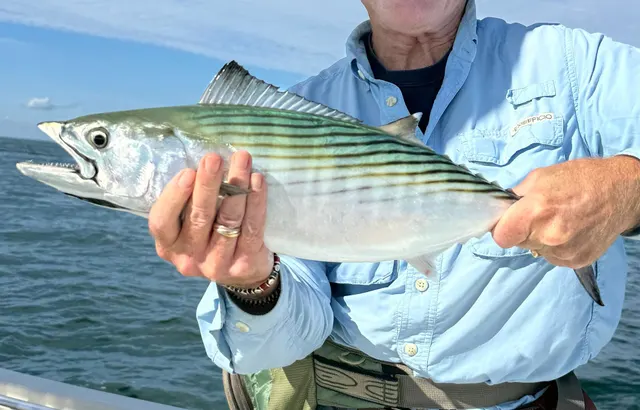 Atlantic bonitoA tuna-family fish with the dark muscle the hazard depends on, taken on warm coasts where formation is fastest.
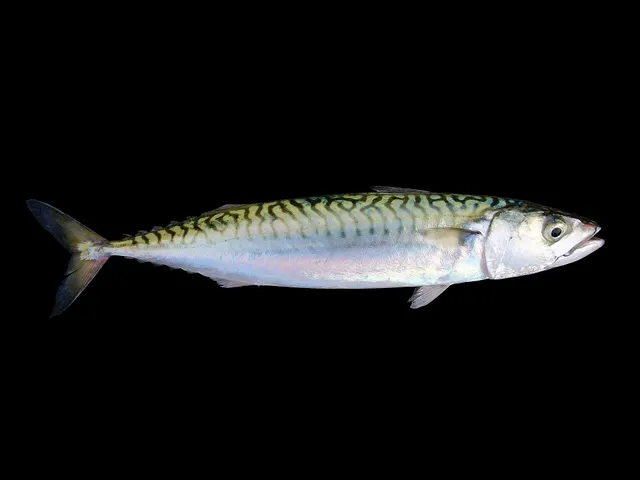 Atlantic mackerelThe classic scombroid species and the one most likely to be caught in quantity, killed quickly and left in a warm bag — which is the exact sequence the hazard needs.
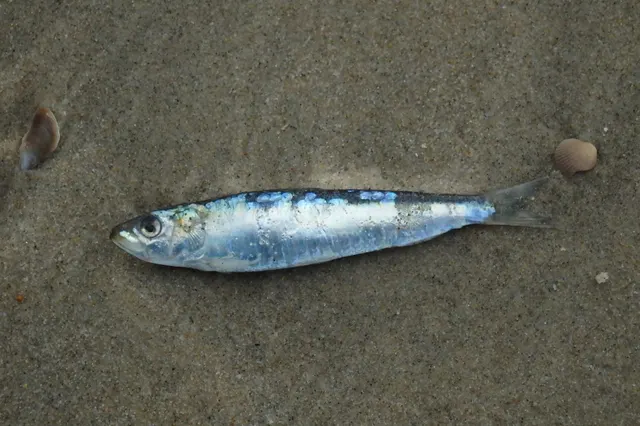 European sardineNot a scombrid, but among the species associated with histamine formation, and one caught in quantity in hot places and frequently left unchilled.
Where it matters
- Feathering and multi-lure tracesThe method and the hazard are the same afternoon. Feathering catches mackerel in numbers, mackerel are the classic scombrotoxin species, and the histamine forms in the fish AFTER capture as a function of time and temperature — so a bucket of mackerel in the sun on a pier is the exact scenario, and cooking does not undo it.
- TrollingThe offshore version of the same problem, with tuna, bonito and their relatives on a deck in the heat and a long run back to harbour. Getting the fish cold immediately is a food-safety operation rather than a matter of quality.
Gear this affects
How this compares
- Gathering shellfish, and the hazard that cooking does not removeThe two food-safety hazards on FishingHQ that cooking does not remove. One is created by the angler after capture and the other is present before it, and the difference decides what can be done about each.
- How histamine forms in a fish, and why the enzyme is the problemThe same hazard at two depths: what to do, and why doing it later does not work.
Sources and evidence
- Fish and Fishery Products Hazards and Controls Guidance — US Food and Drug Administration, Center for Food Safety and Applied Nutrition, 2022 (Standards body)Relied on for: Hazards and controls for fish and fishery products, including scombrotoxin (histamine) formation, the species associated with it, and the time-and-temperature controls that prevent it.States this directlyPassage read and verified
- FishBase: a global information system on fishes — Froese, R. and D. Pauly, eds. — FishBase Consortium (Scientific institute)Relied on for: Distribution, habitat association, depth range, diet, growth and reproductive parameters recorded for the species concerned.States this directlyPassage read and verified
- General angling website restatements of established technique — Various (Credible secondary source)Relied on for: Widely restated angling practice and belief, recorded as practitioner consensus rather than as tested fact.Background and mechanism onlyCitation checked — the work exists and is described correctly
Why the 8 connections on this page are here, and the sources
Fish this applies to
Official guidance — 3 connections
Stated by a fisheries authority, scientific institute or recognised angling body. Authoritative, but summarising rather than demonstrating.
Atlantic bonito
A place that describes a physical process in prose and cannot point at it is restating something FishingHQ should explain once. This is the link that turns the restatement into a reference.
- Fish and Fishery Products Hazards and Controls Guidance — US Food and Drug Administration, Center for Food Safety and Applied Nutrition, 2022 (Standards body)Relied on for: Hazards and controls for fish and fishery products, including scombrotoxin formation, the species associated with it and the time-and-temperature controls that prevent it.States this directlyPassage read and verified
- FishBase: a global information system on fishes — Froese, R. and D. Pauly, eds. — FishBase Consortium (Scientific institute)Relied on for: Family placement, biology and flesh characteristics recorded for the species.Background and mechanism onlyPassage read and verified
Atlantic mackerel
A place that describes a physical process in prose and cannot point at it is restating something FishingHQ should explain once. This is the link that turns the restatement into a reference.
- Fish and Fishery Products Hazards and Controls Guidance — US Food and Drug Administration, Center for Food Safety and Applied Nutrition, 2022 (Standards body)Relied on for: Hazards and controls for fish and fishery products, including scombrotoxin formation, the species associated with it and the time-and-temperature controls that prevent it.States this directlyPassage read and verified
- FishBase: a global information system on fishes — Froese, R. and D. Pauly, eds. — FishBase Consortium (Scientific institute)Relied on for: Family placement, biology and flesh characteristics recorded for the species.Background and mechanism onlyPassage read and verified
European sardine
A place that describes a physical process in prose and cannot point at it is restating something FishingHQ should explain once. This is the link that turns the restatement into a reference.
- Fish and Fishery Products Hazards and Controls Guidance — US Food and Drug Administration, Center for Food Safety and Applied Nutrition, 2022 (Standards body)Relied on for: Hazards and controls for fish and fishery products, including scombrotoxin formation, the species associated with it and the time-and-temperature controls that prevent it.States this directlyPassage read and verified
- FishBase: a global information system on fishes — Froese, R. and D. Pauly, eds. — FishBase Consortium (Scientific institute)Relied on for: Family placement, biology and flesh characteristics recorded for the species.Background and mechanism onlyPassage read and verified
Where it matters
Backed by research — 2 connections
Supported by peer-reviewed research or fisheries science. The sources are listed and can be checked.
Feathering and multi-lure traces
A method or discipline joined to the mechanism that changes how it is conducted. Written where the method's own practice differs because of the mechanism — a different bait, a different season, a different handling routine, a decision not to eat something — and refused where the mechanism is merely true of the fish being caught.
- Fish and Fishery Products Hazards and Controls Guidance — US Food and Drug Administration, Center for Food Safety and Applied Nutrition, 2022 (Standards body)Relied on for: Hazard analysis for fish and fishery products, including scombrotoxin formation with time and temperature, ciguatera, and marine biotoxins in molluscan shellfish.States this directlyPassage read and verified
- Biotoxin and phytoplankton monitoring — Food Standards Agency, 2026 (Government fisheries body)Relied on for: Biotoxin and phytoplankton monitoring in shellfish harvesting areas and the basis on which areas are classified and closed.States this directlyPassage read and verified
Trolling
A method or discipline joined to the mechanism that changes how it is conducted. Written where the method's own practice differs because of the mechanism — a different bait, a different season, a different handling routine, a decision not to eat something — and refused where the mechanism is merely true of the fish being caught.
- Fish and Fishery Products Hazards and Controls Guidance — US Food and Drug Administration, Center for Food Safety and Applied Nutrition, 2022 (Standards body)Relied on for: Hazard analysis for fish and fishery products, including scombrotoxin formation with time and temperature, ciguatera, and marine biotoxins in molluscan shellfish.States this directlyPassage read and verified
- Biotoxin and phytoplankton monitoring — Food Standards Agency, 2026 (Government fisheries body)Relied on for: Biotoxin and phytoplankton monitoring in shellfish harvesting areas and the basis on which areas are classified and closed.States this directlyPassage read and verified
Gear this affects
Official guidance — 1 connection
Stated by a fisheries authority, scientific institute or recognised angling body. Authoritative, but summarising rather than demonstrating.
Catch handling and transport
A place that describes a physical process in prose and cannot point at it is restating something FishingHQ should explain once. This is the link that turns the restatement into a reference.
- Fish and Fishery Products Hazards and Controls Guidance — US Food and Drug Administration, Center for Food Safety and Applied Nutrition, 2022 (Standards body)Relied on for: Hazards and controls for fish and fishery products, including scombrotoxin formation, the species associated with it and the time-and-temperature controls that prevent it.States this directlyPassage read and verified
- FishBase: a global information system on fishes — Froese, R. and D. Pauly, eds. — FishBase Consortium (Scientific institute)Relied on for: Family placement, biology and flesh characteristics recorded for the species.Background and mechanism onlyPassage read and verified
How this compares
What experienced anglers do — 2 connections
Widely and independently recommended by experienced anglers and specialist sources. This is real angling knowledge, not proof: controlled evidence for it is limited, and FishingHQ records it as convention rather than as a demonstrated effect.
Gathering shellfish, and the hazard that cooking does not remove
Two records a reader would reasonably weigh against one another, joined where the comparison teaches something about both. A navigation claim rather than a claim about the world.
- General angling website restatements of established technique — Various (Credible secondary source)Relied on for: Widely restated angling practice and belief, recorded as practitioner consensus rather than as tested fact.Background and mechanism onlyCitation checked — the work exists and is described correctly
- Sea Angler — Bauer Media (Specialist angling publication)Relied on for: Contemporary UK sea angling practice as reported and restated by practitioners, including technique and tackle convention.Background and mechanism onlyCitation checked — the work exists and is described correctly
How histamine forms in a fish, and why the enzyme is the problem
A navigational claim that a reader on one of these pages is likely to want the other. It asserts adjacency of subject matter rather than a fact about the world.
- Sea Angler — Bauer Media (Specialist angling publication)Relied on for: Contemporary UK and European sea angling practice as reported by practitioners, including catch handling convention.States this directlyCitation checked — the work exists and is described correctly
- General angling website restatements of established technique — Various (Credible secondary source)Relied on for: Widely restated angling practice, recorded as consensus rather than as scholarship.Background and mechanism onlyCitation checked — the work exists and is described correctly
How FishingHQ labels evidence is explained in the evidence policy.