Atlantic bonito
Fish · Last reviewed 2026-08-10
A small, fast, striped tuna relative that arrives on temperate coasts in shoals each year and is the most accessible member of the family to a shore angler.
Safety: cliffs and rock platforms — can cause serious injury or death. 5 more points apply here.
How this was identified, and who took it
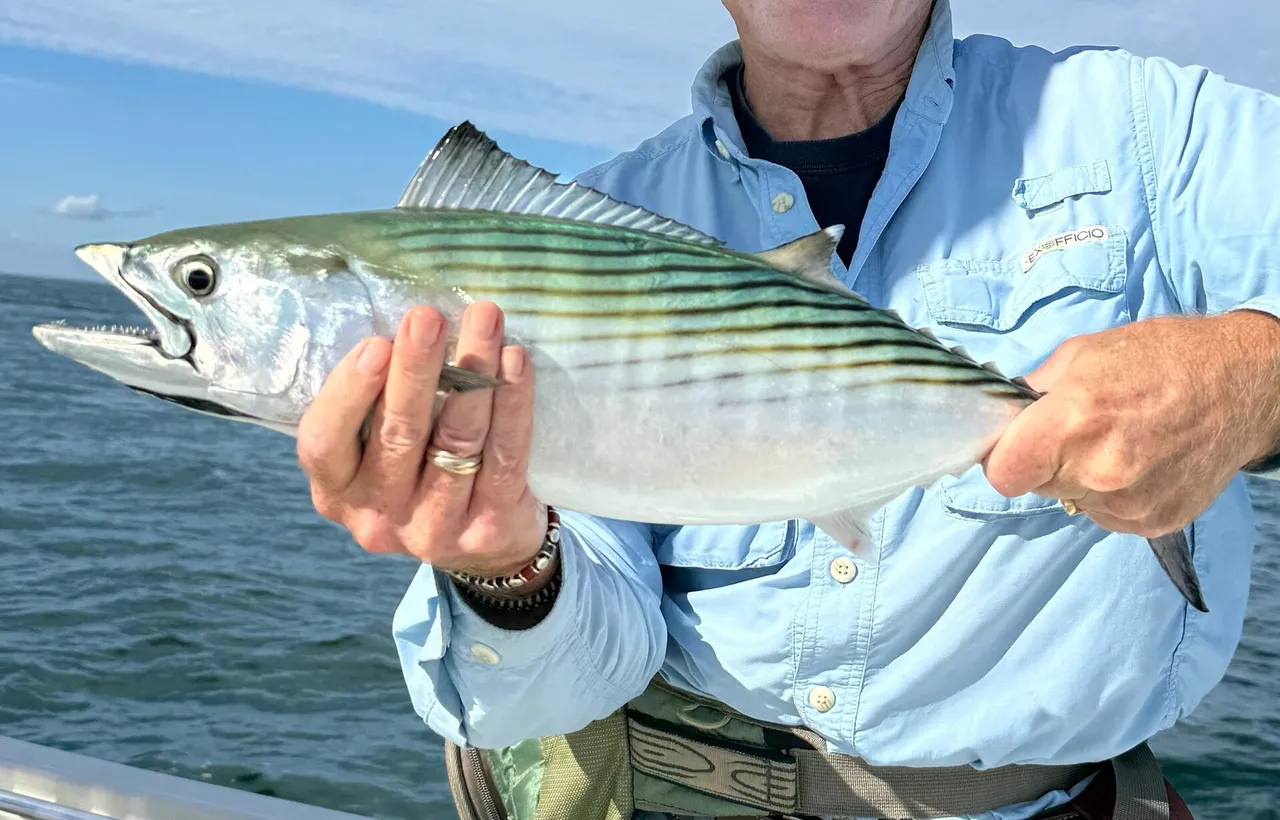
Identified by: The diagnostic is unusually clean. Dark stripes run OBLIQUELY — angled down and forward — across the back and onto the upper flank, which is the character of Sarda and is visible along the whole fish. That separates it from Atlantic mackerel, whose bars are near-vertical and wavy; from little tunny, whose markings stay above the lateral line; and from skipjack, whose stripes run along the belly. The conical teeth are supporting and are inconsistent with Thunnus.ricofish — CC0, via Wikimedia Commons — source, licence
Catching Atlantic bonito
Everything here on fishing for it. Each entry opens the page behind it.
- When
- Jun–Oct — months recorded at the places that document it, not a season for the whole range.
- Where
- 8 places FishingHQ documents — strongest claim anywhere: regular local target · From the shore, From a boat, On a charter
The Atlantic bonito is a scombrid — the tuna and mackerel family — and it occupies the useful middle ground between a mackerel and a tuna. It reaches around ten kilograms, it shoals, it hunts fast at the surface, and it arrives seasonally on temperate coasts in numbers that make it reachable from rock marks, harbour walls and small boats.
It is identified by the oblique dark stripes running along the upper flank — running diagonally forward and down, which separates it from the true tunas and from mackerel. It has teeth, unlike the tunas, which is worth knowing before handling one.
As a target it is exactly what a light-tackle sea angler wants: fast, hard-fighting for its size, willing to chase metal lures at speed, and available from the shore when the shoals are in. Bonito fishing in the Mediterranean and eastern Atlantic in late summer and autumn is one of the more democratic sport fisheries there is — the fish come to where people can reach them.
Like other scombrids it deteriorates very quickly once dead, and the difference between a bonito bled and iced at capture and one left in a bag is the difference between an excellent fish and a poor one.
Gear for this fish
- Metal jigsA small casting metal reaches bonito shoals from shore and boat and matches the small baitfish they are feeding on more closely than a trolled lure can.
- Saltwater luresSmall fast-trolled and spun lures take bonito, which feed on small pelagic shoal fish and select strongly on speed and size rather than on pattern.
Where Atlantic bonito is documented
Places where public sources describe this species as fished, with how it is fished and how strongly the evidence supports it. This is not a range map and it is not a recommendation — it is what has been written down about a fishery rather than a record of any individual catch, and being listed is never permission to fish.
The Azores
1 documented place
Sound or strait
Regular local target
From a boat
Around Jun, Jul, Aug, Sept
Canary Islands
2 documented places
Reef
Seasonal
From a boat
Around Jun, Jul, Aug, Sept, Oct
Sea area
Repeatedly reported
From a boat · On a charter
The Strait of Messina
1 documented place
Tidal race
Seasonal
From a boat · From the shore
Around Jun, Jul, Aug, Sept, Oct
Portugal
2 documented places
Sagres and Cabo de São Vicente
Headland
Recorded here
From a boat
Sea area
Recorded here
On a charter · From a boat
What these strengths mean
- Repeatedly reported
- Several independent public accounts. Enough to say it happens more than once; not enough to call it a fishery.
- Regular local target
- Fishing sources describe this as a normal local target here, not merely as caught.
- Recorded here
- At least one credible public account of this species being caught here. That is all it means.
- Seasonal
- Well supported, and concentrated in part of the year rather than spread through it.
When to fish for atlantic bonito
Where the places here state a season for atlantic bonito, it clusters in Jun–Oct. This is a count of how many documented places name each month — evidence about when people fish for it, not a prediction of what any particular day will produce.
| Jan | Feb | Mar | Apr | May | Jun | Jul | Aug | Sep | Oct | Nov | Dec |
|---|---|---|---|---|---|---|---|---|---|---|---|
| January: no place here names this month — no place names it. | February: no place here names this month — no place names it. | March: no place here names this month — no place names it. | April: no place here names this month — no place names it. | May: no place here names this month — no place names it. | June: 4 places name this month — most places. | July: 4 places name this month — most places. | August: 4 places name this month — most places. | September: 4 places name this month — most places. | October: 3 places name this month — many places. | November: no place here names this month — no place names it. | December: no place here names this month — no place names it. |
4 of the 8 places that record catches of atlantic bonito state which months. The other 4 name no season, so they are counted in neither direction: the shape above is what the dated records say, not the whole picture. The dated records span 4 separate areas.
Identification
- Scientific name
- Sarda sarda
- Family
- Scombridae
- Water
- Saltwater
- Conservation status
- Least Concern
- Regions
- Mediterranean, Western Europe, Britain & Ireland, North Africa, West Africa, North America, Central & South America, East & Southern Africa
- Oblique dark stripes running diagonally along the upper flank — the reliable separation from tunas, which are unstriped, and from mackerel, whose bars are vertical.
- Well-developed conical teeth in the jaws, which tunas lack.
- Body torpedo-shaped with finlets between the second dorsal and the tail, and strong lateral keels on a narrow tail wrist.
- First dorsal fin long and low, running back almost to the second dorsal.
- Separated from the similar striped bonito and from small tunas by the stripe angle and by the presence of teeth.
Size
- Typical
- 1–2.5 kg (2.2–5.5 lb)
- Large
- 4–6 kg (9–13 lb)
Exceptional: Over 8 kg (18 lb); maximum published weight 11 kg
A coastal tuna that stays over the shelf
Atlantic bonito occupy the surface layer of shelf and near-shelf water, and the distinction from the oceanic tunas is the useful one.
THEY ARE NERITIC RATHER THAN OCEANIC. Unlike albacore or bluefin, bonito spend most of their time over the continental shelf and close to coasts, in the upper water column, and they come genuinely inshore — into bays, around headlands and off harbour mouths — in a way the true oceanic tunas rarely do.
WARM SURFACE WATER IS THE REQUIREMENT. They are a warm-temperate species, most abundant where surface temperatures are in the upper part of the temperate range, and their inshore appearance at higher latitudes tracks the seasonal warming of shelf water.
THEY FOLLOW THE BAIT AND THE STRUCTURE THAT CONCENTRATES IT. Bonito hunt small pelagic fish in fast surface attacks, so they are found where anchovy, sardine, sprat and small mackerel are held — over banks, along tide lines, at current boundaries and around headlands where flow concentrates prey. The presence of working birds is a better habitat indicator than any depth figure.
SCHOOLS ARE SIZE-SORTED and move fast, so the habitat is occupied briefly and repeatedly rather than held.
AND THE SPECIES TOLERATES A WIDE SALINITY RANGE, entering brackish water and semi-enclosed seas — one reason it is a familiar fish in the Black Sea and the Mediterranean margins as well as on open Atlantic coasts.
Backed by research — why, and the sources (2)
Supported by peer-reviewed research or fisheries science. The sources are listed and can be checked.
- FAO Species Identification Guides for Fishery Purposes and the FAO Species Catalogues — Food and Agriculture Organization of the United Nations (Scientific institute)Relied on for: Distribution, habitat, depth and fishery accounts for the species in the FAO regional identification guides for the ocean area concerned.States this directlyCitation checked — the work exists and is described correctly
- ICES Advice on fishing opportunities, catch and effort — International Council for the Exploration of the Sea (Scientific institute)Relied on for: Stock assessment, the environmental drivers of stock distribution and abundance, and the scientific basis for advice in the sea areas concerned.States this directlyCitation checked — the work exists and is described correctly
Batch spawning in warm shelf water
Bonito reproduction follows the general scombrid pattern with one distinction that matters: it happens over the shelf rather than out in the ocean.
SPAWNING IS COASTAL AND WARM-SEASON. Adults spawn in warm surface water over and near the shelf, in the warmer months of each hemisphere, in broad areas rather than at defined sites. That puts spawning in the same general water the fishery works, which is unusual among tunas and makes the fish more exposed than an oceanic spawner.
IT IS BATCH SPAWNING OVER AN EXTENDED PERIOD. Females release eggs in multiple batches across weeks rather than in one event, which spreads output and reduces the consequences of a single poor spell of conditions.
EGGS AND LARVAE ARE PELAGIC, drifting in the surface layer, with larval survival strongly dependent on temperature and on the availability of suitable plankton.
MATURITY IS EARLY AND GROWTH IS FAST. Bonito mature at a young age relative to the larger tunas, which is the usual pattern for a short-lived, fast-growing pelagic and is why the species sustains fishing pressure better than its slower-growing relatives.
THERE IS NO NEST, NO SITE FIDELITY AND NO PARENTAL CARE.
AND THE SEMI-ENCLOSED SEAS COMPLICATE THE PICTURE. Populations in the Mediterranean and Black Sea have their own spawning timing and their own migratory patterns, and treating the species as one uniform stock across its range misdescribes it.
Backed by research — why, and the sources (2)
Supported by peer-reviewed research or fisheries science. The sources are listed and can be checked.
- FAO Species Identification Guides for Fishery Purposes and the FAO Species Catalogues — Food and Agriculture Organization of the United Nations (Scientific institute)Relied on for: Distribution, habitat, depth and fishery accounts for the species in the FAO regional identification guides for the ocean area concerned.States this directlyCitation checked — the work exists and is described correctly
- ICES Advice on fishing opportunities, catch and effort — International Council for the Exploration of the Sea (Scientific institute)Relied on for: Stock assessment, the environmental drivers of stock distribution and abundance, and the scientific basis for advice in the sea areas concerned.States this directlyCitation checked — the work exists and is described correctly
The bonito season is the warm water arriving inshore
Bonito are a seasonal visitor over most of their range, and the season is set by surface temperature and by the movement of the bait they follow.
THEY ARRIVE AS SHELF WATER WARMS and leave as it cools. At the northern edge of the range this produces a short and sometimes unreliable late-summer and autumn appearance; further south the season is longer. The fish are following a thermal window rather than a date, so the arrival shifts by weeks between years and in cool years may not happen at all.
THE PREY MOVEMENT IS THE PROXIMATE DRIVER. Bonito follow small pelagic shoals inshore, so their appearance tracks the arrival of anchovy, sprat and small mackerel rather than the temperature directly. When the bait is inshore the bonito are behind it.
AUTUMN IS FREQUENTLY THE PEAK on temperate coasts, because water is at its warmest late in the season and the bait shoals are at their largest after a summer of growth.
THE BLACK SEA AND MEDITERRANEAN POPULATIONS RUN THEIR OWN MIGRATIONS, moving between feeding and spawning areas on a schedule of their own that is well documented and quite distinct from the Atlantic pattern.
AND THE SOUTHERN HEMISPHERE RUNS SIX MONTHS OUT. Any month-anchored statement about this species has to name a hemisphere to mean anything.
Backed by research — why, and the sources (2)
Supported by peer-reviewed research or fisheries science. The sources are listed and can be checked.
- FAO Species Identification Guides for Fishery Purposes and the FAO Species Catalogues — Food and Agriculture Organization of the United Nations (Scientific institute)Relied on for: Distribution, habitat, depth and fishery accounts for the species in the FAO regional identification guides for the ocean area concerned.States this directlyCitation checked — the work exists and is described correctly
- ICES Advice on fishing opportunities, catch and effort — International Council for the Exploration of the Sea (Scientific institute)Relied on for: Stock assessment, the environmental drivers of stock distribution and abundance, and the scientific basis for advice in the sea areas concerned.States this directlyCitation checked — the work exists and is described correctly
Scombroid poisoning is a handling failure, not a cooking one
Bonito carry a hazard that arrives at the table rather than at the boat, and it is the clearest example on FishingHQ of a food-safety problem that is created entirely by how a fish is handled in the first hour.
WHAT SCOMBROID POISONING IS. Scombrid flesh — tuna, bonito, mackerel and their relatives — is rich in the amino acid histidine. Bacteria naturally present on the fish convert histidine to histamine, and they do it fast at warm temperatures. Histamine causes a reaction resembling a severe allergic response: flushing, headache, rapid heartbeat, sweating, nausea, sometimes a peppery or metallic taste from the fish itself.
THE PART THAT MAKES IT A HANDLING SUBJECT is that histamine is HEAT-STABLE. Cooking the fish does not destroy it. Freezing does not destroy it. Once it has formed, it is in the fish permanently, and nothing done in a kitchen afterwards can undo an afternoon in the sun. It is not spoilage in the usual sense either — the fish may look and smell entirely normal.
SO THE CONTROL IS TIME AND TEMPERATURE, AND IT IS APPLIED ON THE BOAT. A bonito that is being kept is dispatched immediately, bled by cutting the gill arches, and put into an ice slurry within minutes rather than left on a deck or in a bag. That is the whole of the prevention, and there is no second chance at it.
THE SAME PRACTICE ALSO DECIDES WHETHER THE FISH IS ANY GOOD. Bonito flesh is dark, oily and metabolically active, and it degrades quickly on any measure. Bled and iced at once it is excellent; left warm for an hour it is neither pleasant nor safe.
FOR FISH BEING RELEASED: keep them in the water, use pliers because the teeth are real, and be quick — scombrids are among the fastest-metabolising fish there are, they exhaust themselves completely in a short fight, and they recover poorly from air exposure.
Official guidance — why, and the sources (2)
Stated by a fisheries authority, scientific institute or recognised angling body. Authoritative, but summarising rather than demonstrating.
- Fish and Fishery Products Hazards and Controls Guidance — US Food and Drug Administration, Center for Food Safety and Applied Nutrition, 2022 (Standards body)Relied on for: That histamine formation in scombroid and other dark-fleshed fish is driven by time and temperature after capture, and that prompt chilling is the control.States this directlyPassage read and verified
- FishBase: a global information system on fishes — Froese, R. and D. Pauly, eds. — FishBase Consortium (Scientific institute)Relied on for: Flesh characteristics and commercial handling of the species.Background and mechanism onlyPassage read and verified
Lifecycle and reproduction
Fast-growing and comparatively short-lived, maturing at around two years and living to about nine. Spawns in warm coastal waters in spring and summer, with pelagic eggs and larvae. Undertakes seasonal migrations along coasts following water temperature and bait, which is what produces the shoals that arrive predictably on temperate coasts each year.
Broadcast spawning in warm coastal water in spring and summer, with pelagic eggs and larvae. High fecundity and fast growth give the species more resilience than the larger scombrids, and stocks are managed regionally across the Atlantic and Mediterranean.
Feeding and senses
A fast shoaling predator taking small schooling fish — anchovy, sardine, sand eel — and squid, hunting cooperatively and driving bait to the surface. The visible surface activity is how the fish are located, and a shoal working bait is frequently marked by birds long before it is seen from a boat or a rock.
Sight-dominant, hunting fast-moving prey visually near the surface with strong responses to flash and speed. This is why small fast-retrieved metal lures dominate the fishery and why slowing down almost always reduces takes. Bonito are also notably selective when feeding on very small bait, which is when small metals and flies outfish everything else.
Through the year
Strongly seasonal on temperate coasts, arriving as water warms in summer and autumn and departing as it cools. Local seasons are defined by arrival rather than by a date. Surface activity, working birds and bait concentrations are the practical indicators, and the fishery is opportunistic rather than planned.
Distribution
Atlantic: eastern Atlantic from Norway south to South Africa including the Mediterranean and Black Sea; western Atlantic from Nova Scotia to Argentina. A pelagic neritic species of coastal waters and the upper water column.
This is a biological range — where the species occurs, not a prediction that you will catch one. To browse the fishing geography FishingHQ holds, start at fishing places.
Why anglers care
A significant seasonal target across the Mediterranean and eastern Atlantic, taken on small metal lures, spinners, feathers and fly from rock marks, harbour walls and small boats, and by trolling. Its accessibility from the shore during the run makes it one of the most democratic sport fisheries in southern Europe.
Handling and returning
Teeth are present and the fish thrashes hard; keep fingers clear of the mouth and use pliers. If retaining, bleed and chill immediately — scombrid flesh deteriorates extremely quickly and this is the single factor that determines whether the fish is good to eat. If releasing, handle in the water and minimise air time; these are fast-metabolising fish that tire quickly and recover poorly.
Going further
- What does atlantic bonito eat? — feeding biology, kept separate from what anglers infer from it.
- Atlantic bonito vs Narrow-barred Spanish mackerel — how to tell them apart.
Safety
Cliffs and rock platforms — Can cause serious injury or death
A great deal of the shore fishery for this species is from ocean rock marks and breakwaters, where swell sweeps anglers off.
What reduces it: Never fish rock marks alone. Watch a mark for a full set cycle before committing. Wear a buoyancy aid and footwear with grip, and plan the escape route first.
Species that bite — Can cause injury needing treatment
Conical teeth in a fast fish that thrashes at the point of landing, frequently on rock or a quay.
What reduces it: Keep fingers clear of the mouth, use pliers or a de-hooking tool, and control the fish before touching it.
Precautions that always apply here
- Keep fingers out of the gills and clear of the teeth. Gill damage is usually fatal to the fish, and several species will remove skin from a finger.
- Wear a buoyancy aid or lifejacket. Cold water incapacitates strong swimmers within a minute, long before swimming ability matters.
- Check the tide before you go and know your exit route. Being cut off is the commonest way a shore session becomes a rescue.
- Tell somebody where you are going and when you expect to be back.
Check the rules before you fish
Fishing laws, bylaws, access rules, seasons, bait restrictions and permitted methods vary by location and can change. Check the current rules from the relevant authority and the water you intend to fish before fishing.
Check with:
- Current national or regional law for where you are fishing
- Current local bylaws
- The relevant fisheries authority
- The landowner, club or fishery whose water it is
- Any restrictions specific to the species or the method you intend to use
Where to go next
Similar and related fish
- European anchovyBonito are anchovy specialists through much of their range, and bonito runs along Mediterranean and Black Sea coasts follow anchovy movements directly.
- European spratSprat and other small clupeids make up the rest of the diet where anchovy are scarce, which is why bonito appear in northern waters in some years and not others.
- Narrow-barred Spanish mackerelBoth are scombrids with teeth, which separates them from the true tunas, and both cut through monofilament. The Spanish mackerel is much the larger and faster of the two.
Where you will find it
- CyprusPart of the same seasonal pelagic run, taken from rock marks and small boats when the fish are inshore. Timing a trip for that window changes what the island offers more than choosing a different coast does.
- Malta and GozoA warm-season pelagic visitor to deep-water shore marks and to the small-boat fishery.
- PortugalPresent seasonally on the shelf and taken on trolled and spun lures when water temperature and bait bring them within reach.
- The Agulhas CurrentWorks the frontal zone between the current and the cooler shelf water inshore of it.
- The Black SeaA seasonal visitor rather than a resident, entering from the Mediterranean through the Bosphorus and running along the coast in autumn. That run is the year's main fishing event on much of the southern coast and carries real cultural weight.
- The Moroccan Atlantic coastWorks the productive upwelling-influenced shelf water, following the small pelagic shoals along the coast.
- The Moroccan Mediterranean coastWorks the productive Alboran water and passes through the Strait on migration, following the small pelagic shoals.
- The Strait of GibraltarWorks the shear zones and current lines the exchange flow generates, following the small pelagic shoals concentrated by the mixing.
2 more
- The Strait of Messina Fishing regions
- The West African coast Fishing regions
Understanding this fish
- How histamine forms in a fish, and why the enzyme is the problemBonito are named explicitly among the scombrotoxin-forming species, and are a warm-water summer fish throughout their range.
- Scombroid poisoning, and why some fish must be chilled immediatelyA tuna-family fish with the dark muscle the hazard depends on, taken on warm coasts where formation is fastest.
Sources and evidence
- FishBase: a global information system on fishes — Froese, R. and D. Pauly, eds. — FishBase Consortium (Scientific institute)Relied on for: Scientific name, family placement in the Scombridae, a maximum length of 91.4 cm FL, a maximum published weight of 11.0 kg, a maximum reported age of 5 years.States this directlyPassage read and verified
- FishBase: a global information system on fishes — Froese, R. and D. Pauly, eds. — FishBase Consortium (Scientific institute)Relied on for: Environment, climate zone and depth range as recorded: Marine; brackish; pelagic-neritic; oceanodromous ; depth range 80 - 200 m . Subtropical; 12°C - 27°C ; 62°N - 40°S, 98°W - 42°EStates this directlyPassage read and verified
- FishBase: a global information system on fishes — Froese, R. and D. Pauly, eds. — FishBase Consortium (Scientific institute)Relied on for: The IUCN Red List category for Sarda sarda — Least Concern, assessed 15 November 2021 — as republished by FishBase, the Red List itself being unreachable during review.States this directlyPassage read and verified
- ICES Advice on fishing opportunities, catch and effort — International Council for the Exploration of the Sea (Scientific institute)Relied on for: That Atlantic and Mediterranean pelagic stocks are assessed regionally through scientific advice processes.Background and mechanism onlyCitation checked — the work exists and is described correctly
Why the 18 connections on this page are here, and the sources
Similar and related fish
Backed by research — 3 connections
Supported by peer-reviewed research or fisheries science. The sources are listed and can be checked.
European anchovy
Recorded diet evidence identifies Engraulis encrasicolus as a food item of this predator at species level. The edge is written at that granularity and no further.
- FishBase: a global information system on fishes — Froese, R. and D. Pauly, eds. — FishBase Consortium (Scientific institute)Relied on for: Food items recorded for this predator, including Engraulis encrasicolus.States this directlyPassage read and verified
- FAO Species Identification Guides for Fishery Purposes and the FAO Species Catalogues — Food and Agriculture Organization of the United Nations (Scientific institute)Relied on for: Species account describing the diet of this predator in the region where Engraulis encrasicolus occurs.Background and mechanism onlyCitation checked — the work exists and is described correctly
European sprat
Recorded diet evidence identifies Sprattus sprattus as a food item of this predator at species level. The edge is written at that granularity and no further.
- FishBase: a global information system on fishes — Froese, R. and D. Pauly, eds. — FishBase Consortium (Scientific institute)Relied on for: Food items recorded for this predator, including Sprattus sprattus.States this directlyPassage read and verified
- FAO Species Identification Guides for Fishery Purposes and the FAO Species Catalogues — Food and Agriculture Organization of the United Nations (Scientific institute)Relied on for: Species account describing the diet of this predator in the region where Sprattus sprattus occurs.Background and mechanism onlyCitation checked — the work exists and is described correctly
Narrow-barred Spanish mackerel
A taxonomic and identification comparison naming both binomials.
- FishBase: a global information system on fishes — Froese, R. and D. Pauly, eds. — FishBase Consortium (Scientific institute)Relied on for: That Scomberomorus commerson and Sarda sarda are both Scombridae possessing well-developed teeth, unlike the true tunas of Thunnus.States this directlyPassage read and verified
How it is caught
Official guidance — 1 connection
Stated by a fisheries authority, scientific institute or recognised angling body. Authoritative, but summarising rather than demonstrating.
Reef spearfishing
A scientific institute reporting what its own survey of the fishery recorded: a two-year catch-recording programme across the Canary archipelago counted and weighed every specimen, and this species appears in its published catch table. That is what Canary spearfishers were measured taking, rather than an inference from where the species lives or an assertion about what people do.
- Spearfishing in the Canary Islands: is the devil as black as it seems to be? — Pablo Martín-Sosa, Instituto Español de Oceanografía — Revista Scientia Insularum, 2019 (Scientific literature)Relied on for: The Canary spearfishing catch table, in which this species appears with a specimen count and a landed weight over the study's two-year recording period.States this directlyPassage read and verified
Gear for this fish
What experienced anglers do — 2 connections
Widely and independently recommended by experienced anglers and specialist sources. This is real angling knowledge, not proof: controlled evidence for it is limited, and FishingHQ records it as convention rather than as a demonstrated effect.
Metal jigs
A practitioner claim about which lure family answers this species' feeding or holding behaviour.
- IGFA International Angling Rules and World Record Requirements — International Game Fish Association (Angling or fisheries organisation)Relied on for: Recognition of the species as an established sport fish taken on artificial lures, and the line and tackle classes used for it.States this directlyPassage read and verified
- General angling website restatements of established technique — Various (Credible secondary source)Relied on for: Widely restated lure practice for this species.Background and mechanism onlyCitation checked — the work exists and is described correctly
Saltwater lures
A practitioner claim about which lure family answers this species' feeding or holding behaviour.
- IGFA International Angling Rules and World Record Requirements — International Game Fish Association (Angling or fisheries organisation)Relied on for: Recognition of the species as an established sport fish taken on artificial lures, and the line and tackle classes used for it.States this directlyPassage read and verified
- General angling website restatements of established technique — Various (Credible secondary source)Relied on for: Widely restated lure practice for this species.Background and mechanism onlyCitation checked — the work exists and is described correctly
Where you will find it
Backed by research — 10 connections
Supported by peer-reviewed research or fisheries science. The sources are listed and can be checked.
Cyprus
A distribution edge resting on published regional identification and distribution references, written where the species is genuinely characteristic of the destination's fishing rather than merely recorded from its waters.
- FAO Species Identification Guides for Fishery Purposes and the FAO Species Catalogues — Food and Agriculture Organization of the United Nations (Scientific institute)Relied on for: Distribution, habitat association and biology of the fishes of the eastern central Atlantic and the Mediterranean, from the regional identification guides prepared for fishery purposes.States this directlyCitation checked — the work exists and is described correctly
- FishBase: a global information system on fishes — Froese, R. and D. Pauly, eds. — FishBase Consortium (Scientific institute)Relied on for: Recorded environment, depth range, distribution and biology of the species named.States this directlyPassage read and verified
Malta and Gozo
A distributional claim about where a species occurs, resting on the regional identification literature rather than on angling report. It says nothing about where a reader should fish.
- FAO Species Identification Guides for Fishery Purposes and the FAO Species Catalogues — Food and Agriculture Organization of the United Nations (Scientific institute)Relied on for: Species composition, habitat association and distribution for the region concerned, as set out in the FAO species identification sheets.States this directlyCitation checked — the work exists and is described correctly
- The IUCN Red List of Threatened Species — International Union for Conservation of Nature (Conservation authority)Relied on for: Global assessment and distribution for the species concerned.States this directlyCitation checked — the work exists and is described correctly
Portugal
Occurrence of the species in these waters: a statement about the animal's distribution, not a venue recommendation.
- The Fishes of the British Isles and North-West Europe — Macmillan, 1969 (Reference work)Relied on for: Distribution and habitat association of fishes in north-west European and eastern Atlantic waters.States this directlyCitation checked — the work exists and is described correctly
- FishBase: a global information system on fishes — Froese, R. and D. Pauly, eds. — FishBase Consortium (Scientific institute)Relied on for: Distribution, depth range and habitat association recorded for the species.States this directlyPassage read and verified
The Agulhas Current
A distribution association between an animal and a kind of water, rather than a claim about any named mark.
- FishBase: a global information system on fishes — Froese, R. and D. Pauly, eds. — FishBase Consortium (Scientific institute)Relied on for: Distribution, habitat association and depth range recorded for the species, including its occurrence in the water body concerned.States this directlyPassage read and verified
- The IUCN Red List of Threatened Species — International Union for Conservation of Nature (Conservation authority)Relied on for: Assessment and range account for the species, including the systems and coasts it occupies.Background and mechanism onlyCitation checked — the work exists and is described correctly
The Black Sea
A distribution edge resting on published identification and distribution references rather than on angling report, written where the species is genuinely characteristic of the system rather than merely recorded in it once.
- FishBase: a global information system on fishes — Froese, R. and D. Pauly, eds. — FishBase Consortium (Scientific institute)Relied on for: Recorded environment, salinity tolerance, depth range, distribution and biology of the species named.States this directlyPassage read and verified
- FAO Species Identification Guides for Fishery Purposes and the FAO Species Catalogues — Food and Agriculture Organization of the United Nations (Scientific institute)Relied on for: Distribution, habitat association and identification of the fishes of the Mediterranean and Black Sea region.States this directlyCitation checked — the work exists and is described correctly
The Moroccan Atlantic coast
A distribution association between an animal and a kind of water, rather than a claim about any named mark.
- FAO Species Identification Guides for Fishery Purposes and the FAO Species Catalogues — Food and Agriculture Organization of the United Nations (Scientific institute)Relied on for: Distribution, habitat, depth and fishery accounts for the species of the eastern central Atlantic and Mediterranean in the FAO regional identification guides.States this directlyCitation checked — the work exists and is described correctly
- FishBase: a global information system on fishes — Froese, R. and D. Pauly, eds. — FishBase Consortium (Scientific institute)Relied on for: Distribution, habitat association and depth range recorded for the species.States this directlyPassage read and verified
The Moroccan Mediterranean coast
A distribution claim about the world, so it rests on the reference datasets rather than on angling report. FishingHQ's evidence policy requires it.
- FishBase: a global information system on fishes — Froese, R. and D. Pauly, eds. — FishBase Consortium (Scientific institute)Relied on for: Distribution, habitat association and depth range recorded for the species, including its occurrence in the water body concerned.States this directlyPassage read and verified
- FAO Species Identification Guides for Fishery Purposes and the FAO Species Catalogues — Food and Agriculture Organization of the United Nations (Scientific institute)Relied on for: Distribution, habitat, depth and fishery accounts for the species of the eastern central Atlantic and Mediterranean.States this directlyCitation checked — the work exists and is described correctly
The Strait of Gibraltar
A distribution association between an animal and a kind of water, rather than a claim about any named mark.
- FAO Species Identification Guides for Fishery Purposes and the FAO Species Catalogues — Food and Agriculture Organization of the United Nations (Scientific institute)Relied on for: Distribution, habitat, depth and fishery accounts for the species of the eastern central Atlantic and Mediterranean in the FAO regional identification guides.States this directlyCitation checked — the work exists and is described correctly
- FishBase: a global information system on fishes — Froese, R. and D. Pauly, eds. — FishBase Consortium (Scientific institute)Relied on for: Distribution, habitat association and depth range recorded for the species.States this directlyPassage read and verified
The Strait of Messina
A distribution association between an animal and a kind of water, rather than a claim about any named mark.
- FishBase: a global information system on fishes — Froese, R. and D. Pauly, eds. — FishBase Consortium (Scientific institute)Relied on for: Distribution, habitat association and depth range recorded for the species, including its occurrence in the water body concerned.States this directlyPassage read and verified
- The IUCN Red List of Threatened Species — International Union for Conservation of Nature (Conservation authority)Relied on for: Assessment and range account for the species, including the systems and coasts it occupies.Background and mechanism onlyCitation checked — the work exists and is described correctly
The West African coast
A distribution association between an animal and a kind of water, rather than a claim about any named mark.
- FishBase: a global information system on fishes — Froese, R. and D. Pauly, eds. — FishBase Consortium (Scientific institute)Relied on for: Distribution, habitat association and depth range recorded for the species, including its occurrence in the water body concerned.States this directlyPassage read and verified
- The IUCN Red List of Threatened Species — International Union for Conservation of Nature (Conservation authority)Relied on for: Assessment and range account for the species, including the systems and coasts it occupies.Background and mechanism onlyCitation checked — the work exists and is described correctly
Understanding this fish
Official guidance — 2 connections
Stated by a fisheries authority, scientific institute or recognised angling body. Authoritative, but summarising rather than demonstrating.
How histamine forms in a fish, and why the enzyme is the problem
A claim that a species belongs to the group in which histamine formation is a recognised hazard. That is a statement about the fish's muscle chemistry and about a named regulatory guidance's own species listing, not about angling practice, so it rests on the guidance rather than on report.
- Fish and Fishery Products Hazards and Controls Guidance — US Food and Drug Administration, Center for Food Safety and Applied Nutrition, 2022 (Standards body)Relied on for: Hazards and controls for fish and fishery products: scombrotoxin formation and the species groups associated with it, seafood parasites, and natural toxins.States this directlyPassage read and verified
Scombroid poisoning, and why some fish must be chilled immediately
A place that describes a physical process in prose and cannot point at it is restating something FishingHQ should explain once. This is the link that turns the restatement into a reference.
- Fish and Fishery Products Hazards and Controls Guidance — US Food and Drug Administration, Center for Food Safety and Applied Nutrition, 2022 (Standards body)Relied on for: Hazards and controls for fish and fishery products, including scombrotoxin formation, the species associated with it and the time-and-temperature controls that prevent it.States this directlyPassage read and verified
- FishBase: a global information system on fishes — Froese, R. and D. Pauly, eds. — FishBase Consortium (Scientific institute)Relied on for: Family placement, biology and flesh characteristics recorded for the species.Background and mechanism onlyPassage read and verified
How FishingHQ labels evidence is explained in the evidence policy.