What does atlantic bonito eat?
What is established about how atlantic bonito feeds, kept separate from what anglers infer from it.
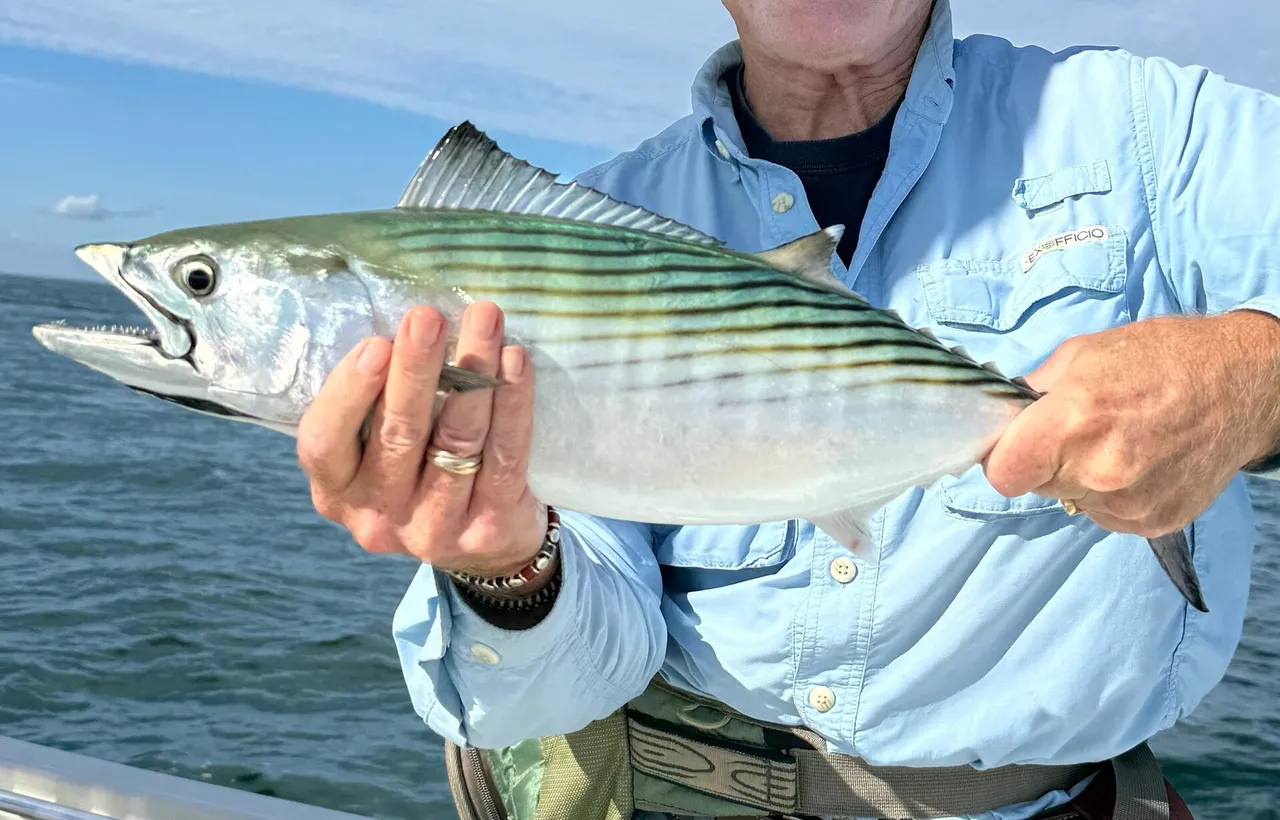
How this was identified, and who took it
Identified by: The diagnostic is unusually clean. Dark stripes run OBLIQUELY — angled down and forward — across the back and onto the upper flank, which is the character of Sarda and is visible along the whole fish. That separates it from Atlantic mackerel, whose bars are near-vertical and wavy; from little tunny, whose markings stay above the lateral line; and from skipjack, whose stripes run along the belly. The conical teeth are supporting and are inconsistent with Thunnus.ricofish — CC0, via Wikimedia Commons — source, licenceWhat is known about how it feeds
The bonito is a small tuna that lives at the pace of its prey, and its diet is close to a single-item one for months at a time.
Both verified relationships are small shoaling clupeoids: anchovy across the Mediterranean, Black Sea and eastern Atlantic, and sprat where anchovy is scarce. Bonito runs along a coast are, in practice, anchovy movements observed from the shore, and the timing of the fishery in the Bosphorus, the northern Mediterranean and the Iberian Atlantic is set by the forage fish rather than by the calendar.
The fish is built for it. Bonito are fast, streamlined, warm-bodied relative to the water around them, and they hunt in coordinated schools that drive bait to the surface. Vision dominates, and the attack is a high-speed visual one made in open water.
The metabolic cost of that lifestyle is the reason for the second characteristic anglers notice: bonito feed hard and frequently, and a school in feeding mode is spectacular and brief.
Growth is fast and life is short — a few years — so populations turn over quickly and abundance responds within a season or two to what the forage base does. In a year when the anchovy fail, the bonito are somewhere else.
The food
Prey with a verified dietary link to this fish. Each entry carries its own evidence, and each is written at the precision the source actually used: a named species where the source named one, a group or food category where it said “polychaetes”, “crustaceans” or “detritus” and meant it. That is why this list is shorter than the animal’s real diet rather than longer.
- European anchovy — Engraulis encrasicolus
Bonito are anchovy specialists through much of their range, and bonito runs along Mediterranean and Black Sea coasts follow anchovy movements directly.
- European sprat — Sprattus sprattus
Sprat and other small clupeids make up the rest of the diet where anchovy are scarce, which is why bonito appear in northern waters in some years and not others.
Food with no page of its own here yet
These are real components of the diet, listed as plain text because FishingHQ has no page for them yet. Inventing pages to make the list look fuller would be the fabrication this whole approach exists to prevent.
- sardine and pilchard
- small mackerel and scad
- squid
- sand smelt
What anglers do with this
Everything below is interpretation, not finding. It is what experienced anglers conclude from the biology above, and the reasoning is usually sound and almost never tested. It is separated from the biology deliberately.
Finding the bait is finding the fish, and that is the whole of the practical reasoning. Anglers follow birds, surface disturbance and the movements of anchovy shoals, and the convention is universal across the fisheries that target the species.
The speed and visual character of the attack is the basis for fast-moving presentations, and the convention that a bonito school responds to speed rather than to scent is held consistently and has not been tested.
One handling point is not interpretation: bonito are warm-bodied, active fish that spoil quickly, and a fish intended for the table needs to be bled and cooled immediately. That is a physiological consequence rather than a preference.
What this does not establish
Two relationships describe a diet that is genuinely narrow but not this narrow, and both stand for a broader group of small shoaling clupeoids. Composition varies by region and by what the local forage base holds. Nothing here establishes proportions or predicts when a run will occur.
Where this connects
These are the baits, lures, methods and explainers FishingHQ already joins to this fish — which is why the list is sometimes short. They are not chosen for this page, and a link here means an evidenced relationship exists, not that it follows from the diet.
Lures recorded for this species
Methods used for it
This page covers feeding. The Atlantic bonito record covers identification, lifecycle, seasonal behaviour, handling and the sources behind all of it.
Reviewed 2026-08-12.