European sprat
Fish · Last reviewed 2026-08-11
A small shoaling clupeid of coastal and shelf water, abundant enough to feed most of the predators in the northern European sea and to support a large fishery besides.
Background, not a fishing profile
This page is here so FishingHQ can describe a biological relationship accurately — usually because a fish covered elsewhere on the site feeds on this. It covers what it is, where it lives and the evidence behind that relationship, and deliberately nothing about methods, bait or tackle. Its presence here is not a statement that anybody fishes for it.
The sprat is a small herring relative that forms dense shoals in coastal water and estuaries, often in enormous numbers and often close inshore in winter.
Its significance is entirely a matter of abundance. Sprat are oily, they shoal tightly, and they occupy shallow water at exactly the times when predators are looking for a concentrated meal. Autumn and winter sprat shoals moving inshore are the reason bass, cod and a good deal else are catchable where and when they are, and the sudden appearance of a sprat shoal changes the fishing over a stretch of coast within a day.
Sprat are also taken commercially in quantity for canning, for fishmeal and, at small sizes, as part of what is sold as whitebait.
The species is here because sprat appears by name in the recorded diets of cod, sea bass, mackerel, bonito, tuna and salmon, and encoding those relationships against a genuine sprat record rather than against some other small silver fish is the whole point of refusing to substitute one fish for another.
Identification
No photograph of European sprat has passed identity review yet, so none is shown. A photograph is published only once somebody has checked the animal in it against the diagnostic features described on this page.
- Scientific name
- Sprattus sprattus
- Family
- Clupeidae
- Water
- Saltwater, Brackish
- Conservation status
- Least Concern
- Regions
- Britain & Ireland, Northern Europe, Western Europe, Mediterranean
- Small, laterally compressed silver fish with a deeply forked tail and a single soft dorsal fin.
- Sharply keeled belly with distinctly serrated scutes that can be felt as a saw edge along the underside.
- Distinguished from a young herring by the position of the dorsal fin, which begins behind the pelvic fins in the sprat.
- No dark spot behind the gill cover, which separates it from small shads.
Size
- Typical
- 9–14 cm
- Large
- up to about 16 cm
Lifecycle and reproduction
Sprat mature at one to two years, live to about five or six, and grow fast. Populations are dominated by a few year classes at a time, so numbers swing sharply between good and poor recruitment years.
Spawning occurs over an extended period from late winter into summer depending on region, with buoyant eggs released into the water column in coastal and shelf water. Larvae drift with currents before shoaling as juveniles inshore.
Feeding and senses
A planktivore. Sprat feed on copepods and other small planktonic crustaceans, taking them individually by sight rather than by filtering. Feeding activity tracks the plankton cycle and is concentrated in the lighter half of the year.
Vision for feeding, and a well-developed lateral line for shoaling. Sprat shoals respond as a unit to the pressure disturbance made by an approaching predator, which is what produces the visible bait-ball behaviour that draws birds.
Through the year
Moves offshore into deeper water in summer and returns to shallow coastal water and estuaries in autumn and winter in much of its range. That inshore winter presence is the event a great deal of northern European predator fishing depends on.
Distribution
The north-east Atlantic from Norway and the Baltic south to Morocco, including the North Sea, the Mediterranean and the Black Sea, in coastal and shelf waters.
This is a biological range — where the species occurs, not a prediction that you will catch one. To browse the fishing geography FishingHQ holds, start at fishing places.
Why anglers care
Not a rod-and-line target. Sprat are widely used as a deadbait, netted or bought frozen, and are far more important as the reason predators are present at all. The presence of a sprat shoal is a fishing signal rather than a fishing opportunity in itself.
Handling and returning
Handled by anglers almost exclusively as a dead bait. Frozen sprat used as bait should be disposed of responsibly rather than returned to the water, particularly where the source water differs from the one being fished.
Where to go next
Similar and related fish
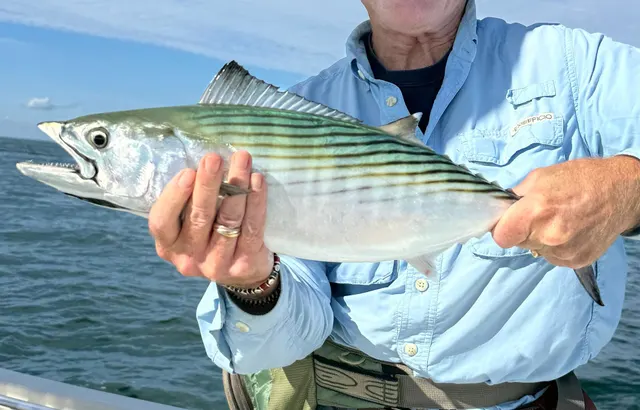 Atlantic bonitoSprat and other small clupeids make up the rest of the diet where anchovy are scarce, which is why bonito appear in northern waters in some years and not others.
- Atlantic horse mackerelLarger horse mackerel take sprat and other small clupeids, and shoals of both together are a common feature of autumn inshore water.
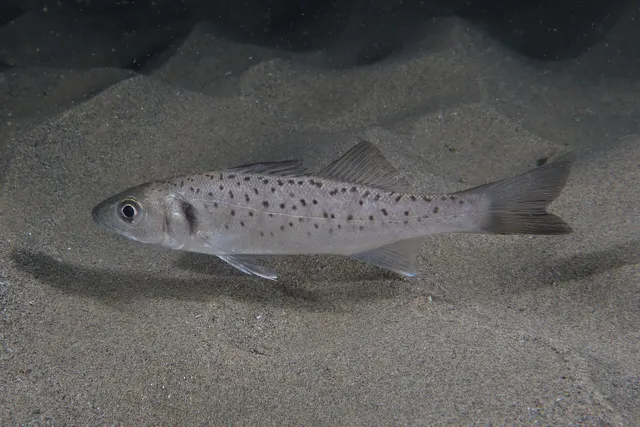 European sea bassAutumn and winter sprat shoals moving inshore are followed by bass, and a sprat shoal in a bay is one of the more reliable indications that bass are present.
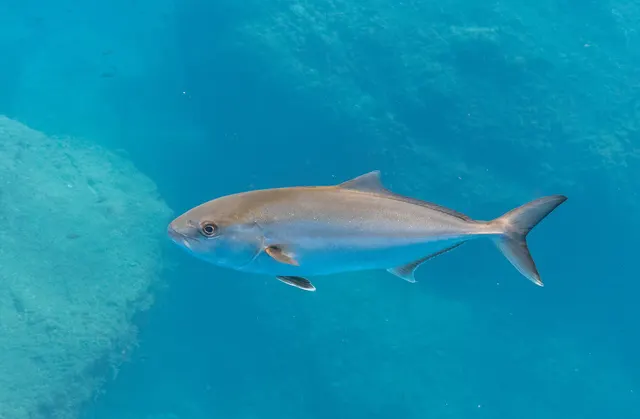 Greater amberjackSmall shoaling clupeids are a principal prey where amberjack range overlaps them, and amberjack hunting behaviour is organised around driving such shoals against structure or the surface.
- John DorySprat shoals over and around structure are prime dory prey: small, abundant, and slow to notice a predator approaching edge-on.
- SpurdogSmall clupeids are a staple, and the reason spurdog shoals follow bait concentrations rather than holding ground.
Where you will find it
- Portland Bill and the Portland RaceShoals in the water around the headland, and its coordinated shoaling defence is exactly what turbulence in a race breaks down.
- The Baltic SeaA principal forage fish of the open Baltic and a major component of the system's pelagic food web.
- The Black SeaOne of the two small pelagic shoaling fish the basin's whole food web rests on, occupying the cold intermediate layer within the thin living zone.
Sources and evidence
- FishBase: a global information system on fishes — Froese, R. and D. Pauly, eds. — FishBase Consortium (Scientific institute)Relied on for: Species identity, binomial, family placement, size, distribution and recorded biology for this species.States this directlyPassage read and verified
- FAO Species Identification Guides for Fishery Purposes and the FAO Species Catalogues — Food and Agriculture Organization of the United Nations (Scientific institute)Relied on for: The regional species account describing identity, distribution and the role of this species in the fisheries and food webs it belongs to.States this directlyCitation checked — the work exists and is described correctly
Why the 9 connections on this page are here, and the sources
Similar and related fish
Backed by research — 6 connections
Supported by peer-reviewed research or fisheries science. The sources are listed and can be checked.
Atlantic bonito
Recorded diet evidence identifies Sprattus sprattus as a food item of this predator at species level. The edge is written at that granularity and no further.
- FishBase: a global information system on fishes — Froese, R. and D. Pauly, eds. — FishBase Consortium (Scientific institute)Relied on for: Food items recorded for this predator, including Sprattus sprattus.States this directlyPassage read and verified
- FAO Species Identification Guides for Fishery Purposes and the FAO Species Catalogues — Food and Agriculture Organization of the United Nations (Scientific institute)Relied on for: Species account describing the diet of this predator in the region where Sprattus sprattus occurs.Background and mechanism onlyCitation checked — the work exists and is described correctly
Atlantic horse mackerel
Recorded diet evidence identifies Sprattus sprattus as a food item of this predator at species level. The edge is written at that granularity and no further.
- FishBase: a global information system on fishes — Froese, R. and D. Pauly, eds. — FishBase Consortium (Scientific institute)Relied on for: Food items recorded for this predator, including Sprattus sprattus.States this directlyPassage read and verified
- FAO Species Identification Guides for Fishery Purposes and the FAO Species Catalogues — Food and Agriculture Organization of the United Nations (Scientific institute)Relied on for: Species account describing the diet of this predator in the region where Sprattus sprattus occurs.Background and mechanism onlyCitation checked — the work exists and is described correctly
European sea bass
Recorded diet evidence identifies Sprattus sprattus as a food item of this predator at species level. The edge is written at that granularity and no further.
- FishBase: a global information system on fishes — Froese, R. and D. Pauly, eds. — FishBase Consortium (Scientific institute)Relied on for: Food items recorded for this predator, including Sprattus sprattus.States this directlyPassage read and verified
- FAO Species Identification Guides for Fishery Purposes and the FAO Species Catalogues — Food and Agriculture Organization of the United Nations (Scientific institute)Relied on for: Species account describing the diet of this predator in the region where Sprattus sprattus occurs.Background and mechanism onlyCitation checked — the work exists and is described correctly
Greater amberjack
Recorded diet evidence identifies Sprattus sprattus as a food item of this predator at species level. The edge is written at that granularity and no further.
- FishBase: a global information system on fishes — Froese, R. and D. Pauly, eds. — FishBase Consortium (Scientific institute)Relied on for: Food items recorded for this predator, including Sprattus sprattus.States this directlyPassage read and verified
- FAO Species Identification Guides for Fishery Purposes and the FAO Species Catalogues — Food and Agriculture Organization of the United Nations (Scientific institute)Relied on for: Species account describing the diet of this predator in the region where Sprattus sprattus occurs.Background and mechanism onlyCitation checked — the work exists and is described correctly
John Dory
A dietary claim naming Sprattus sprattus specifically, because the edge is about that species and not about small shoaling fish generally.
- The Fishes of the British Isles and North-West Europe — Macmillan, 1969 (Reference work)Relied on for: The piscivorous diet of Zeus faber, and the distribution and shoaling habit of Sprattus sprattus in north-east Atlantic and shelf waters.States this directlyCitation checked — the work exists and is described correctly
- Cefas science, advice and data on marine and freshwater environments — Centre for Environment, Fisheries and Aquaculture Science (Government fisheries body)Relied on for: UK survey data on the distribution and abundance of Sprattus sprattus and its role in the shelf food web.States this directlyCitation checked — the work exists and is described correctly
Spurdog
A dietary claim made at SPECIES level because the reference works identify the prey to species: the evidence is about Sprattus sprattus specifically, which is what a preys_on edge against that record asserts.
- The Fishes of the British Isles and North-West Europe — Macmillan, 1969 (Reference work)Relied on for: The diet of the British sharks, skates and rays as set out in the species accounts, in which Sprattus sprattus is identified to species among the recorded prey.States this directlyCitation checked — the work exists and is described correctly
- FAO Species Identification Guides for Fishery Purposes and the FAO Species Catalogues — Food and Agriculture Organization of the United Nations (Scientific institute)Relied on for: Feeding habits and prey composition for the eastern Atlantic elasmobranchs, including the occurrence of Sprattus sprattus in the diet.States this directlyCitation checked — the work exists and is described correctly
Where you will find it
Backed by research — 3 connections
Supported by peer-reviewed research or fisheries science. The sources are listed and can be checked.
Portland Bill and the Portland Race
A distribution association between an animal and a kind of water, rather than a claim about any named mark.
- The Fishes of the British Isles and North-West Europe — Macmillan, 1969 (Reference work)Relied on for: Distribution, habitat association, depth and ground preference of fishes in British and north-west European waters.States this directlyCitation checked — the work exists and is described correctly
- FishBase: a global information system on fishes — Froese, R. and D. Pauly, eds. — FishBase Consortium (Scientific institute)Relied on for: Distribution, habitat association and depth range recorded for the species.Background and mechanism onlyPassage read and verified
The Baltic Sea
Occurrence of the species in this system or along this coast: a statement about the animal's distribution, not a venue recommendation.
- The Fishes of the British Isles and North-West Europe — Macmillan, 1969 (Reference work)Relied on for: Distribution and habitat association of fishes in British and north-west European waters.States this directlyCitation checked — the work exists and is described correctly
- FishBase: a global information system on fishes — Froese, R. and D. Pauly, eds. — FishBase Consortium (Scientific institute)Relied on for: Distribution, depth range and habitat association recorded for the species.States this directlyPassage read and verified
The Black Sea
A distribution edge resting on published identification and distribution references rather than on angling report, written where the species is genuinely characteristic of the system rather than merely recorded in it once.
- FishBase: a global information system on fishes — Froese, R. and D. Pauly, eds. — FishBase Consortium (Scientific institute)Relied on for: Recorded environment, salinity tolerance, depth range, distribution and biology of the species named.States this directlyPassage read and verified
- FAO Species Identification Guides for Fishery Purposes and the FAO Species Catalogues — Food and Agriculture Organization of the United Nations (Scientific institute)Relied on for: Distribution, habitat association and identification of the fishes of the Mediterranean and Black Sea region.States this directlyCitation checked — the work exists and is described correctly
How FishingHQ labels evidence is explained in the evidence policy.