European anchovy
Fish · Last reviewed 2026-08-11
A small, large-mouthed shoaling fish of warm coastal seas, and the principal forage species of the Mediterranean and the Iberian Atlantic.
Background, not a fishing profile
This page is here so FishingHQ can describe a biological relationship accurately — usually because a fish covered elsewhere on the site feeds on this. It covers what it is, where it lives and the evidence behind that relationship, and deliberately nothing about methods, bait or tackle. Its presence here is not a statement that anybody fishes for it.
The European anchovy is instantly recognisable at close range: a small silver fish with an enormous mouth extending well behind the eye and a snout that overhangs it, giving the head a distinctive pointed profile.
It shoals in vast numbers in coastal and shelf water, moving inshore in the warmer months and dispersing offshore and deeper in winter. Anchovy abundance is strongly driven by temperature and by upwelling, and it varies between years by more than an order of magnitude, which propagates directly into the abundance of everything that eats them.
The species supports a very large commercial fishery around the Mediterranean, the Bay of Biscay and north-west Africa, and it is the basis of a substantial food culture.
It matters because anchovy is a named prey item for bonito, bluefin tuna, sea bass and dentex, among others, and the Mediterranean predator fisheries are effectively organised around where the anchovy shoals are.
Identification
No photograph of European anchovy has passed identity review yet, so none is shown. A photograph is published only once somebody has checked the animal in it against the diagnostic features described on this page.
- Scientific name
- Engraulis encrasicolus
- Family
- Engraulidae
- Water
- Saltwater, Brackish
- Conservation status
- Least Concern
- Regions
- Mediterranean, Western Europe, West Africa, Britain & Ireland
- Very large mouth with the upper jaw extending well behind the rear margin of the eye.
- Pointed, overhanging snout giving a distinctive wedge-shaped head in profile.
- Slender, rounded body with a bright silver lateral stripe and a translucent greenish or blue back.
- Belly rounded and smooth, without the serrated keel of a sprat or a sardine.
Size
- Typical
- 9–15 cm
- Large
- up to about 20 cm
Lifecycle and reproduction
Anchovy mature within their first year, live only three or four years, and depend almost entirely on the current year's recruitment. That short life makes populations extremely responsive to environmental conditions in both directions.
Spawning occurs in batches through the warmer months, with distinctive ellipsoidal buoyant eggs released into the water column in coastal and shelf water. Individual females spawn repeatedly over a season rather than once.
Feeding and senses
A planktivore feeding on copepods, other small crustaceans and larvae, taken both by particulate feeding and by filtering while swimming with the mouth open, which the very large gape is adapted for.
Vision for particulate feeding and a well-developed lateral line for schooling. Anchovy shoals respond collectively and rapidly to predator disturbance, forming the tight defensive balls that draw birds and larger fish.
Through the year
Moves inshore and towards the surface in warm months and offshore and deeper in winter. Predator fishing in the Mediterranean and Iberian Atlantic tracks these movements closely.
Distribution
The eastern Atlantic from the North Sea south to South Africa, and throughout the Mediterranean and Black Seas, in coastal and shelf waters usually within the upper hundred metres.
This is a biological range — where the species occurs, not a prediction that you will catch one. To browse the fishing geography FishingHQ holds, start at fishing places.
Why anglers care
Not a rod-and-line target. Anchovies are used as bait and as chum in several Mediterranean and Atlantic fisheries, and their principal significance to anglers is that predatory fish concentrate where the shoals are.
Handling and returning
Extremely soft and quick to deteriorate, and handled by anglers only as bait rather than as a catch. Anchovies are used fresh or frozen and lose condition within hours at ambient temperature, which is why they are kept iced from the moment they are landed.
Where to go next
Similar and related fish
- Atlantic bluefin tunaIn the Mediterranean and eastern Atlantic anchovy is a principal prey, and bluefin feeding activity concentrates where the anchovy shoals are.
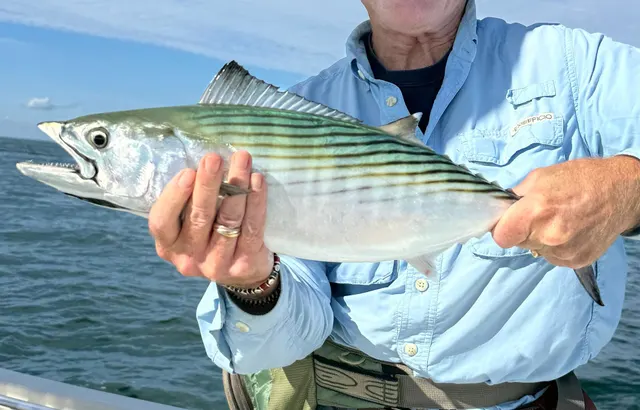 Atlantic bonitoBonito are anchovy specialists through much of their range, and bonito runs along Mediterranean and Black Sea coasts follow anchovy movements directly.
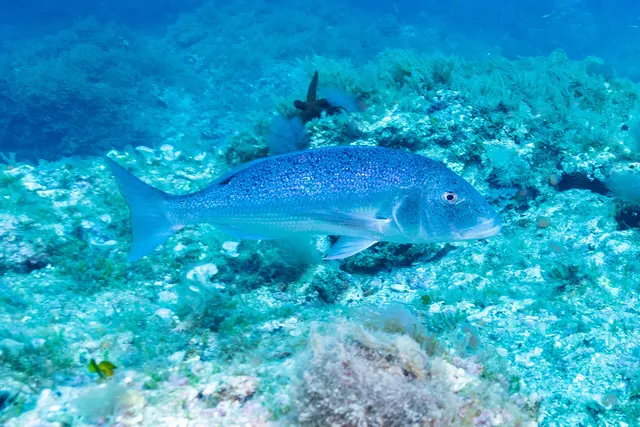 Common dentexSmall shoaling clupeids and anchovies are taken in open water, which is when dentex move off the structure they otherwise hold to.
Where you will find it
- PortugalA principal small pelagic of the upwelling system off this coast, and part of the forage base the whole shelf fishery depends on.
- The Bay of BiscayA defining small pelagic of the bay, whose concentrations at the shelf edge and over the canyons are what the tuna come for and what the region's pelagic fisheries are built on.
- The Black SeaThe most important fish in the basin by volume and the centre of a whole regional food culture on the Turkish coast. Its collapse under the introduced comb jelly in the 1980s and its subsequent partial recovery is the best-documented sequence of its kind anywhere.
- The Moroccan Atlantic coastOne of the small pelagic species the Canary Current upwelling supports in quantity, and part of the forage base the whole coastal fishery rests on.
- The Strait of GibraltarConcentrates in the mixing the two-layer exchange produces, forming the forage base that draws the larger pelagics and the cetaceans.
- The Strait of MessinaOne of the small pelagic species supporting the artisanal fishery of the surrounding coast and the forage base beneath the larger predators.
- The West African coastOne of the small pelagic species supported by the coastal upwelling at the northern end of the coast, and part of the forage base the whole fishery rests on.
Understanding this fish
Told apart from
Sources and evidence
- FishBase: a global information system on fishes — Froese, R. and D. Pauly, eds. — FishBase Consortium (Scientific institute)Relied on for: Species identity, binomial, family placement, size, distribution and recorded biology for this species.States this directlyPassage read and verified
- FAO Species Identification Guides for Fishery Purposes and the FAO Species Catalogues — Food and Agriculture Organization of the United Nations (Scientific institute)Relied on for: The regional species account describing identity, distribution and the role of this species in the fisheries and food webs it belongs to.States this directlyCitation checked — the work exists and is described correctly
Why the 12 connections on this page are here, and the sources
Similar and related fish
Backed by research — 3 connections
Supported by peer-reviewed research or fisheries science. The sources are listed and can be checked.
Atlantic bluefin tuna
Recorded diet evidence identifies Engraulis encrasicolus as a food item of this predator at species level. The edge is written at that granularity and no further.
- FishBase: a global information system on fishes — Froese, R. and D. Pauly, eds. — FishBase Consortium (Scientific institute)Relied on for: Food items recorded for this predator, including Engraulis encrasicolus.States this directlyPassage read and verified
- FAO Species Identification Guides for Fishery Purposes and the FAO Species Catalogues — Food and Agriculture Organization of the United Nations (Scientific institute)Relied on for: Species account describing the diet of this predator in the region where Engraulis encrasicolus occurs.Background and mechanism onlyCitation checked — the work exists and is described correctly
Atlantic bonito
Recorded diet evidence identifies Engraulis encrasicolus as a food item of this predator at species level. The edge is written at that granularity and no further.
- FishBase: a global information system on fishes — Froese, R. and D. Pauly, eds. — FishBase Consortium (Scientific institute)Relied on for: Food items recorded for this predator, including Engraulis encrasicolus.States this directlyPassage read and verified
- FAO Species Identification Guides for Fishery Purposes and the FAO Species Catalogues — Food and Agriculture Organization of the United Nations (Scientific institute)Relied on for: Species account describing the diet of this predator in the region where Engraulis encrasicolus occurs.Background and mechanism onlyCitation checked — the work exists and is described correctly
Common dentex
Recorded diet evidence identifies Engraulis encrasicolus as a food item of this predator at species level. The edge is written at that granularity and no further.
- FishBase: a global information system on fishes — Froese, R. and D. Pauly, eds. — FishBase Consortium (Scientific institute)Relied on for: Food items recorded for this predator, including Engraulis encrasicolus.States this directlyPassage read and verified
- FAO Species Identification Guides for Fishery Purposes and the FAO Species Catalogues — Food and Agriculture Organization of the United Nations (Scientific institute)Relied on for: Species account describing the diet of this predator in the region where Engraulis encrasicolus occurs.Background and mechanism onlyCitation checked — the work exists and is described correctly
Where you will find it
Backed by research — 7 connections
Supported by peer-reviewed research or fisheries science. The sources are listed and can be checked.
Portugal
Occurrence of the species in these waters: a statement about the animal's distribution, not a venue recommendation.
- The Fishes of the British Isles and North-West Europe — Macmillan, 1969 (Reference work)Relied on for: Distribution and habitat association of fishes in north-west European and eastern Atlantic waters.States this directlyCitation checked — the work exists and is described correctly
- FishBase: a global information system on fishes — Froese, R. and D. Pauly, eds. — FishBase Consortium (Scientific institute)Relied on for: Distribution, depth range and habitat association recorded for the species.States this directlyPassage read and verified
The Bay of Biscay
Occurrence of the species in this system or along this coast: a statement about the animal's distribution, not a venue recommendation.
- The Fishes of the British Isles and North-West Europe — Macmillan, 1969 (Reference work)Relied on for: Distribution and habitat association of fishes in British and north-west European waters.States this directlyCitation checked — the work exists and is described correctly
- FishBase: a global information system on fishes — Froese, R. and D. Pauly, eds. — FishBase Consortium (Scientific institute)Relied on for: Distribution, depth range and habitat association recorded for the species.States this directlyPassage read and verified
The Black Sea
A distribution edge resting on published identification and distribution references rather than on angling report, written where the species is genuinely characteristic of the system rather than merely recorded in it once.
- FishBase: a global information system on fishes — Froese, R. and D. Pauly, eds. — FishBase Consortium (Scientific institute)Relied on for: Recorded environment, salinity tolerance, depth range, distribution and biology of the species named.States this directlyPassage read and verified
- FAO Species Identification Guides for Fishery Purposes and the FAO Species Catalogues — Food and Agriculture Organization of the United Nations (Scientific institute)Relied on for: Distribution, habitat association and identification of the fishes of the Mediterranean and Black Sea region.States this directlyCitation checked — the work exists and is described correctly
The Moroccan Atlantic coast
A distribution association between an animal and a kind of water, rather than a claim about any named mark.
- FAO Species Identification Guides for Fishery Purposes and the FAO Species Catalogues — Food and Agriculture Organization of the United Nations (Scientific institute)Relied on for: Distribution, habitat, depth and fishery accounts for the species of the eastern central Atlantic and Mediterranean in the FAO regional identification guides.States this directlyCitation checked — the work exists and is described correctly
- FishBase: a global information system on fishes — Froese, R. and D. Pauly, eds. — FishBase Consortium (Scientific institute)Relied on for: Distribution, habitat association and depth range recorded for the species.States this directlyPassage read and verified
The Strait of Gibraltar
A distribution association between an animal and a kind of water, rather than a claim about any named mark.
- FAO Species Identification Guides for Fishery Purposes and the FAO Species Catalogues — Food and Agriculture Organization of the United Nations (Scientific institute)Relied on for: Distribution, habitat, depth and fishery accounts for the species of the eastern central Atlantic and Mediterranean in the FAO regional identification guides.States this directlyCitation checked — the work exists and is described correctly
- FishBase: a global information system on fishes — Froese, R. and D. Pauly, eds. — FishBase Consortium (Scientific institute)Relied on for: Distribution, habitat association and depth range recorded for the species.States this directlyPassage read and verified
The Strait of Messina
A distribution association between an animal and a kind of water, rather than a claim about any named mark.
- FishBase: a global information system on fishes — Froese, R. and D. Pauly, eds. — FishBase Consortium (Scientific institute)Relied on for: Distribution, habitat association and depth range recorded for the species, including its occurrence in the water body concerned.States this directlyPassage read and verified
- The IUCN Red List of Threatened Species — International Union for Conservation of Nature (Conservation authority)Relied on for: Assessment and range account for the species, including the systems and coasts it occupies.Background and mechanism onlyCitation checked — the work exists and is described correctly
The West African coast
A distribution association between an animal and a kind of water, rather than a claim about any named mark.
- FishBase: a global information system on fishes — Froese, R. and D. Pauly, eds. — FishBase Consortium (Scientific institute)Relied on for: Distribution, habitat association and depth range recorded for the species, including its occurrence in the water body concerned.States this directlyPassage read and verified
- The IUCN Red List of Threatened Species — International Union for Conservation of Nature (Conservation authority)Relied on for: Assessment and range account for the species, including the systems and coasts it occupies.Background and mechanism onlyCitation checked — the work exists and is described correctly
Understanding this fish
Official guidance — 1 connection
Stated by a fisheries authority, scientific institute or recognised angling body. Authoritative, but summarising rather than demonstrating.
How histamine forms in a fish, and why the enzyme is the problem
A claim that a species belongs to the group in which histamine formation is a recognised hazard. That is a statement about the fish's muscle chemistry and about a named regulatory guidance's own species listing, not about angling practice, so it rests on the guidance rather than on report.
- Fish and Fishery Products Hazards and Controls Guidance — US Food and Drug Administration, Center for Food Safety and Applied Nutrition, 2022 (Standards body)Relied on for: Hazards and controls for fish and fishery products: scombrotoxin formation and the species groups associated with it, seafood parasites, and natural toxins.States this directlyPassage read and verified
Told apart from
What experienced anglers do — 1 connection
Widely and independently recommended by experienced anglers and specialist sources. This is real angling knowledge, not proof: controlled evidence for it is limited, and FishingHQ records it as convention rather than as a demonstrated effect.
European sardine
Two records a reader would reasonably weigh against one another, joined where the comparison teaches something about both. A navigation claim rather than a claim about the world.
- General angling website restatements of established technique — Various (Credible secondary source)Relied on for: Widely restated angling practice and belief, recorded as practitioner consensus rather than as tested fact.Background and mechanism onlyCitation checked — the work exists and is described correctly
- Sea Angler — Bauer Media (Specialist angling publication)Relied on for: Contemporary UK sea angling practice as reported and restated by practitioners, including technique and tackle convention.Background and mechanism onlyCitation checked — the work exists and is described correctly
How FishingHQ labels evidence is explained in the evidence policy.