Atlantic bluefin tuna
Fish · Last reviewed 2026-08-10
A warm-blooded ocean-crossing predator reaching three metres and 680 kilograms, whose collapse and partial recovery is the most consequential fisheries story of the last fifty years.
Safety: line under tension — can cause serious injury or death. 5 more points apply here.
Catching Atlantic bluefin tuna
Everything here on fishing for it. Each entry opens the page behind it.
- When
- Apr–Dec — months recorded at the places that document it, not a season for the whole range.
- Where
- 4 places FishingHQ documents — strongest claim anywhere: seasonal · From a boat, On a charter
The Atlantic bluefin tuna is among the most remarkable animals in the sea and the subject of the most consequential fisheries argument of the modern era.
Physically it is extraordinary. It is regionally endothermic, using counter-current heat exchangers to keep its swimming muscle, eyes, brain and viscera far warmer than the surrounding water — which lets it hunt in cold water that would immobilise an ordinary fish and cross entire oceans. Tagged individuals have crossed the Atlantic in both directions and returned to natal spawning grounds. It reaches three metres and a maximum published weight of 684 kilograms.
Its fishery history is the reason it matters beyond angling. Driven by an extremely high-value sashimi market, Atlantic bluefin were fished down severely through the late twentieth century, to the point where the species became the emblem of fisheries mismanagement and a candidate for international trade prohibition. Since then, substantially tightened international management has produced a genuine and measurable recovery in the eastern stock — one of the few unambiguous fisheries success stories at that scale, and a direct rebuttal to the idea that nothing can be done.
Recreationally it has returned to waters where it had been absent for decades, including around Britain and Ireland, where a tightly controlled catch-and-release fishery now operates.
Where Atlantic bluefin tuna is documented
Places where public sources describe this species as fished, with how it is fished and how strongly the evidence supports it. This is not a range map and it is not a recommendation — it is what has been written down about a fishery rather than a record of any individual catch, and being listed is never permission to fish.
Canary Islands
1 documented place
Sea area
Seasonal
From a boat · On a charter
Around Apr, May, Jun, Jul, Aug, Sept
The Cornish and Devon coasts
1 documented place
Sea area
Seasonal
On a charter
Around Aug, Sept, Oct, Nov, Dec
Portugal
2 documented places
Sea area
Repeatedly reported
On a charter · From a boat
Offshore bank
Recorded here
On a charter
What these strengths mean
- Seasonal
- Well supported, and concentrated in part of the year rather than spread through it.
- Repeatedly reported
- Several independent public accounts. Enough to say it happens more than once; not enough to call it a fishery.
- Recorded here
- At least one credible public account of this species being caught here. That is all it means.
Rules, seasons and limits
The 2026 season, set out separately for each jurisdiction because the rules genuinely differ between them — and for this species, in this year, two of them do. This describes each regime as the fisheries authority publishes it. It is not permission, it is not advice, and it cannot tell you whether you personally may fish — the authority named on each card can.
England
Permit scheme · 2026 season
A fisheries authority runs a permit scheme here and published its conditions for this season.
- Season
- 13 July to 30 November 2026
- Quota cycle
- 2026–2028 TAC cycle
- Where it applies
- English waters only. The authority states that anyone wishing to operate outside English waters must apply to the relevant fisheries authority for that jurisdiction.
- Permitted method
- Rod and line only.
- Retention
- Strictly catch and release. A bluefin tuna must not be harmed, removed from the sea, brought aboard a vessel, transferred to any other vessel, or landed.
- Permits
- 145 — Permits awarded for 2026: 89 charter vessels and 56 private vessels
- Who may take part
- Charter vessels and private vessels may both apply, which is a change from the earlier CHART pilot's charter-only fleet.
- All 89 charter vessels that applied for 2026 were awarded a permit; the remaining places went to private vessels by random ballot.
- Charter vessels may hold a multi-year permit inside the 2026–2028 quota cycle; private vessels hold one-year permits.
- Every trip must carry a person aboard who has passed the accredited training.
- Vessel
- At least 5 metres overall length and powered by an engine or motor.
- Registered in the United Kingdom under the Merchant Shipping Act 1995.
- A charter vessel additionally requires a valid Small Commercial Vessel Certificate.
- Training
- Required. Accredited training delivered online and in person, running 1 May to 30 June, covering fish welfare and best-practice handling and bycatch mitigation. A person who has passed it must be aboard for every trip. Delivered by Angling Trust.
- Reporting
- Within 24 hours of the vessel's return, to the Marine Management Organisation, by the permitted vessel, for every trip made under the permit. A trip on which nothing was caught must still be reported. The record covers date of the trip, ICES rectangle fished, number of bluefin tuna caught, length of each fish, gear used, fight time, recovery period.
- Welfare and release
- A code of conduct produced by the Angling Trust with Cefas and Natural England sets the handling and release expectations.
- Fish welfare and best-practice handling is a required module of the accredited training rather than a recommendation.
- Not established
- The tonnage set aside for incidental recreational mortalities is not published on the pages read; only the 120 tonnes allocated to the commercial fishery out of a 230-tonne UK quota is stated.
- Authority
- Marine Management Organisation — the body that publishes these rules, and the one to ask. Read on 28 August 2026.
Northern Ireland
Scientific programme only · 2026 season
Participation here runs through a named scientific programme rather than an open permit scheme.
- Where it applies
- Northern Ireland waters, administered separately from the rest of the UK.
- Permitted method
- Rod and line, within the terms of the programme licence.
- Retention
- Catch, tag and release. The programme's stated purpose is collecting data with an emphasis on animal welfare, and no retention is described anywhere in the material read.
- Who may take part
- Participation runs through NI CHART, a DAERA and AFBI catch-tag-release programme, with successful applicants receiving a licence.
- DAERA states that anglers in Northern Ireland cannot lawfully target bluefin tuna outside the programme.
- An application pack is obtained by emailing DAERA Sea Fisheries.
- Not established
- The 2026 application window: DAERA published the application on 26 August 2026, and no closing date was confirmed. A closing date of 7 September 2026 was reported in a secondary trend note and could NOT be verified against any authoritative source; it is recorded here as an unverified claim rather than published as a deadline.
- The Northern Ireland season dates are not stated on any page read.
- The number of licences or participating vessels is not stated on any page read.
- Whether Angling Trust accredited training applies in Northern Ireland as it does in England is not stated.
- Authority
- Department of Agriculture, Environment and Rural Affairs (DAERA) Sea Fisheries — the body that publishes these rules, and the one to ask. Read on 28 August 2026.
Scotland
No scheme found · 2026 season
No recreational scheme for this species was found in an authoritative source for this jurisdiction. That is a gap in what has been checked rather than a statement about the law, and the authority named below is the one to ask.
- Where it applies
- Scottish waters. UK commercial vessels authorised for 2026 may target bluefin tuna in English, Welsh AND Scottish waters; the recreational permit schemes found apply to English and Welsh waters only.
- Permitted method
- Not established. No recreational catch-and-release permit scheme for Scottish waters was found.
- Retention
- Not established. Every UK recreational scheme found for 2026 is strictly catch and release, but that is a fact about England and Wales rather than about Scotland.
- Not established
- No Scottish recreational bluefin permit scheme was found on the UK-wide 2026 guidance, on the 2026 opening announcement, or through searching for a Marine Directorate scheme. The UK-wide guidance names no Scottish scheme and directs applicants outside English waters to the relevant fisheries authority without naming one for Scotland.
- This is an absence of found evidence and NOT a finding that no scheme exists. Anyone planning to fish for bluefin tuna in Scottish waters should ask the Marine Directorate rather than infer anything from this record.
- Authority
- Scottish Government Marine Directorate — the body that publishes these rules, and the one to ask. Read on 28 August 2026.
Wales
Permit scheme · 2026 season
A fisheries authority runs a permit scheme here and published its conditions for this season.
- Quota cycle
- 2026–2028 TAC cycle
- Where it applies
- NOT the whole Welsh zone. The permit covers the Welsh zone from 500m off the low water spring tide mark, south of a line due west from Trwyn Dinllaen on the north Lleyn Peninsula, and west of a line due south from Mumbles Lighthouse. It excludes inlets and estuaries such as Milford Haven, keeps a 500m buffer from shorelines including Skomer, Skokholm, Ramsey and Bardsey, and prohibits fishing inside Grassholm, Carmarthen Bay and Northern Cardigan Bay SPAs.
- Permitted method
- Rod and line only.
- Retention
- All bluefin tuna caught must be released unharmed where possible, and must not be removed from the sea, brought aboard a vessel, transferred to any other vessel, or landed.
- Who may take part
- A permit issued by the Welsh Government, held by a named authorised person, with the permit owner responsible for compliance and reporting.
- England's permit does not carry into Welsh waters: the authority for English waters directs anyone operating elsewhere to apply to that jurisdiction's own fisheries authority.
- Vessel
- A valid Small Commercial Vessel Certificate is required under the Merchant Shipping (Small Workboats and Pilot Boats) Regulations 1998.
- Reporting
- Within 24 hours of the end of each fishing trip, to the Welsh Government, in the format it requests, by the permit owner, who must ensure the master provides the record. A trip on which nothing was caught must still be reported. The record covers permit number, master's name and address, vessel name, date of the trip, number of bluefin tuna caught, length of each fish, whether each fish was released alive or dead, details of any bycatch.
- Welfare and release
- The master must comply with a four-stage bycatch protocol: Minimal Risk, Be Alert, Avoid, and Cease and Review.
- If a bird or marine mammal is hooked, lines and baits come in immediately, the skipper leaves the area, and tuna fishing stops for the day; a hooked bottlenose dolphin is reported and reviewed with Welsh Government Science and Natural Resources Wales.
- The authorisation may be withdrawn without notice if the activity is likely to have a significant effect on a European Marine Site.
- Not established
- The permit conditions document read does not state the Welsh season's opening and closing dates, and no other authoritative page consulted gave them.
- The number of recreational permits issued for Welsh waters is not published on the pages read.
- Authority
- Welsh Government — the body that publishes these rules, and the one to ask. Read on 28 August 2026.
Identification
No photograph of Atlantic bluefin tuna has passed identity review yet, so none is shown. A photograph is published only once somebody has checked the animal in it against the diagnostic features described on this page.
- Scientific name
- Thunnus thynnus
- Family
- Scombridae
- Water
- Saltwater
- Conservation status
- Least Concern
- Regions
- North America, Western Europe, Britain & Ireland, Northern Europe, Mediterranean, Caribbean, North Africa, Central & South America
- Very large, deep, torpedo-shaped body, deepest near the middle of the first dorsal fin base.
- Second dorsal fin taller than the first, and both pectoral fins SHORT — reaching only to about the eleventh or twelfth dorsal spine, which separates it from yellowfin and albacore.
- Dark metallic blue-black above, silvery-white below, with the lower flanks marked by colourless lines and rows of spots in fresh fish.
- Finlets between the second dorsal and the tail are dusky yellow edged with black, rather than the bright yellow of yellowfin.
- Narrow caudal peduncle with strong lateral keels; deeply lunate tail.
Size
- Typical
- 30–80 kg (66–176 lb)
- Large
- 150–300 kg (330–660 lb)
Exceptional: Over 400 kg (880 lb); maximum published weight 684 kg
A warm-blooded fish that can use cold water
Atlantic bluefin tuna have the widest thermal habitat of any tuna, and the reason is physiological rather than behavioural.
THEY ARE ENDOTHERMIC. Bluefin retain metabolic heat using counter-current heat exchangers, keeping muscle, viscera, brain and eyes warmer than the surrounding water. That is what allows them to occupy cold northern feeding grounds that no other tuna can use, and to dive deep repeatedly without losing function.
SO THEIR HABITAT SPANS AN ENORMOUS TEMPERATURE RANGE, from subtropical spawning water to cold water off Norway, Iceland and Atlantic Canada.
THEY ARE OCEANIC AND HIGHLY MIGRATORY, crossing the Atlantic and returning, with electronic tagging showing individual movements of thousands of kilometres and repeated basin-scale crossings.
THEY DIVE DEEP AND FREQUENTLY, using the whole water column down to several hundred metres, and depth use varies with region, season and time of day.
FRONTS, SHELF EDGES AND UPWELLING SUPPLY THE PREY. On the feeding grounds bluefin work temperature and current boundaries where herring, mackerel, sandeel and squid concentrate, and they come genuinely inshore where deep water and bait allow — which is why they appear in coastal fisheries at the northern end of the range.
AND THE TWO SPAWNING AREAS DEFINE TWO STOCKS. Fish spawning in the Mediterranean and in the Gulf of Mexico are managed as separate stocks despite mixing on the feeding grounds, which is one of the harder problems in fisheries assessment.
Backed by research — why, and the sources (2)
Supported by peer-reviewed research or fisheries science. The sources are listed and can be checked.
- ICES Advice on fishing opportunities, catch and effort — International Council for the Exploration of the Sea (Scientific institute)Relied on for: Stock assessment, the environmental drivers of stock distribution and abundance, and the scientific basis for advice in the sea areas concerned.States this directlyCitation checked — the work exists and is described correctly
- FishBase: a global information system on fishes — Froese, R. and D. Pauly, eds. — FishBase Consortium (Scientific institute)Relied on for: Distribution, habitat association, depth range, size, reproduction and life-history parameters recorded for the species.States this directlyPassage read and verified
Why the most dangerous moment is the one where nobody is fighting the fish
Bluefin are the only species on FishingHQ where the handling guidance is written primarily to protect the people rather than the fish, and the reason is that the dangerous part is not the fight.
THE FIGHT IS CONTROLLED. An angler is in a harness, in a chair or braced, attached to a rod with a drag setting, and everything is happening at a distance measured in tens of metres. It is exhausting and it is not where people are hurt.
THE DANGEROUS MOMENT IS THE LEADER. When the fish is close enough, somebody takes hold of the leader by hand — wiring the fish — to bring it the last few metres. At that instant a person is physically connected, with no drag and no give, to an animal that may weigh several hundred kilograms and is capable of accelerating away faster than anything can be released. A wrap of leader around a hand or a forearm at that moment removes the person from the boat, and it does so before anybody can react.
WHICH IS WHY THE RULES ARE ABOUT PEOPLE AND POSITIONS RATHER THAN TECHNIQUE. Nobody stands in the line's path or behind somebody who is wiring. A wireman takes turns around a gloved hand that can be shed, never around the hand itself, and the instruction is to let go — always, immediately, without hesitation, whatever it costs. Roles are agreed before the fish is close, not shouted during. The deck is cleared of everything anybody could trip on.
AND THE FISH'S SIDE OF THIS IS ALSO EXCEPTIONAL. Bluefin are endothermic, generating and retaining heat in the swimming muscle, and a prolonged fight raises core temperature into a range that damages muscle tissue — a phenomenon commercial handlers know as burnt tuna and release fisheries know as a fish that swims away and dies. That is why release-orientated bluefin fishing uses heavy tackle deliberately: the shortest possible fight is the single largest determinant of whether the fish survives. The fish is then held alongside in the water, unhooked or the leader cut, and released without ever being lifted.
The same endothermy is why a fish being kept is iced immediately: warm muscle in a large tuna spoils from the inside outward, and it does it fast.
Official guidance — why, and the sources (4)
Stated by a fisheries authority, scientific institute or recognised angling body. Authoritative, but summarising rather than demonstrating.
- Understanding the Complexity of Catch-and-Release in Recreational Fishing — Reviews in Fisheries Science 15:75–167, 2007 (Scientific literature)Relied on for: The determinants of catch-and-release outcome in recreational fisheries, and the gap between angler belief and measured survival.States this directlyCitation checked — the work exists and is described correctly
- Do we need species-specific guidelines for catch-and-release recreational angling? — Biodiversity and Conservation 14:1195–1209, 2005 (Scientific literature)Relied on for: That air exposure, handling duration and water temperature are the dominant modifiable determinants of post-release survival.States this directlyCitation checked — the work exists and is described correctly
- Sea Angler — Bauer Media (Specialist angling publication)Relied on for: Established boat and shore practice for handling and returning the species.States this directlyCitation checked — the work exists and is described correctly
- IGFA International Angling Rules and World Record Requirements — International Game Fish Association (Angling or fisheries organisation)Relied on for: Handling, release and tackle conventions in recognised sport fisheries for the species.Background and mechanism onlyPassage read and verified
A local season that is an ocean-scale process, and what the North Atlantic return demonstrates
Atlantic bluefin are the species that most clearly shows why a local fishing season can be a poor guide to what is actually happening.
THE FISH FOLLOWS TEMPERATURE AND BAIT ACROSS AN OCEAN. Bluefin undertake long migrations between warm spawning areas and cold, productive feeding grounds, and they are physiologically equipped to do it — they are regional endotherms, retaining metabolic heat in the swimming muscle, viscera, brain and eyes through counter-current heat exchangers. That lets a bluefin operate efficiently in water far colder than any ordinary fish of its type could tolerate, and it is why the species can exploit high-latitude feeding grounds and then return to spawn in warm water.
SO PRESENCE IN ANY REGION IS DEFINED BY THE ARRIVAL OF BAIT AND SUITABLE WATER, NOT BY A DATE. A local season opens when the herring, mackerel or sardine that the fish are following arrive, and that timing shifts between years. Nothing about a bluefin's calendar is fixed by the calendar.
AND THE NORTH-EAST ATLANTIC RETURN IS THE ILLUSTRATION WORTH SITTING WITH. Bluefin were a familiar sight in the North Sea and around Britain and Ireland in the early twentieth century, supporting a well-known sport fishery, and then essentially vanished from those waters for decades. In recent years they have returned in numbers, and new recreational fisheries have been established around that.
Nothing changed locally. What changed was the stock, which recovered substantially under international management after severe depletion, together with shifting oceanographic conditions and the distribution of prey. A fishery that appeared on a British coast is the visible end of a management and ecological process operating across an entire ocean over half a century.
WHICH IS THE GENERAL LESSON: for a highly migratory species, the local season is an output of something much larger, and reading it as a local phenomenon gets the causation backwards. Access to these fisheries is tightly controlled and entirely current and local; this page does not state what applies anywhere.
Backed by research — why, and the sources (4)
Supported by peer-reviewed research or fisheries science. The sources are listed and can be checked.
- FishBase: a global information system on fishes — Froese, R. and D. Pauly, eds. — FishBase Consortium (Scientific institute)Relied on for: Depth range, migration, spawning season and temperature association recorded for the species.States this directlyPassage read and verified
- ICES Advice on fishing opportunities, catch and effort — International Council for the Exploration of the Sea (Scientific institute)Relied on for: Stock distribution, seasonal movement between spawning and feeding grounds, and the assessment basis for the stock.States this directlyCitation checked — the work exists and is described correctly
- The IUCN Red List of Threatened Species — International Union for Conservation of Nature (Conservation authority)Relied on for: Assessment, population trend and the life-history traits that determine sensitivity to seasonal exploitation.States this directlyCitation checked — the work exists and is described correctly
- FishBase: a global information system on fishes — Froese, R. and D. Pauly, eds. — FishBase Consortium (Scientific institute)Relied on for: Spawning season, migration and life-history data recorded for the species.States this directlyPassage read and verified
Two spawning grounds for one ocean, and a stock structure that took decades to establish
Atlantic bluefin reproduction is the clearest case on FishingHQ of reproductive biology deciding an entire international management framework, and the framework rests on one fact.
THE ATLANTIC POPULATION SPAWNS IN TWO PLACES AND ESSENTIALLY NOWHERE ELSE. Western fish spawn in the Gulf of Mexico and eastern fish in the Mediterranean, in warm water in spring and early summer. Those are the recognised principal spawning grounds for an animal that ranges across an entire ocean, and the confinement of reproduction to two comparatively small warm areas is the species' defining vulnerability.
THE TWO GROUPS MIX ON THE FEEDING GROUNDS AND SEPARATE TO SPAWN, which is the fact that makes the management so difficult. Fish from both origins occupy the same North Atlantic feeding areas, so a fishery operating there is taking fish from two stocks with different sizes, different productivities and different recovery trajectories, and cannot tell them apart by looking. Establishing that through otolith chemistry, genetics and electronic tagging took decades and it changed the assessment fundamentally.
MATURITY DIFFERS BETWEEN THE TWO and this compounds it: western fish are understood to mature considerably later than eastern fish, so the same length fish is reproductively mature in one population and not in the other. A single minimum size cannot be right for both.
SPAWNING REQUIRES WARM WATER, which is why the grounds are where they are, and it makes the species' reproduction sensitive to changes in the temperature and circulation of those two specific areas in a way its enormous feeding range disguises.
FECUNDITY IS VERY HIGH AND SO IS EARLY MORTALITY, in the standard broadcast pattern, so recruitment is variable and only loosely coupled to spawning stock size.
AND THE ENTIRE FISHERY IS MANAGED INTERNATIONALLY ON THIS BASIS, with quotas, size limits, seasons and recreational measures that differ by area, are revised regularly, and are the product of negotiation as much as of science. Nothing above indicates what any current rule is; the competent authority does.
Backed by research — why, and the sources (2)
Supported by peer-reviewed research or fisheries science. The sources are listed and can be checked.
- IGFA International Angling Rules and World Record Requirements — International Game Fish Association (Angling or fisheries organisation)Relied on for: Recognition of the species as a recognised game fish and the seasonal pattern of the recreational fisheries that target it.Background and mechanism onlyPassage read and verified
- FishBase: a global information system on fishes — Froese, R. and D. Pauly, eds. — FishBase Consortium (Scientific institute)Relied on for: Spawning season, temperature preference, migratory behaviour and seasonal distribution for the species.States this directlyPassage read and verified
Lifecycle and reproduction
Long-lived and late-maturing by tuna standards, with maturity around four to five years in the eastern stock and later in the west, and a lifespan beyond forty years. Spawns in specific and restricted areas — principally the Mediterranean and the Gulf of Mexico — and undertakes trans-oceanic migrations between feeding and spawning grounds. The combination of restricted spawning areas, late maturity and enormous commercial value is precisely what made the species so vulnerable.
Broadcast spawning in warm water in a small number of restricted areas, chiefly the Mediterranean for the eastern stock and the Gulf of Mexico for the western. The geographic concentration of spawning is the species' structural vulnerability: pressure applied in a small area at the right time affects the entire stock, which is also why spatial and temporal closures have been so effective as management tools.
Feeding and senses
A high-speed pelagic predator taking fish — herring, mackerel, sand eel, sardine — along with squid and crustaceans, hunting cooperatively and often driving bait to the surface. Endothermy allows sustained high-speed pursuit and effective hunting in cold water, which is why bluefin range so much further into temperate and cold seas than other tunas.
Sight-dominant, with vision supported by the warming of the eyes and brain, which maintains reaction speed in cold water and at depth. Bluefin hunt visually at very high speed and can nonetheless be extremely selective when feeding on small bait in calm conditions — a combination that makes them both spectacular and frustrating to fish for.
Through the year
Undertakes long seasonal migrations between spawning areas and cold-water feeding grounds, with presence in any given region defined by the arrival of bait and suitable water temperature. The return of bluefin to north-east Atlantic waters in recent years follows stock recovery and shifting conditions rather than any local change, which is a useful illustration that a local fishery can reflect an ocean-scale process.
Distribution
Atlantic: the western Atlantic from Labrador and Newfoundland to the Gulf of Mexico and the Caribbean to Venezuela and Brazil; the eastern Atlantic from the Lofoten Islands off Norway to the Canary Islands, including the Mediterranean and the southern Black Sea.
This is a biological range — where the species occurs, not a prediction that you will catch one. To browse the fishing geography FishingHQ holds, start at fishing places.
Why anglers care
A premier big-game species with a long history, and now the subject of tightly controlled recreational fisheries in several jurisdictions, including catch-and-release programmes with a scientific tagging component in the north-east Atlantic. Access is generally by permit and heavily regulated, reflecting both the stock's history and its value.
Handling and returning
A very large, extremely powerful fish handled under the strictest release protocols of any species on FishingHQ where release fisheries operate. Fish are generally kept in the water alongside the boat, unhooked with the leader controlled and released without lifting. Endothermy means the flesh spoils rapidly if retained, which is why commercial handling ices fish immediately. Prolonged fights substantially reduce release survival, which is why tackle is heavy.
Going further
- What does atlantic bluefin tuna eat? — feeding biology, kept separate from what anglers infer from it.
- Atlantic bluefin tuna vs Yellowfin tuna — how to tell them apart.
Safety
Line under tension — Can cause serious injury or death
Big-game tackle at the extreme end, with drag loads capable of severe injury. A leader being handled with a large tuna attached is the single most dangerous moment in recreational fishing.
What reduces it: Nobody stands in the line's path or behind a leader being wired. Gloves, and a wireman who lets go rather than holds on. Agreed roles before the fish is on. Clear the deck for the endgame.
Boat safety — Can cause serious injury or death
Offshore work, hours from help, with a fish capable of towing a boat and a crew under sustained physical strain.
What reduces it: Lifejackets. A plan filed ashore. Communications that work beyond phone range. Rotate anglers rather than one person fighting to exhaustion.
Precautions that always apply here
- Wear a buoyancy aid or lifejacket. Cold water incapacitates strong swimmers within a minute, long before swimming ability matters.
- Tell somebody where you are going and when you expect to be back.
- Carry a charged phone in a waterproof case, or another means of calling for help.
- Support the fish's weight along its body, keep it out of the water for as short a time as possible, and hold it over something soft.
Check the rules before you fish
Fishing laws, bylaws, access rules, seasons, bait restrictions and permitted methods vary by location and can change. Check the current rules from the relevant authority and the water you intend to fish before fishing.
Check with:
- Current national or regional law for where you are fishing
- Current local bylaws
- The relevant fisheries authority
- The landowner, club or fishery whose water it is
- Any restrictions specific to the species or the method you intend to use
Where to go next
Similar and related fish
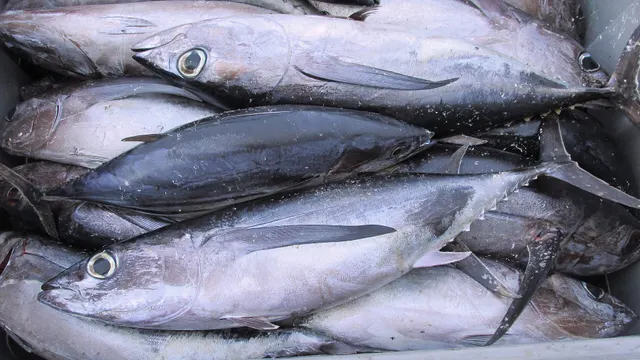 AlbacoreCongeners in Thunnus separated instantly by the pectoral fins: albacore's are enormously long and bluefin's are short. Albacore is the smaller, cooler-water fish.
- Atlantic herringBluefin follow herring shoals in the northern part of the range, and the historical distribution of the North Sea and Nordic bluefin fishery tracked the herring stocks closely.
- European anchovyIn the Mediterranean and eastern Atlantic anchovy is a principal prey, and bluefin feeding activity concentrates where the anchovy shoals are.
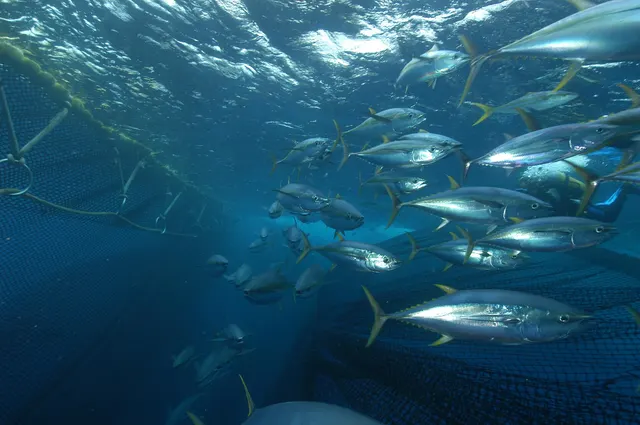 Yellowfin tunaCongeners in Thunnus and both regionally endothermic, but bluefin tolerates far colder water and reaches several times the size. The short pectoral fins separate them.
Where you will find it
- The Bay of BiscayMoves into the bay seasonally to feed on concentrations of small pelagic fish generated at the shelf edge and over the canyons, which is the physical basis of the historical Basque and Cantabrian tuna fisheries.
- The Gulf of MexicoThe western Atlantic population's principal spawning ground, used in spring and early summer, which makes the Gulf central to the species' management.
- The Moroccan Atlantic coastPasses along the coast on migration between Atlantic feeding grounds and the Mediterranean, which links this coast to the trap fisheries at the Strait of Gibraltar.
- The Strait of GibraltarPasses through in both directions on the spawning migration between Atlantic feeding grounds and Mediterranean spawning areas, which is why the trap fishery exists here.
- The Strait of MessinaWorks the same current lines through the strait and is among the most closely managed stocks anywhere.
Understanding this fish
- Cephalopods as preySquid form a substantial part of the diet, particularly at depth and at night when squid rise through the water column.
- Contaminants, and what accumulates in a fishLarge, long-lived and at the top of a marine food web, which is the profile in which methylmercury accumulates to the highest concentrations — and the reason advisories name it.
- How histamine forms in a fish, and why the enzyme is the problemA tuna, and therefore in the group the FDA names — with the additional problem the guidance singles tunas out for: they generate heat in their tissues, so a large fish is warm before it dies and its centre stays warm long afterwards.
Environment and conservation
Sources and evidence
- FishBase: a global information system on fishes — Froese, R. and D. Pauly, eds. — FishBase Consortium (Scientific institute)Relied on for: Scientific name, family placement in the Scombridae, a maximum length of 458 cm TL, a maximum published weight of 684.0 kg, a maximum reported age of 32 years.States this directlyPassage read and verified
- FishBase: a global information system on fishes — Froese, R. and D. Pauly, eds. — FishBase Consortium (Scientific institute)Relied on for: Environment, climate zone and depth range as recorded: Marine; brackish; pelagic-oceanic; oceanodromous ; depth range 0 - 985 m , usually 0 - 100 m. Subtropical; 3°C - 30°C ; 69°N - 58°S, 99°W - 42°EStates this directlyPassage read and verified
- FishBase: a global information system on fishes — Froese, R. and D. Pauly, eds. — FishBase Consortium (Scientific institute)Relied on for: The IUCN Red List category for Thunnus thynnus — Least Concern, assessed 15 January 2021 — as republished by FishBase, the Red List itself being unreachable during review.States this directlyPassage read and verified
- ICES Advice on fishing opportunities, catch and effort — International Council for the Exploration of the Sea (Scientific institute)Relied on for: That highly migratory Atlantic stocks are assessed through international scientific advice processes feeding management measures.States this directlyCitation checked — the work exists and is described correctly
- IGFA International Angling Rules and World Record Requirements — International Game Fish Association (Angling or fisheries organisation)Relied on for: The tackle and line classes used in offshore big-game angling and the conventions defining a fair capture.States this directlyPassage read and verified
- Understanding the Complexity of Catch-and-Release in Recreational Fishing — Reviews in Fisheries Science 15:75–167, 2007 (Scientific literature)Relied on for: That fight duration and handling materially affect the survival of released fish.States this directlyCitation checked — the work exists and is described correctly
Why the 14 connections on this page are here, and the sources
Similar and related fish
Backed by research — 4 connections
Supported by peer-reviewed research or fisheries science. The sources are listed and can be checked.
Albacore
An identification comparison naming both binomials.
- FishBase: a global information system on fishes — Froese, R. and D. Pauly, eds. — FishBase Consortium (Scientific institute)Relied on for: That Thunnus alalunga and Thunnus thynnus are congeners in the genus Thunnus with differing pectoral fin length and maximum size.States this directlyPassage read and verified
Atlantic herring
Recorded diet evidence identifies Clupea harengus as a food item of this predator at species level. The edge is written at that granularity and no further.
- FishBase: a global information system on fishes — Froese, R. and D. Pauly, eds. — FishBase Consortium (Scientific institute)Relied on for: Food items recorded for this predator, including Clupea harengus.States this directlyPassage read and verified
- FAO Species Identification Guides for Fishery Purposes and the FAO Species Catalogues — Food and Agriculture Organization of the United Nations (Scientific institute)Relied on for: Species account describing the diet of this predator in the region where Clupea harengus occurs.Background and mechanism onlyCitation checked — the work exists and is described correctly
European anchovy
Recorded diet evidence identifies Engraulis encrasicolus as a food item of this predator at species level. The edge is written at that granularity and no further.
- FishBase: a global information system on fishes — Froese, R. and D. Pauly, eds. — FishBase Consortium (Scientific institute)Relied on for: Food items recorded for this predator, including Engraulis encrasicolus.States this directlyPassage read and verified
- FAO Species Identification Guides for Fishery Purposes and the FAO Species Catalogues — Food and Agriculture Organization of the United Nations (Scientific institute)Relied on for: Species account describing the diet of this predator in the region where Engraulis encrasicolus occurs.Background and mechanism onlyCitation checked — the work exists and is described correctly
Yellowfin tuna
A taxonomic and identification comparison naming both binomials.
- FishBase: a global information system on fishes — Froese, R. and D. Pauly, eds. — FishBase Consortium (Scientific institute)Relied on for: That Thunnus thynnus and Thunnus albacares are congeners in the genus Thunnus, with differing temperature tolerance and maximum size.States this directlyPassage read and verified
How it is caught
What experienced anglers do — 1 connection
Widely and independently recommended by experienced anglers and specialist sources. This is real angling knowledge, not proof: controlled evidence for it is limited, and FishingHQ records it as convention rather than as a demonstrated effect.
Big-game fishing
A practitioner and rule-framework claim about the discipline's relationship with the species.
- IGFA International Angling Rules and World Record Requirements — International Game Fish Association (Angling or fisheries organisation)Relied on for: The line-class framework, tackle conventions and tag-and-release practice recognised in offshore big-game angling.Passage read and verified
- Sea Angler — Bauer Media (Specialist angling publication)Relied on for: Practitioner treatment of heavy tackle technique for large tuna.Citation checked — the work exists and is described correctly
Where you will find it
Backed by research — 5 connections
Supported by peer-reviewed research or fisheries science. The sources are listed and can be checked.
The Bay of Biscay
Occurrence of the species in this system or along this coast: a statement about the animal's distribution, not a venue recommendation.
- FishBase: a global information system on fishes — Froese, R. and D. Pauly, eds. — FishBase Consortium (Scientific institute)Relied on for: Distribution, salinity tolerance and habitat association recorded for the species, including its occurrence in this system.States this directlyPassage read and verified
- The IUCN Red List of Threatened Species — International Union for Conservation of Nature (Conservation authority)Relied on for: Assessment and range description for the species, including the waters in which it occurs.Background and mechanism onlyCitation checked — the work exists and is described correctly
The Gulf of Mexico
A distribution association between an animal and a kind of water, rather than a claim about any named mark.
- FishBase: a global information system on fishes — Froese, R. and D. Pauly, eds. — FishBase Consortium (Scientific institute)Relied on for: Distribution, habitat association and depth range recorded for the species, including its occurrence in the water body concerned.States this directlyPassage read and verified
- The IUCN Red List of Threatened Species — International Union for Conservation of Nature (Conservation authority)Relied on for: Assessment and range account for the species, including the systems and coasts it occupies.Background and mechanism onlyCitation checked — the work exists and is described correctly
The Moroccan Atlantic coast
A distribution association between an animal and a kind of water, rather than a claim about any named mark.
- FAO Species Identification Guides for Fishery Purposes and the FAO Species Catalogues — Food and Agriculture Organization of the United Nations (Scientific institute)Relied on for: Distribution, habitat, depth and fishery accounts for the species of the eastern central Atlantic and Mediterranean in the FAO regional identification guides.States this directlyCitation checked — the work exists and is described correctly
- FishBase: a global information system on fishes — Froese, R. and D. Pauly, eds. — FishBase Consortium (Scientific institute)Relied on for: Distribution, habitat association and depth range recorded for the species.States this directlyPassage read and verified
The Strait of Gibraltar
A distribution association between an animal and a kind of water, rather than a claim about any named mark.
- FAO Species Identification Guides for Fishery Purposes and the FAO Species Catalogues — Food and Agriculture Organization of the United Nations (Scientific institute)Relied on for: Distribution, habitat, depth and fishery accounts for the species of the eastern central Atlantic and Mediterranean in the FAO regional identification guides.States this directlyCitation checked — the work exists and is described correctly
- FishBase: a global information system on fishes — Froese, R. and D. Pauly, eds. — FishBase Consortium (Scientific institute)Relied on for: Distribution, habitat association and depth range recorded for the species.States this directlyPassage read and verified
The Strait of Messina
A distribution association between an animal and a kind of water, rather than a claim about any named mark.
- FAO Species Identification Guides for Fishery Purposes and the FAO Species Catalogues — Food and Agriculture Organization of the United Nations (Scientific institute)Relied on for: Distribution, habitat, depth and fishery accounts for the species in the FAO regional identification guides for the ocean area concerned.States this directlyCitation checked — the work exists and is described correctly
- FishBase: a global information system on fishes — Froese, R. and D. Pauly, eds. — FishBase Consortium (Scientific institute)Relied on for: Distribution, habitat association and depth range recorded for the species.States this directlyPassage read and verified
Understanding this fish
Backed by research — 2 connections
Supported by peer-reviewed research or fisheries science. The sources are listed and can be checked.
Cephalopods as prey
Recorded diet evidence identifies cephalopods as a food item of this predator at group level rather than to species. The edge points at the taxon record for that reason, and encoding it as a species-level claim would assert something the source does not.
- FishBase: a global information system on fishes — Froese, R. and D. Pauly, eds. — FishBase Consortium (Scientific institute)Relied on for: Food items recorded for this predator, given as cephalopods.States this directlyPassage read and verified
- FAO Species Identification Guides for Fishery Purposes and the FAO Species Catalogues — Food and Agriculture Organization of the United Nations (Scientific institute)Relied on for: Species account describing this predator's diet, recorded at the level of cephalopods.Background and mechanism onlyCitation checked — the work exists and is described correctly
Contaminants, and what accumulates in a fish
A link from a species or a place to the accumulation mechanism that decides whether what is caught there should be eaten, resting on published seafood-hazard guidance and on the species' recorded diet and trophic position.
- ICES Advice on fishing opportunities, catch and effort — International Council for the Exploration of the Sea (Scientific institute)Relied on for: Contaminant monitoring in marine biota and the accumulation of contaminants through marine food webs.States this directlyCitation checked — the work exists and is described correctly
- Fish and Fishery Products Hazards and Controls Guidance — US Food and Drug Administration, Center for Food Safety and Applied Nutrition, 2022 (Standards body)Relied on for: Methylmercury in seafood, the species in which it accumulates, and the advisory approach taken to it.States this directlyPassage read and verified
Official guidance — 1 connection
Stated by a fisheries authority, scientific institute or recognised angling body. Authoritative, but summarising rather than demonstrating.
How histamine forms in a fish, and why the enzyme is the problem
A claim that a species belongs to the group in which histamine formation is a recognised hazard. That is a statement about the fish's muscle chemistry and about a named regulatory guidance's own species listing, not about angling practice, so it rests on the guidance rather than on report.
- Fish and Fishery Products Hazards and Controls Guidance — US Food and Drug Administration, Center for Food Safety and Applied Nutrition, 2022 (Standards body)Relied on for: Hazards and controls for fish and fishery products: scombrotoxin formation and the species groups associated with it, seafood parasites, and natural toxins.States this directlyPassage read and verified
Environment and conservation
Official guidance — 1 connection
Stated by a fisheries authority, scientific institute or recognised angling body. Authoritative, but summarising rather than demonstrating.
Fish stocks and sustainability
A stock-status claim held to an authoritative standard, resting on international assessment.
- ICES Advice on fishing opportunities, catch and effort — International Council for the Exploration of the Sea (Scientific institute)Relied on for: That highly migratory Atlantic stocks including bluefin tuna are assessed through international scientific advice feeding management measures.States this directlyCitation checked — the work exists and is described correctly
- Good Fish Guide — Marine Conservation Society (Conservation authority)Relied on for: That stock assessments distinguish recovering stocks from depleted ones and that management measures are the mechanism.FishingHQ's interpretation of what it saysCitation checked — the work exists and is described correctly
How FishingHQ labels evidence is explained in the evidence policy.