Albacore
Fish · Last reviewed 2026-08-10
The long-finned tuna of temperate open ocean — smaller and cooler-water than its relatives, with pectoral fins so long they are the identification.
Safety: boat safety — can cause serious injury or death. 5 more points apply here.
How this was identified, and who took it
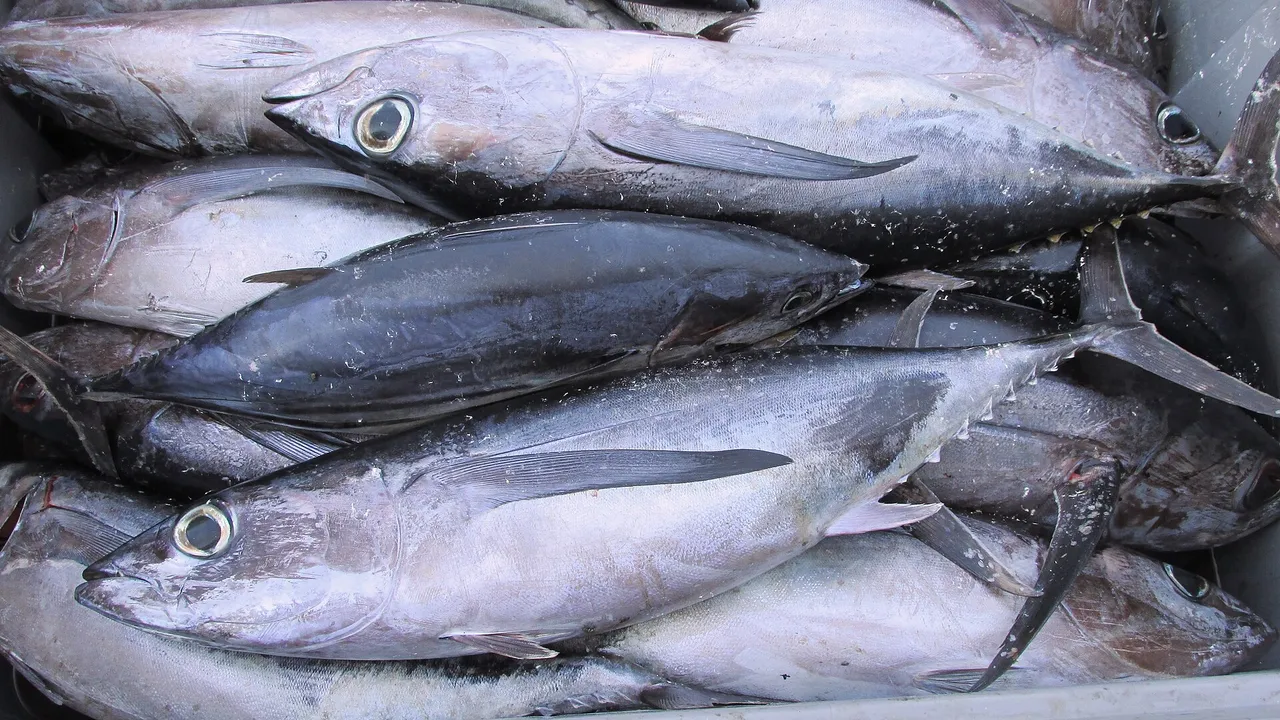
Identified by: Identified on the pectoral fin proportion, which the page names as the defining character and the only one reliable at all sizes: on three individuals in frame the pectoral is a long narrow blade reaching well past the origin of the second dorsal, which no other Thunnus approaches. Body deep and torpedo-shaped with a narrow caudal peduncle. Colour is post-mortem and does no diagnostic work here, which does not matter because the character is a proportion rather than a colour.Joachim Langeneck — CC BY-SA 4.0, via Wikimedia Commons — source, licence
Catching Albacore
Everything here on fishing for it. Each entry opens the page behind it.
- Where
- 3 places FishingHQ documents — strongest claim anywhere: recorded here · From a boat, On a charter
The albacore is the tuna of cooler water, and it is identified by one obvious feature: pectoral fins so long that they reach past the start of the second dorsal fin, giving the fish its other name of longfin tuna. Nothing else in the genus comes close, and the character works at any size.
It is a smaller tuna, reaching around 1.4 metres and sixty kilograms, and it ranges across temperate and subtropical open ocean worldwide. Like other tunas it is regionally endothermic, and that capacity is what lets it operate in water considerably cooler than yellowfin or bigeye tolerate — which is why albacore fisheries exist off temperate coasts where other tunas are absent.
Commercially it is the tuna most often sold as white meat, and it supports substantial pole-and-line and troll fisheries that are among the more selective in the tuna world. Recreationally it is a significant offshore target off the western United States, the Azores, South Africa, Australia and New Zealand, usually taken by trolling and by live-baiting once a school is located.
Its stocks are managed as several regional units, and status differs between them, which is the usual position for a widely distributed migratory fish and the reason a single global statement about albacore is not worth much.
How it is caught
Where Albacore is documented
Places where public sources describe this species as fished, with how it is fished and how strongly the evidence supports it. This is not a range map and it is not a recommendation — it is what has been written down about a fishery rather than a record of any individual catch, and being listed is never permission to fish.
Portugal
2 documented places
Sea area
Recorded here
On a charter · From a boat
Offshore bank
Recorded here
On a charter
What these strengths mean
- Recorded here
- At least one credible public account of this species being caught here. That is all it means.
Identification
- Scientific name
- Thunnus alalunga
- Family
- Scombridae
- Water
- Saltwater
- Conservation status
- Least Concern
- Regions
- Global, North America, Western Europe, Mediterranean, Indo-Pacific, East & Southern Africa, Australia, New Zealand, Central & South America, East Asia
- Extremely long pectoral fins, reaching well past the origin of the second dorsal fin — the defining character and reliable at all sizes.
- Metallic dark blue above shading to silvery-white below, with an iridescent blue band along the flank in fresh fish.
- A white trailing edge to the tail — a useful confirming character.
- Body deep and torpedo-shaped with a narrow caudal peduncle and strong lateral keels.
- Finlets dusky yellow; no bright yellow finlets or long second dorsal and anal lobes as in yellowfin.
Size
- Typical
- 8–15 kg (18–33 lb)
- Large
- 20–30 kg (44–66 lb)
Exceptional: Over 40 kg (88 lb); maximum published weight 60.3 kg
A tuna that lives in a temperature band rather than a place
Albacore are oceanic, epipelagic and highly migratory, and their habitat is best understood as a moving envelope of water rather than as a region.
TEMPERATURE IS THE BOUNDARY. Albacore associate closely with surface water in a fairly narrow thermal band — cooler than the tropical tunas prefer — and the fishery follows that band as it shifts north and south with the season. A fisher looking for albacore is looking at a sea surface temperature chart before anything else.
THE THERMOCLINE IS THE FLOOR. Albacore have a comparatively limited tolerance for the low oxygen and cold below the thermocline, so in a strongly stratified ocean they are concentrated into the mixed layer above it. Where the thermocline is shallow, the habitable band is thin and the fish are correspondingly concentrated.
FRONTS ARE THE STRUCTURE. In open ocean with no bottom to relate to, albacore aggregate along thermal fronts, current boundaries and convergence zones where prey concentrates. The transition zone between cool subarctic and warm subtropical water in both the Pacific and Atlantic is the classic albacore ground for exactly this reason.
JUVENILES AND ADULTS USE DIFFERENT DEPTHS. Younger fish are surface-oriented and support the surface troll and pole-and-line fisheries; larger adults spend more time deeper and are taken more often on longlines.
AND THE FISH DIVE FAR BELOW THEIR HABITAT BAND to feed, returning to the warmer layer to recover — so a depth record and a habitat description are answering different questions.
Backed by research — why, and the sources (2)
Supported by peer-reviewed research or fisheries science. The sources are listed and can be checked.
- ICES Advice on fishing opportunities, catch and effort — International Council for the Exploration of the Sea (Scientific institute)Relied on for: Stock assessment, the environmental drivers of stock distribution and abundance, and the scientific basis for advice in the sea areas concerned.States this directlyCitation checked — the work exists and is described correctly
- FishBase: a global information system on fishes — Froese, R. and D. Pauly, eds. — FishBase Consortium (Scientific institute)Relied on for: Distribution, habitat association, depth range, size, reproduction and life-history parameters recorded for the species.States this directlyPassage read and verified
Spawning in warm water, far from where they are fished
Albacore spawn in the warm parts of their range and are fished in the cool parts, and that separation is the most important structural fact about the species' reproduction.
SPAWNING IS SUBTROPICAL AND OFFSHORE. Adults move into warm oceanic water — well above the temperatures the feeding fishery works in — to spawn, in broad areas rather than at defined sites. Nothing about the spawning grounds resembles the frontal zones the fish are caught on.
SPAWNING IS BATCH AND PROTRACTED. Females release eggs in multiple batches over an extended period rather than in a single event, which spreads reproductive output across weeks and across conditions. Fecundity is high, as it is for most tunas.
EGGS AND LARVAE ARE PELAGIC and drift in the surface layer, with survival driven by temperature and by prey availability in the first weeks.
MATURITY COMES AT SEVERAL YEARS, and the age and size at which it occurs differ between ocean basins and between the northern and southern stocks — which is one of the reasons those stocks are assessed and managed separately.
THERE IS NO NEST, NO SITE FIDELITY AND NO PARENTAL CARE. The strategy is volume, warm water and dispersal.
AND THE ASSESSMENT CONSEQUENCE IS WORTH STATING: because spawning happens away from the fishery, the fishery's own data says comparatively little about reproduction, and stock assessment for this species leans on separate surveys and on modelling rather than on what the boats see.
Backed by research — why, and the sources (2)
Supported by peer-reviewed research or fisheries science. The sources are listed and can be checked.
- ICES Advice on fishing opportunities, catch and effort — International Council for the Exploration of the Sea (Scientific institute)Relied on for: Stock assessment, the environmental drivers of stock distribution and abundance, and the scientific basis for advice in the sea areas concerned.States this directlyCitation checked — the work exists and is described correctly
- FishBase: a global information system on fishes — Froese, R. and D. Pauly, eds. — FishBase Consortium (Scientific institute)Relied on for: Distribution, habitat association, depth range, size, reproduction and life-history parameters recorded for the species.States this directlyPassage read and verified
A season that is really a migration arriving
Albacore seasonality is migration seasonality: the fish are somewhere all year, and a given coast has a season because that is when the fish are near it.
THE PATTERN IS A SEASONAL SHIFT ALONG THE THERMAL GRADIENT. Fish move poleward and shoreward as surface water warms through the warmer half of the year, and back towards warmer, lower-latitude water as it cools. A regional albacore season is the arrival and departure of that movement.
SO THE SEASON MOVES BETWEEN YEARS. Because the driver is water temperature and frontal position rather than a date, an early or late warming shifts the fishery by weeks, and in anomalous years the fish may not reach a given ground at all. Fisheries here plan on sea surface temperature rather than on calendars.
IN THE NORTH ATLANTIC AND BAY OF BISCAY the fishery is a warm-season one, with fish moving in as surface water warms and supporting the pole-and-line and troll fisheries through those months. In the North Pacific the equivalent movement brings fish towards the North American coast on a comparable seasonal schedule.
JUVENILE AND ADULT SEASONS DIFFER. Surface fisheries take mostly younger fish during their seasonal inshore movement; longline fisheries take larger fish over a broader period because they reach the depths those fish occupy.
AND HEMISPHERE MATTERS. Northern and southern albacore stocks run their seasonal movements six months apart, so a month-based statement about albacore is wrong for half the world unless it says which half it means.
Backed by research — why, and the sources (2)
Supported by peer-reviewed research or fisheries science. The sources are listed and can be checked.
- ICES Advice on fishing opportunities, catch and effort — International Council for the Exploration of the Sea (Scientific institute)Relied on for: Stock assessment, the environmental drivers of stock distribution and abundance, and the scientific basis for advice in the sea areas concerned.States this directlyCitation checked — the work exists and is described correctly
- FishBase: a global information system on fishes — Froese, R. and D. Pauly, eds. — FishBase Consortium (Scientific institute)Relied on for: Distribution, habitat association, depth range, size, reproduction and life-history parameters recorded for the species.States this directlyPassage read and verified
Tuna handling scaled to a fish one person can lift, and the clock that starts at capture
Albacore sit in an awkward place: they are a genuine tuna with a tuna's physiology, at a size a single angler handles alone. Most of the handling advice attached to tunas was written for fish that need three people and a gaff, and applying it here produces the wrong answers in both directions.
THE FISH ARRIVES HOT AND THAT IS THE CENTRAL FACT. Albacore are regional endotherms — they retain metabolic heat in the swimming muscle through counter-current heat exchangers, so muscle temperature runs above the surrounding water. A hard fight adds a great deal more heat to a body that is already built not to shed it, on top of the lactate load of a maximal anaerobic effort. The consequence for a released fish is delayed mortality that looks like nothing at the boat, and the consequence for a fish being kept is that the flesh begins degrading immediately.
SO THE HANDLING RULE FOR A RELEASE IS SHORT FIGHT, MINIMAL LIFT, WATER CONTACT. Heavier tackle that ends the fight quickly is a welfare decision here rather than a sporting compromise. If the fish is going back it should be unhooked in the water or over the side wherever possible, because a tuna's body is unsupported by anything except water and a fish dropped on a deck damages itself against it.
AND THE RULE FOR A FISH BEING KEPT IS THE OPPOSITE OF GENTLE: KILL IT AT ONCE AND CHILL IT AT ONCE. Albacore are scombrids, and scombrids accumulate histamine when the flesh is held warm after death — the bacterial conversion of free histidine, which no amount of later cooking reverses. Scombrotoxin poisoning is a food-safety failure caused entirely by the handling of the hour after capture, and the control is temperature: dispatch immediately, bleed, and get the fish into ice slurry rather than into a dry box in the sun. This is the one species group where a warm dead fish is a hazard rather than merely poor housekeeping.
THE PHYSICAL HAZARDS TO THE PERSON ARE MINOR AND REAL. Albacore have very long pectoral fins that are stiff and edged, small sharp teeth, and finlets and a caudal keel that will open a hand on a fish that is thrashing. The tail is the dangerous end on a deck; the fish should be controlled by the head and the caudal peduncle, and gloves make more difference than they do on most species.
A GAFF IS A DECISION, NOT A TOOL. Gaffing commits the fish, so it belongs only where the fish is being kept. A fish intended for release should never meet one, and on albacore-sized fish there is rarely a need.
What experienced anglers do — why, and the sources (3)
Widely and independently recommended by experienced anglers and specialist sources. This is real angling knowledge, not proof: controlled evidence for it is limited, and FishingHQ records it as convention rather than as a demonstrated effect.
- IGFA International Angling Rules and World Record Requirements — International Game Fish Association (Angling or fisheries organisation)Relied on for: Recognition of the species as a recognised game fish and the practice of the recreational fisheries that target it.Background and mechanism onlyPassage read and verified
- Do we need species-specific guidelines for catch-and-release recreational angling? — Biodiversity and Conservation 14:1195–1209, 2005 (Scientific literature)Relied on for: Physiological consequences of exhaustive exercise in fish, including lactate accumulation, thermal load and delayed mortality.States this directlyCitation checked — the work exists and is described correctly
- Fish and Fishery Products Hazards and Controls Guidance — US Food and Drug Administration, Center for Food Safety and Applied Nutrition, 2022 (Standards body)Relied on for: Scombrotoxin (histamine) formation in scombrid fish, the time-and-temperature conditions that produce it, and the chilling controls that prevent it.States this directlyPassage read and verified
Lifecycle and reproduction
Grows fast and matures at around five years, living to about fifteen. Spawns in subtropical waters, with pelagic eggs and larvae. Undertakes long migrations between temperate feeding grounds and warmer spawning areas, with distinct stocks in the North and South Atlantic, the Indian Ocean and the North and South Pacific — which is why status varies so much between regions.
Broadcast spawning in warm subtropical waters, with very high fecundity and pelagic eggs and larvae. The separation between cool feeding grounds and warm spawning areas produces the long seasonal migrations the species is known for, and means a fish encountered off a temperate coast is on a feeding rather than a breeding phase of its cycle.
Feeding and senses
Feeds on fish, cephalopods and crustaceans in open water, hunting in schools and frequently near temperature fronts and current edges where prey concentrates. As with other tunas, endothermy supports sustained high-speed pursuit, and here it also permits foraging in water too cool for congeners.
Sight-dominant, with the warming of eyes and brain maintaining performance in cool water — which is the sensory half of the same adaptation that lets the species occupy temperate seas. Albacore hunt visually at speed and respond well to trolled lures worked at pace.
Through the year
Strongly migratory, following water temperature and bait, with fisheries appearing seasonally as schools move along temperate coasts. Local seasons are defined by the arrival of suitable water rather than by a date, and are opposite between hemispheres. Temperature fronts, current edges and bird activity are the practical indicators of where fish are.
Distribution
Cosmopolitan in temperate and tropical waters of the Atlantic, Indian and Pacific oceans, including the Mediterranean, generally between about 40 degrees north and 40 degrees south. An oceanic pelagic species of the open sea.
This is a biological range — where the species occurs, not a prediction that you will catch one. To browse the fishing geography FishingHQ holds, start at fishing places.
Why anglers care
A significant offshore recreational target off temperate coasts worldwide, taken by trolling feathers, jets and skirted lures, and by live-baiting once a school is located. Commercially important and often taken by pole-and-line and troll methods, which are among the more selective gear types in tuna fisheries.
Handling and returning
A fast, strong fish that comes aboard with hooks in it and thrashes. Control it before it arrives on deck. If retaining, bleed and chill immediately — the endothermic body heat means flesh quality degrades quickly, which is why commercial vessels ice albacore at once. If releasing, minimise the fight and support the fish horizontally in the water.
Safety
Boat safety — Can cause serious injury or death
Offshore work a long way from help, on a moving deck, through long days.
What reduces it: Lifejackets worn. File a plan ashore. Carry communications that work beyond phone range. Check the forecast for the whole window rather than the departure.
Hooks and barbs — Can cause injury needing treatment
Trolling lures carry substantial hooks, and a green tuna thrashing at boatside or on deck drives them into whatever is nearby.
What reduces it: Control the fish before it comes aboard. Use a gaff or net properly rather than swinging the fish in. Keep the deck clear during the endgame and de-hook with a tool.
Precautions that always apply here
- Wear a buoyancy aid or lifejacket. Cold water incapacitates strong swimmers within a minute, long before swimming ability matters.
- Tell somebody where you are going and when you expect to be back.
- Carry a charged phone in a waterproof case, or another means of calling for help.
- If a hook goes past the barb into a person, cut the line, leave the hook where it is, and get medical help. Pulling it back out does far more damage than pushing it through under proper care.
Check the rules before you fish
Fishing laws, bylaws, access rules, seasons, bait restrictions and permitted methods vary by location and can change. Check the current rules from the relevant authority and the water you intend to fish before fishing.
Check with:
- Current national or regional law for where you are fishing
- Current local bylaws
- The relevant fisheries authority
- The landowner, club or fishery whose water it is
- Any restrictions specific to the species or the method you intend to use
Where to go next
Similar and related fish
Where you will find it
- The Agulhas CurrentOccurs on the offshore side of the system and is taken along the current edge by the pelagic fishery.
- The Bay of BiscayThe summer tuna of the Cantabrian and Basque ports, taken historically by pole and line and live bait over the shelf edge — the bonito del norte fishery.
- The Humboldt CurrentOccurs on the offshore side of the system, where the cold productive water meets warmer oceanic water.
- The Strait of GibraltarUses the strait as a migratory corridor and is taken along the current lines either side of it.
- The Strait of MessinaWorks the deeper water either side of the sill and is taken by the longline fishery of the surrounding coast.
Understanding this fish
- How histamine forms in a fish, and why the enzyme is the problemA tuna of the group, and one taken commercially and recreationally at sizes where the interior cools slowly.
- Keeping a catch safe to eatScombrid fish accumulate histamine when held warm after death, which is a hazard created entirely by the hour after capture and not reversed by cooking.
Sources and evidence
- FishBase: a global information system on fishes — Froese, R. and D. Pauly, eds. — FishBase Consortium (Scientific institute)Relied on for: Scientific name, family placement in the Scombridae, a maximum length of 140 cm FL, a maximum published weight of 60.3 kg, a maximum reported age of 9 years.States this directlyPassage read and verified
- FishBase: a global information system on fishes — Froese, R. and D. Pauly, eds. — FishBase Consortium (Scientific institute)Relied on for: Environment, climate zone and depth range as recorded: Marine; pelagic-oceanic; oceanodromous ; depth range 0 - 600 m . Subtropical; 10°C - 25°C ; 60°N - 50°S, 180°W - 180°EStates this directlyPassage read and verified
- FishBase: a global information system on fishes — Froese, R. and D. Pauly, eds. — FishBase Consortium (Scientific institute)Relied on for: The IUCN Red List category for Thunnus alalunga — Least Concern, assessed 15 January 2021 — as republished by FishBase, the Red List itself being unreachable during review.States this directlyPassage read and verified
- ICES Advice on fishing opportunities, catch and effort — International Council for the Exploration of the Sea (Scientific institute)Relied on for: That highly migratory tuna stocks are assessed as regional units through international scientific advice processes.States this directlyCitation checked — the work exists and is described correctly
- IGFA International Angling Rules and World Record Requirements — International Game Fish Association (Angling or fisheries organisation)Relied on for: The tackle classes and trolling conventions used in offshore angling.Background and mechanism onlyPassage read and verified
Why the 10 connections on this page are here, and the sources
Similar and related fish
Backed by research — 1 connection
Supported by peer-reviewed research or fisheries science. The sources are listed and can be checked.
Atlantic bluefin tuna
An identification comparison naming both binomials.
- FishBase: a global information system on fishes — Froese, R. and D. Pauly, eds. — FishBase Consortium (Scientific institute)Relied on for: That Thunnus alalunga and Thunnus thynnus are congeners in the genus Thunnus with differing pectoral fin length and maximum size.States this directlyPassage read and verified
How it is caught
What experienced anglers do — 2 connections
Widely and independently recommended by experienced anglers and specialist sources. This is real angling knowledge, not proof: controlled evidence for it is limited, and FishingHQ records it as convention rather than as a demonstrated effect.
Livebaiting at sea
The page describes locating a school by trolling and then live-baiting it. The two are sequential parts of one fishery rather than alternatives, and both belong on the page.
- IGFA International Angling Rules and World Record Requirements — International Game Fish Association (Angling or fisheries organisation)Relied on for: Documents which fishery and which technique takes this species.States this directlyPassage read and verified
- FishBase: a global information system on fishes — Froese, R. and D. Pauly, eds. — FishBase Consortium (Scientific institute)Relied on for: Independently corroborates the species' recreational capture and range.Background and mechanism onlyPassage read and verified
Trolling
The page names trolling feathers, jets and skirted lures as the primary technique, and trolling is how the fish is found before it is fished for. The commercial pole-and-line and troll fisheries use the same principle.
- IGFA International Angling Rules and World Record Requirements — International Game Fish Association (Angling or fisheries organisation)Relied on for: Documents which fishery and which technique takes this species.States this directlyPassage read and verified
- FishBase: a global information system on fishes — Froese, R. and D. Pauly, eds. — FishBase Consortium (Scientific institute)Relied on for: Independently corroborates the species' recreational capture and range.Background and mechanism onlyPassage read and verified
Where you will find it
Backed by research — 5 connections
Supported by peer-reviewed research or fisheries science. The sources are listed and can be checked.
The Agulhas Current
A distribution association between an animal and a kind of water, rather than a claim about any named mark.
- FishBase: a global information system on fishes — Froese, R. and D. Pauly, eds. — FishBase Consortium (Scientific institute)Relied on for: Distribution, habitat association and depth range recorded for the species, including its occurrence in the water body concerned.States this directlyPassage read and verified
- The IUCN Red List of Threatened Species — International Union for Conservation of Nature (Conservation authority)Relied on for: Assessment and range account for the species, including the systems and coasts it occupies.Background and mechanism onlyCitation checked — the work exists and is described correctly
The Bay of Biscay
Occurrence of the species in this system or along this coast: a statement about the animal's distribution, not a venue recommendation.
- FishBase: a global information system on fishes — Froese, R. and D. Pauly, eds. — FishBase Consortium (Scientific institute)Relied on for: Distribution, salinity tolerance and habitat association recorded for the species, including its occurrence in this system.States this directlyPassage read and verified
- The IUCN Red List of Threatened Species — International Union for Conservation of Nature (Conservation authority)Relied on for: Assessment and range description for the species, including the waters in which it occurs.Background and mechanism onlyCitation checked — the work exists and is described correctly
The Humboldt Current
A distribution association between an animal and a kind of water, rather than a claim about any named mark.
- FishBase: a global information system on fishes — Froese, R. and D. Pauly, eds. — FishBase Consortium (Scientific institute)Relied on for: Distribution, habitat association and depth range recorded for the species, including its occurrence in the water body concerned.States this directlyPassage read and verified
- The IUCN Red List of Threatened Species — International Union for Conservation of Nature (Conservation authority)Relied on for: Assessment and range account for the species, including the systems and coasts it occupies.Background and mechanism onlyCitation checked — the work exists and is described correctly
The Strait of Gibraltar
A distribution association between an animal and a kind of water, rather than a claim about any named mark.
- FAO Species Identification Guides for Fishery Purposes and the FAO Species Catalogues — Food and Agriculture Organization of the United Nations (Scientific institute)Relied on for: Distribution, habitat, depth and fishery accounts for the species of the eastern central Atlantic and Mediterranean in the FAO regional identification guides.States this directlyCitation checked — the work exists and is described correctly
- FishBase: a global information system on fishes — Froese, R. and D. Pauly, eds. — FishBase Consortium (Scientific institute)Relied on for: Distribution, habitat association and depth range recorded for the species.States this directlyPassage read and verified
The Strait of Messina
A distribution association between an animal and a kind of water, rather than a claim about any named mark.
- FishBase: a global information system on fishes — Froese, R. and D. Pauly, eds. — FishBase Consortium (Scientific institute)Relied on for: Distribution, habitat association and depth range recorded for the species, including its occurrence in the water body concerned.States this directlyPassage read and verified
- The IUCN Red List of Threatened Species — International Union for Conservation of Nature (Conservation authority)Relied on for: Assessment and range account for the species, including the systems and coasts it occupies.Background and mechanism onlyCitation checked — the work exists and is described correctly
Understanding this fish
Official guidance — 2 connections
Stated by a fisheries authority, scientific institute or recognised angling body. Authoritative, but summarising rather than demonstrating.
How histamine forms in a fish, and why the enzyme is the problem
A claim that a species belongs to the group in which histamine formation is a recognised hazard. That is a statement about the fish's muscle chemistry and about a named regulatory guidance's own species listing, not about angling practice, so it rests on the guidance rather than on report.
- Fish and Fishery Products Hazards and Controls Guidance — US Food and Drug Administration, Center for Food Safety and Applied Nutrition, 2022 (Standards body)Relied on for: Hazards and controls for fish and fishery products: scombrotoxin formation and the species groups associated with it, seafood parasites, and natural toxins.States this directlyPassage read and verified
Keeping a catch safe to eat
A species joined to the general subject that explains a hazard its own page describes specifically.
- RNLI water safety guidance: cold water shock and Float to Live — Royal National Lifeboat Institution (Water-safety or diver-training authority)Relied on for: Cold water shock and the immersion response, shore angling hazards, small-craft guidance and the circumstances in which water users are most often killed.States this directlyPassage read and verified
- RoSPA water safety information and UK accidental drowning statistics — Royal Society for the Prevention of Accidents (Water-safety or diver-training authority)Relied on for: Accidental drowning statistics and the circumstances in which recreational water users are most often killed.Background and mechanism onlyPassage read and verified
How FishingHQ labels evidence is explained in the evidence policy.