How to identify albacore
Thunnus alalunga · Scombridae
The characters that identify albacore, ranked by how far each one can be trusted on its own.
Safety: boat safety — can cause serious injury or death. One more point applies here.
How this was identified, and who took it
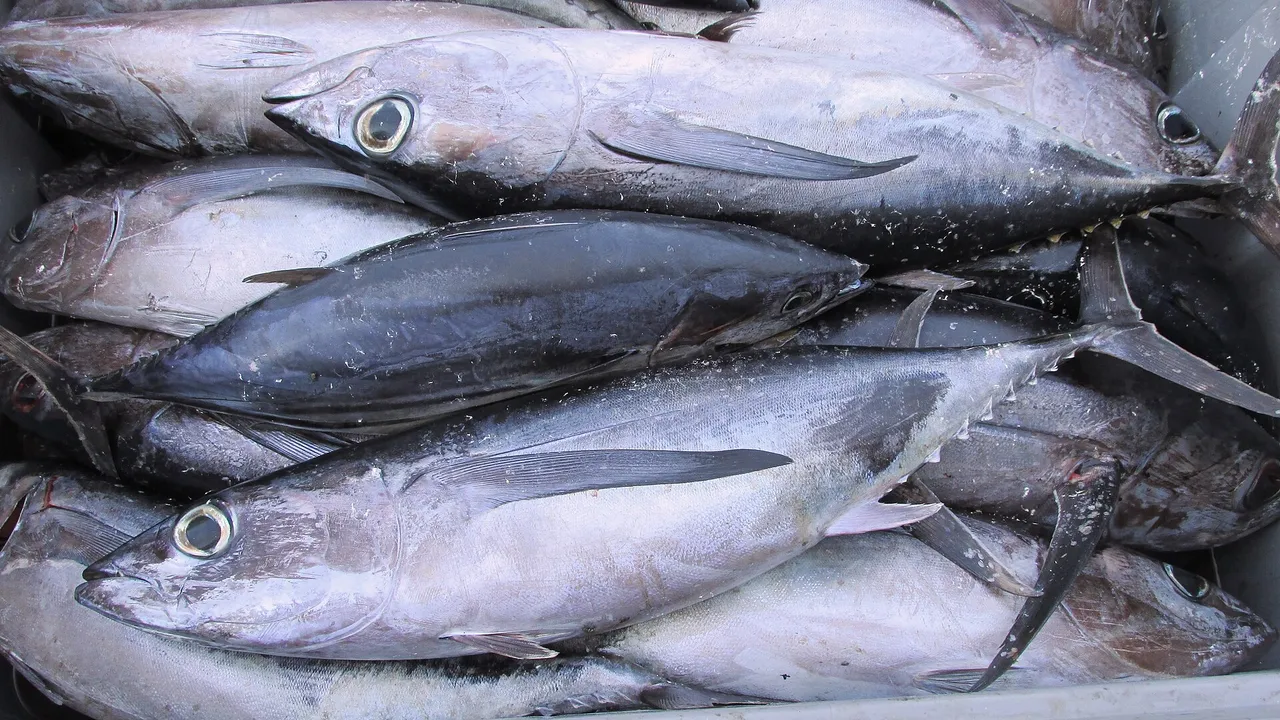
Identified by: Identified on the pectoral fin proportion, which the page names as the defining character and the only one reliable at all sizes: on three individuals in frame the pectoral is a long narrow blade reaching well past the origin of the second dorsal, which no other Thunnus approaches. Body deep and torpedo-shaped with a narrow caudal peduncle. Colour is post-mortem and does no diagnostic work here, which does not matter because the character is a proportion rather than a colour.Joachim Langeneck — CC BY-SA 4.0, via Wikimedia Commons — source, licenceLook at this first
Lay the pectoral fin back along the flank. On an albacore it reaches past the start of the second dorsal fin and often past the anal fin — a blade almost a third of the fish's length. No other tuna comes close, and because it is a proportion rather than a colour it survives death, ice and bad light.
Diagnostic — settles it on its own
Each of these settles the identification on its own. If one is clear, you have your answer.
Pectoral fin reaching past the second dorsal
Fold the fin back and see where it ends. In albacore it passes the origin of the second dorsal fin, and in a well-grown fish it reaches the anal fin. A bigeye's pectoral is long but stops short of that in adults; a yellowfin's and a bluefin's are obviously shorter. Because the character is a ratio between two parts of the same fish, it does not change with condition, and it works on a fish that has been in a box for a day.
Supporting — use with other characters
Real characters that are not conclusive by themselves. Use two or three together.
White trailing edge to the tail
The rear margin of the caudal fin carries a narrow clean white border. It is a good confirming character on a fresh fish and it is the second thing to check once the pectoral has done the work. It fades as the fish dries, so it confirms rather than decides.
Dusky finlets rather than bright yellow ones
The small finlets between the second dorsal and the tail are dull yellow rather than the vivid lemon of a yellowfin, and neither the second dorsal nor the anal fin extends into the long sickle lobes a mature yellowfin grows. Judge the shape before the shade.
Deep torpedo body on a keeled peduncle
The body is thick through the shoulder and tapers to a very narrow tail wrist carrying strong lateral keels. That is the shape of every tuna and it places the fish in the genus rather than naming it; use it to know you are in the right family before checking the fin.
Suggestive only — varies with condition
Hints only. These vary with condition, season, water and how long the fish has been out of it, and a fish that contradicts them is still the same species.
Iridescent flank band in fresh fish
A live or very fresh albacore shows a blue sheen along the flank against a dark metallic back and a white belly. It is beautiful and it is gone within an hour of death, so it can only ever be a hint.
What it gets confused with
- Yellowfin tuna, which in a small fish has a pectoral long enough to cause doubt — check whether it passes the second dorsal origin, and look for the bright yellow finlets a yellowfin carries and an albacore does not.
- Bigeye tuna, whose juveniles have notably long pectorals; in bigeye the fin stops short of the anal fin in adults, and the eye is proportionally larger.
- Small bluefin, which is deeper-bodied with an obviously short pectoral reaching only about as far as the eleventh dorsal spine.
Where this stops working
The pectoral character is at its most useful on fish over a few kilos. Small tuna of several species have proportionally longer pectorals than their adults, and a fish of two or three kilos can genuinely need more than one character. Where a market or a competition requires the species to be certain, the fin measurement is taken against the second dorsal origin rather than judged by eye. Species-level separation within *Thunnus* is done in the scientific literature on gill raker counts and liver morphology, and neither is available to somebody standing on a deck; if the fin length and the finlet colour disagree, the honest answer is that the fish needs somebody with the specimen in front of them.
The full record
This page covers identification only. The Albacore record covers behaviour, lifecycle, distribution, handling and the sources behind all of it.
Reviewed 2026-08-15.
More about this fish
Telling it apart is one question. Here are the others.
Similar and related fish
How it is caught
Where you will find it
- The Agulhas CurrentOccurs on the offshore side of the system and is taken along the current edge by the pelagic fishery.
- The Bay of BiscayThe summer tuna of the Cantabrian and Basque ports, taken historically by pole and line and live bait over the shelf edge — the bonito del norte fishery.
- The Humboldt CurrentOccurs on the offshore side of the system, where the cold productive water meets warmer oceanic water.
- The Strait of GibraltarUses the strait as a migratory corridor and is taken along the current lines either side of it.
- The Strait of MessinaWorks the deeper water either side of the sill and is taken by the longline fishery of the surrounding coast.
Why the 8 connections on this page are here, and the sources
Similar and related fish
Backed by research — 1 connection
Supported by peer-reviewed research or fisheries science. The sources are listed and can be checked.
Atlantic bluefin tuna
An identification comparison naming both binomials.
- FishBase: a global information system on fishes — Froese, R. and D. Pauly, eds. — FishBase Consortium (Scientific institute)Relied on for: That Thunnus alalunga and Thunnus thynnus are congeners in the genus Thunnus with differing pectoral fin length and maximum size.States this directlyPassage read and verified
How it is caught
What experienced anglers do — 2 connections
Widely and independently recommended by experienced anglers and specialist sources. This is real angling knowledge, not proof: controlled evidence for it is limited, and FishingHQ records it as convention rather than as a demonstrated effect.
Livebaiting at sea
The page describes locating a school by trolling and then live-baiting it. The two are sequential parts of one fishery rather than alternatives, and both belong on the page.
- IGFA International Angling Rules and World Record Requirements — International Game Fish Association (Angling or fisheries organisation)Relied on for: Documents which fishery and which technique takes this species.States this directlyPassage read and verified
- FishBase: a global information system on fishes — Froese, R. and D. Pauly, eds. — FishBase Consortium (Scientific institute)Relied on for: Independently corroborates the species' recreational capture and range.Background and mechanism onlyPassage read and verified
Trolling
The page names trolling feathers, jets and skirted lures as the primary technique, and trolling is how the fish is found before it is fished for. The commercial pole-and-line and troll fisheries use the same principle.
- IGFA International Angling Rules and World Record Requirements — International Game Fish Association (Angling or fisheries organisation)Relied on for: Documents which fishery and which technique takes this species.States this directlyPassage read and verified
- FishBase: a global information system on fishes — Froese, R. and D. Pauly, eds. — FishBase Consortium (Scientific institute)Relied on for: Independently corroborates the species' recreational capture and range.Background and mechanism onlyPassage read and verified
Where you will find it
Backed by research — 5 connections
Supported by peer-reviewed research or fisheries science. The sources are listed and can be checked.
The Agulhas Current
A distribution association between an animal and a kind of water, rather than a claim about any named mark.
- FishBase: a global information system on fishes — Froese, R. and D. Pauly, eds. — FishBase Consortium (Scientific institute)Relied on for: Distribution, habitat association and depth range recorded for the species, including its occurrence in the water body concerned.States this directlyPassage read and verified
- The IUCN Red List of Threatened Species — International Union for Conservation of Nature (Conservation authority)Relied on for: Assessment and range account for the species, including the systems and coasts it occupies.Background and mechanism onlyCitation checked — the work exists and is described correctly
The Bay of Biscay
Occurrence of the species in this system or along this coast: a statement about the animal's distribution, not a venue recommendation.
- FishBase: a global information system on fishes — Froese, R. and D. Pauly, eds. — FishBase Consortium (Scientific institute)Relied on for: Distribution, salinity tolerance and habitat association recorded for the species, including its occurrence in this system.States this directlyPassage read and verified
- The IUCN Red List of Threatened Species — International Union for Conservation of Nature (Conservation authority)Relied on for: Assessment and range description for the species, including the waters in which it occurs.Background and mechanism onlyCitation checked — the work exists and is described correctly
The Humboldt Current
A distribution association between an animal and a kind of water, rather than a claim about any named mark.
- FishBase: a global information system on fishes — Froese, R. and D. Pauly, eds. — FishBase Consortium (Scientific institute)Relied on for: Distribution, habitat association and depth range recorded for the species, including its occurrence in the water body concerned.States this directlyPassage read and verified
- The IUCN Red List of Threatened Species — International Union for Conservation of Nature (Conservation authority)Relied on for: Assessment and range account for the species, including the systems and coasts it occupies.Background and mechanism onlyCitation checked — the work exists and is described correctly
The Strait of Gibraltar
A distribution association between an animal and a kind of water, rather than a claim about any named mark.
- FAO Species Identification Guides for Fishery Purposes and the FAO Species Catalogues — Food and Agriculture Organization of the United Nations (Scientific institute)Relied on for: Distribution, habitat, depth and fishery accounts for the species of the eastern central Atlantic and Mediterranean in the FAO regional identification guides.States this directlyCitation checked — the work exists and is described correctly
- FishBase: a global information system on fishes — Froese, R. and D. Pauly, eds. — FishBase Consortium (Scientific institute)Relied on for: Distribution, habitat association and depth range recorded for the species.States this directlyPassage read and verified
The Strait of Messina
A distribution association between an animal and a kind of water, rather than a claim about any named mark.
- FishBase: a global information system on fishes — Froese, R. and D. Pauly, eds. — FishBase Consortium (Scientific institute)Relied on for: Distribution, habitat association and depth range recorded for the species, including its occurrence in the water body concerned.States this directlyPassage read and verified
- The IUCN Red List of Threatened Species — International Union for Conservation of Nature (Conservation authority)Relied on for: Assessment and range account for the species, including the systems and coasts it occupies.Background and mechanism onlyCitation checked — the work exists and is described correctly
Safety
Boat safety — Can cause serious injury or death
Offshore work a long way from help, on a moving deck, through long days.
What reduces it: Lifejackets worn. File a plan ashore. Carry communications that work beyond phone range. Check the forecast for the whole window rather than the departure.
Hooks and barbs — Can cause injury needing treatment
Trolling lures carry substantial hooks, and a green tuna thrashing at boatside or on deck drives them into whatever is nearby.
What reduces it: Control the fish before it comes aboard. Use a gaff or net properly rather than swinging the fish in. Keep the deck clear during the endgame and de-hook with a tool.