The Agulhas Current
Fishing regions · Last reviewed 2026-08-14
One of the fastest western boundary currents on earth, running warm tropical water down the African east coast and producing both the sardine run and one of the most dangerous seas in the world.
Safety: boat safety — can cause serious injury or death. 2 more points apply here.
Being listed here is not permission to fish. What that meansClose
Access, fishing rights, seasons, licences, local bylaws and permitted methods vary and can change. Check current access, permission, local regulations, closures and restrictions before you travel or fish. FishingHQ describes what the ground is and names who holds the answer; it does not hold the answer itself.
Find the authority for a jurisdiction · What FishingHQ does and does not cover
The Agulhas is a system record in the strict sense: it explains a fishery that spans several countries, and none of them contains it.
IT IS A WESTERN BOUNDARY CURRENT AND IT IS VERY FAST. Warm water from the tropical Indian Ocean is carried south-westward along the edge of the African continental shelf, narrow, deep and quick — among the strongest such currents anywhere. It hugs the shelf edge closely, which is unusual and is why its effects reach inshore.
IT MOVES A TROPICAL FAUNA POLEWARD. Species that would be limited by temperature at these latitudes occur far further south than they otherwise would, because the current carries warm water with them. That is why the east coast of southern Africa fishes as a subtropical coast at latitudes where the west coast is cold-temperate.
ITS EDGE IS WHERE THE FISHING HAPPENS. The boundary between the current and the cooler shelf water inshore of it is a sharp front, and fronts concentrate life. Pelagic fishing along this coast is largely a matter of finding and working that edge, along with the eddies and meanders that spin off it.
THE SARDINE RUN IS THE CURRENT BEHAVING UNUSUALLY. Each winter a wedge of cool water pushes north-eastward inshore of the Agulhas, and cold-water sardine shoals move up the coast inside it, into water that is normally too warm for them, dragging an enormous predator assemblage with them. When the cool water does not push far enough, the run is poor. The event is a hydrographic anomaly rather than a migration on a calendar.
AND THE RETROFLECTION IS ITS GLOBAL ROLE. South of Africa the current turns back on itself and shears off eddies that leak warm Indian Ocean water into the Atlantic, which matters to ocean circulation well beyond this coast.
What fishing here is like
A fast, warm, narrow western boundary current running south-westward along the edge of the south-east African shelf, carrying a tropical fauna far poleward and creating a sharp front that concentrates pelagic life. It produces the sardine run each winter, gives the coast beside it a subtropical fishery at temperate latitudes, and generates a sea state — where it meets a south-westerly gale — that is among the most dangerous anywhere. Fishing along it is edge fishing: finding the boundary, the eddies and the upwelling behind the capes.
What dominates
Offshore boat fishing along the current edge and its eddies for tuna, king mackerel, garrick and billfish. Ski-boat fishing launched through surf from beaches with no harbour, the characteristic southern African offshore practice. Rock and surf angling from the coast beside the current, which is where the fishery meets land. Spearfishing on the inshore reefs, with a strong regional tradition. Sardine run fishing and diving, when the event occurs, which is a short and unpredictable window. Commercial line fishing and small-scale netting along the same coast.
The water available
A narrow continental shelf with the current running along its outer edge, so deep, fast, warm water sits unusually close inshore; a sharp thermal and colour front between the current and the cooler shelf water; cyclonic eddies and meanders shed on the inshore side, which generate localised upwelling; upwelling cells behind headlands and capes where the current separates from the coast; a broader shelf on the Agulhas Bank at the southern end, which behaves differently and is a nursery area; and, at the southern extremity, the retroflection where the current turns back east and sheds rings into the Atlantic.
How the rules are structured
The current runs past several countries and no authority manages it. Fisheries within it are governed by whichever coastal state's waters they fall in, each with its own permitting, size and bag limits, closed seasons and protected species, and the high-seas and migratory components sit with regional and international bodies managing tuna and billfish stocks. Marine protected areas along the adjacent coasts constrain fishing at particular places, and several are specifically designed around aggregation and nursery areas rather than around habitat alone. Sharks, some billfish and several linefish species carry protection or restriction in one or more of the countries concerned. The sardine run itself is an event rather than a fishery in regulatory terms, and access to it is governed by the ordinary rules of whichever coast it reaches, plus permitting for commercial dive and boat operations. FishingHQ does not state what any current rule is.
Who to ask
- The national fisheries authority of the coastal state whose waters the fishing takes place in, for permits, limits and protected species.
- The marine protected area management authority where the water sits inside a designated area.
- The regional tuna and billfish commission for the Indian Ocean, for the migratory pelagic stocks the current carries.
- The maritime safety authority and sea rescue service for the coast concerned, whose small-craft and launching requirements apply.
- The relevant provincial or regional conservation body, which in several countries administers recreational marine angling and shore access.
Words you will meet
- The Agulhas front
- The sharp boundary between the warm fast current and the cooler shelf water inshore of it, visible as a colour and temperature change. Pelagic fishing along this coast is largely a matter of locating and working this line.
- Sardine run
- The winter movement of cold-water sardine shoals north-eastward along the coast inside a wedge of cool water, with a large predator assemblage following. A hydrographic event rather than a fixed migration, which is why it fails in some years.
- Ski-boat
- A small, fast, trailerable offshore boat launched directly through the surf from a beach rather than from a harbour. The characteristic southern African offshore craft, and the reason this coast has an offshore fishery at all along stretches with no port.
- Retroflection
- The point south of Africa where the current turns back on itself towards the east, shedding warm-core rings into the South Atlantic. A globally significant piece of ocean circulation that happens at the end of this system.
- Freak wave
- Where the current runs against a south-westerly gale, opposing wind and current shorten and steepen the sea disproportionately, producing occasional waves far larger than the surrounding sea state. This coast is one of the best-documented places in the world for the phenomenon.
Conditions and hazards
The sea state where the Agulhas meets a south-westerly gale is the defining hazard, and it is a documented one rather than a legend: a fast current running against a strong opposing wind steepens and shortens the wave field, and the coast has a long record of large vessels damaged and lost to abnormally large waves. For a small boat the implication is simple — a south-westerly buster arriving on top of the current turns a workable sea into a lethal one in a short time. Launching a ski-boat through surf and recovering it are taught skills with real consequences. Ashore, the coast beside the current is a high-energy one of long-period Indian Ocean swell against rock platforms and steep beaches, and being swept from a ledge is the characteristic fatal angling accident of the region. Sharks are present, including species involved in incidents with people, and the sardine run in particular concentrates them. Water is warm enough that hypothermia is not the immediate risk, which removes one of the usual reasons anglers respect the sea here.
A fast current on a narrow shelf, and why that puts blue water inshore
The Agulhas is unusual among the world's major currents for how close to land it runs, and nearly everything distinctive about the fishing follows from that.
IT IS A WESTERN BOUNDARY CURRENT, which is the class of fast, narrow, deep currents found on the western sides of ocean basins — the Gulf Stream and the Kuroshio are the other familiar examples. They are the return limbs of the great ocean gyres, and they are fast because a rotating planet compresses them against the western margin.
THE SHELF HERE IS NARROW AND THE CURRENT HUGS ITS EDGE. Along much of the south-east African coast the continental shelf is a thin strip, and the current runs along its outer margin at speed. The practical consequence is that genuinely oceanic water sits a short distance from shore — in places within a few kilometres — which is why a small boat launched off a beach can reach blue-water fishing.
THE FRONT IS THE FISHING FEATURE. Where warm current water meets cooler shelf water there is a sharp boundary in temperature, colour and often surface texture. Fronts concentrate plankton, then bait, then predators, and finding the line is the first task of any offshore day on this coast.
EDDIES AND MEANDERS DO THE REST. The current is not a straight pipe: it meanders, and cyclonic eddies spin off its inshore edge. These lift cooler nutrient-rich water towards the surface and create localised production in an otherwise oligotrophic system.
UPWELLING HAPPENS BEHIND THE CAPES. Where the coastline turns and the current separates from it, water is drawn up in the lee, producing cool productive cells at predictable places along the coast. Those cells are why particular stretches fish consistently better than the coast either side of them.
AND THE AGULHAS BANK AT THE SOUTHERN END IS A DIFFERENT ANIMAL. A broad shallow shelf where the coast turns west, it is cooler, more productive and functions as a spawning and nursery area — a shelf sea attached to the end of a current system, behaving nothing like the narrow coast to the north-east.
Backed by research — why, and the sources (2)
Supported by peer-reviewed research or fisheries science. The sources are listed and can be checked.
- ICES Advice on fishing opportunities, catch and effort — International Council for the Exploration of the Sea (Scientific institute)Relied on for: Stock assessment method, environmental drivers of stock distribution, and the scientific basis for advice on shared and migratory stocks.Background and mechanism onlyCitation checked — the work exists and is described correctly
- FishBase: a global information system on fishes — Froese, R. and D. Pauly, eds. — FishBase Consortium (Scientific institute)Relied on for: Distribution, temperature tolerance, migratory behaviour and habitat association of the species concerned.States this directlyPassage read and verified
Tropical fish at temperate latitudes, and a sardine that should not be there
The current's biological signature is that it puts species where the latitude says they should not be, in both directions.
THE TROPICAL COMPONENT IS CARRIED SOUTH. King mackerel, kingfish and trevallies, garrick, queenfish, cobia, sailfish and marlin occur far further south along this coast than they do at comparable latitudes elsewhere, because the water they need is delivered to them. FishingHQ's narrow-barred Spanish mackerel, giant trevally, leerfish and cobia all belong to this pattern.
TUNA AND BILLFISH WORK THE CURRENT EDGE. Yellowfin tuna, albacore, bonito and marlin follow the front and its eddies, and the pelagic fishery along this coast is essentially a fishery on that boundary.
THE ENDEMIC LINEFISH ARE THE RESIDENT LAYER. Dusky kob, spotted grunter, and the seabreams and reef species of the inshore ground occupy the estuaries, surf and reef beside the current, and several of them are seriously depleted — the region's linefish stocks have been the subject of formal management interventions for decades.
THE SARDINE IS THE ANOMALY AND THE SHOW. Sardines are a cold-water species belonging to the west coast upwelling system. Each winter a wedge of cool water pushes north-eastward inshore of the Agulhas, and shoals move up a coast that is normally too warm for them. Following them are common dolphins in the thousands, sharks, gannets diving in continuous streams, and game fish. When the cool water fails to push far enough north, the run does not happen, and that variability is the single most important thing to understand about it.
SHARKS ARE ABUNDANT AND SEVERAL ARE PROTECTED, including species that aggregate on this coast seasonally.
AND THE NURSERY FUNCTION SITS AT THE SOUTHERN END. The broad cool Agulhas Bank is a spawning and nursery ground for several stocks, and larvae spawned there are carried by the current, which makes the physical system a recruitment mechanism as well as a distribution one.
Backed by research — why, and the sources (2)
Supported by peer-reviewed research or fisheries science. The sources are listed and can be checked.
- FishBase: a global information system on fishes — Froese, R. and D. Pauly, eds. — FishBase Consortium (Scientific institute)Relied on for: Distribution, habitat association, depth range and life history recorded for the species occurring in the area.States this directlyPassage read and verified
- The IUCN Red List of Threatened Species — International Union for Conservation of Nature (Conservation authority)Relied on for: Assessment and range account for the species of the region, including the habitats they depend on and the pressures acting on them.States this directlyCitation checked — the work exists and is described correctly
Ski-boats through surf, and fishing a line you cannot see from land
The disciplines here are shaped by two facts: deep water is close, and there are very few harbours.
THE SKI-BOAT IS THE DEFINING CRAFT. Small, fast, trailerable offshore boats are launched directly through the surf from open beaches and recovered the same way, because much of this coast has no harbour. Launching and landing one through breaking water is a taught skill with consequences, done by a crew rather than an individual, and it is what gives access to the offshore fishery along stretches that would otherwise be unreachable.
OFFSHORE FISHING IS FRONT FISHING. The day's work is finding the temperature and colour boundary, then trolling, live-baiting or drifting along it. Sea surface temperature information has changed this fishery more than any tackle development, because the feature being fished is a hydrographic one.
SHORE ANGLING IS A MAJOR REGIONAL DISCIPLINE IN ITS OWN RIGHT. Rock and surf angling from the coast beside the current is organised, competitive and technically serious, with a strong club structure, and it targets the resident linefish rather than the current's pelagics.
SPEARFISHING IS WELL ESTABLISHED on the inshore reefs, in warm clear water, with a substantial regional tradition and its own separate permitting.
THE SARDINE RUN FISHERY IS SHORT, CHAOTIC AND UNRELIABLE. When the run reaches a stretch of coast, shore anglers, boat anglers, netters and divers all converge on it for days rather than weeks. It is a genuine spectacle and a genuine fishery, and planning a trip around it is planning around an event that may not occur.
COMMERCIAL LINEFISHING AND SMALL-SCALE NETTING work the same water, and the interaction between commercial line boats and recreational ski-boats over the same depleted stocks is a persistent management question.
AND ESTUARY FISHING IS THE FOURTH BRANCH, on a coast where many estuaries close behind sandbars for part of the year, which makes them a distinctly different system from a permanently open one.
What experienced anglers do — why, and the sources (2)
Widely and independently recommended by experienced anglers and specialist sources. This is real angling knowledge, not proof: controlled evidence for it is limited, and FishingHQ records it as convention rather than as a demonstrated effect.
- FAO fishing gear types and fishing technology information — Food and Agriculture Organization of the United Nations (Scientific institute)Relied on for: Descriptions of fishing gear types and their operation, including the small-scale gears used by artisanal fisheries in the region.States this directlyCitation checked — the work exists and is described correctly
- IGFA International Angling Rules and World Record Requirements — International Game Fish Association (Angling or fisheries organisation)Relied on for: International recreational angling practice, tackle categories and the conventions applied to recognised catches.Background and mechanism onlyPassage read and verified
Winter is the event season, and the event is not guaranteed
The seasonal structure of this system is unusual because its most famous feature is unreliable by nature.
THE SARDINE RUN IS A WINTER EVENT AND A CONDITIONAL ONE. Cooling water and a wedge of cool water pushing north-eastward inshore of the current allow sardine shoals to move up the coast. Whether the cool water pushes far enough north in a given year decides whether the run reaches a particular coast at all. Some years are spectacular, some are poor, and some produce almost nothing. That variability is the physics rather than a disappointment.
THE GAME FISHING SEASON IS BROADLY SUMMER, when the current is at its warmest and the tropical pelagics reach furthest south. Marlin, sailfish and tuna fishing concentrate in the warmer months.
KING MACKEREL AND GARRICK RUN ON SHOULDER SEASONS, moving along the coast in spring and autumn, and they are the fish that connect the shore fishery to the pelagic one.
THE ESTUARIES OPEN AND CLOSE WITH THE RAINS. Many temporarily open and closed estuaries on this coast breach in the wet season and seal behind a sandbar in the dry. That cycle governs whether estuarine species can recruit, and it makes the estuary fishery genuinely seasonal in a structural rather than a behavioural way.
THE WEATHER SEASON IS THE PRACTICAL CONSTRAINT. South-westerly gales are more frequent in winter, and a south-westerly against the Agulhas is the sea state that stops small-boat fishing dead. Winter offshore days are therefore fewer and more weather-dependent than the fish availability alone would suggest.
AND THE HEMISPHERE MATTERS FOR EVERY DATE. This is a southern-hemisphere coast: winter is the middle of the calendar year and summer straddles the turn of it. A record that used northern-hemisphere month names for seasons here would be wrong by six months, which is exactly why FishingHQ models seasons as biological states rather than as dates.
Backed by research — why, and the sources (2)
Supported by peer-reviewed research or fisheries science. The sources are listed and can be checked.
- ICES Advice on fishing opportunities, catch and effort — International Council for the Exploration of the Sea (Scientific institute)Relied on for: Stock assessment method, environmental drivers of stock distribution, and the scientific basis for advice on shared and migratory stocks.Background and mechanism onlyCitation checked — the work exists and is described correctly
- FishBase: a global information system on fishes — Froese, R. and D. Pauly, eds. — FishBase Consortium (Scientific institute)Relied on for: Distribution, temperature tolerance, migratory behaviour and habitat association of the species concerned.States this directlyPassage read and verified
A current that crosses jurisdictions and belongs to none of them
Governance of this system is the clearest case in FishingHQ of a physical feature that no authority matches.
NOBODY MANAGES THE CURRENT. It flows past several countries, and fishing within it is governed entirely by whichever coastal state's waters a boat happens to be in. There is no Agulhas authority and there could not usefully be one, because the current is a water mass rather than a fishery.
THE COASTAL STATES EACH HAVE THEIR OWN FRAMEWORK, with their own permits, size and bag limits, closed seasons, protected species and marine protected areas. A vessel moving along this coast crosses regulatory boundaries that the fish do not.
THE MIGRATORY PELAGICS SIT WITH A REGIONAL COMMISSION. Tuna and billfish in the Indian Ocean are managed through a regional fisheries management organisation of the fishing states, and national rules for those species sit inside that framework.
LINEFISH MANAGEMENT IS THE LOCAL STORY AND IT HAS BEEN INTERVENTIONIST. Several of the resident linefish stocks along this coast are seriously depleted, and the management response over recent decades has included effort limitation, permit systems, bag limits and closed areas. This is a coast where recreational and commercial line fishing have both been constrained deliberately, and the reasoning is stock-based.
MARINE PROTECTED AREAS ARE SIGNIFICANT AND PURPOSEFUL. Several are designed around specific functions — spawning aggregation sites, nursery estuaries, reef complexes — rather than around scenery, and their boundaries reflect biology.
ESTUARIES ARE FREQUENTLY GOVERNED SEPARATELY from the open coast, with their own rules on gear, species and access, because their nursery function is understood to be disproportionate to their area.
AND THE SARDINE RUN IS NOT A REGULATED FISHERY IN ITSELF. It is an event that occurs in whichever waters it reaches, subject to those waters' rules, plus the permitting that applies to commercial boat and dive operations working it. FishingHQ does not state what any of that currently permits.
Official guidance — why, and the sources (2)
Stated by a fisheries authority, scientific institute or recognised angling body. Authoritative, but summarising rather than demonstrating.
- Good Fish Guide — Marine Conservation Society (Conservation authority)Relied on for: Assessment of fisheries and the management measures applied to them, including gear selectivity and spatial protection.Background and mechanism onlyCitation checked — the work exists and is described correctly
- Code of Conduct for Responsible Fisheries — Food and Agriculture Organization of the United Nations, Rome, 1995 (Standards body)Relied on for: Principles for responsible fisheries management, precaution, and the treatment of small-scale, shared and inland fisheries.States this directlyCitation checked — the work exists and is described correctly
Front, buster, ski-boat: the working words of this coast
This system has a vocabulary that mixes oceanography with a very practical local usage, and both halves are needed.
THE FRONT IS THE OPERATIONAL FEATURE. Anglers here talk about finding the line, the edge or the front, and they mean the boundary between current water and shelf water. It is visible as a colour change and detectable as a temperature change, and it is the thing being fished.
SKI-BOAT NAMES A CRAFT AND A WHOLE PRACTICE. It is not a small boat in general; it is a beach-launched offshore boat designed for surf launching and recovery, and the word carries the launching technique, the crew practice and the trailer with it.
BUSTER NAMES THE WEATHER EVENT THAT MATTERS. A rapid south-westerly change arriving on a coast where the current runs the other way is the condition that produces the dangerous sea, and the local usage treats it as a named thing rather than as a wind direction.
FREAK OR ABNORMAL WAVE IS A TECHNICAL TERM HERE RATHER THAN A FIGURE OF SPEECH. Opposing wind and current steepen and shorten the wave field and can focus energy into occasional waves far larger than the surrounding sea. This coast is one of the best-documented locations in the world for the phenomenon, and it is the reason large vessels as well as small ones treat it seriously.
RETROFLECTION IS THE OCEANOGRAPHIC TERM WORTH KNOWING because it names what happens at the end of the system: the current turns back east and sheds warm rings westward into the Atlantic. It matters to global circulation and it is a genuine piece of scientific vocabulary attached to this coast.
AND THE SARDINE RUN IS A NAME FOR AN EVENT, NOT A SEASON. Treating it as an annual fixture is the most common error a visitor makes, and the local usage is more careful: people talk about whether the run has come, which is the right way to think about it.
What experienced anglers do — why, and the sources (2)
Widely and independently recommended by experienced anglers and specialist sources. This is real angling knowledge, not proof: controlled evidence for it is limited, and FishingHQ records it as convention rather than as a demonstrated effect.
- ICES Advice on fishing opportunities, catch and effort — International Council for the Exploration of the Sea (Scientific institute)Relied on for: Stock assessment method, environmental drivers of stock distribution, and the scientific basis for advice on shared and migratory stocks.Background and mechanism onlyCitation checked — the work exists and is described correctly
- FishBase: a global information system on fishes — Froese, R. and D. Pauly, eds. — FishBase Consortium (Scientific institute)Relied on for: Distribution, temperature tolerance, migratory behaviour and habitat association of the species concerned.States this directlyPassage read and verified
Shipwrecks, sardines and the science that came out of both
The recorded history of this current is mostly a history of things going wrong at sea and of the science that followed.
IT WAS A NAVIGATIONAL PROBLEM BEFORE IT WAS AN OCEANOGRAPHIC ONE. Sailing routes round the southern tip of Africa had to contend with a strong contrary current, and the combination of that current with south-westerly gales produced a long record of losses. The coast's reputation among mariners is old and was earned.
THE ABNORMAL WAVE PROBLEM WAS DOCUMENTED THROUGH SHIP DAMAGE. Twentieth-century incidents involving large vessels structurally damaged by single waves off this coast prompted serious investigation of wave-current interaction, and the resulting understanding — that opposing current steepens and focuses waves — is now standard. The coast is a reference case in that literature.
THE SARDINE RUN HAS BEEN OBSERVED FOR A LONG TIME AND EXPLAINED RECENTLY. The event has been part of coastal life and coastal fishing for generations, with beach netting of stranded shoals a community occasion in places. The hydrographic explanation — a cool-water wedge allowing a cold-water species into warm-water coast — is comparatively modern, and it explains the variability that puzzled earlier accounts.
THE LINEFISH CRISIS IS THE MODERN FISHERIES HISTORY. Serial depletion of the resident linefish stocks along this coast through the twentieth century led to formal emergency measures and a substantial restructuring of both commercial and recreational line fishing. It is one of the better documented cases anywhere of a diverse multi-species line fishery being fished down and then managed hard.
SPEARFISHING AND SKI-BOAT FISHING BOTH DEVELOPED HERE AS DISTINCT REGIONAL PRACTICES within the twentieth century, and both spread outward from this coast.
AND CLIMATE IS THE CURRENT CHAPTER. Changes in the current's strength and position, and in the frequency of the conditions that allow the sardine run, are actively studied, and the run in particular is watched as a possible early indicator of a shifting system.
Official guidance — why, and the sources (2)
Stated by a fisheries authority, scientific institute or recognised angling body. Authoritative, but summarising rather than demonstrating.
- Good Fish Guide — Marine Conservation Society (Conservation authority)Relied on for: Assessment of fisheries and the management measures applied to them, including gear selectivity and spatial protection.Background and mechanism onlyCitation checked — the work exists and is described correctly
- Code of Conduct for Responsible Fisheries — Food and Agriculture Organization of the United Nations, Rome, 1995 (Standards body)Relied on for: Principles for responsible fisheries management, precaution, and the treatment of small-scale, shared and inland fisheries.States this directlyCitation checked — the work exists and is described correctly
A coast that fishes hard and respects the sea unevenly
The angling culture along the Agulhas coast is competitive, capable and — in one specific respect — dangerously relaxed.
SHORE ANGLING IS ORGANISED AND COMPETITIVE. Club structures, provincial and national representative teams, and a serious competition calendar produce a high general standard of casting and rig-building, and a social form quite unlike the largely individual British shore fishery.
THE SKI-BOAT CULTURE IS CREW-BASED AND SKILLED. Launching through surf requires a team, a routine and a shared understanding of when not to go, and the fishery has developed its own etiquette and its own rescue infrastructure around that.
THE SEA RESCUE SERVICE IS PART OF THE CULTURE. A volunteer sea rescue institution is well established along this coast and is closely tied to the fishing community, which is both a service and a signal about how often it is needed.
THE WARM WATER IS THE CULTURAL HAZARD. On a cold-water coast, immersion is obviously dangerous and everybody behaves accordingly. Here the water is warm enough that a swim seems survivable, which removes one of the instinctive brakes — and the actual killers, being swept from a ledge and being caught out by a rapid weather change, are not made less lethal by comfortable water temperature.
THE SARDINE RUN IS A SOCIAL EVENT AS MUCH AS A FISHERY. When it arrives, beaches fill, nets are hauled, and the whole coast turns out. It is one of the few genuinely communal fishing occasions left in a modern fishery.
SPEARFISHING HAS A STRONG REGIONAL IDENTITY, with its own competition history and its own conservation arguments, and it sits within the same permitting framework as other marine recreational fishing.
AND THE CATCH-AND-RELEASE QUESTION IS LIVE. On stocks as depleted as some of the region's linefish, release practice matters, and the region has argued about it seriously rather than assuming it. Warm water, deep-caught fish and barotrauma make the mechanics harder than they look, which is where FishingHQ's handling material applies.
What experienced anglers do — why, and the sources (2)
Widely and independently recommended by experienced anglers and specialist sources. This is real angling knowledge, not proof: controlled evidence for it is limited, and FishingHQ records it as convention rather than as a demonstrated effect.
- FAO fishing gear types and fishing technology information — Food and Agriculture Organization of the United Nations (Scientific institute)Relied on for: Descriptions of fishing gear types and their operation, including the small-scale gears used by artisanal fisheries in the region.States this directlyCitation checked — the work exists and is described correctly
- IGFA International Angling Rules and World Record Requirements — International Game Fish Association (Angling or fisheries organisation)Relied on for: International recreational angling practice, tackle categories and the conventions applied to recognised catches.Background and mechanism onlyPassage read and verified
A current running into a gale, and the warm water that removes the brake
This coast carries a sea-state hazard that is physically distinctive, well documented, and larger in consequence than almost anything else on FishingHQ — and it carries a cultural one that makes the first harder to respect.
START WITH THE PHYSICS, BECAUSE IT IS UNUSUAL. A strong, fast, warm current runs down this coast. When a south-westerly gale arrives and blows against it, the wave field does not merely get rougher: opposing flow compresses the waves, shortening their length and steepening their faces, and the current's own shear can focus wave energy into individual waves far larger than the surrounding sea. This coast has a long documented record of large ships damaged or lost to single abnormal waves, which is unusual — most coasts do not have a mechanism capable of doing that to a ship.
FOR A SMALL BOAT THE IMPLICATION IS ABOUT TIME. The transition from a workable sea to a lethal one can happen within an hour of a front arriving, because the wind does not have to build gradually for the wave field to change — it only has to oppose a current that is already running at speed. So the operative planning input is the forecast arrival of the front, not the current conditions, and a decision to come in has to be made while the sea still looks fine.
LAUNCHING AND RECOVERING THROUGH SURF is the second boat hazard: a genuine crew skill with a routine and an agreed rule about when not to go, and not something to attempt by copying a local crew.
ASHORE, THE MECHANISM IS THE FAMILIAR ONE AT UNFAMILIAR SIZE. Long-period Indian Ocean swell arrives on rock platforms independently of local wind and in sets, and being swept from a ledge after an hour of comfortable conditions is the region's characteristic fatal angling accident.
AND HERE IS THE CULTURAL HAZARD, WORTH STATING PLAINLY. On a cold-water coast everybody behaves cautiously around immersion because the temperature does the persuading. Here the water is warm enough that a swim seems survivable, which removes one of the instinctive brakes — and removes none of the actual killers. Being swept from a ledge into deep moving water is exactly as lethal at twenty-two degrees as at ten. The comfort is real and it is not protective.
SHARKS ARE PRINCIPALLY A DIVER'S CONSIDERATION, and the sardine run concentrates them inshore. That is a reason for specific practice — not carrying speared fish on the person, not diving alone, not entering water where a bait ball is being worked — rather than a general alarm.
WHAT ACTUALLY HELPS. Watch the forecast front rather than the current sea, and come in early. Read swell period as well as height. Watch any ledge through several full sets before committing, and choose a position with a way up. Wear flotation on rock and afloat. And check the current measures with the fisheries authority, because what may be taken here has changed repeatedly on some of these stocks.
Backed by research — why, and the sources (3)
Supported by peer-reviewed research or fisheries science. The sources are listed and can be checked.
- NOAA National Weather Service marine forecasts and marine weather services — National Oceanic and Atmospheric Administration, United States (Government fisheries body)Relied on for: Marine forecasting, warning products, sea state and swell information, and the coastal and offshore zones at which those forecasts are issued.States this directlyCitation checked — the work exists and is described correctly
- Rock fishing safety and the declared lifejacket areas of New South Wales — NSW Department of Primary Industries and Surf Life Saving NSW (Water-safety or diver-training authority)Relied on for: Rock-platform fishing hazards, the mechanism by which anglers are swept from platforms by sets rather than by average conditions, the fatality record that produced the response, and the measures that address it including mandatory lifejacket areas.States this directlyCitation checked — the work exists and is described correctly
- RNLI water safety guidance: cold water shock and Float to Live — Royal National Lifeboat Institution (Water-safety or diver-training authority)Relied on for: Cold water shock and the immersion response, and water-safety guidance for shore anglers and small-craft users.States this directlyPassage read and verified
Some of what lives here
Fish recorded here that FishingHQ holds a reviewed photograph of. It is not a complete list of what The Agulhas Current holds, and it is not a prediction that you will catch any of them — it is a way in to the ones we can show you.
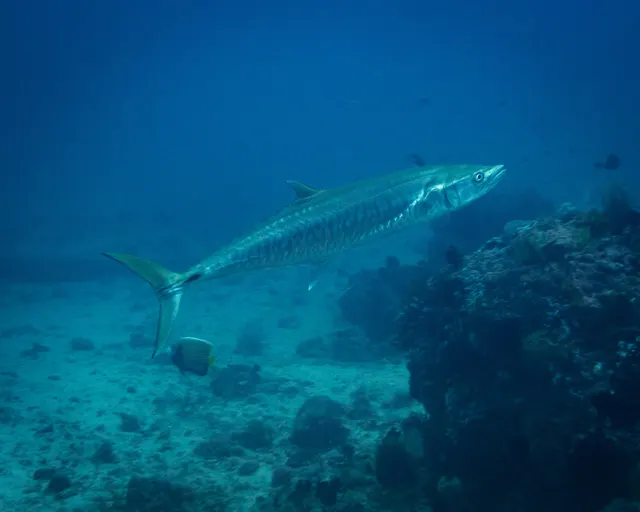 Narrow-barred Spanish mackerelA fast Indo-Pacific mackerel with vertical bars and shearing teeth that is a headline sport and food fish from South Africa to Australia — and a well-known ciguatera risk in parts of its range.
ppericard — CC BY 4.0, via Wikimedia Commons
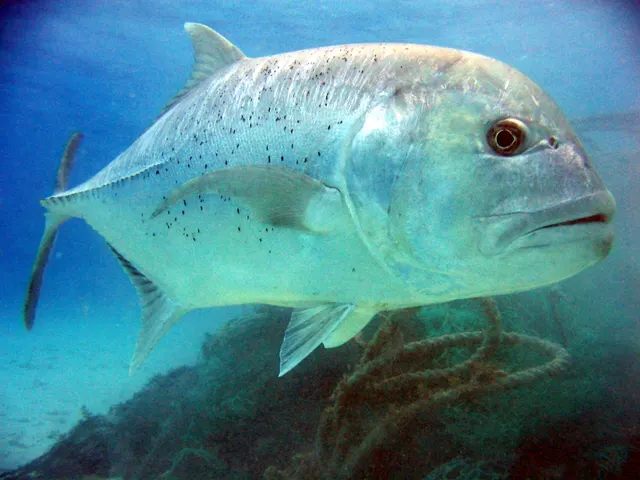 Giant trevallyA hugely powerful Indo-Pacific reef predator that hunts over shallow structure, and the fish popping was built around.
Dr. Dwayne Meadows, NOAA/NMFS/OPR — Public domain, via Wikimedia Commons
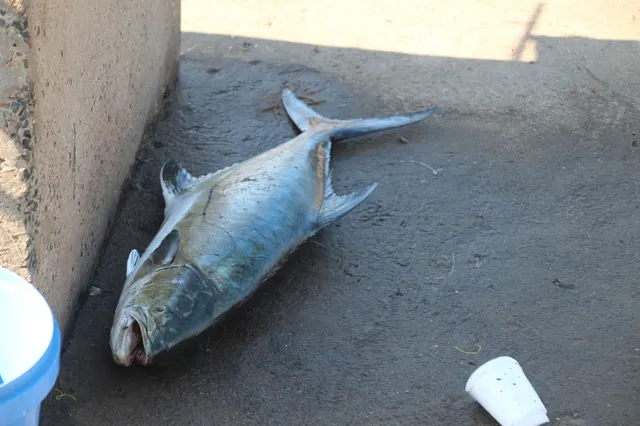 LeerfishA large, fast, laterally compressed jack of Mediterranean and African coasts, known as garrick in South Africa, and a prime surf and lure target.
Erwin Sieben — CC0, via iNaturalist
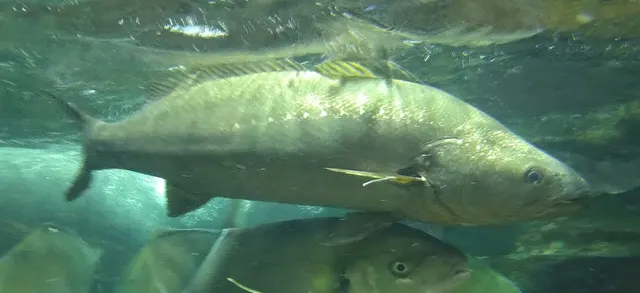 Dusky kobA large, long-lived estuarine and surf predator of southern African and Australian coasts, assessed as Endangered, and one of the clearest cases where a popular sport fish is genuinely in trouble.
タウナギ — CC BY-SA 4.0, via Wikimedia Commons
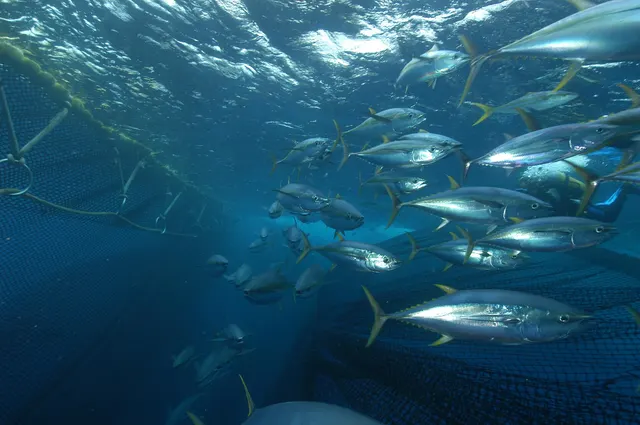 Yellowfin tunaA warm-blooded, high-speed oceanic predator that schools with dolphins and under floating debris, and one of the most commercially important fish in the world.
Marc Taquet — CC BY 4.0, via Wikimedia Commons
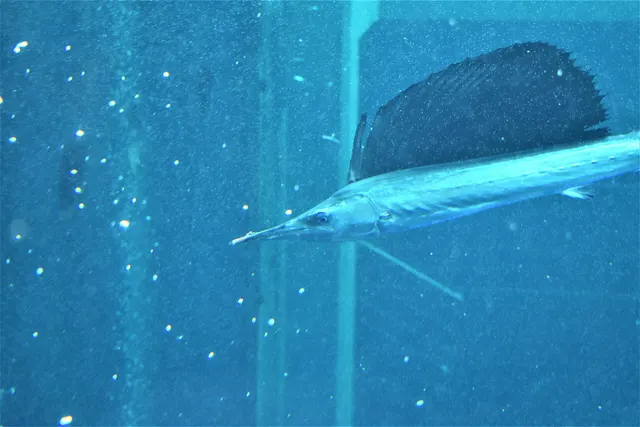 SailfishThe billfish with a sail — a dorsal fin taller than the fish is deep, raised when hunting, and probably the fastest accelerator in the ocean.
出羽雀台 — CC BY-SA 4.0, via Wikimedia Commons
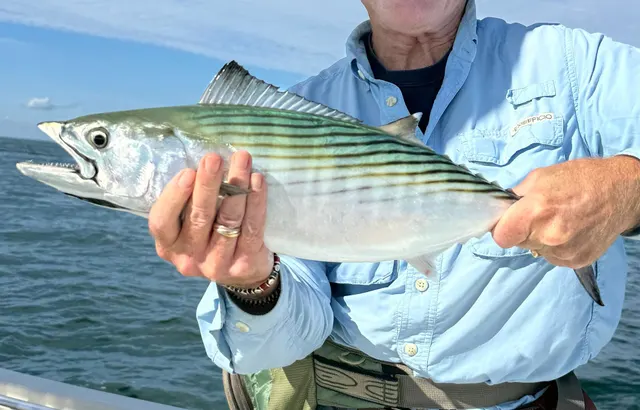 Atlantic bonitoA small, fast, striped tuna relative that arrives on temperate coasts in shoals each year and is the most accessible member of the family to a shore angler.
ricofish — CC0, via Wikimedia Commons
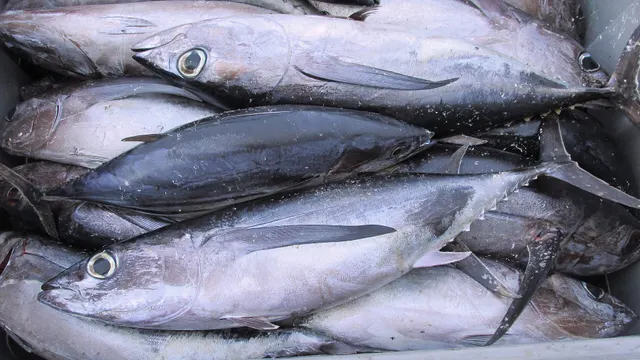 AlbacoreThe long-finned tuna of temperate open ocean — smaller and cooler-water than its relatives, with pectoral fins so long they are the identification.
Joachim Langeneck — CC BY-SA 4.0, via Wikimedia Commons
Safety
Boat safety — Can cause serious injury or death
Where the current runs against a strong south-westerly, the wave field steepens and shortens disproportionately and can focus into individual waves far larger than the surrounding sea. The coast has a documented record of large vessels damaged by single waves; for a small boat the change from workable to lethal can happen within an hour of a front arriving.
What reduces it: Treat a forecast south-westerly change as a reason to be ashore rather than a reason to watch the sky, understand that the danger is the combination of wind against current rather than the wind strength alone, and give yourself time to get back across the bar or onto the beach before the change arrives.
Worse when:
- A rapid south-westerly change onto an established current — the classic dangerous combination on this coast.
- Over the shelf edge, where the current runs fastest.
- On a beach launch, where returning through surf in a rising sea is the hardest part of the day.
Cliffs and rock platforms — Can cause serious injury or death
Long-period Indian Ocean swell arrives on rock platforms and steep beaches independently of local wind. Anglers are swept from ledges by a set wave substantially larger than those preceding it, often after an hour of comfortable conditions, and the water below is deep and moving.
What reduces it: Read swell height, period and direction rather than wind, watch a full set before committing to a platform, stand higher than feels necessary, never turn your back on the sea, wear a buoyancy aid, and fish with somebody who can raise help.
Encounters with marine life — Can cause injury needing treatment
Sharks are abundant along this coast, including species involved in incidents with people, and the sardine run concentrates them inshore in large numbers alongside other predators. Divers, spearfishers and swimmers are the exposed groups.
What reduces it: Do not carry speared fish on your person, leave the water when large sharks are present or behaving assertively, avoid diving in low visibility or around bait shoals, and treat the sardine run as an event to be watched from a boat rather than swum in casually.
Further safety reading
- Boat safety for anglers — A fast current running against a strong south-westerly steepens and shortens the wave field disproportionately, and this coast is one of the best-documented places in the world for abnormally large waves.
- Rock platform and cliff safety — Long-period Indian Ocean swell arrives on rock platforms independently of local wind, and being swept from a ledge is the characteristic fatal angling accident of the region.
- Sharks and spearfishing — Sharks are abundant along this coast and the sardine run concentrates them inshore in large numbers alongside every other predator.
- Weather, lightning and open water — A rapid south-westerly change arriving on an established current is the condition that has caused most losses here, and it can turn a workable sea into a lethal one within an hour.
Check the rules before you fish
Fishing laws, bylaws, access rules, seasons, bait restrictions and permitted methods vary by location and can change. Check the current rules from the relevant authority and the water you intend to fish before fishing.
Check with:
- Current national or regional law for where you are fishing
- Current local bylaws
- The relevant fisheries authority
- The landowner, club or fishery whose water it is
- Any restrictions specific to the species or the method you intend to use
Where to go next
What swims here
- AlbacoreOccurs on the offshore side of the system and is taken along the current edge by the pelagic fishery.
- Atlantic bonitoWorks the frontal zone between the current and the cooler shelf water inshore of it.
- CobiaA warm-water species reaching this coast on current water, associated with structure and with large slow-moving animals.
- Dusky kobOccupies the estuaries and turbid inshore water of the coast the current runs past, using the estuaries as nursery habitat.
- Giant trevallyReaches the south-east African coast on warm current water, at the southern margin of its Indo-Pacific range.
- LeerfishA fast surf and inshore predator of the coast beside the current, following the small pelagic shoals along it.
- Narrow-barred Spanish mackerelCarried far south along the African east coast by the warm current, well beyond where the latitude alone would place it.
- Pacific sardineThe cold-water shoaling species whose winter movement north-eastward inside a wedge of cool water is the sardine run, and which fails to appear when the cool water does not push far enough.
3 more
- Sailfish Fish
- Spotted grunter Fish
- Yellowfin tuna Fish
How people fish here
- Lure fishingTrolling and casting along the frontal zone is the way the current edge is actually fished, because the feature being fished is a hydrographic boundary.
- Sea fishingOffshore boat fishing along the current front and its eddies, and rock and surf angling from the coast beside it, are the two halves of the system's recreational fishery.
- SpearfishingSpearfishing on the inshore reefs beside the current has a substantial regional tradition and its own separate permitting.
How this compares
- South AfricaThe current explains the country's east coast fishery, and it runs past several of that country's neighbours, so it is described where it belongs — with the current itself, rather than inside any one of the countries it passes.
- Southern African fishingThe Agulhas is the warm half of the two-ocean story, carrying tropical species far further south than the latitude would allow and meeting the cold Benguela at the continent's tip.
- The western Indian Ocean coastThis is the coast the Agulhas is assembled on: water leaving the Mozambique Channel southward feeds the current, so the two records are the same water at different stages.
Rules and access
Environment and conservation
- Fish stocks and sustainabilityThe resident linefish stocks of the coast beside this current have been seriously depleted and have been the subject of formal emergency measures and effort limitation for decades.
- Marine protected areas and spearfishingSeveral protected areas on the adjacent coasts are designed around spawning aggregation sites and nursery estuaries rather than around habitat alone.
Sources and evidence
- ICES Advice on fishing opportunities, catch and effort — International Council for the Exploration of the Sea (Scientific institute)Relied on for: Stock assessment method, environmental drivers of stock distribution, and the scientific basis for advice on shared and migratory stocks.Background and mechanism onlyCitation checked — the work exists and is described correctly
- FishBase: a global information system on fishes — Froese, R. and D. Pauly, eds. — FishBase Consortium (Scientific institute)Relied on for: Distribution, temperature tolerance, migratory behaviour and habitat association of the species concerned.States this directlyPassage read and verified
- FishBase: a global information system on fishes — Froese, R. and D. Pauly, eds. — FishBase Consortium (Scientific institute)Relied on for: Distribution, habitat association, depth range and life history recorded for the species occurring in the area.States this directlyPassage read and verified
- The IUCN Red List of Threatened Species — International Union for Conservation of Nature (Conservation authority)Relied on for: Assessment and range account for the species of the region, including the habitats they depend on and the pressures acting on them.States this directlyCitation checked — the work exists and is described correctly
Why the 24 connections on this page are here, and the sources
What swims here
Backed by research — 11 connections
Supported by peer-reviewed research or fisheries science. The sources are listed and can be checked.
Albacore
A distribution association between an animal and a kind of water, rather than a claim about any named mark.
- FishBase: a global information system on fishes — Froese, R. and D. Pauly, eds. — FishBase Consortium (Scientific institute)Relied on for: Distribution, habitat association and depth range recorded for the species, including its occurrence in the water body concerned.States this directlyPassage read and verified
- The IUCN Red List of Threatened Species — International Union for Conservation of Nature (Conservation authority)Relied on for: Assessment and range account for the species, including the systems and coasts it occupies.Background and mechanism onlyCitation checked — the work exists and is described correctly
Atlantic bonito
A distribution association between an animal and a kind of water, rather than a claim about any named mark.
- FishBase: a global information system on fishes — Froese, R. and D. Pauly, eds. — FishBase Consortium (Scientific institute)Relied on for: Distribution, habitat association and depth range recorded for the species, including its occurrence in the water body concerned.States this directlyPassage read and verified
- The IUCN Red List of Threatened Species — International Union for Conservation of Nature (Conservation authority)Relied on for: Assessment and range account for the species, including the systems and coasts it occupies.Background and mechanism onlyCitation checked — the work exists and is described correctly
Cobia
A distribution association between an animal and a kind of water, rather than a claim about any named mark.
- FAO Species Identification Guides for Fishery Purposes and the FAO Species Catalogues — Food and Agriculture Organization of the United Nations (Scientific institute)Relied on for: Distribution, habitat, depth and fishery accounts for the species in the FAO regional identification guides for the ocean area concerned.States this directlyCitation checked — the work exists and is described correctly
- FishBase: a global information system on fishes — Froese, R. and D. Pauly, eds. — FishBase Consortium (Scientific institute)Relied on for: Distribution, habitat association and depth range recorded for the species.States this directlyPassage read and verified
Dusky kob
A distribution association between an animal and a kind of water, rather than a claim about any named mark.
- FishBase: a global information system on fishes — Froese, R. and D. Pauly, eds. — FishBase Consortium (Scientific institute)Relied on for: Distribution, habitat association and depth range recorded for the species, including its occurrence in the water body concerned.States this directlyPassage read and verified
- The IUCN Red List of Threatened Species — International Union for Conservation of Nature (Conservation authority)Relied on for: Assessment and range account for the species, including the systems and coasts it occupies.Background and mechanism onlyCitation checked — the work exists and is described correctly
Giant trevally
A distribution association between an animal and a kind of water, rather than a claim about any named mark.
- FAO Species Identification Guides for Fishery Purposes and the FAO Species Catalogues — Food and Agriculture Organization of the United Nations (Scientific institute)Relied on for: Distribution, habitat, depth and fishery accounts for the species in the FAO regional identification guides for the ocean area concerned.States this directlyCitation checked — the work exists and is described correctly
- FishBase: a global information system on fishes — Froese, R. and D. Pauly, eds. — FishBase Consortium (Scientific institute)Relied on for: Distribution, habitat association and depth range recorded for the species.States this directlyPassage read and verified
Leerfish
A distribution association between an animal and a kind of water, rather than a claim about any named mark.
- FishBase: a global information system on fishes — Froese, R. and D. Pauly, eds. — FishBase Consortium (Scientific institute)Relied on for: Distribution, habitat association and depth range recorded for the species, including its occurrence in the water body concerned.States this directlyPassage read and verified
- The IUCN Red List of Threatened Species — International Union for Conservation of Nature (Conservation authority)Relied on for: Assessment and range account for the species, including the systems and coasts it occupies.Background and mechanism onlyCitation checked — the work exists and is described correctly
Narrow-barred Spanish mackerel
A distribution association between an animal and a kind of water, rather than a claim about any named mark.
- FAO Species Identification Guides for Fishery Purposes and the FAO Species Catalogues — Food and Agriculture Organization of the United Nations (Scientific institute)Relied on for: Distribution, habitat, depth and fishery accounts for the species in the FAO regional identification guides for the ocean area concerned.States this directlyCitation checked — the work exists and is described correctly
- FishBase: a global information system on fishes — Froese, R. and D. Pauly, eds. — FishBase Consortium (Scientific institute)Relied on for: Distribution, habitat association and depth range recorded for the species.States this directlyPassage read and verified
Pacific sardine
A distribution association between an animal and a kind of water, rather than a claim about any named mark.
- FishBase: a global information system on fishes — Froese, R. and D. Pauly, eds. — FishBase Consortium (Scientific institute)Relied on for: Distribution, habitat association and depth range recorded for the species, including its occurrence in the water body concerned.States this directlyPassage read and verified
- The IUCN Red List of Threatened Species — International Union for Conservation of Nature (Conservation authority)Relied on for: Assessment and range account for the species, including the systems and coasts it occupies.Background and mechanism onlyCitation checked — the work exists and is described correctly
Sailfish
A distribution association between an animal and a kind of water, rather than a claim about any named mark.
- FAO Species Identification Guides for Fishery Purposes and the FAO Species Catalogues — Food and Agriculture Organization of the United Nations (Scientific institute)Relied on for: Distribution, habitat, depth and fishery accounts for the species in the FAO regional identification guides for the ocean area concerned.States this directlyCitation checked — the work exists and is described correctly
- FishBase: a global information system on fishes — Froese, R. and D. Pauly, eds. — FishBase Consortium (Scientific institute)Relied on for: Distribution, habitat association and depth range recorded for the species.States this directlyPassage read and verified
Spotted grunter
A distribution association between an animal and a kind of water, rather than a claim about any named mark.
- FishBase: a global information system on fishes — Froese, R. and D. Pauly, eds. — FishBase Consortium (Scientific institute)Relied on for: Distribution, habitat association and depth range recorded for the species, including its occurrence in the water body concerned.States this directlyPassage read and verified
- The IUCN Red List of Threatened Species — International Union for Conservation of Nature (Conservation authority)Relied on for: Assessment and range account for the species, including the systems and coasts it occupies.Background and mechanism onlyCitation checked — the work exists and is described correctly
Yellowfin tuna
A distribution association between an animal and a kind of water, rather than a claim about any named mark.
- FishBase: a global information system on fishes — Froese, R. and D. Pauly, eds. — FishBase Consortium (Scientific institute)Relied on for: Distribution, habitat association and depth range recorded for the species, including its occurrence in the water body concerned.States this directlyPassage read and verified
- The IUCN Red List of Threatened Species — International Union for Conservation of Nature (Conservation authority)Relied on for: Assessment and range account for the species, including the systems and coasts it occupies.Background and mechanism onlyCitation checked — the work exists and is described correctly
How people fish here
What experienced anglers do — 3 connections
Widely and independently recommended by experienced anglers and specialist sources. This is real angling knowledge, not proof: controlled evidence for it is limited, and FishingHQ records it as convention rather than as a demonstrated effect.
Lure fishing
A discipline that is characteristic of the place rather than merely possible there, joined so a reader can move between the place and the practice.
- General angling website restatements of established technique — Various (Credible secondary source)Relied on for: Widely restated practice associating this discipline with this place, recorded as practitioner consensus rather than as tested fact.Background and mechanism onlyCitation checked — the work exists and is described correctly
- Fishers' Craft and Lettered Art: Tracts on Fishing from the End of the Middle Ages — University of Toronto Press, 1997 (Scientific literature)Relied on for: That fishing traditions develop around the water and fish available to them, and the historical method of reading such traditions.States this directlyCitation checked — the work exists and is described correctly
Sea fishing
A discipline that is characteristic of the place rather than merely possible there, joined so a reader can move between the place and the practice.
- General angling website restatements of established technique — Various (Credible secondary source)Relied on for: Widely restated practice associating this discipline with this place, recorded as practitioner consensus rather than as tested fact.Background and mechanism onlyCitation checked — the work exists and is described correctly
- Fishers' Craft and Lettered Art: Tracts on Fishing from the End of the Middle Ages — University of Toronto Press, 1997 (Scientific literature)Relied on for: That fishing traditions develop around the water and fish available to them, and the historical method of reading such traditions.States this directlyCitation checked — the work exists and is described correctly
Spearfishing
A discipline that is characteristic of the place rather than merely possible there, joined so a reader can move between the place and the practice.
- General angling website restatements of established technique — Various (Credible secondary source)Relied on for: Widely restated practice associating this discipline with this place, recorded as practitioner consensus rather than as tested fact.Background and mechanism onlyCitation checked — the work exists and is described correctly
- Fishers' Craft and Lettered Art: Tracts on Fishing from the End of the Middle Ages — University of Toronto Press, 1997 (Scientific literature)Relied on for: That fishing traditions develop around the water and fish available to them, and the historical method of reading such traditions.States this directlyCitation checked — the work exists and is described correctly
How this compares
What experienced anglers do — 3 connections
Widely and independently recommended by experienced anglers and specialist sources. This is real angling knowledge, not proof: controlled evidence for it is limited, and FishingHQ records it as convention rather than as a demonstrated effect.
South Africa
Two places a reader would reasonably weigh against one another, joined where the comparison teaches something about both. It is also how the larger geography is linked to what sits inside it.
- General angling website restatements of established technique — Various (Credible secondary source)Relied on for: Widely restated practice associating this discipline with this place, recorded as practitioner consensus rather than as tested fact.Background and mechanism onlyCitation checked — the work exists and is described correctly
- Fishers' Craft and Lettered Art: Tracts on Fishing from the End of the Middle Ages — University of Toronto Press, 1997 (Scientific literature)Relied on for: That fishing traditions develop around the water and fish available to them, and the historical method of reading such traditions.States this directlyCitation checked — the work exists and is described correctly
Southern African fishing
A continental overview joined to a record it sits above, so that the synthesis and the detail are reachable from one another rather than duplicating each other.
- FAO fishing gear types and fishing technology information — Food and Agriculture Organization of the United Nations (Scientific institute)Relied on for: Classification and description of world fishing gears and the regions in which each is used.States this directlyCitation checked — the work exists and is described correctly
- General angling website restatements of established technique — Various (Credible secondary source)Relied on for: Widely restated descriptions of regional angling practice, recorded as consensus rather than as scholarship.Background and mechanism onlyCitation checked — the work exists and is described correctly
The western Indian Ocean coast
Two places a reader would reasonably weigh against one another, joined where the comparison teaches something about both. It is also how the larger geography is linked to what sits inside it.
- General angling website restatements of established technique — Various (Credible secondary source)Relied on for: Widely restated practice associating this discipline with this place, recorded as practitioner consensus rather than as tested fact.Background and mechanism onlyCitation checked — the work exists and is described correctly
- Fishers' Craft and Lettered Art: Tracts on Fishing from the End of the Middle Ages — University of Toronto Press, 1997 (Scientific literature)Relied on for: That fishing traditions develop around the water and fish available to them, and the historical method of reading such traditions.States this directlyCitation checked — the work exists and is described correctly
Safety reading
Official guidance — 4 connections
Stated by a fisheries authority, scientific institute or recognised angling body. Authoritative, but summarising rather than demonstrating.
Boat safety for anglers
A place is joined to the safety topic that explains a hazard genuinely characteristic of it, so the mechanism is reachable rather than restated as a weak warning.
- RNLI water safety guidance: cold water shock and Float to Live — Royal National Lifeboat Institution (Water-safety or diver-training authority)Relied on for: Cold water shock and the immersion response, shore angling hazards, small-craft guidance and the circumstances in which water users are most often killed.States this directlyPassage read and verified
- RoSPA water safety information and UK accidental drowning statistics — Royal Society for the Prevention of Accidents (Water-safety or diver-training authority)Relied on for: Accidental drowning statistics and the circumstances in which recreational water users are most often killed.Background and mechanism onlyPassage read and verified
Rock platform and cliff safety
A place is joined to the safety topic that explains a hazard genuinely characteristic of it, so the mechanism is reachable rather than restated as a weak warning.
- Rock fishing safety and the declared lifejacket areas of New South Wales — NSW Department of Primary Industries and Surf Life Saving NSW (Water-safety or diver-training authority)Relied on for: Rock and ledge fishing hazards, the mechanism by which anglers are swept from exposed platforms, and the measures that reduce it.States this directlyCitation checked — the work exists and is described correctly
- United States Lifesaving Association public education on rip currents and the surf zone — United States Lifesaving Association (Water-safety or diver-training authority)Relied on for: Surf zone hazards, rip current formation and behaviour, and the circumstances in which people are carried offshore.States this directlyCitation checked — the work exists and is described correctly
Sharks and spearfishing
A place is joined to the safety topic that explains a hazard genuinely characteristic of it, so the mechanism is reachable rather than restated as a weak warning.
- Rock fishing safety and the declared lifejacket areas of New South Wales — NSW Department of Primary Industries and Surf Life Saving NSW (Water-safety or diver-training authority)Relied on for: Rock and ledge fishing hazards, the mechanism by which anglers are swept from exposed platforms, and the measures that reduce it.States this directlyCitation checked — the work exists and is described correctly
- United States Lifesaving Association public education on rip currents and the surf zone — United States Lifesaving Association (Water-safety or diver-training authority)Relied on for: Surf zone hazards, rip current formation and behaviour, and the circumstances in which people are carried offshore.States this directlyCitation checked — the work exists and is described correctly
Weather, lightning and open water
A place is joined to the safety topic that explains a hazard genuinely characteristic of it, so the mechanism is reachable rather than restated as a weak warning.
- RNLI water safety guidance: cold water shock and Float to Live — Royal National Lifeboat Institution (Water-safety or diver-training authority)Relied on for: Cold water shock and the immersion response, shore angling hazards, small-craft guidance and the circumstances in which water users are most often killed.States this directlyPassage read and verified
- RoSPA water safety information and UK accidental drowning statistics — Royal Society for the Prevention of Accidents (Water-safety or diver-training authority)Relied on for: Accidental drowning statistics and the circumstances in which recreational water users are most often killed.Background and mechanism onlyPassage read and verified
Rules and access
Official guidance — 1 connection
Stated by a fisheries authority, scientific institute or recognised angling body. Authoritative, but summarising rather than demonstrating.
Size limits and retention
A place joined to the regulatory concept whose structure it illustrates. The edge asserts that the concept applies here, never what any current rule says.
- Code of Conduct for Responsible Fisheries — Food and Agriculture Organization of the United Nations, Rome, 1995 (Standards body)Relied on for: Principles for the management of fisheries, including licensing, closed seasons, size limits and the treatment of small-scale and shared stocks.States this directlyCitation checked — the work exists and is described correctly
- Good Fish Guide — Marine Conservation Society (Conservation authority)Relied on for: Assessment of fisheries and the management measures applied to them, including the instruments used and their purpose.Background and mechanism onlyCitation checked — the work exists and is described correctly
Environment and conservation
Backed by research — 2 connections
Supported by peer-reviewed research or fisheries science. The sources are listed and can be checked.
Fish stocks and sustainability
An environmental pressure that is specific to this place rather than general to fishing, joined so the issue is anchored to a real example.
- The IUCN Red List of Threatened Species — International Union for Conservation of Nature (Conservation authority)Relied on for: Assessment of the species and habitats affected, and the pressures acting on them, including habitat change and exploitation.States this directlyCitation checked — the work exists and is described correctly
- Code of Conduct for Responsible Fisheries — Food and Agriculture Organization of the United Nations, Rome, 1995 (Standards body)Relied on for: Principles for responsible fisheries management, precaution, gear selectivity and the treatment of shared and small-scale fisheries.Background and mechanism onlyCitation checked — the work exists and is described correctly
Marine protected areas and spearfishing
An environmental pressure that is specific to this place rather than general to fishing, joined so the issue is anchored to a real example.
- Reef Fish Spawning Aggregations: Biology, Research and Management — Springer, Fish & Fisheries Series vol. 35, 2012 (Scientific literature)Relied on for: The vulnerability of aggregating and site-attached species and the role of spatial protection in managing them.States this directlyCitation checked — the work exists and is described correctly
- Fear of fishers: human predation explains behavioral changes in coral reef fishes — PLoS ONE 6(8): e22761, 2011 (Scientific literature)Relied on for: Measured behavioural differences in reef fishes inside and outside protected areas, and what they indicate about protection.States this directlyCitation checked — the work exists and is described correctly
How FishingHQ labels evidence is explained in the evidence policy.