Southern African fishing
Fishing regions · Last reviewed 2026-08-14
Two oceans meeting at the bottom of a continent — one cold and upwelling-driven, one warm and tropical — with a shore-fishing culture that is among the strongest anywhere and a great inland river system behind it.
Safety: cliffs and rock platforms — can cause serious injury or death. One more point applies here.
Being listed here is not permission to fish. What that meansClose
Access, fishing rights, seasons, licences, local bylaws and permitted methods vary and can change. Check current access, permission, local regulations, closures and restrictions before you travel or fish. FishingHQ describes what the ground is and names who holds the answer; it does not hold the answer itself.
Find the authority for a jurisdiction · What FishingHQ does and does not cover
Southern Africa's fishing is defined by a collision of two ocean systems and by the rivers behind them.
THE COLD WEST is driven by the Benguela upwelling, running north up the Atlantic coasts of South Africa and Namibia. Cold, nutrient-rich, foggy, enormously productive, and the basis of a very large commercial fishery. The recreational fishery here is powerful shore fishing into cold surf, for kob, steenbras and galjoen, and a substantial boat fishery.
THE WARM EAST is driven by the Agulhas Current running south down the Indian Ocean coast, carrying tropical water and species far further south than the latitude would suggest. Warm, clear in places, with reef, and a completely different species list — garrick, kingfish, king mackerel, and the sardine run.
THEY MEET at the southern tip, which is one of the more dramatic marine transitions anywhere and one of the reasons the region's species list is so long.
THE SARDINE RUN deserves its own mention: an annual northward movement of enormous shoals of sardines up the east coast, followed by predators — game fish, sharks, dolphins, gannets, whales — in one of the largest visible aggregations of marine life on earth.
INLAND, the Zambezi, Okavango and Orange systems carry tigerfish, yellowfish, tilapia, catfish and — in the Okavango delta — one of the most remarkable seasonal wetland fisheries anywhere. And the introduced trout of the eastern highlands are a legacy fishery of a familiar kind.
SHORE FISHING IS THE REGION'S SIGNATURE. Rock and surf angling here is a developed, competitive, technically serious discipline, and it is also genuinely dangerous on an exposed ocean coast.
What fishing here is like
A two-ocean coast with a cold, upwelling-driven Atlantic side and a warm, current-driven Indian Ocean side, meeting at the southern tip. Shore fishing — rock and surf — is the signature recreational discipline and is developed to a high standard, with a strong competitive tradition. Behind the coast lie major inland river and wetland systems with their own distinct fisheries.
The culture spans a well-organised recreational sector, a very large subsistence and small-scale fishery, and an industrial commercial fleet, and the relationships between the three are an active political question.
What dominates
Rock and surf angling for kob, steenbras, galjoen, garrick and shad, which is the region's defining shore discipline and is technically serious. Boat fishing on both coasts for reef and pelagic species. Ski-boat fishing, a distinctive southern African small-boat tradition launched through the surf. Spearfishing, which has a strong tradition on both coasts. Fly and lure fishing for tigerfish on the Zambezi and Okavango, and for yellowfish on the Orange and Vaal — the latter a genuinely world-class light-tackle fishery. Trout fishing in the eastern highlands, on introduced stocks. Estuary fishing in the many east coast estuaries, which are critical nursery systems and are correspondingly protected.
The water available
Cold Atlantic surf beaches and rocky coasts on the west, with kelp and heavy swell. Warm Indian Ocean coasts on the east, with reef, points and long sand beaches. The meeting zone at the southern tip, with an unusually wide species overlap. Numerous east coast estuaries, which are the nursery for a very large share of the inshore fishery. The Zambezi and Okavango systems, including a seasonal inland delta with an annual flood. The Orange and Vaal river systems. Highland streams and reservoirs in the eastern uplands. Extensive coastal marine protected areas on both coasts.
How the rules are structured
Regulation is national and each country in the region administers its own — South Africa, Namibia, Mozambique, Botswana, Zimbabwe, Zambia and their neighbours all differ. In South Africa a recreational fishing permit is required for marine angling and is obtained through a defined process; freshwater angling is administered provincially and separately, and inland waters frequently sit under provincial conservation authorities. Bag limits, size limits, closed seasons and protected species apply and are actively enforced, with some high-profile species carrying total protection. Marine protected areas are extensive on both coasts and carry their own zoning, with some zones closed to all fishing. Estuaries frequently carry additional rules because of their nursery function. In the inland systems, national park and conservancy authorities govern large areas, and community conservancies — particularly in Namibia and Botswana — hold significant management roles. Cross-border rivers involve more than one country. FishingHQ does not state what any current rule is: establish the position with the national fisheries authority, the provincial conservation authority for inland waters, and the protected-area manager where relevant.
Who to ask
- The national fisheries or environment department of the country concerned, for marine permits, limits and protected species
- The provincial or regional conservation authority, which in several countries administers inland and freshwater angling separately from marine
- The managing authority of any marine protected area, which are extensive on both coasts and frequently zoned
- The national park, conservancy or community authority for inland waters such as the Okavango and Zambezi systems
- The relevant estuary management authority, where estuaries carry additional nursery protections
Words you will meet
- Ski-boat
- A small, powerful, trailerable boat launched directly through the surf from a beach — a distinctive southern African tradition, and a serious skill in its own right.
- Kob and shad
- Kob is the local name for several croaker species and is the region's most prized shore species. Shad is elsewhere called bluefish or tailor — a hard-fighting, sharp-toothed predator, and a name that catches out visitors.
- Galjoen
- A tough, deep-bodied surf-zone fish of the cold coast, strongly associated with rough water and rock, and South Africa's national fish.
- The sardine run
- The annual northward movement of enormous sardine shoals up the east coast in the southern winter, pursued by game fish, sharks, dolphins, birds and whales. One of the largest visible marine aggregations on earth.
Conditions and hazards
Rock and surf angling on an exposed ocean coast is the defining hazard and southern Africa's record is a serious one. Both coasts take large ocean swell, sets are irregular, and anglers are swept from rock ledges. The cold Atlantic side adds rapid incapacitation on immersion; the warm eastern side does not, but the swell is no smaller.
Sharks are present on both coasts and are a genuine consideration for spearfishers and for anyone in the water, requiring local knowledge rather than general anxiety.
Ski-boat launching through surf is a skill and is dangerous when attempted without it.
Inland, the hazards change completely: crocodiles and hippopotamus in the Zambezi and Okavango systems are a serious and frequently underestimated danger, and hippopotamus in particular account for more human deaths than most people expect. Local guidance about where to stand, where to launch and where not to wade is operative safety information.
Malaria is present across much of the inland region and is a travel-health matter to settle before departure.
Sun and heat are constant, and remoteness is real on much of both coasts.
Two oceans, and the line where they meet
THE COLD WEST is driven by the Benguela upwelling, running north along the Atlantic coasts of South Africa and Namibia. Cold, nutrient-rich, frequently foggy, and among the most productive marine systems on earth. Kelp, rock and heavy surf beaches.
THE WARM EAST is driven by the Agulhas Current running south along the Indian Ocean coast, carrying tropical water and tropical species much further south than the latitude alone would allow. Reef, points, long sand beaches, and a subtropical species list.
THEY MEET AT THE SOUTHERN TIP, and the transition zone carries an unusually wide overlap of cold and warm water species — which is why the region's list is so long and why fishing a hundred kilometres along the coast can change everything.
BEHIND THE COAST lie major inland systems: the Zambezi and the Okavango with its seasonal inland delta, the Orange and Vaal, and highland streams in the eastern uplands.
AND THE ESTUARIES on the east coast are the nursery for a very large share of the inshore fishery, which is why they carry disproportionate protection.
Backed by research — why, and the sources (2)
Supported by peer-reviewed research or fisheries science. The sources are listed and can be checked.
- FishBase: a global information system on fishes — Froese, R. and D. Pauly, eds. — FishBase Consortium (Scientific institute)Relied on for: Distribution, habitat association, life history and diet recorded for the species concerned.States this directlyPassage read and verified
- Good Fish Guide — Marine Conservation Society (Conservation authority)Relied on for: Synthesis of stock and gear information relating fishing methods to their effects on stocks and habitats.Background and mechanism onlyCitation checked — the work exists and is described correctly
What is caught, and the run that organises the winter
COLD WEST COAST: kob, west coast steenbras, galjoen, hottentot, snoek, and a substantial commercial hake and sardine fishery offshore.
WARM EAST COAST: garrick, shad, kingfish and other trevally, king mackerel, queenfish, and reef species. Estuaries hold kob, grunter, springer and juveniles of much else.
INLAND: tigerfish in the Zambezi and Okavango, largemouth and smallmouth yellowfish in the Orange and Vaal, tilapia, sharptooth catfish, and introduced trout in the highlands.
THE SARDINE RUN is the region's defining seasonal event: in the southern winter, enormous sardine shoals move north up the east coast, pursued by game fish, sharks, dolphins, gannets and whales in an aggregation visible from the shore. It is variable between years and its drivers are not fully settled, which is worth stating rather than presenting it as a fixture.
AND THE INLAND SEASON IS THE FLOOD. The Okavango's annual flood, arriving months after the rain that caused it, drives the delta's fishery and the tigerfish fishing with it.
Backed by research — why, and the sources (2)
Supported by peer-reviewed research or fisheries science. The sources are listed and can be checked.
- FishBase: a global information system on fishes — Froese, R. and D. Pauly, eds. — FishBase Consortium (Scientific institute)Relied on for: Distribution, habitat association, life history and diet recorded for the species concerned.States this directlyPassage read and verified
- The IUCN Red List of Threatened Species — International Union for Conservation of Nature (Conservation authority)Relied on for: Global extinction-risk assessment, population trend and identified threats for the species concerned.States this directlyCitation checked — the work exists and is described correctly
How it is fished, and why the shore angler is the archetype
ROCK AND SURF ANGLING is the region's signature: long rods, heavy tackle, natural baits, and a technically serious competitive tradition. The archetypal southern African angler is a shore angler, and the equipment and technique reflect an exposed ocean coast rather than a sheltered one.
SKI-BOAT FISHING is the distinctive small-boat tradition — a powerful trailerable boat launched directly through the surf from a beach, which is a genuine skill and a serious undertaking.
BOAT AND REEF FISHING on both coasts, and offshore game fishing on the east.
SPEARFISHING has a strong tradition on both coasts, with the cold-water and shark considerations that come with it.
ESTUARY FISHING on the east coast, frequently on light tackle and frequently under additional rules.
TIGERFISH FISHING on the Zambezi and Okavango, on fly and lure, which is one of Africa's great sport fisheries.
YELLOWFISH ON FLY on the Orange and Vaal, which is a world-class light-tackle fishery and is far less known internationally than it deserves.
AND HIGHLAND TROUT FISHING on introduced stocks, with the same mixed legacy as every other southern-hemisphere trout introduction.
What experienced anglers do — why, and the sources (2)
Widely and independently recommended by experienced anglers and specialist sources. This is real angling knowledge, not proof: controlled evidence for it is limited, and FishingHQ records it as convention rather than as a demonstrated effect.
- General angling website restatements of established technique — Various (Credible secondary source)Relied on for: Widely restated descriptions of regional angling practice, recorded as consensus rather than as scholarship.Background and mechanism onlyCitation checked — the work exists and is described correctly
- FAO fishing gear types and fishing technology information — Food and Agriculture Organization of the United Nations (Scientific institute)Relied on for: Classification and description of world fishing gears and the regions in which each is used.States this directlyCitation checked — the work exists and is described correctly
Three fisheries on one coast, and an unfinished argument
Southern Africa carries three fisheries in the same water and the relationship between them is one of the region's live political questions.
THE INDUSTRIAL COMMERCIAL FLEET works the productive upwelling systems and is economically substantial.
THE SMALL-SCALE AND SUBSISTENCE FISHERY is very large, long-established, and was for a long period poorly recognised in law — a legacy of historical dispossession that post-apartheid fisheries reform in South Africa has attempted to address through small-scale fishing rights, with mixed and contested results.
THE RECREATIONAL SECTOR is well organised, competitive and economically significant, particularly through shore angling and tourism.
Allocating a limited resource between three constituencies with different histories and different power is genuinely difficult, and a visiting angler should understand that the rules they encounter sit inside that argument rather than above it.
THE CONSERVATION PICTURE is correspondingly serious. Several linefish stocks are heavily depleted, some species carry total protection, and marine protected areas on both coasts are extensive and in places fully closed. Those measures are a response to documented decline rather than to precaution alone.
Official guidance — why, and the sources (2)
Stated by a fisheries authority, scientific institute or recognised angling body. Authoritative, but summarising rather than demonstrating.
- Code of Conduct for Responsible Fisheries — Food and Agriculture Organization of the United Nations, Rome, 1995 (Standards body)Relied on for: International principles for responsible fisheries, including small-scale and artisanal fisheries, and the role of national authorities.States this directlyCitation checked — the work exists and is described correctly
- Good Fish Guide — Marine Conservation Society (Conservation authority)Relied on for: Synthesis of stock and gear information relating fishing methods to their effects on stocks and habitats.Background and mechanism onlyCitation checked — the work exists and is described correctly
The words, and two that will mislead a visitor
SKI-BOAT names the surf-launched small boat and the tradition around it. It has nothing to do with skiing.
KOB is the local name for several croaker species and is the most prized shore species on much of the coast.
SHAD is the local name for the fish called bluefish in North America and tailor in Australia — a sharp-toothed, hard-fighting predator, and nothing at all like the European shad, which is a herring relative. This is the region's most reliable naming trap.
GALJOEN is a tough deep-bodied surf-zone fish of the cold coast and South Africa's national fish.
THE SARDINE RUN names the winter aggregation event.
AND LINEFISH is used as a management category covering the many species taken by hook and line — a term that appears throughout the regulations and has no direct European equivalent.
What experienced anglers do — why, and the sources (2)
Widely and independently recommended by experienced anglers and specialist sources. This is real angling knowledge, not proof: controlled evidence for it is limited, and FishingHQ records it as convention rather than as a demonstrated effect.
- FishBase: a global information system on fishes — Froese, R. and D. Pauly, eds. — FishBase Consortium (Scientific institute)Relied on for: Distribution, habitat association, life history and diet recorded for the species concerned.States this directlyPassage read and verified
- General angling website restatements of established technique — Various (Credible secondary source)Relied on for: Widely restated descriptions of regional angling practice, recorded as consensus rather than as scholarship.Background and mechanism onlyCitation checked — the work exists and is described correctly
Who governs it, and why marine and freshwater are different systems
Each country in the region administers its own fisheries and the arrangements differ.
IN SOUTH AFRICA the structural point for a visitor is that MARINE AND FRESHWATER ARE ADMINISTERED SEPARATELY. A recreational marine angling permit is obtained through a defined national process; inland and freshwater angling sits with provincial conservation authorities, with their own permits, seasons and rules. Holding one is not holding the other.
BAG LIMITS, SIZE LIMITS, CLOSED SEASONS AND PROTECTED SPECIES apply and are actively enforced, and some high-profile linefish species carry total protection in response to documented depletion.
MARINE PROTECTED AREAS are extensive on both coasts and are frequently zoned, with some zones closed to all fishing. The boundaries matter and are not always obvious from the shore.
ESTUARIES frequently carry additional rules because of their nursery role.
INLAND, national park, conservancy and community authorities govern large areas — particularly in Namibia and Botswana, where community conservancies hold significant management roles — and cross-border rivers involve more than one country.
FishingHQ states no current rule. Check the national authority for marine, the provincial authority for inland, and the protected-area manager for the specific ground.
Official guidance — why, and the sources (2)
Stated by a fisheries authority, scientific institute or recognised angling body. Authoritative, but summarising rather than demonstrating.
- Code of Conduct for Responsible Fisheries — Food and Agriculture Organization of the United Nations, Rome, 1995 (Standards body)Relied on for: International principles for responsible fisheries, including small-scale and artisanal fisheries, and the role of national authorities.States this directlyCitation checked — the work exists and is described correctly
- Good Fish Guide — Marine Conservation Society (Conservation authority)Relied on for: Synthesis of stock and gear information relating fishing methods to their effects on stocks and habitats.Background and mechanism onlyCitation checked — the work exists and is described correctly
Some of what lives here
Fish recorded here that FishingHQ holds a reviewed photograph of. It is not a complete list of what Southern African fishing holds, and it is not a prediction that you will catch any of them — it is a way in to the ones we can show you.
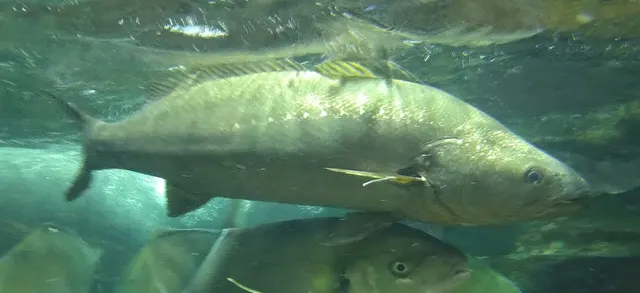 Dusky kobA large, long-lived estuarine and surf predator of southern African and Australian coasts, assessed as Endangered, and one of the clearest cases where a popular sport fish is genuinely in trouble.
タウナギ — CC BY-SA 4.0, via Wikimedia Commons
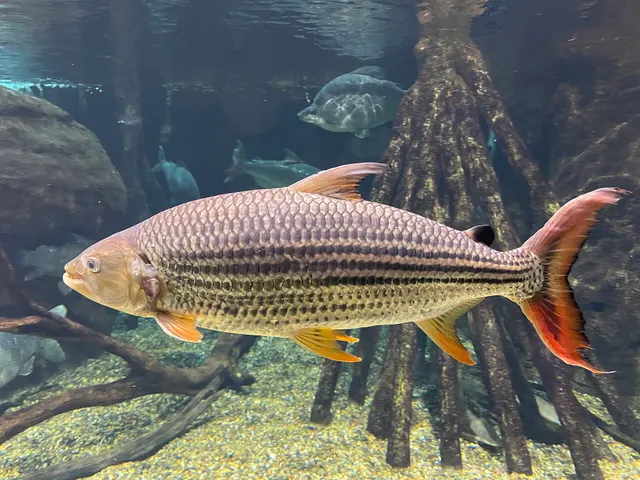 African tigerfishA fast, silver, heavily toothed river predator of tropical Africa whose interlocking fangs are visible with its mouth shut — and one of the hardest fish in fresh water to hook.
Totti — CC BY-SA 4.0, via Wikimedia Commons
Safety
Cliffs and rock platforms — Can cause serious injury or death
Both coasts take large ocean swell arriving in irregular sets, and rock angling from ledges is the region's signature discipline. Anglers are swept from rock and drowned, and on the cold Atlantic side immersion incapacitates within minutes.
What reduces it: Watch any rock mark for a long period before committing and assume the sets seen are not the largest; never fish rock alone; wear a buoyancy aid; plan an exit for a worse sea than the one you arrived in; and treat swell forecasts rather than wind forecasts as the deciding information.
Worse when:
- Ocean groundswell arriving on a locally calm day
- The cold west coast, where immersion is rapidly disabling
- Rising tide against a ledge with a difficult retreat
Encounters with marine life — Can cause serious injury or death
In the Zambezi and Okavango systems, crocodiles and hippopotamus are present wherever there is water. Hippopotamus in particular are responsible for a substantial number of human deaths in Africa each year, and encounters occur at the water's edge and around boats rather than in deep water.
What reduces it: Take and follow local guidance on where to stand, launch and land; never wade or swim in these systems; keep away from banks with hippo paths; and treat any local instruction about a specific stretch as the operative safety information it is.
Worse when:
- Dawn and dusk, when hippopotamus move
- Shallow margins, reed beds and landing points
- Any unguided access to unfamiliar water in these systems
Check the rules before you fish
Fishing laws, bylaws, access rules, seasons, bait restrictions and permitted methods vary by location and can change. Check the current rules from the relevant authority and the water you intend to fish before fishing.
Check with:
- Current national or regional law for where you are fishing
- Current local bylaws
- The relevant fisheries authority
- The landowner, club or fishery whose water it is
- Any restrictions specific to the species or the method you intend to use
Where to go next
What swims here
- African tigerfishThe headline predator of the Zambezi and Okavango systems, and the reason the inland sport fishery exists at the scale it does.
- Dusky kobThe most prized shore species on much of the coast, and a species whose depletion is the clearest local example of why linefish management here is strict.
How people fish here
How this compares
- South AfricaSouth Africa is the region in national detail; the overview covers the wider coast and the inland systems that cross its borders.
- The Agulhas CurrentThe Agulhas is the warm half of the two-ocean story, carrying tropical species far further south than the latitude would allow and meeting the cold Benguela at the continent's tip.
Sources and evidence
- FishBase: a global information system on fishes — Froese, R. and D. Pauly, eds. — FishBase Consortium (Scientific institute)Relied on for: Distribution, habitat association, life history and diet recorded for the species concerned.States this directlyPassage read and verified
- Good Fish Guide — Marine Conservation Society (Conservation authority)Relied on for: Synthesis of stock and gear information relating fishing methods to their effects on stocks and habitats.Background and mechanism onlyCitation checked — the work exists and is described correctly
- Code of Conduct for Responsible Fisheries — Food and Agriculture Organization of the United Nations, Rome, 1995 (Standards body)Relied on for: International principles for responsible fisheries, including small-scale and artisanal fisheries, and the role of national authorities.States this directlyCitation checked — the work exists and is described correctly
Why the 5 connections on this page are here, and the sources
What swims here
Backed by research — 2 connections
Supported by peer-reviewed research or fisheries science. The sources are listed and can be checked.
African tigerfish
A distributional claim taken from reference sources on the species rather than from angling report. It states presence and asserts nothing about a fishery.
- FishBase: a global information system on fishes — Froese, R. and D. Pauly, eds. — FishBase Consortium (Scientific institute)Relied on for: Distribution, habitat association, depth range and life history recorded for the species concerned.States this directlyPassage read and verified
- The IUCN Red List of Threatened Species — International Union for Conservation of Nature (Conservation authority)Relied on for: Global distribution, population trend and extinction-risk assessment for the species concerned.States this directlyCitation checked — the work exists and is described correctly
Dusky kob
A distributional claim taken from reference sources on the species rather than from angling report. It states presence and asserts nothing about a fishery.
- FishBase: a global information system on fishes — Froese, R. and D. Pauly, eds. — FishBase Consortium (Scientific institute)Relied on for: Distribution, habitat association, depth range and life history recorded for the species concerned.States this directlyPassage read and verified
- The IUCN Red List of Threatened Species — International Union for Conservation of Nature (Conservation authority)Relied on for: Global distribution, population trend and extinction-risk assessment for the species concerned.States this directlyCitation checked — the work exists and is described correctly
How people fish here
What experienced anglers do — 1 connection
Widely and independently recommended by experienced anglers and specialist sources. This is real angling knowledge, not proof: controlled evidence for it is limited, and FishingHQ records it as convention rather than as a demonstrated effect.
Sea fishing
Which branch of fishing dominates a region is a statement about practice rather than about the place, and is recorded as convention.
- FAO fishing gear types and fishing technology information — Food and Agriculture Organization of the United Nations (Scientific institute)Relied on for: Classification and description of world fishing gears and the regions in which each is used.States this directlyCitation checked — the work exists and is described correctly
- General angling website restatements of established technique — Various (Credible secondary source)Relied on for: Widely restated descriptions of regional angling practice, recorded as consensus rather than as scholarship.Background and mechanism onlyCitation checked — the work exists and is described correctly
How this compares
What experienced anglers do — 2 connections
Widely and independently recommended by experienced anglers and specialist sources. This is real angling knowledge, not proof: controlled evidence for it is limited, and FishingHQ records it as convention rather than as a demonstrated effect.
South Africa
A continental overview joined to a record it sits above, so that the synthesis and the detail are reachable from one another rather than duplicating each other.
- FAO fishing gear types and fishing technology information — Food and Agriculture Organization of the United Nations (Scientific institute)Relied on for: Classification and description of world fishing gears and the regions in which each is used.States this directlyCitation checked — the work exists and is described correctly
- General angling website restatements of established technique — Various (Credible secondary source)Relied on for: Widely restated descriptions of regional angling practice, recorded as consensus rather than as scholarship.Background and mechanism onlyCitation checked — the work exists and is described correctly
The Agulhas Current
A continental overview joined to a record it sits above, so that the synthesis and the detail are reachable from one another rather than duplicating each other.
- FAO fishing gear types and fishing technology information — Food and Agriculture Organization of the United Nations (Scientific institute)Relied on for: Classification and description of world fishing gears and the regions in which each is used.States this directlyCitation checked — the work exists and is described correctly
- General angling website restatements of established technique — Various (Credible secondary source)Relied on for: Widely restated descriptions of regional angling practice, recorded as consensus rather than as scholarship.Background and mechanism onlyCitation checked — the work exists and is described correctly
How FishingHQ labels evidence is explained in the evidence policy.