African tigerfish
Fish · Last reviewed 2026-08-10
A fast, silver, heavily toothed river predator of tropical Africa whose interlocking fangs are visible with its mouth shut — and one of the hardest fish in fresh water to hook.
Safety: species that bite — can cause serious injury or death. 6 more points apply here.
How this was identified, and who took it
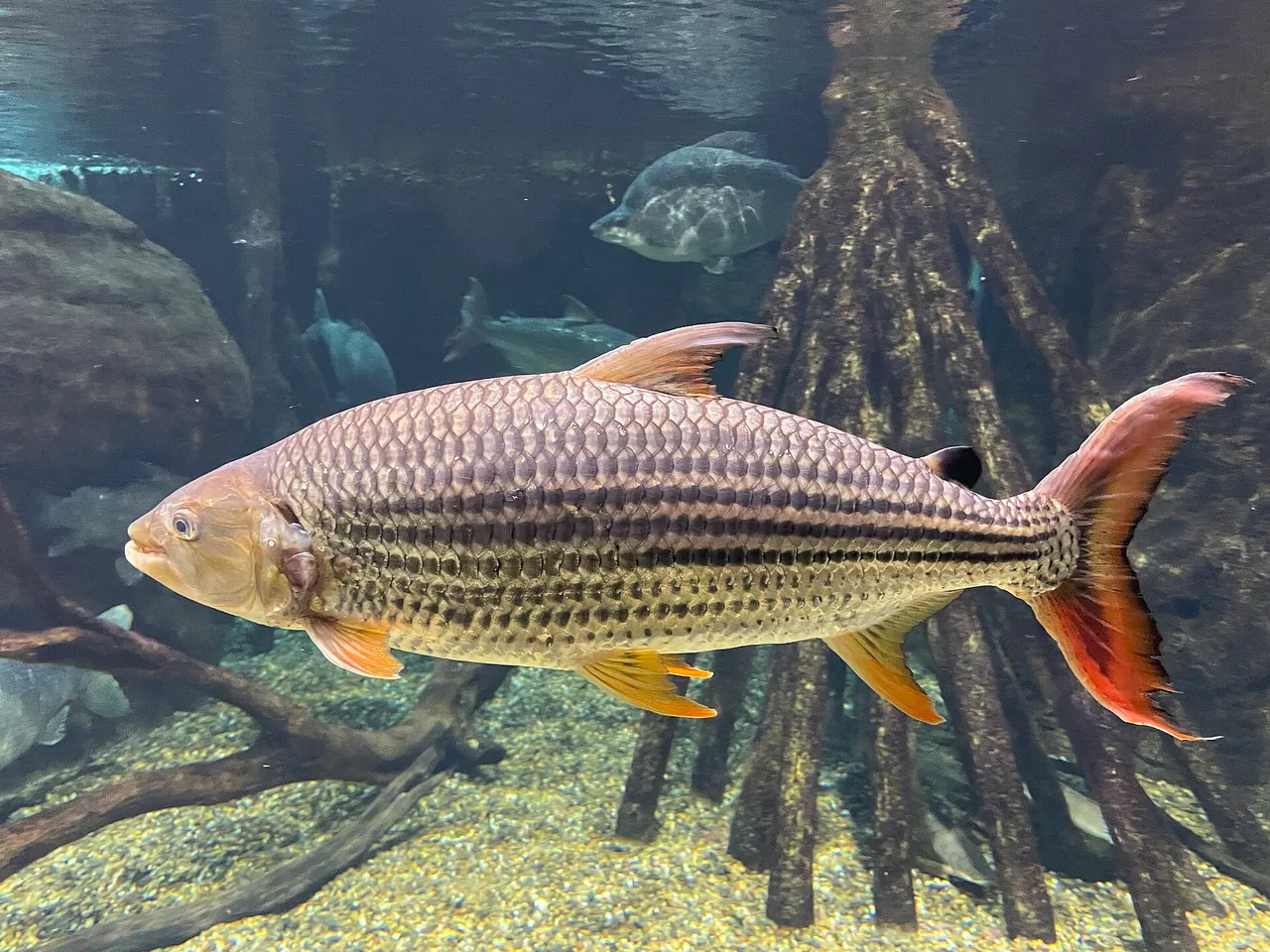
Identified by: Full lateral view in an aquarium. The horizontal dark stripes along the flank, the red-orange fins, the deeply forked red tail and the adipose fin are all clear — the striping is what places it in Hydrocynus.Totti — CC BY-SA 4.0, via Wikimedia Commons — source, licence
Catching African tigerfish
Everything here on fishing for it. Each entry opens the page behind it.
- Ground
The African tigerfish is what happens when a characin — the same broad group as tetras and piranhas — becomes a specialist predator of large African rivers.
The teeth define it. Large fang-like teeth overlap the jaws when the mouth is closed, which is unmistakable and is the reason a wire trace is not optional. They are also the reason the fish is so difficult to hook: the mouth is bony and armoured, the teeth shear rather than hold, and a strike that would set a hook in almost any other fish simply slides. Anglers who have fished for tigerfish generally talk about the ones they lost.
It lives in warm, well-oxygenated water in the larger rivers and lakes of tropical Africa — the Zambezi, the Congo, the Niger, the Nile, Lake Tanganyika and a long list of others — and it hunts in fast open water rather than from cover. Small individuals eat insects and crustaceans; above about ninety to a hundred millimetres they become exclusive fish feeders, which is a sharp and well-documented switch rather than a gradual one.
For anyone fishing outside their home water it matters as more than a curiosity: it is the headline freshwater sport fish of a large part of a continent that European and American angling literature barely mentions.
How it is caught
- SpinningCasting heavy spoons across current into visible structure is the traditional approach, and the retrieve speed is set by a fish that strikes hard and is hard to hook.
- TrollingTrolling is a principal tigerfish method on the Zambezi and its lakes, covering the current lines and drop-offs the fish patrols.
Gear for this fish
- SpoonsHeavy spoons are the traditional tigerfish lure on the Zambezi and its lakes, casting far and flashing hard in the turbid water the fish hunts in.
- StreamersFly fishing for tigerfish with large streamers is well established, and the strike rate to hook-up rate is famously poor because of the bony mouth rather than because of the pattern.
- Wire tracesLarge fang-like teeth that overlap the jaws when the mouth is closed. A wire trace is required tackle rather than a refinement, and this is a fact about the fish rather than a preference.
Identification
- Scientific name
- Hydrocynus vittatus
- Family
- Alestidae
- Water
- Freshwater
- Conservation status
- Least Concern
- Regions
- East & Southern Africa, West Africa, North Africa
- Large fang-like teeth that overlap the jaws and remain visible when the mouth is closed — unmistakable, and shared with no other African freshwater fish an angler is likely to meet.
- Bright silver body with distinct dark horizontal stripes running along the flank.
- Orange to red tail and fins, particularly the caudal and anal fins.
- Deeply forked tail and a streamlined, laterally compressed body built for speed.
- Larger congeners exist in parts of Africa, notably the goliath tigerfish of the Congo, and are separated by size, stripe pattern and range.
Size
- Typical
- 1–3 kg (2–6.5 lb)
- Large
- 6–10 kg (13–22 lb)
Exceptional: Over 15 kg (33 lb); maximum published weight 28 kg
Open, oxygenated, flowing water and the edges within it
African tigerfish are pursuit predators of large open freshwater systems, and their habitat requirements follow from needing both speed and oxygen.
THEY NEED WELL-OXYGENATED WATER and are intolerant of the stagnant, deoxygenated conditions that snakeheads and catfish handle easily. That confines them to flowing rivers, large lakes with wind mixing, and the main channels rather than the backwaters.
THEY HUNT IN OPEN WATER AND AMBUSH FROM EDGES. Tigerfish work channel margins, drop-offs, confluences, rocky reaches and the boundaries between fast and slack water, holding out of the main flow and striking into it. Structure matters as a break rather than as cover.
WARM WATER IS THE OTHER REQUIREMENT — the species is tropical and subtropical, and at the cooler edges of the range it becomes seasonal and sluggish.
JUVENILES USE MARGINAL AND FLOODPLAIN HABITAT, in shallower vegetated water, before moving into the main channel as they grow.
TURBIDITY IS TOLERATED but the fish is a visual predator with excellent eyesight, so clearer reaches concentrate feeding activity.
AND THE LARGE-LAKE POPULATIONS BEHAVE DIFFERENTLY FROM THE RIVER ONES, occupying open pelagic water and hunting shoaling prey — the same species using a completely different habitat, which is worth knowing before generalising about where to expect them.
Backed by research — why, and the sources (2)
Supported by peer-reviewed research or fisheries science. The sources are listed and can be checked.
- FishBase: a global information system on fishes — Froese, R. and D. Pauly, eds. — FishBase Consortium (Scientific institute)Relied on for: Distribution, habitat association, depth range, size, reproduction and life-history parameters recorded for the species.States this directlyPassage read and verified
- The IUCN Red List of Threatened Species — International Union for Conservation of Nature (Conservation authority)Relied on for: Assessment and range account for the species, including the habitats it depends on, its life history and the pressures acting on it.States this directlyCitation checked — the work exists and is described correctly
Spawning on the flood, in the flooded margins
Tigerfish reproduction is tied to the seasonal rise of tropical rivers, and the timing is entirely hydrological.
RISING WATER IS THE TRIGGER. Spawning follows the onset of the rains and the resulting flood, with adults moving out of the main channel into inundated marginal habitat — flooded grass, backwaters and floodplain — to spawn.
EGGS ARE SCATTERED OVER VEGETATION rather than deposited in a nest, and there is no parental care. The flooded vegetation provides both substrate and cover for the resulting fry.
THE FLOODPLAIN IS THE NURSERY. Juveniles grow in the warm, food-rich, predator-sheltered flood before dropping back to the channel as water recedes. Recruitment therefore depends on how much ground flooded, for how long, and how early — the same flood-pulse logic that governs the Mekong and the Amazon.
SO A POOR FLOOD IS A POOR YEAR CLASS, regardless of how many adults spawned. Where rivers are regulated and the flood is suppressed, tigerfish recruitment suffers in a way that no fishing rule addresses.
MATURITY COMES AT A FEW YEARS and the fish grows quickly in warm productive water.
AND THE MIGRATION MATTERS. Populations in river systems undertake spawning movements of substantial distance, so barriers on the mainstem affect reproduction directly.
Backed by research — why, and the sources (2)
Supported by peer-reviewed research or fisheries science. The sources are listed and can be checked.
- FishBase: a global information system on fishes — Froese, R. and D. Pauly, eds. — FishBase Consortium (Scientific institute)Relied on for: Distribution, habitat association, depth range, size, reproduction and life-history parameters recorded for the species.States this directlyPassage read and verified
- The IUCN Red List of Threatened Species — International Union for Conservation of Nature (Conservation authority)Relied on for: Assessment and range account for the species, including the habitats it depends on, its life history and the pressures acting on it.States this directlyCitation checked — the work exists and is described correctly
Interlocking teeth, and why the danger is the head shake
Tigerfish dentition is unusual enough to change how the fish must be held. The teeth are large, conical, and set so that upper and lower rows interlock outside the closed mouth — they are visible with the jaws shut. They are shearing teeth, designed to remove a section from a fish larger than the mouth, and they are set in a bony jaw with an extremely fast closing action.
THE INJURY IS NOT A BITE. It is almost always a head shake. The fish is held, it convulses, and the exposed teeth are dragged across whatever is in contact with them — a forearm, the inside of a hand, a thigh. The wound is a clean deep laceration rather than a puncture, and it bleeds accordingly. This happens on the boat, after the fight, at the moment everybody has relaxed.
SO THE HEAD MUST BE IMMOBILISED FIRST. A wet cloth over the eyes reduces movement markedly. A firm grip across the back of the head, from above, with the body supported, keeps the jaws from travelling. Hands never approach the mouth: long pliers or a hook-out tool, every time, and cut the trace if the hook is deep.
AND THE HOOKS ARE PART OF THE HAZARD. Tigerfish are usually taken on lures with multiple trebles, from a fish that shakes violently, at close range. A fish thrashing with a treble in its jaw and another swinging free is the commonest way people are hooked in this fishery, and it is a worse outcome than the teeth.
HANDLE THEM QUICKLY. These are warm-water fish, often taken in high air temperatures after a hard fight. The fish's tolerance for handling time is lower than the angler's enthusiasm for photographs.
What experienced anglers do — why, and the sources (2)
Widely and independently recommended by experienced anglers and specialist sources. This is real angling knowledge, not proof: controlled evidence for it is limited, and FishingHQ records it as convention rather than as a demonstrated effect.
- FishBase: a global information system on fishes — Froese, R. and D. Pauly, eds. — FishBase Consortium (Scientific institute)Relied on for: Dentition, fin and spine morphology, body form, air-breathing capability and distribution for the species, which are the anatomical facts the handling practice below follows from.States this directlyPassage read and verified
- General angling website restatements of established technique — Various (Credible secondary source)Relied on for: Widely restated angling practice for handling this species, recorded as practitioner consensus rather than as tested fact.Background and mechanism onlyCitation checked — the work exists and is described correctly
A flood-pulse fish: the year is wet and dry, and everything happens on the rise
Tigerfish seasonality is governed by the flood pulse of a tropical river system, which is a fundamentally different clock from the temperature-driven year of a temperate fish and is worth setting out on its own terms.
THE RIVER HAS A WET SEASON AND A DRY SEASON AND THEY ARE NOT SUMMER AND WINTER. In the wet season the river rises, spills onto floodplains, floods grassland and backwaters, becomes turbid and pushes a huge pulse of nutrients and organic material into the system. In the dry season it falls, clears, and contracts into the main channel and residual pools. Every fish in the system organises its life around that cycle.
TIGERFISH SPAWN ON THE RISING WATER. Spawning is cued by rising levels and flooding, with fish moving into inundated marginal areas and floodplain habitat where eggs and larvae have warm shallow productive water and cover. The flood is the reproductive trigger, and a poor flood year produces a poor year class regardless of how many adults are present.
THE PREY BASE FOLLOWS THE SAME PULSE. Small fish spawn and recruit on the flood, and the floodplain becomes a nursery producing enormous numbers of them. As the water falls, those fish are forced off the floodplain and back into the channel — and that draining period is a concentrated feeding opportunity for every predator in the river. Tigerfish exploit it heavily.
WHICH MAKES THE FALLING AND LOW-WATER PERIOD THE PRODUCTIVE ONE FOR AN ANGLER, and for two reasons at once. The water clears, which suits a visual predator and suits anybody trying to present a lure to one; and the prey is concentrated in a smaller volume with the predators on it. High flood water is turbid, spread over an enormous area, and difficult in every respect.
TEMPERATURE STILL MATTERS AT THE EDGES. Tigerfish are warm-water fish and become notably less active in the cooler part of the year in the southern parts of the range, which layers a temperature effect onto the flood cycle in systems like the Zambezi.
SO THE ANSWER TO 'WHEN' IS A HYDROGRAPH RATHER THAN A MONTH. The dates shift between years with the rains, and a season described by calendar in one catchment does not describe another. Where fishing is permitted, in what form and at what time is separately a matter for the competent authority in each country.
Backed by research — why, and the sources (2)
Supported by peer-reviewed research or fisheries science. The sources are listed and can be checked.
- FishBase: a global information system on fishes — Froese, R. and D. Pauly, eds. — FishBase Consortium (Scientific institute)Relied on for: Spawning season, migratory behaviour, temperature preference and seasonal distribution recorded for the species.States this directlyPassage read and verified
- The IUCN Red List of Threatened Species — International Union for Conservation of Nature (Conservation authority)Relied on for: Assessment and life-history account, including reproductive timing and the seasonal pressures on the population.Background and mechanism onlyCitation checked — the work exists and is described correctly
A bony mouth full of interlocking teeth, and why hook penetration is the whole problem
Tigerfish tackle is designed around one fact that most anglers meet for the first time on the water: an enormous proportion of takes do not result in a hooked fish, and the reason is anatomical rather than a matter of timing.
THE MOUTH IS BONE AND THE TEETH INTERLOCK. A tigerfish's jaws carry large conical teeth that close into sockets in the opposing jaw, so a closed mouth is effectively a solid box with very little soft tissue anywhere in it. A hook arriving into that gets almost no penetration, and a fish that clamps down and shakes ejects it. Hook-up rates in this fishery are low by any standard and it is not the angler's fault.
SO EVERYTHING FOLLOWS FROM GETTING A POINT IN. Chemically sharpened, strong, short-shanked hooks kept genuinely sharp — checked and touched up during a session rather than assumed — are the single highest-return tackle decision. A blunt hook here does not merely reduce the odds; it removes them.
AND THE STRIKE HAS TO BE HARD, WHICH SETS THE ROD AND LINE. Driving a point into bone requires the strike to reach the hook, so low-stretch braided line and a rod with the stiffness to transmit it are the standard combination. A soft rod and stretchy line absorb exactly the energy that was needed. This is one of the few fisheries where a stiff rod is a hooking tool rather than a fighting one.
A WIRE TRACE IS NOT OPTIONAL AND IT IS FOR THE SAME REASON AS PIKE. Those teeth part monofilament and braid alike on contact, and a bitten-off fish swims away carrying a lure. The trace is a welfare requirement as much as a tackle one.
THE FISH JUMPS, AND THAT IS WHERE THEY ARE LOST. A tigerfish leaves the water repeatedly and violently, and a hook in bone has nothing holding it once tension drops. Keeping a bend in the rod through a jump — rather than bowing to it as one would for a tarpon — is the practice most experienced anglers settle on, and it is one of the genuine differences from other jumping fish.
AND THE HANDLING KIT IS PART OF THE OUTFIT: long pliers and a controlled grip, because the same teeth that defeat a hook are entirely capable of an injury the record's handling section describes.
What experienced anglers do — why, and the sources (2)
Widely and independently recommended by experienced anglers and specialist sources. This is real angling knowledge, not proof: controlled evidence for it is limited, and FishingHQ records it as convention rather than as a demonstrated effect.
- IGFA International Angling Rules and World Record Requirements — International Game Fish Association (Angling or fisheries organisation)Relied on for: Recognition of the species as a recognised game fish, the tackle classes record fisheries are organised by, and the practice of the fisheries that target it.States this directlyPassage read and verified
- General angling website restatements of established technique — Various (Credible secondary source)Relied on for: The widely restated tackle practice for this species, recorded as a consensus position rather than as an original observation.States this directlyCitation checked — the work exists and is described correctly
Lifecycle and reproduction
Potamodromous — it moves within river systems rather than to the sea — with spawning migrations associated with the flood season. Growth is fast and the species reaches a large size in the biggest systems. Males are recorded reaching a greater maximum length than females, at 105 cm fork length against 74 cm, which is an unusual pattern among large predatory fish and worth noting rather than assuming.
Spawns during the rainy season in flooded marginal habitat and backwaters, where juveniles find food and cover. The flood dependence is the important part: a river system whose flood cycle has been altered by damming loses the spawning and nursery habitat this species relies on, which affects recruitment independently of any fishing pressure.
Feeding and senses
Highly piscivorous, and the switch is sharp — the diet becomes increasingly fish-based with growth and individuals above about 90 to 100 mm are exclusive fish feeders. Recorded prey includes Brycinus, Micralestes, Barbus and Limnothrissa, alongside Caridina shrimp and insects in smaller fish. Hunting is fast pursuit in open water rather than ambush from cover.
Sight-dominant, hunting visually at speed in the clear to lightly stained water of large rivers and lakes. Tigerfish hunt in loose groups and drive prey shoals, and the visual pursuit strategy is why they respond so strongly to fast-moving lures and to flies stripped hard — a bait sitting still is far less interesting to them than something fleeing.
Through the year
Driven by the flood cycle rather than by a temperate four-season year. Rising water disperses fish into flooded margins for spawning; falling water concentrates them and their prey back into channels, which is when the fishing is at its best in most systems. Water temperature between about 22 and 28 degrees defines the range, and activity falls sharply in cooler water.
Distribution
Widely distributed across tropical Africa: the Niger, Bénoué, Ouémé, Senegal, Chad, Volta and Mono river systems in West Africa; the Cross and Sanaga basins in Lower Guinea; the Congo basin; and the Nile, Omo, Zambezi, Limpopo, Rovuma, Shire, Rufiji, Ruaha, Malagarazi and Okavango systems, with Lakes Tanganyika, Rukwa, Albert and Kariba and coastal systems to the Pongolo.
This is a biological range — where the species occurs, not a prediction that you will catch one. To browse the fishing geography FishingHQ holds, start at fishing places.
Why anglers care
The headline freshwater sport fish across a large part of tropical Africa, taken by trolling, casting lures, fly fishing and bait, and supporting a significant recreational and tourism fishery in several countries. It is also an important subsistence and commercial food fish across its range, which means the recreational fishery sits alongside rather than above other uses.
Handling and returning
The teeth are the entire handling problem and they are as dangerous as they look. Never put a hand near the mouth of a tigerfish under any circumstances, alive or apparently dead. Use long-nosed pliers or a de-hooking tool with the fish fully controlled, ideally in the water. A wire trace is required tackle rather than a refinement. Support the body, wet hands, and keep the fish in the water where possible.
Going further
- What does african tigerfish eat? — feeding biology, kept separate from what anglers infer from it.
Safety
Species that bite — Can cause serious injury or death
Large interlocking fang-like teeth on a strong fish that thrashes when handled. A hand near the mouth of a tigerfish will be cut severely, and the wound will be deep.
What reduces it: Never put a hand near the mouth. Control the fish completely before attempting to unhook, ideally in the water and with a second person. Use long-nosed pliers or a de-hooking tool. A wire trace is required tackle.
Encounters with marine life — Can cause serious injury or death
Much of this fish's range is shared with hippopotamus and crocodile, both of which kill people, and the fishing is done from small boats and river banks in exactly that habitat.
What reduces it: Treat local guidance as authoritative and fish with people who know the water. Do not stand at the water's edge, wade, or clean fish at the water. Keep clear of hippo in open water — they are the more dangerous of the two and are frequently underestimated.
Precautions that always apply here
- Keep fingers out of the gills and clear of the teeth. Gill damage is usually fatal to the fish, and several species will remove skin from a finger.
- Wet your hands before touching a fish. Dry hands strip the protective mucus layer that keeps infection out.
- Tell somebody where you are going and when you expect to be back.
- Carry a charged phone in a waterproof case, or another means of calling for help.
- Wear a buoyancy aid or lifejacket. Cold water incapacitates strong swimmers within a minute, long before swimming ability matters.
Check the rules before you fish
Fishing laws, bylaws, access rules, seasons, bait restrictions and permitted methods vary by location and can change. Check the current rules from the relevant authority and the water you intend to fish before fishing.
Check with:
- Current national or regional law for where you are fishing
- Current local bylaws
- The relevant fisheries authority
- The landowner, club or fishery whose water it is
- Any restrictions specific to the species or the method you intend to use
Where to go next
Where it lives
Where you will find it
Understanding this fish
Told apart from
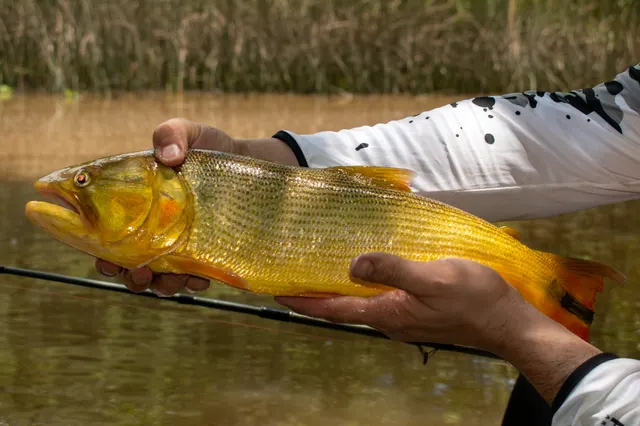 Golden doradoUnrelated characins on two continents that arrived at the same animal: fast, gold, heavily toothed river predators of big warm rivers, both notoriously hard to hook in a bony mouth, both needing a heavy trace.
- Goliath tigerfishThe genus pair. Both carry the interlocking conical teeth; goliath is larger, deeper-bodied and more uniformly silver, and belongs to the Congo basin where African tigerfish belongs to the southern systems. Range is supporting evidence and never an identification on its own.
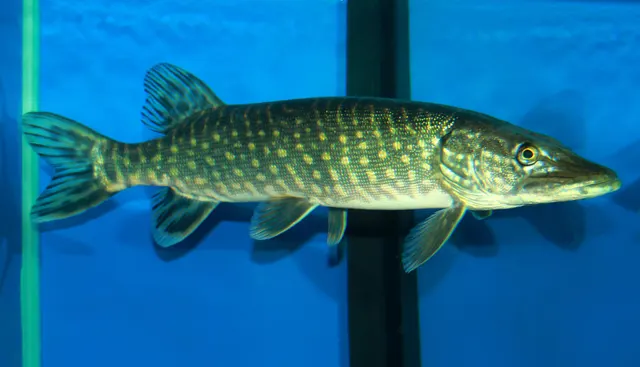 Northern pikeUnrelated fish that arrived at the same solution: a fast, heavily toothed, visually hunting freshwater predator that shears its prey and needs a wire trace between it and the angler.
Sources and evidence
- FishBase: a global information system on fishes — Froese, R. and D. Pauly, eds. — FishBase Consortium (Scientific institute)Relied on for: Scientific name, family placement in the Alestidae, maximum length of 105 cm fork length in males and 74 cm in females with maximum weight of 28 kg, distribution across the Niger, Bénoué, Ouémé, Senegal, Chad, Volta and Mono systems, the Cross and Sanaga basins, the Congo basin, and the Nile, Omo, Zambezi, Limpopo, Rovuma, Shire, Rufiji, Ruaha.States this directlyPassage read and verified
- FishBase: a global information system on fishes — Froese, R. and D. Pauly, eds. — FishBase Consortium (Scientific institute)Relied on for: The IUCN Red List category — Least Concern, assessed 14 February 2025 — is taken from FishBase's republication.States this directlyPassage read and verified
Why the 12 connections on this page are here, and the sources
How it is caught
What experienced anglers do — 2 connections
Widely and independently recommended by experienced anglers and specialist sources. This is real angling knowledge, not proof: controlled evidence for it is limited, and FishingHQ records it as convention rather than as a demonstrated effect.
Spinning
Established angling practice for this species, recorded as convention. The note states the property of the animal or its water that makes the method the answer.
- IGFA International Angling Rules and World Record Requirements — International Game Fish Association (Angling or fisheries organisation)Relied on for: Recognition of the species as an established sport fish and the angling methods and tackle classes conventionally used for it.States this directlyPassage read and verified
- General angling website restatements of established technique — Various (Credible secondary source)Relied on for: Widely restated practice connecting this species and method.Background and mechanism onlyCitation checked — the work exists and is described correctly
Trolling
Established angling practice for this species, recorded as convention. The note states the property of the animal or its water that makes the method the answer.
- IGFA International Angling Rules and World Record Requirements — International Game Fish Association (Angling or fisheries organisation)Relied on for: Recognition of the species as an established sport fish and the angling methods and tackle classes conventionally used for it.States this directlyPassage read and verified
- General angling website restatements of established technique — Various (Credible secondary source)Relied on for: Widely restated practice connecting this species and method.Background and mechanism onlyCitation checked — the work exists and is described correctly
Gear for this fish
What experienced anglers do — 2 connections
Widely and independently recommended by experienced anglers and specialist sources. This is real angling knowledge, not proof: controlled evidence for it is limited, and FishingHQ records it as convention rather than as a demonstrated effect.
Spoons
A practitioner claim about which lure family answers this species' feeding or holding behaviour.
- IGFA International Angling Rules and World Record Requirements — International Game Fish Association (Angling or fisheries organisation)Relied on for: Recognition of the species as an established sport fish taken on artificial lures, and the line and tackle classes used for it.States this directlyPassage read and verified
- General angling website restatements of established technique — Various (Credible secondary source)Relied on for: Widely restated lure practice for this species.Background and mechanism onlyCitation checked — the work exists and is described correctly
Streamers
A practitioner claim about which lure family answers this species' feeding or holding behaviour.
- IGFA International Angling Rules and World Record Requirements — International Game Fish Association (Angling or fisheries organisation)Relied on for: Recognition of the species as an established sport fish taken on artificial lures, and the line and tackle classes used for it.States this directlyPassage read and verified
- General angling website restatements of established technique — Various (Credible secondary source)Relied on for: Widely restated lure practice for this species.Background and mechanism onlyCitation checked — the work exists and is described correctly
Backed by research — 1 connection
Supported by peer-reviewed research or fisheries science. The sources are listed and can be checked.
Wire traces
A tackle requirement resting on verified morphology — the same reasoning FishingHQ applies to pike, and held to the same standard.
- FishBase: a global information system on fishes — Froese, R. and D. Pauly, eds. — FishBase Consortium (Scientific institute)Relied on for: That Hydrocynus vittatus has large fang-like teeth overlapping the jaws when the mouth is closed, and becomes an exclusive fish feeder above 90 to 100 mm.States this directlyPassage read and verified
Where it lives
Backed by research — 1 connection
Supported by peer-reviewed research or fisheries science. The sources are listed and can be checked.
Lowland rivers
A habitat claim held to a scientific standard.
- FishBase: a global information system on fishes — Froese, R. and D. Pauly, eds. — FishBase Consortium (Scientific institute)Relied on for: That Hydrocynus vittatus is a freshwater demersal potamodromous species of warm well-oxygenated waters in larger rivers and lakes at 22 to 28 degrees.States this directlyPassage read and verified
Where you will find it
Backed by research — 2 connections
Supported by peer-reviewed research or fisheries science. The sources are listed and can be checked.
Lake Victoria and the Rift Valley lakes
A distribution association between an animal and a kind of water, rather than a claim about any named mark.
- The IUCN Red List of Threatened Species — International Union for Conservation of Nature (Conservation authority)Relied on for: Assessment and habitat account for the species, including the river or lake system it occupies and the pressures acting on it.States this directlyCitation checked — the work exists and is described correctly
- FishBase: a global information system on fishes — Froese, R. and D. Pauly, eds. — FishBase Consortium (Scientific institute)Relied on for: Distribution, habitat association, size and life history recorded for the species in the system concerned.States this directlyPassage read and verified
Southern African fishing
A distributional claim taken from reference sources on the species rather than from angling report. It states presence and asserts nothing about a fishery.
- FishBase: a global information system on fishes — Froese, R. and D. Pauly, eds. — FishBase Consortium (Scientific institute)Relied on for: Distribution, habitat association, depth range and life history recorded for the species concerned.States this directlyPassage read and verified
- The IUCN Red List of Threatened Species — International Union for Conservation of Nature (Conservation authority)Relied on for: Global distribution, population trend and extinction-risk assessment for the species concerned.States this directlyCitation checked — the work exists and is described correctly
Understanding this fish
Backed by research — 1 connection
Supported by peer-reviewed research or fisheries science. The sources are listed and can be checked.
Characiform fishes as prey
Recorded diet evidence identifies alestid characiforms, recorded as the genera Brycinus and Micralestes as a food item of this predator at group level rather than to species. The edge points at the taxon record for that reason, and encoding it as a species-level claim would assert something the source does not.
- FishBase: a global information system on fishes — Froese, R. and D. Pauly, eds. — FishBase Consortium (Scientific institute)Relied on for: Food items recorded for this predator, given as alestid characiforms, recorded as the genera Brycinus and Micralestes.States this directlyPassage read and verified
- FAO Species Identification Guides for Fishery Purposes and the FAO Species Catalogues — Food and Agriculture Organization of the United Nations (Scientific institute)Relied on for: Species account describing this predator's diet, recorded at the level of alestid characiforms, recorded as the genera Brycinus and Micralestes.Background and mechanism onlyCitation checked — the work exists and is described correctly
Told apart from
Backed by research — 3 connections
Supported by peer-reviewed research or fisheries science. The sources are listed and can be checked.
Golden dorado
A comparison resting on verified dentition, feeding ecology and habitat on both sides rather than on the loose resemblance the angling press usually invokes.
- FishBase: a global information system on fishes — Froese, R. and D. Pauly, eds. — FishBase Consortium (Scientific institute)Relied on for: That Salminus brasiliensis is a carnivorous Bryconidae feeding on fish and crustaceans in large river systems, and that Hydrocynus vittatus is an Alestidae with large fang-like teeth that becomes an exclusive fish feeder above 90 to 100 mm.States this directlyPassage read and verified
Goliath tigerfish
A claim that two species are genuinely confused and are separated by stated characters. It rests on the identification literature rather than on the observation that both exist.
- Freshwater Fishes of the British Isles — HarperCollins (New Naturalist 75), 1992 (Reference work)Relied on for: Distribution, habitat association, identification and life history of the freshwater fishes of the British Isles.States this directlyCitation checked — the work exists and is described correctly
- FishBase: a global information system on fishes — Froese, R. and D. Pauly, eds. — FishBase Consortium (Scientific institute)Relied on for: Distribution, habitat association, depth range, diet and reproductive parameters recorded for the species.States this directlyPassage read and verified
Northern pike
A comparison resting on verified dentition and feeding ecology on both sides rather than on the loose resemblance the angling press usually invokes.
- FishBase: a global information system on fishes — Froese, R. and D. Pauly, eds. — FishBase Consortium (Scientific institute)Relied on for: That Hydrocynus vittatus has large fang-like teeth overlapping the jaws and is an exclusive fish feeder above 90 to 100 mm.States this directlyPassage read and verified
- Pike: Biology and Exploitation — Chapman & Hall (Fish and Fisheries Series 19), 1996 (Scientific literature)Relied on for: Pike dentition and feeding ecology as a visually hunting freshwater piscivore.States this directlyCitation checked — the work exists and is described correctly
How FishingHQ labels evidence is explained in the evidence policy.