Wire traces
Tackle · Last reviewed 2026-08-10
A short length of wire between line and hooks, and the single most important piece of terminal tackle in predator fishing — for the fish's sake, not the angler's.
Safety: fish welfare — can cause serious injury or death.
- Category
- Leaders & traces
A pike's teeth will part monofilament and braid quickly and reliably. A wire trace is the answer, and this page states plainly why it is not optional: a fish that bites through the line swims away with hooks in its mouth, frequently attached to a lure, and it is not a lost fish for the angler so much as a damaged one for the water.
That framing matters because a great many anglers treat the trace as insurance against losing tackle. It is not. It is the piece of equipment that prevents a foreseeable, avoidable harm to the fish, and it should be regarded in the same category as an unhooking mat rather than in the same category as a landing net.
Wire types differ in useful ways. Multi-strand wire is supple and lets a bait behave naturally; single-strand is stiffer, thinner and kinks permanently once bent; titanium is expensive, kink-resistant and springs back. Heavy fluorocarbon is used as a compromise for species with less severe dentition, and it is a compromise rather than a substitute.
What it does
Places a bite-resistant material between the main line and the hooks, so that a fish with cutting dentition cannot part the connection. It also provides abrasion resistance against gill rakers and against structure during a fight.
How to choose one
- Use one for every session targeting a species with teeth, without exception — including when lure fishing for perch in water that also holds pike.
- Match suppleness to presentation: multi-strand for natural bait movement, single-strand or titanium where a stiff, direct connection is wanted.
- Length should exceed the length of the fish's jaw with margin — a trace that ends inside the mouth has failed.
- Check for kinks and rust after every fish; a kinked single-strand trace is a broken trace waiting to happen.
- Crimped and knotted connections both work; whichever is used must be inspected rather than assumed.
What the numbers mean
BREAKING STRAIN in pounds, typically 20–40 lb for pike work — considerably above what the fish can pull, because the requirement is bite resistance rather than tensile strength. STRAND COUNT: 1×7, 7×7 and 49-strand describe construction, with more strands giving more suppleness at the same strength. MATERIAL: stainless steel is standard and cheap; titanium costs several times more, does not kink, and springs back into shape. COATED wires have a plastic sheath that improves handling and hides the wire, at the cost of the coating eventually splitting.
Care, and how it fails
Wire fails at kinks, at crimps, and at the point where it enters a swivel. Single-strand wire that has been bent sharply is permanently weakened and should be replaced rather than straightened. Rinse after use — particularly in salt — and inspect the whole length after every fish, especially the last few centimetres at the hook end where the abrasion is. A trace is a consumable, and treating it as a permanent item is how a fish ends up with a lure in its jaw.
What this is called elsewhere
FishingHQ’s headword is the term used in Britain & Ireland.
- Wire leader — North America, Australia, New Zealand, Global
- The same component under the international word for the section it belongs to. 'Trace' is British; 'leader' is everywhere else.
- Bite trace / shock trace — Britain & Ireland
- British sea-fishing usage distinguishing the short abrasion-resistant section at the hook from the longer shock leader used for casting. Two different jobs sharing the word trace.
Safety
Fish welfare — Can cause serious injury or death
Fishing for a toothy predator without a bite-resistant trace produces bite-offs. The fish swims away with hooks — often a treble-armed lure or deadbait — embedded in its mouth, which impairs feeding and frequently kills it slowly.
What reduces it: Use a wire or heavy fluorocarbon trace on every session where a toothy species might take, replace traces that show kinks or damage, and use barbless or crushed-barb hooks so that a fish that does get away has the best chance of shedding them.
Where to go next
Fish it is used for
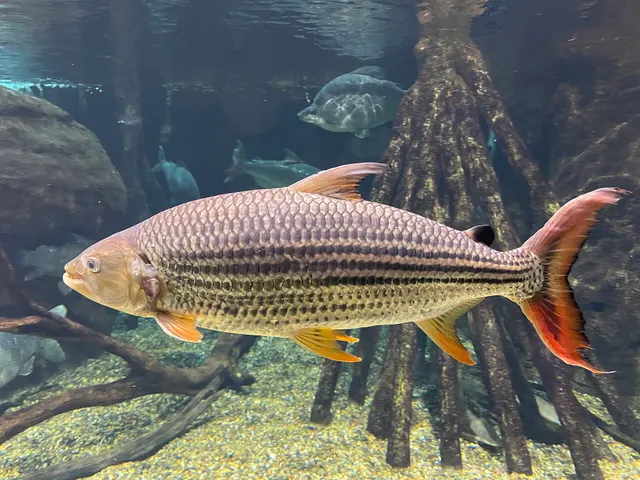 African tigerfishLarge fang-like teeth that overlap the jaws when the mouth is closed. A wire trace is required tackle rather than a refinement, and this is a fact about the fish rather than a preference.
- BluefishTriangular razor-edged teeth that cut monofilament, hooked fish and fingers. A wire trace is required tackle, and this is a fact about the fish.
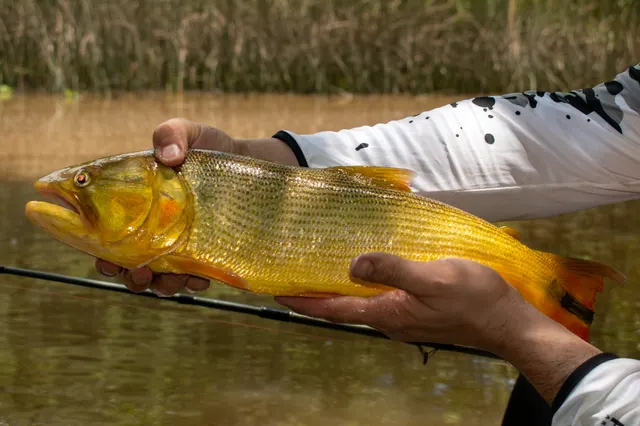 Golden doradoConical teeth in a powerful jaw shear through mono. A heavy trace is required tackle rather than a refinement, and this is a fact about the fish.
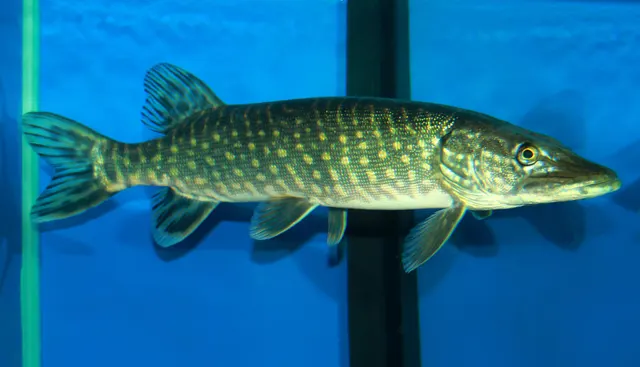 Northern pikeThis is a requirement rather than a preference: a pike will part monofilament or braid, and a fish that bites through swims away with the hooks still in it.
Where it is used
What it works with
- Haywire twistThe termination single-strand wire requires. The distinction matters and the trace's packaging is the authority on it: multi-strand and nylon-coated wires behave differently, many are crimped, and some of the coated ones genuinely can be knotted.
- Wire trace deadbait rigTwo trebles on a wire trace, positioned in the outer flesh of a deadbait so the fish can be struck promptly and hooked in the jaw.
Understanding it
- Leaders and tracesWire answers a cutting problem rather than a strength problem, and that distinction is why heavier nylon is not a substitute.
- What a leader is, and when you need oneThe bite-off job is the one where the leader material is not a preference: a fish that swims away trailing a severed trace has been condemned rather than lost.
Instead of this
Sources and evidence
Why the 10 connections on this page are here, and the sources
Fish it is used for
Backed by research — 2 connections
Supported by peer-reviewed research or fisheries science. The sources are listed and can be checked.
African tigerfish
A tackle requirement resting on verified morphology — the same reasoning FishingHQ applies to pike, and held to the same standard.
- FishBase: a global information system on fishes — Froese, R. and D. Pauly, eds. — FishBase Consortium (Scientific institute)Relied on for: That Hydrocynus vittatus has large fang-like teeth overlapping the jaws when the mouth is closed, and becomes an exclusive fish feeder above 90 to 100 mm.States this directlyPassage read and verified
Golden dorado
A tackle requirement resting on verified dentition.
- FishBase: a global information system on fishes — Froese, R. and D. Pauly, eds. — FishBase Consortium (Scientific institute)Relied on for: That Salminus brasiliensis is carnivorous, feeding on fish and crustaceans, and reaches 100 cm standard length and 31.4 kg.States this directlyPassage read and verified
What experienced anglers do — 2 connections
Widely and independently recommended by experienced anglers and specialist sources. This is real angling knowledge, not proof: controlled evidence for it is limited, and FishingHQ records it as convention rather than as a demonstrated effect.
Bluefish
A tackle requirement resting on the species' verified dentition.
- Sea Angler — Bauer Media (Specialist angling publication)Relied on for: Practitioner treatment of wire and heavy fluorocarbon traces for toothy pelagic species.Citation checked — the work exists and is described correctly
- General angling website restatements of established technique — Various (Credible secondary source)Relied on for: The widely restated practitioner position that bluefish bite through monofilament and require wire.Citation checked — the work exists and is described correctly
Northern pike
Universal across independent specialist sources, and the reasoning is mechanical rather than contested — pike dentition cuts line. Recorded as consensus because no controlled study is needed or available for a mechanical fact of this kind, and because the practice is documented independently across traditions.
- Pike Anglers' Club of Great Britain guidance on pike care and handling — Pike Anglers' Club of Great Britain, 1977 (Angling or fisheries organisation)Relied on for: The explicit statement that hooks and bait must ALWAYS be mounted on a wire trace, from the UK specialist pike organisation. Read during source review.Passage read and verified
- Pike and the Pike Angler — Stanley Paul, 1981 (Specialist angling publication)Relied on for: The requirement for a bite-resistant trace when fishing for pike, and the consequences of not using one.Citation checked — the work exists and is described correctly
- Angling Trust guidance for anglers — Angling Trust (Angling or fisheries organisation)Relied on for: Fish welfare guidance requiring tackle that does not leave hooks in fish.Citation checked — the work exists and is described correctly
Where it is used
What experienced anglers do — 1 connection
Widely and independently recommended by experienced anglers and specialist sources. This is real angling knowledge, not proof: controlled evidence for it is limited, and FishingHQ records it as convention rather than as a demonstrated effect.
Predator fishing
How the discipline classifies it, rather than a claim about how it is fished.
- Pike and the Pike Angler — Stanley Paul, 1981 (Specialist angling publication)Relied on for: Trace use as a defining component of predator tackle.Citation checked — the work exists and is described correctly
- Angling Times — Bauer Media (Specialist angling publication)Relied on for: Contemporary predator tackle practice.Citation checked — the work exists and is described correctly
What it works with
What experienced anglers do — 2 connections
Widely and independently recommended by experienced anglers and specialist sources. This is real angling knowledge, not proof: controlled evidence for it is limited, and FishingHQ records it as convention rather than as a demonstrated effect.
Haywire twist
An arrangement joined to the knot that actually builds it, written where the knot is characteristic of that arrangement rather than merely possible in it. This is the edge a reader travels: they arrive looking for the arrangement and need the connection it depends on.
- Pike and the Pike Angler — Stanley Paul, 1981 (Specialist angling publication)Relied on for: Pike angling practice including wire trace construction and the terminations single-strand wire requires.States this directlyCitation checked — the work exists and is described correctly
- Pike Anglers' Club of Great Britain guidance on pike care and handling — Pike Anglers' Club of Great Britain, 1977 (Angling or fisheries organisation)Relied on for: Pike rig and handling guidance, including the welfare case for wire and what a trace failure means for a fish that breaks off.States this directlyPassage read and verified
- Sea Angler — Bauer Media (Specialist angling publication)Relied on for: British sea angling practice: shock leaders, multi-hook trace construction and the dropper loops a trace is built from.FishingHQ's interpretation of what it saysCitation checked — the work exists and is described correctly
- General angling website restatements of established technique — Various (Credible secondary source)Relied on for: Widely restated descriptions of established connection convention, recorded as practitioner consensus rather than as scholarship.Background and mechanism onlyCitation checked — the work exists and is described correctly
Wire trace deadbait rig
The rig is defined by the component.
- Pike and the Pike Angler — Stanley Paul, 1981 (Specialist angling publication)Relied on for: Trace construction for deadbait rigs.Citation checked — the work exists and is described correctly
- Freshwater Fishing — Macdonald & Jane's, 1975 (Specialist angling publication)Relied on for: Wire trace use in British predator practice.Citation checked — the work exists and is described correctly
Understanding it
Official guidance — 1 connection
Stated by a fisheries authority, scientific institute or recognised angling body. Authoritative, but summarising rather than demonstrating.
Leaders and traces
Specialist body guidance on trace material for toothy species, given as a welfare requirement rather than a preference.
- Pike Anglers' Club of Great Britain guidance on pike care and handling — Pike Anglers' Club of Great Britain, 1977 (Angling or fisheries organisation)Relied on for: Guidance on wire trace use and on avoiding tackle left in fish.States this directlyPassage read and verified
What experienced anglers do — 1 connection
Widely and independently recommended by experienced anglers and specialist sources. This is real angling knowledge, not proof: controlled evidence for it is limited, and FishingHQ records it as convention rather than as a demonstrated effect.
What a leader is, and when you need one
Why it works, and what that rests on. How tackle behaves is established practitioner knowledge reported consistently across independent traditions, and it is described that way rather than as a test that was never run.
- Sea Angler — Bauer Media (Specialist angling publication)Relied on for: Contemporary UK sea angling practice as reported by practitioners, including tackle convention and terminal arrangements.States this directlyCitation checked — the work exists and is described correctly
- Coarse Fishing — A. & C. Black, 1912 (Specialist angling publication)Relied on for: Classical coarse angling practice: float and ledger tackle, shotting, bite registration and the reasoning behind them.States this directlyCitation checked — the work exists and is described correctly
Instead of this
What experienced anglers do — 1 connection
Widely and independently recommended by experienced anglers and specialist sources. This is real angling knowledge, not proof: controlled evidence for it is limited, and FishingHQ records it as convention rather than as a demonstrated effect.
Fluorocarbon leaders
The trade-off is described independently across predator sources.
- Pike and the Pike Angler — Stanley Paul, 1981 (Specialist angling publication)Relied on for: Trace material selection and the consequences of bite-offs.Citation checked — the work exists and is described correctly
- Angling Times — Bauer Media (Specialist angling publication)Relied on for: Contemporary trace material practice.Citation checked — the work exists and is described correctly
How FishingHQ labels evidence is explained in the evidence policy.