Golden dorado
Fish · Last reviewed 2026-08-10
A brilliant gold, heavily toothed river predator of the Paraná and Paraguay systems — a characin built like a salmon and fighting like a tarpon.
Safety: species that bite — can cause serious injury or death. 5 more points apply here.
How this was identified, and who took it
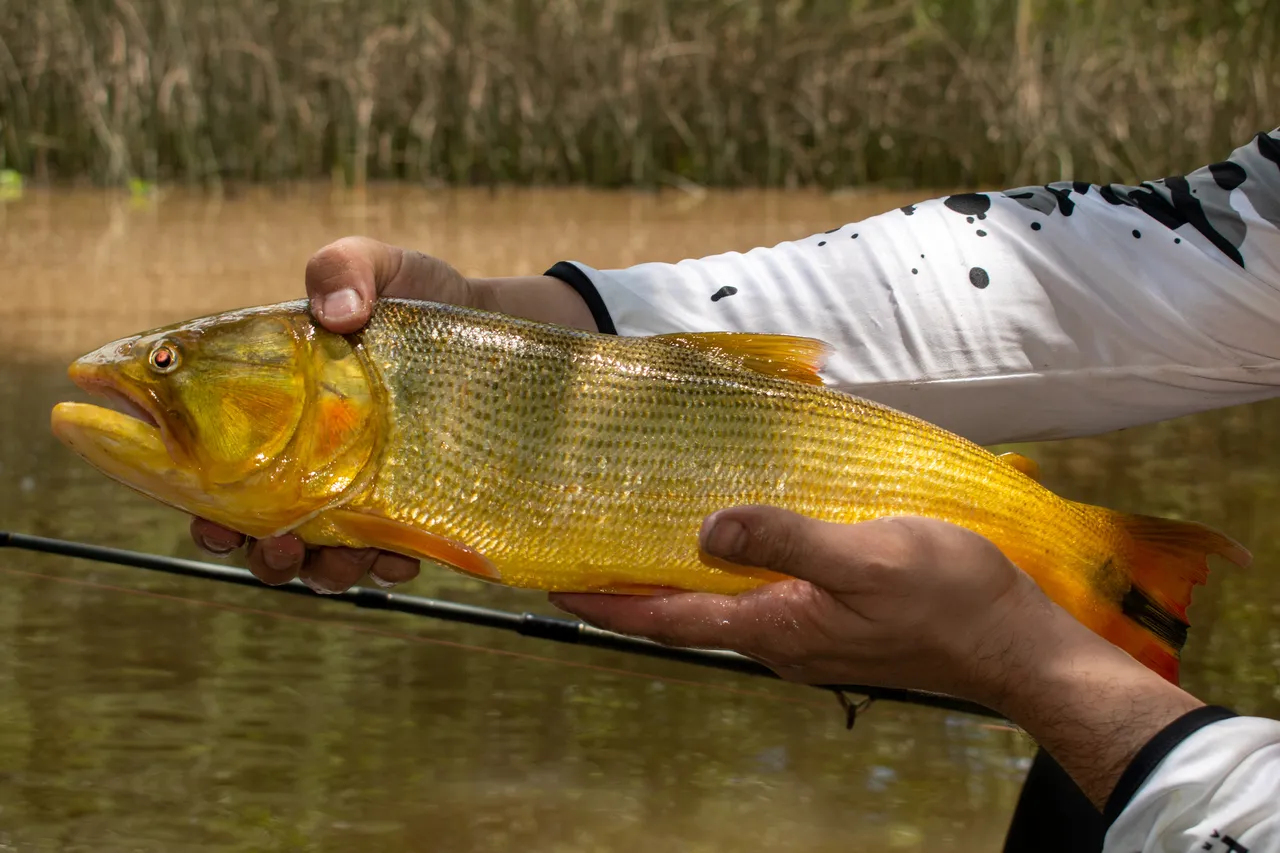
Identified by: All three characters vivid: burnished brassy gold flanks over a darker back with dark scale-row striping; a deep compressed body with a large blunt head and a very large mouth showing conical teeth; and red-orange caudal and anal fins with a distinct BLACK stripe along the middle caudal rays. Four agreeing identifications, none disagreeing.Ezequiel Racker — CC BY, via iNaturalist — source, licenceCatching Golden dorado
Everything here on fishing for it. Each entry opens the page behind it.
The golden dorado is South America's great freshwater sport fish, and it looks the part in a way few fish manage: burnished gold flanks, a red-orange tail, black stripes along the caudal rays, and a head that is mostly jaw.
Taxonomically it is a characin — the same broad group as tetras, piranhas and the African tigerfish — and the resemblance to the tigerfish is instructive, because the two are unrelated in any close sense and have arrived at almost identical solutions. Both are fast, silver-gold, heavily toothed river predators of big warm rivers, and both are exceptionally difficult to hook because the mouth is bony and armoured.
It is potamodromous — it migrates within river systems rather than to the sea — moving up the great rivers of the Paraná, Paraguay and Uruguay basins to spawn. That single fact makes it acutely vulnerable to dams, which is the pressure that matters most for the species even though the IUCN assessment is currently Least Concern.
As a target it jumps repeatedly, runs hard, and throws hooks with a violence that has made losing them a defining part of the experience.
How it is caught
- Saltwater fly fishingLarge streamers on heavy fly tackle are an established dorado approach on the Paraná system, using the tackle class the fish's size and dentition require rather than the water it lives in.
- SpinningDorado are found by casting to current seams, confluences and rapids where they ambush shoaled baitfish, which makes this a reading-the-water fishery rather than a covering-water one.
Gear for this fish
- StreamersLarge streamers on heavy fly tackle are an established dorado method, and the wire or heavy fluorocarbon it requires is a direct response to the dentition.
- Surface luresDorado feed on shoaled baitfish at and near the surface in the Paraná and its tributaries, and surface and shallow lures are the principal artificial approach.
- Wire tracesConical teeth in a powerful jaw shear through mono. A heavy trace is required tackle rather than a refinement, and this is a fact about the fish.
Identification
- Scientific name
- Salminus brasiliensis
- Family
- Bryconidae
- Water
- Freshwater
- Conservation status
- Least Concern
- Regions
- Central & South America
- Brilliant burnished gold to brassy flanks with a darker back, unmistakable in fresh condition.
- Deep-bodied and laterally compressed with a large blunt head and a very large mouth full of conical teeth.
- Red-orange caudal and anal fins, the tail marked with a distinct black stripe along the middle rays.
- Each scale carries a small dark spot, giving a fine speckled pattern over the gold.
- Separated from the smaller Salminus congeners by size and proportion; the black caudal stripe and the fin colour are the quickest field characters.
Size
- Typical
- 2–6 kg (4–13 lb)
- Large
- 10–15 kg (22–33 lb)
Exceptional: Over 20 kg (44 lb); maximum published weight 31.4 kg
Fast water, confluences and rapids: a predator that needs current
Golden dorado are river predators of the great South American basins, and current is the organising feature of their habitat.
THEY HOLD IN AND AROUND FAST WATER. Rapids, weirs, rocky reaches, channel constrictions and the heads of pools are dorado habitat, and the fish position themselves in and behind the flow to intercept prey being swept through.
CONFLUENCES ARE THE CLASSIC FEATURE. Where a tributary meets a larger river, the mixing zone concentrates disoriented prey and dorado hold on the seam. That is the same mechanism FishingHQ describes for tidal races and for Himalayan confluences, operating in a subtropical river.
WARM, WELL-OXYGENATED WATER IS THE REQUIREMENT — the species is subtropical and needs the oxygen its high-activity lifestyle demands, which excludes stagnant backwaters.
THEY ARE HIGHLY MIGRATORY WITHIN THE SYSTEM, moving long distances up and down the mainstem and into tributaries, so a given reach holds fish seasonally rather than permanently.
JUVENILES USE FLOODPLAIN AND MARGINAL HABITAT, growing in the productive inundated ground before joining the channel population.
AND MARSHES AND FLOODPLAINS ARE PART OF THE HABITAT SYSTEM even for adults, which hunt into flooded ground when the water is up — so the species needs both the fast channel and the connected floodplain to work.
Backed by research — why, and the sources (2)
Supported by peer-reviewed research or fisheries science. The sources are listed and can be checked.
- FishBase: a global information system on fishes — Froese, R. and D. Pauly, eds. — FishBase Consortium (Scientific institute)Relied on for: Distribution, habitat association, depth range, size, reproduction and life-history parameters recorded for the species.States this directlyPassage read and verified
- The IUCN Red List of Threatened Species — International Union for Conservation of Nature (Conservation authority)Relied on for: Assessment and range account for the species, including the habitats it depends on, its life history and the pressures acting on it.States this directlyCitation checked — the work exists and is described correctly
A long upstream migration on the rising river
Golden dorado spawning is a migratory, flood-triggered event of the kind that makes a species acutely sensitive to dams.
RISING WATER AND WARMING TRIGGER THE MIGRATION. Adults move upstream in large numbers as the river rises with the seasonal rains, travelling substantial distances — hundreds of kilometres in documented cases — to reach spawning reaches.
SPAWNING IS IN THE MAIN CHANNEL AND ITS MARGINS during the flood, with eggs and larvae carried downstream and into inundated floodplain habitat where the juveniles grow.
THE FLOODPLAIN IS THE NURSERY, so recruitment depends on the extent, timing and duration of the flood as much as on the number of spawners — the flood-pulse logic that governs every great tropical river fishery.
THERE IS NO NEST AND NO PARENTAL CARE. Fecundity is high and the strategy is volume plus timing.
MIGRATION IS THE VULNERABILITY. A dam or a weir on a mainstem intercepts the spawning run entirely, and dorado populations above impassable barriers decline or disappear. Flow regulation that suppresses the flood damages recruitment even where passage exists.
AND CATCH-AND-RELEASE HAS BECOME THE NORM in much of the sport fishery for this species, driven by exactly these pressures — which is a management fact rather than a rule this page states.
Backed by research — why, and the sources (2)
Supported by peer-reviewed research or fisheries science. The sources are listed and can be checked.
- FishBase: a global information system on fishes — Froese, R. and D. Pauly, eds. — FishBase Consortium (Scientific institute)Relied on for: Distribution, habitat association, depth range, size, reproduction and life-history parameters recorded for the species.States this directlyPassage read and verified
- The IUCN Red List of Threatened Species — International Union for Conservation of Nature (Conservation authority)Relied on for: Assessment and range account for the species, including the habitats it depends on, its life history and the pressures acting on it.States this directlyCitation checked — the work exists and is described correctly
Bony jaws, hard teeth, and a fish that jumps at the boat
Dorado present a combination that surprises people who have handled other freshwater predators: an extremely hard bony mouth, teeth that are small but abrasive and numerous, and an aerial fight that frequently ends with the fish arriving at speed and airborne.
THE ABRASION IS THE POINT. Dorado do not slice like a barracuda or puncture like a payara; they grind. A hand in the mouth comes out with the skin removed rather than cut, and the leader is destroyed the same way — which is why heavy abrasion-resistant leader, rather than wire, is the convention in this fishery.
THE JAWS ARE VERY STRONG and the head is bone. Do not attempt to lip or jaw-grip a dorado; there is nothing soft to grip and considerable force behind the closure.
HOLD IT ACROSS THE BODY, wet hands or wet cloth, supported horizontally, and get the hooks out with pliers. Dorado are commonly taken on large lures with trebles and they jump repeatedly, so the same treble-and-thrashing hazard that defines muskie handling applies here at smaller scale.
THE FISH'S SIDE. This is warm water and a hard-fighting fish, which is the combination that produces delayed mortality. Dorado exhaust themselves thoroughly. Revive in flowing water, facing upstream, until the fish takes hold of the current and leaves under its own power — and expect that to take longer than it does for a cold-water fish of the same size.
AND THE SCALES ARE LARGE AND COME OFF EASILY, which matters more than it sounds: descaling a fish by dry-handling it removes its barrier against infection.
What experienced anglers do — why, and the sources (2)
Widely and independently recommended by experienced anglers and specialist sources. This is real angling knowledge, not proof: controlled evidence for it is limited, and FishingHQ records it as convention rather than as a demonstrated effect.
- FishBase: a global information system on fishes — Froese, R. and D. Pauly, eds. — FishBase Consortium (Scientific institute)Relied on for: Dentition, fin and spine morphology, body form, air-breathing capability and distribution for the species, which are the anatomical facts the handling practice below follows from.States this directlyPassage read and verified
- General angling website restatements of established technique — Various (Credible secondary source)Relied on for: Widely restated angling practice for handling this species, recorded as practitioner consensus rather than as tested fact.Background and mechanism onlyCitation checked — the work exists and is described correctly
A flood-cycle fish on a southern calendar, and why falling water is the trigger
Golden dorado organise their year around river flow rather than around a temperate four-season pattern, and every northern assumption a reader brings to this species is either inverted or irrelevant.
THE CALENDAR IS SOUTHERN, which is the first and most easily missed point. The Paraná, Paraguay and Uruguay systems run on the southern hemisphere's year, so the warm, high-water months are those a northern reader associates with winter. Any month named in a northern context is wrong here by six.
RISING WATER TRIGGERS MOVEMENT. Dorado are migratory potamodromous fish that undertake upstream spawning movements associated with rising water and warming temperatures. The flood pulse is the cue — it opens access to spawning areas, floods marginal habitat, and sets the whole reproductive cycle going. During the rise, fish are moving and dispersed.
FALLING WATER IS WHEN THE FISHING WORKS, and the mechanism is the same funnelling that operates on an Australian floodplain. As water drops, prey species that spread into flooded margins and tributaries are drawn back into the main channels, and they concentrate at tributary mouths, confluences and channel constrictions. Dorado station themselves in exactly those places — in the current seams, below rapids, at the edges of the flow — and ambush what the water brings.
SO THE FISHERY IS READ FROM THE RIVER GAUGE rather than from the date. A falling, clearing river after a flood is the condition; when that occurs varies between years and between tributaries in the same system.
AND THE FISH'S OWN EQUIPMENT EXPLAINS THE STYLE OF FISHING. Dorado are visual, aggressive predators on shoaling characins, with a bony mouth and formidable dentition, hunting in fast broken water where prey is disoriented. That is why the fishing is conducted by casting to structure and current seams rather than by covering water, and why wire or heavy fluorocarbon is standard rather than optional.
Backed by research — why, and the sources (2)
Supported by peer-reviewed research or fisheries science. The sources are listed and can be checked.
- FishBase: a global information system on fishes — Froese, R. and D. Pauly, eds. — FishBase Consortium (Scientific institute)Relied on for: Temperature association, migration, flood-cycle response and spawning season recorded for the species.States this directlyPassage read and verified
- IGFA International Angling Rules and World Record Requirements — International Game Fish Association (Angling or fisheries organisation)Relied on for: Recognition of the species as an established sport fish and the seasonal conventions of its recognised fisheries.Background and mechanism onlyPassage read and verified
A hard mouth, a fish that jumps, and terminal tackle that must survive both
Golden dorado tackle sits at an awkward intersection: the fish demands the hook-setting power of a hard-mouthed predator and the shock absorption of a fish that leaves the water repeatedly, and the two pull in opposite directions.
THE MOUTH IS BONY AND THE JAWS ARE POWERFUL. Dorado have a hard, heavily built mouth with prominent teeth and crushing bite pressure, so hook penetration is the first problem exactly as it is with tigerfish. Strong, very sharp, short-shanked hooks and a firm strike are the answer, and light wire hooks intended for trout are straightened as a matter of routine.
THE BITE PRESSURE ALSO DESTROYS LURES. Soft plastics have short lives and hard baits are frequently crushed, so hardware — split rings, hook hangers, the wire through-construction of a lure — matters more than the finish. Upgrading rings and hooks on a lure before fishing it is normal practice rather than an enthusiasm.
A HEAVY LEADER IS REQUIRED AND WIRE IS DEBATED. The teeth and the jaw structure cut through light material, and most anglers use heavy fluorocarbon rather than wire because dorado are visual predators in clear water and takes drop noticeably with wire. That is an honest trade with losses on one side and refusals on the other; both approaches are in use and neither is obviously right.
THE JUMPS ARE WHERE FISH COME OFF, and the mechanism is the same as for tigerfish: a hook in bone with slack line. Keeping tension through a jump, and a drag set to give line smoothly rather than to lock, is what converts hooked fish into landed ones.
THE WATER SETS THE REST. Dorado are fished in rivers with current, structure and frequently a strong flow, so the tackle must be capable of turning a fish away from timber and rock quickly. Fly tackle for them is heavy by freshwater standards for that reason rather than for the fish's weight.
AND THE FISH IS ALMOST ALWAYS RETURNED, which makes hook choice a survival decision. Barbless or crushed barbs and single hooks shorten unhooking substantially on a fish with a mouth that is difficult to work in.
What experienced anglers do — why, and the sources (2)
Widely and independently recommended by experienced anglers and specialist sources. This is real angling knowledge, not proof: controlled evidence for it is limited, and FishingHQ records it as convention rather than as a demonstrated effect.
- IGFA International Angling Rules and World Record Requirements — International Game Fish Association (Angling or fisheries organisation)Relied on for: Recognition of the species as a recognised game fish, the tackle classes record fisheries are organised by, and the practice of the fisheries that target it.States this directlyPassage read and verified
- General angling website restatements of established technique — Various (Credible secondary source)Relied on for: The widely restated tackle practice for this species, recorded as a consensus position rather than as an original observation.States this directlyCitation checked — the work exists and is described correctly
Lifecycle and reproduction
Potamodromous, migrating within river systems to spawn, generally upstream and associated with the wet-season rise. Growth is fast in productive water and large fish are old. Because reproduction depends on being able to move up a river, the species' fate in any given system is largely decided by whether that river is still passable.
Spawns during the flood season after an upstream migration, broadcasting eggs with no parental care. Recruitment depends on the flood pulse reaching floodplain habitat where fry find food and cover. Dams and flow regulation interrupt both halves of that — the migration and the flood — which is why the species is a standard indicator of river connectivity in South American fisheries work.
Feeding and senses
Carnivorous, feeding on fish and crustaceans. Hunts in fast open water and at current seams, frequently in groups that drive prey shoals against structure or the surface. The conical dentition seizes and holds rather than shearing, which is a genuine difference from the African tigerfish it otherwise resembles.
Sight-dominant in the clear to lightly stained water of the upper river systems, hunting visually at speed. Golden dorado respond strongly to fast-moving lures and to flies stripped hard, and considerably less to anything static — a pattern consistent with a pursuit predator that keys on fleeing prey.
Through the year
Organised around the flood cycle rather than a temperate four-season year. Rising water triggers upstream spawning movement; falling water concentrates fish and their prey back into channels and at tributary mouths, which is when the fishing is at its most reliable. Southern-hemisphere calendar, which is the reverse of anything a northern angler will assume.
Distribution
South America: the Paraná, Paraguay and Uruguay River basins, the Laguna dos Patos drainage, and the upper Chaparé and Mamoré River basins in Bolivia. A freshwater benthopelagic and potamodromous species of large rivers, also occurring in ponds.
This is a biological range — where the species occurs, not a prediction that you will catch one. To browse the fishing geography FishingHQ holds, start at fishing places.
Why anglers care
The premier freshwater sport fish of southern South America and the basis of a substantial destination fishery in Argentina, Brazil, Paraguay and Bolivia. Taken on large lures, on fly with heavy tackle, and on live bait. A wire or heavy fluorocarbon trace is required tackle rather than a refinement, and losing fish is normal enough that anglers discuss hook-up rates rather than catches.
Handling and returning
The teeth are the whole handling problem — never put a hand near the mouth. Control the fish fully before unhooking, ideally in the water, and use long-nosed pliers or a de-hooking tool. Support the body horizontally, wet hands, and revive properly; these are hard-fighting fish in warm water and a dorado played to exhaustion needs time before it can swim off.
Going further
- What does golden dorado eat? — feeding biology, kept separate from what anglers infer from it.
Safety
Species that bite — Can cause serious injury or death
Large conical teeth in a powerful jaw on a fish that thrashes hard when handled. A hand near the mouth will be cut deeply.
What reduces it: Never put a hand near the mouth. Control the fish completely before unhooking, ideally in the water and with a second person. Use long-nosed pliers or a de-hooking tool. A heavy trace is required tackle.
Sun, dehydration and fatigue — Can cause injury needing treatment
Subtropical river fishing from small boats, with strong sun, heat and glare off the water through long days.
What reduces it: Cover up rather than relying on sunscreen, wear polarised glasses, and drink steadily rather than when thirsty.
Precautions that always apply here
- Keep fingers out of the gills and clear of the teeth. Gill damage is usually fatal to the fish, and several species will remove skin from a finger.
- Wet your hands before touching a fish. Dry hands strip the protective mucus layer that keeps infection out.
- Support the fish's weight along its body, keep it out of the water for as short a time as possible, and hold it over something soft.
- Tell somebody where you are going and when you expect to be back.
Check the rules before you fish
Fishing laws, bylaws, access rules, seasons, bait restrictions and permitted methods vary by location and can change. Check the current rules from the relevant authority and the water you intend to fish before fishing.
Check with:
- Current national or regional law for where you are fishing
- Current local bylaws
- The relevant fisheries authority
- The landowner, club or fishery whose water it is
- Any restrictions specific to the species or the method you intend to use
Where to go next
Similar and related fish
Where it lives
- Floodplains, backwaters and oxbowsA Paraná-system predator whose fishing follows water level, hunting baitfish concentrated at the mouths of draining side channels and lagoons.
- Lowland riversA potamodromous predator of the great rivers of the Paraná and Paraguay systems, hunting fast open water and current seams rather than ambushing from cover.
Where you will find it
Told apart from
Environment and conservation
Sources and evidence
- FishBase: a global information system on fishes — Froese, R. and D. Pauly, eds. — FishBase Consortium (Scientific institute)Relied on for: Scientific name, family placement in the Bryconidae, maximum length of 100 cm standard length and maximum published weight of 31.4 kg, South American distribution across the Paraná, Paraguay and Uruguay River basins, the Laguna dos Patos drainage and the upper Chaparé and Mamoré basins in Bolivia, freshwater benthopelagic and potamodromous habit, and a carnivorous diet of fish and crustaceans.States this directlyPassage read and verified
- FishBase: a global information system on fishes — Froese, R. and D. Pauly, eds. — FishBase Consortium (Scientific institute)Relied on for: The IUCN Red List category for Salminus brasiliensis — Least Concern, assessed 7 October 2020 — as republished by FishBase.States this directlyPassage read and verified
Why the 11 connections on this page are here, and the sources
Similar and related fish
Backed by research — 1 connection
Supported by peer-reviewed research or fisheries science. The sources are listed and can be checked.
Sábalo
Recorded diet evidence identifies Prochilodus lineatus as a food item of this predator at species level. The edge is written at that granularity and no further.
- FishBase: a global information system on fishes — Froese, R. and D. Pauly, eds. — FishBase Consortium (Scientific institute)Relied on for: Food items recorded for this predator, including Prochilodus lineatus.States this directlyPassage read and verified
- FAO Species Identification Guides for Fishery Purposes and the FAO Species Catalogues — Food and Agriculture Organization of the United Nations (Scientific institute)Relied on for: Species account describing the diet of this predator in the region where Prochilodus lineatus occurs.Background and mechanism onlyCitation checked — the work exists and is described correctly
How it is caught
What experienced anglers do — 2 connections
Widely and independently recommended by experienced anglers and specialist sources. This is real angling knowledge, not proof: controlled evidence for it is limited, and FishingHQ records it as convention rather than as a demonstrated effect.
Saltwater fly fishing
Established angling practice for this species, recorded as convention. The note states the property of the animal or its water that makes the method the answer.
- IGFA International Angling Rules and World Record Requirements — International Game Fish Association (Angling or fisheries organisation)Relied on for: Recognition of the species as an established sport fish and the angling methods and tackle classes conventionally used for it.States this directlyPassage read and verified
- General angling website restatements of established technique — Various (Credible secondary source)Relied on for: Widely restated practice connecting this species and method.Background and mechanism onlyCitation checked — the work exists and is described correctly
Spinning
Established angling practice for this species, recorded as convention. The note states the property of the animal or its water that makes the method the answer.
- IGFA International Angling Rules and World Record Requirements — International Game Fish Association (Angling or fisheries organisation)Relied on for: Recognition of the species as an established sport fish and the angling methods and tackle classes conventionally used for it.States this directlyPassage read and verified
- General angling website restatements of established technique — Various (Credible secondary source)Relied on for: Widely restated practice connecting this species and method.Background and mechanism onlyCitation checked — the work exists and is described correctly
Gear for this fish
What experienced anglers do — 2 connections
Widely and independently recommended by experienced anglers and specialist sources. This is real angling knowledge, not proof: controlled evidence for it is limited, and FishingHQ records it as convention rather than as a demonstrated effect.
Streamers
A practitioner claim about which lure family answers this species' feeding or holding behaviour.
- IGFA International Angling Rules and World Record Requirements — International Game Fish Association (Angling or fisheries organisation)Relied on for: Recognition of the species as an established sport fish taken on artificial lures, and the line and tackle classes used for it.States this directlyPassage read and verified
- General angling website restatements of established technique — Various (Credible secondary source)Relied on for: Widely restated lure practice for this species.Background and mechanism onlyCitation checked — the work exists and is described correctly
Surface lures
A practitioner claim about which lure family answers this species' feeding or holding behaviour.
- IGFA International Angling Rules and World Record Requirements — International Game Fish Association (Angling or fisheries organisation)Relied on for: Recognition of the species as an established sport fish taken on artificial lures, and the line and tackle classes used for it.States this directlyPassage read and verified
- General angling website restatements of established technique — Various (Credible secondary source)Relied on for: Widely restated lure practice for this species.Background and mechanism onlyCitation checked — the work exists and is described correctly
Backed by research — 1 connection
Supported by peer-reviewed research or fisheries science. The sources are listed and can be checked.
Wire traces
A tackle requirement resting on verified dentition.
- FishBase: a global information system on fishes — Froese, R. and D. Pauly, eds. — FishBase Consortium (Scientific institute)Relied on for: That Salminus brasiliensis is carnivorous, feeding on fish and crustaceans, and reaches 100 cm standard length and 31.4 kg.States this directlyPassage read and verified
Where it lives
Backed by research — 2 connections
Supported by peer-reviewed research or fisheries science. The sources are listed and can be checked.
Floodplains, backwaters and oxbows
A habitat association resting on the regional identification and fisheries literature rather than on angling report.
- The Flood Pulse Concept in River-Floodplain Systems — Canadian Special Publication of Fisheries and Aquatic Sciences 106, Department of Fisheries and Oceans, Ottawa, 1989 (Scientific literature)Relied on for: That fish move laterally onto the inundated floodplain to feed and breed and return to the channel as water falls, and that floodplain inundation drives production in large river systems.States this directlyCitation checked — the work exists and is described correctly
- FAO Species Identification Guides for Fishery Purposes and the FAO Species Catalogues — Food and Agriculture Organization of the United Nations (Scientific institute)Relied on for: Habitat association and distribution of the species concerned.States this directlyCitation checked — the work exists and is described correctly
Lowland rivers
A habitat claim held to a scientific standard.
- FishBase: a global information system on fishes — Froese, R. and D. Pauly, eds. — FishBase Consortium (Scientific institute)Relied on for: That Salminus brasiliensis is a freshwater benthopelagic potamodromous species of the Paraná, Paraguay and Uruguay River basins, the Laguna dos Patos drainage and the upper Chaparé and Mamoré basins.States this directlyPassage read and verified
Where you will find it
Backed by research — 1 connection
Supported by peer-reviewed research or fisheries science. The sources are listed and can be checked.
South American fishing
A distributional claim taken from reference sources on the species rather than from angling report. It states presence and asserts nothing about a fishery.
- FishBase: a global information system on fishes — Froese, R. and D. Pauly, eds. — FishBase Consortium (Scientific institute)Relied on for: Distribution, habitat association, depth range and life history recorded for the species concerned.States this directlyPassage read and verified
- The IUCN Red List of Threatened Species — International Union for Conservation of Nature (Conservation authority)Relied on for: Global distribution, population trend and extinction-risk assessment for the species concerned.States this directlyCitation checked — the work exists and is described correctly
Told apart from
Backed by research — 1 connection
Supported by peer-reviewed research or fisheries science. The sources are listed and can be checked.
African tigerfish
A comparison resting on verified dentition, feeding ecology and habitat on both sides rather than on the loose resemblance the angling press usually invokes.
- FishBase: a global information system on fishes — Froese, R. and D. Pauly, eds. — FishBase Consortium (Scientific institute)Relied on for: That Salminus brasiliensis is a carnivorous Bryconidae feeding on fish and crustaceans in large river systems, and that Hydrocynus vittatus is an Alestidae with large fang-like teeth that becomes an exclusive fish feeder above 90 to 100 mm.States this directlyPassage read and verified
Environment and conservation
Backed by research — 1 connection
Supported by peer-reviewed research or fisheries science. The sources are listed and can be checked.
Fish stocks and sustainability
A conservation claim resting on documented life history rather than on advocacy.
- FishBase: a global information system on fishes — Froese, R. and D. Pauly, eds. — FishBase Consortium (Scientific institute)Relied on for: That Salminus brasiliensis is potamodromous, migrating within river systems.States this directlyPassage read and verified
- NASCO conservation and management of North Atlantic salmon — North Atlantic Salmon Conservation Organization (Government fisheries body)Relied on for: That migratory fish depend on river connectivity and that barriers to passage are a recognised management concern.FishingHQ's interpretation of what it saysCitation checked — the work exists and is described correctly
How FishingHQ labels evidence is explained in the evidence policy.