South American fishing
Fishing regions · Last reviewed 2026-08-14
The richest freshwater fish fauna on earth on one side of a mountain range, and one of the most productive cold upwelling coasts on the other — with a trout fishery in the south that was imported and became world-famous.
Safety: venomous and spined species — can cause injury needing treatment. One more point applies here.
Being listed here is not permission to fish. What that meansClose
Access, fishing rights, seasons, licences, local bylaws and permitted methods vary and can change. Check current access, permission, local regulations, closures and restrictions before you travel or fish. FishingHQ describes what the ground is and names who holds the answer; it does not hold the answer itself.
Find the authority for a jurisdiction · What FishingHQ does and does not cover
South America's fishing is organised by the Andes, which divide the continent into three almost unrelated worlds.
EAST OF THE ANDES lie the great tropical river basins — the Amazon above all, then the Orinoco, the Paraná and the Paraguay. The Amazon alone holds more freshwater fish species than any other river system on earth, by a very wide margin, and the number is still rising as taxonomy catches up. This is a fishery organised around a FLOOD PULSE rather than around temperature: the river rises many metres seasonally, floods vast areas of forest, and fish move into the flooded forest to feed and breed. Everything about the fishing follows that cycle.
WEST OF THE ANDES the Humboldt Current runs cold and north along the Pacific coast, driving one of the most productive upwelling systems in the world — the basis of an enormous commercial fishery and of a coastal recreational fishery for corvina, roosterfish and pelagics.
AND IN THE SOUTH, Patagonia carries a cold-temperate fishery on both coasts and inland: sea trout and brown trout in the rivers, and a shore and boat fishery on a wild and thinly populated coast.
THE TROUT ARE INTRODUCED, and that fact is central rather than incidental. Brown and rainbow trout were brought to Patagonia and to Chile from the late nineteenth century, established completely, and created a world-class fishery — and, in doing so, altered the native fish communities permanently. It is the clearest large-scale example in the world of an introduction that produced an outstanding fishery and a genuine ecological cost at the same time, and an honest account has to hold both.
What fishing here is like
Three worlds divided by a mountain range. Tropical river basins of extraordinary diversity in the east, organised by an annual flood pulse; a cold, hugely productive upwelling coast in the west; and a cold-temperate Patagonian fishery in the south built substantially on introduced salmonids.
The culture is overwhelmingly a subsistence and artisanal one in the tropical basins, where fishing is food and transport is by boat, with a specialised sport-fishing sector serving visitors. In Patagonia the sport fishery is internationally famous and locally significant.
What dominates
Lure and fly fishing for peacock bass, payara, arapaima and other tropical predators in the Amazon and Orinoco basins, usually from small boats with local guides. Bait and handline fishing throughout the tropical basins, which is the everyday fishery and is food-driven. Fly fishing for brown and rainbow trout and for sea-run brown trout in Patagonia and Chile, on rivers, lakes and estuaries. Golden dorado fishing on the Paraná and Paraguay systems, on fly and lure. Shore and boat fishing on the Pacific coast for corvina, roosterfish and pelagics. Surfcasting and rock fishing on the Atlantic coast of Argentina, Uruguay and Brazil.
The water available
The Amazon basin: main river, blackwater and whitewater tributaries, flooded forest, oxbow lakes and lagoons, with an annual water-level range of many metres. The Orinoco, Paraná and Paraguay systems with their own floodplains and wetlands. High Andean lakes and rivers. Patagonian rivers, glacial lakes and estuaries. The Humboldt Current coast: cold, upwelling-driven, rocky and sandy. The warm Brazilian Atlantic coast with reefs, mangrove and long beaches. Tierra del Fuego and the sub-Antarctic south.
How the rules are structured
Regulation is national and varies enormously between countries, and in the larger federal countries it varies by state or province as well. Brazil, Argentina, Chile, Peru, Colombia, Venezuela, Bolivia, Ecuador, Uruguay, Guyana and Suriname each have their own fisheries administration and their own licensing. In the Amazon basin, indigenous territories and protected areas cover very large areas and carry their own governance, and fishing within them is a matter for the community and the protecting authority rather than for a national licence alone. Several high-profile species — arapaima notably — are subject to specific management, quota or protection, and to international trade controls. Patagonian trout fisheries are licensed by province or region with defined seasons and frequently with catch-and-release requirements on named waters. Visitors almost always fish through a licensed operator, which is a practical necessity as well as frequently a legal one. FishingHQ does not state what any current rule is: establish the position with the national fisheries authority and, where relevant, with the community or protected-area authority before travelling.
Who to ask
- The national fisheries or environment ministry for the country concerned, which differ substantially across the continent
- The state or provincial authority in federal countries such as Brazil and Argentina, where licensing and seasons are frequently set below national level
- The managing body of any protected area or national park, which covers very large parts of the Amazon and Patagonia
- The relevant indigenous territory or community authority, whose consent governs fishing in large parts of the basin and is not replaceable by a national licence
- The licensed lodge, operator or guide, who in practice holds the current knowledge of what is permitted on the water concerned
Words you will meet
- Várzea and igapó
- The two kinds of Amazonian flooded forest — nutrient-rich whitewater floodplain and nutrient-poor blackwater — which support different fish communities and fish differently.
- Tucunaré
- Peacock bass, in Brazilian usage. The headline sport fish of the Amazon basin, and several distinct species rather than one.
- Dorado
- Golden dorado, the great predator of the Paraná and Paraguay systems. Not to be confused with dolphinfish, which is also called dorado in Spanish on the coast — two entirely different fish, one word.
- Boca
- The mouth of a river or the outflow of a lake. In Patagonian trout fishing a boca is a specific and highly regarded kind of fishing position.
Conditions and hazards
In the tropical basins the hazards are heat, sun, insect-borne disease, remoteness and water. Medical help is frequently many hours away, and travel is by boat. Vaccination and antimalarial advice are a travel-health matter to settle before departure rather than on arrival.
Dangerous animals are a real but frequently overstated consideration: caimans, electric eels, stingrays and piranha all exist and all have specific and manageable precautions, of which the most useful is to shuffle rather than step when wading, because stingrays are the commonest injury by a wide margin.
In Patagonia the hazards are wind, cold, remoteness and fast cold rivers. Patagonian wind is a genuine operational constraint rather than a discomfort.
On the Pacific coast, cold water and heavy swell against rock.
Everywhere: distance, language, and the fact that the person who knows the water is the local guide.
Three worlds divided by a mountain range
THE TROPICAL BASINS east of the Andes — Amazon, Orinoco, Paraná, Paraguay — are the continent's freshwater heart, and they are organised by water level rather than by temperature. The annual flood pulse raises the river many metres, floods enormous areas of forest and grassland, and moves the fish into it. Low water concentrates fish into channels and lagoons and is the productive fishing season; high water disperses them into the forest and is not.
THE HUMBOLDT COAST in the west is cold, upwelling-driven and extraordinarily productive, supporting one of the largest commercial fisheries on the planet and a strong coastal recreational fishery.
PATAGONIA AND THE SOUTH is cold-temperate: glacial lakes, clear rivers, estuaries and a wild coast, with introduced salmonids as the headline species.
AND THE BRAZILIAN ATLANTIC COAST is a fourth environment again — warm, with reef, mangrove and long surf beaches.
What experienced anglers do — why, and the sources (2)
Widely and independently recommended by experienced anglers and specialist sources. This is real angling knowledge, not proof: controlled evidence for it is limited, and FishingHQ records it as convention rather than as a demonstrated effect.
- FishBase: a global information system on fishes — Froese, R. and D. Pauly, eds. — FishBase Consortium (Scientific institute)Relied on for: Distribution, habitat association, life history and diet recorded for the species concerned.States this directlyPassage read and verified
- NOAA National Ocean Service education on estuaries and the National Estuarine Research Reserve System — National Oceanic and Atmospheric Administration, United States (Government fisheries body)Relied on for: Public education on estuarine systems, their productivity and the species that depend on them.States this directlyCitation checked — the work exists and is described correctly
The fish, and the flood that times them
THE AMAZON BASIN holds the richest freshwater fish fauna on earth — thousands of described species, with more added regularly. For an angler the headline fish are peacock bass, arapaima, payara, piraiba and other large catfish, tambaqui and pacu, and a very long list beyond them.
ARAPAIMA deserves separate mention: one of the largest freshwater fish in the world, an air-breather that must surface, historically heavily exploited, and now subject to specific management and in several places to community-managed quota systems that are among the more successful examples of local fisheries governance anywhere.
THE PARANÁ AND PARAGUAY hold golden dorado, surubí and pacu.
PATAGONIA holds brown and rainbow trout, sea-run brown trout, and native galaxiids and perch that the introductions displaced.
THE PACIFIC COAST holds corvina, roosterfish, and the pelagic species the current supports.
AND THE SEASON IS THE FLOOD. In the tropical basins the fishing year is set by rising and falling water, not by temperature, and a trip timed to the wrong water level is a trip largely wasted.
Backed by research — why, and the sources (2)
Supported by peer-reviewed research or fisheries science. The sources are listed and can be checked.
- FishBase: a global information system on fishes — Froese, R. and D. Pauly, eds. — FishBase Consortium (Scientific institute)Relied on for: Distribution, habitat association, life history and diet recorded for the species concerned.States this directlyPassage read and verified
- The IUCN Red List of Threatened Species — International Union for Conservation of Nature (Conservation authority)Relied on for: Global extinction-risk assessment, population trend and identified threats for the species concerned.States this directlyCitation checked — the work exists and is described correctly
How it is fished
IN THE TROPICAL BASINS, from small boats with local guides, using lures and flies for the predators and bait and handlines for everything else. The everyday fishery of the basin is a food fishery conducted with handlines, nets and traps, and the sport fishery sits alongside it rather than replacing it.
PEACOCK BASS FISHING is the best-known visitor fishery, worked with surface lures and jerkbaits along structure and lagoon edges in low water.
GOLDEN DORADO on the Paraná and Paraguay, on fly and lure, in fast water below rapids and around structure.
PATAGONIAN FLY FISHING on rivers, lakes and bocas, and a sea-trout fishery in Tierra del Fuego that is internationally regarded and heavily booked.
COASTAL FISHING on both coasts, from shore and small boats.
AND ALMOST EVERYTHING A VISITOR DOES HERE IS GUIDED, for reasons of access, language, navigation and permission rather than of technique.
What experienced anglers do — why, and the sources (2)
Widely and independently recommended by experienced anglers and specialist sources. This is real angling knowledge, not proof: controlled evidence for it is limited, and FishingHQ records it as convention rather than as a demonstrated effect.
- General angling website restatements of established technique — Various (Credible secondary source)Relied on for: Widely restated descriptions of regional angling practice, recorded as consensus rather than as scholarship.Background and mechanism onlyCitation checked — the work exists and is described correctly
- FAO fishing gear types and fishing technology information — Food and Agriculture Organization of the United Nations (Scientific institute)Relied on for: Classification and description of world fishing gears and the regions in which each is used.States this directlyCitation checked — the work exists and is described correctly
Subsistence, community management, and an introduction that worked too well
Fishing in the tropical basins is first a food system and second a sport. For millions of people in the Amazon and its tributaries, fish is the principal protein and the river is the road. Understanding that changes how a visiting angler reads everything: the boats, the gear, the nets, the timing and the local attitude to catch and release, which is not a universal value.
COMMUNITY-MANAGED FISHERIES in parts of the basin — particularly for arapaima — are among the more encouraging fisheries stories anywhere. Communities count the fish, set and enforce a quota, and hold the benefit. It is a working demonstration that local governance can succeed where distant regulation does not.
THE PATAGONIAN TROUT STORY runs the other way and is worth telling honestly. Brown and rainbow trout were introduced from the late nineteenth century, established across an enormous area, and created a fishery that draws anglers from across the world and supports a substantial local economy. They also displaced and continue to suppress native fish communities that evolved without large predatory salmonids. Both statements are true. It is the clearest large-scale case in the world of an introduction producing an outstanding fishery and a permanent ecological cost together, and it is the reason a modern fisheries authority is so reluctant to authorise anything similar.
Official guidance — why, and the sources (2)
Stated by a fisheries authority, scientific institute or recognised angling body. Authoritative, but summarising rather than demonstrating.
- Code of Conduct for Responsible Fisheries — Food and Agriculture Organization of the United Nations, Rome, 1995 (Standards body)Relied on for: International principles for responsible fisheries, including small-scale and artisanal fisheries and the role of national authorities.States this directlyCitation checked — the work exists and is described correctly
- The IUCN Red List of Threatened Species — International Union for Conservation of Nature (Conservation authority)Relied on for: Global extinction-risk assessment, population trend and identified threats for the species concerned.States this directlyCitation checked — the work exists and is described correctly
The words, and two that will catch you out
VÁRZEA and IGAPÓ distinguish the two kinds of flooded forest — nutrient-rich whitewater floodplain and nutrient-poor blackwater — which hold different fish and fish differently.
TUCUNARÉ is peacock bass in Brazilian usage, and covers several distinct species rather than one.
BOCA is the mouth of a river or the outflow of a lake, and in Patagonian trout fishing it names a specific and prized kind of position.
AND TWO TRAPS. DORADO means golden dorado in the rivers and dolphinfish on the coast — two entirely unrelated fish under one word, in the same language, in the same country. PEJERREY covers several silverside species and appears on menus and in fishing reports meaning different fish in different places.
Spanish and Portuguese both apply across the continent and the fish names do not always agree between them, which is worth checking before booking anything.
What experienced anglers do — why, and the sources (2)
Widely and independently recommended by experienced anglers and specialist sources. This is real angling knowledge, not proof: controlled evidence for it is limited, and FishingHQ records it as convention rather than as a demonstrated effect.
- FishBase: a global information system on fishes — Froese, R. and D. Pauly, eds. — FishBase Consortium (Scientific institute)Relied on for: Distribution, habitat association, life history and diet recorded for the species concerned.States this directlyPassage read and verified
- General angling website restatements of established technique — Various (Credible secondary source)Relied on for: Widely restated descriptions of regional angling practice, recorded as consensus rather than as scholarship.Background and mechanism onlyCitation checked — the work exists and is described correctly
Who governs it, and why a national licence may not be the whole answer
Regulation is national, and in the federal countries — Brazil and Argentina especially — substantially state or provincial. Each country has its own fisheries administration, its own licensing and its own seasons, and there is no continental system.
THE PART VISITORS MISS is that in very large parts of the basin, a national licence is not the operative permission. Indigenous territories and protected areas cover enormous areas, and fishing within them is governed by the community or the protecting authority. Consent from the people whose water it is is both the legal and the ethical requirement, and it is not replaceable by a permit bought elsewhere.
SPECIES-SPECIFIC MANAGEMENT applies to several high-profile fish. Arapaima in particular is subject to management, quota and in places to community systems, and to international trade controls.
PATAGONIAN TROUT FISHERIES are licensed by province or region, with defined seasons and frequently with catch-and-release requirements on named waters.
IN PRACTICE almost every visiting angler fishes through a licensed lodge, operator or guide, who holds the current knowledge of what is permitted where. That is a practical necessity as much as a legal one, and it is the honest recommendation. FishingHQ states no current rule.
Official guidance — why, and the sources (2)
Stated by a fisheries authority, scientific institute or recognised angling body. Authoritative, but summarising rather than demonstrating.
- Code of Conduct for Responsible Fisheries — Food and Agriculture Organization of the United Nations, Rome, 1995 (Standards body)Relied on for: International principles for responsible fisheries, including small-scale and artisanal fisheries and the role of national authorities.States this directlyCitation checked — the work exists and is described correctly
- The IUCN Red List of Threatened Species — International Union for Conservation of Nature (Conservation authority)Relied on for: Global extinction-risk assessment, population trend and identified threats for the species concerned.States this directlyCitation checked — the work exists and is described correctly
Some of what lives here
Fish recorded here that FishingHQ holds a reviewed photograph of. It is not a complete list of what South American fishing holds, and it is not a prediction that you will catch any of them — it is a way in to the ones we can show you.
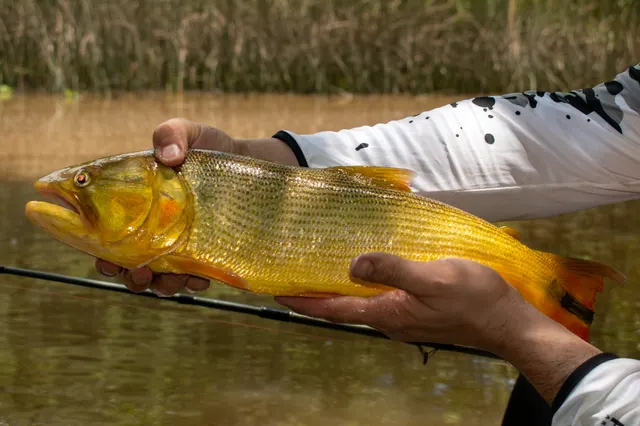 Golden doradoA brilliant gold, heavily toothed river predator of the Paraná and Paraguay systems — a characin built like a salmon and fighting like a tarpon.
Ezequiel Racker — CC BY, via iNaturalist
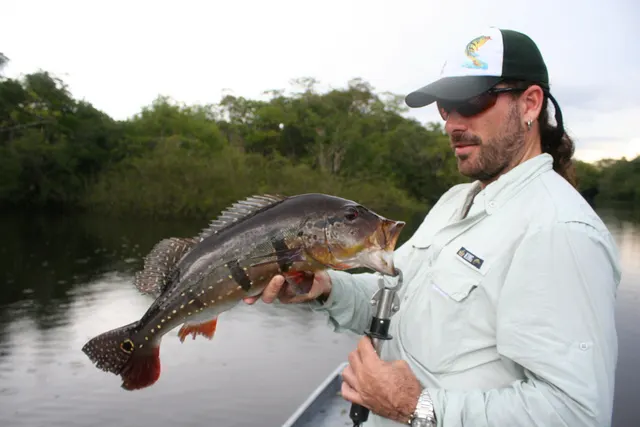 Speckled peacock bassA large Amazonian cichlid — not a bass at all — that hunts small characins in blackwater rivers and strikes surface lures with more violence than almost anything in fresh water.
Wellerson Santana — CC BY-SA 4.0, via Wikimedia Commons
Safety
Venomous and spined species — Can cause injury needing treatment
Freshwater stingrays lie buried in sand and silt in the tropical basins and are the commonest serious injury to waders by a wide margin. The barb causes a deep, extremely painful wound that frequently becomes infected, and medical help is often many hours away.
What reduces it: Shuffle your feet rather than stepping when wading — the shuffle moves a ray off rather than pinning it. Wear footwear, avoid wading in silt and sand where you cannot see the bottom, and take local advice about where wading is done at all.
Worse when:
- Shallow sandy or silty margins in low water
- Remote locations where evacuation takes many hours
Sun, dehydration and fatigue — Can cause injury needing treatment
Equatorial sun on open water, with high humidity and long days in a boat, produces heat illness and severe sunburn quickly. Dehydration degrades judgement before it produces obvious symptoms, and medical help is distant.
What reduces it: Cover up rather than relying on sunscreen, drink more than thirst suggests, take shade during the middle of the day, and treat the schedule as something to adjust rather than endure.
Check the rules before you fish
Fishing laws, bylaws, access rules, seasons, bait restrictions and permitted methods vary by location and can change. Check the current rules from the relevant authority and the water you intend to fish before fishing.
Check with:
- Current national or regional law for where you are fishing
- Current local bylaws
- The relevant fisheries authority
- The landowner, club or fishery whose water it is
- Any restrictions specific to the species or the method you intend to use
Where to go next
What swims here
How people fish here
How this compares
- PatagoniaPatagonia is the continent's cold-temperate exception and the place where an introduced salmonid fishery became world-famous at a documented ecological cost.
- The Amazon basinThe Amazon is the continent's freshwater heart and the clearest expression of a fishery organised by flood pulse rather than by temperature.
Environment and conservation
Sources and evidence
- FishBase: a global information system on fishes — Froese, R. and D. Pauly, eds. — FishBase Consortium (Scientific institute)Relied on for: Distribution, habitat association, life history and diet recorded for the species concerned.States this directlyPassage read and verified
- The IUCN Red List of Threatened Species — International Union for Conservation of Nature (Conservation authority)Relied on for: Global extinction-risk assessment, population trend and identified threats for the species concerned.States this directlyCitation checked — the work exists and is described correctly
- Code of Conduct for Responsible Fisheries — Food and Agriculture Organization of the United Nations, Rome, 1995 (Standards body)Relied on for: International principles for responsible fisheries, including small-scale and artisanal fisheries and the role of national authorities.States this directlyCitation checked — the work exists and is described correctly
Why the 6 connections on this page are here, and the sources
What swims here
Backed by research — 2 connections
Supported by peer-reviewed research or fisheries science. The sources are listed and can be checked.
Golden dorado
A distributional claim taken from reference sources on the species rather than from angling report. It states presence and asserts nothing about a fishery.
- FishBase: a global information system on fishes — Froese, R. and D. Pauly, eds. — FishBase Consortium (Scientific institute)Relied on for: Distribution, habitat association, depth range and life history recorded for the species concerned.States this directlyPassage read and verified
- The IUCN Red List of Threatened Species — International Union for Conservation of Nature (Conservation authority)Relied on for: Global distribution, population trend and extinction-risk assessment for the species concerned.States this directlyCitation checked — the work exists and is described correctly
Speckled peacock bass
A distributional claim taken from reference sources on the species rather than from angling report. It states presence and asserts nothing about a fishery.
- FishBase: a global information system on fishes — Froese, R. and D. Pauly, eds. — FishBase Consortium (Scientific institute)Relied on for: Distribution, habitat association, depth range and life history recorded for the species concerned.States this directlyPassage read and verified
- The IUCN Red List of Threatened Species — International Union for Conservation of Nature (Conservation authority)Relied on for: Global distribution, population trend and extinction-risk assessment for the species concerned.States this directlyCitation checked — the work exists and is described correctly
How people fish here
What experienced anglers do — 1 connection
Widely and independently recommended by experienced anglers and specialist sources. This is real angling knowledge, not proof: controlled evidence for it is limited, and FishingHQ records it as convention rather than as a demonstrated effect.
Lure fishing
Which branch of fishing dominates a region is a statement about practice rather than about the place, and is recorded as convention.
- FAO fishing gear types and fishing technology information — Food and Agriculture Organization of the United Nations (Scientific institute)Relied on for: Classification and description of world fishing gears and the regions in which each is used.States this directlyCitation checked — the work exists and is described correctly
- General angling website restatements of established technique — Various (Credible secondary source)Relied on for: Widely restated descriptions of regional angling practice, recorded as consensus rather than as scholarship.Background and mechanism onlyCitation checked — the work exists and is described correctly
How this compares
What experienced anglers do — 2 connections
Widely and independently recommended by experienced anglers and specialist sources. This is real angling knowledge, not proof: controlled evidence for it is limited, and FishingHQ records it as convention rather than as a demonstrated effect.
Patagonia
A continental overview joined to a record it sits above, so that the synthesis and the detail are reachable from one another rather than duplicating each other.
- FAO fishing gear types and fishing technology information — Food and Agriculture Organization of the United Nations (Scientific institute)Relied on for: Classification and description of world fishing gears and the regions in which each is used.States this directlyCitation checked — the work exists and is described correctly
- General angling website restatements of established technique — Various (Credible secondary source)Relied on for: Widely restated descriptions of regional angling practice, recorded as consensus rather than as scholarship.Background and mechanism onlyCitation checked — the work exists and is described correctly
The Amazon basin
A continental overview joined to a record it sits above, so that the synthesis and the detail are reachable from one another rather than duplicating each other.
- FAO fishing gear types and fishing technology information — Food and Agriculture Organization of the United Nations (Scientific institute)Relied on for: Classification and description of world fishing gears and the regions in which each is used.States this directlyCitation checked — the work exists and is described correctly
- General angling website restatements of established technique — Various (Credible secondary source)Relied on for: Widely restated descriptions of regional angling practice, recorded as consensus rather than as scholarship.Background and mechanism onlyCitation checked — the work exists and is described correctly
Environment and conservation
Official guidance — 1 connection
Stated by a fisheries authority, scientific institute or recognised angling body. Authoritative, but summarising rather than demonstrating.
Invasive species and biosecurity
An environmental claim about a region, limited to what the cited fisheries and conservation bodies set out.
- Code of Conduct for Responsible Fisheries — Food and Agriculture Organization of the United Nations, Rome, 1995 (Standards body)Relied on for: International principles for responsible fisheries, including small-scale fisheries and the role of national authorities.States this directlyCitation checked — the work exists and is described correctly
- Good Fish Guide — Marine Conservation Society (Conservation authority)Relied on for: Synthesis of stock and gear information relating fishing methods to their effects on stocks and habitats.Background and mechanism onlyCitation checked — the work exists and is described correctly
How FishingHQ labels evidence is explained in the evidence policy.