Speckled peacock bass
Fish · Last reviewed 2026-08-10
A large Amazonian cichlid — not a bass at all — that hunts small characins in blackwater rivers and strikes surface lures with more violence than almost anything in fresh water.
Safety: biosecurity and disease transfer — can cause serious injury or death. 6 more points apply here.
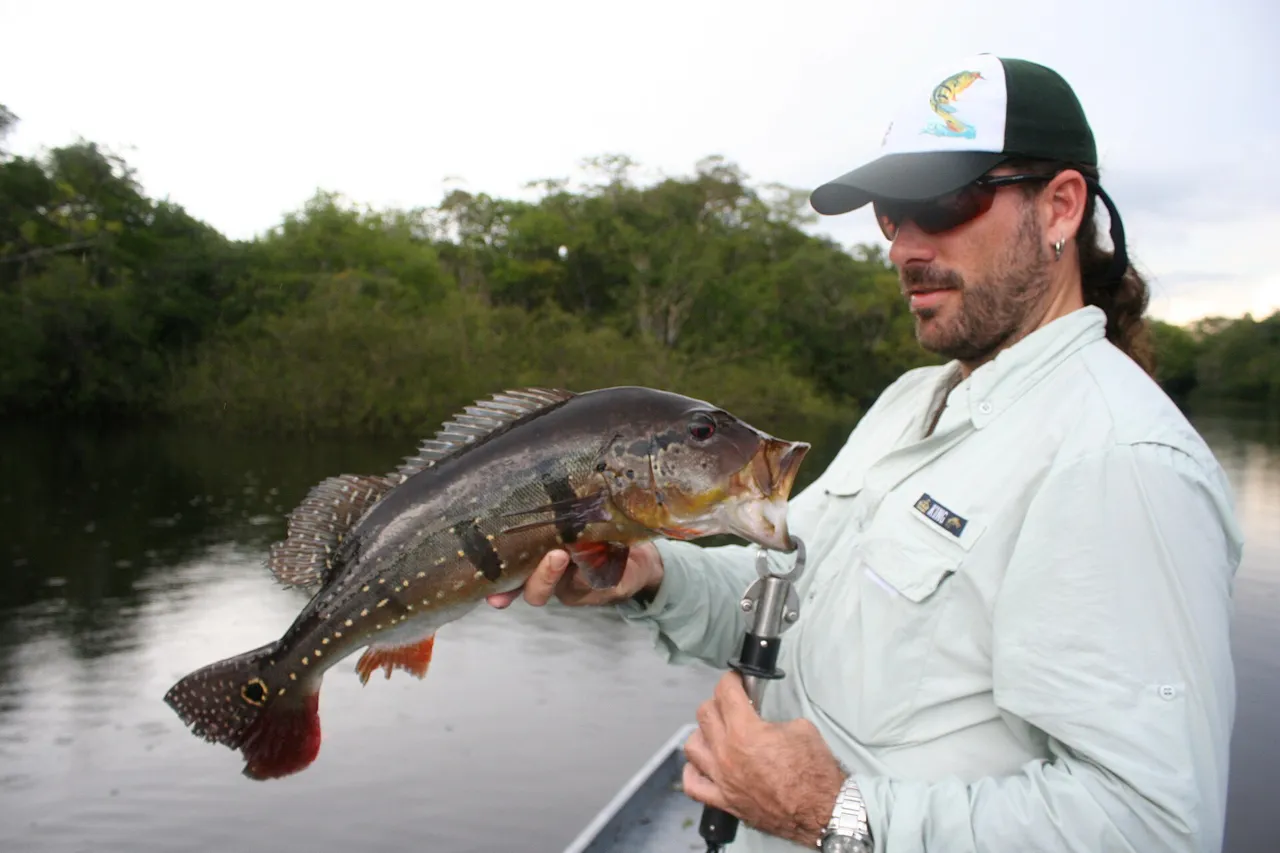
How this was identified, and who took it
Identified by: Both characters, and unusually the frame shows the TRANSITION between them rather than one end of it: the three dark vertical flank bars of the resting pattern are still present while rows of pale gold speckles have come up over the flank, which is the change the page describes. The black ocellus ringed in gold at the base of the tail is unambiguous and places the fish in Cichla.Wellerson Santana — CC BY-SA 4.0, via Wikimedia Commons — source, licence
Catching Speckled peacock bass
Everything here on fishing for it. Each entry opens the page behind it.
The peacock bass is another common name doing damage. It is not a bass and it is not related to one: Cichla is a genus of large predatory cichlids from northern South America, closer to a tilapia than to anything in the Centrarchidae.
What it is, is one of the most explosive freshwater sport fish there is. Peacock bass hunt small characins in the lagoons and channels of blackwater rivers, and they take a surface lure with a violence that regularly startles people who have caught large fish elsewhere. The strike is the entire appeal, and the fishery is built around it.
Cichla temensis specifically — the speckled peacock bass — is the largest of the genus commonly fished for and the one most sought after. It lives in the Negro and Uatumã drainages of the Amazon basin and in Orinoco tributaries in Venezuela and Colombia, in water that is acidic and stained dark by tannins, with a pH FishBase gives as roughly 5.5 to 6.5. That is unusual water chemistry and it is part of why the region's fish are what they are.
Several Cichla species are fished under the same common name and they are frequently confused, including in angling media, which is a good reason to work at species level rather than by common name.
Gear for this fish
- JerkbaitsA subsurface jerkbait covers fish holding deeper than a surface bait will move them, particularly in clear water and bright light.
- Surface luresThe large propeller surface bait ripped across the surface is the defining peacock bass method, and it works because the fish attacks a disturbance rather than inspecting a profile.
Identification
- Scientific name
- Cichla temensis
- Family
- Cichlidae
- Water
- Freshwater
- Conservation status
- Least Concern
- Regions
- Central & South America
- Three dark vertical bars on the flank in the resting pattern, which fade and are replaced by rows of pale speckles when the fish is in spawning condition — the source of the name speckled.
- A prominent black eyespot ringed with gold at the base of the tail, present in all Cichla species.
- Large elongate cichlid body with a single long dorsal fin notched between spiny and soft portions.
- Golden to olive flanks with red or orange on the lower body and fins, intensifying in breeding fish.
- Several Cichla species overlap and are routinely confused; the pattern change between barred and speckled phases in this species is one of the more useful separating features.
Size
- Typical
- 2–5 kg (4–11 lb)
- Large
- 7–9 kg (15–20 lb)
Exceptional: Over 10 kg (22 lb); maximum published weight 12.2 kg
A dry-season fishery, because the water has to fall
Peacock bass seasonality in the Amazon and Orinoco basins is the inverse of a temperate fishery: the good period is the low-water one.
FALLING AND LOW WATER CONCENTRATES THEM. During the flood, fish disperse into inundated forest and floodplain over an enormous area and are effectively unreachable. As water falls, they are forced back into lagoons, channels and river margins, where they concentrate and where the water clears.
CLEAR WATER IS THE OTHER REQUIREMENT. Peacock bass are visual ambush predators, and the sport fishery depends on being able to see and be seen — which is why it operates on clearwater and blackwater tributaries rather than on the turbid whitewater mainstem, and why it follows the falling hydrograph.
SO THE SEASON IS HYDROLOGICAL, NOT THERMAL. Water temperature barely changes across the year; water level changes by many metres, and it is the level that decides everything.
DIFFERENT TRIBUTARIES DROP AT DIFFERENT TIMES, so the regional season moves between river systems across the year, and operators follow it.
SPAWNING OCCURS IN THE LOW-WATER PERIOD in shallow margins, with pairs clearing a site and guarding eggs and fry — so the concentrated fishing season and the reproductive season overlap, which is a real consideration rather than an incidental one.
AND EL NIÑO AND YEAR-TO-YEAR HYDROLOGY MOVE THE SEASON. An unusually high or prolonged flood delays or shortens it, and a season is a prediction about a river rather than a date in a calendar.
Backed by research — why, and the sources (2)
Supported by peer-reviewed research or fisheries science. The sources are listed and can be checked.
- FishBase: a global information system on fishes — Froese, R. and D. Pauly, eds. — FishBase Consortium (Scientific institute)Relied on for: Distribution, habitat association, depth range, size, reproduction and life-history parameters recorded for the species.States this directlyPassage read and verified
- The IUCN Red List of Threatened Species — International Union for Conservation of Nature (Conservation authority)Relied on for: Assessment and range account for the species, including the habitats it depends on, its life history and the pressures acting on it.States this directlyCitation checked — the work exists and is described correctly
Heat, air, and the fish that is guarding something
Speckled peacock bass are handled in the hottest conditions any species on FishingHQ is regularly fished in, and the two things that go wrong both follow from that rather than from the fish's anatomy.
THE FIRST IS THERMAL. Amazonian air temperatures in the dry season are extreme, and a fish lifted out of water at thirty degrees into air at forty is losing its oxygen supply at the moment its oxygen demand is highest, having just fought hard in warm water that holds relatively little to begin with. Peacock bass fight in short, violent bursts that run deep into anaerobic metabolism, and the recovery from that requires exactly the oxygen the situation is not providing. A fish held up for a photograph in that heat is being asked to do the impossible, and it is a fishery where the photograph is very much the point for most visiting anglers.
What works is the same everywhere and matters more here: the fish stays in the water, is supported horizontally with a wet hand under the belly, is photographed at the surface rather than held up, and is given time facing into whatever current there is.
THE SECOND IS BEHAVIOURAL AND IT IS AN ETHICAL QUESTION RATHER THAN A TECHNICAL ONE. Peacock bass are substrate-spawning cichlids with intense parental care: a pair guards a mass of fry and attacks anything that approaches. That aggression is a large part of why the fishery works — a lure worked near a guarded brood is attacked because it is a threat, not because it is food — and it means the fish most reliably caught during the spawning period are guarding parents. A guarding fish removed from its brood, even briefly, leaves the fry undefended in water full of predators, and a fish removed permanently leaves them to fail entirely.
The honest statement is that this is a real cost, that it is inherent in the method rather than incidental to it, and that returning such fish immediately and to the spot they came from is the minimum. Whether to fish guarded broods at all is a judgement each angler and each operation makes.
What experienced anglers do — why, and the sources (4)
Widely and independently recommended by experienced anglers and specialist sources. This is real angling knowledge, not proof: controlled evidence for it is limited, and FishingHQ records it as convention rather than as a demonstrated effect.
- Understanding the Complexity of Catch-and-Release in Recreational Fishing — Reviews in Fisheries Science 15:75–167, 2007 (Scientific literature)Relied on for: The determinants of catch-and-release outcome in recreational fisheries, and the gap between angler belief and measured survival.States this directlyCitation checked — the work exists and is described correctly
- Do we need species-specific guidelines for catch-and-release recreational angling? — Biodiversity and Conservation 14:1195–1209, 2005 (Scientific literature)Relied on for: That air exposure, handling duration and water temperature are the dominant modifiable determinants of post-release survival.States this directlyCitation checked — the work exists and is described correctly
- FishBase: a global information system on fishes — Froese, R. and D. Pauly, eds. — FishBase Consortium (Scientific institute)Relied on for: Morphology, dentition, spination, thermal tolerance, reproductive strategy and depth range recorded for the species.States this directlyPassage read and verified
- The IUCN Red List of Threatened Species — International Union for Conservation of Nature (Conservation authority)Relied on for: Assessment, population trend and the life-history traits — longevity, growth rate, sex structure — that determine a population's sensitivity to the removal of large individuals.Background and mechanism onlyCitation checked — the work exists and is described correctly
Clear warm water, structure and no current: a cichlid that needs the river to slow down
Peacock bass habitat is narrower than their reputation suggests, and the narrowness explains exactly where in an Amazonian system they are found.
THEY NEED SLOW OR STILL WATER, WHICH IS THE KEY CONSTRAINT. Despite living in one of the world's great river systems, peacock bass avoid strong current. They occupy lagoons, backwaters, flooded forest margins, oxbows, lake-like river widenings and the slack water behind structure — and they are largely absent from fast main-channel flow. A visitor expecting to fish a big river for them is looking at the wrong water.
WATER CLARITY MATTERS BECAUSE THEY HUNT BY SIGHT. Peacock bass are visual ambush predators, and they are strongly associated with the clearer black-water and clear-water systems rather than with heavily silted white-water rivers. Where a river is turbid, they are scarce, and this is a substantial part of why particular tributaries are productive and adjacent ones are not.
STRUCTURE IS WHERE THEY HOLD. Fallen timber, submerged trees, rock, sandbars, weed edges, and the boundary between flooded forest and open lagoon. They are ambush predators taking small fish over a short distance, and they position accordingly.
TEMPERATURE SETS THE RANGE ABSOLUTELY. These are tropical fish with no cold tolerance, which confines them to warm water and is what limits established introduced populations to the warmest parts of the countries they have been moved to.
THE WATER LEVEL CYCLE MOVES THE WHOLE HABITAT. On a high flood the fish disperse into inundated forest and are effectively unreachable; as levels drop they concentrate in lagoons and channels with the prey that is being forced out with them. That falling-water concentration is the habitat's most important seasonal property, and it is the same flood-pulse mechanism the tigerfish and mahseer records describe on other continents.
AND THE FISH GUARD THEIR YOUNG, which ties the habitat to shallow protected margins for part of the year in a way an open-water predator's does not.
Backed by research — why, and the sources (2)
Supported by peer-reviewed research or fisheries science. The sources are listed and can be checked.
- FishBase: a global information system on fishes — Froese, R. and D. Pauly, eds. — FishBase Consortium (Scientific institute)Relied on for: Habitat association, depth range, salinity tolerance, temperature range, spawning season and reproductive mode recorded for the species.States this directlyPassage read and verified
- The IUCN Red List of Threatened Species — International Union for Conservation of Nature (Conservation authority)Relied on for: Assessment and life-history account, including the habitats the species depends on and the pressures on them.Background and mechanism onlyCitation checked — the work exists and is described correctly
Both parents guarding, and a brood that is defended rather than abandoned
Peacock bass reproduction is unusual on FishingHQ because both parents stay, and the consequences of that run through the whole fishery.
A PAIR CLEANS A SITE AND SPAWNS ON IT. Peacock bass are substrate spawners: a pair selects and cleans a hard surface — rock, submerged wood, compacted sand — in shallow protected water, and the female deposits adhesive eggs on it. There is nothing casual about the site selection and the pair will defend it before spawning as well as after.
BOTH PARENTS THEN GUARD, WHICH IS THE DISTINCTIVE PART. Unlike the single guarding male of a largemouth bass nest, peacock bass pair-bond through the brood period and both fish defend the eggs and then the shoal of fry, driving off anything that approaches. The fry are herded as a dense visible cloud and shepherded through shallow water for a considerable period.
WHICH MAKES THE GUARDING PAIR EXTRAORDINARILY AGGRESSIVE AND EXTRAORDINARILY VULNERABLE AT ONCE. A guarding peacock bass attacks anything near the fry including lures, which is the reason the fishing over broods is so easy and the reason it matters: removing either parent exposes the whole brood, and removing both effectively ends it.
THE TIMING FOLLOWS THE WATER LEVEL RATHER THAN THE MONTH. Spawning is concentrated in the low-water and falling-water period when lagoon and margin habitat is stable and shallow, which is the same part of the cycle that concentrates the fishing. That coincidence — best fishing and peak reproduction in the same weeks — is the central management tension for the species.
MULTIPLE BROODS ARE POSSIBLE within a season where conditions allow, which gives some resilience.
AND THE HONEST CONCLUSION IS ABOUT RESTRAINT RATHER THAN TECHNIQUE. A visibly guarding pair with fry is the easiest fishing available and the most costly, and returning such fish quickly and moving on is the practice the better-run fisheries encourage. What any jurisdiction requires is a matter for the competent authority.
Backed by research — why, and the sources (2)
Supported by peer-reviewed research or fisheries science. The sources are listed and can be checked.
- FishBase: a global information system on fishes — Froese, R. and D. Pauly, eds. — FishBase Consortium (Scientific institute)Relied on for: Habitat association, depth range, salinity tolerance, temperature range, spawning season and reproductive mode recorded for the species.States this directlyPassage read and verified
- The IUCN Red List of Threatened Species — International Union for Conservation of Nature (Conservation authority)Relied on for: Assessment and life-history account, including the habitats the species depends on and the pressures on them.Background and mechanism onlyCitation checked — the work exists and is described correctly
Lifecycle and reproduction
Occupies deeper littoral areas of lagoons and the sandy and rocky banks of main river channels, moving with the flood cycle. Growth is fast in productive years. As with most large predators in flood-pulse systems, the annual water cycle rather than temperature is what structures the year, and fish are concentrated or dispersed according to water level rather than season in the temperate sense.
Oviparous. Cichlids as a family are notable for parental care and Cichla species are substrate spawners that guard eggs and young, though FishBase's summary for this species does not detail the behaviour and this page therefore does not describe it in detail. Spawning is tied to the low-water period in most systems, when clear shallow margins are available.
Feeding and senses
Feeds primarily on small fish, particularly characids under about ten centimetres. The narrowness of that is the practically useful fact: peacock bass are eating small silver shoaling fish, and lures that imitate that size and profile — rather than large ones — are what the fishery actually runs on, despite the size of the predator.
Sight-dominant, hunting visually in the clear but darkly stained water of blackwater rivers where light penetration is limited but clarity is high. That combination favours high-contrast prey silhouettes, which is why surface and near-surface presentations that break the light are so effective and why the strike is so often at the surface.
Through the year
Governed by the flood pulse rather than by temperature. High water disperses fish into flooded forest and margins where they are extremely difficult to find; falling and low water concentrates them and their prey into lagoons and channels, which is when the fishery works. This is a completely different organising principle from the temperate seasonal cycle and is a good example of why FishingHQ describes drivers rather than months.
Distribution
South America: the Amazon basin in the Negro and Uatumã river drainages, and Orinoco basin tributaries in Venezuela and Colombia. Occupies deeper littoral areas in lagoons and the sandy and rocky banks of the main river channel, in acidic blackwater of about pH 5.5 to 6.5.
This is a biological range — where the species occurs, not a prediction that you will catch one. To browse the fishing geography FishingHQ holds, start at fishing places.
Why anglers care
The headline freshwater sport fish of the Amazon and Orinoco basins and the basis of a substantial destination angling economy, fished with surface lures, jerkbaits and fly. Introduced populations of various Cichla species exist elsewhere, including in Florida and parts of Asia, where they are non-native and their effects on local fish communities are a live question rather than a settled one.
Handling and returning
Large peacock bass have small but abrasive teeth and strong jaws; support the body horizontally and wet hands. The main handling issue is heat: air temperatures in this range are high, and a fish held out of the water for photographs in that heat is under real stress. Keep the fish in the water, minimise air time, and revive it properly before release.
Going further
- What does speckled peacock bass eat? — feeding biology, kept separate from what anglers infer from it.
Safety
Biosecurity and disease transfer — Can cause serious injury or death
Cichla species introduced outside their native range are effective predators of small fish and have established in several countries. Movement of live fish is the route.
What reduces it: Never move live fish or water between waters. Clean, drain, dry and check equipment. Where the species is non-native, establish what the local requirement is rather than assuming a fish should be returned.
Species that bite — Can cause injury needing treatment
The rivers this fish lives in also hold caiman, electric eels, stingrays and, in places, piranha, and the fishing is done from small boats and banks in that habitat.
What reduces it: Fish with people who know the water and treat local guidance as authoritative. Do not wade or swim in unfamiliar water. Shuffle rather than step where wading is unavoidable, because freshwater stingrays lie buried in sand.
Precautions that always apply here
- Wet your hands before touching a fish. Dry hands strip the protective mucus layer that keeps infection out.
- Support the fish's weight along its body, keep it out of the water for as short a time as possible, and hold it over something soft.
- Check, clean and dry your kit between different waters — the published guidance is 48 hours’ drying, in sunlight where possible, because a number of invasive species survive over two weeks in damp conditions. Nets, boots and wet mats move invasive species and disease more effectively than anything else anglers do.
- Never move live fish, live bait or water from one water to another.
- Tell somebody where you are going and when you expect to be back.
Check the rules before you fish
Fishing laws, bylaws, access rules, seasons, bait restrictions and permitted methods vary by location and can change. Check the current rules from the relevant authority and the water you intend to fish before fishing.
Check with:
- Current national or regional law for where you are fishing
- Current local bylaws
- The relevant fisheries authority
- The landowner, club or fishery whose water it is
- Any restrictions specific to the species or the method you intend to use
Where to go next
Similar and related fish
Where it lives
- Floodplains, backwaters and oxbowsLagoons, cut-off channels and floodplain lakes hold peacock bass, and the fishing is organised around falling water concentrating them into reachable systems.
- Lowland riversLives in acidic blackwater around pH 5.5 to 6.5, in the deeper littoral of lagoons and along the sandy and rocky banks of the main channel — and is a cichlid, not a bass.
Where you will find it
Understanding this fish
Environment and conservation
Sources and evidence
- FishBase: a global information system on fishes — Froese, R. and D. Pauly, eds. — FishBase Consortium (Scientific institute)Relied on for: Scientific name, family placement in the Cichlidae, maximum length of 99 cm and maximum published weight of 12.2 kg, South American distribution in the Amazon basin's Negro and Uatumã drainages and Orinoco basin tributaries in Venezuela and Colombia.States this directlyPassage read and verified
- FishBase: a global information system on fishes — Froese, R. and D. Pauly, eds. — FishBase Consortium (Scientific institute)Relied on for: The IUCN Red List category — Least Concern, assessed 5 November 2020 — is taken from FishBase's republication.States this directlyPassage read and verified
- Check Clean Dry — biosecurity guidance for water users — GB Non-native Species Secretariat (Conservation authority)Relied on for: The general framework by which introduced predatory fish are assessed and managed, and live movement as the transmission route.FishingHQ's interpretation of what it saysPassage read and verified
Why the 10 connections on this page are here, and the sources
Similar and related fish
Backed by research — 1 connection
Supported by peer-reviewed research or fisheries science. The sources are listed and can be checked.
Butterfly peacock bass
An identification comparison naming both binomials: Cichla ocellaris and Cichla temensis.
- FishBase: a global information system on fishes — Froese, R. and D. Pauly, eds. — FishBase Consortium (Scientific institute)Relied on for: Morphological and distributional data for Cichla ocellaris and for Cichla temensis.States this directlyPassage read and verified
- The IUCN Red List of Threatened Species — International Union for Conservation of Nature (Conservation authority)Relied on for: Separate assessments treating Cichla ocellaris and Cichla temensis as distinct species.States this directlyCitation checked — the work exists and is described correctly
How it is caught
What experienced anglers do — 1 connection
Widely and independently recommended by experienced anglers and specialist sources. This is real angling knowledge, not proof: controlled evidence for it is limited, and FishingHQ records it as convention rather than as a demonstrated effect.
Spinning
Established angling practice for this species, recorded as convention. The note states the property of the animal or its water that makes the method the answer.
- IGFA International Angling Rules and World Record Requirements — International Game Fish Association (Angling or fisheries organisation)Relied on for: Recognition of the species as an established sport fish and the angling methods and tackle classes conventionally used for it.States this directlyPassage read and verified
- General angling website restatements of established technique — Various (Credible secondary source)Relied on for: Widely restated practice connecting this species and method.Background and mechanism onlyCitation checked — the work exists and is described correctly
Gear for this fish
What experienced anglers do — 2 connections
Widely and independently recommended by experienced anglers and specialist sources. This is real angling knowledge, not proof: controlled evidence for it is limited, and FishingHQ records it as convention rather than as a demonstrated effect.
Jerkbaits
A practitioner claim about which lure family answers this species' feeding or holding behaviour.
- IGFA International Angling Rules and World Record Requirements — International Game Fish Association (Angling or fisheries organisation)Relied on for: Recognition of the species as an established sport fish taken on artificial lures, and the line and tackle classes used for it.States this directlyPassage read and verified
- General angling website restatements of established technique — Various (Credible secondary source)Relied on for: Widely restated lure practice for this species.Background and mechanism onlyCitation checked — the work exists and is described correctly
Surface lures
A practitioner claim about which lure family answers this species' feeding or holding behaviour.
- IGFA International Angling Rules and World Record Requirements — International Game Fish Association (Angling or fisheries organisation)Relied on for: Recognition of the species as an established sport fish taken on artificial lures, and the line and tackle classes used for it.States this directlyPassage read and verified
- General angling website restatements of established technique — Various (Credible secondary source)Relied on for: Widely restated lure practice for this species.Background and mechanism onlyCitation checked — the work exists and is described correctly
Where it lives
Backed by research — 2 connections
Supported by peer-reviewed research or fisheries science. The sources are listed and can be checked.
Floodplains, backwaters and oxbows
A habitat association resting on the regional identification and fisheries literature rather than on angling report.
- The Flood Pulse Concept in River-Floodplain Systems — Canadian Special Publication of Fisheries and Aquatic Sciences 106, Department of Fisheries and Oceans, Ottawa, 1989 (Scientific literature)Relied on for: That fish move laterally onto the inundated floodplain to feed and breed and return to the channel as water falls, and that floodplain inundation drives production in large river systems.States this directlyCitation checked — the work exists and is described correctly
- FAO Species Identification Guides for Fishery Purposes and the FAO Species Catalogues — Food and Agriculture Organization of the United Nations (Scientific institute)Relied on for: Habitat association and distribution of the species concerned.States this directlyCitation checked — the work exists and is described correctly
Lowland rivers
A habitat claim held to a scientific standard.
- FishBase: a global information system on fishes — Froese, R. and D. Pauly, eds. — FishBase Consortium (Scientific institute)Relied on for: That Cichla temensis is a freshwater benthopelagic Cichlidae of the Amazon and Orinoco basins occupying deeper littoral areas in lagoons and the sandy and rocky banks of the main river channel at pH 5.5 to 6.5.States this directlyPassage read and verified
Where you will find it
Backed by research — 2 connections
Supported by peer-reviewed research or fisheries science. The sources are listed and can be checked.
South American fishing
A distributional claim taken from reference sources on the species rather than from angling report. It states presence and asserts nothing about a fishery.
- FishBase: a global information system on fishes — Froese, R. and D. Pauly, eds. — FishBase Consortium (Scientific institute)Relied on for: Distribution, habitat association, depth range and life history recorded for the species concerned.States this directlyPassage read and verified
- The IUCN Red List of Threatened Species — International Union for Conservation of Nature (Conservation authority)Relied on for: Global distribution, population trend and extinction-risk assessment for the species concerned.States this directlyCitation checked — the work exists and is described correctly
The Amazon basin
A distribution association between an animal and a kind of water, rather than a claim about any named mark.
- FishBase: a global information system on fishes — Froese, R. and D. Pauly, eds. — FishBase Consortium (Scientific institute)Relied on for: Distribution, habitat association and depth range recorded for the species, including its occurrence in the water body concerned.States this directlyPassage read and verified
- The IUCN Red List of Threatened Species — International Union for Conservation of Nature (Conservation authority)Relied on for: Assessment and range account for the species, including the systems and coasts it occupies.Background and mechanism onlyCitation checked — the work exists and is described correctly
Understanding this fish
Backed by research — 1 connection
Supported by peer-reviewed research or fisheries science. The sources are listed and can be checked.
Characiform fishes as prey
Recorded diet evidence identifies characids, recorded as small shoaling characiforms under about ten centimetres as a food item of this predator at group level rather than to species. The edge points at the taxon record for that reason, and encoding it as a species-level claim would assert something the source does not.
- FishBase: a global information system on fishes — Froese, R. and D. Pauly, eds. — FishBase Consortium (Scientific institute)Relied on for: Food items recorded for this predator, given as characids, recorded as small shoaling characiforms under about ten centimetres.States this directlyPassage read and verified
- FAO Species Identification Guides for Fishery Purposes and the FAO Species Catalogues — Food and Agriculture Organization of the United Nations (Scientific institute)Relied on for: Species account describing this predator's diet, recorded at the level of characids, recorded as small shoaling characiforms under about ten centimetres.Background and mechanism onlyCitation checked — the work exists and is described correctly
Environment and conservation
Official guidance — 1 connection
Stated by a fisheries authority, scientific institute or recognised angling body. Authoritative, but summarising rather than demonstrating.
Invasive species and biosecurity
An introduction-pathway claim held to an authoritative standard.
- Check Clean Dry — biosecurity guidance for water users — GB Non-native Species Secretariat (Conservation authority)Relied on for: That the movement of live fish is a principal pathway for the introduction and spread of non-native aquatic species, and the framework by which introduced predators are assessed.States this directlyPassage read and verified
- FishBase: a global information system on fishes — Froese, R. and D. Pauly, eds. — FishBase Consortium (Scientific institute)Relied on for: That Cichla temensis is a piscivorous cichlid native to the Amazon and Orinoco basins.States this directlyPassage read and verified
How FishingHQ labels evidence is explained in the evidence policy.