What does speckled peacock bass eat?
What is established about how speckled peacock bass feeds, kept separate from what anglers infer from it.
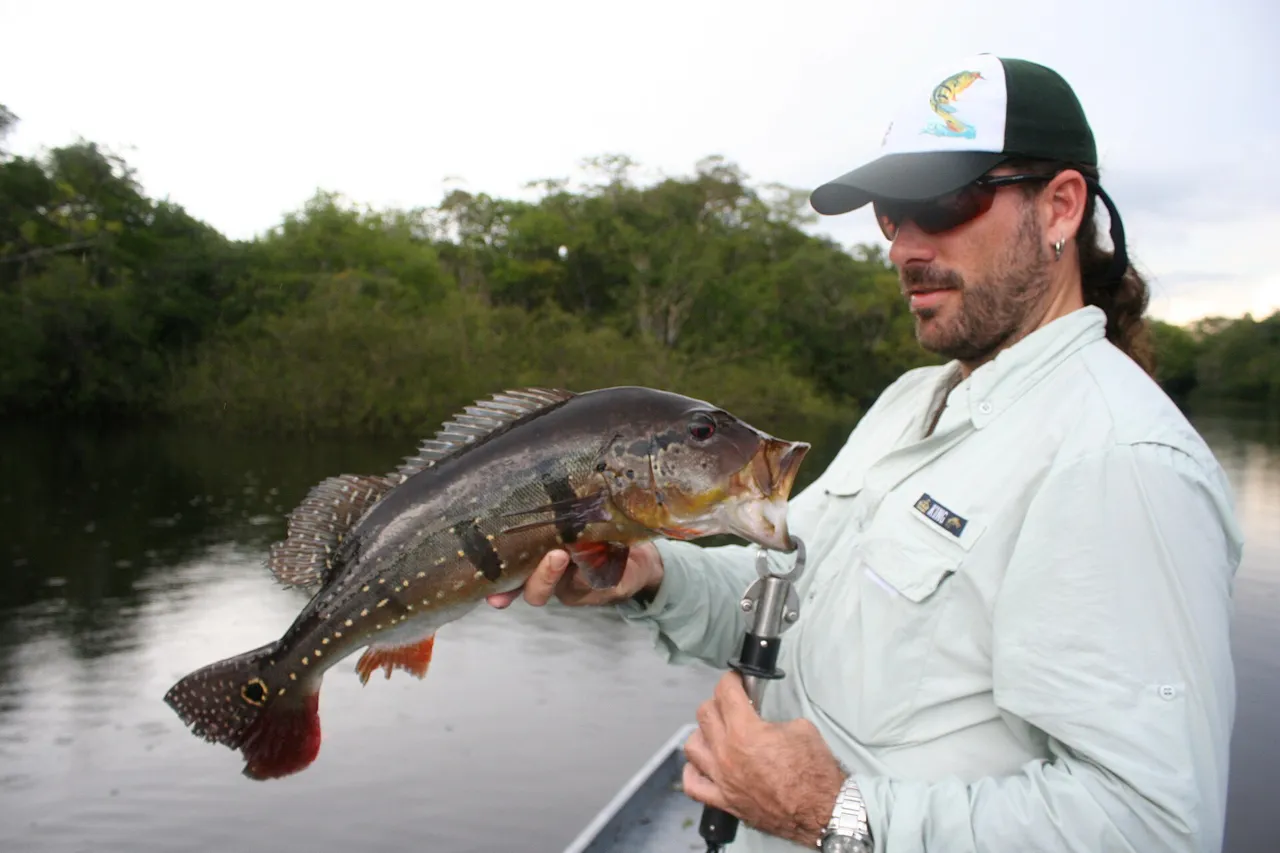
How this was identified, and who took it
Identified by: Both characters, and unusually the frame shows the TRANSITION between them rather than one end of it: the three dark vertical flank bars of the resting pattern are still present while rows of pale gold speckles have come up over the flank, which is the change the page describes. The black ocellus ringed in gold at the base of the tail is unambiguous and places the fish in Cichla.Wellerson Santana — CC BY-SA 4.0, via Wikimedia Commons — source, licenceWhat is known about how it feeds
A peacock bass is a large, powerful predator that spends its life eating very small fish, and the mismatch is the most useful thing to know about it.
The recorded diet is dominated by characids under about ten centimetres — small silver shoaling fish of the kind that occur in enormous numbers throughout the Amazon and Orinoco systems. The verified relationship is to characiform fishes, at order level, because the evidence identifies the prey by family and size rather than by species and FishingHQ holds none of those characids as records.
That narrowness is unusual. Most predators of comparable size on FishingHQ take prey across a wide size range as gape allows; this one concentrates on a band well below what it could physically swallow.
The hunting is a high-speed strike from an ambush position, usually against structure — fallen timber, rock, the edges of channels — and frequently in very shallow water. The species is aggressive to a degree that has been studied rather than merely reported, and it will strike repeatedly at an object it does not swallow.
Parental care is worth stating because it changes behaviour seasonally: peacock bass are cichlids, they guard nests and young, and a guarding fish attacks intruders. Some of what looks like feeding is territorial defence, and the two are not distinguishable from the outside.
Water level governs everything in these systems. Falling water concentrates both predator and prey into the main channels and lagoons; rising water disperses them into flooded forest where they are effectively unreachable.
The food
Prey with a verified dietary link to this fish. Each entry carries its own evidence, and each is written at the precision the source actually used: a named species where the source named one, a group or food category where it said “polychaetes”, “crustaceans” or “detritus” and meant it. That is why this list is shorter than the animal’s real diet rather than longer.
- Characiform fishes as prey — a group rather than a species: the evidence names the group
The peacock bass record identifies its prey as characids under about ten centimetres, which is a family-level identification with a size qualifier and no species behind it. The narrowness of the size range is the practically important part and it survives the taxon-level encoding.
Food with no page of its own here yet
These are real components of the diet, listed as plain text because FishingHQ has no page for them yet. Inventing pages to make the list look fuller would be the fabrication this whole approach exists to prevent.
- juvenile cichlids
- smaller peacock bass (cannibalism)
- freshwater shrimp
- small catfish
What anglers do with this
Everything below is interpretation, not finding. It is what experienced anglers conclude from the biology above, and the reasoning is usually sound and almost never tested. It is separated from the biology deliberately.
The prey-size narrowness is the most actionable fact and it runs against instinct: the fishery works on presentations imitating small fish rather than large ones, despite the size of the predator. Anglers state this consistently and it is a direct inference from the recorded diet.
The aggression and the repeated striking are used to argue for persistence — working the same fish rather than moving on — which is practitioner reasoning from an observed behaviour.
The water-level relationship is the timing, and it is the organising fact of the whole fishery: the season is set by the hydrological cycle rather than by a calendar, and a trip planned against the wrong water level fails regardless of everything else.
Where nest-guarding fish are being caught, returning them promptly matters more than usual, because a guarding parent removed from a nest leaves the young exposed.
What this does not establish
One taxon-level relationship, encoded at order level where the source says family with a size qualifier — a deliberate loss of precision rather than a gain. Nothing here establishes proportions. The genus contains several species that are frequently not separated in dietary studies, and the account may not describe all of them equally well.
Where this connects
These are the baits, lures, methods and explainers FishingHQ already joins to this fish — which is why the list is sometimes short. They are not chosen for this page, and a link here means an evidenced relationship exists, not that it follows from the diet.
Lures recorded for this species
Methods used for it
Where it lives
This page covers feeding. The Speckled peacock bass record covers identification, lifecycle, seasonal behaviour, handling and the sources behind all of it.
Reviewed 2026-08-12.