Characiform fishes as prey
Explainer · Last reviewed 2026-08-12
The tetras and their relatives — the dominant small shoaling freshwater fish of South America and Africa, and the forage base of the predators in both.
Background, not a fishing profile
This page is here so FishingHQ can describe a biological relationship accurately — usually because a fish covered elsewhere on the site feeds on this. It covers what it is, where it lives and the evidence behind that relationship, and deliberately nothing about methods, bait or tackle. Its presence here is not a statement that anybody fishes for it.
Characiformes is a large order of freshwater fish centred on two continents, and in both it occupies the position that small cyprinids occupy in Europe: abundant, shoaling, mid-water, and eaten by everything larger.
In South America the family Characidae supplies most of it — the tetras and their relatives, present in enormous numbers and variety. In Africa the family Alestidae does the same job, and the genera Brycinus and Micralestes are named directly in the African tigerfish record as recorded prey.
This page exists because that is the granularity the evidence has. Diet studies of tropical freshwater predators report characids, or a named genus, and rarely a species; FishingHQ holds none of those genera as species pages, and pointing an edge at a representative characiform because one happened to exist would be exactly the substitution FishingHQ refuses to make.
The scope is the order Characiformes: the African Alestidae, the South American Characidae and their relatives, at the small shoaling sizes taken as prey. It does not cover the large characiforms that are angling targets in their own right — the golden dorado and the payara are characiforms, and where a predator takes one of those the edge belongs on the species page.
The sábalo is also a characiform, and the golden dorado's predation on it is recorded at species level precisely because that evidence supports it.
Where to go next
Fish this applies to
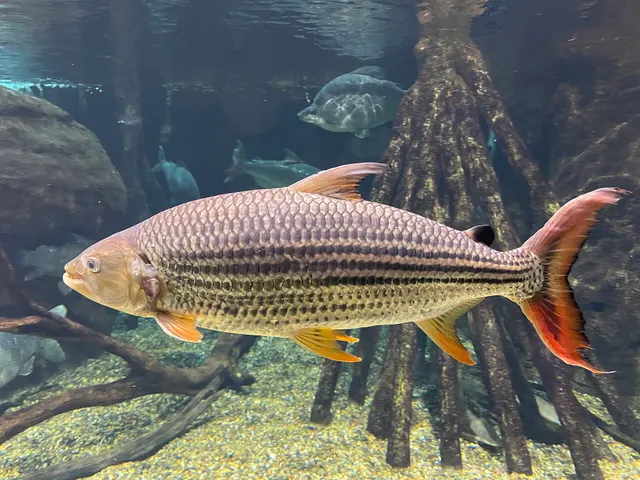 African tigerfishThe tigerfish page names Brycinus and Micralestes among recorded prey. Both are Alestidae, the African characiform family, and FishingHQ holds neither as a species — so the edge is written at the order the evidence identifies rather than pointed at a substitute.
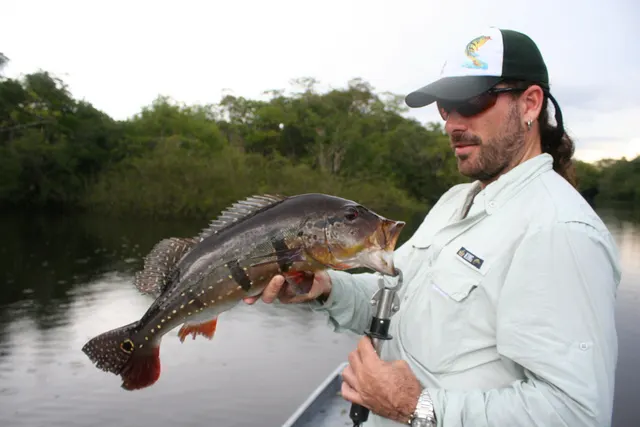 Speckled peacock bassThe peacock bass record identifies its prey as characids under about ten centimetres, which is a family-level identification with a size qualifier and no species behind it. The narrowness of the size range is the practically important part and it survives the taxon-level encoding.
More explainers
Not related to this page — just the rest of the section. There is little else joined to this subject yet, and a short page should still lead somewhere.
Sources and evidence
- FishBase: a global information system on fishes — Froese, R. and D. Pauly, eds. — FishBase Consortium (Scientific institute)Relied on for: Recorded food items for the species this category is cited for, at the granularity the database records them.States this directlyPassage read and verified
- FAO Species Identification Guides for Fishery Purposes and the FAO Species Catalogues — Food and Agriculture Organization of the United Nations (Scientific institute)Relied on for: Species accounts describing feeding, given as food category or broad taxon where that is what the account states.States this directlyCitation checked — the work exists and is described correctly
Why the 2 connections on this page are here, and the sources
Fish this applies to
Backed by research — 2 connections
Supported by peer-reviewed research or fisheries science. The sources are listed and can be checked.
African tigerfish
Recorded diet evidence identifies alestid characiforms, recorded as the genera Brycinus and Micralestes as a food item of this predator at group level rather than to species. The edge points at the taxon record for that reason, and encoding it as a species-level claim would assert something the source does not.
- FishBase: a global information system on fishes — Froese, R. and D. Pauly, eds. — FishBase Consortium (Scientific institute)Relied on for: Food items recorded for this predator, given as alestid characiforms, recorded as the genera Brycinus and Micralestes.States this directlyPassage read and verified
- FAO Species Identification Guides for Fishery Purposes and the FAO Species Catalogues — Food and Agriculture Organization of the United Nations (Scientific institute)Relied on for: Species account describing this predator's diet, recorded at the level of alestid characiforms, recorded as the genera Brycinus and Micralestes.Background and mechanism onlyCitation checked — the work exists and is described correctly
Speckled peacock bass
Recorded diet evidence identifies characids, recorded as small shoaling characiforms under about ten centimetres as a food item of this predator at group level rather than to species. The edge points at the taxon record for that reason, and encoding it as a species-level claim would assert something the source does not.
- FishBase: a global information system on fishes — Froese, R. and D. Pauly, eds. — FishBase Consortium (Scientific institute)Relied on for: Food items recorded for this predator, given as characids, recorded as small shoaling characiforms under about ten centimetres.States this directlyPassage read and verified
- FAO Species Identification Guides for Fishery Purposes and the FAO Species Catalogues — Food and Agriculture Organization of the United Nations (Scientific institute)Relied on for: Species account describing this predator's diet, recorded at the level of characids, recorded as small shoaling characiforms under about ten centimetres.Background and mechanism onlyCitation checked — the work exists and is described correctly
How FishingHQ labels evidence is explained in the evidence policy.