The Amazon basin
Fishing regions · Last reviewed 2026-08-14
The largest freshwater system on earth, holding more fish species than the Atlantic Ocean, and running on a flood pulse that moves the whole fishery into the forest and back every year.
Being listed here is not permission to fish. What that meansClose
Access, fishing rights, seasons, licences, local bylaws and permitted methods vary and can change. Check current access, permission, local regulations, closures and restrictions before you travel or fish. FishingHQ describes what the ground is and names who holds the answer; it does not hold the answer itself.
Find the authority for a jurisdiction · What FishingHQ does and does not cover
The Amazon is a system-tier record because the physical behaviour of the water explains the fishery completely, and no jurisdiction-level account could.
THE FLOOD PULSE IS THE ORGANISING PHENOMENON. The basin rises and falls by many metres annually, flooding an enormous area of forest for months and then draining back into channels and lagoons. That is not a flood in the temperate sense of an event; it is the normal annual state of the system, and the entire ecology is built around it. Fish move into the inundated forest to feed and breed on fruit, seeds, insects and the productivity the flood releases, and retreat to the channels and lagoons as it falls.
WHICH MEANS THE FISHERY HAS A SEASON THAT IS A WATER LEVEL RATHER THAN A MONTH. At high water the fish are dispersed through thousands of square kilometres of flooded forest and are effectively unreachable; as the water drops they are concentrated into a shrinking volume with their prey, and that falling and low-water period is when the fishing works. The dates shift between years and between sub-basins.
THREE KINDS OF WATER MAKE UP THE SYSTEM AND THEY ARE GENUINELY DIFFERENT. White water is silt-laden, nutrient-rich and productive, draining the Andes. Black water is stained dark by dissolved organic acids, is nutrient-poor, acidic and remarkably clear despite its colour. Clear water drains ancient shields and is exactly what it says. The species assemblages, the visibility and the fishing methods differ between them, and the peacock bass fishery in particular is a black-water and clear-water proposition rather than a white-water one.
THE DIVERSITY IS THE OTHER HEADLINE FACT. The basin holds more freshwater fish species than any other system on earth — a figure exceeding the entire Atlantic Ocean's fish fauna — and a great many remain undescribed. That is a genuine scientific statement rather than a rhetorical one.
AND THE SPORT FISHERY IS A SMALL PART OF A VAST SUBSISTENCE AND COMMERCIAL ONE. Fish are the principal protein source for much of the basin's population, and the recreational fishery sits alongside that rather than replacing it. Nothing here states what any current rule is.
What fishing here is like
The largest river system on earth and the most species-rich fresh water anywhere, running on an annual flood pulse of many metres that moves the entire fishery into flooded forest and back again. The recreational fishery is dominated by peacock bass in black and clear water, with payara, arapaima, catfish and a very large number of other species available. Access is by live-aboard boat, mothership and small craft; the productive season is a falling and low-water window that shifts between years and between sub-basins. Subsistence and commercial fishing are far larger than the sport fishery and shape the resource.
What dominates
Lure and fly fishing for peacock bass in lagoons, backwaters and flooded-forest margins, principally at low water. Fishing for payara and other predators around rapids and channel structure. Fly and lure fishing for arapaima where permitted, and under managed community arrangements in some areas. Bait and lure fishing for the large catfishes of the main channels. Traditional and subsistence methods including nets, traps, spears and hand lines, which dominate the basin's fishing overall. Live-aboard and mothership operations providing access to remote tributaries.
The water available
White-water rivers carrying Andean silt, nutrient-rich and turbid; black-water rivers stained by dissolved organic acids, acidic, nutrient-poor and clear; clear-water rivers draining ancient shields; extensive seasonally flooded forest — várzea on white water and igapó on black water; lagoons, oxbows and backwaters connected to the main channels at high water and isolated at low; rapids and rocky channel sections; and enormous main-stem rivers many kilometres wide.
How the rules are structured
The basin spans several countries, principally Brazil, Peru, Colombia, Ecuador, Bolivia and Venezuela, each with its own fisheries administration, and rules differ across borders that are invisible on the water. National environmental and fisheries agencies set closed seasons, size limits and species protections, and many closed seasons are tied to the reproductive period on a defined annual basis. Indigenous territories and protected areas carry their own arrangements and in many cases their own community management, and access to them is separately controlled. Arapaima in particular is subject to specific protection and to community-managed harvest arrangements in parts of the basin. Export and international trade in some species is separately regulated. FishingHQ does not state what any current rule is.
Who to ask
- The national fisheries or environmental agency of the country whose waters are being fished — the basin spans several and their rules differ.
- The management authority of any indigenous territory, extractive reserve or protected area in which fishing is proposed, which frequently administers its own community arrangements.
- State or departmental environmental authorities where fisheries administration is devolved below national level, which it is in several basin countries.
- Any community management body operating a managed harvest arrangement, particularly for arapaima, whose consent is a practical as well as a legal matter.
Words you will meet
- Várzea
- Seasonally flooded forest along white-water rivers, nutrient-rich because of the silt the flood deposits, and among the most productive freshwater habitats on earth.
- Igapó
- Seasonally flooded forest along black-water rivers. Nutrient-poor and acidic by comparison with várzea, and holding a different fauna.
- Black water
- River water stained dark brown by dissolved organic acids leached from forest litter, nutrient-poor, acidic and — despite the colour — very clear. The principal peacock bass habitat.
- The flood pulse
- The annual rise and fall of the river by many metres, which floods enormous areas of forest and then drains. The organising ecological process of the entire basin, and the thing that decides when the fishing works.
- Pirarucu / arapaima
- One of the largest freshwater fishes in the world, an obligate air-breather of the basin's lakes and slow waters, subject to specific protection and to community-managed harvest arrangements in parts of the basin.
Conditions and hazards
Remoteness is the dominant consideration: much of the fishery is days from medical assistance and outside any communications coverage, which makes evacuation planning and a filed itinerary genuinely important rather than a formality. Heat and humidity are extreme and dehydration and heat illness are common causes of trouble. Mosquito-borne disease is a real risk across the basin and prophylaxis and vaccination are matters for a travel medicine practitioner rather than for a fishing site. Water hazards include very strong currents in main channels, rapids, submerged timber, and rapidly changing levels. Wildlife considerations include caiman, electric eels, stingrays in shallow sandy margins — where shuffling rather than stepping is the established practice — and piranha, whose actual risk is routinely overstated relative to the others. Boat traffic on main channels is heavy and includes large vessels. Local guidance is authoritative on all of it.
The flood pulse: why the fishing season is a water level and not a month
Every question about when to fish the Amazon resolves into a question about where the water is, and the mechanism is worth understanding because it applies across the whole basin and to almost every species in it.
THE RIVER RISES AND FALLS BY MANY METRES EVERY YEAR. Rain in the headwaters and across the basin produces an annual flood that inundates an enormous area of forest for months, then drains back into the channels, lagoons and lakes. This is the system's normal condition rather than an event, and the fish have evolved around it completely.
AT HIGH WATER THE FISH LEAVE THE RIVER. Flooded forest offers food that the channel cannot — fruit, seeds, insects, and the invertebrate production the inundation releases — and fish disperse into it across thousands of square kilometres. Many species breed on the rise. From a fishing point of view they have simply gone: the water they occupy is a forest, it is impossible to fish effectively, and the fish are not concentrated anywhere.
AS THE WATER FALLS, EVERYTHING IS FORCED BACK. Fish must retreat to permanent water or be stranded, and they do so along with their prey. Predators follow, and the shrinking lagoons and channels concentrate an entire season's production into a small volume. That falling and low-water period is when the recreational fishery operates, and it is the whole basis of the peacock bass season.
SO THE DATES MOVE AND THEY MOVE BY SUB-BASIN. Tributaries drain at different rates and the pulse arrives at different times across the basin, which is why an operation may fish one river system in one part of the year and another elsewhere. A single Amazon calendar does not exist.
WATER CLARITY FOLLOWS THE SAME CURVE and it matters for a sight-hunting predator. Falling black water clears; falling white water remains turbid. That is a substantial part of why the peacock bass fishery is a black-water and clear-water proposition.
AND THE SAME MECHANISM DRIVES THE SUBSISTENCE FISHERY, at a far larger scale. Fish trapped in shrinking lagoons are how a great many people in the basin obtain protein, and the low-water period is a season of plenty for entirely practical reasons. The record's tigerfish and mahseer material describes the same flood-pulse logic in Africa and Asia; this is the largest example of it on earth.
Backed by research — why, and the sources (2)
Supported by peer-reviewed research or fisheries science. The sources are listed and can be checked.
- The IUCN Red List of Threatened Species — International Union for Conservation of Nature (Conservation authority)Relied on for: Assessment and habitat accounts for the species of the system, including the habitats they depend on and the pressures on them.States this directlyCitation checked — the work exists and is described correctly
- FishBase: a global information system on fishes — Froese, R. and D. Pauly, eds. — FishBase Consortium (Scientific institute)Relied on for: Distribution, habitat association and life history of the species occurring in the system.States this directlyPassage read and verified
Black, white and clear: three kinds of river and three different fisheries
The Amazon is routinely spoken of as one river and it is at least three kinds of water, distinguishable by eye and holding different fish.
WHITE WATER IS ANDEAN AND IT IS TURBID. Rivers draining the Andes carry an enormous suspended sediment load, which makes them opaque, pale brown and highly productive — the silt is nutrient. The flooded forest along them is várzea, the most productive freshwater habitat in the basin, and the fish assemblage is dominated by species adapted to low visibility, including the great migratory catfishes and characins that navigate by other senses.
BLACK WATER IS FOREST-DERIVED AND IT IS CLEAR. Rivers draining ancient lowland forest carry dissolved organic acids leached from leaf litter, which stain the water deep tea-brown, acidify it and leave it nutrient-poor. Critically, it is also very clear: visibility in black water is far better than the colour suggests. That combination — clear, acidic, unproductive — supports fewer fish overall but favours sight-hunting predators, and it is the classic peacock bass environment.
CLEAR WATER DRAINS ANCIENT SHIELDS and is intermediate: low sediment, low stain, good visibility, moderate productivity.
WHICH MEANS THE METHOD FOLLOWS THE WATER TYPE. Sight-based lure and fly fishing for peacock bass works in black and clear water and works badly in white. Bait and scent-led approaches for the large catfishes work in white water where nothing visual would. An angler arriving with one approach for the whole basin has misunderstood it.
MOSQUITOES DIFFER TOO, which is a genuinely practical consequence rather than an aside: black water's acidity suppresses mosquito breeding markedly, and black-water trips are considerably more comfortable than white-water ones.
AND THE MEETING OF WATER TYPES IS ITSELF A FEATURE. Where a black-water tributary joins a white-water main stem the two run side by side for a considerable distance before mixing, and the boundary is a visible line in the river. Those confluences concentrate fish and are among the more productive pieces of water in the system — which is a physical explanation rather than a location recommendation.
Backed by research — why, and the sources (2)
Supported by peer-reviewed research or fisheries science. The sources are listed and can be checked.
- The IUCN Red List of Threatened Species — International Union for Conservation of Nature (Conservation authority)Relied on for: Assessment and habitat accounts for the species of the system, including the habitats they depend on and the pressures on them.States this directlyCitation checked — the work exists and is described correctly
- FishBase: a global information system on fishes — Froese, R. and D. Pauly, eds. — FishBase Consortium (Scientific institute)Relied on for: Distribution, habitat association and life history of the species occurring in the system.States this directlyPassage read and verified
A river that feeds a continent
Fishing in the Amazon is primarily a food system and secondarily a sport, and the proportions matter.
FISH IS THE PROTEIN OF THE BASIN. Per-capita fish consumption in parts of the Amazon is among the highest in the world, and for riverine communities wild-caught fish is the principal source of animal protein. That makes the basin's fishery a nutrition question before it is anything else.
RIBEIRINHO COMMUNITIES LIVE BY THE RIVER AND WITH IT. Households along the channels and lakes fish with nets, lines, traps and spears, moving with the flood cycle, and the knowledge of where fish are at which water level is detailed and transmitted.
COMMUNITY MANAGEMENT OF FLOODPLAIN LAKES IS A REAL AND SUCCESSFUL INSTITUTION. Agreements under which communities control access to particular lakes, protect them in the low-water season and harvest under agreed rules have produced measurable recoveries of arapaima in particular, and the model is one of the better-documented community fisheries successes anywhere.
THE SPORT FISHERY IS SMALL, HIGH-VALUE AND CONCENTRATED. Peacock bass fishing from mothership and lodge operations on clearwater tributaries serves an international market and is release-oriented, and where it is structured to pay communities for protecting water it can align with the food fishery rather than compete with it.
THE ORNAMENTAL FISH TRADE IS A SIGNIFICANT LIVELIHOOD in parts of the basin, supplying the aquarium market, and it supports communities in areas where little else does.
AND FISHINGHQ DOES NOT SPEAK FOR THESE COMMUNITIES. What is recorded here is what the public and scientific record supports about how the basin's fisheries work.
Official guidance — why, and the sources (2)
Stated by a fisheries authority, scientific institute or recognised angling body. Authoritative, but summarising rather than demonstrating.
- Fishers' Craft and Lettered Art: Tracts on Fishing from the End of the Middle Ages — University of Toronto Press, 1997 (Scientific literature)Relied on for: The historical development of fishing practice and its transmission, and the method of reading a fishing tradition from its documentary record.States this directlyCitation checked — the work exists and is described correctly
- Code of Conduct for Responsible Fisheries — Food and Agriculture Organization of the United Nations, Rome, 1995 (Standards body)Relied on for: Principles for fisheries management including the treatment of traditional, small-scale and shared fisheries, against which historical arrangements can be read.Background and mechanism onlyCitation checked — the work exists and is described correctly
Nets, harpoons, handlines and a lure fishery in clear water
The basin's disciplines are dominated by small-scale food fishing, with a specialist sport fishery on particular water.
GILLNETTING AND SEINE FISHING is the principal commercial and subsistence method, worked from small boats in channels, lakes and floodplain.
HANDLINING AND SIMPLE ROD FISHING is universal, and it is how most households take fish.
HARPOON AND SPEAR FISHING IS THE ARAPAIMA METHOD. Because arapaima are obligate air breathers and must surface to breathe, they can be located and taken with a harpoon by a fisher who knows the lake — which is exactly why they are so easy to overfish and why the community management model that counts surfacing fish works.
TRAPS AND WEIRS work the channels between lakes and river as water levels drop.
BOW FISHING AND GIGGING are practised in the shallow flooded margins in places.
LURE FISHING FOR PEACOCK BASS is the sport discipline, worked on clearwater and blackwater tributaries where visibility permits sight fishing, with surface lures and heavy tackle for fish that hit hard and run into structure.
FLY FISHING FOR PEACOCK BASS AND OTHER SPECIES has developed on the same water.
ORNAMENTAL FISH COLLECTION uses fine nets and traps in small streams and margins, and it is a distinct skilled practice.
AND THE WATER TYPE DECIDES WHAT IS POSSIBLE. Whitewater rivers are turbid and are netted; clearwater and blackwater tributaries are transparent and can be sight-fished, which is why the sport fishery is concentrated where it is.
What experienced anglers do — why, and the sources (2)
Widely and independently recommended by experienced anglers and specialist sources. This is real angling knowledge, not proof: controlled evidence for it is limited, and FishingHQ records it as convention rather than as a demonstrated effect.
- General angling website restatements of established technique — Various (Credible secondary source)Relied on for: Widely restated practice associating this discipline or technique with this place, recorded as practitioner consensus rather than as tested fact.Background and mechanism onlyCitation checked — the work exists and is described correctly
- Fishers' Craft and Lettered Art: Tracts on Fishing from the End of the Middle Ages — University of Toronto Press, 1997 (Scientific literature)Relied on for: That fishing traditions develop around the water and fish available to them, and the historical method of reading such traditions from their documentary record.States this directlyCitation checked — the work exists and is described correctly
Rubber, roads and a fishery counted late
The Amazon's fisheries history is short in the written record and long in practice, and its modern chapter is one of accelerating pressure.
INDIGENOUS AND RIVERINE FISHERIES ARE ANCIENT AND CONTINUOUS, and the technologies — traps, weirs, harpoons, fish poisons in some traditions — are long established and adapted to the flood cycle.
THE RUBBER BOOM BROUGHT POPULATION AND MARKETS to the basin at the end of the nineteenth century, and with them a commercial demand for fish to feed a growing riverine population.
SALTED PIRARUCU WAS THE BASIN'S TRADED PRODUCT. Arapaima, salted and dried, was traded widely through the basin as a staple, and the commercial demand for it drove the species to severe depletion across much of its range.
ROADS AND URBAN GROWTH CHANGED THE FISHERY in the twentieth century, with growing cities creating markets that a subsistence fishery could not meet without commercialisation, and with ice and transport extending the reach of commercial fishing far up the tributaries.
THE COMMUNITY MANAGEMENT MOVEMENT EMERGED FROM THE LATE TWENTIETH CENTURY, with lake agreements, protected floodplain lakes and, for arapaima, a counting-and-quota system operated by the communities themselves. The recovery of arapaima under those arrangements is one of the clearest community fisheries successes on record.
HYDROPOWER AND DEFORESTATION ARE THE MODERN PRESSURES. Dams on major tributaries fragment migration routes for the basin's long-distance migratory catfish, and deforestation alters the flood regime and the flooded-forest habitat that a great deal of the fauna depends on.
AND THE FLOODED FOREST IS THE HABITAT AT STAKE. Many Amazonian fish feed on fruit and seeds from inundated forest, so forest loss is directly a fisheries issue rather than an adjacent one.
Official guidance — why, and the sources (2)
Stated by a fisheries authority, scientific institute or recognised angling body. Authoritative, but summarising rather than demonstrating.
- Fishers' Craft and Lettered Art: Tracts on Fishing from the End of the Middle Ages — University of Toronto Press, 1997 (Scientific literature)Relied on for: The historical development of fishing practice and its transmission, and the method of reading a fishing tradition from its documentary record.States this directlyCitation checked — the work exists and is described correctly
- Code of Conduct for Responsible Fisheries — Food and Agriculture Organization of the United Nations, Rome, 1995 (Standards body)Relied on for: Principles for fisheries management including the treatment of traditional, small-scale and shared fisheries, against which historical arrangements can be read.Background and mechanism onlyCitation checked — the work exists and is described correctly
National law, community agreements and a protected giant
The Amazon's fisheries governance combines national frameworks with community arrangements that carry a great deal of the real management.
NATIONAL FISHERIES AUTHORITIES SET THE FRAMEWORK in each basin country, with closed seasons, minimum sizes, gear restrictions and protected species, and with state or provincial implementation.
CLOSED SEASONS PROTECT THE SPAWNING MIGRATION. The piracema — the upstream spawning migration on rising water — is protected by closed seasons in several countries, and it is one of the more significant fisheries measures in the basin.
ARAPAIMA IS THE SPECIES-SPECIFIC CASE. Severely depleted by commercial fishing, it is protected with capture restricted, and where harvest is permitted it is generally under a community management arrangement with a quota based on an actual count of the fish present. Because the species must surface to breathe, that count is possible — which is a rare instance of a species' biology making a quota verifiable.
COMMUNITY FISHING AGREEMENTS ARE THE OPERATIVE INSTRUMENT IN MANY PLACES. Lake-by-lake agreements determining who may fish, when and with what gear, recognised to varying degrees in national law, carry a substantial share of the real management of the floodplain.
PROTECTED AREAS AND SUSTAINABLE USE RESERVES cover large parts of the basin, and several are specifically designed around allowing regulated local resource use rather than excluding it.
ORNAMENTAL FISH EXPORT IS SEPARATELY REGULATED, with species lists and quotas.
SPORT FISHING OPERATES UNDER PERMITS AND FREQUENTLY UNDER COMMUNITY AGREEMENT, and where lodges pay communities for access to protected water the arrangement is the fishery's licence in the meaningful sense.
AND FISHINGHQ DOES NOT STATE WHAT ANY OF THIS CURRENTLY PERMITS.
Official guidance — why, and the sources (2)
Stated by a fisheries authority, scientific institute or recognised angling body. Authoritative, but summarising rather than demonstrating.
- Code of Conduct for Responsible Fisheries — Food and Agriculture Organization of the United Nations, Rome, 1995 (Standards body)Relied on for: Principles for the management of fisheries, including licensing, closed seasons, size limits and the treatment of small-scale and shared stocks.States this directlyCitation checked — the work exists and is described correctly
- Good Fish Guide — Marine Conservation Society (Conservation authority)Relied on for: Assessment of fisheries and the management measures applied to them, including the instruments used and their purpose.Background and mechanism onlyCitation checked — the work exists and is described correctly
Some of what lives here
Fish recorded here that FishingHQ holds a reviewed photograph of. It is not a complete list of what The Amazon basin holds, and it is not a prediction that you will catch any of them — it is a way in to the ones we can show you.
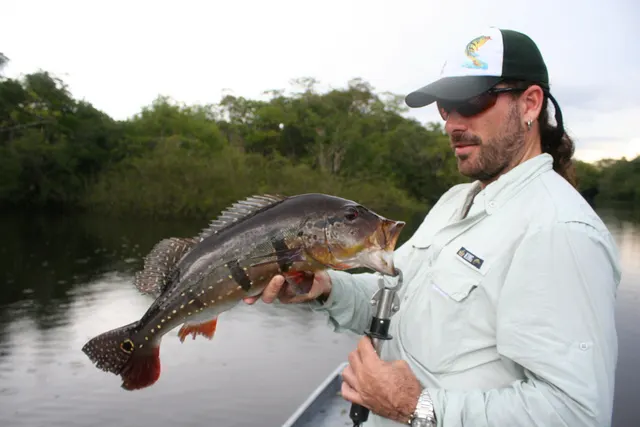 Speckled peacock bassA large Amazonian cichlid — not a bass at all — that hunts small characins in blackwater rivers and strikes surface lures with more violence than almost anything in fresh water.
Wellerson Santana — CC BY-SA 4.0, via Wikimedia Commons
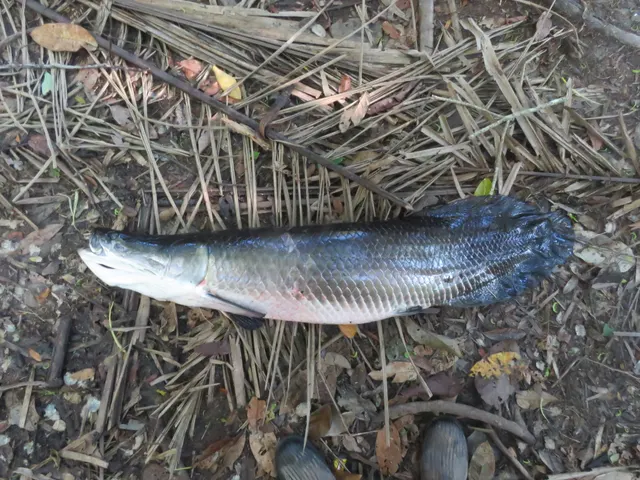 ArapaimaOne of the largest freshwater fish in the world, an air-breathing Amazonian giant that must surface regularly and is managed through community quota systems.
Vincent A. Vos — CC BY, via iNaturalist
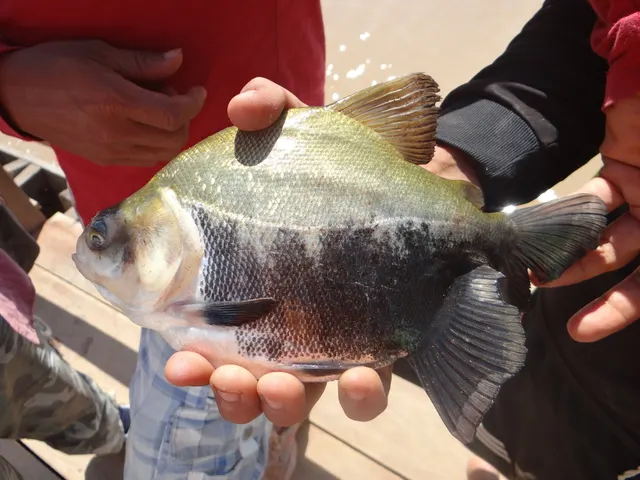 TambaquiA very large Amazonian characin with molar-like teeth for crushing fruit and seeds, feeding in flooded forest and dispersing seeds as it goes.
Vincent A. Vos — CC BY, via iNaturalist
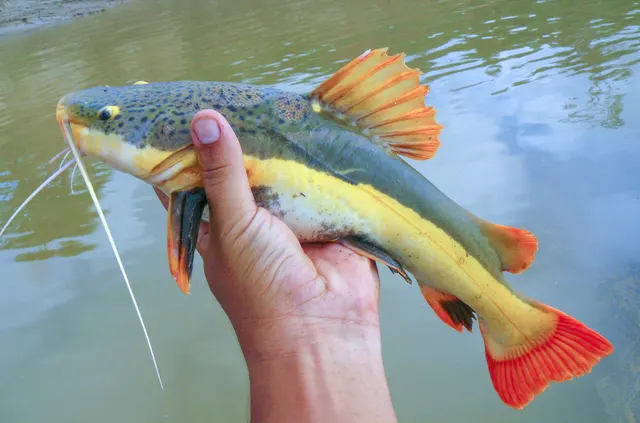 Redtail catfishA very large Amazonian catfish with a brilliant orange-red tail and a white belly stripe, popular in the aquarium trade and unsuited to it.
w_endo — CC0, via iNaturalist
Safety
Further safety reading
- Dangerous animals where you fish — Caimans, venomous snakes and stingrays occupy exactly the margins and shallows anglers work, and remoteness turns a treatable injury into a serious one.
- Fishing alone — Much of the fishery is days from medical assistance and outside communications coverage, which makes evacuation planning a genuine requirement rather than a formality.
- Sun, dehydration and fatigue — Extreme heat and humidity cause more trouble in the basin than any of the wildlife, and dehydration and heat illness are the common causes of a trip going wrong.
Check the rules before you fish
Fishing laws, bylaws, access rules, seasons, bait restrictions and permitted methods vary by location and can change. Check the current rules from the relevant authority and the water you intend to fish before fishing.
Check with:
- Current national or regional law for where you are fishing
- Current local bylaws
- The relevant fisheries authority
- The landowner, club or fishery whose water it is
- Any restrictions specific to the species or the method you intend to use
Where to go next
What swims here
- ArapaimaAn obligate air-breathing giant of the basin's lakes and slow waters, subject to specific protection and to community-managed harvest arrangements in parts of the system.
- Butterfly peacock bassA smaller peacock bass of the basin's slow and still waters, widely distributed and frequently taken alongside its larger relatives.
- PayaraOccupies fast water, rapids and channel structure, hunting in current where the peacock bass will not go.
- Redtail catfishA large catfish of the main channels and deeper water, feeding by scent and touch in turbid conditions.
- Speckled peacock bassThe basin's principal sport fish, occupying black-water and clear-water lagoons, backwaters and flooded-forest margins and absent from strong current.
- Spotted sorubimA large migratory catfish of the basin's main channels, undertaking long movements within the system.
- TambaquiA fruit- and seed-eating characin of the flooded forest, whose feeding depends directly on the annual inundation of the várzea.
How people fish here
Local knowledge
How this compares
Environment and conservation
Sources and evidence
- The IUCN Red List of Threatened Species — International Union for Conservation of Nature (Conservation authority)Relied on for: Assessment and habitat accounts for the species of the system, including the habitats they depend on and the pressures on them.States this directlyCitation checked — the work exists and is described correctly
- FishBase: a global information system on fishes — Froese, R. and D. Pauly, eds. — FishBase Consortium (Scientific institute)Relied on for: Distribution, habitat association and life history of the species occurring in the system.States this directlyPassage read and verified
Why the 14 connections on this page are here, and the sources
What swims here
Backed by research — 7 connections
Supported by peer-reviewed research or fisheries science. The sources are listed and can be checked.
Arapaima
A distribution association between an animal and a kind of water, rather than a claim about any named mark.
- FishBase: a global information system on fishes — Froese, R. and D. Pauly, eds. — FishBase Consortium (Scientific institute)Relied on for: Distribution, habitat association and depth range recorded for the species, including its occurrence in the water body concerned.States this directlyPassage read and verified
- The IUCN Red List of Threatened Species — International Union for Conservation of Nature (Conservation authority)Relied on for: Assessment and range account for the species, including the systems and coasts it occupies.Background and mechanism onlyCitation checked — the work exists and is described correctly
Butterfly peacock bass
A distribution association between an animal and a kind of water, rather than a claim about any named mark.
- FishBase: a global information system on fishes — Froese, R. and D. Pauly, eds. — FishBase Consortium (Scientific institute)Relied on for: Distribution, habitat association and depth range recorded for the species, including its occurrence in the water body concerned.States this directlyPassage read and verified
- The IUCN Red List of Threatened Species — International Union for Conservation of Nature (Conservation authority)Relied on for: Assessment and range account for the species, including the systems and coasts it occupies.Background and mechanism onlyCitation checked — the work exists and is described correctly
Payara
A distribution association between an animal and a kind of water, rather than a claim about any named mark.
- FishBase: a global information system on fishes — Froese, R. and D. Pauly, eds. — FishBase Consortium (Scientific institute)Relied on for: Distribution, habitat association and depth range recorded for the species, including its occurrence in the water body concerned.States this directlyPassage read and verified
- The IUCN Red List of Threatened Species — International Union for Conservation of Nature (Conservation authority)Relied on for: Assessment and range account for the species, including the systems and coasts it occupies.Background and mechanism onlyCitation checked — the work exists and is described correctly
Redtail catfish
A distribution association between an animal and a kind of water, rather than a claim about any named mark.
- FishBase: a global information system on fishes — Froese, R. and D. Pauly, eds. — FishBase Consortium (Scientific institute)Relied on for: Distribution, habitat association and depth range recorded for the species, including its occurrence in the water body concerned.States this directlyPassage read and verified
- The IUCN Red List of Threatened Species — International Union for Conservation of Nature (Conservation authority)Relied on for: Assessment and range account for the species, including the systems and coasts it occupies.Background and mechanism onlyCitation checked — the work exists and is described correctly
Speckled peacock bass
A distribution association between an animal and a kind of water, rather than a claim about any named mark.
- FishBase: a global information system on fishes — Froese, R. and D. Pauly, eds. — FishBase Consortium (Scientific institute)Relied on for: Distribution, habitat association and depth range recorded for the species, including its occurrence in the water body concerned.States this directlyPassage read and verified
- The IUCN Red List of Threatened Species — International Union for Conservation of Nature (Conservation authority)Relied on for: Assessment and range account for the species, including the systems and coasts it occupies.Background and mechanism onlyCitation checked — the work exists and is described correctly
Spotted sorubim
A distribution association between an animal and a kind of water, rather than a claim about any named mark.
- FishBase: a global information system on fishes — Froese, R. and D. Pauly, eds. — FishBase Consortium (Scientific institute)Relied on for: Distribution, habitat association and depth range recorded for the species, including its occurrence in the water body concerned.States this directlyPassage read and verified
- The IUCN Red List of Threatened Species — International Union for Conservation of Nature (Conservation authority)Relied on for: Assessment and range account for the species, including the systems and coasts it occupies.Background and mechanism onlyCitation checked — the work exists and is described correctly
Tambaqui
A distribution association between an animal and a kind of water, rather than a claim about any named mark.
- FishBase: a global information system on fishes — Froese, R. and D. Pauly, eds. — FishBase Consortium (Scientific institute)Relied on for: Distribution, habitat association and depth range recorded for the species, including its occurrence in the water body concerned.States this directlyPassage read and verified
- The IUCN Red List of Threatened Species — International Union for Conservation of Nature (Conservation authority)Relied on for: Assessment and range account for the species, including the systems and coasts it occupies.Background and mechanism onlyCitation checked — the work exists and is described correctly
How people fish here
What experienced anglers do — 1 connection
Widely and independently recommended by experienced anglers and specialist sources. This is real angling knowledge, not proof: controlled evidence for it is limited, and FishingHQ records it as convention rather than as a demonstrated effect.
Lure fishing
A discipline that is characteristic of the place rather than merely possible there, joined so a reader can move between the place and the practice.
- General angling website restatements of established technique — Various (Credible secondary source)Relied on for: Widely restated practice associating this discipline with this place, recorded as practitioner consensus rather than as tested fact.Background and mechanism onlyCitation checked — the work exists and is described correctly
- Fishers' Craft and Lettered Art: Tracts on Fishing from the End of the Middle Ages — University of Toronto Press, 1997 (Scientific literature)Relied on for: That fishing traditions develop around the water and fish available to them, and the historical method of reading such traditions.States this directlyCitation checked — the work exists and is described correctly
Local knowledge
Backed by research — 1 connection
Supported by peer-reviewed research or fisheries science. The sources are listed and can be checked.
Seasonal rivers, and water that is not always there
A place that describes a physical process in prose and cannot point at it is restating something FishingHQ should explain once. This is the link that turns the restatement into a reference.
- NOAA National Ocean Service education on estuaries and the National Estuarine Research Reserve System — National Oceanic and Atmospheric Administration, United States (Government fisheries body)Relied on for: The physical structure and ecology of estuarine, lagoon and coastal systems, including salinity gradients, exchange and nursery function.States this directlyCitation checked — the work exists and is described correctly
- Cefas science, advice and data on marine and freshwater environments — Centre for Environment, Fisheries and Aquaculture Science (Government fisheries body)Relied on for: Coastal and transitional water science, including salinity, water quality and the biology those conditions support.States this directlyCitation checked — the work exists and is described correctly
How this compares
What experienced anglers do — 1 connection
Widely and independently recommended by experienced anglers and specialist sources. This is real angling knowledge, not proof: controlled evidence for it is limited, and FishingHQ records it as convention rather than as a demonstrated effect.
South American fishing
A continental overview joined to a record it sits above, so that the synthesis and the detail are reachable from one another rather than duplicating each other.
- FAO fishing gear types and fishing technology information — Food and Agriculture Organization of the United Nations (Scientific institute)Relied on for: Classification and description of world fishing gears and the regions in which each is used.States this directlyCitation checked — the work exists and is described correctly
- General angling website restatements of established technique — Various (Credible secondary source)Relied on for: Widely restated descriptions of regional angling practice, recorded as consensus rather than as scholarship.Background and mechanism onlyCitation checked — the work exists and is described correctly
Safety reading
Official guidance — 3 connections
Stated by a fisheries authority, scientific institute or recognised angling body. Authoritative, but summarising rather than demonstrating.
Dangerous animals where you fish
A place or practice joined to the hazard that is characteristic of it, so the hazard has real settings and the place cannot describe the fishing without the risk.
- The IUCN Red List of Threatened Species — International Union for Conservation of Nature (Conservation authority)Relied on for: Assessment, range and habitat account for the species concerned, including large predators and their distribution.States this directlyCitation checked — the work exists and is described correctly
- FishBase: a global information system on fishes — Froese, R. and D. Pauly, eds. — FishBase Consortium (Scientific institute)Relied on for: Habitat association, distribution and, where recorded, venom and injury risk for the species concerned.States this directlyPassage read and verified
Fishing alone
A place is joined to the safety topic that explains a hazard genuinely characteristic of it, so the mechanism is reachable rather than restated as a weak warning.
- RNLI water safety guidance: cold water shock and Float to Live — Royal National Lifeboat Institution (Water-safety or diver-training authority)Relied on for: Cold water shock and the immersion response, shore angling hazards, small-craft guidance and the circumstances in which water users are most often killed.States this directlyPassage read and verified
- RoSPA water safety information and UK accidental drowning statistics — Royal Society for the Prevention of Accidents (Water-safety or diver-training authority)Relied on for: Accidental drowning statistics and the circumstances in which recreational water users are most often killed.Background and mechanism onlyPassage read and verified
Sun, dehydration and fatigue
A place is joined to the safety topic that explains a hazard genuinely characteristic of it, so the mechanism is reachable rather than restated as a weak warning.
- RNLI water safety guidance: cold water shock and Float to Live — Royal National Lifeboat Institution (Water-safety or diver-training authority)Relied on for: Cold water shock and the immersion response, shore angling hazards, small-craft guidance and the circumstances in which water users are most often killed.States this directlyPassage read and verified
- RoSPA water safety information and UK accidental drowning statistics — Royal Society for the Prevention of Accidents (Water-safety or diver-training authority)Relied on for: Accidental drowning statistics and the circumstances in which recreational water users are most often killed.Background and mechanism onlyPassage read and verified
Environment and conservation
Backed by research — 1 connection
Supported by peer-reviewed research or fisheries science. The sources are listed and can be checked.
Fish stocks and sustainability
An environmental pressure that is specific to this place rather than general to fishing, joined so the issue is anchored to a real example.
- ICES Advice on fishing opportunities, catch and effort — International Council for the Exploration of the Sea (Scientific institute)Relied on for: Stock status, environmental pressures and the scientific basis for advice in the waters concerned.Background and mechanism onlyCitation checked — the work exists and is described correctly
- The IUCN Red List of Threatened Species — International Union for Conservation of Nature (Conservation authority)Relied on for: Assessment of the species and habitats affected, and the pressures acting on them.States this directlyCitation checked — the work exists and is described correctly
How FishingHQ labels evidence is explained in the evidence policy.