Arapaima
Fish · Last reviewed 2026-08-10
One of the largest freshwater fish in the world, an air-breathing Amazonian giant that must surface regularly and is managed through community quota systems.
Safety: injury while handling fish — can cause serious injury or death.
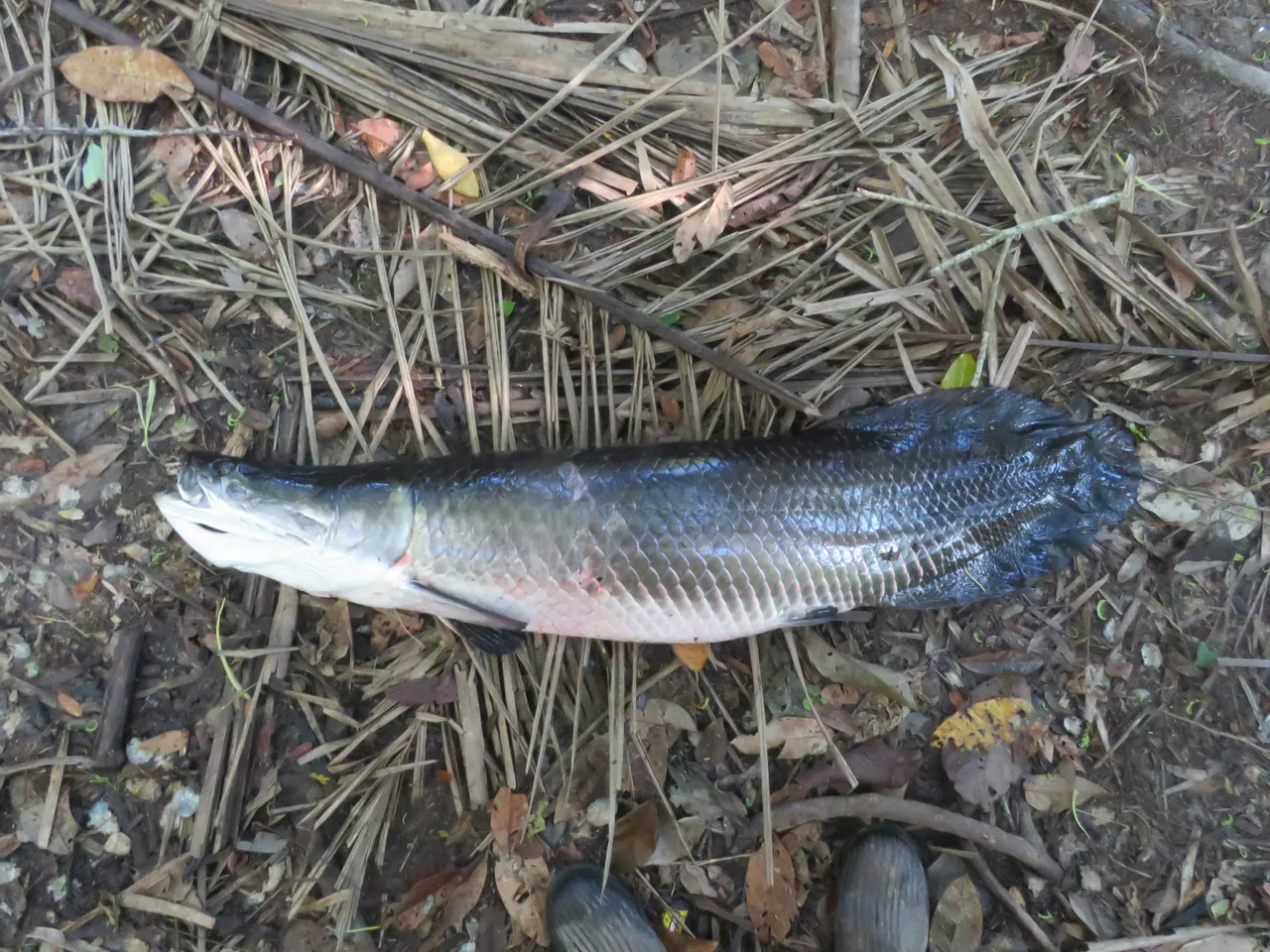
How this was identified, and who took it
Identified by: Very large armour-like scales over an elongate body, dorsal and anal fins set far back close to the tail, a flattened bony head with a high-set mouth, and red-pink over the rear flank and ventral surface. Noted honestly: the Bolivian population is introduced and specific identity within Arapaima is not settled, so this frame underwrites the genus confidently and the binomial only as the source states it.Vincent A. Vos — CC BY, via iNaturalist — source, licenceCatching Arapaima
Everything here on fishing for it. Each entry opens the page behind it.
Arapaima is an obligate air-breather. Its swim bladder functions as a lung, and the fish must surface every ten to twenty minutes to gulp air or it drowns. That single fact shapes everything about it — where it lives, how it is found, and why it was so easy to overfish.
Because the fish must surface, it can be counted. Community-based management in parts of Brazil and Peru uses that: local fishers count surfacing arapaima in each lake and take a quota based on the count. It is one of the more genuinely successful community fisheries management schemes anywhere, and populations have recovered substantially where it operates.
It is also a formidable angling target — enormous, powerful and taken on fly and lure in managed fisheries.
How it is caught
Identification
- Scientific name
- Arapaima gigas
- Family
- Arapaimidae
- Water
- Freshwater
- Conservation status
- Data Deficient
- Regions
- Central & South America
- Enormous elongate body with large scales, and prominent red-orange markings on the rear body and fins in adults.
- A bony, flattened head with the mouth set high, and dorsal and anal fins set far back near the tail.
- Must surface regularly to breathe air, producing a characteristic roll and gulp.
- Large tongue with bony toothed plates, used together with the palate to crush prey.
Size
- Typical
- Most rod-caught fish 20–60 kg (44–130 lb)
- Large
- 80–150 kg (175–330 lb)
Exceptional: FishBase records a maximum of 450 cm and 200 kg
An air-breathing giant, and a tail that has injured more people than the mouth
Arapaima handling is unlike anything else in freshwater and almost none of the risk is where a first-time angler looks for it.
THE HAZARD IS THE BODY, NOT THE HEAD. An arapaima is an enormous, heavily armoured, extremely powerful fish with a bony head and a muscular tail, and the characteristic injury in this fishery is a person struck by a thrashing fish — broken ribs, broken fingers, concussion from the head, and blows from the tail delivered with the mass of a very large animal behind them. Serious injuries have happened to guides who knew exactly what they were doing.
SO IT IS A MANAGED PROCEDURE, NOT A GRIP. The fish is brought into shallow water and restrained there by more than one person, with the head controlled and the fish kept in the water. It is not lifted. In the well-run fisheries for this species the handling protocol is fixed, guides run it, and an angler's job is to do what they are told and stay clear.
THE SCALES ARE ARMOUR AND ALSO A HAZARD — large, hard and with edges, and a fish sliding past a bare leg removes skin.
THE FISH BREATHES AIR, which changes the welfare arithmetic in one useful way and one dangerous one. It can tolerate being out of water better than any comparable fish. It cannot tolerate being held so that it cannot reach the surface, and a fish restrained underwater during a long unhooking is being drowned.
AND THE CONSERVATION CONTEXT IS THE POINT. Arapaima are heavily depleted across much of their range and the sustainable fisheries that exist are managed community arrangements with strict rules. Those rules are the handling guidance, and they are more authoritative than anything a general fishing site can say.
Official guidance — why, and the sources (1)
Stated by a fisheries authority, scientific institute or recognised angling body. Authoritative, but summarising rather than demonstrating.
- The IUCN Red List of Threatened Species — International Union for Conservation of Nature (Conservation authority)Relied on for: Conservation status and the managed nature of the remaining sustainable fisheries for this genus.Background and mechanism onlyCitation checked — the work exists and is described correctly
Lifecycle and reproduction
Fast-growing and long-lived, reaching a very large size. Parental care is substantial, and the obligate air-breathing habit means the fish is always locatable — which historically made it extremely vulnerable to harpoon and net fishing.
Builds nests in shallow water as flood waters rise, and both parents guard the young. The male shelters fry near his head, and a substance secreted from glands on his head is thought to help keep the shoal together.
Feeding and senses
Takes fish and other prey with a rapid suction strike, crushing them between the bony tongue and the palate rather than biting.
Hunts by sight in shallow floodplain lakes and channels, and its need to surface makes it as visible to prey and predators as to fishers.
Through the year
Reproduction and feeding follow the flood pulse, with nesting on rising water and concentration in lakes as water falls — the period when counting and managed harvest occur.
Distribution
South America: Amazon River basin. The active fishing of this fish has reduced both the population size, and occurrence of large individuals, especially around the populated regions of the Amazon
This is a biological range — where the species occurs, not a prediction that you will catch one. To browse the fishing geography FishingHQ holds, start at fishing places.
Why anglers care
A destination fly and lure target in managed fisheries in Guyana, Brazil and Peru, fished with very large flies and lures in floodplain lakes. Its significance is as one of the largest freshwater fish available to an angler and as a conservation success story where community quota management has been applied. FishingHQ does not state what any rule is; access is controlled and varies by country and community.
Handling and returning
An enormous fish that must be handled in the water and never lifted clear. Large scales and a bony head make it awkward and heavy; it thrashes with real force. Handle with experienced local guides, support the body in the water, minimise handling time, and allow it to surface and breathe during the process.
Safety
Injury while handling fish — Can cause serious injury or death
An arapaima of this size can break bones with a thrash of the head or tail and has injured anglers and guides during landing.
What reduces it: Keep the fish in the water, follow experienced guides, keep clear of the head and tail, and never attempt to lift or straddle the fish.
Where to go next
Where it lives
- Floodplains, backwaters and oxbowsA floodplain animal whose air-breathing lung is what allows it to occupy oxygen-poor lagoons and flooded forest that few large fish can tolerate — and what makes it countable, because it must surface.
- Lowland riversOccupies floodplain lakes and channels, surfacing regularly to breathe air.
- Lowland stillwatersOccupies floodplain lakes and channels, surfacing regularly to breathe air.
Where you will find it
Understanding this fish
- How fish breatheThe most extreme case in FishingHQ and an OBLIGATE air breather: an arapaima that cannot reach the surface drowns. Its swim bladder is modified into a lung-like organ, it surfaces to gulp air every ten to twenty minutes, and that single fact organises everything about it — where it can live, how it survives the deoxygenated water of a shrinking dry-season pool, and how it is located by fishermen, who watch and listen for the rise rather than searching the water.
- Seasonal rivers, and water that is not always thereThe same system, the opposite strategy. As the floodplain drains, arapaima are trapped in shrinking pools where oxygen collapses — and because they breathe air they survive there while everything else suffocates, in water that concentrates prey. The dry season is a feeding opportunity for them and a lethal squeeze for everything around them.
Sources and evidence
- FishBase: a global information system on fishes — Froese, R. and D. Pauly, eds. — FishBase Consortium (Scientific institute)Relied on for: Family, maximum size, depth and environment, distribution and the IUCN assessment for Arapaima gigas.States this directlyPassage read and verified
- The IUCN Red List of Threatened Species — International Union for Conservation of Nature (Conservation authority)Relied on for: The Data Deficient assessment for Arapaima gigas, assessed 01 August 1996.States this directlyCitation checked — the work exists and is described correctly
Why the 8 connections on this page are here, and the sources
How it is caught
What experienced anglers do — 2 connections
Widely and independently recommended by experienced anglers and specialist sources. This is real angling knowledge, not proof: controlled evidence for it is limited, and FishingHQ records it as convention rather than as a demonstrated effect.
Spinning
A practitioner claim about how Arapaima gigas is commonly fished, following from where and how it feeds.
- General angling website restatements of established technique — Various (Credible secondary source)Relied on for: Widely restated practitioner accounts of fishing for arapaima.Citation checked — the work exists and is described correctly
- Sea Angler — Bauer Media (Specialist angling publication)Relied on for: Practitioner treatment of the methods used for arapaima and comparable species.Citation checked — the work exists and is described correctly
Stillwater fly fishing
A practitioner claim about how Arapaima gigas is commonly fished, following from where and how it feeds.
- General angling website restatements of established technique — Various (Credible secondary source)Relied on for: Widely restated practitioner accounts of fishing for arapaima.Citation checked — the work exists and is described correctly
- Sea Angler — Bauer Media (Specialist angling publication)Relied on for: Practitioner treatment of the methods used for arapaima and comparable species.Citation checked — the work exists and is described correctly
Where it lives
Backed by research — 3 connections
Supported by peer-reviewed research or fisheries science. The sources are listed and can be checked.
Floodplains, backwaters and oxbows
A habitat association resting on the regional identification and fisheries literature rather than on angling report.
- The Flood Pulse Concept in River-Floodplain Systems — Canadian Special Publication of Fisheries and Aquatic Sciences 106, Department of Fisheries and Oceans, Ottawa, 1989 (Scientific literature)Relied on for: That fish move laterally onto the inundated floodplain to feed and breed and return to the channel as water falls, and that floodplain inundation drives production in large river systems.States this directlyCitation checked — the work exists and is described correctly
- FAO Species Identification Guides for Fishery Purposes and the FAO Species Catalogues — Food and Agriculture Organization of the United Nations (Scientific institute)Relied on for: Habitat association and distribution of the species concerned.States this directlyCitation checked — the work exists and is described correctly
Lowland rivers
A habitat association for Arapaima gigas taken from the environment and distribution data on its FishBase summary.
- FishBase: a global information system on fishes — Froese, R. and D. Pauly, eds. — FishBase Consortium (Scientific institute)Relied on for: The environment, depth range and habitat description recorded for Arapaima gigas.States this directlyPassage read and verified
Lowland stillwaters
A habitat association for Arapaima gigas taken from the environment and distribution data on its FishBase summary.
- FishBase: a global information system on fishes — Froese, R. and D. Pauly, eds. — FishBase Consortium (Scientific institute)Relied on for: The environment, depth range and habitat description recorded for Arapaima gigas.States this directlyPassage read and verified
Where you will find it
Backed by research — 1 connection
Supported by peer-reviewed research or fisheries science. The sources are listed and can be checked.
The Amazon basin
A distribution association between an animal and a kind of water, rather than a claim about any named mark.
- FishBase: a global information system on fishes — Froese, R. and D. Pauly, eds. — FishBase Consortium (Scientific institute)Relied on for: Distribution, habitat association and depth range recorded for the species, including its occurrence in the water body concerned.States this directlyPassage read and verified
- The IUCN Red List of Threatened Species — International Union for Conservation of Nature (Conservation authority)Relied on for: Assessment and range account for the species, including the systems and coasts it occupies.Background and mechanism onlyCitation checked — the work exists and is described correctly
Understanding this fish
Backed by research — 2 connections
Supported by peer-reviewed research or fisheries science. The sources are listed and can be checked.
How fish breathe
A species joined to the mechanism it is a worked example of, written only where the species demonstrates the mechanism unusually clearly rather than where it is merely subject to it.
- FishBase: a global information system on fishes — Froese, R. and D. Pauly, eds. — FishBase Consortium (Scientific institute)Relied on for: Recorded environment, respiration, oxygen tolerance, feeding biology, growth, longevity and distribution of the species named.States this directlyPassage read and verified
- The IUCN Red List of Threatened Species — International Union for Conservation of Nature (Conservation authority)Relied on for: Conservation assessment, recorded threats and population trend of the species named.States this directlyCitation checked — the work exists and is described correctly
Seasonal rivers, and water that is not always there
A species joined to the mechanism it is a worked example of, written only where the species demonstrates the mechanism unusually clearly rather than where it is merely subject to it.
- The Flood Pulse Concept in River-Floodplain Systems — Canadian Special Publication of Fisheries and Aquatic Sciences 106, Department of Fisheries and Oceans, Ottawa, 1989 (Scientific literature)Relied on for: The flood pulse concept in river-floodplain systems: how seasonal inundation drives productivity, fish movement onto the floodplain and life-history timing.States this directlyCitation checked — the work exists and is described correctly
- FishBase: a global information system on fishes — Froese, R. and D. Pauly, eds. — FishBase Consortium (Scientific institute)Relied on for: Recorded environment, seasonal behaviour and feeding biology of the species named.States this directlyPassage read and verified
How FishingHQ labels evidence is explained in the evidence policy.