Seasonal rivers, and water that is not always there
Explainer · Last reviewed 2026-08-14
Across most of the world's land area a river is a seasonal event rather than a permanent feature, and the fish that live in one are adapted to surviving in disconnected pools until the water returns.
Every freshwater record written from a temperate perspective assumes that a river contains water all year. Across a very large fraction of the inhabited world, that is simply not true, and the fishing follows a completely different logic.
THE PATTERN IS FLOW, THEN CONTRACTION, THEN POOLS. In semi-arid and Mediterranean climates a river runs strongly in the wet season, often fed by winter rain or spring snowmelt from mountains. As the dry season advances, flow falls, riffles stop running, and the channel becomes a chain of disconnected pools held by bedrock, deep bends or springs. Some systems dry entirely; many do not, and the pools that persist are the whole fishery.
THE POOLS ARE WHERE EVERYTHING IS. When a river contracts, its fish do not disperse — they concentrate, at densities that would be impossible in a flowing river. That is both an opportunity and a serious conservation problem: a contracted pool is easy to fish and easy to empty, and the fish in it have nowhere to go.
CONDITIONS IN A CONTRACTING POOL DETERIORATE PREDICTABLY. Water warms, oxygen falls, waste concentrates, and predation pressure rises as birds and mammals find the same concentration the angler has. Fish in late-season pools are already stressed, which changes the handling calculation: catch-and-release survival in warm, low-oxygen water is much poorer than in cool flowing water, and the honest response is often to fish elsewhere or not at all.
THE FISH ARE ADAPTED, AND THE ADAPTATIONS ARE THE INTELLIGENCE. Species in seasonal systems tend to grow fast, mature early and spawn on the flood, timing reproduction to the arrival of water rather than to a date. Many can tolerate temperatures and oxygen levels that would kill a trout. Some can move considerable distances overland-adjacent through flooded margins when the system reconnects.
RECONNECTION IS THE EVENT OF THE YEAR. When the first substantial rains arrive, pools join, fish move, spawning is triggered, and the system redistributes. In many places that is the single most important date in the fishing calendar and it is not on any calendar — it varies by weeks between years.
AND HUMAN ABSTRACTION IS PART OF THE HYDROLOGY, not a separate topic. Irrigation, reservoirs and groundwater pumping change when and whether a seasonal river flows, so the natural pattern and the managed one are frequently indistinguishable from the bank. Where a river is regulated by a dam, the flow regime is a management decision, and the fishery is downstream of that decision in every sense.
Fishing a river that is refilling, and the danger of one that is
A river that dries and refills is not a normal river with an interruption. It is a system whose whole biology is organised around the refill, and the fishing follows that rather than the calendar.
THE REFILL IS THE EVENT. When water returns to a dry or nearly dry channel, it reconnects pools that have been isolated, floods ground that has been dry long enough to accumulate terrestrial food, and triggers movement and frequently spawning in species that have been waiting for exactly that cue. Productivity spikes, and the fishing with it. This is the same mechanism as a tropical flood pulse operating on a smaller and less reliable scale.
BEFORE IT, THE FISH ARE CONCENTRATED AND SHOULD USUALLY BE LEFT ALONE. As a seasonal river shrinks, everything alive in it is squeezed into whatever pools remain — warming, deoxygenating and full of fish that have nowhere to go. That is the easiest fishing of the year and the least defensible: those fish are the ones that will restock the system if they survive, and they are already at the limit of what they can tolerate. `warm-water-fishing-and-the-oxygen-problem` describes exactly this water.
AFTER IT, THE FISHING SPREADS OUT AND GETS HARDER, which is a good sign rather than a bad one.
AND THE PRACTICAL READING IS THE CONNECTION RATHER THAN THE LEVEL. What matters is not how much water there is but whether the pools have joined up, because a connected river lets fish move and a disconnected one does not. A channel that looks full can still be a chain of separate pools, and a modest flow that has just linked them changes everything.
THE SAFETY SIDE IS THE PART MOST OFTEN UNDERESTIMATED, and it belongs here because the fishing and the hazard peak together. A dry or low channel refills faster than anybody expects, from rain that fell somewhere else, and the bed is the problem: sun-baked silt, loose gravel and undercut banks that have been drying and cracking. A watercourse can rise while the sky overhead is clear, and the ground beside it is at its least stable exactly when the water arrives.
WHICH MAKES THE CATCHMENT THE THING TO WATCH RATHER THAN THE WEATHER OVERHEAD. On a system like this, rain fifty kilometres upstream is more relevant than the conditions where you are standing, and the rise can arrive as a distinct front of water rather than as a gradual increase.
Backed by research — why, and the sources (4)
Supported by peer-reviewed research or fisheries science. The sources are listed and can be checked.
- The Flood Pulse Concept in River-Floodplain Systems — Canadian Special Publication of Fisheries and Aquatic Sciences 106, Department of Fisheries and Oceans, Ottawa, 1989 (Scientific literature)Relied on for: The flood pulse concept in river-floodplain systems: how seasonal inundation drives productivity, fish movement and life-history timing.States this directlyCitation checked — the work exists and is described correctly
- The European Environment Agency's assessments of Europe's waters, seas and coasts — European Environment Agency, Copenhagen (Conservation authority)Relied on for: Assessment of Europe's surface waters including hydrological pressure, flow regime alteration and the condition of river systems.States this directlyCitation checked — the work exists and is described correctly
- Freshwater Fishes of the British Isles — HarperCollins (New Naturalist 75), 1992 (Reference work)Relied on for: Life history, physiological tolerance, feeding biology and seasonal behaviour of European freshwater fishes.States this directlyCitation checked — the work exists and is described correctly
- FishBase: a global information system on fishes — Froese, R. and D. Pauly, eds. — FishBase Consortium (Scientific institute)Relied on for: Recorded environment, temperature and oxygen tolerance, depth range and feeding biology of the species named.States this directlyPassage read and verified
Where to go next
Fish this applies to
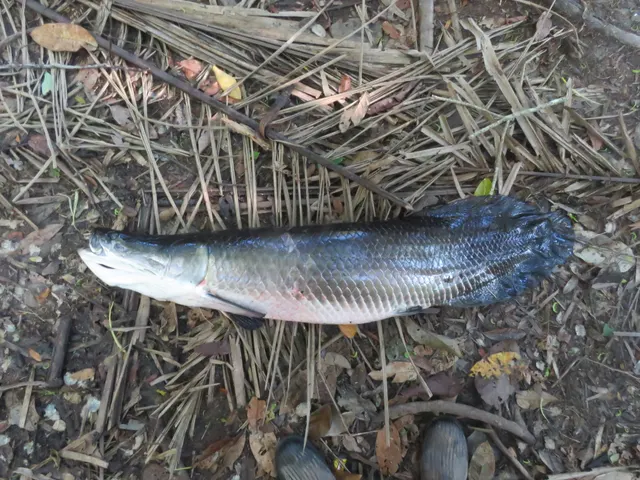 ArapaimaThe same system, the opposite strategy. As the floodplain drains, arapaima are trapped in shrinking pools where oxygen collapses — and because they breathe air they survive there while everything else suffocates, in water that concentrates prey. The dry season is a feeding opportunity for them and a lethal squeeze for everything around them.
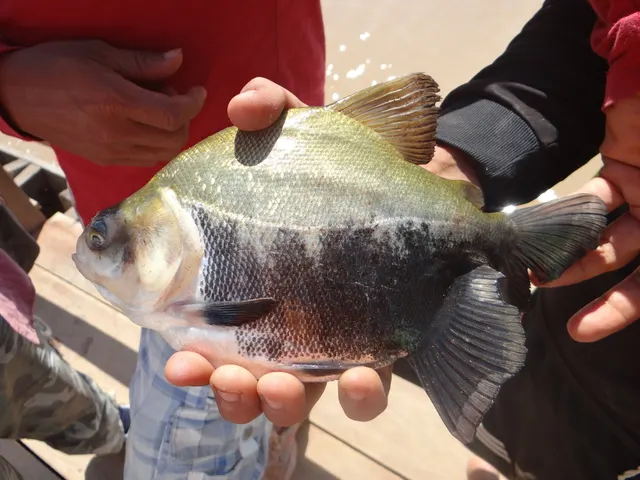 TambaquiThe clearest worked example of a flood-pulse fish in FishingHQ. Tambaqui move onto inundated Amazon floodplain forest during high water and feed on fruits and seeds falling from the trees — crushing them with molar-like teeth — then retreat to the channel as the water drops. Its whole feeding year is the flood, and it is a seed disperser as well as a fish.
Where this applies
- Moroccan mountain and reservoir fresh waterThe mechanism this freshwater system runs on: winter rain and snowmelt, contraction to disconnected pools through the dry season, and reconnection when substantial rain returns.
- The Amazon basinThe flood pulse is the same mechanism at continental scale and in the opposite direction: fish disperse into flooded forest on the rise and concentrate in the channel as it falls.
- The Indian subcontinent coastsMonsoon hydrology governs the rivers behind this coast, and the pre-monsoon contraction and post-monsoon reconnection organise the freshwater fishing year.
How this compares
- Currents, eddies and where fish holdReading a river assumes the river is there. Where it is not, the reading problem becomes which pools persist and why.
- The fishing year: what each season changesWhere temperature varies little, the year is organised by rainfall instead — which governs a very large part of the world's inland fishing and is invisible from a temperate perspective.
- Warm-water fishing, and the oxygen problemA contracting pool in late summer is the oxygen problem in its most concentrated form, and the handling consequences are the same only more so.
Sources and evidence
- FishBase: a global information system on fishes — Froese, R. and D. Pauly, eds. — FishBase Consortium (Scientific institute)Relied on for: Distribution, habitat association, depth range, diet, growth and reproductive parameters recorded for the species concerned.States this directlyPassage read and verified
- Cefas science, advice and data on marine and freshwater environments — Centre for Environment, Fisheries and Aquaculture Science (Government fisheries body)Relied on for: Marine and freshwater environmental science, including coastal processes, water quality, shellfish and finfish biology and the monitoring behind them.States this directlyCitation checked — the work exists and is described correctly
- The IUCN Red List of Threatened Species — International Union for Conservation of Nature (Conservation authority)Relied on for: Assessment, population trend and range account for the species.Background and mechanism onlyCitation checked — the work exists and is described correctly
Why the 8 connections on this page are here, and the sources
Fish this applies to
Backed by research — 2 connections
Supported by peer-reviewed research or fisheries science. The sources are listed and can be checked.
Arapaima
A species joined to the mechanism it is a worked example of, written only where the species demonstrates the mechanism unusually clearly rather than where it is merely subject to it.
- The Flood Pulse Concept in River-Floodplain Systems — Canadian Special Publication of Fisheries and Aquatic Sciences 106, Department of Fisheries and Oceans, Ottawa, 1989 (Scientific literature)Relied on for: The flood pulse concept in river-floodplain systems: how seasonal inundation drives productivity, fish movement onto the floodplain and life-history timing.States this directlyCitation checked — the work exists and is described correctly
- FishBase: a global information system on fishes — Froese, R. and D. Pauly, eds. — FishBase Consortium (Scientific institute)Relied on for: Recorded environment, seasonal behaviour and feeding biology of the species named.States this directlyPassage read and verified
Tambaqui
A species joined to the mechanism it is a worked example of, written only where the species demonstrates the mechanism unusually clearly rather than where it is merely subject to it.
- The Flood Pulse Concept in River-Floodplain Systems — Canadian Special Publication of Fisheries and Aquatic Sciences 106, Department of Fisheries and Oceans, Ottawa, 1989 (Scientific literature)Relied on for: The flood pulse concept in river-floodplain systems: how seasonal inundation drives productivity, fish movement onto the floodplain and life-history timing.States this directlyCitation checked — the work exists and is described correctly
- FishBase: a global information system on fishes — Froese, R. and D. Pauly, eds. — FishBase Consortium (Scientific institute)Relied on for: Recorded environment, seasonal behaviour and feeding biology of the species named.States this directlyPassage read and verified
Where this applies
Backed by research — 3 connections
Supported by peer-reviewed research or fisheries science. The sources are listed and can be checked.
Moroccan mountain and reservoir fresh water
What is distinctive about fishing somewhere is usually a process working differently there, so the process is explained once here rather than restated for every place.
- Cefas science, advice and data on marine and freshwater environments — Centre for Environment, Fisheries and Aquaculture Science (Government fisheries body)Relied on for: Marine and freshwater environmental science, including coastal physical processes, productivity and the monitoring behind them.States this directlyCitation checked — the work exists and is described correctly
- ICES Advice on fishing opportunities, catch and effort — International Council for the Exploration of the Sea (Scientific institute)Relied on for: Stock assessment and advice for north-east Atlantic and adjacent stocks, including the environmental drivers of productivity.Background and mechanism onlyCitation checked — the work exists and is described correctly
The Amazon basin
A place that describes a physical process in prose and cannot point at it is restating something FishingHQ should explain once. This is the link that turns the restatement into a reference.
- NOAA National Ocean Service education on estuaries and the National Estuarine Research Reserve System — National Oceanic and Atmospheric Administration, United States (Government fisheries body)Relied on for: The physical structure and ecology of estuarine, lagoon and coastal systems, including salinity gradients, exchange and nursery function.States this directlyCitation checked — the work exists and is described correctly
- Cefas science, advice and data on marine and freshwater environments — Centre for Environment, Fisheries and Aquaculture Science (Government fisheries body)Relied on for: Coastal and transitional water science, including salinity, water quality and the biology those conditions support.States this directlyCitation checked — the work exists and is described correctly
The Indian subcontinent coasts
A place that describes a physical process in prose and cannot point at it is restating something FishingHQ should explain once. This is the link that turns the restatement into a reference.
- NOAA National Ocean Service education on estuaries and the National Estuarine Research Reserve System — National Oceanic and Atmospheric Administration, United States (Government fisheries body)Relied on for: The physical structure and ecology of estuarine, lagoon and coastal systems, including salinity gradients, exchange and nursery function.States this directlyCitation checked — the work exists and is described correctly
- Cefas science, advice and data on marine and freshwater environments — Centre for Environment, Fisheries and Aquaculture Science (Government fisheries body)Relied on for: Coastal and transitional water science, including salinity, water quality and the biology those conditions support.States this directlyCitation checked — the work exists and is described correctly
How this compares
What experienced anglers do — 3 connections
Widely and independently recommended by experienced anglers and specialist sources. This is real angling knowledge, not proof: controlled evidence for it is limited, and FishingHQ records it as convention rather than as a demonstrated effect.
Currents, eddies and where fish hold
Two records a reader would reasonably weigh against one another, joined where the comparison teaches something about both. A navigation claim rather than a claim about the world.
- General angling website restatements of established technique — Various (Credible secondary source)Relied on for: Widely restated angling practice and belief, recorded as practitioner consensus rather than as tested fact.Background and mechanism onlyCitation checked — the work exists and is described correctly
- Sea Angler — Bauer Media (Specialist angling publication)Relied on for: Contemporary UK sea angling practice as reported and restated by practitioners, including technique and tackle convention.Background and mechanism onlyCitation checked — the work exists and is described correctly
The fishing year: what each season changes
Two conditions records a reader will weigh against one another, joined where the contrast is what makes either usable.
- Freshwater Fishes of the British Isles — HarperCollins (New Naturalist 75), 1992 (Reference work)Relied on for: Biology, distribution and seasonal behaviour of British and Irish freshwater fishes, including temperature responses and spawning timing.States this directlyCitation checked — the work exists and is described correctly
- FishBase: a global information system on fishes — Froese, R. and D. Pauly, eds. — FishBase Consortium (Scientific institute)Relied on for: Temperature tolerance, spawning timing, activity period and habitat association recorded for the species concerned.States this directlyPassage read and verified
Warm-water fishing, and the oxygen problem
Two records a reader would reasonably weigh against one another, joined where the comparison teaches something about both. A navigation claim rather than a claim about the world.
- General angling website restatements of established technique — Various (Credible secondary source)Relied on for: Widely restated angling practice and belief, recorded as practitioner consensus rather than as tested fact.Background and mechanism onlyCitation checked — the work exists and is described correctly
- Sea Angler — Bauer Media (Specialist angling publication)Relied on for: Contemporary UK sea angling practice as reported and restated by practitioners, including technique and tackle convention.Background and mechanism onlyCitation checked — the work exists and is described correctly
How FishingHQ labels evidence is explained in the evidence policy.