Tambaqui
Fish · Last reviewed 2026-08-10
A very large Amazonian characin with molar-like teeth for crushing fruit and seeds, feeding in flooded forest and dispersing seeds as it goes.
Safety: injury while handling fish — can cause injury needing treatment.
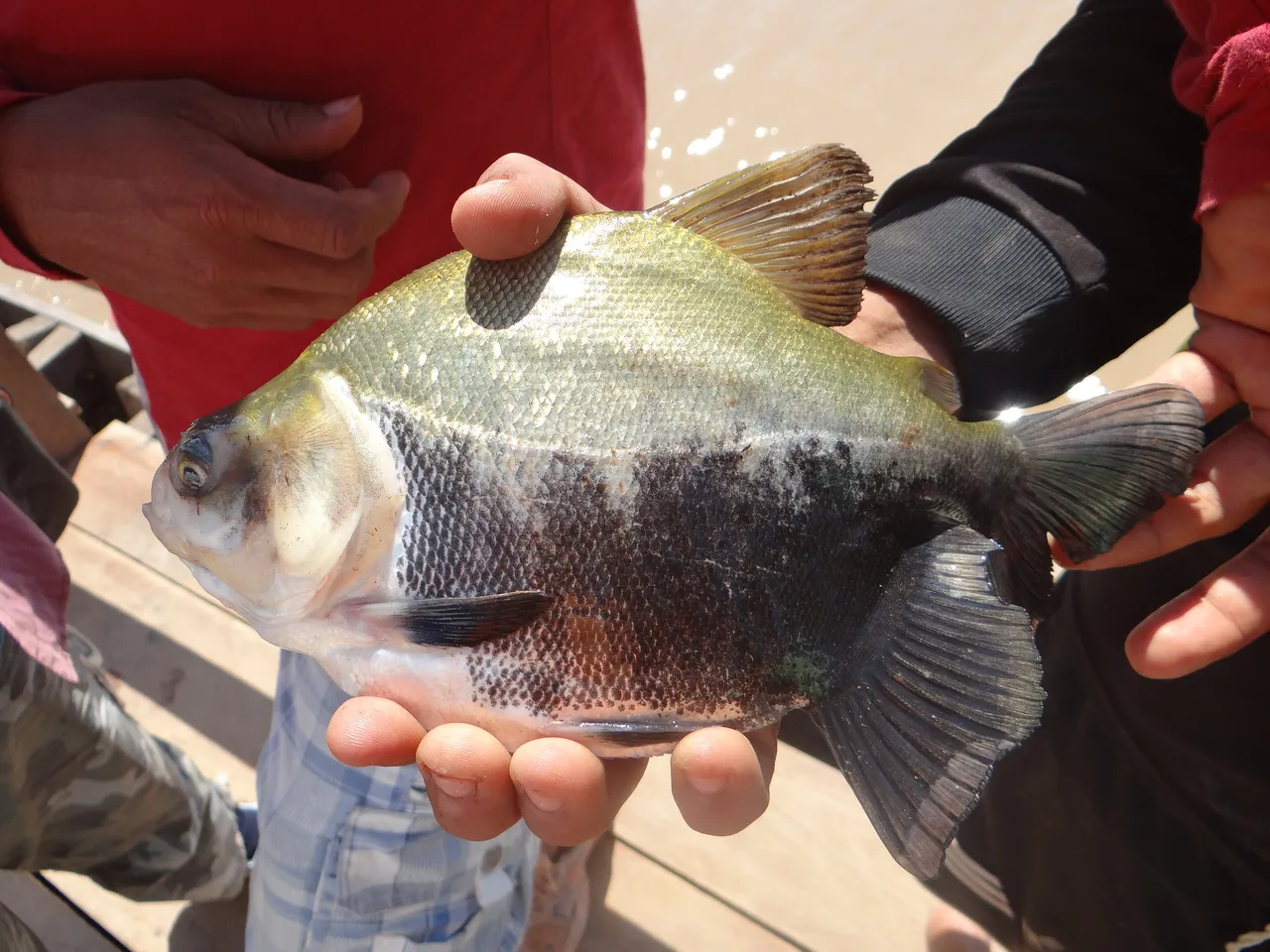
How this was identified, and who took it
Identified by: Deep, strongly compressed disc-shaped body, olive-gold dorsal half against an abruptly dark ventral half, rayed adipose fin and truncate caudal, identified at source with three agreeing identifications and none disagreeing. The limitation is stated on the page: Colossoma macropomum and Piaractus brachypomus are separated on dentition and gill rakers, which a photograph does not carry, and this individual is not full grown.Vincent A. Vos — CC BY, via iNaturalist — source, licenceCatching Tambaqui
Everything here on fishing for it. Each entry opens the page behind it.
Tambaqui is one of the most ecologically interesting fish on FishingHQ. It is a large, deep-bodied Amazonian characin with heavy molar-like teeth, and it feeds in the flooded forest during the annual inundation, crushing fallen fruits and seeds from the trees above.
In doing so it disperses seeds — some pass through intact and germinate — which makes it a genuine agent of forest regeneration. Fish as seed dispersers is not a fringe idea in Amazonia; it is central to how the floodplain forest works, and tambaqui is the best-known example.
It is a major food fish, heavily farmed, and a substantial angling target taken on fruit and nut baits in a style found almost nowhere else.
How it is caught
Identification
- Scientific name
- Colossoma macropomum
- Family
- Serrasalmidae
- Water
- Freshwater
- Conservation status
- Near Threatened
- Regions
- Central & South America
- Very deep, laterally compressed body with a small head relative to the bulk.
- Heavy molar-like teeth in both jaws for crushing seeds and fruit, not the sharp triangular teeth of a piranha.
- Olive to grey-green upper body shading to black on the lower flank and belly in adults.
- A small adipose fin with rays, and a moderately forked tail.
Size
- Typical
- 4–12 kg (8.8–26 lb)
- Large
- 20–30 kg (44–66 lb)
Exceptional: FishBase records a maximum of 108 cm and 40 kg
Molar teeth built to crack nuts, and a hand is easier than a nut
Tambaqui have one of the most distinctive dentitions in freshwater fishing and it produces an injury almost nobody anticipates.
THE TEETH ARE MOLARS. Broad, flat, powerful crushing teeth, in rows, driven by heavy jaw musculature adapted to cracking hard fruits and seeds that fall into flooded forest. They do not cut anything. They crush, and the force available is considerable.
SO THE INJURY IS A CRUSHED FINGER, not a laceration, and it can break bone. Anglers accustomed to reading danger from visible sharp teeth look into a tambaqui's mouth, see flat plates, and reach in. That is the mechanism. Do not put fingers in the mouth of a tambaqui of any size, and use pliers of adequate length.
THE BODY IS DEEP AND HEAVY and the fish is powerful. Support it horizontally, two hands, and do not hang it vertically.
THE WATER IS WARM AND THE FIGHT IS HARD, which is the standard tropical release problem: exhaustion plus low dissolved oxygen plus warm air equals delayed mortality. Keep it wet, keep it brief, revive it properly.
AND THE SCALES ARE LARGE AND SHED EASILY. A fish dragged onto a bank or held against a dry surface loses scales and slime together, and both are barriers against infection in water with a high bacterial load.
What experienced anglers do — why, and the sources (2)
Widely and independently recommended by experienced anglers and specialist sources. This is real angling knowledge, not proof: controlled evidence for it is limited, and FishingHQ records it as convention rather than as a demonstrated effect.
- FishBase: a global information system on fishes — Froese, R. and D. Pauly, eds. — FishBase Consortium (Scientific institute)Relied on for: Dentition, fin and spine morphology, body form, air-breathing capability and distribution for the species, which are the anatomical facts the handling practice below follows from.States this directlyPassage read and verified
- General angling website restatements of established technique — Various (Credible secondary source)Relied on for: Widely restated angling practice for handling this species, recorded as practitioner consensus rather than as tested fact.Background and mechanism onlyCitation checked — the work exists and is described correctly
Lifecycle and reproduction
Fast-growing and long-lived, reaching a very large size. Its life cycle is tied to the flood pulse — growth occurs largely during the months when the forest is inundated and fruit is available.
Spawns in main river channels at the start of the rising water, with juveniles moving into floodplain lakes and flooded forest to grow. The flood pulse governs the whole reproductive cycle.
Feeding and senses
Crushes fruits, seeds and nuts falling into flooded forest with heavy molar teeth, and also takes zooplankton and invertebrates, particularly when young.
Locates falling fruit by sound and surface disturbance as much as by sight — the sound of fruit hitting water attracts feeding fish, which is directly exploited by anglers.
Through the year
Feeds heavily in flooded forest during high water and concentrates in river channels and lakes as water falls. The fishing calendar follows the flood cycle entirely.
Distribution
South America: Amazon and Orinoco basins as wild form; pisciculture form largely distributed in South America
This is a biological range — where the species occurs, not a prediction that you will catch one. To browse the fishing geography FishingHQ holds, start at fishing places.
Why anglers care
A major Amazonian angling and food species, fished with fruit, nuts and seeds as bait in flooded forest, and increasingly on fly with fruit-imitating patterns — one of the very few fisheries in the world built around imitating fruit. Its significance is size, strength and a genuinely distinctive method, and it is heavily farmed across South America.
Handling and returning
A very heavy, deep-bodied fish. Support horizontally with both hands, keep it in the water where possible, and use a large net. The crushing teeth are powerful enough to injure a finger placed in the mouth.
Safety
Injury while handling fish — Can cause injury needing treatment
The molar teeth are adapted to crush hard nuts and seeds and will crush a finger placed in the mouth.
What reduces it: Never put fingers in the mouth. Use long pliers and control the fish across the body.
Where to go next
Where it lives
- Floodplains, backwaters and oxbowsMoves into flooded forest on the rise and feeds on fruit and seeds falling from it, dispersing intact seeds as it goes. The clearest illustration in FishingHQ of a fish depending on a terrestrial food web.
- Lowland riversFeeds in flooded amazonian forest, crushing fallen fruit and seeds.
Where you will find it
Understanding this fish
Sources and evidence
- FishBase: a global information system on fishes — Froese, R. and D. Pauly, eds. — FishBase Consortium (Scientific institute)Relied on for: Family, maximum size, depth and environment, distribution and the IUCN assessment for Colossoma macropomum.States this directlyPassage read and verified
- The IUCN Red List of Threatened Species — International Union for Conservation of Nature (Conservation authority)Relied on for: The Near Threatened assessment for Colossoma macropomum, assessed 17 December 2020.States this directlyCitation checked — the work exists and is described correctly
Why the 6 connections on this page are here, and the sources
How it is caught
What experienced anglers do — 2 connections
Widely and independently recommended by experienced anglers and specialist sources. This is real angling knowledge, not proof: controlled evidence for it is limited, and FishingHQ records it as convention rather than as a demonstrated effect.
Float fishing
A practitioner claim about how Colossoma macropomum is commonly fished, following from where and how it feeds.
- General angling website restatements of established technique — Various (Credible secondary source)Relied on for: Widely restated practitioner accounts of fishing for tambaqui.Citation checked — the work exists and is described correctly
- Sea Angler — Bauer Media (Specialist angling publication)Relied on for: Practitioner treatment of the methods used for tambaqui and comparable species.Citation checked — the work exists and is described correctly
Ledgering
A practitioner claim about how Colossoma macropomum is commonly fished, following from where and how it feeds.
- General angling website restatements of established technique — Various (Credible secondary source)Relied on for: Widely restated practitioner accounts of fishing for tambaqui.Citation checked — the work exists and is described correctly
- Sea Angler — Bauer Media (Specialist angling publication)Relied on for: Practitioner treatment of the methods used for tambaqui and comparable species.Citation checked — the work exists and is described correctly
Where it lives
Backed by research — 2 connections
Supported by peer-reviewed research or fisheries science. The sources are listed and can be checked.
Floodplains, backwaters and oxbows
A habitat association resting on the regional identification and fisheries literature rather than on angling report.
- The Flood Pulse Concept in River-Floodplain Systems — Canadian Special Publication of Fisheries and Aquatic Sciences 106, Department of Fisheries and Oceans, Ottawa, 1989 (Scientific literature)Relied on for: That fish move laterally onto the inundated floodplain to feed and breed and return to the channel as water falls, and that floodplain inundation drives production in large river systems.States this directlyCitation checked — the work exists and is described correctly
- FAO Species Identification Guides for Fishery Purposes and the FAO Species Catalogues — Food and Agriculture Organization of the United Nations (Scientific institute)Relied on for: Habitat association and distribution of the species concerned.States this directlyCitation checked — the work exists and is described correctly
Lowland rivers
A habitat association for Colossoma macropomum taken from the environment and distribution data on its FishBase summary.
- FishBase: a global information system on fishes — Froese, R. and D. Pauly, eds. — FishBase Consortium (Scientific institute)Relied on for: The environment, depth range and habitat description recorded for Colossoma macropomum.States this directlyPassage read and verified
Where you will find it
Backed by research — 1 connection
Supported by peer-reviewed research or fisheries science. The sources are listed and can be checked.
The Amazon basin
A distribution association between an animal and a kind of water, rather than a claim about any named mark.
- FishBase: a global information system on fishes — Froese, R. and D. Pauly, eds. — FishBase Consortium (Scientific institute)Relied on for: Distribution, habitat association and depth range recorded for the species, including its occurrence in the water body concerned.States this directlyPassage read and verified
- The IUCN Red List of Threatened Species — International Union for Conservation of Nature (Conservation authority)Relied on for: Assessment and range account for the species, including the systems and coasts it occupies.Background and mechanism onlyCitation checked — the work exists and is described correctly
Understanding this fish
Backed by research — 1 connection
Supported by peer-reviewed research or fisheries science. The sources are listed and can be checked.
Seasonal rivers, and water that is not always there
A species joined to the mechanism it is a worked example of, written only where the species demonstrates the mechanism unusually clearly rather than where it is merely subject to it.
- The Flood Pulse Concept in River-Floodplain Systems — Canadian Special Publication of Fisheries and Aquatic Sciences 106, Department of Fisheries and Oceans, Ottawa, 1989 (Scientific literature)Relied on for: The flood pulse concept in river-floodplain systems: how seasonal inundation drives productivity, fish movement onto the floodplain and life-history timing.States this directlyCitation checked — the work exists and is described correctly
- FishBase: a global information system on fishes — Froese, R. and D. Pauly, eds. — FishBase Consortium (Scientific institute)Relied on for: Recorded environment, seasonal behaviour and feeding biology of the species named.States this directlyPassage read and verified
How FishingHQ labels evidence is explained in the evidence policy.