The Indian subcontinent coasts
Fishing regions · Last reviewed 2026-08-14
A coastline where the wind reverses twice a year, taking the currents, the upwelling and the whole fishery with it — and where several million people fish from beaches with no harbour at all.
Safety: moving water and currents — can cause serious injury or death. 3 more points apply here.
Being listed here is not permission to fish. What that meansClose
Access, fishing rights, seasons, licences, local bylaws and permitted methods vary and can change. Check current access, permission, local regulations, closures and restrictions before you travel or fish. FishingHQ describes what the ground is and names who holds the answer; it does not hold the answer itself.
Find the authority for a jurisdiction · What FishingHQ does and does not cover
The subcontinent's coasts qualify as a coast-tier record because a single physical mechanism — the monsoon reversal — governs the fishing from the Gulf of Kutch round to the Bay of Bengal, across several jurisdictions that could not each explain it.
THE MONSOON REVERSES THE OCEAN, NOT JUST THE WEATHER. The northern Indian Ocean is the only major ocean basin whose surface circulation reverses seasonally. South-westerly winds in one half of the year and north-easterly in the other drive currents that change direction, and along the west coast that reversal produces strong seasonal upwelling. This is not a subtlety of climate; it is the reason the fishery exists in the form it does.
THE WEST COAST IS THE PRODUCTIVE ONE. Upwelling along the Arabian Sea margin during and after the south-west monsoon brings nutrient-rich water to the surface and drives an enormous pelagic fishery — oil sardine, Indian mackerel, anchovy — that supports everything above it.
THE EAST COAST IS A DELTA COAST. The Bay of Bengal receives the Ganges, Brahmaputra, Godavari, Krishna and Mahanadi, so the eastern seaboard is low, silty, delta-fronted and heavily influenced by fresh water. It is also the cyclone coast, and the storms are the most consequential fact about fishing there.
THE FISHERY IS ARTISANAL AT ENORMOUS SCALE. Millions of people fish these coasts, a great deal of it from open beaches with no harbour: boats are launched through surf and recovered onto sand, and shore seine netting worked by whole villages is still a live practice in places.
AND SHORE ANGLING IS A REAL BUT SMALL LAYER on top of that, alongside a growing recreational fishery for giant trevally, barramundi and threadfin around estuaries, backwaters and rocky headlands.
What fishing here is like
A very long tropical coastline whose fishing is governed by a seasonal wind reversal that changes the currents, drives upwelling on the western side and delivers cyclones to the eastern one. Overwhelmingly an artisanal food fishery of enormous scale, much of it launched through surf from open beaches rather than from harbours, with shore seines, gillnets, hooks and traps. A modern mechanised fleet works alongside it. Recreational angling is small, growing, and concentrated on estuaries, backwaters, headlands and the offshore islands.
What dominates
Small-boat gillnetting, hook-and-line and trap fishing from beach-launched and harbour-based craft, which accounts for most of the effort. Shore seine netting worked by teams from open beaches, a genuinely communal practice still alive in places. Cast netting in estuaries, backwaters and shallow water at very large scale. Mechanised trawling and purse seining from the larger ports. Shore angling from rock, groyne and beach for trevally, queenfish, threadfin and croaker. Estuary and backwater lure fishing for barramundi and mangrove jack. Offshore popping and jigging around the island groups. Shellfish, crab and prawn gathering in estuaries and mudflats.
The water available
Long open surf beaches with no natural shelter along much of both coasts; rocky headlands and laterite platforms, particularly along the south-west; extensive brackish backwater and lagoon systems behind the western coastal strip; the great delta systems and mangrove forest of the eastern seaboard; muddy shallow shelf water in the north-east and clearer water in the south; coral reef around the offshore island groups and parts of the southern coast; and a narrow, steeply shelving shelf in the south-west compared with a broad shallow one in the north-east.
How the rules are structured
Marine fisheries in this region are administered through a division between national and state or provincial jurisdiction: coastal waters out to a defined limit are generally administered by the coastal state or province under its own marine fishing regulation act, and the waters beyond by the national government. That means the operative rule for inshore fishing usually comes from the state rather than the country, and adjacent states differ. A seasonal fishing ban covering the monsoon period is applied to mechanised fishing on both seaboards and is one of the more significant management measures in the region, though its dates and scope are set separately by each state and by the national government. Traditional and artisanal fishing is regulated separately from mechanised fishing and frequently more lightly. Marine protected areas, national parks and biosphere reserves cover parts of the coast, including major mangrove and reef systems, with their own rules. Several species carry national protection, including sea turtles, some sharks and rays, and sea cucumbers. Recreational angling is not comprehensively licensed as a category and is frequently governed by local permission and by the protected-area status of the water. FishingHQ does not state what any current rule is.
Who to ask
- The fisheries department of the coastal state or province concerned, which administers inshore marine fishing under its own marine fishing regulation legislation.
- The national fisheries ministry or department, for waters beyond the state limit, national policy and deep-sea fishing.
- The protected area or wildlife authority where the water lies inside a national park, sanctuary, biosphere reserve or marine protected area.
- The coastal zone management authority, for activities in the regulated coastal zone including access and construction.
- The relevant coastguard or maritime authority, for small-boat safety requirements and weather restrictions.
Words you will meet
- Kattumaram
- The lashed-log raft of the Coromandel coast, from which the English word catamaran derives, although the original is a raft rather than a twin hull. Designed to be launched through surf and to remain workable when swamped, because it does not rely on being watertight.
- Backwaters
- The interconnected brackish lagoons, canals and lakes behind the south-western coastal strip. A distinct fishery in their own right, with prawn, pearl spot, mullet and barramundi, and with traditional stake and Chinese dip net gear.
- Rampon / shore seine
- A large net taken out by boat, set in a semicircle from the beach and hauled in by a team on the sand. A communal method with an established share system for dividing the catch, and one of the oldest fishing practices on these coasts.
- Monsoon ban
- The seasonal closure applied to mechanised fishing during the monsoon period. Its stated purpose is protection of the spawning and recruitment season as well as safety, and its dates differ between the two seaboards and between states.
- Oil sardine
- The small pelagic fish whose abundance on the south-west coast tracks the strength of the upwelling. Its year-to-year swings are the clearest single indicator of what the monsoon has done to the fishery.
Conditions and hazards
Surf is the dominant hazard on both coasts and it is why so much of the traditional craft is designed around swamping rather than around staying dry. Rip currents on long open beaches are strong and are a major cause of drowning in the region. The south-west monsoon brings months of heavy onshore weather in which small-boat fishing is genuinely dangerous, which is part of the reasoning behind the seasonal closure. The eastern seaboard is a cyclone coast, and tropical cyclones in the Bay of Bengal have caused some of the largest loss of life of any storms anywhere; storm surge over a low delta coastline is the mechanism. Heat, humidity and sun exposure are severe. Estuarine and delta systems in the north-east hold saltwater crocodiles, and parts of the mangrove forest hold tigers, both of which are genuine rather than theoretical hazards to people working the water. Water quality near large cities and river mouths is frequently poor, and any wound acquired in it should be treated seriously.
The only ocean that changes direction, and what that does to the fishing
The northern Indian Ocean does something no other ocean basin does at this scale, and the entire fishery of these coasts is downstream of it.
THE WIND REVERSES AND THE CURRENT FOLLOWS. Because the basin is bounded to the north by a continent that heats and cools far faster than the sea, the pressure gradient — and therefore the wind — reverses seasonally. South-westerly through the summer monsoon, north-easterly through the winter. The surface circulation reverses with it, which is a genuinely unusual property of an ocean.
UPWELLING IS THE CONSEQUENCE THAT MATTERS ON THE WEST COAST. During and after the south-west monsoon, wind-driven transport moves surface water away from the south-western shore and cold nutrient-rich water rises to replace it. That is the same physical mechanism the Galicia, Pacific Northwest and Benguela-facing records describe, operating seasonally rather than continuously, and it drives an enormous production of small pelagic fish.
OIL SARDINE IS THE INDEX OF IT. The abundance of oil sardine along the south-west coast varies enormously between years and tracks the strength and timing of the upwelling. When the monsoon underperforms, the sardine fishery collapses, and everything that eats sardines follows. Very few fisheries anywhere are so legible a readout of a single physical process.
THE EAST COAST WORKS DIFFERENTLY BECAUSE THE RIVERS DOMINATE. The Bay of Bengal receives an enormous freshwater and sediment discharge, which stratifies the surface layer and suppresses the mixing that would otherwise bring nutrients up. The result is a coast that is productive because of what the rivers deliver rather than because of what upwelling raises, and it is a nursery coast rather than an upwelling one.
THE SHELF SHAPE COMPLETES THE PICTURE. The south-western shelf is narrow and drops away quickly, putting deep water close to shore; the north-eastern shelf is broad, shallow and muddy. That single difference explains most of the contrast in what is caught, how far boats go, and how the shore fishery works on the two sides.
Backed by research — why, and the sources (2)
Supported by peer-reviewed research or fisheries science. The sources are listed and can be checked.
- FishBase: a global information system on fishes — Froese, R. and D. Pauly, eds. — FishBase Consortium (Scientific institute)Relied on for: Distribution, habitat association, depth range and life history recorded for the species occurring in the area.States this directlyPassage read and verified
- The IUCN Red List of Threatened Species — International Union for Conservation of Nature (Conservation authority)Relied on for: Assessment and range account for the species of the region, including the habitats they depend on and the pressures acting on them.States this directlyCitation checked — the work exists and is described correctly
From oil sardine to giant trevally: what these coasts hold
The species set spans small pelagics taken by the tonne and large predators taken one at a time, and both matter.
SMALL PELAGICS ARE THE FOUNDATION. Oil sardine, Indian mackerel and anchovies are the volume fishery of the west coast, and their abundance is set by the upwelling. They are the forage base for almost everything else and the protein base for a very large number of people.
THE LARGE PELAGICS FOLLOW THEM. Longtail tuna, narrow-barred Spanish mackerel, queenfish, trevally and barracuda work the same water, and the Spanish mackerel in particular is a mainstay of both commercial and recreational fishing along the whole coast.
GIANT TREVALLY AND BLUEFIN TREVALLY HOLD THE ROCKY AND REEF GROUND, particularly in the south and around the island groups, and are the principal target of the small sport fishery that has grown up here.
BARRAMUNDI AND THREADFIN ARE THE ESTUARY FISH. Barramundi occupy backwaters, estuaries and river mouths across the region, and blue threadfin and related species work the same turbid, tidal, mud-bottomed water. Both are catchable on lures, which is why the recreational estuary fishery has developed around them.
CROAKERS, GRUNTERS AND MULLET fill the surf and estuary niches, and dusky kob and spotted grunter occur in the same kind of water FishingHQ describes for southern Africa.
SHARKS AND RAYS ARE PRESENT, IMPORTANT AND UNDER PRESSURE. The region historically landed a very large share of the world's shark and ray catch, much of it as bycatch in gillnet and trawl fisheries, and several species carry national protection now.
AND THE NON-FINFISH FISHERY IS ENORMOUS. Penaeid prawns are the highest-value export fishery of the region and support a huge trawl and estuarine sector; mud crab is taken from mangrove and backwater systems; squid and cuttlefish are a major landing; and clams and mussels are gathered from estuaries and backwaters at scale. Sea cucumber has been depleted and protected. Any account of species here that stopped at finfish would miss the most valuable part of the fishery.
Backed by research — why, and the sources (2)
Supported by peer-reviewed research or fisheries science. The sources are listed and can be checked.
- FishBase: a global information system on fishes — Froese, R. and D. Pauly, eds. — FishBase Consortium (Scientific institute)Relied on for: Distribution, habitat association, depth range and life history recorded for the species occurring in the area.States this directlyPassage read and verified
- The IUCN Red List of Threatened Species — International Union for Conservation of Nature (Conservation authority)Relied on for: Assessment and range account for the species of the region, including the habitats they depend on and the pressures acting on them.States this directlyCitation checked — the work exists and is described correctly
Launching through surf, and the gear that follows from having no harbour
The defining practical fact about fishing on much of this coast is the absence of shelter, and the disciplines are shaped by it.
BEACH LAUNCHING IS THE NORM OVER LONG STRETCHES. There is no harbour for much of both seaboards, so boats are launched off open sand through breaking surf and recovered the same way. Everything about the craft follows: traditional designs are rafts or sewn-plank boats that work when swamped rather than hulls that must stay dry, they are light enough to be carried up the beach by a team, and they are handled by crews who launch as a group.
THE KATTUMARAM IS THE CLEAREST EXAMPLE. A raft of lashed logs, worked off the Coromandel coast, has no interior to flood and therefore cannot be sunk by breaking water. It is a design solution to a surf coast, and the English word catamaran comes from it even though the modern meaning has drifted.
SHORE SEINE NETTING IS THE COMMUNAL DISCIPLINE. A long net is taken out by boat, laid in a semicircle from the beach and hauled in by teams on the sand, with the catch divided under an established share system. It is one of the oldest fishing practices on these coasts, it involves whole villages, and it is in decline under competition from mechanised gear.
GILLNETTING AND HOOK-AND-LINE FROM SMALL BOATS is the largest single category of effort, worked from beach-launched and harbour-based craft alike.
CAST NETTING IS UBIQUITOUS in estuaries, backwaters and shallow water, at a scale where it is an ordinary domestic skill rather than a specialist technique.
MECHANISED TRAWLING AND PURSE SEINING operate from the larger ports and are regulated separately from the artisanal sector. The tension between the two — over grounds, over gear and over the seasonal closure — is one of the defining fisheries politics of the region.
AND RECREATIONAL ANGLING IS A SMALL, MODERN, GROWING LAYER: shore casting from rock and groyne, lure fishing for barramundi in backwaters and estuaries, and offshore popping and jigging around the island groups.
What experienced anglers do — why, and the sources (2)
Widely and independently recommended by experienced anglers and specialist sources. This is real angling knowledge, not proof: controlled evidence for it is limited, and FishingHQ records it as convention rather than as a demonstrated effect.
- FAO fishing gear types and fishing technology information — Food and Agriculture Organization of the United Nations (Scientific institute)Relied on for: Descriptions of fishing gear types and their operation, including the small-scale and pole-and-line gears used in the region.States this directlyCitation checked — the work exists and is described correctly
- IGFA International Angling Rules and World Record Requirements — International Game Fish Association (Angling or fisheries organisation)Relied on for: International recreational angling practice, tackle categories and the conventions applied to recognised catches.Background and mechanism onlyPassage read and verified
A year in three parts: pre-monsoon, monsoon, post-monsoon
The fishing calendar on these coasts is not a temperature calendar and it is not a four-season one. It has three phases and they are defined by the monsoon.
THE PRE-MONSOON PERIOD IS HOT, CALM AND CLEAR. The sea is settled, small boats work freely, water clarity in the south is at its best, and it is the most comfortable time for shore and offshore angling. Heat ashore is at its most severe and the fishing day shifts to the ends of the day.
THE SOUTH-WEST MONSOON SHUTS THE WEST COAST DOWN. Months of strong onshore wind, heavy rain and dangerous surf make small-boat fishing genuinely hazardous on the western seaboard. A seasonal closure on mechanised fishing is applied during this period, with the stated purposes of protecting the spawning and recruitment season and of safety. Traditional craft are frequently exempted, which is one of the recurring sources of dispute between the sectors.
THE POST-MONSOON PERIOD IS THE PRODUCTIVE ONE. As the wind eases and the upwelling-driven production works through the food web, the west coast fishery comes back strongly. This is when the small pelagic fishery peaks and when the predators that follow it are most available. On the east coast the north-east monsoon arrives in this window, bringing its own rain and its own rough weather to the other seaboard.
THE CYCLONE SEASON STRADDLES THE TRANSITIONS. Bay of Bengal cyclones concentrate before and after the south-west monsoon, and they are the most dangerous events on this coast by a very large margin.
AND THE BIOLOGY IS TIED TO ALL OF IT. Prawn recruitment into estuaries, the spawning of the small pelagics, and the movement of barramundi and threadfin between estuary and sea are all keyed to the rains and the salinity changes they produce. In this region, asking when the season is means asking what the monsoon has done, and the answer varies substantially between years.
Backed by research — why, and the sources (2)
Supported by peer-reviewed research or fisheries science. The sources are listed and can be checked.
- FishBase: a global information system on fishes — Froese, R. and D. Pauly, eds. — FishBase Consortium (Scientific institute)Relied on for: Distribution, habitat association, depth range and life history recorded for the species occurring in the area.States this directlyPassage read and verified
- The IUCN Red List of Threatened Species — International Union for Conservation of Nature (Conservation authority)Relied on for: Assessment and range account for the species of the region, including the habitats they depend on and the pressures acting on them.States this directlyCitation checked — the work exists and is described correctly
State waters, national waters and a seasonal ban that is not one rule
The governance structure here has one feature that determines almost every practical answer, and it is worth stating before any detail.
INSHORE WATERS ARE ADMINISTERED BY THE STATE OR PROVINCE, NOT THE COUNTRY. Coastal waters out to a defined limit fall to the coastal state under its own marine fishing regulation legislation, and waters beyond that limit to the national government. Since almost all inshore fishing happens inside the state limit, the operative rule is usually a state rule, and adjacent states along the same continuous coast can and do differ.
THE MONSOON CLOSURE IS THE BIGGEST SINGLE MEASURE AND IT IS ALSO NOT ONE RULE. A seasonal ban on mechanised fishing during the monsoon applies on both seaboards, with different dates on each, set separately by states and by the national government. Its stated aims are protection of spawning and recruitment and safety during the worst weather. It is one of the more significant fisheries interventions anywhere by the number of vessels affected.
ARTISANAL AND MECHANISED SECTORS ARE REGULATED DIFFERENTLY. Traditional craft are frequently treated separately from mechanised vessels in respect of the closure, of zoning and of permitted grounds, and the allocation of inshore water between them is a persistent point of conflict.
PROTECTED AREAS COVER SIGNIFICANT COASTAL HABITAT, including major mangrove systems, reef around the island groups, and turtle nesting coast. Their rules are set by wildlife and forest authorities rather than by fisheries departments, which means the applicable body can differ from what an angler expects.
SPECIES PROTECTION IS SUBSTANTIAL. Sea turtles, several sharks and rays, sea cucumbers and some other invertebrates carry national protection, and taking or possessing them is restricted regardless of the fishery.
RECREATIONAL ANGLING IS NOT COMPREHENSIVELY LICENSED AS A CATEGORY across the region, which does not mean it is unrestricted: protected-area rules, state fishery rules and local permission all bear on it, and in several well-known angling waters access is controlled by a specific authority or community arrangement. FishingHQ does not state what any of that currently permits.
Official guidance — why, and the sources (2)
Stated by a fisheries authority, scientific institute or recognised angling body. Authoritative, but summarising rather than demonstrating.
- Good Fish Guide — Marine Conservation Society (Conservation authority)Relied on for: Assessment of fisheries and the management measures applied to them, including gear selectivity and spatial protection.States this directlyCitation checked — the work exists and is described correctly
- Code of Conduct for Responsible Fisheries — Food and Agriculture Organization of the United Nations, Rome, 1995 (Standards body)Relied on for: Principles for responsible fisheries management, precaution, gear selectivity and the treatment of small-scale and shared stocks.States this directlyCitation checked — the work exists and is described correctly
Words for a raft, a net and a lagoon
The vocabulary of these coasts includes at least one word that has travelled into English with its meaning changed, which is a good reason to be careful with the rest.
KATTUMARAM MEANS TIED WOOD, and it names the lashed-log raft of the south-eastern coast. English borrowed it as catamaran and applied it to twin-hulled vessels, which the original is not. Using the English word for the Indian craft describes the wrong object, and this is a clean example of why a regional terminology block exists in this model at all.
BACKWATERS NAMES A SPECIFIC LANDSCAPE rather than being a general term for still water. The interconnected brackish lagoons, canals and lakes behind the south-western coastal strip form a continuous system with its own fishery, its own gear — including stake nets and the shore-mounted dip nets often called Chinese nets — and its own species.
SHORE SEINE HAS MANY LOCAL NAMES ALONG THE COAST, and the practice is more specific than the English phrase suggests: it includes the share system by which the catch is divided among the hauling team, which is as much a part of the institution as the net.
THE MONSOON BAN IS A PHRASE AN ANGLER WILL MEET CONSTANTLY and should understand as a mechanised-sector closure with locally varying dates rather than as a blanket prohibition on fishing.
OIL SARDINE IS WORTH KNOWING AS A TERM because it names the single species whose abundance most reliably indicates what the ocean has done that year, and because its swings are discussed in the region the way stock news is discussed elsewhere.
AND THE REGIONAL LANGUAGES CARRY MOST OF THE REAL VOCABULARY. The coast spans many languages, and fish names, gear names and ground names differ every few hundred kilometres. FishingHQ records the terms that are stable across the region and in the published record, and does not invent a pan-Indian vocabulary that does not exist.
What experienced anglers do — why, and the sources (2)
Widely and independently recommended by experienced anglers and specialist sources. This is real angling knowledge, not proof: controlled evidence for it is limited, and FishingHQ records it as convention rather than as a demonstrated effect.
- FAO fishing gear types and fishing technology information — Food and Agriculture Organization of the United Nations (Scientific institute)Relied on for: Descriptions of fishing gear types and their operation, including the small-scale and pole-and-line gears used in the region.States this directlyCitation checked — the work exists and is described correctly
- IGFA International Angling Rules and World Record Requirements — International Game Fish Association (Angling or fisheries organisation)Relied on for: International recreational angling practice, tackle categories and the conventions applied to recognised catches.Background and mechanism onlyPassage read and verified
Ancient trade, mechanisation and the collision between two fleets
The fishing history of these coasts is long, but the decisive events are recent and are still being worked out.
THE COAST HAS BEEN A TRADING AND FISHING SEABOARD FOR MILLENNIA. Ports on both seaboards were nodes in Indian Ocean trade networks connecting Arabia, East Africa and South-East Asia long before European arrival, and the monsoon reversal is precisely what made that trade possible: the sailing seasons out and back were set by the wind.
THE TRADITIONAL FISHERY WAS ORGANISED BY COMMUNITY AND CRAFT. Fishing communities along both coasts had their own caste, guild or village structures, their own share systems for dividing catch, and their own rules about grounds. Much of that persists.
MECHANISATION ARRIVED IN THE MID-TWENTIETH CENTURY AND CHANGED EVERYTHING. Programmes to introduce trawlers and mechanised boats — partly aimed at export earnings from prawns — created a second fleet fishing the same inshore water as the traditional one, with far greater capacity. The resulting conflict over grounds and gear is the central fisheries politics of the region and produced much of the zoning and closure regulation that exists today.
THE PRAWN EXPORT BOOM IS THE ECONOMIC HINGE. High-value penaeid prawns for export drove trawl expansion, aquaculture development in coastal wetlands, and substantial conversion of mangrove and backwater habitat.
THE 2004 TSUNAMI WAS THE MOST DESTRUCTIVE SINGLE EVENT IN THE MODERN HISTORY of this coast, killing very large numbers of coastal people, destroying fleets and villages along the eastern seaboard, and reshaping both the coastline and the policy attention paid to it.
AND MANGROVE LOSS IS THE LONG CONSERVATION STORY. Clearance for aquaculture, agriculture and development has removed large areas of mangrove that functioned as nursery habitat and as storm buffer. Where it has been protected or replanted, both functions are the stated reason, which is a useful illustration that habitat protection here is a fisheries measure and a disaster-risk measure at the same time.
Official guidance — why, and the sources (2)
Stated by a fisheries authority, scientific institute or recognised angling body. Authoritative, but summarising rather than demonstrating.
- Good Fish Guide — Marine Conservation Society (Conservation authority)Relied on for: Assessment of fisheries and the management measures applied to them, including gear selectivity and spatial protection.States this directlyCitation checked — the work exists and is described correctly
- Code of Conduct for Responsible Fisheries — Food and Agriculture Organization of the United Nations, Rome, 1995 (Standards body)Relied on for: Principles for responsible fisheries management, precaution, gear selectivity and the treatment of small-scale and shared stocks.States this directlyCitation checked — the work exists and is described correctly
A working coast, and where angling sits on it
The culture of fishing here is a working culture first, and a visiting angler should understand what they are joining.
FISHING IS AN OCCUPATION AND FREQUENTLY AN INHERITED ONE. Coastal fishing communities along both seaboards have long-established social structures, and fishing is a family and community livelihood rather than an individual pursuit. The beach at dawn is a workplace with its own order to it.
THE SHARE SYSTEM IS THE SOCIAL TECHNOLOGY. Catch from a shore seine or a crewed boat is divided under an agreed system between the crew, the net owner and the boat, and those arrangements are long-standing and locally specific. They are the reason a communal net can be worked by people who own none of it.
WOMEN DOMINATE THE POST-HARVEST ECONOMY in much of the region — sorting, drying, processing and marketing the catch — and the visible fishery at the water's edge is only half of the actual fishery.
DRIED AND SALTED FISH IS A MAJOR PRODUCT rather than a curiosity, and it is how a seasonal glut from an unrefrigerated fishery reaches inland markets. It shapes which species have value and how they are handled.
RECREATIONAL ANGLING IS SMALL, URBAN-ROOTED AND GROWING. Lure fishing for barramundi and trevally, offshore popping around the island groups, and a shore-casting scene around the larger cities have developed within the last few decades, with a strong catch-and-release ethic in the sport sector that sits somewhat oddly beside a food fishery on the same water.
RELEASE IN THIS CLIMATE IS DEMANDING. Warm water holds less oxygen and a hard-fought fish recovers slowly; the handling material on FishingHQ applies with particular force. So does the simple courtesy of not treating somebody's livelihood ground as a venue.
AND FISHINGHQ DOES NOT SPEAK FOR THESE COMMUNITIES. What is recorded here is what the public and published record supports about how these fisheries work.
Official guidance — why, and the sources (2)
Stated by a fisheries authority, scientific institute or recognised angling body. Authoritative, but summarising rather than demonstrating.
- Good Fish Guide — Marine Conservation Society (Conservation authority)Relied on for: Assessment of fisheries and the management measures applied to them, including gear selectivity and spatial protection.States this directlyCitation checked — the work exists and is described correctly
- Code of Conduct for Responsible Fisheries — Food and Agriculture Organization of the United Nations, Rome, 1995 (Standards body)Relied on for: Principles for responsible fisheries management, precaution, gear selectivity and the treatment of small-scale and shared stocks.States this directlyCitation checked — the work exists and is described correctly
The monsoon is the calendar, and lightning is the statistic
These coasts are organised around the monsoon to a degree that has no equivalent in European or North American fishing, and the safety consequence is that the fishing calendar and the survivable-sea calendar are the same calendar rather than two independent ones.
THE SOUTH-WEST MONSOON REVERSES A WHOLE COAST. From roughly June, the west coast of India receives sustained onshore wind, heavy rain and a large, persistent, disorganised sea for months. This is not a storm that passes; it is a season. Small-craft fishing largely stops, surf on the open beaches becomes genuinely dangerous, and river mouths run hard and brown with debris. Then it withdraws, the east coast takes its turn with the north-east monsoon and with the Bay of Bengal's cyclone seasons either side of it, and the pattern repeats with different geography.
WHY THAT IS A SAFETY POINT RATHER THAN A SEASONAL NOTE. The shoulder periods — the weeks either side of the monsoon's arrival and departure — are when conditions are transitional, when the fishing is frequently excellent, and when the sea is least predictable. That is exactly when people go out. Treat the monsoon advisories and cyclone warnings as the primary planning input rather than as background, and understand that the local fleet not going out is the most reliable forecast available.
THE LIGHTNING RISK DESERVES ITS OWN PARAGRAPH BECAUSE THE NUMBERS ARE UNUSUAL. The subcontinent records among the highest lightning fatality counts in the world, concentrated in the pre-monsoon and monsoon periods, and a very large share of those deaths are of people working outdoors in the open. An angler on an open beach or in a small boat, holding a carbon rod, is the tallest conductive object in a flat landscape. There is no safe position outdoors in a thunderstorm; the only mitigation is to be inside a substantial building or a hard-topped vehicle before the storm arrives, which means leaving when the build starts rather than when the rain does.
THE SURF IS THE THIRD, and it is the ordinary open-beach problem at a scale many visitors underestimate: long shelving sand beaches, a big incoming swell, and rip currents forming in the troughs between bars and running seaward. The rule is unchanged and it transfers everywhere — do not wade beyond thigh depth in surf, and if taken by a rip, go across the flow rather than against it.
AND THE ESTUARIES CARRY THE FOURTH, which is that this is a coast where crocodiles occupy some brackish and estuarine systems. Where they are present the mitigation is behavioural rather than technical: keep away from the water's edge in known habitat, do not wade, do not clean fish at the waterline, and take local advice about which systems are which seriously.
Official guidance — why, and the sources (4)
Stated by a fisheries authority, scientific institute or recognised angling body. Authoritative, but summarising rather than demonstrating.
- Met Office shipping forecast, inshore waters forecast and marine warnings — Met Office, United Kingdom (Government fisheries body)Relied on for: That marine and inshore forecasts, sea state, swell and wind are the operative inputs for shore and small-craft decisions, and the spatial and temporal resolution at which such forecasts are issued.States this directlyCitation checked — the work exists and is described correctly
- NOAA National Weather Service marine forecasts and marine weather services — National Oceanic and Atmospheric Administration, United States (Government fisheries body)Relied on for: Marine forecasting practice, the interpretation of sea state and swell products, and the limits of forecast resolution in coastal and enclosed waters.States this directlyCitation checked — the work exists and is described correctly
- United States Lifesaving Association public education on rip currents and the surf zone — United States Lifesaving Association (Water-safety or diver-training authority)Relied on for: Surf-zone hazards, the formation and behaviour of rip currents, and the guidance issued to people entering or working in surf.States this directlyCitation checked — the work exists and is described correctly
- FAO Species Identification Guides for Fishery Purposes and the FAO Species Catalogues — Food and Agriculture Organization of the United Nations (Scientific institute)Relied on for: Regional species identification and the distribution of venomous, spined and otherwise hazardous species in the waters named.States this directlyCitation checked — the work exists and is described correctly
Some of what lives here
Fish recorded here that FishingHQ holds a reviewed photograph of. It is not a complete list of what The Indian subcontinent coasts holds, and it is not a prediction that you will catch any of them — it is a way in to the ones we can show you.
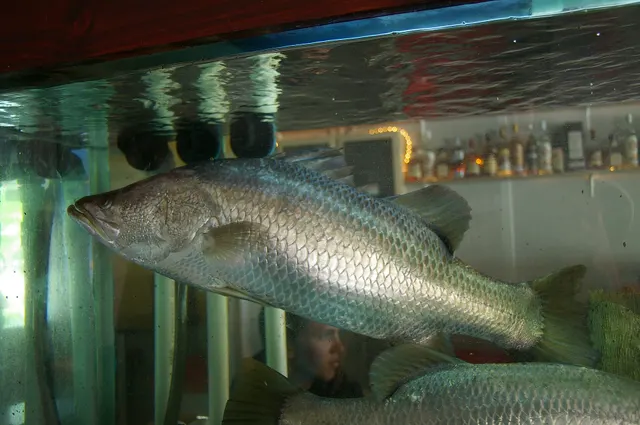 BarramundiAn estuarine ambush predator that begins life as a male and changes sex to female, so the largest fish are all breeding hens.
John Robert McPherson — CC0 1.0 Public Domain Dedication, via Wikimedia Commons
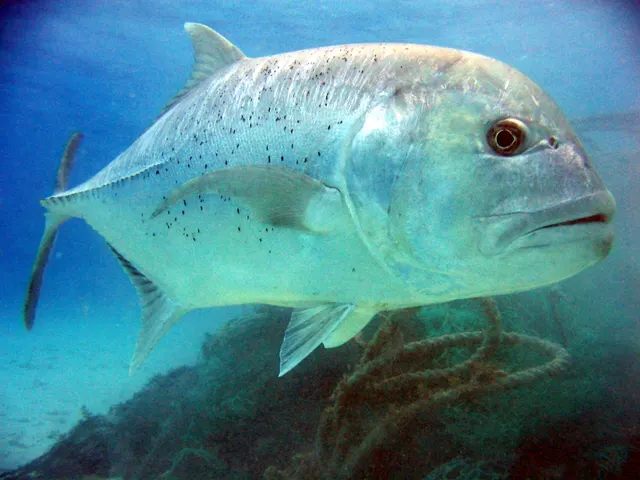 Giant trevallyA hugely powerful Indo-Pacific reef predator that hunts over shallow structure, and the fish popping was built around.
Dr. Dwayne Meadows, NOAA/NMFS/OPR — Public domain, via Wikimedia Commons
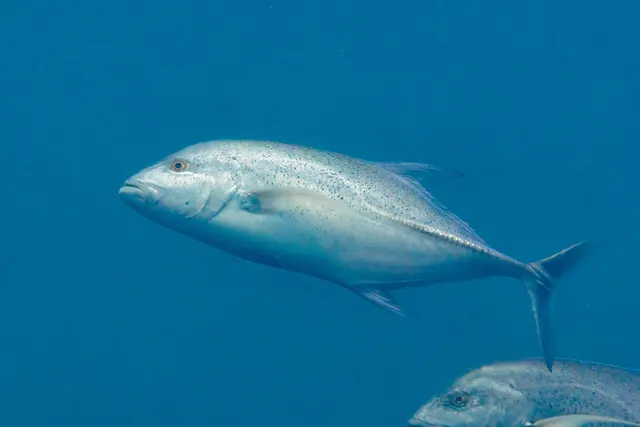 Bluefin trevallyA brilliantly marked reef trevally with electric blue fins that hunts cooperatively with other predators — including, remarkably, with octopus and moray eels.
Diego Delso — CC BY-SA 4.0, via Wikimedia Commons
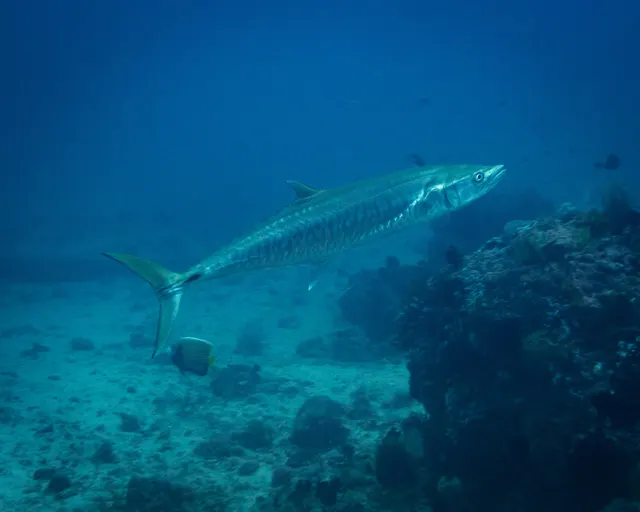 Narrow-barred Spanish mackerelA fast Indo-Pacific mackerel with vertical bars and shearing teeth that is a headline sport and food fish from South Africa to Australia — and a well-known ciguatera risk in parts of its range.
ppericard — CC BY 4.0, via Wikimedia Commons
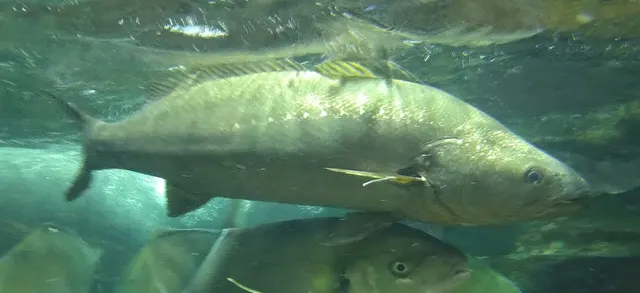 Dusky kobA large, long-lived estuarine and surf predator of southern African and Australian coasts, assessed as Endangered, and one of the clearest cases where a popular sport fish is genuinely in trouble.
タウナギ — CC BY-SA 4.0, via Wikimedia Commons
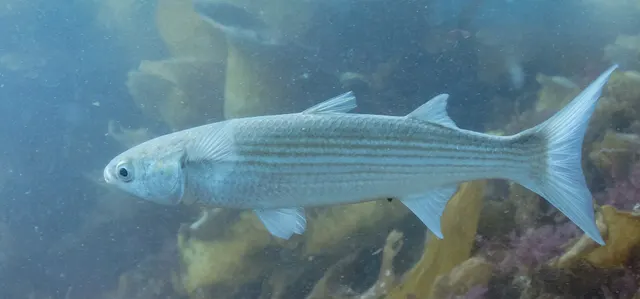 Flathead grey mulletThe most widely distributed mullet in the world, found on almost every warm and temperate coast, and a detritus feeder with a gizzard-like stomach.
Diego Delso, CC BY-SA 4.0, via Wikimedia Commons
Safety
Moving water and currents — Can cause serious injury or death
Long open surf beaches on both coasts generate strong, persistent rip currents, and there is no shelter along much of the shore. People wading, swimming or working the wash are carried offshore, and drowning on these beaches is a major cause of death in the region.
What reduces it: Recognise a rip as darker, calmer water running seaward between areas of breaking waves, and stay out of it. Do not wade beyond thigh depth in surf, do not attempt to swim directly back against a rip, and treat a beach with no lifeguard cover as one where self-rescue is the only rescue.
Worse when:
- During and around the south-west monsoon, when surf is heaviest on the west coast.
- At river mouths and gaps in a sandbar, where the outflow concentrates.
- On a falling tide, which strengthens the seaward flow.
Weather and lightning — Can cause serious injury or death
The Bay of Bengal is one of the most dangerous cyclone basins in the world. A low, densely populated delta coastline means storm surge rather than wind is the killing mechanism, and historic cyclones here have caused enormous loss of life. The south-west monsoon brings months of dangerous conditions to the western seaboard.
What reduces it: Treat cyclone warnings as absolute and evacuate rather than assess, do not fish from small boats during monsoon conditions, and understand that a seasonal closure exists partly because the weather in that window kills people.
Species that bite — Can cause serious injury or death
Estuarine and delta systems in the north-east hold saltwater crocodiles, and parts of the mangrove forest hold tigers. Both take people who work the water, and the risk is highest to those in small boats or working banks and creeks.
What reduces it: Do not enter or work crocodile habitat without local guidance, stay out of the water entirely where crocodiles are present, avoid regular patterns at the same place and time, and treat local advice on which creeks are avoided as knowledge rather than superstition.
Sun, dehydration and fatigue — Can cause injury needing treatment
Heat and humidity on an unshaded coast are severe for much of the year, and heat exhaustion develops before obvious symptoms appear. Water quality near cities and river mouths is frequently poor, so cuts and abrasions acquired in it infect readily.
What reduces it: Fish the ends of the day, carry substantially more water than seems necessary, cover up rather than relying on sunscreen alone, and clean and dress any wound acquired in turbid coastal or estuarine water promptly.
Further safety reading
- Boat safety for anglers — Small craft working an exposed coast during and around the monsoon face conditions severe enough that the seasonal closure is partly a safety measure.
- Dangerous animals where you fish — Saltwater crocodiles occupy estuarine and mangrove systems here, and venomous snakes and venomous fish are ordinary rather than exceptional hazards at the water's edge.
- Shore entry and exit for divers — Long open surf beaches with no shelter mean launching and landing through breaking water is the ordinary hazard, and it is why the traditional craft are designed around being swamped.
- Sun, dehydration and fatigue — Heat and humidity on an unshaded tropical coast are severe for much of the year and heat exhaustion develops before obvious symptoms.
- Weather, lightning and open water — The Bay of Bengal is one of the most dangerous cyclone basins in the world, and storm surge over a low delta coastline is the mechanism that kills.
Check the rules before you fish
Fishing laws, bylaws, access rules, seasons, bait restrictions and permitted methods vary by location and can change. Check the current rules from the relevant authority and the water you intend to fish before fishing.
Check with:
- Current national or regional law for where you are fishing
- Current local bylaws
- The relevant fisheries authority
- The landowner, club or fishery whose water it is
- Any restrictions specific to the species or the method you intend to use
Where to go next
What swims here
- BarramundiUses the backwaters, estuaries and river mouths along both seaboards, and is the principal target of the region's growing estuary lure fishery.
- Blue threadfinWorks the turbid surf and estuarine ground, feeding on what the wash and the tide turn over.
- Bluefin trevallyOccupies the same reef and rock ground as its larger relative along the southern and island coasts.
- BluefishOccurs along the coast as a shoaling predator on the small pelagic fish the seasonal upwelling supports.
- Dusky kobOccupies estuaries and turbid inshore water on this coast as it does on the southern African one, hunting by sound and lateral line.
- Flathead grey mulletWidespread in estuaries, backwaters and lagoon systems along both seaboards.
- Giant trevallyHolds the rocky and reef ground, particularly in the south and around the offshore island groups.
- Longtail tunaA coastal tuna of the shelf waters on both seaboards, following the small pelagic shoals the upwelling produces.
1 more
How people fish here
- HandliningHook-and-line fishing from beach-launched and harbour-based small boats is a very large part of the artisanal fishery.
- Sea fishingShore angling from rock, groyne and beach, and small-boat sport fishing in estuaries and around the island groups, are a small and growing recreational layer.
- Traditional net fishingShore seines hauled by teams from open beaches, gillnets from small craft and cast netting in backwaters account for most of the coast's fishing effort.
- TrawlingMechanised trawling from the larger ports operates alongside the artisanal sector and is regulated separately from it.
Local knowledge
How this compares
Rules and access
- Close seasonsA seasonal ban on mechanised fishing during the monsoon applies on both seaboards with different dates on each, and it is one of the largest closures anywhere by vessel numbers affected.
- Licences and permissionInshore waters are administered by the coastal state or province rather than nationally, so the operative rule usually comes from a state act and adjacent states differ.
Environment and conservation
- Bycatch and discardsTrawl and gillnet fisheries on this coast historically landed a very large share of the world's shark and ray catch, much of it as bycatch.
- Fish stocks and sustainabilityOil sardine abundance on the south-west coast tracks the strength of the seasonal upwelling, making this one of the clearest readouts anywhere of a physical process governing a fishery.
History and culture
Sources and evidence
- FishBase: a global information system on fishes — Froese, R. and D. Pauly, eds. — FishBase Consortium (Scientific institute)Relied on for: Distribution, habitat association, depth range and life history recorded for the species occurring in the area.States this directlyPassage read and verified
- The IUCN Red List of Threatened Species — International Union for Conservation of Nature (Conservation authority)Relied on for: Assessment and range account for the species of the region, including the habitats they depend on and the pressures acting on them.States this directlyCitation checked — the work exists and is described correctly
- Good Fish Guide — Marine Conservation Society (Conservation authority)Relied on for: Assessment of fisheries and the management measures applied to them, including gear selectivity and spatial protection.States this directlyCitation checked — the work exists and is described correctly
- Code of Conduct for Responsible Fisheries — Food and Agriculture Organization of the United Nations, Rome, 1995 (Standards body)Relied on for: Principles for responsible fisheries management, precaution, gear selectivity and the treatment of small-scale and shared stocks.States this directlyCitation checked — the work exists and is described correctly
- United States Lifesaving Association public education on rip currents and the surf zone — United States Lifesaving Association (Water-safety or diver-training authority)Relied on for: Surf zone hazards, rip current formation and behaviour, and the circumstances in which people are carried offshore or drowned.States this directlyCitation checked — the work exists and is described correctly
- RNLI water safety guidance: cold water shock and Float to Live — Royal National Lifeboat Institution (Water-safety or diver-training authority)Relied on for: Water safety guidance and the circumstances in which recreational water users get into difficulty in and around the sea.Background and mechanism onlyPassage read and verified
Why the 25 connections on this page are here, and the sources
What swims here
Backed by research — 9 connections
Supported by peer-reviewed research or fisheries science. The sources are listed and can be checked.
Barramundi
A distribution association between an animal and a kind of water, rather than a claim about any named mark.
- FAO Species Identification Guides for Fishery Purposes and the FAO Species Catalogues — Food and Agriculture Organization of the United Nations (Scientific institute)Relied on for: Distribution, habitat, depth and fishery accounts for the species in the FAO regional identification guides for the ocean area concerned.States this directlyCitation checked — the work exists and is described correctly
- FishBase: a global information system on fishes — Froese, R. and D. Pauly, eds. — FishBase Consortium (Scientific institute)Relied on for: Distribution, habitat association and depth range recorded for the species.States this directlyPassage read and verified
Blue threadfin
A distribution association between an animal and a kind of water, rather than a claim about any named mark.
- FAO Species Identification Guides for Fishery Purposes and the FAO Species Catalogues — Food and Agriculture Organization of the United Nations (Scientific institute)Relied on for: Distribution, habitat, depth and fishery accounts for the species in the FAO regional identification guides for the ocean area concerned.States this directlyCitation checked — the work exists and is described correctly
- FishBase: a global information system on fishes — Froese, R. and D. Pauly, eds. — FishBase Consortium (Scientific institute)Relied on for: Distribution, habitat association and depth range recorded for the species.States this directlyPassage read and verified
Bluefin trevally
A distribution association between an animal and a kind of water, rather than a claim about any named mark.
- FAO Species Identification Guides for Fishery Purposes and the FAO Species Catalogues — Food and Agriculture Organization of the United Nations (Scientific institute)Relied on for: Distribution, habitat, depth and fishery accounts for the species in the FAO regional identification guides for the ocean area concerned.States this directlyCitation checked — the work exists and is described correctly
- FishBase: a global information system on fishes — Froese, R. and D. Pauly, eds. — FishBase Consortium (Scientific institute)Relied on for: Distribution, habitat association and depth range recorded for the species.States this directlyPassage read and verified
Bluefish
A distribution association between an animal and a kind of water, rather than a claim about any named mark.
- FAO Species Identification Guides for Fishery Purposes and the FAO Species Catalogues — Food and Agriculture Organization of the United Nations (Scientific institute)Relied on for: Distribution, habitat, depth and fishery accounts for the species in the FAO regional identification guides for the ocean area concerned.States this directlyCitation checked — the work exists and is described correctly
- FishBase: a global information system on fishes — Froese, R. and D. Pauly, eds. — FishBase Consortium (Scientific institute)Relied on for: Distribution, habitat association and depth range recorded for the species.States this directlyPassage read and verified
Dusky kob
A distribution association between an animal and a kind of water, rather than a claim about any named mark.
- FAO Species Identification Guides for Fishery Purposes and the FAO Species Catalogues — Food and Agriculture Organization of the United Nations (Scientific institute)Relied on for: Distribution, habitat, depth and fishery accounts for the species in the FAO regional identification guides for the ocean area concerned.States this directlyCitation checked — the work exists and is described correctly
- FishBase: a global information system on fishes — Froese, R. and D. Pauly, eds. — FishBase Consortium (Scientific institute)Relied on for: Distribution, habitat association and depth range recorded for the species.States this directlyPassage read and verified
Flathead grey mullet
A distribution association between an animal and a kind of water, rather than a claim about any named mark.
- FAO Species Identification Guides for Fishery Purposes and the FAO Species Catalogues — Food and Agriculture Organization of the United Nations (Scientific institute)Relied on for: Distribution, habitat, depth and fishery accounts for the species in the FAO regional identification guides for the ocean area concerned.States this directlyCitation checked — the work exists and is described correctly
- FishBase: a global information system on fishes — Froese, R. and D. Pauly, eds. — FishBase Consortium (Scientific institute)Relied on for: Distribution, habitat association and depth range recorded for the species.States this directlyPassage read and verified
Giant trevally
A distribution association between an animal and a kind of water, rather than a claim about any named mark.
- FAO Species Identification Guides for Fishery Purposes and the FAO Species Catalogues — Food and Agriculture Organization of the United Nations (Scientific institute)Relied on for: Distribution, habitat, depth and fishery accounts for the species in the FAO regional identification guides for the ocean area concerned.States this directlyCitation checked — the work exists and is described correctly
- FishBase: a global information system on fishes — Froese, R. and D. Pauly, eds. — FishBase Consortium (Scientific institute)Relied on for: Distribution, habitat association and depth range recorded for the species.States this directlyPassage read and verified
Longtail tuna
A distribution association between an animal and a kind of water, rather than a claim about any named mark.
- FAO Species Identification Guides for Fishery Purposes and the FAO Species Catalogues — Food and Agriculture Organization of the United Nations (Scientific institute)Relied on for: Distribution, habitat, depth and fishery accounts for the species in the FAO regional identification guides for the ocean area concerned.States this directlyCitation checked — the work exists and is described correctly
- FishBase: a global information system on fishes — Froese, R. and D. Pauly, eds. — FishBase Consortium (Scientific institute)Relied on for: Distribution, habitat association and depth range recorded for the species.States this directlyPassage read and verified
Narrow-barred Spanish mackerel
A distribution association between an animal and a kind of water, rather than a claim about any named mark.
- FAO Species Identification Guides for Fishery Purposes and the FAO Species Catalogues — Food and Agriculture Organization of the United Nations (Scientific institute)Relied on for: Distribution, habitat, depth and fishery accounts for the species in the FAO regional identification guides for the ocean area concerned.States this directlyCitation checked — the work exists and is described correctly
- FishBase: a global information system on fishes — Froese, R. and D. Pauly, eds. — FishBase Consortium (Scientific institute)Relied on for: Distribution, habitat association and depth range recorded for the species.States this directlyPassage read and verified
How people fish here
What experienced anglers do — 4 connections
Widely and independently recommended by experienced anglers and specialist sources. This is real angling knowledge, not proof: controlled evidence for it is limited, and FishingHQ records it as convention rather than as a demonstrated effect.
Handlining
A discipline that is characteristic of the place rather than merely possible there, joined so a reader can move between the place and the practice.
- General angling website restatements of established technique — Various (Credible secondary source)Relied on for: Widely restated practice associating this discipline with this place, recorded as practitioner consensus rather than as tested fact.Background and mechanism onlyCitation checked — the work exists and is described correctly
- Fishers' Craft and Lettered Art: Tracts on Fishing from the End of the Middle Ages — University of Toronto Press, 1997 (Scientific literature)Relied on for: That fishing traditions develop around the water and fish available to them, and the historical method of reading such traditions.States this directlyCitation checked — the work exists and is described correctly
Sea fishing
A discipline that is characteristic of the place rather than merely possible there, joined so a reader can move between the place and the practice.
- General angling website restatements of established technique — Various (Credible secondary source)Relied on for: Widely restated practice associating this discipline with this place, recorded as practitioner consensus rather than as tested fact.Background and mechanism onlyCitation checked — the work exists and is described correctly
- Fishers' Craft and Lettered Art: Tracts on Fishing from the End of the Middle Ages — University of Toronto Press, 1997 (Scientific literature)Relied on for: That fishing traditions develop around the water and fish available to them, and the historical method of reading such traditions.States this directlyCitation checked — the work exists and is described correctly
Traditional net fishing
A discipline that is characteristic of the place rather than merely possible there, joined so a reader can move between the place and the practice.
- General angling website restatements of established technique — Various (Credible secondary source)Relied on for: Widely restated practice associating this discipline with this place, recorded as practitioner consensus rather than as tested fact.Background and mechanism onlyCitation checked — the work exists and is described correctly
- Fishers' Craft and Lettered Art: Tracts on Fishing from the End of the Middle Ages — University of Toronto Press, 1997 (Scientific literature)Relied on for: That fishing traditions develop around the water and fish available to them, and the historical method of reading such traditions.States this directlyCitation checked — the work exists and is described correctly
Trawling
A discipline that is characteristic of the place rather than merely possible there, joined so a reader can move between the place and the practice.
- General angling website restatements of established technique — Various (Credible secondary source)Relied on for: Widely restated practice associating this discipline with this place, recorded as practitioner consensus rather than as tested fact.Background and mechanism onlyCitation checked — the work exists and is described correctly
- Fishers' Craft and Lettered Art: Tracts on Fishing from the End of the Middle Ages — University of Toronto Press, 1997 (Scientific literature)Relied on for: That fishing traditions develop around the water and fish available to them, and the historical method of reading such traditions.States this directlyCitation checked — the work exists and is described correctly
Local knowledge
Backed by research — 1 connection
Supported by peer-reviewed research or fisheries science. The sources are listed and can be checked.
Seasonal rivers, and water that is not always there
A place that describes a physical process in prose and cannot point at it is restating something FishingHQ should explain once. This is the link that turns the restatement into a reference.
- NOAA National Ocean Service education on estuaries and the National Estuarine Research Reserve System — National Oceanic and Atmospheric Administration, United States (Government fisheries body)Relied on for: The physical structure and ecology of estuarine, lagoon and coastal systems, including salinity gradients, exchange and nursery function.States this directlyCitation checked — the work exists and is described correctly
- Cefas science, advice and data on marine and freshwater environments — Centre for Environment, Fisheries and Aquaculture Science (Government fisheries body)Relied on for: Coastal and transitional water science, including salinity, water quality and the biology those conditions support.States this directlyCitation checked — the work exists and is described correctly
How this compares
What experienced anglers do — 1 connection
Widely and independently recommended by experienced anglers and specialist sources. This is real angling knowledge, not proof: controlled evidence for it is limited, and FishingHQ records it as convention rather than as a demonstrated effect.
Sri Lanka
A comparison a traveller choosing between two destinations genuinely needs.
- General angling website restatements of established technique — Various (Credible secondary source)Relied on for: Widely restated descriptions of regional practice, ground and species, recorded as consensus rather than as scholarship.Background and mechanism onlyCitation checked — the work exists and is described correctly
- Code of Conduct for Responsible Fisheries — Food and Agriculture Organization of the United Nations, Rome, 1995 (Standards body)Relied on for: International principles for responsible fisheries, including the management of small-scale and artisanal fisheries.Background and mechanism onlyCitation checked — the work exists and is described correctly
Safety reading
Official guidance — 5 connections
Stated by a fisheries authority, scientific institute or recognised angling body. Authoritative, but summarising rather than demonstrating.
Boat safety for anglers
A place is joined to the safety topic that explains a hazard genuinely characteristic of it, so the mechanism is reachable rather than restated as a weak warning.
- RNLI water safety guidance: cold water shock and Float to Live — Royal National Lifeboat Institution (Water-safety or diver-training authority)Relied on for: Cold water shock and the immersion response, shore angling hazards, small-craft guidance and the circumstances in which water users are most often killed.States this directlyPassage read and verified
- RoSPA water safety information and UK accidental drowning statistics — Royal Society for the Prevention of Accidents (Water-safety or diver-training authority)Relied on for: Accidental drowning statistics and the circumstances in which recreational water users are most often killed.Background and mechanism onlyPassage read and verified
Dangerous animals where you fish
A place or practice joined to the hazard that is characteristic of it, so the hazard has real settings and the place cannot describe the fishing without the risk.
- The IUCN Red List of Threatened Species — International Union for Conservation of Nature (Conservation authority)Relied on for: Assessment, range and habitat account for the species concerned, including large predators and their distribution.States this directlyCitation checked — the work exists and is described correctly
- FishBase: a global information system on fishes — Froese, R. and D. Pauly, eds. — FishBase Consortium (Scientific institute)Relied on for: Habitat association, distribution and, where recorded, venom and injury risk for the species concerned.States this directlyPassage read and verified
Shore entry and exit for divers
A place is joined to the safety topic that explains a hazard genuinely characteristic of it, so the mechanism is reachable rather than restated as a weak warning.
- Rock fishing safety and the declared lifejacket areas of New South Wales — NSW Department of Primary Industries and Surf Life Saving NSW (Water-safety or diver-training authority)Relied on for: Rock and ledge fishing hazards, the mechanism by which anglers are swept from exposed platforms, and the measures that reduce it.States this directlyCitation checked — the work exists and is described correctly
- United States Lifesaving Association public education on rip currents and the surf zone — United States Lifesaving Association (Water-safety or diver-training authority)Relied on for: Surf zone hazards, rip current formation and behaviour, and the circumstances in which people are carried offshore.States this directlyCitation checked — the work exists and is described correctly
Sun, dehydration and fatigue
A place is joined to the safety topic that explains a hazard genuinely characteristic of it, so the mechanism is reachable rather than restated as a weak warning.
- NOAA National Weather Service marine forecasts and marine weather services — National Oceanic and Atmospheric Administration, United States (Government fisheries body)Relied on for: Marine forecasting, tropical cyclone warning practice and the products issued for coastal and offshore waters.States this directlyCitation checked — the work exists and is described correctly
- NOAA Diving Manual: Diving for Science and Technology — National Oceanic and Atmospheric Administration, US Department of Commerce (Scientific institute)Relied on for: Diving and in-water hazards, including hazardous marine life, currents and the management of operations in remote locations.Background and mechanism onlyCitation checked — the work exists and is described correctly
Weather, lightning and open water
A place is joined to the safety topic that explains a hazard genuinely characteristic of it, so the mechanism is reachable rather than restated as a weak warning.
- NOAA National Weather Service marine forecasts and marine weather services — National Oceanic and Atmospheric Administration, United States (Government fisheries body)Relied on for: Marine forecasting, tropical cyclone warning practice and the products issued for coastal and offshore waters.States this directlyCitation checked — the work exists and is described correctly
- NOAA Diving Manual: Diving for Science and Technology — National Oceanic and Atmospheric Administration, US Department of Commerce (Scientific institute)Relied on for: Diving and in-water hazards, including hazardous marine life, currents and the management of operations in remote locations.Background and mechanism onlyCitation checked — the work exists and is described correctly
Rules and access
Official guidance — 2 connections
Stated by a fisheries authority, scientific institute or recognised angling body. Authoritative, but summarising rather than demonstrating.
Close seasons
A place joined to the regulatory concept whose structure it illustrates. The edge asserts that the concept applies here, never what any current rule says.
- Code of Conduct for Responsible Fisheries — Food and Agriculture Organization of the United Nations, Rome, 1995 (Standards body)Relied on for: Principles for the management of fisheries, including licensing, closed seasons, size limits and the treatment of small-scale and shared stocks.States this directlyCitation checked — the work exists and is described correctly
- Good Fish Guide — Marine Conservation Society (Conservation authority)Relied on for: Assessment of fisheries and the management measures applied to them, including the instruments used and their purpose.Background and mechanism onlyCitation checked — the work exists and is described correctly
Licences and permission
A place joined to the regulatory concept whose structure it illustrates. The edge asserts that the concept applies here, never what any current rule says.
- Code of Conduct for Responsible Fisheries — Food and Agriculture Organization of the United Nations, Rome, 1995 (Standards body)Relied on for: Principles for the management of fisheries, including licensing, closed seasons, size limits and the treatment of small-scale and shared stocks.States this directlyCitation checked — the work exists and is described correctly
- Good Fish Guide — Marine Conservation Society (Conservation authority)Relied on for: Assessment of fisheries and the management measures applied to them, including the instruments used and their purpose.Background and mechanism onlyCitation checked — the work exists and is described correctly
Environment and conservation
Backed by research — 2 connections
Supported by peer-reviewed research or fisheries science. The sources are listed and can be checked.
Bycatch and discards
An environmental pressure that is specific to this place rather than general to fishing, joined so the issue is anchored to a real example.
- The IUCN Red List of Threatened Species — International Union for Conservation of Nature (Conservation authority)Relied on for: Assessment of the species and habitats affected, and the pressures acting on them, including habitat change and exploitation.States this directlyCitation checked — the work exists and is described correctly
- Code of Conduct for Responsible Fisheries — Food and Agriculture Organization of the United Nations, Rome, 1995 (Standards body)Relied on for: Principles for responsible fisheries management, precaution, gear selectivity and the treatment of shared and small-scale fisheries.Background and mechanism onlyCitation checked — the work exists and is described correctly
Fish stocks and sustainability
An environmental pressure that is specific to this place rather than general to fishing, joined so the issue is anchored to a real example.
- The IUCN Red List of Threatened Species — International Union for Conservation of Nature (Conservation authority)Relied on for: Assessment of the species and habitats affected, and the pressures acting on them, including habitat change and exploitation.States this directlyCitation checked — the work exists and is described correctly
- Code of Conduct for Responsible Fisheries — Food and Agriculture Organization of the United Nations, Rome, 1995 (Standards body)Relied on for: Principles for responsible fisheries management, precaution, gear selectivity and the treatment of shared and small-scale fisheries.Background and mechanism onlyCitation checked — the work exists and is described correctly
History and culture
Official guidance — 1 connection
Stated by a fisheries authority, scientific institute or recognised angling body. Authoritative, but summarising rather than demonstrating.
Fishing, communities and economies
A place joined to the documented fishing tradition it belongs to, so the history has a real setting and the place has a real past.
- Fishers' Craft and Lettered Art: Tracts on Fishing from the End of the Middle Ages — University of Toronto Press, 1997 (Scientific literature)Relied on for: The historical development of fishing practice and its transmission, and the method of reading a fishing tradition from its documentary record.States this directlyCitation checked — the work exists and is described correctly
- Words of the Lagoon: Fishing and Marine Lore in the Palau District of Micronesia — University of California Press, Berkeley, 1981 (Reference work)Relied on for: Documented traditional marine knowledge and fishing practice, and the social organisation of fishing rights and closures.Background and mechanism onlyCitation checked — the work exists and is described correctly
How FishingHQ labels evidence is explained in the evidence policy.