Sri Lanka
Fishing regions · Last reviewed 2026-08-17
A tropical island with reef, surf and estuary on the coast and an ancient network of man-made reservoirs inland — one of very few destinations where a visitor can seriously fish both salt and fresh from the same base.
Safety: encounters with marine life — can cause serious injury or death. 2 more points apply here.
Being listed here is not permission to fish. What that meansClose
Access, fishing rights, seasons, licences, local bylaws and permitted methods vary and can change. Check current access, permission, local regulations, closures and restrictions before you travel or fish. FishingHQ describes what the ground is and names who holds the answer; it does not hold the answer itself.
Find the authority for a jurisdiction · What FishingHQ does and does not cover
Sri Lanka ranked fourth on FishingHQ's destination model and was built ahead of two candidates above it, because it is the one that most exercises what FishingHQ can now do.
IT HAS BOTH, PROPERLY. Most tropical destinations are a coast with a lagoon attached. Sri Lanka has a coast with reef, surf beach, rocky headland, estuary and mangrove — and inland, a freshwater fishery of real substance in the tank system.
THE TANKS ARE THE PART NOBODY EXPECTS. Sri Lanka's dry zone is covered by man-made reservoirs, many of them ancient, built over two millennia for irrigation and still functioning. They are large, shallow, warm, structurally complex and full of fish, and they hold a mixture of native species and introduced ones — including tilapia and, in places, giant snakehead and other introduced predators. It is a substantial freshwater resource almost entirely undocumented for visiting anglers in English.
THE COAST CHANGES SIDE WITH THE MONSOON. Two monsoons hit opposite coasts at opposite times of year, which means that in almost any month one side of the island is fishable and the other is not. That single fact organises the whole travel calendar and is the most useful practical thing on this page.
AND THE MANGROVE AND ESTUARINE SYSTEMS ARE REAL. Lagoons, tidal creeks and mangrove line substantial parts of the coast, holding barramundi, mangrove jack, threadfin, mud crab and prawns — the exact community the environment pages describe. A traveller with a rod and a hired vehicle can fish reef, surf, estuary and reservoir inside a week.
What fishing here is like
A tropical island at the southern tip of the Indian subcontinent, with a wet zone in the south-west and a dry zone across the north and east, and two monsoons arriving at opposite times on opposite coasts.
The coastal fishing is varied in a way few tropical islands are: fringing and patch reef, long surf beaches, rocky headlands, sheltered bays, and substantial lagoon, estuary and mangrove systems on several parts of the coast. Deep water is not far offshore, and there is a real offshore fishery for pelagics.
Inland, the dry zone carries an extraordinary network of man-made reservoirs — tanks — many of them ancient irrigation works still in use, which together form one of the larger inland fisheries in South Asia. They are shallow, warm, weedy and productive, and they are a food fishery first and a sport fishery a distant second.
The recreational angling sector is small and the tourism sector is very large, so the fishing a visitor does is generally arranged through a local guide or done independently from shore. There is no established angling-tourism industry of the kind Thailand has, which is precisely why the model ranked it: real fishing, real access, and almost nothing written for a visitor.
What dominates
Shore fishing from beach, rock and lagoon mouth — light lure and bait fishing for trevallies, queenfish, barracuda, snappers and emperors, and heavier tackle where deep water is close.
Estuary and lagoon fishing, which is where the barramundi, mangrove jack, threadfin and estuarine cod are, and which is best done from a small boat or a kayak given the mangrove structure.
Offshore boat fishing for tuna, sailfish, wahoo, dorado and giant trevally, run as a small charter sector from several coastal towns.
Freshwater fishing in the tanks, which is genuinely undeveloped for visitors: lure fishing for introduced predators and native species from bank and small boat. Fly fishing is essentially unrepresented and would work.
Crab and prawn gathering is a substantial local activity in the lagoon and mangrove systems rather than a visitor one, and mud crab in particular is both a fishery and a menu item across the island.
The water available
Fringing and patch coral reef, particularly on the east and south coasts. Long surf beaches. Rocky headlands and boulder coast. Sheltered bays and lagoons.
Extensive lagoon, estuary and mangrove systems, including some of the larger mangrove areas in South Asia, holding the tropical estuarine community FishingHQ describes.
Inland: an enormous network of man-made reservoirs across the dry zone, shallow and warm and structurally complex, plus rivers running from the central highlands. The highland streams hold introduced trout in a few places, which is a curiosity rather than a fishery.
Offshore, the continental shelf is narrow in places and deep water is reachable within a short run.
How the rules are structured
Sri Lankan national fisheries and aquatic resources law, administered through the national fisheries department, with separate wildlife and environmental administration covering protected areas — and a very substantial share of the tank system and several coastal areas sit inside national parks and reserves where different rules apply.
What matters structurally for a visitor: fishing inside a national park or reserve is a wildlife matter rather than a fisheries one and the answer is usually no; the tanks are working irrigation infrastructure with local fishing communities holding rights over them, so access is a social question as much as a legal one; and boat operation, offshore fishing and the taking of certain species are separately regulated.
NOTHING ON THIS PAGE IS A CURRENT RULE. Licensing, permitted methods, marine park boundaries, spearfishing restrictions, size limits and what may be taken all differ here from what a visitor will assume, differ between areas, and are revised. Establish the position with the authorities named on this page before fishing, and do it before travelling rather than on arrival. FishingHQ does not state what any current rule is.
Who to ask
- The Department of Fisheries and Aquatic Resources, for the national fisheries framework, licensing and species restrictions
- The Department of Wildlife Conservation, for national parks and reserves — which cover a substantial share of the tank system and several coastal areas, and where fishing is generally a different question entirely
- The Central Environmental Authority and the Coast Conservation Department, for coastal and lagoon protection and for anything touching mangrove
- The local fisheries inspector or the community organisation holding rights over a particular tank, which is frequently the only practical source for whether fishing there is acceptable
- A local guide or operator, who will know both the legal and the social position and is the fastest honest route to either
Words you will meet
- Tank
- A man-made reservoir, from the Portuguese tanque. Sri Lanka's dry zone is covered in them, many built over two thousand years ago for irrigation and still in use. The word does not mean a small pond — some are very large.
- Wewa
- The Sinhala word for a tank or reservoir, and the element in an enormous number of place names across the dry zone.
- Lagoon
- Used here for the brackish coastal water bodies connected to the sea, several of them large, mangrove-fringed and the centre of local fishing and crabbing.
- Oruwa
- The traditional outrigger canoe of the Sri Lankan coast, still used for inshore fishing, and a craft a visitor is far more likely to see than a fibreglass boat in many places.
- Maha and Yala
- The two agricultural seasons, driven by the two monsoons — Maha the north-east, Yala the south-west. They organise water levels in the tanks and therefore the fishing in them.
Conditions and hazards
HEAT AND HUMIDITY are constant and are the most likely thing to spoil a trip. Tropical sun on open water, high humidity that prevents cooling, and long days produce heat exhaustion before people recognise it.
THE SURF AND THE RIPS on the exposed coast are serious, and they are exactly the beaches that look most inviting. Which coast is exposed depends on the monsoon, and a beach that is flat in January can be dangerous in July.
CROCODILES ARE PRESENT in lagoons, estuaries, rivers and many tanks, and they are not a theoretical hazard here. Local advice about specific waters is the authority and is worth taking absolutely. Do not wade in lagoons or tanks, do not clean fish at the water's edge, and do not establish a routine at one spot.
WILDLIFE AROUND THE TANKS. Elephants use the tanks, particularly at dawn and dusk, and elephant encounters cause more human deaths in Sri Lanka than any other animal. Water buffalo are unpredictable. Neither is a reason not to go; both are a reason to have somebody local with you.
MOSQUITO-BORNE DISEASE is a genuine consideration in lagoon, tank and mangrove environments, and dengue in particular is present. Repellent and cover at dawn and dusk are practical rather than fussy.
AND ROAD TRAVEL is the statistically most dangerous part of a Sri Lankan fishing trip by a considerable margin, which is worth stating because it is the risk nobody plans for.
The monsoons decide which coast, and that is the single most useful fact
Sri Lanka has two monsoons arriving at opposite times on opposite coasts, and a visitor who understands that has solved most of the planning problem.
THE SOUTH-WEST MONSOON runs roughly May to September and hits the south-west and west coasts. During it, the west and south are wet, windy and rough, and the east and north-east are settled and clear.
THE NORTH-EAST MONSOON runs roughly October to February and does the reverse. The east coast becomes rough and the south and west become workable.
WHICH MEANS THERE IS ALWAYS A FISHABLE COAST. In almost any month one side of the island is calm and clear and the other is not, and moving from one to the other is a few hours by road. That is genuinely unusual and it is the reason Sri Lanka works as a destination in months when comparable places do not.
THE INTER-MONSOON PERIODS — roughly March to April and again in October — are frequently the best of both, with settled conditions on several coasts at once and thunderstorms in the afternoons.
AND THE TANKS RUN ON THE SAME CLOCK. Reservoir levels rise with the monsoon that feeds the catchment and fall through the dry months. Falling water concentrates fish exactly as it does anywhere else the flood-pulse mechanic applies, so the tail of the dry season is the productive window and full tanks after heavy rain are the difficult one. This is the same principle as the run-off in northern Australia, at a different scale.
WHAT THIS PAGE WILL NOT DO is tell you which month to book. Monsoon timing varies year to year and has become less predictable, and a fishing trip planned around a calendar rather than a forecast is a trip planned around an average.
What experienced anglers do — why, and the sources (2)
Widely and independently recommended by experienced anglers and specialist sources. This is real angling knowledge, not proof: controlled evidence for it is limited, and FishingHQ records it as convention rather than as a demonstrated effect.
- General angling website restatements of established technique — Various (Credible secondary source)Relied on for: Widely restated descriptions of regional practice, ground and species, recorded as consensus rather than as scholarship.Background and mechanism onlyCitation checked — the work exists and is described correctly
- FAO Species Identification Guides for Fishery Purposes and the FAO Species Catalogues — Food and Agriculture Organization of the United Nations (Scientific institute)Relied on for: Species composition, habitat association and distribution for the region concerned, as set out in the FAO species identification sheets.States this directlyCitation checked — the work exists and is described correctly
The tanks, and the freshwater fishery almost nobody writes about
Sri Lanka's dry zone carries a network of man-made reservoirs that is genuinely remarkable and almost entirely absent from English-language fishing material.
WHAT THEY ARE. Irrigation reservoirs — tanks — many built between two thousand and fifteen hundred years ago as part of a hydraulic civilisation, still functioning, and ranging from village ponds to sheets of water several kilometres across. They are shallow, warm, weedy, structurally complex, full of standing timber and drowned vegetation, and connected to one another by channels.
WHAT LIVES IN THEM. A mixture of native and introduced species, and the introduced ones dominate the fishery: tilapia above all, plus carps, and in places introduced predators including snakeheads. Native species include a range of barbs, catfishes and the freshwater fish of the region. The tanks are a food fishery first, worked by local communities with nets and traps, and a sport fishery only incidentally.
WHY THAT MATTERS TO A VISITOR. A tank is not a wilderness lake; it is working infrastructure with a community that has rights over it and depends on it. Turning up and fishing one is a social question before it is a legal one, and the answer is frequently yes with somebody local and no without. That is the honest position and it is more useful than a list of waters.
THE FISHING ITSELF. Bank fishing and small-boat fishing with lures over drowned structure, in warm shallow water — closer to fishing a tropical impoundment than anything European. It is undeveloped for visitors, and fly fishing in particular is effectively unpractised and would work.
AND THE PARKS COMPLICATE IT. A substantial number of tanks sit inside national parks and reserves where fishing is a wildlife matter rather than a fisheries one, and the answer there is generally no. Crocodiles and elephants both use tanks heavily, which is a second and independent reason not to wander onto one alone.
NOTHING ON THIS PAGE IS A CURRENT RULE. Licensing, permitted methods, marine park boundaries, spearfishing restrictions, size limits and what may be taken all differ here from what a visitor will assume, differ between areas, and are revised. Establish the position with the authorities named on this page before fishing, and do it before travelling rather than on arrival. FishingHQ does not state what any current rule is.
What experienced anglers do — why, and the sources (3)
Widely and independently recommended by experienced anglers and specialist sources. This is real angling knowledge, not proof: controlled evidence for it is limited, and FishingHQ records it as convention rather than as a demonstrated effect.
- General angling website restatements of established technique — Various (Credible secondary source)Relied on for: Widely restated descriptions of regional practice, ground and species, recorded as consensus rather than as scholarship.Background and mechanism onlyCitation checked — the work exists and is described correctly
- Code of Conduct for Responsible Fisheries — Food and Agriculture Organization of the United Nations, Rome, 1995 (Standards body)Relied on for: International principles for responsible fisheries, including the management of small-scale and artisanal fisheries and the protection of critical habitat.Background and mechanism onlyCitation checked — the work exists and is described correctly
- FAO Species Identification Guides for Fishery Purposes and the FAO Species Catalogues — Food and Agriculture Organization of the United Nations (Scientific institute)Relied on for: Species composition, habitat association and distribution for the region concerned, as set out in the FAO species identification sheets.States this directlyCitation checked — the work exists and is described correctly
Lagoons, mangrove and the estuarine fishery
The lagoon and mangrove systems are where Sri Lanka's coastal fishing is most distinctive and where the environment layer on FishingHQ applies most directly.
WHAT IS THERE. Substantial brackish lagoons connected to the sea, mangrove-fringed creeks, and tidal estuaries, several of them large. The community is the tropical estuarine one: barramundi, mangrove jack, estuarine cod, threadfin, mullet, juvenile trevallies, and mud crab and prawns in quantity.
HOW IT FISHES. The mangrove mechanic applies exactly as described on the habitat record — catch disperses into flooded root structure on the flood and is flushed out through creek mouths on the drop, and the predators stack at the outlets. A small boat or a kayak reaches the creeks that a larger craft cannot, and the fishing is casting to structure with tackle heavy enough to turn a fish before it reaches roots.
THE CRAB AND PRAWN FISHERY IS LOCAL RATHER THAN VISITING, and it is substantial. Mud crab from the lagoons appears on menus across the island, and the lagoon prawn fishery is a significant part of the coastal economy. A visitor is far more likely to eat this fishery than to participate in it, which is worth knowing before assuming a crab pot is an option.
AND THE MANGROVE HAS A RESTORATION STORY. Sri Lanka has lost mangrove to aquaculture conversion and development, as most of tropical Asia has, and has been the subject of significant restoration and protection effort. Areas under protection and areas under restoration both exist, and fishing them may be restricted for reasons that have nothing to do with fish stocks.
WHICH BRINGS THE SAME CAVEAT AS EVERY OTHER SECTION HERE. Lagoons, mangrove and coastal wetland attract coastal-protection and wildlife designations as well as fisheries rules, and the two administrations answer different questions. Ask both.
NOTHING ON THIS PAGE IS A CURRENT RULE. Licensing, permitted methods, marine park boundaries, spearfishing restrictions, size limits and what may be taken all differ here from what a visitor will assume, differ between areas, and are revised. Establish the position with the authorities named on this page before fishing, and do it before travelling rather than on arrival. FishingHQ does not state what any current rule is.
Backed by research — why, and the sources (4)
Supported by peer-reviewed research or fisheries science. The sources are listed and can be checked.
- The World's Mangroves and their Fisheries — FAO Forestry and Fisheries assessments — Food and Agriculture Organization of the United Nations, Rome (Standards body)Relied on for: The nursery function of mangrove systems for tropical coastal fisheries and the dependence of specific fisheries on that habitat.States this directlyCitation checked — the work exists and is described correctly
- FAO Species Identification Guides for Fishery Purposes and the FAO Species Catalogues — Food and Agriculture Organization of the United Nations (Scientific institute)Relied on for: Species composition, habitat association and distribution for the region concerned, as set out in the FAO species identification sheets.States this directlyCitation checked — the work exists and is described correctly
- Code of Conduct for Responsible Fisheries — Food and Agriculture Organization of the United Nations, Rome, 1995 (Standards body)Relied on for: International principles for responsible fisheries, including the management of small-scale and artisanal fisheries and the protection of critical habitat.Background and mechanism onlyCitation checked — the work exists and is described correctly
- General angling website restatements of established technique — Various (Credible secondary source)Relied on for: Widely restated descriptions of regional practice, ground and species, recorded as consensus rather than as scholarship.Background and mechanism onlyCitation checked — the work exists and is described correctly
Some of what lives here
Fish recorded here that FishingHQ holds a reviewed photograph of. It is not a complete list of what Sri Lanka holds, and it is not a prediction that you will catch any of them — it is a way in to the ones we can show you.
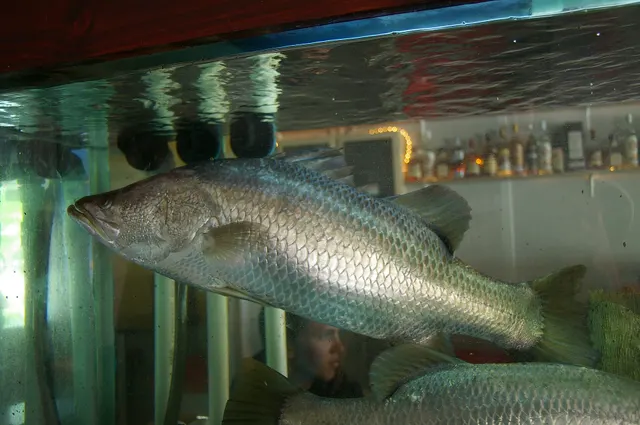 BarramundiAn estuarine ambush predator that begins life as a male and changes sex to female, so the largest fish are all breeding hens.
John Robert McPherson — CC0 1.0 Public Domain Dedication, via Wikimedia Commons
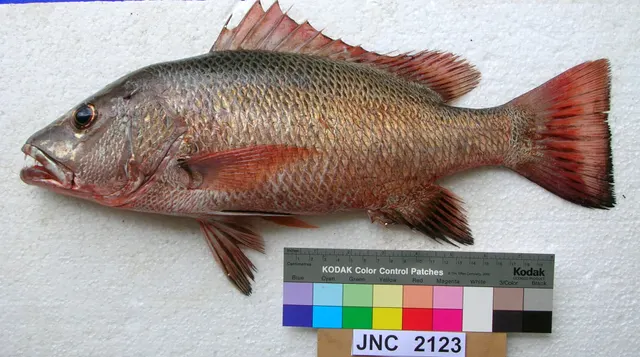 Mangrove jackA powerful red snapper of mangrove creeks and estuaries that moves to offshore reef as it matures, notorious for reaching structure the instant it is hooked.
Jean-Lou Justine — CC BY-SA 4.0, via Wikimedia Commons
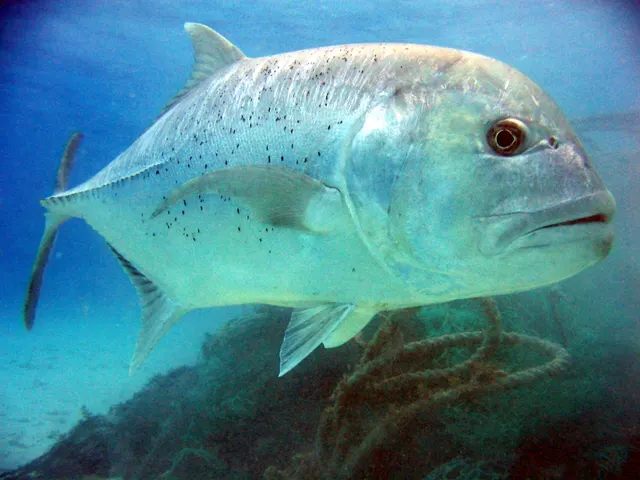 Giant trevallyA hugely powerful Indo-Pacific reef predator that hunts over shallow structure, and the fish popping was built around.
Dr. Dwayne Meadows, NOAA/NMFS/OPR — Public domain, via Wikimedia Commons
Safety
Encounters with marine life — Can cause serious injury or death
Crocodiles inhabit lagoons, estuaries, rivers and a great many tanks, and attacks occur. Around the tanks, elephants cause more human deaths in Sri Lanka than any other animal and use the water at dawn and dusk.
What reduces it: Take local advice about specific waters absolutely — it is based on what has happened there and FishingHQ will not summarise it. Do not wade in lagoons or tanks. Do not clean fish at the water's edge. Do not walk to a tank alone at dawn or dusk. Fish inland water with somebody local.
Worse when:
- Dawn and dusk
- Wading or working at the water's edge
- Repeating a routine at one spot
Drowning and immersion — Can cause serious injury or death
Surf and rip currents on the exposed coast are serious, and which coast is exposed changes with the monsoon. A beach that was calm in one season can be dangerous in the other, and visitor drownings are a recurring problem here.
What reduces it: Establish which monsoon is running and which coast it is hitting. Do not wade or swim on an exposed surf beach because it was calm on a previous visit. Ask locally about a specific beach rather than judging it by appearance.
Worse when:
- The monsoon coast in season
- Beaches with no lifeguard
- Fishing alone from a surf beach
Sun, dehydration and fatigue — Can cause injury needing treatment
Tropical heat with high humidity prevents the body cooling by evaporation, so heat exhaustion arrives faster than the temperature suggests and is frequently mistaken for tiredness.
What reduces it: Fish the ends of the day, take shade seriously, and drink far more than feels necessary. Treat loss of concentration as a signal to stop, particularly before driving.
Worse when:
- Midday on open water
- Long days in a boat with no cover
Further safety reading
- Dangerous animals where you fish — Crocodiles in lagoons, rivers and many tanks, and elephants using the tanks at dawn and dusk. Local advice is the authority.
Check the rules before you fish
Fishing laws, bylaws, access rules, seasons, bait restrictions and permitted methods vary by location and can change. Check the current rules from the relevant authority and the water you intend to fish before fishing.
Check with:
- Current national or regional law for where you are fishing
- Current local bylaws
- The relevant fisheries authority
- The landowner, club or fishery whose water it is
- Any restrictions specific to the species or the method you intend to use
Where to go next
What swims here
- BarramundiIn the lagoon, estuary and mangrove systems, which are substantial on several parts of the coast.
- Blue threadfinTurbid estuarine and lagoon water, responding to freshwater flow as it does across its Indo-Pacific range.
- Giant trevallyReef edges, lagoon mouths and offshore, and one of the species the small charter sector runs for.
- Mangrove jackEstuarine snags and mangrove creeks, with the larger fish moving out to reef as they mature.
- Mud crabA significant local lagoon fishery and a menu item across the island, worked by communities rather than by visitors.
- Nile tilapiaIntroduced and now the dominant species of the tank fishery, where it is a food fish first and a sport fish incidentally.
How this compares
- MangroveThe lagoon and creek systems are mangrove, and the tide mechanic described there is what the estuarine fishing here runs on.
- ReservoirsThe tank system is a reservoir fishery — shallow, warm, weedy and structurally complex — with two thousand years of history attached to it.
- Saltwater fly fishingLagoon, estuary and mangrove systems holding barramundi, mangrove jack and threadfin, which is the mangrove fly problem — turning a fish out of cover — rather than the flats one.
- The Egyptian Red Sea coastTwo tropical destinations ranked in the same batch and almost opposite in structure: one has reef and no fresh water at all, the other has reef, mangrove, estuary and an ancient reservoir network.
- The Indian subcontinent coastsThe island and the mainland coast it sits off, sharing a fauna and differing sharply in access, monsoon timing and how much of the coast a visitor can reach.
- Tropical estuary and tidal creekTwo monsoons on opposite coasts at opposite times, which is the wet-dry cycle this page describes, applied to an island.
Rules and access
Sources and evidence
- FAO Species Identification Guides for Fishery Purposes and the FAO Species Catalogues — Food and Agriculture Organization of the United Nations (Scientific institute)Relied on for: Species composition, habitat association and distribution for the region concerned, as set out in the FAO species identification sheets.States this directlyCitation checked — the work exists and is described correctly
- The World's Mangroves and their Fisheries — FAO Forestry and Fisheries assessments — Food and Agriculture Organization of the United Nations, Rome (Standards body)Relied on for: The nursery function of mangrove systems for tropical coastal fisheries and the dependence of specific fisheries on that habitat.States this directlyCitation checked — the work exists and is described correctly
- Code of Conduct for Responsible Fisheries — Food and Agriculture Organization of the United Nations, Rome, 1995 (Standards body)Relied on for: International principles for responsible fisheries, including the management of small-scale and artisanal fisheries and the protection of critical habitat.Background and mechanism onlyCitation checked — the work exists and is described correctly
- General angling website restatements of established technique — Various (Credible secondary source)Relied on for: Widely restated descriptions of regional practice, ground and species, recorded as consensus rather than as scholarship.Background and mechanism onlyCitation checked — the work exists and is described correctly
- The IUCN Red List of Threatened Species — International Union for Conservation of Nature (Conservation authority)Relied on for: Global assessments and distribution for the species and habitats concerned, including reef-associated and migratory species.States this directlyCitation checked — the work exists and is described correctly
Why the 14 connections on this page are here, and the sources
What swims here
Backed by research — 6 connections
Supported by peer-reviewed research or fisheries science. The sources are listed and can be checked.
Barramundi
A distributional claim about where a species occurs, resting on the regional identification literature rather than on angling report. It says nothing about where a reader should fish.
- FAO Species Identification Guides for Fishery Purposes and the FAO Species Catalogues — Food and Agriculture Organization of the United Nations (Scientific institute)Relied on for: Species composition, habitat association and distribution for the region concerned, as set out in the FAO species identification sheets.States this directlyCitation checked — the work exists and is described correctly
- The IUCN Red List of Threatened Species — International Union for Conservation of Nature (Conservation authority)Relied on for: Global assessment and distribution for the species concerned.States this directlyCitation checked — the work exists and is described correctly
Blue threadfin
A distributional claim about where a species occurs, resting on the regional identification literature rather than on angling report. It says nothing about where a reader should fish.
- FAO Species Identification Guides for Fishery Purposes and the FAO Species Catalogues — Food and Agriculture Organization of the United Nations (Scientific institute)Relied on for: Species composition, habitat association and distribution for the region concerned, as set out in the FAO species identification sheets.States this directlyCitation checked — the work exists and is described correctly
- The IUCN Red List of Threatened Species — International Union for Conservation of Nature (Conservation authority)Relied on for: Global assessment and distribution for the species concerned.States this directlyCitation checked — the work exists and is described correctly
Giant trevally
A distributional claim about where a species occurs, resting on the regional identification literature rather than on angling report. It says nothing about where a reader should fish.
- FAO Species Identification Guides for Fishery Purposes and the FAO Species Catalogues — Food and Agriculture Organization of the United Nations (Scientific institute)Relied on for: Species composition, habitat association and distribution for the region concerned, as set out in the FAO species identification sheets.States this directlyCitation checked — the work exists and is described correctly
- The IUCN Red List of Threatened Species — International Union for Conservation of Nature (Conservation authority)Relied on for: Global assessment and distribution for the species concerned.States this directlyCitation checked — the work exists and is described correctly
Mangrove jack
A distributional claim about where a species occurs, resting on the regional identification literature rather than on angling report. It says nothing about where a reader should fish.
- FAO Species Identification Guides for Fishery Purposes and the FAO Species Catalogues — Food and Agriculture Organization of the United Nations (Scientific institute)Relied on for: Species composition, habitat association and distribution for the region concerned, as set out in the FAO species identification sheets.States this directlyCitation checked — the work exists and is described correctly
- The IUCN Red List of Threatened Species — International Union for Conservation of Nature (Conservation authority)Relied on for: Global assessment and distribution for the species concerned.States this directlyCitation checked — the work exists and is described correctly
Mud crab
A distributional claim about where a species occurs, resting on the regional identification literature rather than on angling report. It says nothing about where a reader should fish.
- FAO Species Identification Guides for Fishery Purposes and the FAO Species Catalogues — Food and Agriculture Organization of the United Nations (Scientific institute)Relied on for: Species composition, habitat association and distribution for the region concerned, as set out in the FAO species identification sheets.States this directlyCitation checked — the work exists and is described correctly
- The IUCN Red List of Threatened Species — International Union for Conservation of Nature (Conservation authority)Relied on for: Global assessment and distribution for the species concerned.States this directlyCitation checked — the work exists and is described correctly
Nile tilapia
A distributional claim about where a species occurs, resting on the regional identification literature rather than on angling report. It says nothing about where a reader should fish.
- FAO Species Identification Guides for Fishery Purposes and the FAO Species Catalogues — Food and Agriculture Organization of the United Nations (Scientific institute)Relied on for: Species composition, habitat association and distribution for the region concerned, as set out in the FAO species identification sheets.States this directlyCitation checked — the work exists and is described correctly
- The IUCN Red List of Threatened Species — International Union for Conservation of Nature (Conservation authority)Relied on for: Global assessment and distribution for the species concerned.States this directlyCitation checked — the work exists and is described correctly
How this compares
What experienced anglers do — 6 connections
Widely and independently recommended by experienced anglers and specialist sources. This is real angling knowledge, not proof: controlled evidence for it is limited, and FishingHQ records it as convention rather than as a demonstrated effect.
Mangrove
A destination joined to the ground it is made of, so a reader can follow from the place to how the habitat behaves.
- General angling website restatements of established technique — Various (Credible secondary source)Relied on for: Widely restated descriptions of regional practice, ground and species, recorded as consensus rather than as scholarship.Background and mechanism onlyCitation checked — the work exists and is described correctly
- Code of Conduct for Responsible Fisheries — Food and Agriculture Organization of the United Nations, Rome, 1995 (Standards body)Relied on for: International principles for responsible fisheries, including the management of small-scale and artisanal fisheries.Background and mechanism onlyCitation checked — the work exists and is described correctly
Reservoirs
A destination joined to the ground it is made of, so a reader can follow from the place to how the habitat behaves.
- General angling website restatements of established technique — Various (Credible secondary source)Relied on for: Widely restated descriptions of regional practice, ground and species, recorded as consensus rather than as scholarship.Background and mechanism onlyCitation checked — the work exists and is described correctly
- Code of Conduct for Responsible Fisheries — Food and Agriculture Organization of the United Nations, Rome, 1995 (Standards body)Relied on for: International principles for responsible fisheries, including the management of small-scale and artisanal fisheries.Background and mechanism onlyCitation checked — the work exists and is described correctly
Saltwater fly fishing
A comparison a reader making this decision genuinely needs.
- Still Water Fly-Fishing — Andre Deutsch, 1952 (Specialist angling publication)Relied on for: Fly-fishing practice from a practitioner tradition: line control, depth management, retrieve and the reading of water.States this directlyCitation checked — the work exists and is described correctly
- Sea Angler — Bauer Media (Specialist angling publication)Relied on for: Contemporary UK sea angling practice as reported by practitioners: ground, tackle, presentation and seasonal timing.States this directlyCitation checked — the work exists and is described correctly
The Egyptian Red Sea coast
A comparison a traveller choosing between two destinations genuinely needs.
- General angling website restatements of established technique — Various (Credible secondary source)Relied on for: Widely restated descriptions of regional practice, ground and species, recorded as consensus rather than as scholarship.Background and mechanism onlyCitation checked — the work exists and is described correctly
- Code of Conduct for Responsible Fisheries — Food and Agriculture Organization of the United Nations, Rome, 1995 (Standards body)Relied on for: International principles for responsible fisheries, including the management of small-scale and artisanal fisheries.Background and mechanism onlyCitation checked — the work exists and is described correctly
The Indian subcontinent coasts
A comparison a traveller choosing between two destinations genuinely needs.
- General angling website restatements of established technique — Various (Credible secondary source)Relied on for: Widely restated descriptions of regional practice, ground and species, recorded as consensus rather than as scholarship.Background and mechanism onlyCitation checked — the work exists and is described correctly
- Code of Conduct for Responsible Fisheries — Food and Agriculture Organization of the United Nations, Rome, 1995 (Standards body)Relied on for: International principles for responsible fisheries, including the management of small-scale and artisanal fisheries.Background and mechanism onlyCitation checked — the work exists and is described correctly
Tropical estuary and tidal creek
A destination joined to the ground it is made of, so a reader can follow from the place to how the habitat behaves.
- General angling website restatements of established technique — Various (Credible secondary source)Relied on for: Widely restated descriptions of regional practice, ground and species, recorded as consensus rather than as scholarship.Background and mechanism onlyCitation checked — the work exists and is described correctly
- Code of Conduct for Responsible Fisheries — Food and Agriculture Organization of the United Nations, Rome, 1995 (Standards body)Relied on for: International principles for responsible fisheries, including the management of small-scale and artisanal fisheries.Background and mechanism onlyCitation checked — the work exists and is described correctly
Safety reading
Official guidance — 1 connection
Stated by a fisheries authority, scientific institute or recognised angling body. Authoritative, but summarising rather than demonstrating.
Dangerous animals where you fish
A link to a safety topic substantial enough to be read in full.
- RNLI water safety guidance: cold water shock and Float to Live — Royal National Lifeboat Institution (Water-safety or diver-training authority)Relied on for: Water safety guidance for coastal users.States this directlyPassage read and verified
Rules and access
Official guidance — 1 connection
Stated by a fisheries authority, scientific institute or recognised angling body. Authoritative, but summarising rather than demonstrating.
Who regulates fishing, and how to find your rules
This points to the kind of rule that applies rather than to any rule itself, so the page carries the notice that the requirement varies.
- Code of Conduct for Responsible Fisheries — Food and Agriculture Organization of the United Nations, Rome, 1995 (Standards body)Relied on for: International principles for fisheries management, including the role of national authorities and the management of protected areas.Background and mechanism onlyCitation checked — the work exists and is described correctly
- Angling Trust guidance for anglers — Angling Trust (Angling or fisheries organisation)Relied on for: The structure of angling regulation and the framework within which anglers are asked to establish local rules.States this directlyCitation checked — the work exists and is described correctly
How FishingHQ labels evidence is explained in the evidence policy.