Mangrove
Habitat · Last reviewed 2026-08-17
A forest that is underwater twice a day. The roots are the habitat, the nursery function is the point, and almost every tropical inshore fish an angler catches spent part of its life here.
Safety: tides and being cut off — can cause serious injury or death. 4 more points apply here.
- Water
- Saltwater, Brackish
A mangrove is the only forest on FishingHQ and it is the most productive thing in it.
WHAT IT PHYSICALLY IS. Salt-tolerant trees growing in the tropical and subtropical intertidal, rooted in soft anoxic sediment, with aerial root systems — prop roots, pneumatophores, buttresses — that hold the tree up in mud and get oxygen to it. Twice a day the tide floods the root zone and twice a day it drains. That cycle is the whole system.
THE ROOTS ARE THE HABITAT AND THEY ARE THE FISHING. A mangrove root system is a three-dimensional maze of hard vertical structure standing in soft ground, and it functions exactly as a reef does: it gives small animals somewhere a large animal cannot follow. Juvenile fish, prawns and crabs occupy the root zone at high water and are pushed out of it as the tide falls, which is when the predators are waiting.
SO THE FISHING IS ABOUT THE TIDE MOVING PREY, NOT ABOUT THE FISH FEEDING. On a flood, catch disperses into cover and becomes hard to reach. On an ebb, the cover drains and everything that was hiding in it is pushed into the channel. That single mechanic explains why mangrove fishing is organised around the drop, why creek mouths concentrate fish, and why the same spot is empty and then full within two hours.
AND IT IS A NURSERY FOR FISHERIES THAT HAPPEN ELSEWHERE. A great many tropical coastal species — penaeid prawns above all, and a long list of snappers, emperors, jacks and barramundi — pass their juvenile life in mangrove and are caught as adults on reefs and open coasts miles away. Removing mangrove does not reduce mangrove fishing; it reduces fishing somewhere else, years later, which is exactly why the loss has been so easy to permit.
What characterises it
Salt-tolerant trees on soft intertidal sediment through the tropics and subtropics, with aerial root systems that hold the tree in mud and supply it with oxygen. Species vary by region and by position on the shore, and the zonation is real: the seaward fringe, the mid-forest and the landward margin differ in inundation, salinity and root form.
The water is warm, frequently turbid with suspended fine sediment, and often stained brown by tannins leached from leaf litter — which reduces light penetration sharply and is one reason mangrove fish tend to be ambush predators with good low-light vision rather than pursuit hunters.
Oxygen is the constraint people underestimate. The sediment is anoxic within millimetres of the surface, warm water holds less dissolved oxygen than cold, and decomposition of leaf litter consumes more. In the back of a creek at the end of a hot dry season, dissolved oxygen can fall low enough to matter to the fish and to anything released there.
The geography a fisher actually meets is a system rather than a shoreline: a main channel, side creeks that drain the forest, drains and gutters cutting the flats, a seaward fringe of overhanging root, and — behind it — ground that is only water on a big tide.
What lives there
Extraordinarily productive, and productive somewhere else. The base is leaf litter rather than plankton: mangroves shed enormous quantities of leaf material which is broken down by crabs, bacteria and fungi into detritus that feeds prawns, molluscs and small fish. That detrital pathway, plus the physical refuge of the roots, is what makes the system a nursery.
The resident community is dominated by crabs — sesarmid leaf-eaters in the forest, mud crabs in the creeks and burrows, fiddler crabs on the flats — together with mudskippers, gobies, small fish and molluscs on the roots. The predators are visitors that follow the tide: barramundi, snook, mangrove jack, tarpon, jacks and trevallies, threadfin, estuarine cod and — in many systems — juvenile sharks and rays using the shallow turbid water as a nursery of their own.
The fisheries dependence is documented rather than inferred. Penaeid prawn fisheries and mud crab fisheries are directly mangrove-dependent, and a substantial share of tropical coastal finfish species use mangrove as juvenile habitat before recruiting to reef and open coast. Mangrove extent has declined markedly over recent decades, with aquaculture conversion, timber extraction and coastal development the principal causes — and in several places prawn and crab ponds were built by clearing the habitat that produced the wild prawns and crabs.
Through the year
Two cycles run at once and they operate on completely different clocks.
THE TIDE is the short cycle and it is the one that decides a session. Spring tides flood further into the forest and drain harder out of it, moving more prey and producing shorter, sharper feeding windows; neaps move less water and spread the fishing out. The state of the tide matters more than the time of day in most mangrove systems.
THE WET AND DRY SEASON is the long cycle. Wet-season rain lowers salinity, colours the water, floods the landward margin and — where the system connects to a river — triggers the run-off fishing described on the tropical estuary record. The dry season concentrates fish into the deeper channels and holes as the shallows become too warm, too saline or too shallow to hold them, which makes them easier to find and more vulnerable to being fished out.
Temperature varies less than in a temperate system and matters more at the extremes: the back of a shallow creek on a still hot afternoon can become genuinely inhospitable, and fish leave it.
How the tide decides everything, and why the drop is the fishing
The single most useful thing to understand about a mangrove is that the fish are not responding to the time of day. They are responding to where the water is.
AT HIGH WATER THE FOREST IS OPEN. Prawns, small fish, juvenile crabs and everything else that lives in the root zone spread into it, because the flooded roots are cover a large predator cannot work. The prey is dispersed through a structure that protects it, and it is very hard to reach with a lure or a bait.
AS THE TIDE FALLS THE COVER DRAINS. Water leaves the forest through creeks, drains and gutters, and it takes everything that was sheltering in there with it. That is not a gradual process — it concentrates into specific outlets, and it happens on a schedule.
SO THE PREDATORS WAIT AT THE OUTLETS. A creek mouth, a drain cutting a flat, a gutter beside a root line, the deep side of a bend below a draining bank: these are ambush positions and the fish take them up as the tide turns. This is why mangrove fishing is so often described as fishing the last two hours of the ebb, and it is why a spot that produced nothing at high water produces repeatedly ninety minutes later.
THE SPRING/NEAP CYCLE CHANGES THE INTENSITY. A big spring tide floods further into the forest, so more prey goes in and more comes out, in a shorter window and with more current behind it. Neaps move less and spread the same fishing over longer, slower periods. Which is better depends on the system, and both catch fish.
AND THE MECHANIC GENERALISES. It is the same mechanic as a temperate estuary draining a saltmarsh, or a British sandflat emptying into a channel — a large shallow area with cover, emptying through a small number of outlets, with predators at the outlets. What makes the mangrove version distinctive is that the cover is three-dimensional and hard, so the contrast between 'unfishable' and 'concentrated' is far sharper than it is over marsh or sand.
WHAT MAY BE DONE HERE IS NOT ON THIS PAGE. Access, permitted methods, protected areas, closed seasons and what may be taken differ between administrations and are revised. Check the current position with the fisheries or environmental authority for the water concerned.
What experienced anglers do — why, and the sources (4)
Widely and independently recommended by experienced anglers and specialist sources. This is real angling knowledge, not proof: controlled evidence for it is limited, and FishingHQ records it as convention rather than as a demonstrated effect.
- General angling website restatements of established technique — Various (Credible secondary source)Relied on for: Widely restated descriptions of technique, fish behaviour and regional practice, recorded as consensus rather than as scholarship.Background and mechanism onlyCitation checked — the work exists and is described correctly
- The World's Mangroves and their Fisheries — FAO Forestry and Fisheries assessments — Food and Agriculture Organization of the United Nations, Rome (Standards body)Relied on for: The nursery function of mangrove systems for tropical coastal fisheries, the dependence of specific fisheries on mangrove habitat, and the direction and principal causes of mangrove loss.States this directlyCitation checked — the work exists and is described correctly
- NOAA National Ocean Service education on estuaries and the National Estuarine Research Reserve System — National Oceanic and Atmospheric Administration, United States (Government fisheries body)Relied on for: Estuarine function: the salinity gradient, tidal exchange, sediment and nutrient dynamics, and the nursery role of transitional waters.States this directlyCitation checked — the work exists and is described correctly
- Words of the Lagoon: Fishing and Marine Lore in the Palau District of Micronesia — University of California Press, Berkeley, 1981 (Reference work)Relied on for: Traditional knowledge of tropical inshore systems — lagoon, reef and mangrove — including seasonal and lunar patterns in fish movement and the local management of those systems.States this directlyCitation checked — the work exists and is described correctly
Fishing structure you cannot follow a fish into
Mangrove fishing has one tactical problem and everything about the tackle follows from it: the fish lives in cover it can reach and you cannot.
THE CAST IS INTO THE STRUCTURE, NOT PAST IT. Productive water is the last half-metre against the roots, the shaded overhang, the mouth of a drain, the deeper side of a snag. A cast that lands two metres out has landed in the wrong place, which is why accuracy under overhanging branches matters more here than distance does anywhere.
THE FIGHT IS DECIDED IN THE FIRST SECOND. A hooked mangrove jack, barramundi or estuarine cod turns for the roots immediately, and if it gets there the line is cut on oyster-encrusted timber. The convention across every mangrove fishery in the world is therefore the same: heavier line than the fish's size suggests, a heavy abrasion leader, a locked or nearly locked drag at the strike, and turning the fish rather than playing it. Anglers who fish this ground describe losing fish they never had a chance with, and that is the correct expectation rather than a failure.
SO THE TACKLE IS ABOUT ABRASION AND LEVERAGE, NOT SUBTLETY. Oyster growth on roots and rock is the thing that actually parts line — teeth are often not involved at all — and a leader is there to survive a shell edge.
BAIT, LURE AND FLY ALL WORK AND THEY SOLVE THE PROBLEM DIFFERENTLY. A bait fished at a drain mouth waits for the fish to come out; a lure worked along a root line provokes a fish out of cover; a fly delivers something small and quiet where a lure would spook fish in shallow clear water. None is more legitimate than the others and the choice is mostly about how much cover there is.
AND A KAYAK IS FREQUENTLY THE RIGHT CRAFT. Mangrove creeks are shallow, narrow, overhung and often unreachable by a boat with a motor and a hull that draws anything. A kayak reaches them, and brings its own problems — see the hazards on this page, because a tidal creek system is a genuinely serious place to be caught out in.
What experienced anglers do — why, and the sources (3)
Widely and independently recommended by experienced anglers and specialist sources. This is real angling knowledge, not proof: controlled evidence for it is limited, and FishingHQ records it as convention rather than as a demonstrated effect.
- General angling website restatements of established technique — Various (Credible secondary source)Relied on for: Widely restated descriptions of technique, fish behaviour and regional practice, recorded as consensus rather than as scholarship.Background and mechanism onlyCitation checked — the work exists and is described correctly
- FAO Species Identification Guides for Fishery Purposes and the FAO Species Catalogues — Food and Agriculture Organization of the United Nations (Scientific institute)Relied on for: Habitat association, depth range and distribution of the species concerned, as set out in the FAO species identification sheets for the region.States this directlyCitation checked — the work exists and is described correctly
- Words of the Lagoon: Fishing and Marine Lore in the Palau District of Micronesia — University of California Press, Berkeley, 1981 (Reference work)Relied on for: Traditional knowledge of tropical inshore systems — lagoon, reef and mangrove — including seasonal and lunar patterns in fish movement and the local management of those systems.States this directlyCitation checked — the work exists and is described correctly
The nursery, and why clearing a mangrove reduces fishing somewhere else
The most important thing about mangrove for fishing is a claim about a different place.
A VERY LARGE SHARE OF TROPICAL COASTAL SPECIES USES MANGROVE AS A NURSERY. Penaeid prawns are the clearest case and the most economically consequential: the commercial prawn fisheries of northern Australia, South-East Asia and the Americas depend on juveniles that grew in mangrove and estuarine habitat before moving offshore. Mud crab is directly dependent throughout its life. A long list of snappers, emperors, jacks, groupers and barramundi passes its juvenile stage there and is caught as adults on reef and open coast.
WHICH MEANS THE DAMAGE IS DISPLACED IN SPACE AND TIME. Clearing a mangrove does not reduce the catch in the mangrove — nobody was fishing it commercially — it reduces the catch on a reef several years later. That delay and that distance are exactly why mangrove conversion has been so easy to permit, and why the loss is discussed in fisheries terms rather than only in conservation ones.
THE DECLINE IS REAL AND ITS CAUSES ARE KNOWN. Global mangrove extent has fallen markedly over recent decades. Aquaculture conversion — much of it for prawn ponds — timber extraction, charcoal production and coastal development are the principal drivers. FishingHQ states the direction and the causes and no figure, because area estimates are revised and a number written here would go quietly out of date.
AND THERE IS A CARBON AND COASTAL-DEFENCE ARGUMENT that is not FishingHQ's subject but is worth knowing exists: mangrove sediment stores carbon at high density, and the root systems dissipate wave energy in a way that matters to the people living behind them.
WHAT AN ANGLER ACTUALLY CONTROLS is small and not nothing: do not cut or break roots to get a lure back, do not drive a boat through shallow root systems, do not leave line in a root system — monofilament in mangrove roots is close to permanent — and treat juvenile fish in a nursery creek as juveniles rather than as small fish.
WHAT MAY BE DONE HERE IS NOT ON THIS PAGE. Access, permitted methods, protected areas, closed seasons and what may be taken differ between administrations and are revised. Check the current position with the fisheries or environmental authority for the water concerned.
Backed by research — why, and the sources (3)
Supported by peer-reviewed research or fisheries science. The sources are listed and can be checked.
- The World's Mangroves and their Fisheries — FAO Forestry and Fisheries assessments — Food and Agriculture Organization of the United Nations, Rome (Standards body)Relied on for: The nursery function of mangrove systems for tropical coastal fisheries, the dependence of specific fisheries on mangrove habitat, and the direction and principal causes of mangrove loss.States this directlyCitation checked — the work exists and is described correctly
- Code of Conduct for Responsible Fisheries — Food and Agriculture Organization of the United Nations, Rome, 1995 (Standards body)Relied on for: International principles for responsible fisheries, including the protection of critical habitat and nursery areas and the management of small-scale fisheries.Background and mechanism onlyCitation checked — the work exists and is described correctly
- The IUCN Red List of Threatened Species — International Union for Conservation of Nature (Conservation authority)Relied on for: Global assessments and habitat associations for the species and habitats concerned, including the status of seagrass-dependent and mangrove-dependent taxa.States this directlyCitation checked — the work exists and is described correctly
Some of what lives here
Fish recorded here that FishingHQ holds a reviewed photograph of. It is not a complete list of what Mangrove holds, and it is not a prediction that you will catch any of them — it is a way in to the ones we can show you.
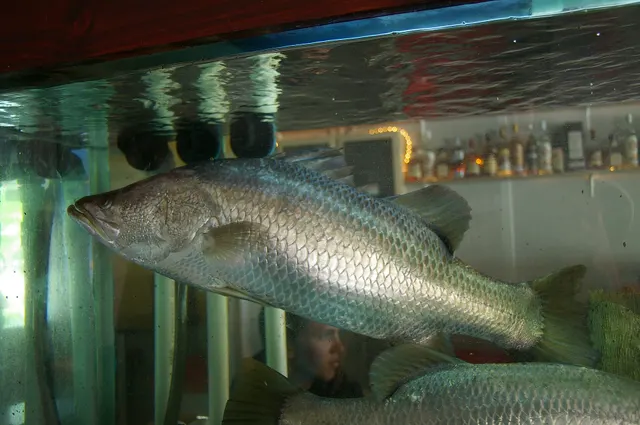 BarramundiAn estuarine ambush predator that begins life as a male and changes sex to female, so the largest fish are all breeding hens.
John Robert McPherson — CC0 1.0 Public Domain Dedication, via Wikimedia Commons
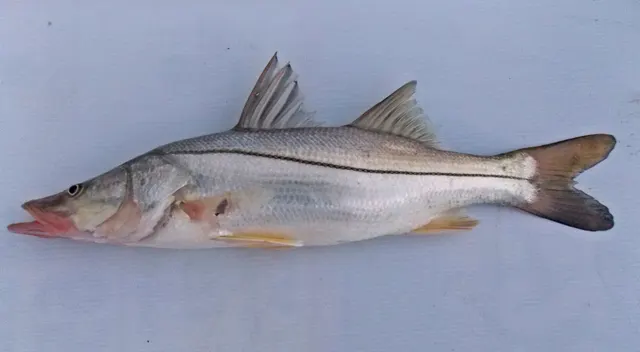 Common snookA structure-hugging ambush predator of tropical American coasts, marked by a hard black lateral line, that moves freely between the sea and fresh water.
jose_colorado-dapa — CC BY-SA 4.0, via Wikimedia Commons
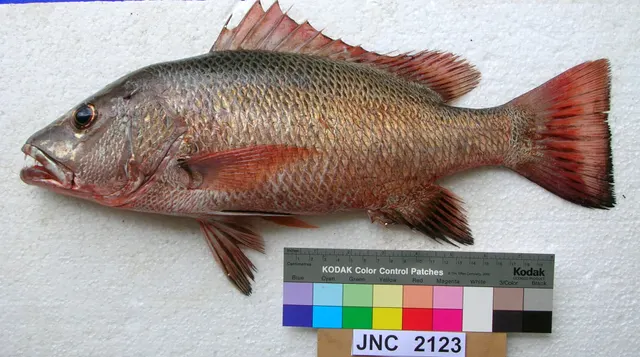 Mangrove jackA powerful red snapper of mangrove creeks and estuaries that moves to offshore reef as it matures, notorious for reaching structure the instant it is hooked.
Jean-Lou Justine — CC BY-SA 4.0, via Wikimedia Commons
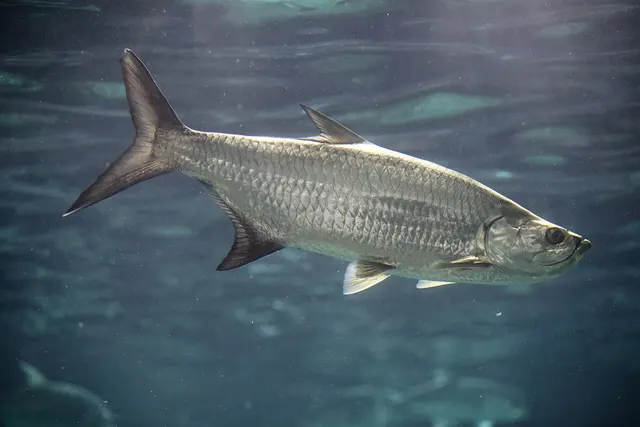 Atlantic tarponA huge, ancient, air-breathing fish of tropical Atlantic coasts that jumps repeatedly when hooked and is almost never eaten — fished purely for the encounter.
Daiju Azuma — CC BY-SA 4.0, via Wikimedia Commons
Safety
Tides and being cut off — Can cause serious injury or death
A mangrove creek system drains and fills fast, the channels look alike, and a system that was navigable an hour ago is mud. Craft are left dry on a falling tide and people attempting to walk out sink. The forest also removes every landmark and every sightline, so being lost and being cut off arrive together.
What reduces it: Know the tide before entering a creek system, and plan the trip around the return rather than around the fishing. Set a turnaround time and keep it. Note the state of the tide at the entrance on the way in. Do not go in alone. Carry a means of calling for help that survives immersion and tell somebody where you are going.
Worse when:
- Big spring tides, where the range is greatest and the drain fastest
- Unfamiliar systems with several similar channels
- Late in the day, where a wrong turn is followed by darkness
Drowning and immersion — Can cause serious injury or death
Mangrove sediment is soft, deep and full of root. A person who steps out of a craft can sink past the knee and be held there, and root systems trap a foot in a way sand does not. On a rising tide that is a life-threatening situation, and bystanders who wade in to help routinely become a second casualty.
What reduces it: Do not step out of a craft into mangrove mud unless you know the ground. Test before committing weight, spread your load if you begin to sink, and do not struggle. Call for help early rather than late.
Worse when:
- Rising tide
- Working alone
- Fine sediment near a recently shifted channel
Encounters with marine life — Can cause serious injury or death
In parts of the mangrove's range — northern Australia, New Guinea, much of South and South-East Asia — estuarine crocodiles inhabit exactly these creek systems, and people are killed in them. Elsewhere the relevant animals differ: bull sharks in turbid estuarine water, stingrays on the flats, and in several regions venomous snakes in the forest itself.
What reduces it: Follow local advice without exception and treat it as the authority. FishingHQ does not offer guidance on crocodile country and will not summarise it: the knowledge is specific to the system and is held by local authorities and the people who live there. Do not wade, do not clean fish at the water's edge, and do not establish a routine at the same spot.
Worse when:
- Wading, or working at the water's edge
- Dawn, dusk and darkness
- Repeating the same activity at the same place, which is how a predator learns a pattern
Sun, dehydration and fatigue — Can cause injury needing treatment
Tropical heat, high humidity, no breeze inside a creek system and hard physical work in a kayak or on foot. Heat exhaustion degrades judgement well before it produces obvious symptoms, and the decisions being degraded are tidal ones.
What reduces it: Far more water than feels necessary, shade and cover rather than sunscreen alone, and a plan that has you out of the system before the hottest part of the day. Treat a headache or a loss of concentration as a reason to leave.
Worse when:
- Still, humid conditions inside the forest
- Long paddles against a tide
- Dry-season afternoons
Injury while handling fish — Can cause injury needing treatment
Oysters grow on mangrove roots, and they are sharp enough to open a hand or a leg to the bone. Falls against a root system, grabbing a root to steady a craft, or wading past one all produce deep contaminated lacerations, and tropical marine wounds infect fast.
What reduces it: Gloves for handling roots or lines against them, and footwear with a firm sole. Clean and dress any cut immediately and properly, and seek medical advice if it inflames — this is not an ordinary graze.
Worse when:
- Steadying a kayak against roots
- Falling tide, when the encrusted zone is exposed
Further safety reading
- Dangerous animals where you fish — Estuarine crocodiles across much of the range, bull sharks in turbid water, and in several regions venomous snakes in the forest itself. Local advice is the authority.
- Sun, dehydration and fatigue — Tropical heat, high humidity and no breeze inside a creek system, degrading exactly the judgement the tide requires.
- Tides and being cut off — A creek system drains fast, the channels look alike and the forest removes every landmark, so being lost and being cut off arrive together.
Check the rules before you fish
Fishing laws, bylaws, access rules, seasons, bait restrictions and permitted methods vary by location and can change. Check the current rules from the relevant authority and the water you intend to fish before fishing.
Check with:
- Current national or regional law for where you are fishing
- Current local bylaws
- The relevant fisheries authority
- The landowner, club or fishery whose water it is
- Any restrictions specific to the species or the method you intend to use
Where to go next
Fish found here
- Atlantic tarponJuvenile tarpon occupy mangrove-fringed backwaters and low-oxygen creeks that few predators can tolerate — the swim bladder they can breathe through is what makes that possible — and adults hunt the channels.
- BarramundiJuveniles use mangrove and associated wetland as nursery habitat, and adults hunt the root edges and creek mouths on a falling tide. FishingHQ described this in prose for four sprints and had nothing to point at.
- Blacktip reef sharkJuveniles occupy shallow mangrove-fringed flats and lagoons as nursery ground before moving to reef, which is where snorkellers most often meet them.
- Blue threadfinAn estuarine and mangrove-associated species of the tropical Indo-Pacific, taken over mud and around creek mouths.
- Bull sharkTurbid mangrove and estuarine water is nursery habitat for bull sharks, and the species' salinity tolerance takes juveniles far up systems where nothing else of that size occurs.
- Common snookThe Atlantic counterpart of the same pattern: snook hold against mangrove root structure and ambush prey flushed out of it as the tide drops.
- Giant African threadfinThe West African equivalent, associated with mangrove-fringed estuaries and turbid inshore water.
- Mangrove jackNamed for the habitat. Juveniles and sub-adults live in mangrove creeks and estuarine snags before moving offshore to reef as they mature, which is why the fish an angler catches in a creek and the fish a diver sees on a reef are different sizes of the same species.
4 more
- Mud crab Fish
- Queenfish Fish
- Red lionfish Fish
- Spotted grunter Fish
Reading this water
- Bottom type, and what lives on itThe general principle — that what lives somewhere is decided by what the ground is made of — with a case where the ground is made of trees.
- Fly fishing for warm-water and tropical speciesThe habitat that concentrates the fishing. Roots shelter juvenile fish and crustaceans and the predators that follow them, which is why so much tropical fly fishing is accurate casting at an edge rather than searching open water.
How this compares
- EstuaryThe temperate estuary record and this one share a salinity gradient and very little else about how the year works: one is organised around water warming, the other around a forest flooding twice a day.
- Kelp forestTwo forests that do the same job in different water: three-dimensional structure that gives small animals somewhere large ones cannot follow, one built of trees in the intertidal and one of algae below it.
- Mudflats and intertidal sandflatsBoth are soft intertidal ground that floods and drains, and the hazards rhyme — cut-off, soft sediment, no landmarks. One has a forest on it, which changes everything about the fishing and nothing about the mud.
- Sri LankaThe lagoon and creek systems are mangrove, and the tide mechanic described there is what the estuarine fishing here runs on.
- Tropical estuary and tidal creekThe forest and the system it sits in. Mangrove explains the structure and the tide; the tropical estuary explains the season and the flood.
Environment and conservation
- Fish stocks and sustainabilityThe displaced-damage argument: clearing mangrove does not reduce the catch in the mangrove, it reduces the catch on a reef several years later. That delay and that distance are why the conversion has been so easy to permit.
- Habitat damage from bank and shore accessRoot systems are the habitat. Cutting or breaking roots to free a lure, driving a boat through shallow root ground, and monofilament left in a root system — which is close to permanent — are the damage an angler personally controls.
Sources and evidence
- The World's Mangroves and their Fisheries — FAO Forestry and Fisheries assessments — Food and Agriculture Organization of the United Nations, Rome (Standards body)Relied on for: The nursery function of mangrove systems for tropical coastal fisheries, the dependence of specific fisheries on mangrove habitat, and the direction and principal causes of mangrove loss.States this directlyCitation checked — the work exists and is described correctly
- Code of Conduct for Responsible Fisheries — Food and Agriculture Organization of the United Nations, Rome, 1995 (Standards body)Relied on for: International principles for responsible fisheries, including the protection of critical habitat and nursery areas and the management of small-scale fisheries.Background and mechanism onlyCitation checked — the work exists and is described correctly
- NOAA National Ocean Service education on estuaries and the National Estuarine Research Reserve System — National Oceanic and Atmospheric Administration, United States (Government fisheries body)Relied on for: Estuarine function: the salinity gradient, tidal exchange, sediment and nutrient dynamics, and the nursery role of transitional waters.States this directlyCitation checked — the work exists and is described correctly
- FAO Species Identification Guides for Fishery Purposes and the FAO Species Catalogues — Food and Agriculture Organization of the United Nations (Scientific institute)Relied on for: Habitat association, depth range and distribution of the species concerned, as set out in the FAO species identification sheets for the region.States this directlyCitation checked — the work exists and is described correctly
- Words of the Lagoon: Fishing and Marine Lore in the Palau District of Micronesia — University of California Press, Berkeley, 1981 (Reference work)Relied on for: Traditional knowledge of tropical inshore systems — lagoon, reef and mangrove — including seasonal and lunar patterns in fish movement and the local management of those systems.States this directlyCitation checked — the work exists and is described correctly
Why the 24 connections on this page are here, and the sources
Fish found here
Backed by research — 12 connections
Supported by peer-reviewed research or fisheries science. The sources are listed and can be checked.
Atlantic tarpon
A habitat association resting on the regional identification and fisheries literature rather than on angling report.
- FAO Species Identification Guides for Fishery Purposes and the FAO Species Catalogues — Food and Agriculture Organization of the United Nations (Scientific institute)Relied on for: Habitat association, depth range and distribution of the species concerned as set out in the FAO species identification sheets for the region.States this directlyCitation checked — the work exists and is described correctly
- The World's Mangroves and their Fisheries — FAO Forestry and Fisheries assessments — Food and Agriculture Organization of the United Nations, Rome (Standards body)Relied on for: The dependence of tropical coastal fisheries species on mangrove and estuarine habitat, including the nursery function.States this directlyCitation checked — the work exists and is described correctly
Barramundi
A habitat association resting on the regional identification and fisheries literature rather than on angling report.
- FAO Species Identification Guides for Fishery Purposes and the FAO Species Catalogues — Food and Agriculture Organization of the United Nations (Scientific institute)Relied on for: Habitat association, depth range and distribution of the species concerned as set out in the FAO species identification sheets for the region.States this directlyCitation checked — the work exists and is described correctly
- The World's Mangroves and their Fisheries — FAO Forestry and Fisheries assessments — Food and Agriculture Organization of the United Nations, Rome (Standards body)Relied on for: The dependence of tropical coastal fisheries species on mangrove and estuarine habitat, including the nursery function.States this directlyCitation checked — the work exists and is described correctly
Blacktip reef shark
A habitat association resting on the regional identification and fisheries literature rather than on angling report.
- FAO Species Identification Guides for Fishery Purposes and the FAO Species Catalogues — Food and Agriculture Organization of the United Nations (Scientific institute)Relied on for: Habitat association, depth range and distribution of the species concerned as set out in the FAO species identification sheets for the region.States this directlyCitation checked — the work exists and is described correctly
- The World's Mangroves and their Fisheries — FAO Forestry and Fisheries assessments — Food and Agriculture Organization of the United Nations, Rome (Standards body)Relied on for: The dependence of tropical coastal fisheries species on mangrove and estuarine habitat, including the nursery function.States this directlyCitation checked — the work exists and is described correctly
Blue threadfin
A habitat association resting on the regional identification and fisheries literature rather than on angling report.
- FAO Species Identification Guides for Fishery Purposes and the FAO Species Catalogues — Food and Agriculture Organization of the United Nations (Scientific institute)Relied on for: Habitat association, depth range and distribution of the species concerned as set out in the FAO species identification sheets for the region.States this directlyCitation checked — the work exists and is described correctly
- The World's Mangroves and their Fisheries — FAO Forestry and Fisheries assessments — Food and Agriculture Organization of the United Nations, Rome (Standards body)Relied on for: The dependence of tropical coastal fisheries species on mangrove and estuarine habitat, including the nursery function.States this directlyCitation checked — the work exists and is described correctly
Bull shark
A habitat association resting on the regional identification and fisheries literature rather than on angling report.
- FAO Species Identification Guides for Fishery Purposes and the FAO Species Catalogues — Food and Agriculture Organization of the United Nations (Scientific institute)Relied on for: Habitat association, depth range and distribution of the species concerned as set out in the FAO species identification sheets for the region.States this directlyCitation checked — the work exists and is described correctly
- The World's Mangroves and their Fisheries — FAO Forestry and Fisheries assessments — Food and Agriculture Organization of the United Nations, Rome (Standards body)Relied on for: The dependence of tropical coastal fisheries species on mangrove and estuarine habitat, including the nursery function.States this directlyCitation checked — the work exists and is described correctly
Common snook
A habitat association resting on the regional identification and fisheries literature rather than on angling report.
- FAO Species Identification Guides for Fishery Purposes and the FAO Species Catalogues — Food and Agriculture Organization of the United Nations (Scientific institute)Relied on for: Habitat association, depth range and distribution of the species concerned as set out in the FAO species identification sheets for the region.States this directlyCitation checked — the work exists and is described correctly
- The World's Mangroves and their Fisheries — FAO Forestry and Fisheries assessments — Food and Agriculture Organization of the United Nations, Rome (Standards body)Relied on for: The dependence of tropical coastal fisheries species on mangrove and estuarine habitat, including the nursery function.States this directlyCitation checked — the work exists and is described correctly
Giant African threadfin
A habitat association resting on the regional identification and fisheries literature rather than on angling report.
- FAO Species Identification Guides for Fishery Purposes and the FAO Species Catalogues — Food and Agriculture Organization of the United Nations (Scientific institute)Relied on for: Habitat association, depth range and distribution of the species concerned as set out in the FAO species identification sheets for the region.States this directlyCitation checked — the work exists and is described correctly
- The World's Mangroves and their Fisheries — FAO Forestry and Fisheries assessments — Food and Agriculture Organization of the United Nations, Rome (Standards body)Relied on for: The dependence of tropical coastal fisheries species on mangrove and estuarine habitat, including the nursery function.States this directlyCitation checked — the work exists and is described correctly
Mangrove jack
A habitat association resting on the regional identification and fisheries literature rather than on angling report.
- FAO Species Identification Guides for Fishery Purposes and the FAO Species Catalogues — Food and Agriculture Organization of the United Nations (Scientific institute)Relied on for: Habitat association, depth range and distribution of the species concerned as set out in the FAO species identification sheets for the region.States this directlyCitation checked — the work exists and is described correctly
- The World's Mangroves and their Fisheries — FAO Forestry and Fisheries assessments — Food and Agriculture Organization of the United Nations, Rome (Standards body)Relied on for: The dependence of tropical coastal fisheries species on mangrove and estuarine habitat, including the nursery function.States this directlyCitation checked — the work exists and is described correctly
Mud crab
A habitat association resting on the regional identification and fisheries literature rather than on angling report.
- FAO Species Identification Guides for Fishery Purposes and the FAO Species Catalogues — Food and Agriculture Organization of the United Nations (Scientific institute)Relied on for: Habitat association, depth range and distribution of the species concerned as set out in the FAO species identification sheets for the region.States this directlyCitation checked — the work exists and is described correctly
- The World's Mangroves and their Fisheries — FAO Forestry and Fisheries assessments — Food and Agriculture Organization of the United Nations, Rome (Standards body)Relied on for: The dependence of tropical coastal fisheries species on mangrove and estuarine habitat, including the nursery function.States this directlyCitation checked — the work exists and is described correctly
Queenfish
Recorded by FishBase as reef-associated and amphidromous, moving between marine and brackish water, which puts it on mangrove edge and estuary mouth as well as on open coast.
- FishBase: a global information system on fishes — Froese, R. and D. Pauly, eds. — FishBase Consortium (Scientific institute)Relied on for: Environment, depth range, habitat association and distribution for Scomberoides commersonnianus.States this directlyPassage read and verified
Red lionfish
A habitat association resting on the invasion literature rather than on angling report.
- NOAA research and management guidance on the invasive Indo-Pacific lionfish — NOAA National Centers for Coastal Ocean Science (Scientific institute)Relied on for: The habitat range of Pterois in the invaded western Atlantic, including its use of mangrove, estuarine and artificial structure alongside coral reef.States this directlyCitation checked — the work exists and is described correctly
- FAO Species Identification Guides for Fishery Purposes and the FAO Species Catalogues — Food and Agriculture Organization of the United Nations (Scientific institute)Relied on for: Habitat association and distribution of the species.States this directlyCitation checked — the work exists and is described correctly
Spotted grunter
A habitat association resting on the regional identification and fisheries literature rather than on angling report.
- FAO Species Identification Guides for Fishery Purposes and the FAO Species Catalogues — Food and Agriculture Organization of the United Nations (Scientific institute)Relied on for: Habitat association, depth range and distribution of the species concerned as set out in the FAO species identification sheets for the region.States this directlyCitation checked — the work exists and is described correctly
- The World's Mangroves and their Fisheries — FAO Forestry and Fisheries assessments — Food and Agriculture Organization of the United Nations, Rome (Standards body)Relied on for: The dependence of tropical coastal fisheries species on mangrove and estuarine habitat, including the nursery function.States this directlyCitation checked — the work exists and is described correctly
Reading this water
What experienced anglers do — 2 connections
Widely and independently recommended by experienced anglers and specialist sources. This is real angling knowledge, not proof: controlled evidence for it is limited, and FishingHQ records it as convention rather than as a demonstrated effect.
Bottom type, and what lives on it
An explainer that carries a mechanism the subject record depends on.
- General angling website restatements of established technique — Various (Credible secondary source)Relied on for: Widely restated descriptions of technique, ground and fish behaviour, recorded as consensus rather than as scholarship.Background and mechanism onlyCitation checked — the work exists and is described correctly
- Sea Angler — Bauer Media (Specialist angling publication)Relied on for: Contemporary angling practice as reported by practitioners: ground, tackle, presentation and seasonal timing.States this directlyCitation checked — the work exists and is described correctly
Fly fishing for warm-water and tropical species
A fish or a water joined to the fly-fishing mechanism it is a worked example of, written only where the subject's own behaviour or physical character is what this page explains. The direction is the one FishingHQ writes this kind of connection in, and the one it already uses 176 times, and it is also the semantically correct one: the mechanism explains the fish, not the reverse.
- FAO Species Identification Guides for Fishery Purposes and the FAO Species Catalogues — Food and Agriculture Organization of the United Nations (Scientific institute)Relied on for: Distribution, habitat association and feeding biology of tropical inshore and reef species, from regional identification guides prepared for fishery purposes.States this directlyCitation checked — the work exists and is described correctly
- FishBase: a global information system on fishes — Froese, R. and D. Pauly, eds. — FishBase Consortium (Scientific institute)Relied on for: Recorded environment, depth range, feeding biology and distribution of the tropical species named.States this directlyPassage read and verified
How this compares
What experienced anglers do — 5 connections
Widely and independently recommended by experienced anglers and specialist sources. This is real angling knowledge, not proof: controlled evidence for it is limited, and FishingHQ records it as convention rather than as a demonstrated effect.
Estuary
A comparison a reader trying to understand one of these systems genuinely needs, joining two records that resolve one another.
- FAO Species Identification Guides for Fishery Purposes and the FAO Species Catalogues — Food and Agriculture Organization of the United Nations (Scientific institute)Relied on for: Habitat association, depth range and distribution of the species concerned as set out in the FAO species identification sheets for the region.States this directlyCitation checked — the work exists and is described correctly
- The World's Mangroves and their Fisheries — FAO Forestry and Fisheries assessments — Food and Agriculture Organization of the United Nations, Rome (Standards body)Relied on for: The dependence of tropical coastal fisheries species on mangrove and estuarine habitat, including the nursery function.States this directlyCitation checked — the work exists and is described correctly
Kelp forest
A comparison a reader trying to understand one of these systems genuinely needs, joining two records that resolve one another.
- FAO Species Identification Guides for Fishery Purposes and the FAO Species Catalogues — Food and Agriculture Organization of the United Nations (Scientific institute)Relied on for: Habitat association, depth range and distribution of the species concerned as set out in the FAO species identification sheets for the region.States this directlyCitation checked — the work exists and is described correctly
- The World's Mangroves and their Fisheries — FAO Forestry and Fisheries assessments — Food and Agriculture Organization of the United Nations, Rome (Standards body)Relied on for: The dependence of tropical coastal fisheries species on mangrove and estuarine habitat, including the nursery function.States this directlyCitation checked — the work exists and is described correctly
Mudflats and intertidal sandflats
A comparison a reader trying to understand one of these systems genuinely needs, joining two records that resolve one another.
- FAO Species Identification Guides for Fishery Purposes and the FAO Species Catalogues — Food and Agriculture Organization of the United Nations (Scientific institute)Relied on for: Habitat association, depth range and distribution of the species concerned as set out in the FAO species identification sheets for the region.States this directlyCitation checked — the work exists and is described correctly
- The World's Mangroves and their Fisheries — FAO Forestry and Fisheries assessments — Food and Agriculture Organization of the United Nations, Rome (Standards body)Relied on for: The dependence of tropical coastal fisheries species on mangrove and estuarine habitat, including the nursery function.States this directlyCitation checked — the work exists and is described correctly
Sri Lanka
A destination joined to the ground it is made of, so a reader can follow from the place to how the habitat behaves.
- General angling website restatements of established technique — Various (Credible secondary source)Relied on for: Widely restated descriptions of regional practice, ground and species, recorded as consensus rather than as scholarship.Background and mechanism onlyCitation checked — the work exists and is described correctly
- Code of Conduct for Responsible Fisheries — Food and Agriculture Organization of the United Nations, Rome, 1995 (Standards body)Relied on for: International principles for responsible fisheries, including the management of small-scale and artisanal fisheries.Background and mechanism onlyCitation checked — the work exists and is described correctly
Tropical estuary and tidal creek
A comparison a reader trying to understand one of these systems genuinely needs, joining two records that resolve one another.
- FAO Species Identification Guides for Fishery Purposes and the FAO Species Catalogues — Food and Agriculture Organization of the United Nations (Scientific institute)Relied on for: Habitat association, depth range and distribution of the species concerned as set out in the FAO species identification sheets for the region.States this directlyCitation checked — the work exists and is described correctly
- The World's Mangroves and their Fisheries — FAO Forestry and Fisheries assessments — Food and Agriculture Organization of the United Nations, Rome (Standards body)Relied on for: The dependence of tropical coastal fisheries species on mangrove and estuarine habitat, including the nursery function.States this directlyCitation checked — the work exists and is described correctly
Safety reading
Official guidance — 3 connections
Stated by a fisheries authority, scientific institute or recognised angling body. Authoritative, but summarising rather than demonstrating.
Dangerous animals where you fish
A link to a safety topic substantial enough to be read in full.
- RNLI water safety guidance: cold water shock and Float to Live — Royal National Lifeboat Institution (Water-safety or diver-training authority)Relied on for: Water safety guidance for coastal and inland users.States this directlyPassage read and verified
Sun, dehydration and fatigue
A link to a safety topic substantial enough to be read in full.
- RNLI water safety guidance: cold water shock and Float to Live — Royal National Lifeboat Institution (Water-safety or diver-training authority)Relied on for: Water safety guidance for coastal and inland users.States this directlyPassage read and verified
Tides and being cut off
A link to a safety topic substantial enough to be read in full.
- RNLI water safety guidance: cold water shock and Float to Live — Royal National Lifeboat Institution (Water-safety or diver-training authority)Relied on for: Water safety guidance for coastal and inland users.States this directlyPassage read and verified
Environment and conservation
Backed by research — 2 connections
Supported by peer-reviewed research or fisheries science. The sources are listed and can be checked.
Fish stocks and sustainability
An environmental effect attached to the habitat it happens to, resting on an authoritative source rather than on advocacy.
- The World's Mangroves and their Fisheries — FAO Forestry and Fisheries assessments — Food and Agriculture Organization of the United Nations, Rome (Standards body)Relied on for: The direction and principal causes of mangrove loss, and the dependence of coastal fisheries on the habitat being lost.States this directlyCitation checked — the work exists and is described correctly
- Code of Conduct for Responsible Fisheries — Food and Agriculture Organization of the United Nations, Rome, 1995 (Standards body)Relied on for: International principles on the protection of critical habitat and nursery areas within responsible fisheries management.Background and mechanism onlyCitation checked — the work exists and is described correctly
Habitat damage from bank and shore access
An environmental effect attached to the habitat it happens to, resting on an authoritative source rather than on advocacy.
- The World's Mangroves and their Fisheries — FAO Forestry and Fisheries assessments — Food and Agriculture Organization of the United Nations, Rome (Standards body)Relied on for: The direction and principal causes of mangrove loss, and the dependence of coastal fisheries on the habitat being lost.States this directlyCitation checked — the work exists and is described correctly
- Code of Conduct for Responsible Fisheries — Food and Agriculture Organization of the United Nations, Rome, 1995 (Standards body)Relied on for: International principles on the protection of critical habitat and nursery areas within responsible fisheries management.Background and mechanism onlyCitation checked — the work exists and is described correctly
How FishingHQ labels evidence is explained in the evidence policy.