Common snook
Fish · Last reviewed 2026-08-10
A structure-hugging ambush predator of tropical American coasts, marked by a hard black lateral line, that moves freely between the sea and fresh water.
Safety: injury while handling fish — can cause injury needing treatment. 5 more points apply here.
How this was identified, and who took it
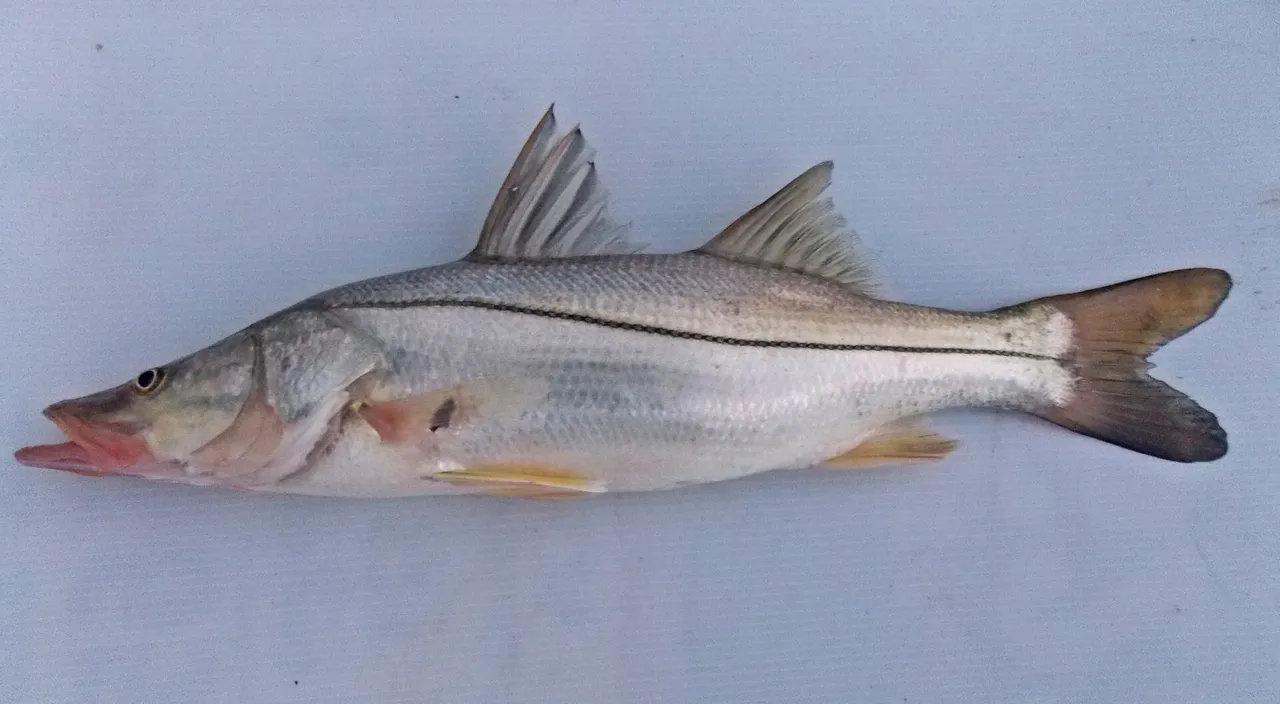
Identified by: The heavy black lateral line running unbroken onto the caudal fin is the diagnostic character for the species, and it could not be clearer. Sloping forehead, protruding lower jaw and yellow pelvic fin all confirm it.jose_colorado-dapa — CC BY-SA 4.0, via Wikimedia Commons — source, licence
Catching Common snook
Everything here on fishing for it. Each entry opens the page behind it.
- Where
- 3 places FishingHQ documents — strongest claim anywhere: repeatedly reported · From the shore, From a boat, Fly fishing
The common snook is the American tropics' equivalent of the barramundi, and the resemblance is more than superficial — they are close relatives in related families, built to the same design and doing the same job.
Everything about the fish says ambush predator. The head profile is concave, the mouth is large and protrusible, and the body is built for a short violent acceleration rather than a chase. Snook hold against structure — mangrove roots, dock pilings, bridge fenders, undercut banks, the edges of passes — where current delivers prey past a fixed point, and they take it with a suction strike and immediately return to the structure they came from.
That last habit is what defines fishing for them. The fight is decided in the first two seconds, and an angler who cannot turn a snook away from a piling loses it there.
Its tolerance of salinity is very wide, so a single fish may be found in surf, in a mangrove creek, in a coastal lagoon or well up a river in fresh water. What it does not tolerate is cold: hard winter cold events have caused large-scale snook kills at the northern edge of the range, which is the constraint that fixes its distribution.
How it is caught
- Livebaiting at seaA live bait drifted into an ambush point takes the larger snook that will refuse an artificial, particularly around passes on a moving tide.
- Saltwater fly fishingThe mangrove problem: a cast into the structure, an immediate take, and a fight decided in the first second by whether the tackle can turn the fish out of the roots.
- SpinningSnook hold in current against mangrove roots, bridge pilings and dock lights, and lures are swum with the flow into the ambush point rather than retrieved across it.
Gear for this fish
- JerkbaitsA suspending minnow paused in the current beside structure exploits an ambush predator that strikes at a hesitating target rather than a fleeing one.
- Soft plasticsSnook hold in current around mangrove roots, bridge pilings and dock lights, and a soft plastic swum with the flow into an ambush point is the standard presentation.
Where Common snook is documented
Places where public sources describe this species as fished, with how it is fished and how strongly the evidence supports it. This is not a range map and it is not a recommendation — it is what has been written down about a fishery rather than a record of any individual catch, and being listed is never permission to fish.
Florida
3 documented places
Bridge
Repeatedly reported
From the shore · From a boat
Bridge
Recorded here
From the shore · From a boat
Mangrove shore
Repeatedly reported
From a boat · Fly fishing
What these strengths mean
- Repeatedly reported
- Several independent public accounts. Enough to say it happens more than once; not enough to call it a fishery.
- Recorded here
- At least one credible public account of this species being caught here. That is all it means.
Identification
- Scientific name
- Centropomus undecimalis
- Family
- Centropomidae
- Water
- Saltwater, Brackish, Freshwater
- Conservation status
- Least Concern
- Regions
- Caribbean, North America, Central & South America
- A hard, unbroken black lateral line running the length of the body and continuing onto the tail — the single most distinctive mark, and the origin of the name linesider.
- Strongly concave head profile with a protruding lower jaw and a large protrusible mouth.
- Two separate dorsal fins; a sharply serrated preoperculum on the gill cover.
- Silver to yellow-bronze flanks; fins often yellow, particularly during spawning.
- Several Centropomus species overlap in range and are readily confused; fin ray counts and body proportion separate them, not the lateral line, which they share.
Size
- Typical
- 1.5–5 kg (3–11 lb)
- Large
- 9–14 kg (20–31 lb)
Exceptional: Over 18 kg (40 lb); maximum published weight 24.3 kg
A gill plate that cuts line, leader and fingers
Snook have one feature that dominates their handling and it is not in the mouth.
THE GILL COVER IS A BLADE. The rear edge of the operculum on a snook is thin, hard and genuinely sharp — sharp enough that it is a recognised cause of cut-off leaders when a fish turns its head during a fight, and sharp enough to lay open the fingers of anybody who grips the fish behind the head. It is the single most common injury in the fishery.
SO THE GRIP IS THE LOWER JAW. Snook have no cutting teeth — an abrasive pad only — and lipping is safe and standard, with the other hand supporting the body. Hands never go across the gill covers.
THE FISH IS ALSO TEMPERATURE-SENSITIVE at the cold end. Snook are a subtropical species with a well-documented vulnerability to cold snaps, and significant mortality events have followed sudden temperature drops in the northern parts of their range. A fish caught in unusually cold water is already stressed before it is hooked.
AND THEY ARE HEAVILY MANAGED. Slot limits, closed seasons and, in some jurisdictions, a permit requirement in addition to a licence. The fishery is release-dominated and the release should be done in the water where possible: unhook boat-side or in the shallows, support the fish, and hold it upright until it goes.
THE STRUCTURE THEY LIVE IN is a hazard in itself. Snook sit under docks, in mangroves and around pilings, which means anglers reach into places containing barnacles and oysters. Those cut worse than the fish does.
What experienced anglers do — why, and the sources (2)
Widely and independently recommended by experienced anglers and specialist sources. This is real angling knowledge, not proof: controlled evidence for it is limited, and FishingHQ records it as convention rather than as a demonstrated effect.
- FishBase: a global information system on fishes — Froese, R. and D. Pauly, eds. — FishBase Consortium (Scientific institute)Relied on for: Dentition, fin and spine morphology, body form, air-breathing capability and distribution for the species, which are the anatomical facts the handling practice below follows from.States this directlyPassage read and verified
- General angling website restatements of established technique — Various (Credible secondary source)Relied on for: Widely restated angling practice for handling this species, recorded as practitioner consensus rather than as tested fact.Background and mechanism onlyCitation checked — the work exists and is described correctly
Spawning in the passes, where the tide does the work
Snook reproduction is a piece of tidal engineering, and understanding it explains both where the fish are in summer and why that timing matters.
THE SITE IS CHOSEN FOR THE CURRENT. Snook aggregate to spawn near passes and inlets — the narrow connections between the open sea and the estuarine systems behind them — in summer. The reason is transport: eggs and larvae released there are carried by the flooding tide into the estuarine nurseries where juveniles must grow. The fish are not spawning in the pass because the pass suits the adults; they are spawning there because it is the delivery mechanism for the next generation.
WHICH MAKES THE NURSERY HABITAT LOAD-BEARING. Juvenile snook depend on shallow, sheltered, low-salinity backwater — mangrove creeks, marsh edges, drainage sloughs — and that is precisely the habitat coastal development removes, hardens or disconnects. A system with plenty of adult snook and no functioning nursery produces nothing, and the loss is invisible from the fishery for years.
AND THE AGGREGATION IS THE VULNERABILITY, in the standard way. Fish concentrate predictably in time and place, in narrow, accessible, well-known locations, at the one time of year they are all together. That is simultaneously when they are easiest to catch and when catching them matters most — which is the general rule for aggregating spawners and is stated here because snook are among the clearest cases of it in an accessible inshore fishery.
SNOOK ARE ALSO PROTANDROUS — maturing as males and changing sex to female with size and age — which means the large fish are the females and size-selective removal is female-selective removal. That compounds the aggregation problem: the fish worth keeping are the ones the population can least afford to lose.
THEY ARE ADDITIONALLY COLD-INTOLERANT, and severe cold events have produced substantial snook kills at the northern edge of the range, which is a separate constraint that interacts with everything above.
Close seasons over the spawning period and slot limits are common instruments in this fishery for exactly these reasons. What any of them currently are is local, changes, and is not stated here.
Backed by research — why, and the sources (4)
Supported by peer-reviewed research or fisheries science. The sources are listed and can be checked.
- Reef Fish Spawning Aggregations: Biology, Research and Management — Springer, Fish & Fisheries Series vol. 35, 2012 (Scientific literature)Relied on for: The biology of reef fish spawning aggregations, their predictability in time and space, and the disproportionate effect of fishing them on population reproductive output.States this directlyCitation checked — the work exists and is described correctly
- FishBase: a global information system on fishes — Froese, R. and D. Pauly, eds. — FishBase Consortium (Scientific institute)Relied on for: Spawning season, aggregation behaviour and reproductive mode recorded for the species.States this directlyPassage read and verified
- FishBase: a global information system on fishes — Froese, R. and D. Pauly, eds. — FishBase Consortium (Scientific institute)Relied on for: Reproductive mode, spawning season, fecundity, parental care, sex-change pattern and larval development recorded for the species.States this directlyPassage read and verified
- The IUCN Red List of Threatened Species — International Union for Conservation of Nature (Conservation authority)Relied on for: Assessment, population trend, and the life-history traits — age at maturity, longevity, reproductive strategy — that determine sensitivity to exploitation.States this directlyCitation checked — the work exists and is described correctly
A tropical fish at a temperate edge, and a season set by cold snaps and spawning tides
Snook seasonality is governed by two things that have nothing to do with each other: an absolute intolerance of cold, and a summer spawning strategy tied to passes and tides.
COLD IS THE HARD LIMIT AND IT IS NOT GRADUAL. Snook are a tropical species living at the northern edge of their range in the southern United States, and they die at temperatures that many inshore fish tolerate easily. Severe cold events have produced large-scale snook mortality, and the northern boundary of the population is effectively drawn by how far north a fish can survive a bad winter. Consequently, autumn and winter movement is a retreat: into rivers, creeks, canals, deep basins, power-plant outflows and any thermally buffered water, and the fish stay there.
WHICH MAKES WINTER SNOOK A DIFFERENT FISHERY IN A DIFFERENT PLACE. The fish are inshore and upriver, in warmer, often fresher water, and they feed little in the coldest periods. This is also when they are most concentrated and most vulnerable, and several jurisdictions manage the species with seasonal closures for reasons including exactly that. What those rules are is a matter for the competent authority and they are not inferable from the biology.
SUMMER TAKES THEM TO THE PASSES TO SPAWN. Through the warm months mature snook aggregate near inlets, passes and beaches, spawning around the new and full moons on strong outgoing tides so that eggs are carried out and then returned into the estuary on the flood. The aggregation is predictable in place and time, and it is the period when the largest fish are most accessible — which is the standard aggregation problem again.
JUVENILES USE MANGROVE AND BACKWATER CREEKS, and their season is one of gradual movement out of those nurseries as they grow rather than an annual cycle.
SNOOK ARE PROTANDROUS — maturing as males and changing to female — so the large fish in a summer aggregation are disproportionately female, and size-selective removal has the same consequence it has in barramundi.
AND SALINITY IS A FREE VARIABLE FOR THIS SPECIES, which is why the winter refuge can be a freshwater canal. Snook move between salt, brackish and fresh water readily, and a seasonal account that assumes they stay in the sea will miss most of the winter population.
Backed by research — why, and the sources (2)
Supported by peer-reviewed research or fisheries science. The sources are listed and can be checked.
- NOAA National Ocean Service education on estuaries and the National Estuarine Research Reserve System — National Oceanic and Atmospheric Administration, United States (Government fisheries body)Relied on for: Estuarine structure and function, the seasonal temperature and salinity regime, and the nursery role of estuarine habitat.States this directlyCitation checked — the work exists and is described correctly
- FishBase: a global information system on fishes — Froese, R. and D. Pauly, eds. — FishBase Consortium (Scientific institute)Relied on for: Spawning season, salinity tolerance, temperature preference and seasonal distribution for the species.States this directlyPassage read and verified
Mangrove roots, bridge shadow and a thermal refuge: habitat chosen by structure and by temperature
Snook habitat has two organising principles — structure to ambush from, and somewhere warm enough to survive a cold snap — and they operate on completely different timescales.
STRUCTURE IS THE DAY-TO-DAY REQUIREMENT. Snook hold against mangrove roots, dock pilings, bridge fenders, seawalls, rock jetties, culverts, oyster bars and any hard edge in moving water, facing into the current and ambushing what the flow delivers. The relationship is hydraulic rather than decorative: the fish sits in the slack behind an obstruction and takes prey that the current has pushed past it.
WHICH MAKES ARTIFICIAL LIGHT PART OF THE HABITAT, and it is worth naming because it looks like an anomaly and is not. Dock and bridge lighting concentrates baitfish and gives an ambush predator a lit background to hunt against, and snook use lit structure at night as consistently as they use mangrove by day.
SALINITY IS ESSENTIALLY A FREE VARIABLE. Snook move between full salt, brackish and fresh water readily, occupying beaches and passes, estuaries, rivers, canals and lakes connected to tidewater. That freedom is what makes the second principle possible.
TEMPERATURE IS THE HARD CONSTRAINT AND IT OVERRIDES EVERYTHING SEASONALLY. Snook are tropical and are killed by cold, and in winter they abandon exposed structure entirely for thermal refuges — deep basins, rivers, canals, power-plant outflows and anywhere the water holds heat. That is a habitat requirement with no substitute, and the northern edge of the population is drawn by how far north a fish can find one.
JUVENILES USE MANGROVE CREEKS AND BACKWATERS, shallow, warm, low-salinity and heavily vegetated, and those nurseries are exactly the habitat coastal development removes. Recruitment depends on them rather than on the adult structure.
AND THE SPAWNING HABITAT IS SOMEWHERE ELSE AGAIN — the passes and beaches — which means a snook population needs three distinct habitats within reach of one another, and loss of any one of them is a loss of the population.
Backed by research — why, and the sources (2)
Supported by peer-reviewed research or fisheries science. The sources are listed and can be checked.
- NOAA National Ocean Service education on estuaries and the National Estuarine Research Reserve System — National Oceanic and Atmospheric Administration, United States (Government fisheries body)Relied on for: Estuarine structure and function, the salinity gradient, seasonal temperature regime and the nursery role of estuarine habitat.States this directlyCitation checked — the work exists and is described correctly
- FishBase: a global information system on fishes — Froese, R. and D. Pauly, eds. — FishBase Consortium (Scientific institute)Relied on for: Salinity tolerance, habitat association, spawning season and life-stage distribution for the species.States this directlyPassage read and verified
Lifecycle and reproduction
Spawns near passes and inlets in the warmer months, with larvae recruiting into shallow, low-salinity backwater nurseries — mangrove creeks, lagoons and river mouths. Juveniles use those nurseries for the first years of life and move seaward as they grow. Growth is moderate and the species is reasonably long-lived, and its dependence on shallow coastal nursery habitat makes it sensitive to coastal development independently of fishing pressure.
Aggregating spawner near passes and inlets in summer, where tidal flow carries larvae into estuarine nurseries. The aggregation behaviour is the vulnerability: fish concentrate predictably in time and place, which is both when they are easiest to catch and when catching them matters most. Closed seasons over the spawning period and slot limits are common instruments in this fishery, and FishingHQ does not state what any of them currently are.
Feeding and senses
Feeds on fishes — gobies, mojarras and anchovies are recorded — and on crustaceans including shrimps and crabs. Feeding is an ambush from structure, using suction through a large protrusible mouth rather than pursuit. Snook orient into current and take prey delivered past them, which is why a bait or lure that arrives naturally with the flow is far more effective than one presented across it.
Feeds heavily at night and around artificial light, where the light-and-shade edge concentrates bait and gives an ambush predator a working boundary. Sight matters at those edges; in turbid backwater the lateral line carries more of the load. The reliance on ambush from structure means that what determines success is usually position rather than presentation.
Through the year
Moves toward passes and inlets to spawn in the warmer months and disperses into estuaries, rivers and backwaters as water cools. Cold is the limiting factor: significant cold events cause mortality at the northern edge of the range, and fish retreat to deeper and warmer refuges in winter. Tidal flow governs the daily fishing, since the entire feeding strategy depends on current delivering prey.
Distribution
Western Atlantic: southern Florida, the south-eastern Gulf of Mexico, most of the Antilles, and the Caribbean coast of Central and South America south to Rio de Janeiro, with records from North Carolina and Texas. Found in coastal waters, estuaries and lagoons and penetrating well into fresh water, usually shallower than twenty metres.
This is a biological range — where the species occurs, not a prediction that you will catch one. To browse the fishing geography FishingHQ holds, start at fishing places.
Why anglers care
A premier inshore sport species across Florida, the Caribbean and Central America, fished with lures, live bait and fly around structure, passes, bridges and mangrove edges. Highly regarded as food where retention is permitted, and subject to strict slot and season management in much of the range as a result — a fishery where the recreational and conservation pressures are unusually visible.
Handling and returning
The preoperculum is razor-sharp and is the injury this fish causes — deep cuts to hands and forearms when somebody grips it behind the head. Hold by the lower jaw with the other hand supporting the belly, keeping fingers well clear of the gill covers. Wet hands, minimise air time, and revive properly in warm water. Where a slot limit protects large breeding fish, prompt correct release is the purpose of the rule.
Going further
- What does common snook eat? — feeding biology, kept separate from what anglers infer from it.
Safety
Injury while handling fish — Can cause injury needing treatment
The serrated preoperculum on the gill cover is genuinely razor-sharp and causes deep lacerations to hands and forearms, almost always when the fish is gripped behind the head.
What reduces it: Never put a hand near the gill covers. Hold by the lower jaw with the other hand under the belly. Wet hands and use a knotless net or lip grip with the weight supported.
Hooks and barbs — Can cause injury needing treatment
Fishing tight to structure at night with heavy tackle and treble-hooked lures, frequently from docks and bridges, produces hook injuries.
What reduces it: Control the fish before unhooking, use a de-hooking tool rather than fingers, and carry a light so you can see what you are doing.
Precautions that always apply here
- Wet your hands before touching a fish. Dry hands strip the protective mucus layer that keeps infection out.
- Keep fingers out of the gills and clear of the teeth. Gill damage is usually fatal to the fish, and several species will remove skin from a finger.
- Support the fish's weight along its body, keep it out of the water for as short a time as possible, and hold it over something soft.
- If a hook goes past the barb into a person, cut the line, leave the hook where it is, and get medical help. Pulling it back out does far more damage than pushing it through under proper care.
Check the rules before you fish
Fishing laws, bylaws, access rules, seasons, bait restrictions and permitted methods vary by location and can change. Check the current rules from the relevant authority and the water you intend to fish before fishing.
Check with:
- Current national or regional law for where you are fishing
- Current local bylaws
- The relevant fisheries authority
- The landowner, club or fishery whose water it is
- Any restrictions specific to the species or the method you intend to use
Where to go next
Similar and related fish
Where it lives
- EstuaryHolds against structure where current delivers prey past a fixed ambush point, and moves freely between the surf, mangrove creeks and fresh water — the fight is decided in the first two seconds.
- MangroveThe Atlantic counterpart of the same pattern: snook hold against mangrove root structure and ambush prey flushed out of it as the tide drops.
- Tropical estuary and tidal creekThe Atlantic analogue, moving between fresh, brackish and salt water and concentrating at outflows and passes.
Where you will find it
- FloridaOccupies mangrove, structure and passes in the backcountry and along both coasts, and is cold-sensitive enough that severe cold events have caused mass mortality.
- The Yucatán and Mexican Caribbean coastIn the same brackish lagoon and mangrove water as the juvenile tarpon, which is why the two are frequently caught in a single session and why the lagoons matter as much as the flats.
Understanding this fish
- Decapod crustaceans as preyShrimp are a substantial part of the diet, particularly on outgoing tides when they are flushed out of mangrove and grass habitat.
- Fly fishing for warm-water and tropical speciesThe structure-oriented case. Snook hold hard against mangrove roots, docks and edges and run straight back into them when hooked, so the fishing is about accurate short casting into cover rather than about distance.
Told apart from
Sources and evidence
- FishBase: a global information system on fishes — Froese, R. and D. Pauly, eds. — FishBase Consortium (Scientific institute)Relied on for: Scientific name, family placement in the Centropomidae, maximum length of 140 cm and maximum published weight of 24.3 kg, western Atlantic distribution from southern Florida and the south-eastern Gulf of Mexico through most of the Antilles and the Caribbean coast of Central and South America to Rio de Janeiro with records from North Carolina and Texas, occurrence in marine.States this directlyPassage read and verified
- FishBase: a global information system on fishes — Froese, R. and D. Pauly, eds. — FishBase Consortium (Scientific institute)Relied on for: The IUCN Red List category — Least Concern, assessed 8 February 2019 — is taken from FishBase's republication.States this directlyPassage read and verified
Why the 14 connections on this page are here, and the sources
Similar and related fish
Backed by research — 1 connection
Supported by peer-reviewed research or fisheries science. The sources are listed and can be checked.
Scaled sardine
Recorded diet evidence identifies Harengula jaguana as a food item of this predator at species level. The edge is written at that granularity and no further.
- FishBase: a global information system on fishes — Froese, R. and D. Pauly, eds. — FishBase Consortium (Scientific institute)Relied on for: Food items recorded for this predator, including Harengula jaguana.States this directlyPassage read and verified
- FAO Species Identification Guides for Fishery Purposes and the FAO Species Catalogues — Food and Agriculture Organization of the United Nations (Scientific institute)Relied on for: Species account describing the diet of this predator in the region where Harengula jaguana occurs.Background and mechanism onlyCitation checked — the work exists and is described correctly
How it is caught
What experienced anglers do — 3 connections
Widely and independently recommended by experienced anglers and specialist sources. This is real angling knowledge, not proof: controlled evidence for it is limited, and FishingHQ records it as convention rather than as a demonstrated effect.
Livebaiting at sea
Established angling practice for this species, recorded as convention. The note states the property of the animal or its water that makes the method the answer.
- IGFA International Angling Rules and World Record Requirements — International Game Fish Association (Angling or fisheries organisation)Relied on for: Recognition of the species as an established sport fish and the angling methods and tackle classes conventionally used for it.States this directlyPassage read and verified
- General angling website restatements of established technique — Various (Credible secondary source)Relied on for: Widely restated practice connecting this species and method.Background and mechanism onlyCitation checked — the work exists and is described correctly
Saltwater fly fishing
A statement about how a species is fished, which is angling convention rather than biology and is labelled as such.
- Still Water Fly-Fishing — Andre Deutsch, 1952 (Specialist angling publication)Relied on for: Fly-fishing practice from a practitioner tradition: line control, depth management, retrieve and the reading of water.States this directlyCitation checked — the work exists and is described correctly
- Sea Angler — Bauer Media (Specialist angling publication)Relied on for: Contemporary UK sea angling practice as reported by practitioners: ground, tackle, presentation and seasonal timing.States this directlyCitation checked — the work exists and is described correctly
Spinning
Established angling practice for this species, recorded as convention. The note states the property of the animal or its water that makes the method the answer.
- IGFA International Angling Rules and World Record Requirements — International Game Fish Association (Angling or fisheries organisation)Relied on for: Recognition of the species as an established sport fish and the angling methods and tackle classes conventionally used for it.States this directlyPassage read and verified
- General angling website restatements of established technique — Various (Credible secondary source)Relied on for: Widely restated practice connecting this species and method.Background and mechanism onlyCitation checked — the work exists and is described correctly
Gear for this fish
What experienced anglers do — 2 connections
Widely and independently recommended by experienced anglers and specialist sources. This is real angling knowledge, not proof: controlled evidence for it is limited, and FishingHQ records it as convention rather than as a demonstrated effect.
Jerkbaits
A practitioner claim about which lure family answers this species' feeding or holding behaviour.
- IGFA International Angling Rules and World Record Requirements — International Game Fish Association (Angling or fisheries organisation)Relied on for: Recognition of the species as an established sport fish taken on artificial lures, and the line and tackle classes used for it.States this directlyPassage read and verified
- General angling website restatements of established technique — Various (Credible secondary source)Relied on for: Widely restated lure practice for this species.Background and mechanism onlyCitation checked — the work exists and is described correctly
Soft plastics
A practitioner claim about which lure family answers this species' feeding or holding behaviour.
- IGFA International Angling Rules and World Record Requirements — International Game Fish Association (Angling or fisheries organisation)Relied on for: Recognition of the species as an established sport fish taken on artificial lures, and the line and tackle classes used for it.States this directlyPassage read and verified
- General angling website restatements of established technique — Various (Credible secondary source)Relied on for: Widely restated lure practice for this species.Background and mechanism onlyCitation checked — the work exists and is described correctly
Where it lives
Backed by research — 3 connections
Supported by peer-reviewed research or fisheries science. The sources are listed and can be checked.
Estuary
A habitat claim held to a scientific standard.
- FishBase: a global information system on fishes — Froese, R. and D. Pauly, eds. — FishBase Consortium (Scientific institute)Relied on for: That Centropomus undecimalis occurs in marine, fresh and brackish water in coastal waters, estuaries and lagoons, penetrating into fresh water at depths under 20 m.States this directlyPassage read and verified
Mangrove
A habitat association resting on the regional identification and fisheries literature rather than on angling report.
- FAO Species Identification Guides for Fishery Purposes and the FAO Species Catalogues — Food and Agriculture Organization of the United Nations (Scientific institute)Relied on for: Habitat association, depth range and distribution of the species concerned as set out in the FAO species identification sheets for the region.States this directlyCitation checked — the work exists and is described correctly
- The World's Mangroves and their Fisheries — FAO Forestry and Fisheries assessments — Food and Agriculture Organization of the United Nations, Rome (Standards body)Relied on for: The dependence of tropical coastal fisheries species on mangrove and estuarine habitat, including the nursery function.States this directlyCitation checked — the work exists and is described correctly
Tropical estuary and tidal creek
A habitat association resting on the regional identification and fisheries literature rather than on angling report.
- FAO Species Identification Guides for Fishery Purposes and the FAO Species Catalogues — Food and Agriculture Organization of the United Nations (Scientific institute)Relied on for: Habitat association, depth range and distribution of the species concerned as set out in the FAO species identification sheets for the region.States this directlyCitation checked — the work exists and is described correctly
- The World's Mangroves and their Fisheries — FAO Forestry and Fisheries assessments — Food and Agriculture Organization of the United Nations, Rome (Standards body)Relied on for: The dependence of tropical coastal fisheries species on mangrove and estuarine habitat, including the nursery function.States this directlyCitation checked — the work exists and is described correctly
Where you will find it
Backed by research — 2 connections
Supported by peer-reviewed research or fisheries science. The sources are listed and can be checked.
Florida
A distribution association between an animal and a kind of water, rather than a claim about any named mark.
- NOAA National Ocean Service education on estuaries and the National Estuarine Research Reserve System — National Oceanic and Atmospheric Administration, United States (Government fisheries body)Relied on for: Estuarine, seagrass and coastal habitat function in North American waters, and the nursery role of shallow habitat for the species concerned.Background and mechanism onlyCitation checked — the work exists and is described correctly
- FishBase: a global information system on fishes — Froese, R. and D. Pauly, eds. — FishBase Consortium (Scientific institute)Relied on for: Distribution, habitat association, depth range and life history recorded for the species.States this directlyPassage read and verified
The Yucatán and Mexican Caribbean coast
That a species occurs in these waters, drawn from distribution science. It is a statement about where the animal lives and is not a statement that anybody will catch one, still less where.
- FAO Species Identification Guides for Fishery Purposes and the FAO Species Catalogues — Food and Agriculture Organization of the United Nations (Scientific institute)Relied on for: Identification, distribution and habitat association of the fishes and invertebrates of the tropical region named.States this directlyCitation checked — the work exists and is described correctly
- FishBase: a global information system on fishes — Froese, R. and D. Pauly, eds. — FishBase Consortium (Scientific institute)Relied on for: Recorded distribution, depth range and habitat association of the species named, including its occurrence in the waters concerned.States this directlyPassage read and verified
Understanding this fish
Backed by research — 1 connection
Supported by peer-reviewed research or fisheries science. The sources are listed and can be checked.
Decapod crustaceans as prey
Recorded diet evidence identifies penaeid shrimps and other decapod crustaceans as a food item of this predator at group level rather than to species. The edge points at the taxon record for that reason, and encoding it as a species-level claim would assert something the source does not.
- FishBase: a global information system on fishes — Froese, R. and D. Pauly, eds. — FishBase Consortium (Scientific institute)Relied on for: Food items recorded for this predator, given as penaeid shrimps and other decapod crustaceans.States this directlyPassage read and verified
- FAO Species Identification Guides for Fishery Purposes and the FAO Species Catalogues — Food and Agriculture Organization of the United Nations (Scientific institute)Relied on for: Species account describing this predator's diet, recorded at the level of penaeid shrimps and other decapod crustaceans.Background and mechanism onlyCitation checked — the work exists and is described correctly
What experienced anglers do — 1 connection
Widely and independently recommended by experienced anglers and specialist sources. This is real angling knowledge, not proof: controlled evidence for it is limited, and FishingHQ records it as convention rather than as a demonstrated effect.
Fly fishing for warm-water and tropical species
A fish or a water joined to the fly-fishing mechanism it is a worked example of, written only where the subject's own behaviour or physical character is what this page explains. The direction is the one FishingHQ writes this kind of connection in, and the one it already uses 176 times, and it is also the semantically correct one: the mechanism explains the fish, not the reverse.
- FAO Species Identification Guides for Fishery Purposes and the FAO Species Catalogues — Food and Agriculture Organization of the United Nations (Scientific institute)Relied on for: Distribution, habitat association and feeding biology of tropical inshore and reef species, from regional identification guides prepared for fishery purposes.States this directlyCitation checked — the work exists and is described correctly
- FishBase: a global information system on fishes — Froese, R. and D. Pauly, eds. — FishBase Consortium (Scientific institute)Relied on for: Recorded environment, depth range, feeding biology and distribution of the tropical species named.States this directlyPassage read and verified
Told apart from
Backed by research — 1 connection
Supported by peer-reviewed research or fisheries science. The sources are listed and can be checked.
Barramundi
A comparison resting on documented family placement and shared habitat use rather than on resemblance alone.
- FishBase: a global information system on fishes — Froese, R. and D. Pauly, eds. — FishBase Consortium (Scientific institute)Relied on for: That Centropomus undecimalis is a Centropomidae occurring in marine, fresh and brackish water in coastal waters, estuaries and lagoons, and that Lates calcarifer is a Latidae with comparable estuarine and freshwater habitat use.States this directlyPassage read and verified
How FishingHQ labels evidence is explained in the evidence policy.