Scaled sardine
Fish · Last reviewed 2026-08-11
A small coastal clupeid of the warm western Atlantic, known to anglers as the pilchard or greenback and central to inshore live-bait fishing in the region.
Background, not a fishing profile
This page is here so FishingHQ can describe a biological relationship accurately — usually because a fish covered elsewhere on the site feeds on this. It covers what it is, where it lives and the evidence behind that relationship, and deliberately nothing about methods, bait or tackle. Its presence here is not a statement that anybody fishes for it.
The scaled sardine is a small, deep-bodied clupeid of shallow coastal and estuarine water from the Gulf of Mexico through the Caribbean, forming dense shoals over grass flats, around structure and along beaches.
It matters to fishing on two connected levels. It is a principal natural prey of snook, tarpon, spotted seatrout, jacks and mackerel, and it is the live bait those fisheries are built on — caught fresh each morning with a cast net over chum, kept in a circular bait well, and fished live or used to chum fish into range.
That second use is one of the clearest cases in FishingHQ of a bait practice that genuinely does follow from a diet relationship, and it is worth noting that FishingHQ still keeps the two claims separate: what the fish eats and how it is fished as bait are evidenced independently on the bait and method pages.
Anglers in the region call it a pilchard, greenback or whitebait, none of which is its name anywhere else, which is a good illustration of why FishingHQ keys on binomials.
Identification
No photograph of Scaled sardine has passed identity review yet, so none is shown. A photograph is published only once somebody has checked the animal in it against the diagnostic features described on this page.
- Scientific name
- Harengula jaguana
- Family
- Clupeidae
- Water
- Saltwater, Brackish
- Conservation status
- Least Concern
- Regions
- North America, Caribbean, Central & South America
- Deep, laterally compressed silver body with a bright green or blue-green back.
- A faint dark shoulder spot behind the gill cover, less pronounced than in a menhaden.
- Serrated belly keel, and a pelvic fin origin beneath the dorsal fin.
- Distinguished from the related redear sardine by the absence of a distinct orange mark on the gill cover.
Size
- Typical
- 10–18 cm
- Large
- up to about 21 cm
Lifecycle and reproduction
Short-lived and fast-growing, maturing within the first year and rarely living beyond three. Abundance inshore is highly seasonal and varies with water temperature.
Spawns over an extended warm-season period in coastal water, releasing buoyant eggs. Juveniles use estuaries and grass flats as nursery habitat.
Feeding and senses
Feeds on zooplankton — copepods, small crustaceans and larvae — taken by particulate feeding and by filtering, and it is readily drawn to chum, which is the basis of how anglers catch it.
Vision for feeding, and lateral-line-mediated shoaling that keeps the school tight enough for a single cast net to take several hundred fish at once.
Through the year
Most abundant inshore in the warmer months and moving out of the shallowest water in winter, particularly at the northern edge of the range. Its seasonal availability sets the calendar for live-bait fishing in the region.
Distribution
The western Atlantic from Florida and the northern Gulf of Mexico through the Caribbean to southern Brazil, in shallow coastal water, bays and around grass flats.
This is a biological range — where the species occurs, not a prediction that you will catch one. To browse the fishing geography FishingHQ holds, start at fishing places.
Why anglers care
Never a target on rod and line, and one of the most heavily used live baits in the western Atlantic. Its ecological role and its use as bait are related and are evidenced separately.
Handling and returning
Very delicate and prone to losing scales, which kills them; bait wells for this species are circular and smooth-sided for exactly that reason, and fish are moved with a soft net rather than by hand.
Where to go next
Similar and related fish
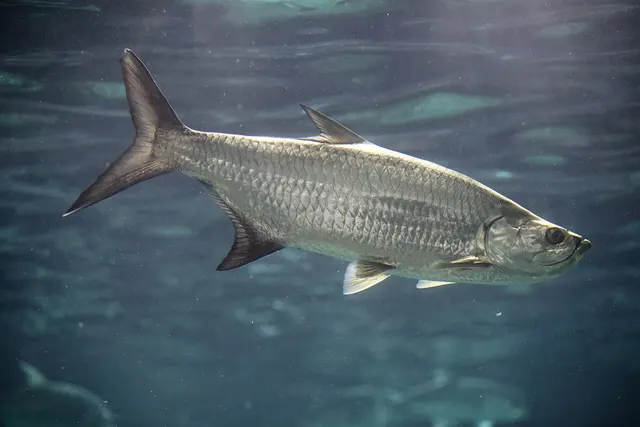 Atlantic tarponScaled sardines are a principal prey in the shallow coastal and estuarine water tarpon use, and the seasonal availability of the bait shapes the fishery's calendar.
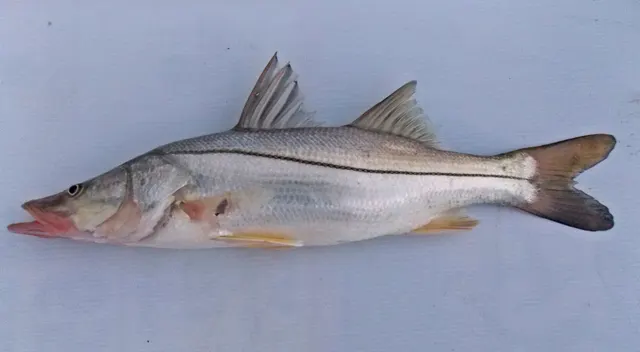 Common snookSnook feed heavily on scaled sardines around structure and along beaches, which is the ecological basis of the live-bait fishery for them.
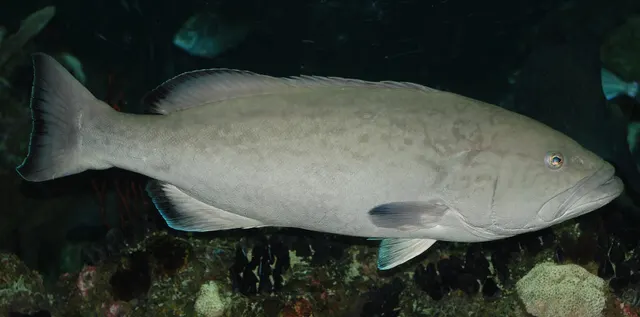 Gag grouperSmall clupeids are a principal fish prey for gag over inshore and nearshore structure.
More fish
Not related to this page — just the rest of the section. There is little else joined to this subject yet, and a short page should still lead somewhere.
Sources and evidence
- FishBase: a global information system on fishes — Froese, R. and D. Pauly, eds. — FishBase Consortium (Scientific institute)Relied on for: Species identity, binomial, family placement, size, distribution and recorded biology for this species.States this directlyPassage read and verified
- FAO Species Identification Guides for Fishery Purposes and the FAO Species Catalogues — Food and Agriculture Organization of the United Nations (Scientific institute)Relied on for: The regional species account describing identity, distribution and the role of this species in the fisheries and food webs it belongs to.States this directlyCitation checked — the work exists and is described correctly
Why the 3 connections on this page are here, and the sources
Similar and related fish
Backed by research — 3 connections
Supported by peer-reviewed research or fisheries science. The sources are listed and can be checked.
Atlantic tarpon
Recorded diet evidence identifies Harengula jaguana as a food item of this predator at species level. The edge is written at that granularity and no further.
- FishBase: a global information system on fishes — Froese, R. and D. Pauly, eds. — FishBase Consortium (Scientific institute)Relied on for: Food items recorded for this predator, including Harengula jaguana.States this directlyPassage read and verified
- FAO Species Identification Guides for Fishery Purposes and the FAO Species Catalogues — Food and Agriculture Organization of the United Nations (Scientific institute)Relied on for: Species account describing the diet of this predator in the region where Harengula jaguana occurs.Background and mechanism onlyCitation checked — the work exists and is described correctly
Common snook
Recorded diet evidence identifies Harengula jaguana as a food item of this predator at species level. The edge is written at that granularity and no further.
- FishBase: a global information system on fishes — Froese, R. and D. Pauly, eds. — FishBase Consortium (Scientific institute)Relied on for: Food items recorded for this predator, including Harengula jaguana.States this directlyPassage read and verified
- FAO Species Identification Guides for Fishery Purposes and the FAO Species Catalogues — Food and Agriculture Organization of the United Nations (Scientific institute)Relied on for: Species account describing the diet of this predator in the region where Harengula jaguana occurs.Background and mechanism onlyCitation checked — the work exists and is described correctly
Gag grouper
Recorded diet evidence identifies Harengula jaguana as a food item of this predator at species level. The edge is written at that granularity and no further.
- FishBase: a global information system on fishes — Froese, R. and D. Pauly, eds. — FishBase Consortium (Scientific institute)Relied on for: Food items recorded for this predator, including Harengula jaguana.States this directlyPassage read and verified
- FAO Species Identification Guides for Fishery Purposes and the FAO Species Catalogues — Food and Agriculture Organization of the United Nations (Scientific institute)Relied on for: Species account describing the diet of this predator in the region where Harengula jaguana occurs.Background and mechanism onlyCitation checked — the work exists and is described correctly
How FishingHQ labels evidence is explained in the evidence policy.