Sockeye salmon
Fish · Last reviewed 2026-08-10
The plankton-feeding Pacific salmon that turns brilliant scarlet to spawn, depends on lakes rather than just rivers, and barely takes a lure at all.
Safety: moving water and currents — can cause serious injury or death. 5 more points apply here.
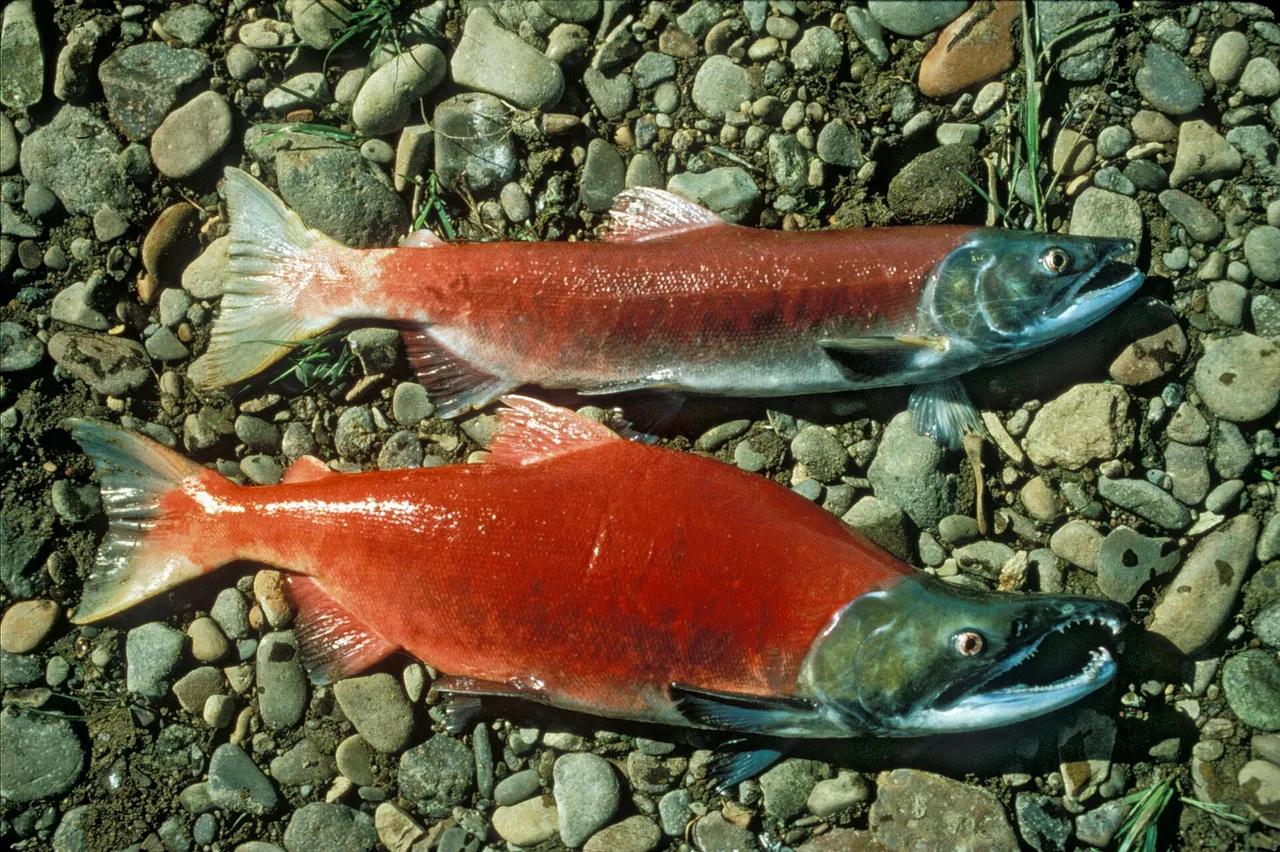
How this was identified, and who took it
Identified by: Male and female in full spawning colour: brilliant red body, green head, and no black spotting on the back — the absence of spotting is the character that separates spawning sockeye from the other Pacific salmon. A US Fish and Wildlife Service photograph.David Menke — Public domain, via Wikimedia Commons — source, licence
Catching Sockeye salmon
Everything here on fishing for it. Each entry opens the page behind it.
The sockeye is the odd one out among Pacific salmon, and every unusual thing about it comes from its diet. Alone in the genus it feeds primarily on zooplankton rather than on fish, filtering it with unusually long, fine gill rakers — which is why it is so difficult to catch on anything designed to look like a baitfish, and why the fishery for it relies on flossing techniques and on aggression rather than on imitation.
Its second peculiarity is lakes. Sockeye juveniles rear in lakes rather than in streams, which ties the species to river systems that have a lake in them and makes it absent from otherwise suitable rivers that do not. That dependence is why sockeye runs are so concentrated in particular systems and why the loss of lake access — to a dam, typically — removes a run entirely rather than reducing it.
And it produces the most striking transformation of any salmon: sea-run fish are plain blue-green and silver, and spawning fish turn brilliant scarlet with a green head, the males developing a humped back and hooked jaw. The landlocked form, called kokanee, does the same thing at a fraction of the size and is a significant fishery in its own right.
Identification
- Scientific name
- Oncorhynchus nerka
- Family
- Salmonidae
- Water
- Freshwater, Saltwater, Brackish, Moves between fresh and salt water
- Conservation status
- Least Concern
- Regions
- North America, Arctic & Subarctic, East Asia
- Sea-run fish plain silver with a blue-green back and NO distinct black spots on the back or tail — the absence of spotting is the quickest separation from chinook, coho and pink.
- Spawning fish brilliant scarlet with a green head; males develop a humped back and hooked kype.
- Long, fine, numerous gill rakers, reflecting the plankton diet — a diagnostic character on a fish in hand.
- Body slender and streamlined compared with chinook.
- The landlocked form, kokanee, is identical in form at much smaller size.
Size
- Typical
- 1.5–3 kg (3–6.5 lb)
- Large
- 3.5–5 kg (7.7–11 lb)
Exceptional: Over 6 kg (13 lb); maximum published weight 7.7 kg
The only Pacific salmon that needs a lake
Sockeye salmon habitat has one requirement that separates them from every other Pacific salmon, and it explains their entire distribution.
JUVENILES REAR IN LAKES. Sockeye fry move from the spawning gravel into a lake and spend one to three years there feeding on zooplankton before going to sea. No lake, no sockeye — which is why sockeye occur in some river systems and not in neighbouring ones with identical spawning gravel.
SO LAKE PRODUCTIVITY DRIVES THE POPULATION. The zooplankton production of the rearing lake sets how many juveniles it can support, and sockeye abundance tracks lake conditions as much as it tracks marine survival.
SPAWNING HABITAT IS GRAVEL, in lake inlet and outlet streams, in the lake shallows themselves where groundwater upwells, and in mainstem reaches. Beach spawning on lake shores is a genuine and distinctive part of the species' repertoire.
AT SEA THEY ARE OPEN-OCEAN PLANKTON FEEDERS, ranging widely across the North Pacific, which is unusual for a salmon and gives them a different marine ecology from the piscivorous chinook and coho.
KOKANEE ARE THE LAND-LOCKED FORM, completing the whole cycle in fresh water without a marine phase — the same species occupying a permanently freshwater habitat.
AND THE LAKE DEPENDENCY MAKES THEM VULNERABLE TO A SPECIFIC SET OF THREATS: anything that blocks access to the rearing lake, or degrades its productivity, removes the population regardless of how good the river is.
Backed by research — why, and the sources (2)
Supported by peer-reviewed research or fisheries science. The sources are listed and can be checked.
- NASCO conservation and management of North Atlantic salmon — North Atlantic Salmon Conservation Organization (Government fisheries body)Relied on for: Anadromous salmonid biology, run timing, spawning habitat requirements and the management principles applied to them.States this directlyCitation checked — the work exists and is described correctly
- FishBase: a global information system on fishes — Froese, R. and D. Pauly, eds. — FishBase Consortium (Scientific institute)Relied on for: Distribution, habitat association, depth range, size, reproduction and life-history parameters recorded for the species.States this directlyPassage read and verified
Red fish on the gravel, and a homing precision that made the species
Sockeye spawning is the most visually famous salmon event there is, and the underlying biology is about precision rather than spectacle.
ADULTS TRANSFORM COMPLETELY. Returning sockeye turn deep red with green heads, and males develop a pronounced hooked jaw and humped back. The change is metabolic as well as visual — the fish stops feeding on entering fresh water and runs entirely on stored reserves.
HOMING IS EXTREMELY PRECISE. Sockeye return not merely to their natal river but to their natal spawning area, which has produced a mosaic of genetically distinct sub-populations within single systems, each adapted to its own reach, timing and conditions. That diversity is why some systems are resilient — a poor year for one sub-population is buffered by others.
SPAWNING IS ON GRAVEL, in streams and on lake beaches with groundwater upwelling, with the female cutting and defending a redd.
SEMELPARITY IS ABSOLUTE. All adults die after spawning, and the carcasses deliver marine nutrients into the lake and stream system — a subsidy that measurably supports the productivity the next generation's juveniles depend on.
RUN TIMING IS GENETICALLY DETERMINED AND SUB-POPULATION SPECIFIC, so a system's overall run is a sum of many precisely timed components.
AND THAT STRUCTURE IS WHY MANAGEMENT IS ESCAPEMENT-BASED AND IN-SEASON: counting fish onto the spawning grounds and adjusting the fishery accordingly is the only way to protect components that a single aggregate quota would average away.
Backed by research — why, and the sources (2)
Supported by peer-reviewed research or fisheries science. The sources are listed and can be checked.
- NASCO conservation and management of North Atlantic salmon — North Atlantic Salmon Conservation Organization (Government fisheries body)Relied on for: Anadromous salmonid biology, run timing, spawning habitat requirements and the management principles applied to them.States this directlyCitation checked — the work exists and is described correctly
- FishBase: a global information system on fishes — Froese, R. and D. Pauly, eds. — FishBase Consortium (Scientific institute)Relied on for: Distribution, habitat association, depth range, size, reproduction and life-history parameters recorded for the species.States this directlyPassage read and verified
A plankton feeder in a river, and why how it was hooked is the first question
Sockeye pose a handling question that no other salmon on FishingHQ poses, and it arises before the fish is landed.
SOCKEYE ARE PLANKTIVORES. Uniquely among the Pacific salmon, they feed largely on zooplankton at sea, filtered with unusually fine and numerous gill rakers, and they do not pursue fish. Combined with the general cessation of feeding on entry to fresh water, this means a sockeye in a river has very little inclination to take anything, and the conventional angling relationship between an offer and a feeding response is weak to absent.
THE CONSEQUENCE IS THAT MANY SOCKEYE ARE HOOKED BY CONTACT RATHER THAN BY TAKE — a line drifted through a dense concentration of fish makes contact with a mouth, or with something else. That distinction is not a technicality. Where a fish is hooked outside the mouth it is legally a foul-hooked fish in most jurisdictions and must be returned, and the practices that deliberately produce such hookings are prohibited in most sockeye fisheries and enforced against. This is genuinely one of the most closely regulated angling situations there is, the rules differ by river and by year, and they are the local authority's to state.
WHAT THAT MEANS FOR HANDLING. The first thing to establish about a landed sockeye is where the hook is, because it decides what happens next, and it decides it before any question of technique arises.
AND A RETURNED FISH IS RETURNED UNDER THE ORDINARY PACIFIC SALMON CONSTRAINT: it is spending a fixed budget it cannot refill, so the fight is kept short, the fish stays in the water, it is unhooked with a tool, and it is supported facing into the current until it holds itself. A sockeye that has been chased through a shoal, played hard and lifted for a photograph has been charged for all three from an account that closed at the river mouth.
Official guidance — why, and the sources (2)
Stated by a fisheries authority, scientific institute or recognised angling body. Authoritative, but summarising rather than demonstrating.
- NASCO conservation and management of North Atlantic salmon — North Atlantic Salmon Conservation Organization (Government fisheries body)Relied on for: Conservation of anadromous salmonids and the handling and release practice adopted in their fisheries.States this directlyCitation checked — the work exists and is described correctly
- FishBase: a global information system on fishes — Froese, R. and D. Pauly, eds. — FishBase Consortium (Scientific institute)Relied on for: Life history of the Pacific salmons, including cessation of feeding on entry to fresh water and post-spawning mortality.States this directlyPassage read and verified
A salmon that needs a lake, and a run whose timing is inherited
Sockeye have the most constrained seasonality of the Pacific salmon because their life cycle requires a specific piece of habitat that most rivers do not have.
THE LAKE IS THE REQUIREMENT AND IT SETS THE WHOLE PATTERN. Sockeye juveniles rear in lakes, feeding on zooplankton for a year or more before smolting, so a sockeye run exists only where a river system contains a suitable nursery lake. Adults return to spawn in the lake itself, in its inlet and outlet streams, or on lake shoals — and the run timing is tuned to deliver fry into that lake when its plankton production can support them.
RUN TIMING IS HEREDITARY AND EXTREMELY PRECISE. Individual sockeye populations return at consistent, narrow times of year, and different populations within one large system return weeks apart. That precision is an adaptation to lake and stream conditions specific to each population, which is why sockeye are managed as many separate stocks rather than as one species and why a run's timing is one of its defining characteristics.
WHICH MAKES THE SEASON SHORT AND CONCENTRATED. A sockeye river goes from empty to full and back within weeks, and the fishery, the bears, the eagles and the whole seasonal economy of some regions turn on that window.
FEEDING STOPS AT ENTRY AND THE TRANSFORMATION IS DRAMATIC. Sockeye entering fresh water cease feeding and reabsorb body tissue to fuel migration and spawning, turning red-bodied and green-headed in the process. That is why fresh sockeye taken in salt or lower river water are in prime condition and fish taken far upriver are not, and it is a seasonal gradient along a single river rather than a difference between rivers.
CYCLIC ABUNDANCE IS A REAL AND STRIKING FEATURE. Some sockeye systems show pronounced multi-year cycles in run size, with dominant years recurring on a regular interval, and the mechanisms behind them include lake productivity and predation dynamics rather than fishing.
KOKANEE ARE THE SAME SPECIES WITHOUT THE SEA, and they retain the lake requirement and the autumn spawning timing while completing the whole cycle in fresh water — a useful demonstration that the lake, not the ocean, is the non-negotiable part.
AND SOCKEYE FISHERIES ARE AMONG THE MOST TIGHTLY AND MOST FREQUENTLY ADJUSTED ANYWHERE, opened and closed in-season on escapement counts. Nothing above indicates what is permitted; the competent authority does.
Backed by research — why, and the sources (2)
Supported by peer-reviewed research or fisheries science. The sources are listed and can be checked.
- NASCO conservation and management of North Atlantic salmon — North Atlantic Salmon Conservation Organization (Government fisheries body)Relied on for: Run timing, migratory behaviour and the environmental cues governing the return of anadromous salmonids to fresh water.Background and mechanism onlyCitation checked — the work exists and is described correctly
- FishBase: a global information system on fishes — Froese, R. and D. Pauly, eds. — FishBase Consortium (Scientific institute)Relied on for: Spawning season, migratory behaviour and life-history timing for the species.States this directlyPassage read and verified
Lifecycle and reproduction
Anadromous and semelparous, with a life history tied to lakes: juveniles rear in a lake for one to three years before migrating to sea, spend one to four years in the North Pacific, and return to spawn once and die. The lake-rearing requirement is the defining constraint — sockeye are essentially absent from river systems without an accessible lake, and blocking access to one eliminates the run.
Redd-spawning in gravel, frequently in lake tributaries or on lake shores where groundwater upwells, in late summer and autumn. Both parents die after spawning. The landlocked kokanee form completes the same cycle without ever going to sea, and populations can switch between the two strategies where sea access changes.
Feeding and senses
Primarily a zooplankton feeder throughout life, using long fine gill rakers to filter copepods and other small crustaceans, supplemented by insects and occasionally small fish. This is the key to everything about fishing for the species: a fish that eats plankton has no interest in a lure imitating a baitfish, which is why sockeye fisheries depend on line manipulation and territorial aggression rather than on imitation.
Homing by olfaction, as in all Pacific salmon. Feeding at sea is a filtering behaviour driven by encountering plankton concentrations rather than by hunting individual prey, which is consistent with the species' indifference to conventional lures. In fresh water, returning fish respond to intrusion rather than to food.
Through the year
Run timing is tightly tied to particular systems and is among the most predictable of any salmon, with the largest runs concentrated in a few river systems and occurring within narrow windows. Ocean conditions in the preceding years drive run size, and returns can vary by an order of magnitude between years for reasons that have nothing to do with the river.
Distribution
North Pacific: from Alaska and the Bering Sea south to Oregon on the North American coast, and along the Asian coast to Japan and Kamchatka. Landlocked kokanee populations occur naturally and have been widely introduced across North America and elsewhere.
This is a biological range — where the species occurs, not a prediction that you will catch one. To browse the fishing geography FishingHQ holds, start at fishing places.
Why anglers care
A major commercial and subsistence species and a significant sport fishery in a small number of systems, where the technique depends on intercepting migrating fish rather than on presenting food. Kokanee are a substantial freshwater fishery in their own right across western North America, taken by trolling small attractors. Culturally central to the indigenous peoples of the North Pacific coast.
Handling and returning
Handle in the water and support horizontally. Returning fish are already committed to a terminal migration and cannot recover condition, so minimise the fight and the handling. In many systems there are specific rules about how and where sockeye may be taken, reflecting the difficulty of hooking them conventionally, and those are exactly the local rules FishingHQ does not attempt to state.
Going further
- What does sockeye salmon eat? — feeding biology, kept separate from what anglers infer from it.
- Sockeye salmon vs Chinook salmon — how to tell them apart.
- Sockeye salmon vs Chum salmon — how to tell them apart.
Safety
Moving water and currents — Can cause serious injury or death
Sockeye fisheries concentrate large numbers of anglers on fast cold rivers during narrow run windows, which combines wading hazard with crowding.
What reduces it: Wading staff and buoyancy aid. Do not wade beyond your ability because a spot is crowded. Check the catchment forecast, and treat other people's casting as a hazard in crowded conditions.
Species that bite — Can cause serious injury or death
Sockeye runs concentrate bears in enormous numbers, and the largest sockeye systems are also the best-known bear-viewing locations for exactly that reason.
What reduces it: Treat local guidance as authoritative. Fish with others, make noise, never approach a carcass, and be prepared to leave a spot to a bear rather than negotiating for it.
Precautions that always apply here
- Wear a buoyancy aid or lifejacket. Cold water incapacitates strong swimmers within a minute, long before swimming ability matters.
- Do not wade alone. Judge depth and flow from the bank first, and turn back sooner than feels necessary.
- Tell somebody where you are going and when you expect to be back.
- Carry a charged phone in a waterproof case, or another means of calling for help.
Check the rules before you fish
Fishing laws, bylaws, access rules, seasons, bait restrictions and permitted methods vary by location and can change. Check the current rules from the relevant authority and the water you intend to fish before fishing.
Check with:
- Current national or regional law for where you are fishing
- Current local bylaws
- The relevant fisheries authority
- The landowner, club or fishery whose water it is
- Any restrictions specific to the species or the method you intend to use
Where to go next
Similar and related fish
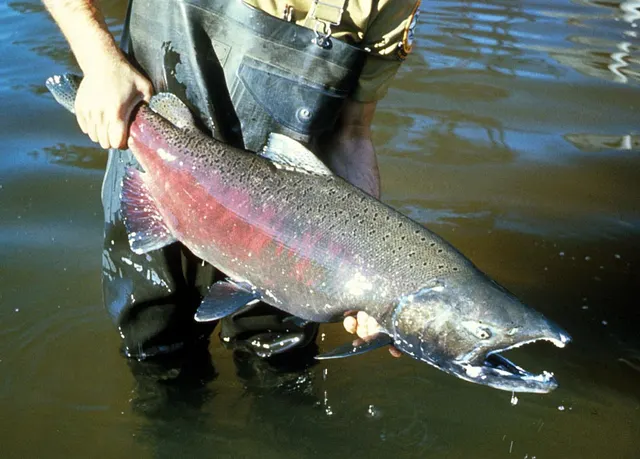 Chinook salmonCongeners with completely different diets: chinook eats fish, sockeye filters plankton with long fine gill rakers. That is why sockeye barely take lures and chinook do.
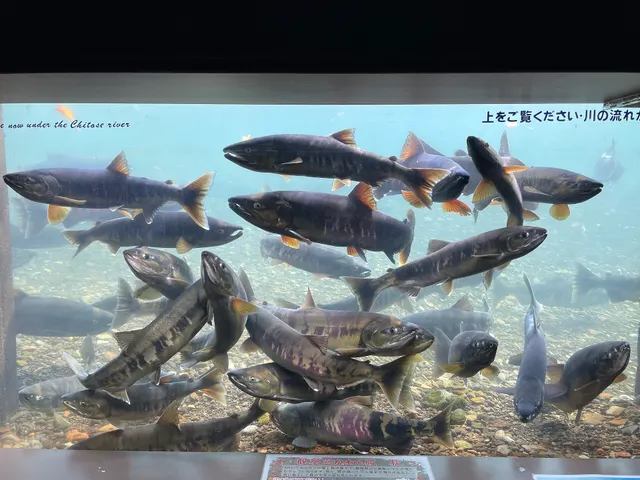 Chum salmonBoth lack the black body spotting of the other pacific salmon, and are separated by fin tips and calico barring.
Where you will find it
- AlaskaReturns to the state's nursery-lake systems in enormous numbers, Bristol Bay supporting among the largest wild sockeye runs remaining anywhere.
- CanadaRuns the Pacific drainages that contain suitable nursery lakes, the Fraser system foremost among them.
- The Pacific Northwest coastRuns in large numbers in particular systems, and its plankton-feeding habit makes it unusually difficult to hook conventionally — which is why the fisheries for it are so specifically regulated.
Understanding this fish
Sources and evidence
- FishBase: a global information system on fishes — Froese, R. and D. Pauly, eds. — FishBase Consortium (Scientific institute)Relied on for: Scientific name, family placement in the Salmonidae, a maximum length of 84.0 cm TL, a maximum published weight of 7.7 kg, a maximum reported age of 8 years.States this directlyPassage read and verified
- FishBase: a global information system on fishes — Froese, R. and D. Pauly, eds. — FishBase Consortium (Scientific institute)Relied on for: Environment, climate zone and depth range as recorded: Marine; freshwater; brackish; pelagic-oceanic; anadromous ; depth range 0 - 250 m . Temperate; 0°C - 25°C ; 72°N - 42°N, 130°E - 109°WStates this directlyPassage read and verified
- FishBase: a global information system on fishes — Froese, R. and D. Pauly, eds. — FishBase Consortium (Scientific institute)Relied on for: The IUCN Red List category for Oncorhynchus nerka — Least Concern, assessed 24 November 2010 — as republished by FishBase, the Red List itself being unreachable during review.States this directlyPassage read and verified
- NASCO conservation and management of North Atlantic salmon — North Atlantic Salmon Conservation Organization (Government fisheries body)Relied on for: That anadromous salmon are managed at the level of individual river populations with run-specific measures.FishingHQ's interpretation of what it saysCitation checked — the work exists and is described correctly
Why the 7 connections on this page are here, and the sources
Similar and related fish
Backed by research — 2 connections
Supported by peer-reviewed research or fisheries science. The sources are listed and can be checked.
Chinook salmon
A comparison resting on documented feeding morphology and naming both binomials.
- FishBase: a global information system on fishes — Froese, R. and D. Pauly, eds. — FishBase Consortium (Scientific institute)Relied on for: That Oncorhynchus nerka and Oncorhynchus tshawytscha are congeners in the genus Oncorhynchus with differing feeding ecology.States this directlyPassage read and verified
Chum salmon
An identification comparison naming both binomials: Oncorhynchus keta and Oncorhynchus nerka.
- FishBase: a global information system on fishes — Froese, R. and D. Pauly, eds. — FishBase Consortium (Scientific institute)Relied on for: Morphological and distributional data for Oncorhynchus keta and for Oncorhynchus nerka.States this directlyPassage read and verified
- The IUCN Red List of Threatened Species — International Union for Conservation of Nature (Conservation authority)Relied on for: Separate assessments treating Oncorhynchus keta and Oncorhynchus nerka as distinct species.States this directlyCitation checked — the work exists and is described correctly
How it is caught
What experienced anglers do — 1 connection
Widely and independently recommended by experienced anglers and specialist sources. This is real angling knowledge, not proof: controlled evidence for it is limited, and FishingHQ records it as convention rather than as a demonstrated effect.
Drift fishing
Established angling practice for this species, recorded as convention. The note states the property of the animal or its water that makes the method the answer.
- IGFA International Angling Rules and World Record Requirements — International Game Fish Association (Angling or fisheries organisation)Relied on for: Recognition of the species as an established sport fish and the angling methods and tackle classes conventionally used for it.States this directlyPassage read and verified
- General angling website restatements of established technique — Various (Credible secondary source)Relied on for: Widely restated practice connecting this species and method.Background and mechanism onlyCitation checked — the work exists and is described correctly
Where you will find it
Backed by research — 3 connections
Supported by peer-reviewed research or fisheries science. The sources are listed and can be checked.
Alaska
A distribution association between an animal and a kind of water, rather than a claim about any named mark.
- FishBase: a global information system on fishes — Froese, R. and D. Pauly, eds. — FishBase Consortium (Scientific institute)Relied on for: Distribution, habitat association and depth range recorded for the species, including its occurrence in the water body concerned.States this directlyPassage read and verified
- The IUCN Red List of Threatened Species — International Union for Conservation of Nature (Conservation authority)Relied on for: Assessment and range account for the species, including the systems and coasts it occupies.Background and mechanism onlyCitation checked — the work exists and is described correctly
Canada
A distribution association between an animal and a kind of water, rather than a claim about any named mark.
- FishBase: a global information system on fishes — Froese, R. and D. Pauly, eds. — FishBase Consortium (Scientific institute)Relied on for: Distribution, habitat association and depth range recorded for the species, including its occurrence in the water body concerned.States this directlyPassage read and verified
- The IUCN Red List of Threatened Species — International Union for Conservation of Nature (Conservation authority)Relied on for: Assessment and range account for the species, including the systems and coasts it occupies.Background and mechanism onlyCitation checked — the work exists and is described correctly
The Pacific Northwest coast
Occurrence of the species in this system or along this coast: a statement about the animal's distribution, not a venue recommendation.
- FishBase: a global information system on fishes — Froese, R. and D. Pauly, eds. — FishBase Consortium (Scientific institute)Relied on for: Distribution, salinity tolerance and habitat association recorded for the species, including its occurrence in this system.States this directlyPassage read and verified
- The IUCN Red List of Threatened Species — International Union for Conservation of Nature (Conservation authority)Relied on for: Assessment and range description for the species, including the waters in which it occurs.Background and mechanism onlyCitation checked — the work exists and is described correctly
Understanding this fish
Backed by research — 1 connection
Supported by peer-reviewed research or fisheries science. The sources are listed and can be checked.
Krill and planktonic crustaceans as prey
Recorded diet evidence identifies euphausiids and copepods as a food item of this predator at group level rather than to species. The edge points at the taxon record for that reason, and encoding it as a species-level claim would assert something the source does not.
- FishBase: a global information system on fishes — Froese, R. and D. Pauly, eds. — FishBase Consortium (Scientific institute)Relied on for: Food items recorded for this predator, given as euphausiids and copepods.States this directlyPassage read and verified
- FAO Species Identification Guides for Fishery Purposes and the FAO Species Catalogues — Food and Agriculture Organization of the United Nations (Scientific institute)Relied on for: Species account describing this predator's diet, recorded at the level of euphausiids and copepods.Background and mechanism onlyCitation checked — the work exists and is described correctly
How FishingHQ labels evidence is explained in the evidence policy.