How to identify sockeye salmon
Oncorhynchus nerka · Salmonidae
The characters that identify sockeye salmon, ranked by how far each one can be trusted on its own.
Safety: moving water and currents — can cause serious injury or death. One more point applies here.
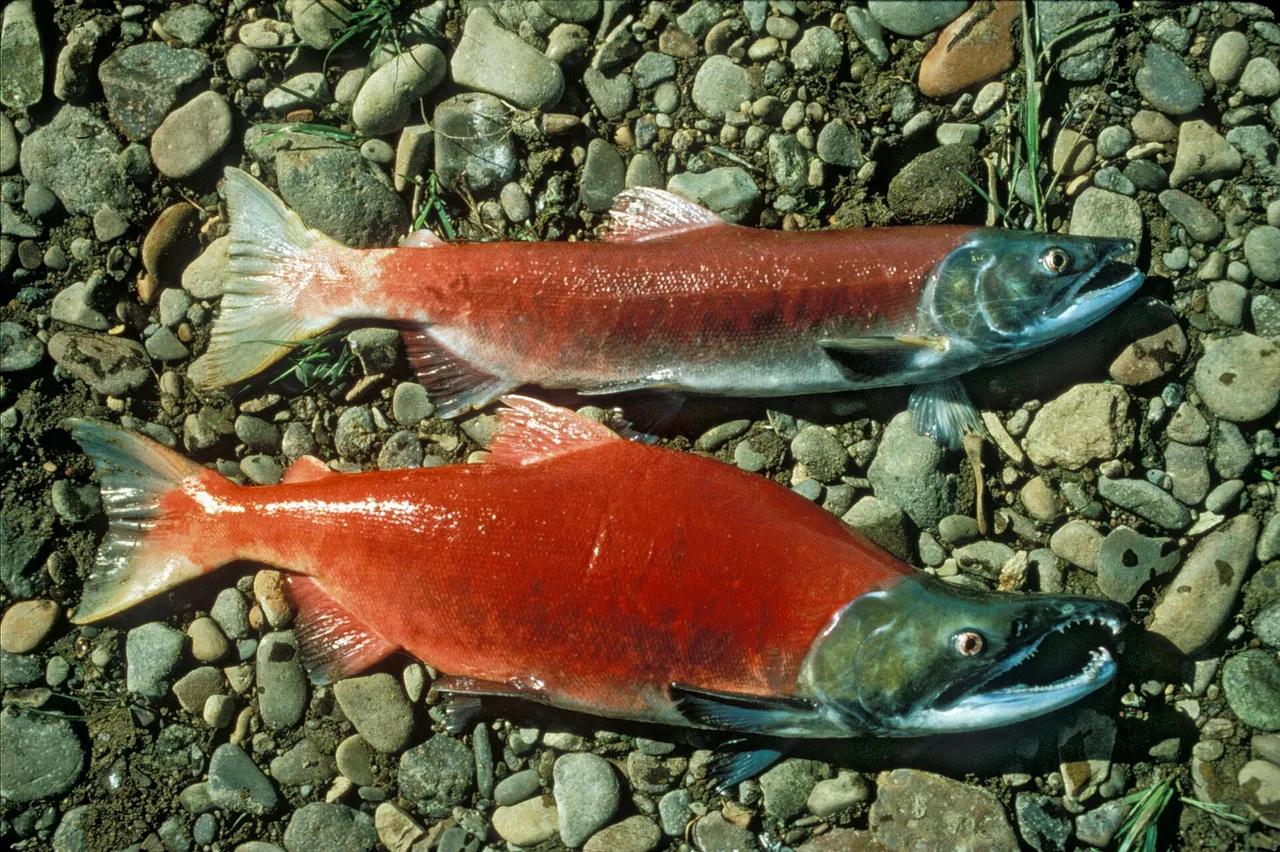
How this was identified, and who took it
Identified by: Male and female in full spawning colour: brilliant red body, green head, and no black spotting on the back — the absence of spotting is the character that separates spawning sockeye from the other Pacific salmon. A US Fish and Wildlife Service photograph.David Menke — Public domain, via Wikimedia Commons — source, licenceLook at this first
On a fresh sea-run sockeye the useful character is an absence. The back and the tail carry no distinct black spots at all, where chinook, coho and pink all do. A plain silver Pacific salmon with a clean tail is a sockeye until something contradicts it.
Diagnostic — settles it on its own
Each of these settles the identification on its own. If one is clear, you have your answer.
No spotting on back or tail
Fine dark speckling may be present; discrete round black spots are not. Every other Pacific salmon likely to be alongside it carries them somewhere, so their absence is genuinely informative rather than merely negative.
Gill rakers: long, fine and many
Lift the gill cover and the rakers on the first arch are numerous, slender and closely set, in a way no other Pacific salmon matches. It is a plankton-feeder's apparatus and it is the character a biologist would use. Requires a fish in hand.
Supporting — use with other characters
Real characters that are not conclusive by themselves. Use two or three together.
A slim build
Narrower through the body and lighter for its length than a chinook, with a fine tail wrist. Consistent enough to be useful in a mixed catch and not enough to name a fish on its own.
Suggestive only — varies with condition
Hints only. These vary with condition, season, water and how long the fish has been out of it, and a fish that contradicts them is still the same species.
Scarlet body and green head on spawners
The most photographed fish in the Pacific, and a character with a narrow window. It is unmistakable for the weeks it lasts and absent for the rest of the animal's life, and the fish it is being distinguished from also change colour.
What it gets confused with
- Chum salmon, the hardest of them at sea, separated by gill raker count and by the chum's larger pupil in a smaller eye.
- Pink salmon, which carries large oval spots on the tail that a sockeye never has.
- Kokanee, which is the same species landlocked and simply smaller — not a different fish.
Side by side: Sockeye salmon vs Chinook salmon, Sockeye salmon vs Chum salmon.
Where this stops working
At sea and in bright condition, sockeye and chum are the genuinely difficult pair and are separated on characters this page ranks as needing a fish in hand. Kokanee are sockeye and no character will separate them, because there is nothing to separate. Once fish are in spawning colour the whole page becomes less useful and local run timing tells you more than anatomy does.
The full record
This page covers identification only. The Sockeye salmon record covers behaviour, lifecycle, distribution, handling and the sources behind all of it.
Reviewed 2026-08-14.
More about this fish
Telling it apart is one question. Here are the others.
Similar and related fish
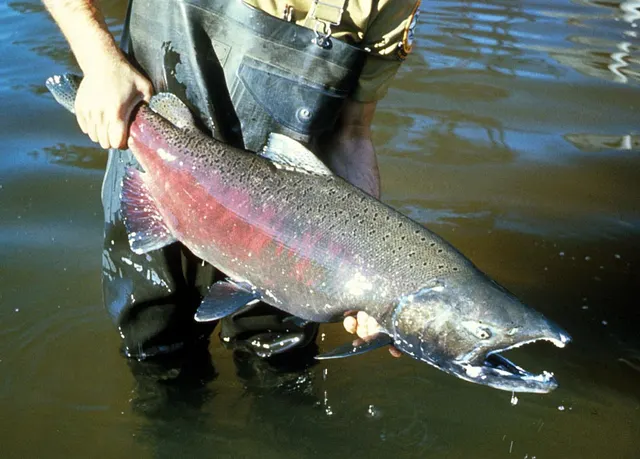 Chinook salmonCongeners with completely different diets: chinook eats fish, sockeye filters plankton with long fine gill rakers. That is why sockeye barely take lures and chinook do.
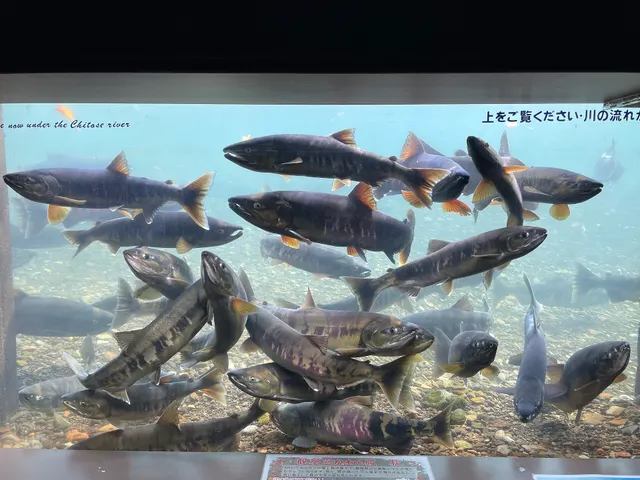 Chum salmonBoth lack the black body spotting of the other pacific salmon, and are separated by fin tips and calico barring.
How it is caught
Where you will find it
- AlaskaReturns to the state's nursery-lake systems in enormous numbers, Bristol Bay supporting among the largest wild sockeye runs remaining anywhere.
- CanadaRuns the Pacific drainages that contain suitable nursery lakes, the Fraser system foremost among them.
- The Pacific Northwest coastRuns in large numbers in particular systems, and its plankton-feeding habit makes it unusually difficult to hook conventionally — which is why the fisheries for it are so specifically regulated.
Why the 6 connections on this page are here, and the sources
Similar and related fish
Backed by research — 2 connections
Supported by peer-reviewed research or fisheries science. The sources are listed and can be checked.
Chinook salmon
A comparison resting on documented feeding morphology and naming both binomials.
- FishBase: a global information system on fishes — Froese, R. and D. Pauly, eds. — FishBase Consortium (Scientific institute)Relied on for: That Oncorhynchus nerka and Oncorhynchus tshawytscha are congeners in the genus Oncorhynchus with differing feeding ecology.States this directlyPassage read and verified
Chum salmon
An identification comparison naming both binomials: Oncorhynchus keta and Oncorhynchus nerka.
- FishBase: a global information system on fishes — Froese, R. and D. Pauly, eds. — FishBase Consortium (Scientific institute)Relied on for: Morphological and distributional data for Oncorhynchus keta and for Oncorhynchus nerka.States this directlyPassage read and verified
- The IUCN Red List of Threatened Species — International Union for Conservation of Nature (Conservation authority)Relied on for: Separate assessments treating Oncorhynchus keta and Oncorhynchus nerka as distinct species.States this directlyCitation checked — the work exists and is described correctly
How it is caught
What experienced anglers do — 1 connection
Widely and independently recommended by experienced anglers and specialist sources. This is real angling knowledge, not proof: controlled evidence for it is limited, and FishingHQ records it as convention rather than as a demonstrated effect.
Drift fishing
Established angling practice for this species, recorded as convention. The note states the property of the animal or its water that makes the method the answer.
- IGFA International Angling Rules and World Record Requirements — International Game Fish Association (Angling or fisheries organisation)Relied on for: Recognition of the species as an established sport fish and the angling methods and tackle classes conventionally used for it.States this directlyPassage read and verified
- General angling website restatements of established technique — Various (Credible secondary source)Relied on for: Widely restated practice connecting this species and method.Background and mechanism onlyCitation checked — the work exists and is described correctly
Where you will find it
Backed by research — 3 connections
Supported by peer-reviewed research or fisheries science. The sources are listed and can be checked.
Alaska
A distribution association between an animal and a kind of water, rather than a claim about any named mark.
- FishBase: a global information system on fishes — Froese, R. and D. Pauly, eds. — FishBase Consortium (Scientific institute)Relied on for: Distribution, habitat association and depth range recorded for the species, including its occurrence in the water body concerned.States this directlyPassage read and verified
- The IUCN Red List of Threatened Species — International Union for Conservation of Nature (Conservation authority)Relied on for: Assessment and range account for the species, including the systems and coasts it occupies.Background and mechanism onlyCitation checked — the work exists and is described correctly
Canada
A distribution association between an animal and a kind of water, rather than a claim about any named mark.
- FishBase: a global information system on fishes — Froese, R. and D. Pauly, eds. — FishBase Consortium (Scientific institute)Relied on for: Distribution, habitat association and depth range recorded for the species, including its occurrence in the water body concerned.States this directlyPassage read and verified
- The IUCN Red List of Threatened Species — International Union for Conservation of Nature (Conservation authority)Relied on for: Assessment and range account for the species, including the systems and coasts it occupies.Background and mechanism onlyCitation checked — the work exists and is described correctly
The Pacific Northwest coast
Occurrence of the species in this system or along this coast: a statement about the animal's distribution, not a venue recommendation.
- FishBase: a global information system on fishes — Froese, R. and D. Pauly, eds. — FishBase Consortium (Scientific institute)Relied on for: Distribution, salinity tolerance and habitat association recorded for the species, including its occurrence in this system.States this directlyPassage read and verified
- The IUCN Red List of Threatened Species — International Union for Conservation of Nature (Conservation authority)Relied on for: Assessment and range description for the species, including the waters in which it occurs.Background and mechanism onlyCitation checked — the work exists and is described correctly
Safety
Moving water and currents — Can cause serious injury or death
Sockeye fisheries concentrate large numbers of anglers on fast cold rivers during narrow run windows, which combines wading hazard with crowding.
What reduces it: Wading staff and buoyancy aid. Do not wade beyond your ability because a spot is crowded. Check the catchment forecast, and treat other people's casting as a hazard in crowded conditions.
Species that bite — Can cause serious injury or death
Sockeye runs concentrate bears in enormous numbers, and the largest sockeye systems are also the best-known bear-viewing locations for exactly that reason.
What reduces it: Treat local guidance as authoritative. Fish with others, make noise, never approach a carcass, and be prepared to leave a spot to a bear rather than negotiating for it.