Chinook salmon
Fish · Last reviewed 2026-08-10
The largest Pacific salmon, reaching over sixty kilograms, and the one whose runs carry the most cultural and ecological weight on that coast.
Safety: moving water and currents — can cause serious injury or death. 6 more points apply here.
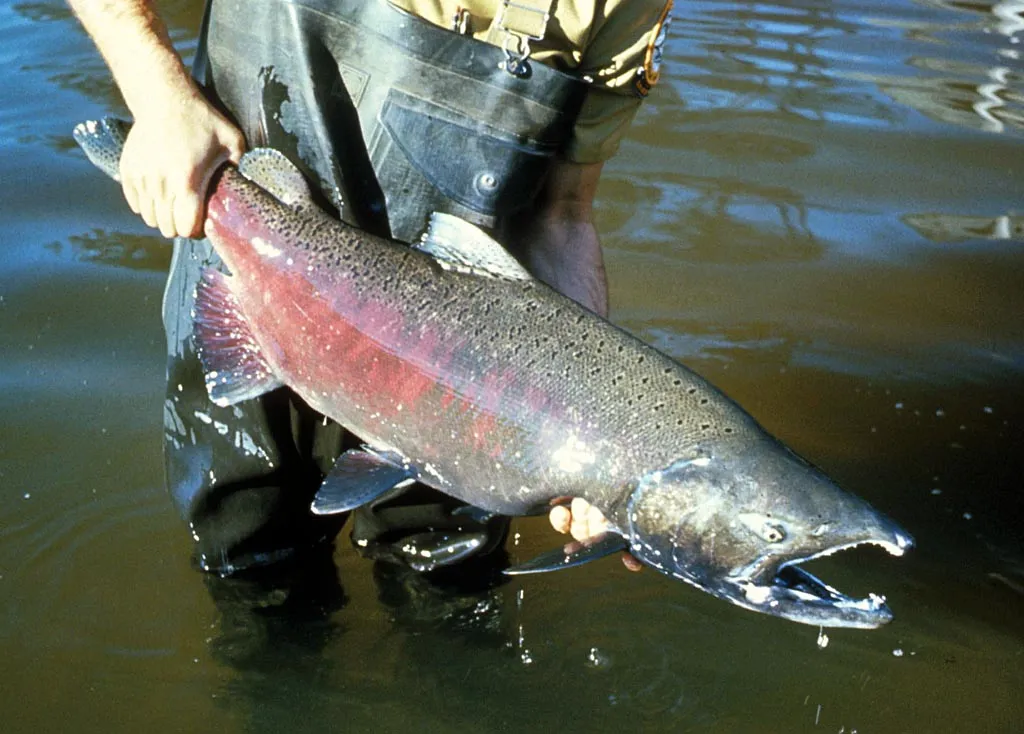
How this was identified, and who took it
Identified by: The two diagnostic chinook characters are both visible and both legible: heavy black spotting distributed across the upper and lower lobes of the caudal fin, where coho carries spots on the upper lobe only; and the dark gum line at the base of the teeth in the open lower jaw, which coho lacks. The fish is in spawning colour, which is stated in the caption because the flank red is not a year-round character.U.S. Geological Survey — public domain, via Wikimedia Commons — source, licence
Catching Chinook salmon
Everything here on fishing for it. Each entry opens the page behind it.
- Ground
The chinook is the biggest of the Pacific salmon and the one most people mean when they say king salmon. It reaches a maximum published weight over sixty kilograms, it runs into rivers from Alaska to California and across to Kamchatka, and its returning adults are the foundation of an entire ecosystem — bears, eagles, orcas and the forests fertilised by carcasses all depend on the run.
Like all Pacific salmon it is semelparous: it spawns once and dies. That is the biological fact that separates the genus from Atlantic salmon and from trout, and it changes everything about how the fish should be thought about. A returning chinook is on a one-way trip, its body already breaking down, and it is not feeding in any normal sense — which is why the question of why a returning salmon takes a lure at all is genuinely unresolved rather than merely unexplained.
The runs are also in trouble across much of the range, from dams, habitat loss, hatchery interactions and ocean conditions, and several populations are protected. That makes chinook a species where the regulatory picture is unusually complex and unusually local, and where FishingHQ's refusal to state current rules is doing more work than usual.
How it is caught
Identification
- Scientific name
- Oncorhynchus tshawytscha
- Family
- Salmonidae
- Water
- Freshwater, Saltwater, Brackish, Moves between fresh and salt water
- Conservation status
- Least Concern
- Regions
- North America, Arctic & Subarctic, East Asia, New Zealand, Central & South America
- Black gums at the base of the teeth in the lower jaw — the classic separation from coho, whose gums are pale. Worth learning, because it is reliable.
- Small black spots on the back, dorsal fin AND both lobes of the tail.
- Sea-run fish bright silver with a bluish-green back; spawning fish darken to olive, maroon or almost black, with males developing a hooked kype.
- Body deep and heavy relative to other Pacific salmon at the same length.
- Adipose fin present; anal fin with more rays than a trout's, which is the family character separating Oncorhynchus from Salmo.
Size
- Typical
- 4–10 kg (9–22 lb)
- Large
- 15–25 kg (33–55 lb)
Exceptional: Over 30 kg (66 lb); maximum published weight 61.4 kg
The biggest redds, the longest journeys and several distinct run types
Chinook salmon spawning is the largest-scale salmonid reproduction on FishingHQ, and its most important feature is that a single river holds several different versions of it.
RUN TYPES ARE THE DEFINING COMPLEXITY. Chinook return in spring, summer, autumn and winter runs depending on the population, each genetically distinct, each entering fresh water at a different stage of maturity and each spawning at a different time. Spring-run fish enter immature and hold in cold water for months before spawning; autumn-run fish enter ready to spawn. Treating chinook as having one spawning season misdescribes the species.
THEY SPAWN IN LARGE GRAVEL, and because the fish are big, the redds are large and are cut in coarser substrate and stronger flow than other salmon use — which is why chinook can use mainstem reaches that smaller salmon cannot.
MIGRATIONS ARE VERY LONG in some populations, with historical runs reaching well over a thousand kilometres inland, and those long-distance populations are the ones most damaged by dams.
SEMELPARITY IS ABSOLUTE. Adults die after spawning, and the carcasses subsidise the productivity of the stream.
JACKS RETURN PRECOCIOUSLY, as in coho, providing an alternative male reproductive tactic.
AND THE SPRING RUN IS THE VULNERABLE ONE. Fish that enter early and hold through summer need cold water for months before spawning, so warming and habitat loss hit spring-run populations hardest — and several are of serious conservation concern while autumn runs in the same rivers persist.
Backed by research — why, and the sources (2)
Supported by peer-reviewed research or fisheries science. The sources are listed and can be checked.
- NASCO conservation and management of North Atlantic salmon — North Atlantic Salmon Conservation Organization (Government fisheries body)Relied on for: Anadromous salmonid biology, run timing, spawning habitat requirements and the management principles applied to them.States this directlyCitation checked — the work exists and is described correctly
- FishBase: a global information system on fishes — Froese, R. and D. Pauly, eds. — FishBase Consortium (Scientific institute)Relied on for: Distribution, habitat association, depth range, size, reproduction and life-history parameters recorded for the species.States this directlyPassage read and verified
A fish with no more meals: why the fight matters more than the handling
The single most important fact about handling a Pacific salmon in fresh water is one that has nothing to do with hands. The fish has stopped eating and will not start again.
WHAT SEMELPARITY MEANS IN PRACTICE. A chinook entering fresh water carries the entire energy budget for the rest of its life: the migration, sometimes hundreds of kilometres and against current; the physiological rebuild of its body into spawning condition; the competition on the gravel; and the spawning itself. It will not feed to replace any of it. Everything it spends is spent from a fixed account, and the account was closed at the river mouth.
A PROLONGED FIGHT IS A WITHDRAWAL FROM THAT ACCOUNT. In a resident species — a trout, a bass, a pike — a hard fight is followed by recovery, and recovery is followed by feeding, and the cost is repaid. In a chinook it is not repaid. The lactate produced by a long anaerobic effort has to be cleared, the disturbance to blood chemistry has to be corrected, and the energy for both comes out of the reserve that was supposed to get the fish onto the gravel. A fish that swims away strongly can still fail to spawn, which is a form of mortality no angler ever observes.
SO THE PRIORITY ORDER IS DIFFERENT FROM ALMOST EVERY OTHER SPECIES. Fight duration comes first, and it is the reason salmon fisheries use tackle heavy enough to end a fight quickly rather than tackle light enough to make it sporting. Air exposure comes second, and the fish is unhooked in the water. Handling technique comes third, and it is straightforward: support horizontally, never by the tail alone, never lifted clear.
AND FISH ON THE GRAVEL ARE LEFT ALONE. A chinook holding on a redd is at the end of the process the whole fishery depends on, and disturbing one costs the population the thing the fish spent its entire budget to do. In many places that is also a legal matter, set locally.
Backed by research — why, and the sources (2)
Supported by peer-reviewed research or fisheries science. The sources are listed and can be checked.
- NASCO conservation and management of North Atlantic salmon — North Atlantic Salmon Conservation Organization (Government fisheries body)Relied on for: Conservation of anadromous salmonids and the handling and release practice adopted in their fisheries.States this directlyCitation checked — the work exists and is described correctly
- FishBase: a global information system on fishes — Froese, R. and D. Pauly, eds. — FishBase Consortium (Scientific institute)Relied on for: Life history of the Pacific salmons, including cessation of feeding on entry to fresh water and post-spawning mortality.States this directlyPassage read and verified
Big rivers and deep cold water: the salmon that needs the most of everything
Chinook are the largest Pacific salmon and their habitat requirements scale with them, which is why they are the species most consistently lost when a river system is altered.
THE SPAWNING HABITAT IS LARGE, CLEAN GRAVEL IN STRONG FLOW. A chinook is a big fish digging a big redd, and it needs coarser substrate and deeper, faster water than the smaller Pacific salmon do. That places chinook spawning in the main stems and larger tributaries of river systems rather than in small headwater streams — which is exactly where dams, abstraction and channel engineering concentrate. A system can retain excellent coho habitat in its small tributaries and have lost its chinook habitat entirely.
JUVENILE STRATEGY IS UNUSUALLY VARIABLE AND THAT MULTIPLIES THE REQUIREMENT. Some chinook populations migrate to sea in their first months, using estuaries and the lower river heavily as rearing habitat; others rear in fresh water for a year or more, needing cool complex stream habitat throughout. A single river may hold both. Protecting one life-history type does not protect the other, and the diversity itself is what makes a stock resilient.
THE ESTUARY IS A HABITAT IN ITS OWN RIGHT AND IT IS CHRONICALLY UNDERVALUED. Juvenile chinook use tidal marsh, side channels and shallow estuarine edge to grow and to make the physiological transition to salt water. Diking, filling and channelising an estuary removes that habitat, and the fish arrive at sea smaller and survive less well.
THE MARINE PHASE IS DEEP, COLD AND COASTAL-TO-OCEANIC. Chinook occupy cooler, deeper water than the other Pacific salmon while at sea and are the species most associated with fishing at depth — which is a habitat fact anglers use directly, because chinook are found below the thermocline and below the schools of surface-oriented coho.
TEMPERATURE IS THE BINDING CONSTRAINT THROUGHOUT and it is tightening. Adult chinook holding in rivers through summer before spawning need cold refuge — deep pools, spring inflows, tributary confluences — and warming rivers with reduced summer flows remove exactly those refuges. Pre-spawn mortality in warm low-flow years is a habitat failure rather than a fishing one.
AND THE PACIFIC NORTHWEST'S FISHERIES REST ON THIS. The region's coastal, river and inshore fishing character is built on the salmon runs, and the runs are built on cold, connected, gravel-bedded rivers with functioning estuaries at the bottom of them.
Backed by research — why, and the sources (2)
Supported by peer-reviewed research or fisheries science. The sources are listed and can be checked.
- NASCO conservation and management of North Atlantic salmon — North Atlantic Salmon Conservation Organization (Government fisheries body)Relied on for: Freshwater and marine habitat requirements of anadromous salmonids, the river conditions on which spawning and juvenile survival depend, and the pressures on them.States this directlyCitation checked — the work exists and is described correctly
- FishBase: a global information system on fishes — Froese, R. and D. Pauly, eds. — FishBase Consortium (Scientific institute)Relied on for: Habitat association, life-stage distribution and migratory behaviour for the species.Background and mechanism onlyPassage read and verified
Runs, not a season: why one river has chinook in spring and another in autumn
Chinook are the salmon whose seasonality is least reducible to a single answer, because the species has evolved multiple distinct run timings and a river may hold several of them.
A 'RUN' IS A DISTINCT REPRODUCTIVE POPULATION WITH ITS OWN SCHEDULE. Spring-run, summer-run and autumn-run chinook enter fresh water at different times, in different physiological states, and spawn in different places within a system. Spring-run fish enter early, in immature condition, and hold in cold deep pools for months before spawning; autumn-run fish enter mature and spawn soon after arrival. They are not the same fish arriving late — they are separate populations with heritable timing.
WHICH MEANS THE SEASON IS A PROPERTY OF THE RIVER, NOT OF THE SPECIES. Two rivers a hundred miles apart can have chinook present at completely different times of year, and a single large river system may have fish entering across most of the year because it holds several runs. Any calendar for chinook is a calendar for one system.
THE SPRING RUNS ARE THE FRAGILE ONES, AND THE REASON IS THERMAL. A fish that enters in spring must survive an entire summer in the river without feeding, which requires deep, cold holding water. Those are precisely the habitats lost to dams, abstraction and warming, and spring runs have consequently been reduced or extirpated in many systems while autumn runs persist. Losing a run is losing a distinct population, not a portion of one.
SMOLT MIGRATION IS THE OTHER SEASONAL EVENT and it runs the other way. Juveniles move seaward in spring, timed to river flow and to conditions in the estuary and nearshore ocean, and survival is strongly dependent on arriving when the coastal food supply is there. A mismatch between smolt arrival and ocean productivity is one of the main drivers of variation in returns years later.
OCEAN CONDITIONS SET THE SIZE OF THE RUN, NOT THE TIMING OF IT. Multi-year ocean cycles drive large swings in survival, so a river can have good and poor years with no change in its freshwater habitat at all.
AND EVERY FISHERY FOR THEM IS REGULATED IN DETAIL AND SEPARATELY. Seasons, methods, marking requirements and closures for chinook are set river by river and revised frequently, often in-season. Nothing above indicates what is permitted anywhere; the competent authority does.
Backed by research — why, and the sources (2)
Supported by peer-reviewed research or fisheries science. The sources are listed and can be checked.
- NASCO conservation and management of North Atlantic salmon — North Atlantic Salmon Conservation Organization (Government fisheries body)Relied on for: Run timing, migratory behaviour and the environmental cues governing the return of anadromous salmonids to fresh water.Background and mechanism onlyCitation checked — the work exists and is described correctly
- FishBase: a global information system on fishes — Froese, R. and D. Pauly, eds. — FishBase Consortium (Scientific institute)Relied on for: Spawning season, migratory behaviour and life-history timing for the species.States this directlyPassage read and verified
Lifecycle and reproduction
Anadromous and semelparous. Juveniles rear in fresh water for months to a year or more depending on the population, migrate to sea, spend one to several years feeding in the North Pacific, and return to their natal river to spawn once and die. Run timing varies enormously between populations — spring, summer, autumn and winter runs exist and are genetically distinct — which is why management is by run rather than by species.
The female cuts a redd in gravel with her tail, deposits eggs which the male fertilises, and covers them; both fish then die within days or weeks. The carcasses are a major nutrient input to the river and surrounding forest, and that nutrient transfer from ocean to land is one of the clearest ecosystem services any fish provides. Eggs overwinter in the gravel and emerge as fry in spring.
Feeding and senses
At sea, a piscivore taking herring, sand lance, squid and crustaceans, and growing very fast on that diet. On entering fresh water to spawn the digestive system regresses and the fish effectively stops feeding — which makes the fact that returning salmon take lures and flies a genuinely open question, variously explained as aggression, territoriality or residual reflex. FishingHQ records that the explanation is unresolved rather than picking one.
Homing to the natal river is achieved largely by olfaction, with the fish imprinting on the chemical signature of its home water as a juvenile and detecting it on return — one of the best-documented navigational feats in fish. At sea, sight and the lateral line drive feeding. The olfactory sensitivity is also why anglers are careful about what is on their hands and their bait in some salmon fisheries.
Through the year
Organised entirely around run timing, which differs between populations within the same river system. Spring, summer, autumn and winter runs exist; each enters fresh water at a different time and in a different physiological state. Ocean conditions in the years before a run largely determine its size, which means a poor return often reflects something that happened at sea years earlier rather than anything in the river that season.
Distribution
North Pacific: from the Bering Strait and Alaska south along the North American coast to California, and along the Asian coast to Japan and the Kamchatka peninsula. Introduced to the Great Lakes, New Zealand, Chile and elsewhere, with self-sustaining populations established in several.
This is a biological range — where the species occurs, not a prediction that you will catch one. To browse the fishing geography FishingHQ holds, start at fishing places.
Why anglers care
A premier sport fish on the Pacific coast of North America, taken by trolling and mooching at sea, and by fly, spinner and bait in rivers. Culturally central to the indigenous peoples of that coast, with fishing rights recognised in law and administered separately from the recreational fishery. The regulatory picture is exceptionally complex and local, with individual runs protected under endangered species legislation in parts of the range.
Handling and returning
A large, powerful fish. Handle in the water and support horizontally. In rivers, fish on spawning gravel should not be disturbed and in many places may not legally be targeted. Where release is intended, minimise the fight, keep the fish wet and revive it facing into the current. Note that a returning salmon is a fish with a limited remaining lifespan and no capacity to recover condition, which changes the calculus around a long fight.
Going further
- What does chinook salmon eat? — feeding biology, kept separate from what anglers infer from it.
- Chinook salmon vs Atlantic salmon — how to tell them apart.
- Chinook salmon vs Rainbow trout — how to tell them apart.
- Chinook salmon vs Sockeye salmon — how to tell them apart.
- Chinook salmon vs Coho salmon — how to tell them apart.
Safety
Moving water and currents — Can cause serious injury or death
Salmon river fishing means wading fast, cold, powerful water, frequently in remote country and often at low light. Rivers rise quickly with rainfall in the catchment rather than overhead.
What reduces it: Use a wading staff and a buoyancy aid, and do not wade alone in heavy water. Check the forecast for the catchment. Know the exit before you commit to a crossing, and be willing to walk round.
Species that bite — Can cause serious injury or death
Across much of the native range, salmon rivers in the run season are also where bears concentrate, for the same reason the anglers are there.
What reduces it: Make noise, fish with others, carry deterrent where it is advised locally, and never stand between a bear and the water or a bear and a carcass. Treat local guidance as authoritative rather than cautious.
Precautions that always apply here
- Wear a buoyancy aid or lifejacket. Cold water incapacitates strong swimmers within a minute, long before swimming ability matters.
- Do not wade alone. Judge depth and flow from the bank first, and turn back sooner than feels necessary.
- Tell somebody where you are going and when you expect to be back.
- Carry a charged phone in a waterproof case, or another means of calling for help.
- Support the fish's weight along its body, keep it out of the water for as short a time as possible, and hold it over something soft.
Check the rules before you fish
Fishing laws, bylaws, access rules, seasons, bait restrictions and permitted methods vary by location and can change. Check the current rules from the relevant authority and the water you intend to fish before fishing.
Check with:
- Current national or regional law for where you are fishing
- Current local bylaws
- The relevant fisheries authority
- The landowner, club or fishery whose water it is
- Any restrictions specific to the species or the method you intend to use
Where to go next
Similar and related fish
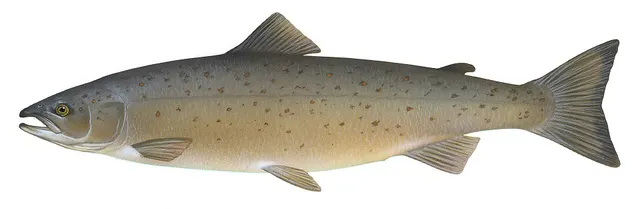 Atlantic salmonThe clearest illustration of what semelparity means: Atlantic salmon can spawn more than once and Pacific salmon cannot. Same family, one irreversible difference.
- Coho salmonCongeners that run the same rivers at overlapping times and are separated by the gums: chinook black, coho pale. The rules for them frequently differ, which is why the character is worth learning.
- Northern anchovyIn the California Current anchovy replaces sand lance as the dominant forage item, and the anchovy and sardine regime shift changes what chinook are eating for decades at a time.
- Pacific sand lanceSand lance are a principal prey of chinook in coastal waters, and chinook condition in the north-eastern Pacific tracks sand lance abundance closely.
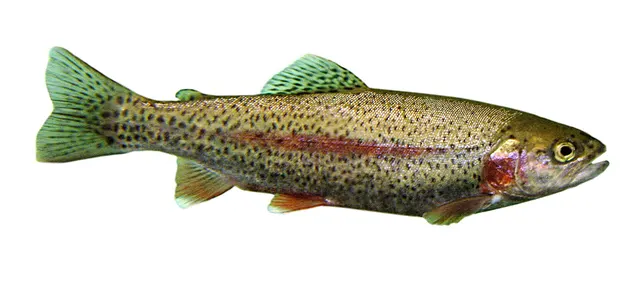 Rainbow troutCongeners in the genus Oncorhynchus. The difference that matters is that chinook is semelparous and dies after spawning while rainbow trout is not — the same genus, two entirely different life strategies.
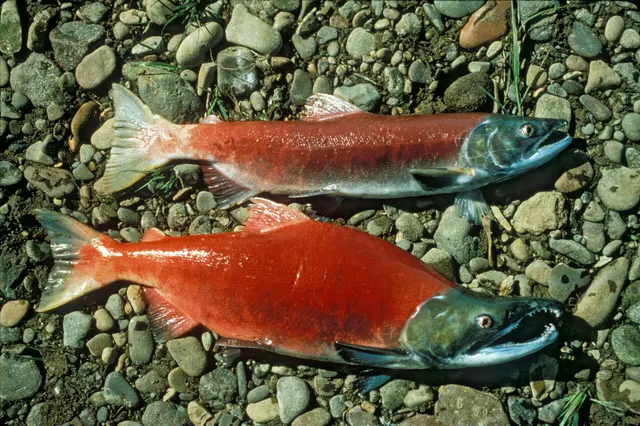 Sockeye salmonCongeners with completely different diets: chinook eats fish, sockeye filters plankton with long fine gill rakers. That is why sockeye barely take lures and chinook do.
Where it lives
Where you will find it
- AlaskaRuns rivers across the state, with several stocks in serious decline and managed by in-season emergency order.
- CanadaRuns the Pacific drainages of British Columbia and is the largest of the five Pacific salmon returning to Canadian rivers.
- PatagoniaNow running a number of Chilean rivers as feral self-sustaining populations, a large anadromous predator in a system that previously had none.
- The Great LakesIntroduced deliberately from the Pacific drainage from the 1960s to control irrupting alewife and to create a sport fishery. The modern open-water troll fishery is built on it and is maintained by stocking.
- The Pacific Northwest coastThe largest of the Pacific salmon and the organising species of the region's saltwater and river fisheries, with many populations listed as threatened or endangered.
Sources and evidence
- FishBase: a global information system on fishes — Froese, R. and D. Pauly, eds. — FishBase Consortium (Scientific institute)Relied on for: Scientific name, family placement in the Salmonidae, a maximum length of 150 cm TL, a maximum published weight of 61.4 kg, a maximum reported age of 9 years.States this directlyPassage read and verified
- FishBase: a global information system on fishes — Froese, R. and D. Pauly, eds. — FishBase Consortium (Scientific institute)Relied on for: Environment, climate zone and depth range as recorded: Marine; freshwater; brackish; benthopelagic; anadromous ; depth range 0 - 375 m . Temperate; 0°C - 25°C ; 71°N - 27°N, 136°E - 112°WStates this directlyPassage read and verified
- FishBase: a global information system on fishes — Froese, R. and D. Pauly, eds. — FishBase Consortium (Scientific institute)Relied on for: The IUCN Red List category for Oncorhynchus tshawytscha — Least Concern, assessed 18 September 2020 — as republished by FishBase, the Red List itself being unreachable during review.States this directlyPassage read and verified
- NASCO conservation and management of North Atlantic salmon — North Atlantic Salmon Conservation Organization (Government fisheries body)Relied on for: That anadromous salmon are managed with reference to individual river populations and that migration and passage are central management concerns.FishingHQ's interpretation of what it saysCitation checked — the work exists and is described correctly
- Understanding the Complexity of Catch-and-Release in Recreational Fishing — Reviews in Fisheries Science 15:75–167, 2007 (Scientific literature)Relied on for: That fight duration and handling materially affect the survival and condition of released fish.States this directlyCitation checked — the work exists and is described correctly
Why the 14 connections on this page are here, and the sources
Similar and related fish
Backed by research — 6 connections
Supported by peer-reviewed research or fisheries science. The sources are listed and can be checked.
Atlantic salmon
A life-history comparison naming both binomials, and one that corrects a common assumption that all salmon die after spawning.
- FishBase: a global information system on fishes — Froese, R. and D. Pauly, eds. — FishBase Consortium (Scientific institute)Relied on for: That Oncorhynchus tshawytscha is an anadromous Salmonidae of the North Pacific, distinct from Salmo salar of the North Atlantic.States this directlyPassage read and verified
- NASCO conservation and management of North Atlantic salmon — North Atlantic Salmon Conservation Organization (Government fisheries body)Relied on for: The anadromous life history of Atlantic salmon, including repeat spawning, and its management as distinct river populations.States this directlyCitation checked — the work exists and is described correctly
Coho salmon
A taxonomic and identification comparison naming both binomials, with a practical consequence.
- FishBase: a global information system on fishes — Froese, R. and D. Pauly, eds. — FishBase Consortium (Scientific institute)Relied on for: That Oncorhynchus tshawytscha and Oncorhynchus kisutch are congeners in the genus Oncorhynchus occupying overlapping North Pacific ranges.States this directlyPassage read and verified
Northern anchovy
Recorded diet evidence identifies Engraulis mordax as a food item of this predator at species level. The edge is written at that granularity and no further.
- FishBase: a global information system on fishes — Froese, R. and D. Pauly, eds. — FishBase Consortium (Scientific institute)Relied on for: Food items recorded for this predator, including Engraulis mordax.States this directlyPassage read and verified
- FAO Species Identification Guides for Fishery Purposes and the FAO Species Catalogues — Food and Agriculture Organization of the United Nations (Scientific institute)Relied on for: Species account describing the diet of this predator in the region where Engraulis mordax occurs.Background and mechanism onlyCitation checked — the work exists and is described correctly
Pacific sand lance
Recorded diet evidence identifies Ammodytes personatus as a food item of this predator at species level. The edge is written at that granularity and no further.
- FishBase: a global information system on fishes — Froese, R. and D. Pauly, eds. — FishBase Consortium (Scientific institute)Relied on for: Food items recorded for this predator, including Ammodytes personatus.States this directlyPassage read and verified
- FAO Species Identification Guides for Fishery Purposes and the FAO Species Catalogues — Food and Agriculture Organization of the United Nations (Scientific institute)Relied on for: Species account describing the diet of this predator in the region where Ammodytes personatus occurs.Background and mechanism onlyCitation checked — the work exists and is described correctly
Rainbow trout
A taxonomic claim naming both binomials, with the life-history contrast being the useful content.
- FishBase: a global information system on fishes — Froese, R. and D. Pauly, eds. — FishBase Consortium (Scientific institute)Relied on for: That Oncorhynchus mykiss and Oncorhynchus tshawytscha are congeners in the genus Oncorhynchus, the Pacific salmon and trout.States this directlyPassage read and verified
Sockeye salmon
A comparison resting on documented feeding morphology and naming both binomials.
- FishBase: a global information system on fishes — Froese, R. and D. Pauly, eds. — FishBase Consortium (Scientific institute)Relied on for: That Oncorhynchus nerka and Oncorhynchus tshawytscha are congeners in the genus Oncorhynchus with differing feeding ecology.States this directlyPassage read and verified
How it is caught
What experienced anglers do — 1 connection
Widely and independently recommended by experienced anglers and specialist sources. This is real angling knowledge, not proof: controlled evidence for it is limited, and FishingHQ records it as convention rather than as a demonstrated effect.
Trolling
A practitioner claim about the principal marine method for the species.
- General angling website restatements of established technique — Various (Credible secondary source)Relied on for: Widely restated practitioner accounts of trolling and mooching for Pacific salmon in coastal waters.Citation checked — the work exists and is described correctly
- Sea Angler — Bauer Media (Specialist angling publication)Relied on for: Practitioner treatment of trolling technique for salmon and other pelagic species.Citation checked — the work exists and is described correctly
Gear for this fish
What experienced anglers do — 1 connection
Widely and independently recommended by experienced anglers and specialist sources. This is real angling knowledge, not proof: controlled evidence for it is limited, and FishingHQ records it as convention rather than as a demonstrated effect.
Spoons
A practitioner claim about which lure family answers this species' feeding or holding behaviour.
- General angling website restatements of established technique — Various (Credible secondary source)Relied on for: Widely restated North American lure practice for this species.Background and mechanism onlyCitation checked — the work exists and is described correctly
- IGFA International Angling Rules and World Record Requirements — International Game Fish Association (Angling or fisheries organisation)Relied on for: Recognition of the species as an established sport fish taken on artificial lures, and the tackle conventions used for it.States this directlyPassage read and verified
Where it lives
Backed by research — 1 connection
Supported by peer-reviewed research or fisheries science. The sources are listed and can be checked.
Spate rivers
A claim that the species uses rain-fed rivers on impermeable geology, resting on documented distribution and spawning habitat rather than on angling report.
- FishBase: a global information system on fishes — Froese, R. and D. Pauly, eds. — FishBase Consortium (Scientific institute)Relied on for: Recorded depth range, temperature tolerance and habitat association for the species outside north-west Europe.States this directlyPassage read and verified
- The IUCN Red List of Threatened Species — International Union for Conservation of Nature (Conservation authority)Relied on for: Global conservation assessment, range and recorded threats for the species.States this directlyCitation checked — the work exists and is described correctly
Where you will find it
Backed by research — 5 connections
Supported by peer-reviewed research or fisheries science. The sources are listed and can be checked.
Alaska
A distribution association between an animal and a kind of water, rather than a claim about any named mark.
- FishBase: a global information system on fishes — Froese, R. and D. Pauly, eds. — FishBase Consortium (Scientific institute)Relied on for: Distribution, habitat association and depth range recorded for the species, including its occurrence in the water body concerned.States this directlyPassage read and verified
- The IUCN Red List of Threatened Species — International Union for Conservation of Nature (Conservation authority)Relied on for: Assessment and range account for the species, including the systems and coasts it occupies.Background and mechanism onlyCitation checked — the work exists and is described correctly
Canada
A distribution association between an animal and a kind of water, rather than a claim about any named mark.
- FishBase: a global information system on fishes — Froese, R. and D. Pauly, eds. — FishBase Consortium (Scientific institute)Relied on for: Distribution, habitat association and depth range recorded for the species, including its occurrence in the water body concerned.States this directlyPassage read and verified
- The IUCN Red List of Threatened Species — International Union for Conservation of Nature (Conservation authority)Relied on for: Assessment and range account for the species, including the systems and coasts it occupies.Background and mechanism onlyCitation checked — the work exists and is described correctly
Patagonia
A distribution association between an animal and a kind of water, rather than a claim about any named mark.
- The IUCN Red List of Threatened Species — International Union for Conservation of Nature (Conservation authority)Relied on for: Assessment and habitat account for the species, including the river or lake system it occupies and the pressures acting on it.States this directlyCitation checked — the work exists and is described correctly
- FishBase: a global information system on fishes — Froese, R. and D. Pauly, eds. — FishBase Consortium (Scientific institute)Relied on for: Distribution, habitat association, size and life history recorded for the species in the system concerned.States this directlyPassage read and verified
The Great Lakes
Occurrence of the species in this system or along this coast: a statement about the animal's distribution, not a venue recommendation.
- FishBase: a global information system on fishes — Froese, R. and D. Pauly, eds. — FishBase Consortium (Scientific institute)Relied on for: Distribution, salinity tolerance and habitat association recorded for the species, including its occurrence in this system.States this directlyPassage read and verified
- The IUCN Red List of Threatened Species — International Union for Conservation of Nature (Conservation authority)Relied on for: Assessment and range description for the species, including the waters in which it occurs.Background and mechanism onlyCitation checked — the work exists and is described correctly
The Pacific Northwest coast
Occurrence of the species in this system or along this coast: a statement about the animal's distribution, not a venue recommendation.
- FishBase: a global information system on fishes — Froese, R. and D. Pauly, eds. — FishBase Consortium (Scientific institute)Relied on for: Distribution, salinity tolerance and habitat association recorded for the species, including its occurrence in this system.States this directlyPassage read and verified
- The IUCN Red List of Threatened Species — International Union for Conservation of Nature (Conservation authority)Relied on for: Assessment and range description for the species, including the waters in which it occurs.Background and mechanism onlyCitation checked — the work exists and is described correctly
How FishingHQ labels evidence is explained in the evidence policy.