Chinook salmon vs Rainbow trout
How to tell them apart, and what follows from getting it right.
Why they get confused
Both are Oncorhynchus, both occur in the same Pacific rivers and in the Great Lakes, and the sea-run form of the rainbow — the steelhead — is a large, bright silver, tail-spotted anadromous fish that looks a great deal like a salmon and behaves like one. Add in that juvenile chinook and resident rainbows share the same streams, and the pair produces genuine errors at both ends of the size range. The characters that separate them are small and specific rather than obvious.
Chinook salmon
Oncorhynchus tshawytscha — Salmonidae
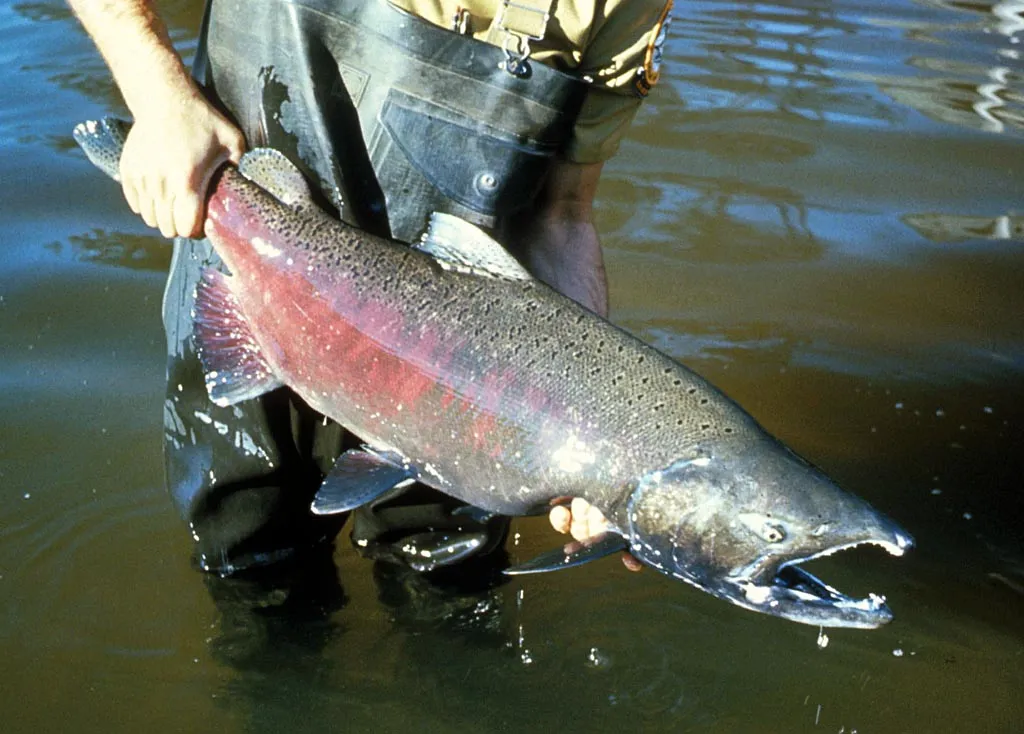

Rainbow trout
Oncorhynchus mykiss — Salmonidae
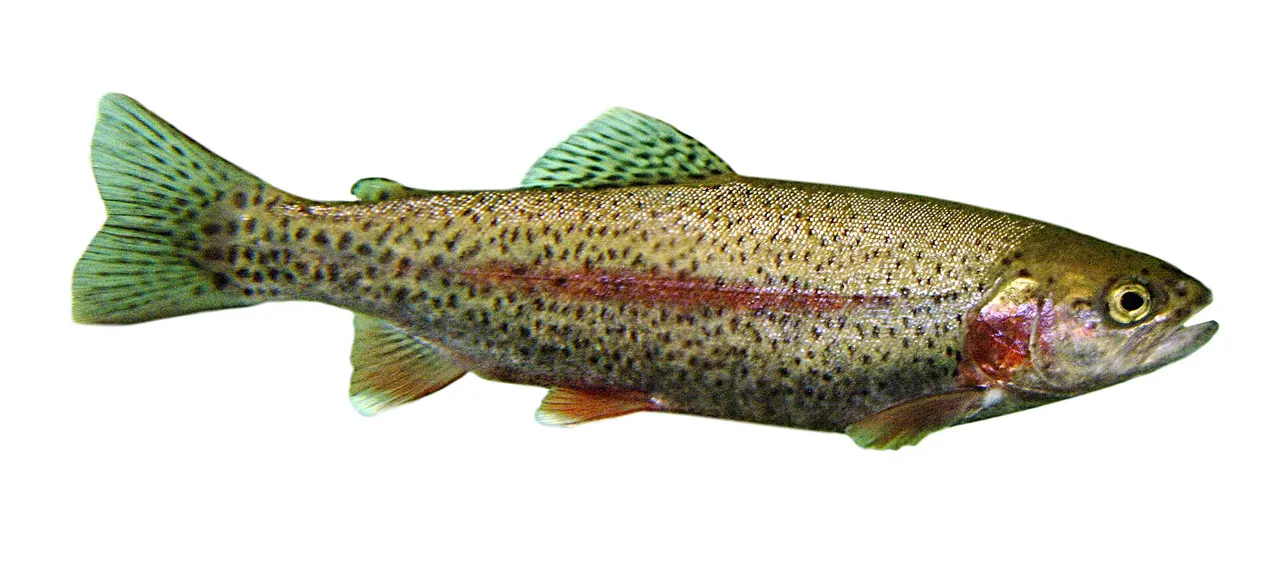

The differences
Each difference is marked with how far it can be trusted on its own. A single diagnostic character settles the identification; suggestive ones only narrow it.
| Character | Chinook salmon | Rainbow trout | Reliability |
|---|---|---|---|
| Colour of the gum line at the base of the lower teethIdentification | Black gums at the base of the lower jaw teeth. | Pale gums; no dark line at the tooth base. | Diagnostic on its own |
| Number of rays in the anal finIdentification | A long-based anal fin with a high ray count — the family character separating Pacific salmon from trout, and countable on a fish in hand. | A shorter-based anal fin with a distinctly lower ray count. | Diagnostic on its own |
| Mouth and jaw colour insideIdentification | Mouth dark overall, consistent with the black gum line. | Mouth pale, and the flank frequently retains at least a trace of the pink band even on bright fish. | Supporting — use with others |
| What happens after spawningSpawning | Dies after spawning, always. | May survive and spawn again; steelhead kelts return to sea and come back. | Supporting — use with others |
| Body depth and bulkSize | Deep and heavy through the body, and reaching weights no rainbow approaches. | More slender for its length; even a large steelhead is a different shape from a chinook of the same length. | Suggestive only — varies |
| Handling and release prospectsHandling | A large fish that must be supported horizontally and, if it is a spawning-run adult, is running on finite reserves. | Steelhead are widely released and survive it well; keeping the fish in the water and minimising air exposure is what decides whether they do. | Supporting — use with others |
Why it matters
On the Pacific coast and in the Great Lakes these two are regulated separately and frequently in opposite directions, with different seasons, different bag limits, different mark-selective rules for hatchery versus wild fish, and in places a complete prohibition on retaining wild steelhead while hatchery chinook may be kept. Several steelhead populations are listed under endangered species legislation. The identification is therefore the thing that decides whether a fish may legally be in your hands at all, and the anal-fin count is the character that works on a wet silver fish at the water's edge. What applies is a matter for the competent authority and changes in-season.
The full records
This page compares two species. Each of them has a complete record covering biology, behaviour, handling and the evidence behind all of it.
More about chinook salmon
Where it lives, how it is caught, and what else it is confused with.
Similar and related fish
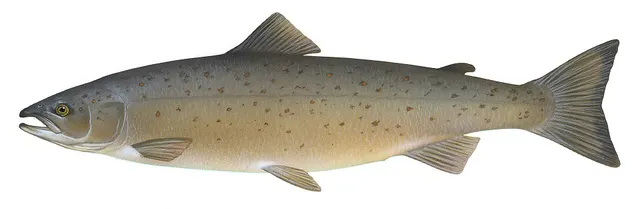 Atlantic salmonThe clearest illustration of what semelparity means: Atlantic salmon can spawn more than once and Pacific salmon cannot. Same family, one irreversible difference.
- Coho salmonCongeners that run the same rivers at overlapping times and are separated by the gums: chinook black, coho pale. The rules for them frequently differ, which is why the character is worth learning.
- Northern anchovyIn the California Current anchovy replaces sand lance as the dominant forage item, and the anchovy and sardine regime shift changes what chinook are eating for decades at a time.
- Pacific sand lanceSand lance are a principal prey of chinook in coastal waters, and chinook condition in the north-eastern Pacific tracks sand lance abundance closely.
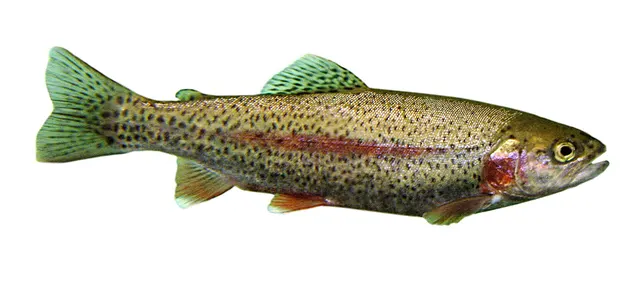 Rainbow troutCongeners in the genus Oncorhynchus. The difference that matters is that chinook is semelparous and dies after spawning while rainbow trout is not — the same genus, two entirely different life strategies.
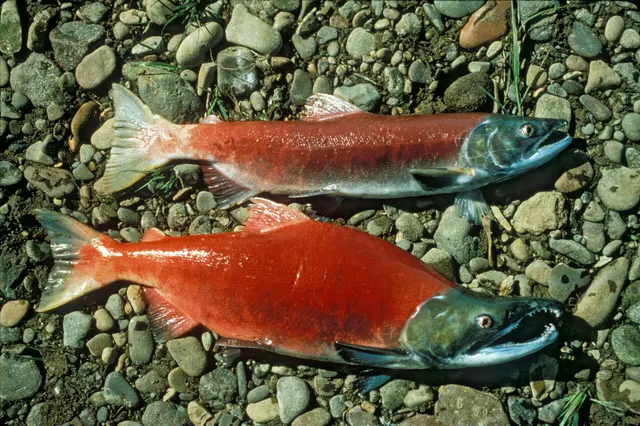 Sockeye salmonCongeners with completely different diets: chinook eats fish, sockeye filters plankton with long fine gill rakers. That is why sockeye barely take lures and chinook do.
How it is caught
Gear for this fish
Where it lives
Why the 9 connections on this page are here, and the sources
Similar and related fish
Backed by research — 6 connections
Supported by peer-reviewed research or fisheries science. The sources are listed and can be checked.
Atlantic salmon
A life-history comparison naming both binomials, and one that corrects a common assumption that all salmon die after spawning.
- FishBase: a global information system on fishes — Froese, R. and D. Pauly, eds. — FishBase Consortium (Scientific institute)Relied on for: That Oncorhynchus tshawytscha is an anadromous Salmonidae of the North Pacific, distinct from Salmo salar of the North Atlantic.States this directlyPassage read and verified
- NASCO conservation and management of North Atlantic salmon — North Atlantic Salmon Conservation Organization (Government fisheries body)Relied on for: The anadromous life history of Atlantic salmon, including repeat spawning, and its management as distinct river populations.States this directlyCitation checked — the work exists and is described correctly
Coho salmon
A taxonomic and identification comparison naming both binomials, with a practical consequence.
- FishBase: a global information system on fishes — Froese, R. and D. Pauly, eds. — FishBase Consortium (Scientific institute)Relied on for: That Oncorhynchus tshawytscha and Oncorhynchus kisutch are congeners in the genus Oncorhynchus occupying overlapping North Pacific ranges.States this directlyPassage read and verified
Northern anchovy
Recorded diet evidence identifies Engraulis mordax as a food item of this predator at species level. The edge is written at that granularity and no further.
- FishBase: a global information system on fishes — Froese, R. and D. Pauly, eds. — FishBase Consortium (Scientific institute)Relied on for: Food items recorded for this predator, including Engraulis mordax.States this directlyPassage read and verified
- FAO Species Identification Guides for Fishery Purposes and the FAO Species Catalogues — Food and Agriculture Organization of the United Nations (Scientific institute)Relied on for: Species account describing the diet of this predator in the region where Engraulis mordax occurs.Background and mechanism onlyCitation checked — the work exists and is described correctly
Pacific sand lance
Recorded diet evidence identifies Ammodytes personatus as a food item of this predator at species level. The edge is written at that granularity and no further.
- FishBase: a global information system on fishes — Froese, R. and D. Pauly, eds. — FishBase Consortium (Scientific institute)Relied on for: Food items recorded for this predator, including Ammodytes personatus.States this directlyPassage read and verified
- FAO Species Identification Guides for Fishery Purposes and the FAO Species Catalogues — Food and Agriculture Organization of the United Nations (Scientific institute)Relied on for: Species account describing the diet of this predator in the region where Ammodytes personatus occurs.Background and mechanism onlyCitation checked — the work exists and is described correctly
Rainbow trout
A taxonomic claim naming both binomials, with the life-history contrast being the useful content.
- FishBase: a global information system on fishes — Froese, R. and D. Pauly, eds. — FishBase Consortium (Scientific institute)Relied on for: That Oncorhynchus mykiss and Oncorhynchus tshawytscha are congeners in the genus Oncorhynchus, the Pacific salmon and trout.States this directlyPassage read and verified
Sockeye salmon
A comparison resting on documented feeding morphology and naming both binomials.
- FishBase: a global information system on fishes — Froese, R. and D. Pauly, eds. — FishBase Consortium (Scientific institute)Relied on for: That Oncorhynchus nerka and Oncorhynchus tshawytscha are congeners in the genus Oncorhynchus with differing feeding ecology.States this directlyPassage read and verified
How it is caught
What experienced anglers do — 1 connection
Widely and independently recommended by experienced anglers and specialist sources. This is real angling knowledge, not proof: controlled evidence for it is limited, and FishingHQ records it as convention rather than as a demonstrated effect.
Trolling
A practitioner claim about the principal marine method for the species.
- General angling website restatements of established technique — Various (Credible secondary source)Relied on for: Widely restated practitioner accounts of trolling and mooching for Pacific salmon in coastal waters.Citation checked — the work exists and is described correctly
- Sea Angler — Bauer Media (Specialist angling publication)Relied on for: Practitioner treatment of trolling technique for salmon and other pelagic species.Citation checked — the work exists and is described correctly
Gear for this fish
What experienced anglers do — 1 connection
Widely and independently recommended by experienced anglers and specialist sources. This is real angling knowledge, not proof: controlled evidence for it is limited, and FishingHQ records it as convention rather than as a demonstrated effect.
Spoons
A practitioner claim about which lure family answers this species' feeding or holding behaviour.
- General angling website restatements of established technique — Various (Credible secondary source)Relied on for: Widely restated North American lure practice for this species.Background and mechanism onlyCitation checked — the work exists and is described correctly
- IGFA International Angling Rules and World Record Requirements — International Game Fish Association (Angling or fisheries organisation)Relied on for: Recognition of the species as an established sport fish taken on artificial lures, and the tackle conventions used for it.States this directlyPassage read and verified
Where it lives
Backed by research — 1 connection
Supported by peer-reviewed research or fisheries science. The sources are listed and can be checked.
Spate rivers
A claim that the species uses rain-fed rivers on impermeable geology, resting on documented distribution and spawning habitat rather than on angling report.
- FishBase: a global information system on fishes — Froese, R. and D. Pauly, eds. — FishBase Consortium (Scientific institute)Relied on for: Recorded depth range, temperature tolerance and habitat association for the species outside north-west Europe.States this directlyPassage read and verified
- The IUCN Red List of Threatened Species — International Union for Conservation of Nature (Conservation authority)Relied on for: Global conservation assessment, range and recorded threats for the species.States this directlyCitation checked — the work exists and is described correctly
Reviewed 2026-08-13. FishingHQ does not state what any rule is or where any rule applies. Where this page says the two species are managed differently, that is a reason to check the authority for the water you are on — not a statement of what it requires.