Coho salmon
Fish · Last reviewed 2026-08-10
The acrobatic Pacific salmon — smaller than a chinook, far more willing to take a lure or fly, and the one most river anglers actually catch.
Safety: moving water and currents — can cause serious injury or death. 6 more points apply here.
Catching Coho salmon
Everything here on fishing for it. Each entry opens the page behind it.
- Ground
The coho is the Pacific salmon that behaves most like a sport fish. Where a chinook is large and dour and a sockeye barely takes a lure at all, a coho is aggressive, takes readily, and jumps repeatedly when hooked. That combination has made it the mainstay of a great deal of Pacific salmon angling despite being considerably smaller than a chinook.
It is separated from the chinook most reliably by the gums: coho have WHITE or pale gums at the base of the teeth where chinook are black. The tail spotting differs too — coho are spotted on the upper lobe only, chinook on both. Both characters are worth knowing because the two run in the same rivers at overlapping times and the rules for them frequently differ.
Its life history is more compressed than the chinook's: typically a year or more in fresh water as a juvenile, then eighteen months at sea, then return. Like all Pacific salmon it spawns once and dies. And like all of them, its runs have declined substantially across much of the southern part of the range, with populations protected in parts of the western United States.
Gear for this fish
- SpoonsCoho chase harder and shallower than chinook and respond to a faster, brighter spoon — the same category answering a different fish with a different retrieve speed.
- StreamersCoho in estuaries and lower rivers take a stripped streamer aggressively, which is the basis of a distinct and well-established fly fishery for them.
Identification
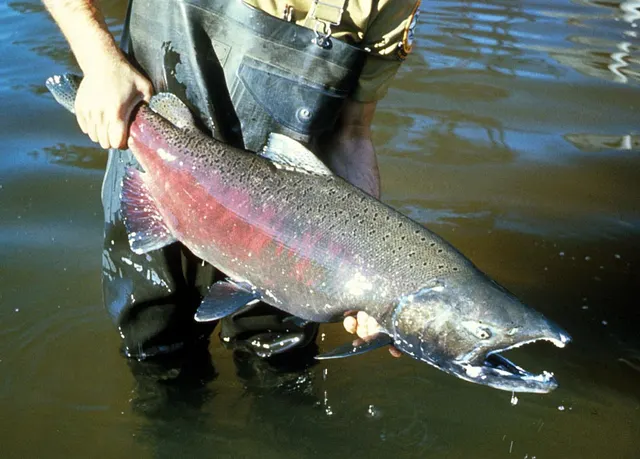
No photograph of Coho salmon has passed identity review yet, so none is shown. A photograph is published only once somebody has checked the animal in it against the diagnostic features described on this page.
- Scientific name
- Oncorhynchus kisutch
- Family
- Salmonidae
- Water
- Freshwater, Saltwater, Brackish, Moves between fresh and salt water
- Conservation status
- Least Concern
- Regions
- North America, Arctic & Subarctic, East Asia
- WHITE or pale gums at the base of the teeth — the reliable separation from chinook, which has black gums.
- Small black spots on the back and on the UPPER lobe of the tail only; chinook are spotted on both lobes.
- Sea-run fish bright silver with a metallic blue back; spawning fish develop deep red flanks and a green head, with males growing a pronounced hooked kype.
- Body more slender than a chinook of the same length.
- Adipose fin present; the anal fin has more rays than any trout's, the family character of Oncorhynchus.
Size
- Typical
- 2–4 kg (4–9 lb)
- Large
- 5–8 kg (11–18 lb)
Exceptional: Over 10 kg (22 lb); maximum published weight 15.2 kg
Small streams first, then the ocean: a fish that needs both
Coho salmon habitat is unusual among Pacific salmon because the freshwater phase is long and the habitat it requires is small.
JUVENILES SPEND A FULL YEAR OR MORE IN FRESH WATER, unlike pink or chum salmon which go to sea almost immediately. That extended rearing makes coho more dependent on freshwater habitat quality than any other Pacific salmon.
AND THE HABITAT THEY NEED IS SLOW, COMPLEX AND SMALL. Juvenile coho use pools, side channels, beaver ponds, off-channel wetlands and woody debris — low-velocity, structurally complex water rather than the fast riffles other salmonids favour. Winter refuge habitat of this kind is frequently the limiting factor on a whole population.
WHICH IS WHY CHANNELISATION HURTS THEM MOST. Straightening a stream, removing wood and disconnecting side channels removes exactly the habitat coho juveniles depend on, and coho declines in developed catchments track that loss closely.
SMALL COASTAL STREAMS SUPPORT THEM DISPROPORTIONATELY, and coho use tributaries too small for larger salmon.
ADULTS AT SEA OCCUPY COASTAL AND SHELF WATERS, generally closer inshore and for a shorter period than chinook, before returning.
AND ESTUARIES ARE A REAL TRANSITION HABITAT, used for physiological adjustment and feeding in both directions, and frequently the most degraded part of the whole path.
Backed by research — why, and the sources (2)
Supported by peer-reviewed research or fisheries science. The sources are listed and can be checked.
- NASCO conservation and management of North Atlantic salmon — North Atlantic Salmon Conservation Organization (Government fisheries body)Relied on for: Anadromous salmonid biology, run timing, spawning habitat requirements and the management principles applied to them.States this directlyCitation checked — the work exists and is described correctly
- FishBase: a global information system on fishes — Froese, R. and D. Pauly, eds. — FishBase Consortium (Scientific institute)Relied on for: Distribution, habitat association, depth range, size, reproduction and life-history parameters recorded for the species.States this directlyPassage read and verified
Autumn runs into small tributaries, and death after spawning
Coho spawning follows the Pacific salmon pattern — a single reproductive event followed by death — with a distinctive preference for small water.
ADULTS RETURN IN AUTUMN AND EARLY WINTER, entering rivers on rising flows after autumn rain, and they penetrate far into small tributaries that larger salmon cannot use.
THE FEMALE CUTS A REDD in clean gravel, generally in the tail of a pool or the head of a riffle where flow draws water down through the substrate. She defends it after spawning until she dies.
SPAWNING IS SEMELPAROUS. Adults die after spawning, and the carcasses deliver marine-derived nutrients into the stream — a genuinely important input to the productivity of the whole system, including the food supply of the next generation.
INCUBATION RUNS THROUGH WINTER, with emergence in spring, and fry then remain in fresh water for a year or more.
RAIN AND FLOW ARE THE PROXIMATE TRIGGER for river entry, so run timing shifts with the weather rather than with a date, and a dry autumn holds fish in the estuary.
JACKS ARE PART OF THE STRATEGY. A proportion of males return precociously after only a short time at sea, sneaking spawnings rather than competing directly, which is a genuine alternative reproductive tactic rather than an anomaly.
AND HATCHERY INFLUENCE IS PERVASIVE across much of the range, which complicates any statement about wild coho reproduction and is worth knowing before reading run statistics.
Backed by research — why, and the sources (2)
Supported by peer-reviewed research or fisheries science. The sources are listed and can be checked.
- NASCO conservation and management of North Atlantic salmon — North Atlantic Salmon Conservation Organization (Government fisheries body)Relied on for: Anadromous salmonid biology, run timing, spawning habitat requirements and the management principles applied to them.States this directlyCitation checked — the work exists and is described correctly
- FishBase: a global information system on fishes — Froese, R. and D. Pauly, eds. — FishBase Consortium (Scientific institute)Relied on for: Distribution, habitat association, depth range, size, reproduction and life-history parameters recorded for the species.States this directlyPassage read and verified
Bright fish, coloured fish, and why the same handling gives different outcomes
Coho pass through a physiological transformation between the sea and the gravel, and a fish's position along that path decides how much handling it can survive — which means the same technique produces different results on the same river in the same week.
A BRIGHT FISH, freshly in from salt water, is at its physiological peak: full energy reserves, intact scales, a working immune system, an unmodified body. It can absorb a fight and a release, and it has the reserves to complete everything that follows.
A COLOURED FISH, weeks into fresh water and into spawning condition, is a different animal. The body has been reabsorbing itself to fuel the migration and to build gonads. The skin thickens and the scales become embedded but the mucus layer and immune function decline, fungal infection becomes common, and the fish is running down a reserve that is visibly close to exhausted. It has less to spend on recovering from a fight and less capacity to resist an infection introduced by a hand that removed its mucus.
THE PRACTICAL CONSEQUENCE IS THAT HANDLING SHOULD GET MORE CONSERVATIVE AS THE SEASON GOES ON, which is the opposite of what usually happens — anglers get more casual as fish get more numerous and less valuable-looking.
What the fish needs is the same in both cases and matters more in the second: a short fight, wet hands or none at all, no lifting clear of the water, no contact with dry gravel or a dry bank, and a release facing into current until it holds itself. Coloured fish especially should be handled through the net or not at all.
AND THE FISH ON THE REDDS ARE OFF LIMITS, for the same reason as every other Pacific salmon: they are doing the only thing left that they exist to do, and in most places targeting them is a legal question answered locally rather than a judgement call.
Backed by research — why, and the sources (2)
Supported by peer-reviewed research or fisheries science. The sources are listed and can be checked.
- NASCO conservation and management of North Atlantic salmon — North Atlantic Salmon Conservation Organization (Government fisheries body)Relied on for: Conservation of anadromous salmonids and the handling and release practice adopted in their fisheries.States this directlyCitation checked — the work exists and is described correctly
- FishBase: a global information system on fishes — Froese, R. and D. Pauly, eds. — FishBase Consortium (Scientific institute)Relied on for: Life history of the Pacific salmons, including cessation of feeding on entry to fresh water and post-spawning mortality.States this directlyPassage read and verified
A late-autumn river fish, and a year in fresh water before it ever sees the sea
Coho seasonality is more consistent than chinook's and it is defined by two features: a late run, and an unusually long freshwater juvenile stage.
THE ADULT RUN IS LATE AND RAIN-DRIVEN. Coho typically return to fresh water in autumn and early winter, and entry is strongly cued by rainfall raising river levels — a dry autumn holds fish off the coast and a heavy rain event moves them in a rush. That makes coho river fishing far more responsive to weather than to date: the same week can be empty or full depending on what the sky did.
THEY SPAWN IN SMALL TRIBUTARIES, WHICH SHAPES EVERYTHING. Coho favour small streams and headwater tributaries rather than main stems, and that is a habitat preference with a seasonal consequence — those small waters are only accessible when flows are up, so the run timing and the rainfall are functionally the same variable.
THE JUVENILE STAGE IS THE LONG PART AND IT IS THE BOTTLENECK. Coho fry typically spend a full year or more in fresh water before smolting, holding in pools, side channels, off-channel ponds and beaver ponds. That means a coho population depends on year-round freshwater habitat quality — summer low flows, winter high flows, and refuge from both. Winter habitat in particular, where juveniles shelter from scouring flows, is a recognised limiting factor.
SO THE SEASONS THAT MATTER MOST ARE NOT THE ONES ANGLERS SEE. Summer drought and winter flood in a small tributary determine how many fish return two or three years later, and neither event involves an adult salmon.
AT SEA THEY ARE SHALLOWER AND MORE SURFACE-ORIENTED THAN CHINOOK, feeding aggressively on baitfish in coastal waters through the summer and putting on weight rapidly in the final months before returning. The late-summer coastal fishery is that feeding phase, and the fish are in prime condition then and deteriorate rapidly once they enter fresh water.
JACKS COMPLICATE THE PICTURE and are worth naming. A proportion of males return a year early at small size, which changes the size composition of a run and is a normal part of the life history rather than a defect.
AND FISHERIES FOR THEM ARE MANAGED IN-SEASON AND BY POPULATION. Wild and hatchery fish are frequently treated differently, and marking, retention and closure rules change year to year. The competent authority is the only source.
Backed by research — why, and the sources (2)
Supported by peer-reviewed research or fisheries science. The sources are listed and can be checked.
- NASCO conservation and management of North Atlantic salmon — North Atlantic Salmon Conservation Organization (Government fisheries body)Relied on for: Run timing, migratory behaviour and the environmental cues governing the return of anadromous salmonids to fresh water.Background and mechanism onlyCitation checked — the work exists and is described correctly
- FishBase: a global information system on fishes — Froese, R. and D. Pauly, eds. — FishBase Consortium (Scientific institute)Relied on for: Spawning season, migratory behaviour and life-history timing for the species.States this directlyPassage read and verified
Lifecycle and reproduction
Anadromous and semelparous. Juveniles typically spend a year or more rearing in small streams — which makes small-stream habitat unusually important for this species compared with others in the genus — before migrating to sea for around eighteen months and returning to spawn once and die. The heavy dependence on small tributary habitat is why coho have suffered so badly from the loss of side channels, wood and beaver ponds.
Redd-spawning in gravel in autumn and early winter, with both parents dying after spawning. Juveniles rear in slow, complex, woody habitat rather than in the main channel, and the availability of that habitat is frequently the factor limiting a population — a river with plenty of spawning gravel and no rearing habitat produces few adults.
Feeding and senses
At sea, an aggressive piscivore taking herring, sand lance and squid, growing rapidly in a short marine phase. In fresh water as returning adults they largely cease feeding, but retain a marked aggression that makes them far more willing to take lures and flies than most Pacific salmon — which is the practical reason this species dominates the river fishery.
Homing by olfaction to the natal stream, as in the rest of the genus. At sea and in estuaries, sight-driven feeding on fast-moving prey, which is consistent with the aggressive response to flashy lures and stripped flies that defines the fishery for them.
Through the year
Runs generally later than chinook in the same systems, entering fresh water in autumn and early winter with rising flows after rain. The timing is tied to freshets rather than to a date, so a dry autumn delays a run and a wet one brings it in — which is the single most useful thing to know about planning to fish for them.
Distribution
North Pacific: from Alaska south to central California on the North American coast, and along the Asian coast to Japan and the Kamchatka peninsula. Introduced to the Great Lakes and elsewhere, with established populations in several places outside the native range.
This is a biological range — where the species occurs, not a prediction that you will catch one. To browse the fishing geography FishingHQ holds, start at fishing places.
Why anglers care
The most willing of the Pacific salmon and consequently the backbone of the river sport fishery, taken on spinners, spoons, flies and bait. Also fished at sea by trolling. Its aggression and its habit of jumping repeatedly make it the species most anglers on that coast actually enjoy catching, whatever the chinook's size advantage.
Handling and returning
Handle in the water, support horizontally and minimise air time. Fish on spawning gravel should be left alone, and in many places may not be targeted. A returning coho has a fixed remaining lifespan and cannot recover condition, so a prolonged fight costs the fish more than it would a resident species.
Going further
- What does coho salmon eat? — feeding biology, kept separate from what anglers infer from it.
- Coho salmon vs Chinook salmon — how to tell them apart.
Safety
Moving water and currents — Can cause serious injury or death
River salmon fishing means wading cold, fast water in autumn and winter, frequently in remote country and in poor light, and rivers rise fast with rain in the catchment.
What reduces it: Wading staff and buoyancy aid, and do not wade alone in heavy water. Check the catchment forecast rather than the local one. Identify the exit before crossing.
Species that bite — Can cause injury needing treatment
In much of the native range, autumn salmon rivers concentrate bears at the same time and place as anglers.
What reduces it: Make noise, fish with others, carry deterrent where locally advised, and never approach a carcass or come between a bear and the water.
Precautions that always apply here
- Wear a buoyancy aid or lifejacket. Cold water incapacitates strong swimmers within a minute, long before swimming ability matters.
- Do not wade alone. Judge depth and flow from the bank first, and turn back sooner than feels necessary.
- Tell somebody where you are going and when you expect to be back.
- Carry a charged phone in a waterproof case, or another means of calling for help.
- Support the fish's weight along its body, keep it out of the water for as short a time as possible, and hold it over something soft.
Check the rules before you fish
Fishing laws, bylaws, access rules, seasons, bait restrictions and permitted methods vary by location and can change. Check the current rules from the relevant authority and the water you intend to fish before fishing.
Check with:
- Current national or regional law for where you are fishing
- Current local bylaws
- The relevant fisheries authority
- The landowner, club or fishery whose water it is
- Any restrictions specific to the species or the method you intend to use
Where to go next
Similar and related fish
 Chinook salmonCongeners that run the same rivers at overlapping times and are separated by the gums: chinook black, coho pale. The rules for them frequently differ, which is why the character is worth learning.
- Pacific sand lanceSand lance are heavily taken by coho in coastal waters, particularly during the marine growth phase before return.
Where it lives
Where you will find it
- AlaskaReturns late and rain-driven to small tributaries across the state, rearing in fresh water for a year or more before smolting.
- The Great LakesIntroduced alongside chinook for the same reasons, and supports both an open-water and a tributary fishery.
- The Pacific Northwest coastRuns the rivers of this coast and supports both a saltwater and a tributary fishery, taking a stripped fly aggressively in estuaries and lower rivers.
Sources and evidence
- FishBase: a global information system on fishes — Froese, R. and D. Pauly, eds. — FishBase Consortium (Scientific institute)Relied on for: Scientific name, family placement in the Salmonidae, a maximum length of 108 cm TL, a maximum published weight of 15.2 kg, a maximum reported age of 5 years.States this directlyPassage read and verified
- FishBase: a global information system on fishes — Froese, R. and D. Pauly, eds. — FishBase Consortium (Scientific institute)Relied on for: Environment, climate zone and depth range as recorded: Marine; freshwater; brackish; pelagic-neritic; anadromous ; depth range 0 - 250 m . Subtropical; 0°C - 25°C ; 72°N - 22°N, 135°E - 111°WStates this directlyPassage read and verified
- FishBase: a global information system on fishes — Froese, R. and D. Pauly, eds. — FishBase Consortium (Scientific institute)Relied on for: The IUCN Red List category for Oncorhynchus kisutch — Least Concern, assessed 27 July 2020 — as republished by FishBase, the Red List itself being unreachable during review.States this directlyPassage read and verified
- NASCO conservation and management of North Atlantic salmon — North Atlantic Salmon Conservation Organization (Government fisheries body)Relied on for: That anadromous salmon management operates at the level of individual river populations and that freshwater habitat quality is a central concern.FishingHQ's interpretation of what it saysCitation checked — the work exists and is described correctly
Why the 9 connections on this page are here, and the sources
Similar and related fish
Backed by research — 2 connections
Supported by peer-reviewed research or fisheries science. The sources are listed and can be checked.
Chinook salmon
A taxonomic and identification comparison naming both binomials, with a practical consequence.
- FishBase: a global information system on fishes — Froese, R. and D. Pauly, eds. — FishBase Consortium (Scientific institute)Relied on for: That Oncorhynchus tshawytscha and Oncorhynchus kisutch are congeners in the genus Oncorhynchus occupying overlapping North Pacific ranges.States this directlyPassage read and verified
Pacific sand lance
Recorded diet evidence identifies Ammodytes personatus as a food item of this predator at species level. The edge is written at that granularity and no further.
- FishBase: a global information system on fishes — Froese, R. and D. Pauly, eds. — FishBase Consortium (Scientific institute)Relied on for: Food items recorded for this predator, including Ammodytes personatus.States this directlyPassage read and verified
- FAO Species Identification Guides for Fishery Purposes and the FAO Species Catalogues — Food and Agriculture Organization of the United Nations (Scientific institute)Relied on for: Species account describing the diet of this predator in the region where Ammodytes personatus occurs.Background and mechanism onlyCitation checked — the work exists and is described correctly
How it is caught
What experienced anglers do — 1 connection
Widely and independently recommended by experienced anglers and specialist sources. This is real angling knowledge, not proof: controlled evidence for it is limited, and FishingHQ records it as convention rather than as a demonstrated effect.
Spinning
A practitioner claim about relative willingness, labelled as convention because no controlled comparison supports it.
- General angling website restatements of established technique — Various (Credible secondary source)Relied on for: Widely restated practitioner accounts of coho as the most aggressive Pacific salmon toward lures in fresh water.Citation checked — the work exists and is described correctly
- Trout & Salmon — Bauer Media (Specialist angling publication)Relied on for: Contemporary treatment of spinner and spoon technique for salmon.Citation checked — the work exists and is described correctly
Gear for this fish
What experienced anglers do — 2 connections
Widely and independently recommended by experienced anglers and specialist sources. This is real angling knowledge, not proof: controlled evidence for it is limited, and FishingHQ records it as convention rather than as a demonstrated effect.
Spoons
A practitioner claim about which lure family answers this species' feeding or holding behaviour.
- General angling website restatements of established technique — Various (Credible secondary source)Relied on for: Widely restated North American lure practice for this species.Background and mechanism onlyCitation checked — the work exists and is described correctly
- IGFA International Angling Rules and World Record Requirements — International Game Fish Association (Angling or fisheries organisation)Relied on for: Recognition of the species as an established sport fish taken on artificial lures, and the tackle conventions used for it.States this directlyPassage read and verified
Streamers
A practitioner claim about which lure family answers this species' feeding or holding behaviour.
- Trout & Salmon — Bauer Media (Specialist angling publication)Relied on for: Fly categories and their application to salmonids in running and still water.States this directlyCitation checked — the work exists and is described correctly
- Still Water Fly-Fishing — Andre Deutsch, 1952 (Specialist angling publication)Relied on for: Still-water fly categories, and the feeding observations they are chosen from.Background and mechanism onlyCitation checked — the work exists and is described correctly
Where it lives
Backed by research — 1 connection
Supported by peer-reviewed research or fisheries science. The sources are listed and can be checked.
Spate rivers
A claim that the species uses rain-fed rivers on impermeable geology, resting on documented distribution and spawning habitat rather than on angling report.
- FishBase: a global information system on fishes — Froese, R. and D. Pauly, eds. — FishBase Consortium (Scientific institute)Relied on for: Recorded depth range, temperature tolerance and habitat association for the species outside north-west Europe.States this directlyPassage read and verified
- The IUCN Red List of Threatened Species — International Union for Conservation of Nature (Conservation authority)Relied on for: Global conservation assessment, range and recorded threats for the species.States this directlyCitation checked — the work exists and is described correctly
Where you will find it
Backed by research — 3 connections
Supported by peer-reviewed research or fisheries science. The sources are listed and can be checked.
Alaska
A distribution association between an animal and a kind of water, rather than a claim about any named mark.
- FishBase: a global information system on fishes — Froese, R. and D. Pauly, eds. — FishBase Consortium (Scientific institute)Relied on for: Distribution, habitat association and depth range recorded for the species, including its occurrence in the water body concerned.States this directlyPassage read and verified
- The IUCN Red List of Threatened Species — International Union for Conservation of Nature (Conservation authority)Relied on for: Assessment and range account for the species, including the systems and coasts it occupies.Background and mechanism onlyCitation checked — the work exists and is described correctly
The Great Lakes
Occurrence of the species in this system or along this coast: a statement about the animal's distribution, not a venue recommendation.
- FishBase: a global information system on fishes — Froese, R. and D. Pauly, eds. — FishBase Consortium (Scientific institute)Relied on for: Distribution, salinity tolerance and habitat association recorded for the species, including its occurrence in this system.States this directlyPassage read and verified
- The IUCN Red List of Threatened Species — International Union for Conservation of Nature (Conservation authority)Relied on for: Assessment and range description for the species, including the waters in which it occurs.Background and mechanism onlyCitation checked — the work exists and is described correctly
The Pacific Northwest coast
Occurrence of the species in this system or along this coast: a statement about the animal's distribution, not a venue recommendation.
- FishBase: a global information system on fishes — Froese, R. and D. Pauly, eds. — FishBase Consortium (Scientific institute)Relied on for: Distribution, salinity tolerance and habitat association recorded for the species, including its occurrence in this system.States this directlyPassage read and verified
- The IUCN Red List of Threatened Species — International Union for Conservation of Nature (Conservation authority)Relied on for: Assessment and range description for the species, including the waters in which it occurs.Background and mechanism onlyCitation checked — the work exists and is described correctly
How FishingHQ labels evidence is explained in the evidence policy.