The Pacific Northwest coast
Fishing regions · Last reviewed 2026-08-13
Cold, productive, upwelling-fed water against a coast of rock, kelp and drowned inlets, with rivers that carry salmon inland. Three things FishingHQ already models — salmon runs, razor clam biotoxin closures and descending-device rockfish release — all belong here.
Safety: moving water and currents — can cause serious injury or death. 2 more points apply here.
Being listed here is not permission to fish. What that meansClose
Access, fishing rights, seasons, licences, local bylaws and permitted methods vary and can change. Check current access, permission, local regulations, closures and restrictions before you travel or fish. FishingHQ describes what the ground is and names who holds the answer; it does not hold the answer itself.
Find the authority for a jurisdiction · What FishingHQ does and does not cover
The Pacific Northwest is a coast-tier case because it is where several distinct pieces of intelligence FishingHQ already holds converge on one physical setting, and none of them makes full sense without it.
THE WATER IS COLD, PRODUCTIVE AND UPWELLING-DRIVEN. Northerly winds in the warmer months drive coastal upwelling, bringing cold nutrient-rich deep water to the surface and generating very high productivity along the shelf. That supports the forage base — herring, anchovy, sand lance, euphausiids — on which everything else depends, and it is why the coast holds the fisheries it does. The upwelling also brings low-oxygen and low-pH water onto the shelf, which is why this coast has become a focus for research on hypoxia and ocean acidification.
THE COASTLINE IS THREE DIFFERENT THINGS. There is exposed outer coast — rock headlands, sea stacks, long surf beaches, and heavy Pacific swell. There is an enormous system of sheltered inland waters, the Salish Sea, formed by glacial scouring and drowned by sea-level rise, with deep channels, strong tidal streams and complex bathymetry. And in British Columbia there are long, deep, glacially carved inlets running far inland. Each supports quite different fishing, and the sheltered inside waters are the reason so much small-boat and kayak fishing is possible on a coast whose outer edge is severe.
SALMON ARE THE ORGANISING SPECIES. Five Pacific salmon species plus steelhead run the rivers of this coast, and their life histories tie the ocean to the land in a literal way: fish feed at sea, return to natal rivers, spawn, and die, transferring marine-derived nutrients into freshwater and terrestrial systems. Bears, eagles and forests are measurably fed by them. The runs are also the axis around which the region's fisheries management, its treaty framework and much of its conservation politics turn.
AND THE RIVERS ARE WHERE THE PRESSURE IS. Damming, logging, road building, water abstraction, urbanisation and hatchery influence have all affected salmon runs, and many populations are listed as threatened or endangered. The management framework is correspondingly complex: federal, state or provincial, and tribal or First Nations authorities all hold jurisdiction over different aspects, and treaty fishing rights are legally distinct and long-established.
THE ROCKFISH ARE THE OTHER SIGNATURE FISHERY and they carry a specific problem. Rockfish of many species occupy rocky and reef ground at depth, are extremely long-lived — some species reach ages well over a century — and are mature late. Fish brought up from depth suffer severe barotrauma, and descending devices are the practical answer that makes release actually work.
AND THE RAZOR CLAM FISHERY is where shellfish biotoxin monitoring is most visible to the public: seasons on this coast are opened and closed on the basis of domoic acid testing rather than on a calendar.
What fishing here is like
Cold, productive, strongly tidal water against a coast that ranges from severely exposed outer shore to deeply sheltered inland sea. Salmon dominate the culture and the management. Bottom fishing for rockfish, lingcod and halibut over rocky ground is a major activity, as is Dungeness crab potting and razor clam digging. The sheltered inside waters support extensive small-boat and kayak fishing; the outer coast does not, and the difference between them is the most important thing a visitor can understand.
What dominates
Salmon fishing by trolling, mooching and casting in salt water, and by fly and drift fishing in the rivers. Bottom fishing and jigging for rockfish, lingcod and Pacific halibut over rock and reef. Recreational crab potting, principally for Dungeness crab, which is enormously popular. Razor clam digging on the surf beaches, which is a distinct and culturally significant activity. Kayak fishing in the sheltered inside waters. Spearfishing on the rocky coast, which is separately regulated and where rockfish conservation measures apply directly.
The water available
Exposed outer coast with rock headlands, sea stacks and long dissipative surf beaches; an extensive sheltered inland sea of deep glacially scoured channels, islands, sills and strong tidal streams; long deep glacial inlets; extensive bull kelp and giant kelp forest on rocky ground; eelgrass beds and mud flats in estuaries; and hundreds of salmon-bearing rivers from short coastal streams to major systems reaching far inland.
How the rules are structured
Among the most complex frameworks FishingHQ describes. In the United States, federal agencies manage listed species and offshore waters, state agencies manage recreational fishing, and treaty tribes hold co-management authority and separately administered fishing rights established by long-standing treaties and confirmed by litigation. In Canada, the federal fisheries department manages the fishery, with First Nations rights recognised in law and administered through separate arrangements. Salmon seasons are frequently set in-season on the basis of run forecasts and actual returns rather than fixed in advance. Rockfish measures include area closures, depth restrictions, retention rules and descending-device requirements in some jurisdictions. Razor clam seasons are opened and closed on the basis of biotoxin testing. Crab fisheries carry size, sex and gear rules. All of this changes frequently, and FishingHQ does not state what any current rule is.
Who to ask
- The state fish and wildlife agency — Washington, Oregon, California or Alaska — for recreational fishing in US state waters.
- Fisheries and Oceans Canada, for recreational fishing in British Columbia.
- NOAA Fisheries, for listed species, offshore waters and federal management in the United States.
- The relevant treaty tribe or First Nation natural resources authority, whose fisheries are separately administered and legally distinct.
- The state health department's shellfish programme, whose biotoxin testing determines whether razor clam and other shellfish harvest may take place at all.
- The Pacific Fishery Management Council, for federal fishery management planning on the US west coast.
Words you will meet
- Salish Sea
- The sheltered inland sea comprising Puget Sound, the Strait of Georgia and the Strait of Juan de Fuca, spanning the US–Canada border. Deep, glacially scoured, strongly tidal and the setting for a large share of the region's small-boat fishing.
- Mooching
- A regional salmon technique using a cut-plug herring on a sliding sinker, fished on a slow drift and allowed to spin naturally. Distinct from trolling and strongly associated with this coast.
- Descending device
- A weighted device that returns a barotrauma-affected fish to depth and releases it there, so that the expanded swim bladder recompresses and the fish can swim away. Required in some jurisdictions on this coast for released rockfish and central to making the release effective at all.
- Domoic acid
- A biotoxin produced by certain diatoms which accumulates in shellfish, causes amnesic shellfish poisoning, is not destroyed by cooking and cannot be detected by inspection. Razor clam seasons on this coast are opened and closed on the basis of testing for it.
- Bull kelp
- A large annual kelp forming dense surface canopies on rocky ground. It provides the structural habitat that much of the inshore rockfish, lingcod and juvenile salmon community depends on, and its extent has declined markedly in parts of the region.
Conditions and hazards
The outer coast and the inside waters present different hazards and both are underestimated. On the outer coast, Pacific ground swell is large, long-period and arrives independently of local wind; river bar crossings at the mouths of the Columbia and other rivers are among the most dangerous small-craft situations anywhere, because ebbing river flow against incoming swell produces steep breaking seas over a shallow bar. Sneaker waves on the surf beaches — a substantially larger wave arriving without warning — are a documented and recurring cause of death, and they are the specific hazard of razor clam digging, which is done facing away from the sea. Inside the sheltered waters the hazard is tidal: streams through the narrows and passes run hard enough to exceed a small craft's speed, and tide rips over sills produce standing waves and overfalls. Water temperature is low year-round throughout, so immersion is immediately serious everywhere, and cold water shock rather than swimming failure is the mechanism. Fog is common and removes both navigation and visibility to other vessels.
Why the seasons are set by testing rather than by dates
The Pacific Northwest is where the difference between a calendar season and a monitored season is most visible to ordinary fishers, and it is worth understanding as a general principle rather than as a local quirk.
RAZOR CLAM SEASONS ARE OPENED ON TEST RESULTS. Domoic acid is a neurotoxin produced by diatoms of the genus Pseudo-nitzschia, which bloom on this coast in some years and not others. Filter-feeding shellfish concentrate it, and razor clams in particular retain it for a long time after a bloom has passed. It causes amnesic shellfish poisoning, it is not destroyed by cooking or freezing, and it cannot be detected by looking at, smelling or tasting the clam. There is no way for a digger to assess it.
SO THE ONLY CONTROL IS TESTING, and the season is therefore a public health decision rather than a fisheries one. Beaches are sampled, results are published, and openings are announced — sometimes days in advance, sometimes for a single tide series, sometimes cancelled after a bloom. A calendar cannot express this because the bloom does not follow one.
SALMON SEASONS ARE SET IN-SEASON FOR A DIFFERENT REASON. Run sizes vary enormously between years, forecasts are uncertain, and many populations are listed under endangered species legislation, so fisheries are managed to avoid impacts on the weakest stock in a mixed run rather than to the abundance of the strongest. That means openings, closures, gear rules and retention rules can change during a season on the basis of actual returns.
AND ROCKFISH MEASURES REFLECT LONGEVITY. Several rockfish species live well over a century and mature late, so a population removed takes generations to rebuild. Depth restrictions, area closures and descending-device requirements exist because release from depth does not work without intervention.
THE TRANSFERABLE POINT IS THIS. On a coast where the binding constraints are a toxin bloom, a weak stock in a mixed run, and a fish that cannot get back down on its own, no fixed calendar could do the job — the rules have to respond to measurement. FishingHQ states none of them, because a rule that is set in-season is precisely the kind that must be read from the authority on the day. What generalises is knowing that this is the kind of coast where that is true.
Official guidance — why, and the sources (4)
Stated by a fisheries authority, scientific institute or recognised angling body. Authoritative, but summarising rather than demonstrating.
- Fish and Fishery Products Hazards and Controls Guidance — US Food and Drug Administration, Center for Food Safety and Applied Nutrition, 2022 (Standards body)Relied on for: That bivalve molluscs concentrate pathogens and algal biotoxins, that biotoxins survive cooking and cannot be detected by inspection, and that harvest area classification and biotoxin monitoring are the controls.States this directlyPassage read and verified
- Good Fish Guide — Marine Conservation Society (Conservation authority)Relied on for: Stock and method assessment for commercially and recreationally taken shellfish and the management measures applied.Background and mechanism onlyCitation checked — the work exists and is described correctly
- FishBase: a global information system on fishes — Froese, R. and D. Pauly, eds. — FishBase Consortium (Scientific institute)Relied on for: Distribution, habitat association and salinity tolerance of the species named as characteristic of these waters.States this directlyPassage read and verified
- The IUCN Red List of Threatened Species — International Union for Conservation of Nature (Conservation authority)Relied on for: Assessment and habitat account for the species named, including the threats operating in this system.Background and mechanism onlyCitation checked — the work exists and is described correctly
Salmon as a nutrient pump, and what a run actually moves
The Pacific salmon runs of this coast are the clearest large-scale example anywhere of a fishery that is also an ecosystem process, and the mechanism is worth setting out because it explains why the runs matter beyond the fish.
THE FISH GROW AT SEA AND DIE INLAND. A Pacific salmon accumulates essentially all of its body mass feeding in the North Pacific, returns to its natal river, spawns, and dies. Because the species are semelparous, the entire adult body is deposited in fresh water rather than returning to the ocean.
THAT IS A TRANSFER OF MARINE NUTRIENTS UPHILL, AGAINST GRAVITY AND AGAINST THE FLOW OF EVERY RIVER. Nitrogen, phosphorus and carbon that entered the food web in the open ocean end up in a mountain stream. The quantity is substantial: historically, salmon runs moved an enormous mass of marine-derived material inland every year.
AND THE ECOSYSTEM IS BUILT ON IT. Bears and eagles take salmon from streams and carry carcasses into the forest, where decomposition releases those nutrients into soil. Marine-derived nitrogen is measurable in the wood of streamside trees. Stream invertebrates and juvenile fish — including next year's salmon — feed on carcasses and eggs. The productivity of the forest and the river is partly a function of how many fish came back.
WHICH MEANS A LOST RUN IS NOT ONLY A LOST FISHERY. It is the removal of a nutrient subsidy from an entire catchment, and the effects show up in trees, birds, bears and in the productivity available to the next generation of salmon — a feedback that makes recovery harder than the arithmetic of adult numbers suggests.
THE MANAGEMENT CONSEQUENCE follows directly and explains the framework's complexity. Salmon connect the open ocean, the coast, the estuary, the river and the forest, and they cross the jurisdictions of federal, state or provincial, tribal and First Nations authorities on the way. No single body controls the whole life cycle, and the treaty rights held by Indigenous nations on this coast are long-established, legally distinct and central rather than peripheral to how the fishery is governed.
For an angler the practical upshot is that salmon rules here are more complex, more dynamic and more legally layered than almost anywhere else FishingHQ describes, and reading them from the relevant authority is not optional.
Backed by research — why, and the sources (2)
Supported by peer-reviewed research or fisheries science. The sources are listed and can be checked.
- FishBase: a global information system on fishes — Froese, R. and D. Pauly, eds. — FishBase Consortium (Scientific institute)Relied on for: Distribution, habitat association and salinity tolerance of the species named as characteristic of these waters.States this directlyPassage read and verified
- The IUCN Red List of Threatened Species — International Union for Conservation of Nature (Conservation authority)Relied on for: Assessment and habitat account for the species named, including the threats operating in this system.Background and mechanism onlyCitation checked — the work exists and is described correctly
Outer coast, inside sea and glacial inlet: three coastlines pretending to be one
The single most useful thing to understand about this coast is that it is three quite different physical environments, and confusing them is how visitors get into trouble.
THE OUTER COAST IS SEVERE. Rock headlands, sea stacks, long dissipative surf beaches and heavy Pacific ground swell arriving from storms thousands of miles away. The swell is large, long-period and independent of local wind — a calm, sunny, windless day on this coast can have six-foot breaking surf on the beach and a bar that is not crossable. Small-boat operation here is a serious undertaking and beach access requires reading the swell rather than the sky.
THE INSIDE WATERS ARE A DIFFERENT SEA ENTIRELY. The Salish Sea — Puget Sound, the Strait of Georgia and the Strait of Juan de Fuca — is a glacially scoured, drowned system of deep channels, islands, sills and passes, sheltered from Pacific swell and strongly tidal. This is where the small-boat and kayak fishing happens, and it is possible precisely because the outer coast is taking the swell.
THE GLACIAL INLETS OF BRITISH COLUMBIA are a third form: long, deep, steep-sided fjords running far inland, with fresh water at the head and salt at the mouth, and a character closer to a Norwegian fjord than to anything else on the coast.
WITHIN ALL THREE, KELP IS THE STRUCTURAL HABITAT. Bull kelp and giant kelp form dense forest over rocky ground, and it is the structure that holds rockfish, lingcod and juvenile salmon. Bull kelp is annual, so the forest appears and disappears through the year, which changes both the fishing and the navigation.
ESTUARIES, EELGRASS AND MUD FLATS occupy the river mouths and provide the nursery habitat for juvenile salmon, Dungeness crab and much else, and their condition is a limiting factor on several of the fisheries.
AND THE RIVERS ARE PART OF THE COAST RATHER THAN SEPARATE FROM IT. Hundreds of salmon-bearing systems, from short coastal streams to major rivers reaching hundreds of miles inland, and the fishing on the coast is unintelligible without them.
Backed by research — why, and the sources (2)
Supported by peer-reviewed research or fisheries science. The sources are listed and can be checked.
- NASCO conservation and management of North Atlantic salmon — North Atlantic Salmon Conservation Organization (Government fisheries body)Relied on for: Anadromous salmonid biology, run timing, freshwater habitat requirements and the management principles applied to them.Background and mechanism onlyCitation checked — the work exists and is described correctly
- FishBase: a global information system on fishes — Froese, R. and D. Pauly, eds. — FishBase Consortium (Scientific institute)Relied on for: Distribution, habitat association and life history of the species occurring on the coast.Background and mechanism onlyPassage read and verified
Five salmon and a steelhead, rockfish that live for a century, and the crab everybody wants
The Pacific Northwest's species list is dominated by one group and made interesting by three others, and each carries a distinct management consequence.
FIVE PACIFIC SALMON SPECIES PLUS STEELHEAD run the rivers of this coast, and they are not interchangeable. Chinook are the largest, deepest-holding and most variable in run timing; coho are late, rain-driven and small-tributary spawners; sockeye require a nursery lake and return on a hereditary schedule; pink and chum have their own patterns; steelhead are sea-run rainbow trout that, unlike the Pacific salmon, may survive to spawn again. The season, the method and the management differ for each, which is why 'salmon fishing' here always means a particular species in a particular system.
ROCKFISH ARE THE OTHER GREAT GROUP AND THEY ARE EXTRAORDINARILY LONG-LIVED. Many species reach ages measured in decades and some in more than a century, mature late, and are site-attached on rocky ground. That combination makes them exceptionally vulnerable to local depletion and exceptionally slow to recover, and it is why rockfish conservation areas, depth restrictions and descending-device requirements exist on this coast. A rockfish brought from depth cannot return unaided, and releasing one at the surface generally kills it.
LINGCOD AND PACIFIC HALIBUT complete the bottom fishery — both large, both associated with rock and hard ground, and both carrying their own management regimes.
DUNGENESS CRAB IS THE INVERTEBRATE HEADLINE and is the target of one of the largest recreational fisheries on the coast, with rules on size, sex and gear that are among the most consistently enforced anywhere.
RAZOR CLAMS ARE THE SURF-BEACH SPECIES and the one whose availability is decided by testing rather than by biology.
AND THE FORAGE BASE IS WHAT MAKES ALL OF IT POSSIBLE — herring, anchovy, sand lance and euphausiids supported by the upwelling. Herring spawn events on this coast are ecological occasions in their own right, and the state of the forage fish is the state of everything above them.
Backed by research — why, and the sources (2)
Supported by peer-reviewed research or fisheries science. The sources are listed and can be checked.
- Do we need species-specific guidelines for catch-and-release recreational angling? — Biodiversity and Conservation 14:1195–1209, 2005 (Scientific literature)Relied on for: Catch-and-release science including barotrauma, depth-related injury and the effect of recompression on survival.States this directlyCitation checked — the work exists and is described correctly
- The IUCN Red List of Threatened Species — International Union for Conservation of Nature (Conservation authority)Relied on for: Assessment and life-history accounts for long-lived rockfish species.Background and mechanism onlyCitation checked — the work exists and is described correctly
A coast where the season is set in-season, and where a closure is a health measure
Pacific Northwest seasonality is unusual because for two of its four main fisheries the timing is not predictable in advance at all, and that is a structural feature rather than an inconvenience.
THE SALMON YEAR IS A SEQUENCE OF RUNS RATHER THAN A SEASON. Different species and different populations enter fresh water at different times, and a single large river system may have fish arriving across most of the year. Spring chinook, summer runs, autumn coho and chum, and winter steelhead each have their own window, and each window belongs to a particular river. There is no coastwide salmon calendar and anybody offering one is describing a single system.
AND THE FISHERIES ARE FREQUENTLY SET IN-SEASON. Because seasons depend on actual returns rather than on forecasts alone, openings and closures on this coast are adjusted during the year on the basis of counts. A fishery that was open last week may not be this week, and the reverse. That is a genuinely different planning problem from a fixed statutory season, and it means checking current status is not optional diligence — it is the only way to know.
RAZOR CLAM SEASONS ARE DECIDED BY TESTING. Domoic acid, a biotoxin produced by certain diatoms, accumulates in shellfish, is not destroyed by cooking, and cannot be detected by looking, smelling or tasting. Beaches are opened and closed on the basis of laboratory testing, sometimes at short notice and sometimes for a whole season. This is a public-health measure operating on a completely different logic from a fisheries season, and treating a beach as open because it was open last year is the specific mistake this arrangement exists to prevent.
THE BIOLOGICAL SEASON UNDERNEATH IS TEMPERATURE AND UPWELLING. Upwelling in the warmer months drives the productivity that supports the forage base; bottom fishing is available year-round where weather allows; and crab condition varies through the moult cycle, with soft-shell crabs poor value at particular times.
WINTER IS DEFINED BY WEATHER RATHER THAN BY BIOLOGY on the outer coast, where Pacific storms make access the limiting factor for months at a time. The inside waters remain fishable throughout.
WHAT IS OPEN, WHERE AND WHEN IS ENTIRELY A MATTER FOR THE COMPETENT AUTHORITIES, and on this coast that means several of them at once. FishingHQ does not state what any current rule is.
Official guidance — why, and the sources (2)
Stated by a fisheries authority, scientific institute or recognised angling body. Authoritative, but summarising rather than demonstrating.
- Fish and Fishery Products Hazards and Controls Guidance — US Food and Drug Administration, Center for Food Safety and Applied Nutrition, 2022 (Standards body)Relied on for: Marine biotoxins in shellfish, including amnesic shellfish poisoning, the fact that cooking does not destroy the toxin, and the role of monitoring programmes.States this directlyPassage read and verified
- Good Fish Guide — Marine Conservation Society (Conservation authority)Relied on for: Stock and fishery assessment and the management measures attached to shellfish harvest.Background and mechanism onlyCitation checked — the work exists and is described correctly
Federal, state, provincial, tribal and a health department: five kinds of authority on one beach
The Pacific Northwest has the most complex regulatory shape FishingHQ describes, and the complexity is not bureaucratic accident — it reflects genuinely distinct legal authorities with genuinely distinct standing.
IN THE UNITED STATES, THREE LAYERS OPERATE AT ONCE. State fish and wildlife agencies manage recreational fishing in state waters. Federal agencies manage offshore waters and species listed under federal endangered species legislation, which on this coast includes salmon and steelhead populations. And the Pacific Fishery Management Council conducts federal fishery management planning for the west coast. A recreational angler may be subject to all three depending on where they are and what they are fishing for.
TREATY TRIBES HOLD CO-MANAGEMENT AUTHORITY AND THIS IS THE PART MOST VISITORS DO NOT EXPECT. Treaty tribes in this region hold fishing rights established by long-standing treaties and confirmed through litigation, and they are co-managers of the fishery rather than stakeholders in it. Tribal fisheries are separately administered under tribal authority and are legally distinct from state-regulated recreational fishing. Understanding that these are sovereign arrangements rather than an allocation within the state system is basic to understanding how this coast is governed.
IN CANADA, THE FEDERAL FISHERIES DEPARTMENT MANAGES THE FISHERY in British Columbia, with First Nations rights recognised in law and administered through separate arrangements — a different constitutional structure reaching a comparable result.
A HEALTH AUTHORITY DECIDES WHETHER SHELLFISH MAY BE TAKEN AT ALL. State health department shellfish programmes conduct the biotoxin testing that opens and closes razor clam and other shellfish harvest, and that decision is independent of the fisheries agency. A beach can be within an open fishing season and closed on health grounds.
WHICH MEANS FIVE DIFFERENT KINDS OF AUTHORITY CAN BEAR ON ONE PERSON STANDING ON ONE BEACH, and none of them is a subset of another.
EVERYTHING HERE CHANGES FREQUENTLY, including in-season. FishingHQ does not state what any current rule is, does not indicate whether any fishery is open, and does not imply any access or entitlement. The relevant state, provincial, federal, tribal and health authorities are the sources, and on this coast more than most, checking all of the ones that apply is the actual task.
Official guidance — why, and the sources (2)
Stated by a fisheries authority, scientific institute or recognised angling body. Authoritative, but summarising rather than demonstrating.
- NASCO conservation and management of North Atlantic salmon — North Atlantic Salmon Conservation Organization (Government fisheries body)Relied on for: Anadromous salmonid biology, run timing, freshwater habitat requirements and the management principles applied to them.Background and mechanism onlyCitation checked — the work exists and is described correctly
- FishBase: a global information system on fishes — Froese, R. and D. Pauly, eds. — FishBase Consortium (Scientific institute)Relied on for: Distribution, habitat association and life history of the species occurring on the coast.Background and mechanism onlyPassage read and verified
Mooching, the Salish Sea, descending devices and domoic acid: a vocabulary you need before you arrive
The Pacific Northwest's terminology carries a surprising amount of load, and several terms name things that either do not exist elsewhere or exist without a name.
MOOCHING is a salmon technique specific enough to this coast that it functions as a regional identifier. A cut-plug herring — a whole herring with the head removed at an angle — is fished on a sliding sinker and allowed to spin naturally on a slow drift. It is neither trolling nor still fishing, it requires a particular rod action and a particular patience, and it produces a distinctive slow take that has to be given time.
THE SALISH SEA is the modern name for the sheltered inland waters spanning the US–Canada border. Adopting a single name for a single body of water that two countries had previously named in pieces was a deliberate act, and it matters practically because the ecosystem behaves as one system while the regulation does not.
DESCENDING DEVICE names a piece of equipment that changed rockfish release entirely. It is a weighted device that carries a barotrauma-affected fish back to depth and releases it there, allowing the expanded swim bladder to recompress so the fish can swim away. Without one, a released rockfish floats and dies. In some jurisdictions on this coast carrying one is required.
DOMOIC ACID is the biotoxin that governs razor clam harvest. It is worth knowing the name because the whole opening-and-closing regime is built on testing for it, because cooking does not destroy it, and because no inspection of the clam reveals it.
BULL KELP names the large annual kelp that forms the surface canopy on rocky ground here. Annual is the operative word: the forest grows and dies back within a year, so a mark that was kelp-covered in September is open water in March.
A BAR CROSSING is the name for the specific and lethal situation where a river's ebbing flow meets incoming ocean swell over a shallow bar at a river mouth. The Columbia bar is the famous one. The term names a hazard rather than a place, and it is one of the most dangerous small-craft situations anywhere in the world.
AND A SNEAKER WAVE is the local name for a substantially larger wave arriving without warning on a surf beach — the documented, recurring cause of deaths among people facing away from the sea, which is exactly what razor clam digging requires.
What experienced anglers do — why, and the sources (2)
Widely and independently recommended by experienced anglers and specialist sources. This is real angling knowledge, not proof: controlled evidence for it is limited, and FishingHQ records it as convention rather than as a demonstrated effect.
- United States Lifesaving Association public education on rip currents and the surf zone — United States Lifesaving Association (Water-safety or diver-training authority)Relied on for: Surf zone hazards, wave behaviour and the mechanisms by which people are caught out on exposed beaches.States this directlyCitation checked — the work exists and is described correctly
- NOAA National Weather Service marine forecasts and marine weather services — National Oceanic and Atmospheric Administration, United States (Government fisheries body)Relied on for: Marine forecasting for US coastal waters, including swell, bar conditions and the interpretation of a forecast.States this directlyCitation checked — the work exists and is described correctly
Ten thousand years of salmon, a canning boom, and dams that are now coming out
The Pacific Northwest's fishing history runs longer and has swung further than almost anywhere else on FishingHQ, and the current management landscape is unintelligible without it.
INDIGENOUS SALMON FISHING HERE IS THOUSANDS OF YEARS OLD and it was not incidental. Salmon were the economic and cultural foundation of the peoples of this coast, taken with weirs, traps, dip nets and spears at known places on known runs, preserved by drying and smoking, traded far inland, and embedded in social and ceremonial life. Particular fishing places belonged to particular groups and were managed as property. This is one of the great fisheries of human history and it was operating continuously for millennia before any of the modern arrangements existed.
TREATIES IN THE NINETEENTH CENTURY RESERVED THOSE FISHING RIGHTS, and the subsequent history of their suppression, litigation and eventual judicial confirmation is the reason treaty tribes are co-managers of this fishery today. The regulatory framework's most distinctive feature is a direct product of this history.
THE CANNING BOOM TRANSFORMED THE FISHERY FROM THE 1860s ONWARD. Industrial canneries on the Columbia and elsewhere, fish wheels, traps and enormous gillnet fleets removed salmon on a scale that had no precedent, and the declines followed quickly. Much of the modern management apparatus was built in reaction to that period.
DAMS CHANGED THE RIVERS PERMANENTLY IN THE TWENTIETH CENTURY. Hydroelectric development on the Columbia, Snake and other systems blocked or degraded access to enormous areas of spawning habitat, altered flow and temperature regimes, and drove several populations to listing under endangered species legislation. Hatcheries were built partly to compensate, and the consequences of that decision are still being worked through.
AND DAM REMOVAL IS NOW PART OF THE STORY, which is genuinely unusual. Several significant removals on this coast have been completed, with rivers reopening to anadromous fish after a century, and the recolonisation observed afterwards has been fast enough to change assumptions about what recovery is possible. That is a rare case of a fishery's history running in reverse.
RAZOR CLAM DIGGING HAS ITS OWN LONG HISTORY as a coastal community activity and remains a mass-participation tradition, which is why its closure on health grounds is felt as more than an inconvenience.
What experienced anglers do — why, and the sources (2)
Widely and independently recommended by experienced anglers and specialist sources. This is real angling knowledge, not proof: controlled evidence for it is limited, and FishingHQ records it as convention rather than as a demonstrated effect.
- NASCO conservation and management of North Atlantic salmon — North Atlantic Salmon Conservation Organization (Government fisheries body)Relied on for: Anadromous salmonid biology, run timing, freshwater habitat requirements and the management principles applied to them.Background and mechanism onlyCitation checked — the work exists and is described correctly
- FishBase: a global information system on fishes — Froese, R. and D. Pauly, eds. — FishBase Consortium (Scientific institute)Relied on for: Distribution, habitat association and life history of the species occurring on the coast.Background and mechanism onlyPassage read and verified
A place where fishing is identity, and where conservation practice is unusually mainstream
The Pacific Northwest's fishing culture is distinctive in two ways that are worth stating: salmon are a regional identity rather than a species, and conservation practice here has been normalised to a degree that is unusual anywhere.
SALMON ARE THE CULTURAL CENTRE AND THE ATTACHMENT IS GENUINE. Runs are followed in the news, returns are discussed publicly, and the fish appear in art, ceremony, place names and civic identity across the region. For the indigenous peoples of this coast that relationship is thousands of years old and continues in ceremonial and treaty-based fisheries; for the settler communities it is more recent and still strongly held. A run failing is a regional event rather than an angling one.
CONSERVATION PRACTICE IS MAINSTREAM RATHER THAN MARGINAL. The descending device is the clearest example: a piece of equipment specifically for releasing fish successfully, adopted widely, required in places, and understood by ordinary anglers as part of the kit. Selective fisheries, mark-selective retention rules distinguishing hatchery from wild fish, and voluntary release of wild steelhead are all normal here in a way they are not in most fisheries.
CRABBING AND CLAMMING ARE FAMILY ACTIVITIES ON A LARGE SCALE, and that shapes the culture considerably. Dungeness crab potting from a dock and razor clam digging on a beach are things large numbers of people do with children, which produces a broad public familiarity with size limits, sex identification and closures that a purely rod-and-line culture does not.
THE OUTDOOR CULTURE IS SERIOUS ABOUT WEATHER AND EQUIPMENT because the coast requires it. Cold water year-round, big swell, fog and bar crossings produce a boating culture with a high baseline of competence and a strong safety norm, and the same is true of the kayak fishing community in the inside waters.
THERE IS ALSO A REAL AND CONTINUING TENSION IN THE POLITICS OF ALL THIS — between commercial, recreational and tribal fisheries, between hydropower and habitat, between hatchery and wild fish. Anybody spending time here will encounter it, and understanding that it is a genuine argument between people with legitimate positions is more useful than picking a side from outside.
AND THE PRACTICAL COURTESY IS TO ASSUME NOTHING ABOUT ACCESS. Land ownership, tribal jurisdiction and beach access all vary, and asking is the norm.
What experienced anglers do — why, and the sources (2)
Widely and independently recommended by experienced anglers and specialist sources. This is real angling knowledge, not proof: controlled evidence for it is limited, and FishingHQ records it as convention rather than as a demonstrated effect.
- NASCO conservation and management of North Atlantic salmon — North Atlantic Salmon Conservation Organization (Government fisheries body)Relied on for: Anadromous salmonid biology, run timing, freshwater habitat requirements and the management principles applied to them.Background and mechanism onlyCitation checked — the work exists and is described correctly
- FishBase: a global information system on fishes — Froese, R. and D. Pauly, eds. — FishBase Consortium (Scientific institute)Relied on for: Distribution, habitat association and life history of the species occurring on the coast.Background and mechanism onlyPassage read and verified
The bar, the sneaker wave, and a digger facing the wrong way
This coast has one of the clearest and most documented small-craft killers anywhere, one of the clearest shore killers, and a third hazard that quietly applies to both. They are worth separating.
A RIVER BAR IS A MACHINE FOR MAKING BREAKING WATER. At the mouth of a large river, the ebbing freshwater flow runs seaward over a shallow sand bar, and the ocean swell runs landward over the same ground. Opposing flows shorten and steepen the waves; shallow ground makes them break; and the result is a confined band of steep breaking sea across the only way in or out. The Columbia's bar is among the most dangerous small-craft situations anywhere and it is not the only one on this coast.
WHAT MAKES IT PARTICULARLY DANGEROUS IS THE TIMING RATHER THAN THE SEA. The bar is workable on a flood or at slack, and it is a different place on a big ebb with swell running. So the sequence that catches people is the ordinary one: out through a benign bar in the morning, back through a lethal one in the afternoon, having made no error at all except failing to plan the return against the tide rather than against the fishing. Bar conditions are forecast and reported; that report, not the look of the water from inside, is the document.
THE SHORE KILLER IS THE SNEAKER WAVE, AND ITS VICTIMS ARE FACING AWAY. A wave substantially larger than everything before it arrives on a flat beach with no warning, runs far further up than the preceding waves, and takes people standing on ground that has been dry all morning. The specific fatality pattern on this coast involves razor clam digging, and the reason is posture: a digger works bent over, looking down, facing the land. The sea is behind them and they are not watching it. The same applies to anybody sorting tackle, photographing a fish or walking a beach with a load.
SO THE INSTRUCTION IS BEHAVIOURAL RATHER THAN TECHNICAL. Never turn your back on the ocean on these beaches. Watch a beach before working it, note how far the largest waves reach, and stay above that. And treat large drift logs as machinery rather than furniture: a log a wave lifts weighs tonnes, moves without warning, and crushes people against it.
AND THE THIRD HAZARD IS UNDER ALL OF IT. The water here is cold year-round, including in summer, and including in the sheltered inside waters where the flat surface conceals the same temperature. Cold water shock — the involuntary gasp and loss of breathing control in the first minute — is the mechanism rather than swimming failure. In the inside waters that combines with tidal streams through the narrows and passes, which run hard enough to exceed a small craft's speed and produce standing water over the sills.
FOG IS THE FOURTH AND IT REMOVES THE ANSWERS: common here, taking away both navigation and visibility to other vessels, and lifting on no schedule. Check the current marine forecast and the bar report, wear the flotation rather than stowing it, and treat a decision not to cross as a normal outcome.
Official guidance — why, and the sources (3)
Stated by a fisheries authority, scientific institute or recognised angling body. Authoritative, but summarising rather than demonstrating.
- NOAA National Weather Service marine forecasts and marine weather services — National Oceanic and Atmospheric Administration, United States (Government fisheries body)Relied on for: Marine forecasting, warning products, sea state and swell information, and the coastal and offshore zones at which those forecasts are issued.States this directlyCitation checked — the work exists and is described correctly
- United States Lifesaving Association public education on rip currents and the surf zone — United States Lifesaving Association (Water-safety or diver-training authority)Relied on for: Surf-zone hazards including rip currents, sneaker waves and shore dump, how they are recognised, and the public guidance on escaping them.States this directlyCitation checked — the work exists and is described correctly
- RNLI water safety guidance: cold water shock and Float to Live — Royal National Lifeboat Institution (Water-safety or diver-training authority)Relied on for: Cold water shock and the immersion response, and water-safety guidance for shore anglers and small-craft users.States this directlyPassage read and verified
Some of what lives here
Fish recorded here that FishingHQ holds a reviewed photograph of. It is not a complete list of what The Pacific Northwest coast holds, and it is not a prediction that you will catch any of them — it is a way in to the ones we can show you.
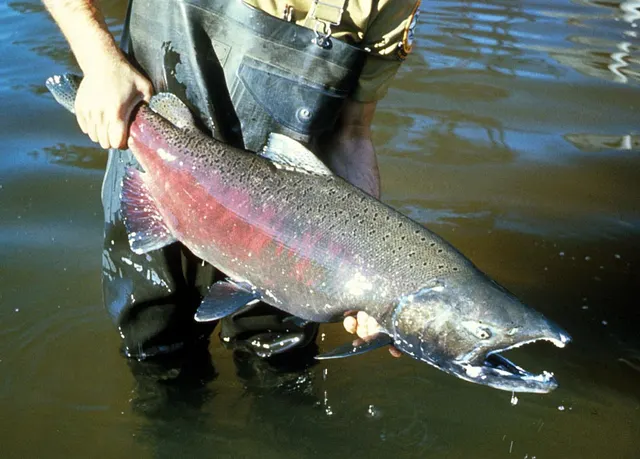 Chinook salmonThe largest Pacific salmon, reaching over sixty kilograms, and the one whose runs carry the most cultural and ecological weight on that coast.
U.S. Geological Survey — public domain, via Wikimedia Commons
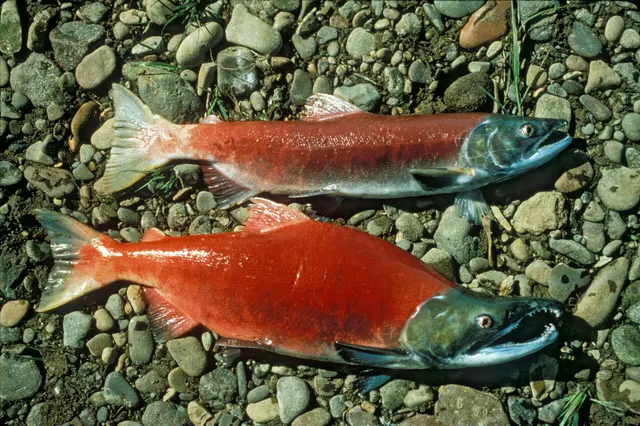 Sockeye salmonThe plankton-feeding Pacific salmon that turns brilliant scarlet to spawn, depends on lakes rather than just rivers, and barely takes a lure at all.
David Menke — Public domain, via Wikimedia Commons
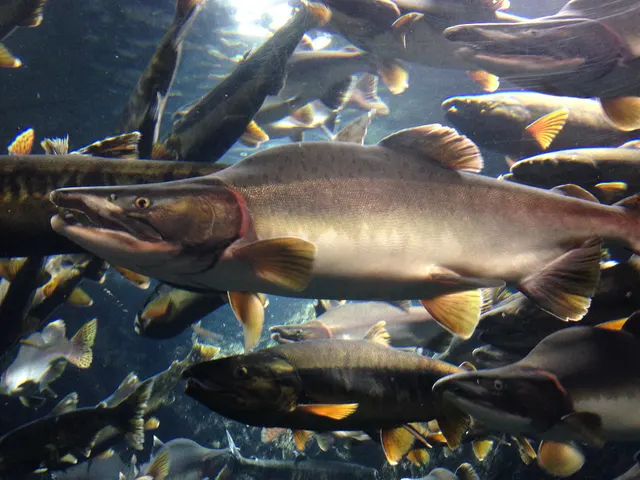 Pink salmonThe smallest and most abundant Pacific salmon, running on a strict two-year cycle, and the male developing a pronounced hump at spawning.
Totti — CC BY-SA 4.0, via Wikimedia Commons
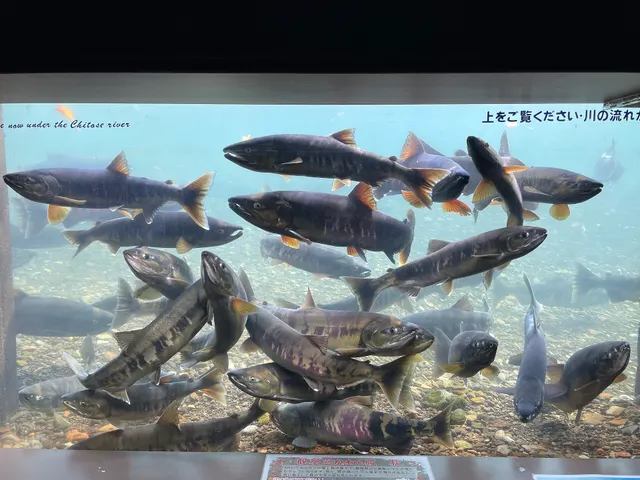 Chum salmonA large Pacific salmon without body spotting, developing striking purple calico bars and enlarged canine teeth at spawning, and the widest-ranging of its genus.
Totti — CC BY-SA 4.0, via Wikimedia Commons
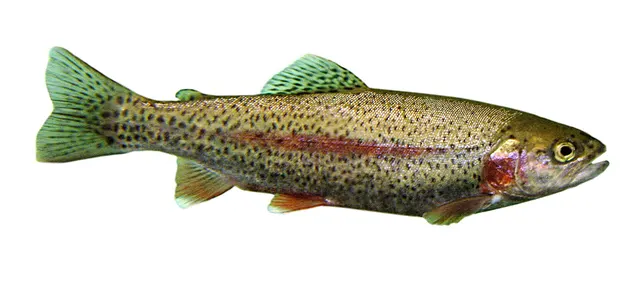 Rainbow troutThe most widely introduced sport fish on Earth — a Pacific salmonid now stocked on every continent except Antarctica, and the same species as the steelhead.
Jonathunder — CC BY-SA 3.0, via Wikimedia Commons
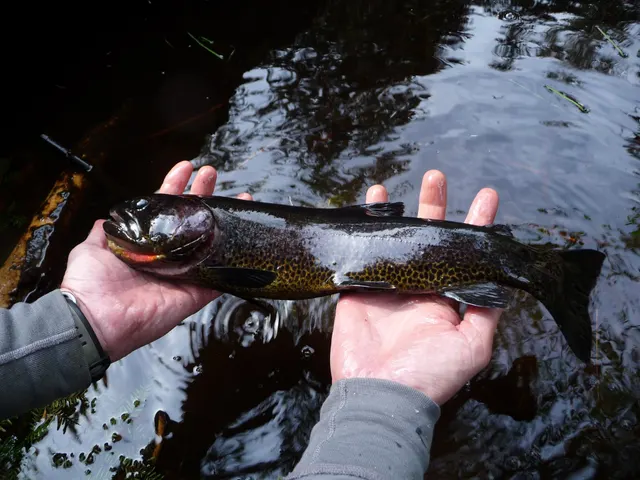 Cutthroat troutThe native trout of western North America, named for a red slash under the jaw, and a species fragmented into subspecies that hybridise readily with introduced rainbows.
Bruce Deagle — CC BY, via iNaturalist
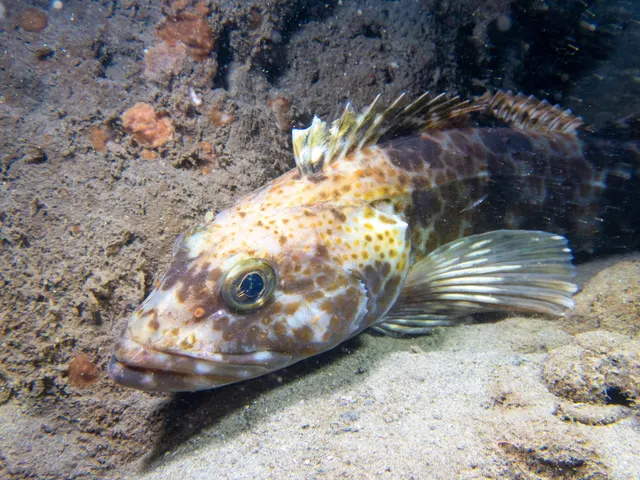 LingcodA large ambush predator of Pacific rocky reefs with an enormous toothed mouth, no relation to true cod, and a serious barotrauma problem on release.
Mike Carr — CC BY, via iNaturalist
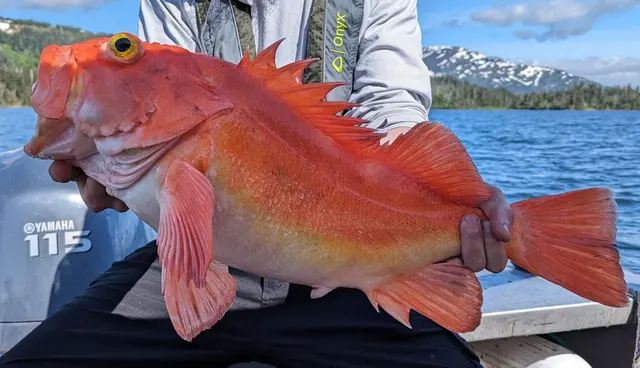 Yelloweye rockfishA brilliant orange-red deepwater rockfish that lives well over a century, matures very late, and is a rebuilding species under strict protection.
Alexandria 'Alex' Wenninger — CC BY, via iNaturalist
Safety
Moving water and currents — Can cause serious injury or death
River bar crossings at the mouths of the Columbia and other Pacific Northwest rivers produce steep breaking seas when ebbing river flow meets incoming ocean swell over shallow ground, and they are among the most dangerous small-craft situations anywhere. On the surf beaches, sneaker waves — a wave substantially larger than those preceding it — arrive without warning and are a recurring cause of death, particularly among razor clam diggers who are facing away from the sea.
What reduces it: Treat bar crossings as requiring local knowledge, current bar conditions and the right state of tide, and do not attempt them on the strength of a general forecast. On surf beaches, face the sea periodically, never turn your back on it for extended periods, keep well up the beach, and treat any long-period swell as a reason to stay clear of the water's edge.
Worse when:
- Ebb tide against incoming swell at a river mouth, which is when a bar is at its worst.
- Long-period Pacific ground swell arriving with no local wind.
- Low tide razor clam digging, which puts people far out on an open beach with their backs to the sea.
Cold water shock — Can cause serious injury or death
Water temperature on this coast is low year-round, including through summer, and immersion produces an involuntary gasp and hyperventilation that incapacitates competent swimmers within the first minute. This applies equally in the sheltered inside waters, where the calm surface conceals the same temperature.
What reduces it: Wear a lifejacket or buoyancy aid on any small craft, dress for the water rather than the air, and treat sheltered water as no warmer than exposed water because it is not.
Tides and being cut off — Can cause injury needing treatment
Tidal streams through the narrows, passes and sills of the inside waters run hard enough to exceed the speed of a small boat or kayak, and tide rips over sills produce standing waves and overfalls that are dangerous out of proportion to the weather.
What reduces it: Consult a tidal stream atlas rather than only a tide table, plan passages through narrows for slack water, and do not treat a passage made easily with the stream as evidence it can be made back against it.
Further safety reading
- Boat safety for anglers — River bar crossings where ebbing flow meets incoming Pacific swell over shallow ground are among the most dangerous small-craft situations anywhere, and they require local knowledge and the right state of tide rather than a general forecast.
- Cold water shock and immersion — Water temperature is low year-round including through summer, and it is no warmer in the sheltered inside waters than on the exposed coast.
- Tides and being cut off — Tidal streams through the narrows, passes and sills of the inside waters run hard enough to exceed the speed of a small boat or kayak, and tide rips over sills produce standing waves out of proportion to the weather.
Check the rules before you fish
Fishing laws, bylaws, access rules, seasons, bait restrictions and permitted methods vary by location and can change. Check the current rules from the relevant authority and the water you intend to fish before fishing.
Check with:
- Current national or regional law for where you are fishing
- Current local bylaws
- The relevant fisheries authority
- The landowner, club or fishery whose water it is
- Any restrictions specific to the species or the method you intend to use
Where to go next
What swims here
- Black rockfishOne of many long-lived rockfish species over rock and kelp ground here, and the group whose barotrauma on release is the reason descending devices are used and in places required.
- Chinook salmonThe largest of the Pacific salmon and the organising species of the region's saltwater and river fisheries, with many populations listed as threatened or endangered.
- Chum salmonRuns late in the season and supports both a fishery and, through its carcasses, a substantial nutrient transfer into the region's rivers and forests.
- Coho salmonRuns the rivers of this coast and supports both a saltwater and a tributary fishery, taking a stripped fly aggressively in estuaries and lower rivers.
- Cutthroat troutNative to the coastal rivers and present in both resident and sea-run forms, feeding in estuaries and nearshore water.
- LingcodOccupies high-current rocky ground and is the signature nearshore predator, with winter nest-guarding males particularly exposed to capture.
- Northern anchovyForms the other half of the small pelagic forage base generated by coastal upwelling on this coast.
- Pacific sand lanceA key forage species of the nearshore, burrowing in clean sand and supporting salmon, seabirds and marine mammals alike.
6 more
- Pacific sardine Fish
- Pink salmon Fish
- Rainbow trout Fish
- Razor clam Fish
- Sockeye salmon Fish
- Yelloweye rockfish Fish
How people fish here
- Fly fishingRiver fly fishing for steelhead and salmon is a defining tradition of this coast and one with its own techniques and considerable conservation sensitivity.
- Lure fishingTrolling, mooching and jigging for salmon in salt water dominate the region's saltwater effort, and mooching is a technique strongly associated with this coast specifically.
- Traps and potsRecreational Dungeness crab potting is enormously popular throughout the sheltered inside waters and is governed by size, sex and gear rules.
Local knowledge
How this compares
- CanadaThe Pacific Northwest coast page describes the physical system that continues north into British Columbia; the Canadian page describes the jurisdiction that governs it and the very different interior fishery beside it.
- North American saltwater fishingThe Pacific Northwest is the cold upwelling counterweight to the Gulf, on the same continent under the same federal system and with almost nothing else in common.
Environment and conservation
- Fish stocks and sustainabilitySalmon fisheries here are managed to protect the weakest stock in a mixed run rather than to the abundance of the strongest, and rockfish measures reflect species that live well over a century and mature late.
- Marine protected areas and spearfishingRockfish conservation areas and other spatial measures are used on this coast precisely because several of the species concerned are long-lived, site-attached and cannot be released successfully from depth without intervention.
Sources and evidence
- Cefas science, advice and data on marine and freshwater environments — Centre for Environment, Fisheries and Aquaculture Science (Government fisheries body)Relied on for: Marine and freshwater environmental science, including the physical characterisation of shelf seas and the monitoring programmes that describe them.States this directlyCitation checked — the work exists and is described correctly
- ICES Advice on fishing opportunities, catch and effort — International Council for the Exploration of the Sea (Scientific institute)Relied on for: Ecoregion description, stock distribution and the hydrography of the area assessed.States this directlyCitation checked — the work exists and is described correctly
- FishBase: a global information system on fishes — Froese, R. and D. Pauly, eds. — FishBase Consortium (Scientific institute)Relied on for: Distribution, habitat association and salinity tolerance of the species named as characteristic of these waters.States this directlyPassage read and verified
- The IUCN Red List of Threatened Species — International Union for Conservation of Nature (Conservation authority)Relied on for: Assessment and habitat account for the species named, including the threats operating in this system.Background and mechanism onlyCitation checked — the work exists and is described correctly
Why the 25 connections on this page are here, and the sources
What swims here
Backed by research — 14 connections
Supported by peer-reviewed research or fisheries science. The sources are listed and can be checked.
Black rockfish
Occurrence of the species in this system or along this coast: a statement about the animal's distribution, not a venue recommendation.
- FishBase: a global information system on fishes — Froese, R. and D. Pauly, eds. — FishBase Consortium (Scientific institute)Relied on for: Distribution, salinity tolerance and habitat association recorded for the species, including its occurrence in this system.States this directlyPassage read and verified
- The IUCN Red List of Threatened Species — International Union for Conservation of Nature (Conservation authority)Relied on for: Assessment and range description for the species, including the waters in which it occurs.Background and mechanism onlyCitation checked — the work exists and is described correctly
Chinook salmon
Occurrence of the species in this system or along this coast: a statement about the animal's distribution, not a venue recommendation.
- FishBase: a global information system on fishes — Froese, R. and D. Pauly, eds. — FishBase Consortium (Scientific institute)Relied on for: Distribution, salinity tolerance and habitat association recorded for the species, including its occurrence in this system.States this directlyPassage read and verified
- The IUCN Red List of Threatened Species — International Union for Conservation of Nature (Conservation authority)Relied on for: Assessment and range description for the species, including the waters in which it occurs.Background and mechanism onlyCitation checked — the work exists and is described correctly
Chum salmon
Occurrence of the species in this system or along this coast: a statement about the animal's distribution, not a venue recommendation.
- FishBase: a global information system on fishes — Froese, R. and D. Pauly, eds. — FishBase Consortium (Scientific institute)Relied on for: Distribution, salinity tolerance and habitat association recorded for the species, including its occurrence in this system.States this directlyPassage read and verified
- The IUCN Red List of Threatened Species — International Union for Conservation of Nature (Conservation authority)Relied on for: Assessment and range description for the species, including the waters in which it occurs.Background and mechanism onlyCitation checked — the work exists and is described correctly
Coho salmon
Occurrence of the species in this system or along this coast: a statement about the animal's distribution, not a venue recommendation.
- FishBase: a global information system on fishes — Froese, R. and D. Pauly, eds. — FishBase Consortium (Scientific institute)Relied on for: Distribution, salinity tolerance and habitat association recorded for the species, including its occurrence in this system.States this directlyPassage read and verified
- The IUCN Red List of Threatened Species — International Union for Conservation of Nature (Conservation authority)Relied on for: Assessment and range description for the species, including the waters in which it occurs.Background and mechanism onlyCitation checked — the work exists and is described correctly
Cutthroat trout
Occurrence of the species in this system or along this coast: a statement about the animal's distribution, not a venue recommendation.
- FishBase: a global information system on fishes — Froese, R. and D. Pauly, eds. — FishBase Consortium (Scientific institute)Relied on for: Distribution, salinity tolerance and habitat association recorded for the species, including its occurrence in this system.States this directlyPassage read and verified
- The IUCN Red List of Threatened Species — International Union for Conservation of Nature (Conservation authority)Relied on for: Assessment and range description for the species, including the waters in which it occurs.Background and mechanism onlyCitation checked — the work exists and is described correctly
Lingcod
Occurrence of the species in this system or along this coast: a statement about the animal's distribution, not a venue recommendation.
- FishBase: a global information system on fishes — Froese, R. and D. Pauly, eds. — FishBase Consortium (Scientific institute)Relied on for: Distribution, salinity tolerance and habitat association recorded for the species, including its occurrence in this system.States this directlyPassage read and verified
- The IUCN Red List of Threatened Species — International Union for Conservation of Nature (Conservation authority)Relied on for: Assessment and range description for the species, including the waters in which it occurs.Background and mechanism onlyCitation checked — the work exists and is described correctly
Northern anchovy
Occurrence of the species in this system or along this coast: a statement about the animal's distribution, not a venue recommendation.
- FishBase: a global information system on fishes — Froese, R. and D. Pauly, eds. — FishBase Consortium (Scientific institute)Relied on for: Distribution, salinity tolerance and habitat association recorded for the species, including its occurrence in this system.States this directlyPassage read and verified
- The IUCN Red List of Threatened Species — International Union for Conservation of Nature (Conservation authority)Relied on for: Assessment and range description for the species, including the waters in which it occurs.Background and mechanism onlyCitation checked — the work exists and is described correctly
Pacific sand lance
Occurrence of the species in this system or along this coast: a statement about the animal's distribution, not a venue recommendation.
- FishBase: a global information system on fishes — Froese, R. and D. Pauly, eds. — FishBase Consortium (Scientific institute)Relied on for: Distribution, salinity tolerance and habitat association recorded for the species, including its occurrence in this system.States this directlyPassage read and verified
- The IUCN Red List of Threatened Species — International Union for Conservation of Nature (Conservation authority)Relied on for: Assessment and range description for the species, including the waters in which it occurs.Background and mechanism onlyCitation checked — the work exists and is described correctly
Pacific sardine
Occurrence of the species in this system or along this coast: a statement about the animal's distribution, not a venue recommendation.
- FishBase: a global information system on fishes — Froese, R. and D. Pauly, eds. — FishBase Consortium (Scientific institute)Relied on for: Distribution, salinity tolerance and habitat association recorded for the species, including its occurrence in this system.States this directlyPassage read and verified
- The IUCN Red List of Threatened Species — International Union for Conservation of Nature (Conservation authority)Relied on for: Assessment and range description for the species, including the waters in which it occurs.Background and mechanism onlyCitation checked — the work exists and is described correctly
Pink salmon
Occurrence of the species in this system or along this coast: a statement about the animal's distribution, not a venue recommendation.
- FishBase: a global information system on fishes — Froese, R. and D. Pauly, eds. — FishBase Consortium (Scientific institute)Relied on for: Distribution, salinity tolerance and habitat association recorded for the species, including its occurrence in this system.States this directlyPassage read and verified
- The IUCN Red List of Threatened Species — International Union for Conservation of Nature (Conservation authority)Relied on for: Assessment and range description for the species, including the waters in which it occurs.Background and mechanism onlyCitation checked — the work exists and is described correctly
Rainbow trout
Occurrence of the species in this system or along this coast: a statement about the animal's distribution, not a venue recommendation.
- FishBase: a global information system on fishes — Froese, R. and D. Pauly, eds. — FishBase Consortium (Scientific institute)Relied on for: Distribution, salinity tolerance and habitat association recorded for the species, including its occurrence in this system.States this directlyPassage read and verified
- The IUCN Red List of Threatened Species — International Union for Conservation of Nature (Conservation authority)Relied on for: Assessment and range description for the species, including the waters in which it occurs.Background and mechanism onlyCitation checked — the work exists and is described correctly
Razor clam
Occurrence of the species in this system or along this coast: a statement about the animal's distribution, not a venue recommendation.
- FishBase: a global information system on fishes — Froese, R. and D. Pauly, eds. — FishBase Consortium (Scientific institute)Relied on for: Distribution, salinity tolerance and habitat association recorded for the species, including its occurrence in this system.States this directlyPassage read and verified
- The IUCN Red List of Threatened Species — International Union for Conservation of Nature (Conservation authority)Relied on for: Assessment and range description for the species, including the waters in which it occurs.Background and mechanism onlyCitation checked — the work exists and is described correctly
Sockeye salmon
Occurrence of the species in this system or along this coast: a statement about the animal's distribution, not a venue recommendation.
- FishBase: a global information system on fishes — Froese, R. and D. Pauly, eds. — FishBase Consortium (Scientific institute)Relied on for: Distribution, salinity tolerance and habitat association recorded for the species, including its occurrence in this system.States this directlyPassage read and verified
- The IUCN Red List of Threatened Species — International Union for Conservation of Nature (Conservation authority)Relied on for: Assessment and range description for the species, including the waters in which it occurs.Background and mechanism onlyCitation checked — the work exists and is described correctly
Yelloweye rockfish
Occurrence of the species in this system or along this coast: a statement about the animal's distribution, not a venue recommendation.
- FishBase: a global information system on fishes — Froese, R. and D. Pauly, eds. — FishBase Consortium (Scientific institute)Relied on for: Distribution, salinity tolerance and habitat association recorded for the species, including its occurrence in this system.States this directlyPassage read and verified
- The IUCN Red List of Threatened Species — International Union for Conservation of Nature (Conservation authority)Relied on for: Assessment and range description for the species, including the waters in which it occurs.Background and mechanism onlyCitation checked — the work exists and is described correctly
How people fish here
What experienced anglers do — 3 connections
Widely and independently recommended by experienced anglers and specialist sources. This is real angling knowledge, not proof: controlled evidence for it is limited, and FishingHQ records it as convention rather than as a demonstrated effect.
Fly fishing
The discipline that dominates fishing in this place, recorded as established practice rather than as a ranking.
- General angling website restatements of established technique — Various (Credible secondary source)Relied on for: Widely restated practice associating this discipline with this coast or system, recorded as practitioner consensus rather than as tested fact.Background and mechanism onlyCitation checked — the work exists and is described correctly
- Fishers' Craft and Lettered Art: Tracts on Fishing from the End of the Middle Ages — University of Toronto Press, 1997 (Scientific literature)Relied on for: That fishing traditions develop around the water and fish available to them, and the historical method of reading such traditions.States this directlyCitation checked — the work exists and is described correctly
Lure fishing
The discipline that dominates fishing in this place, recorded as established practice rather than as a ranking.
- General angling website restatements of established technique — Various (Credible secondary source)Relied on for: Widely restated practice associating this discipline with this coast or system, recorded as practitioner consensus rather than as tested fact.Background and mechanism onlyCitation checked — the work exists and is described correctly
- Fishers' Craft and Lettered Art: Tracts on Fishing from the End of the Middle Ages — University of Toronto Press, 1997 (Scientific literature)Relied on for: That fishing traditions develop around the water and fish available to them, and the historical method of reading such traditions.States this directlyCitation checked — the work exists and is described correctly
Traps and pots
The discipline that dominates fishing in this place, recorded as established practice rather than as a ranking.
- General angling website restatements of established technique — Various (Credible secondary source)Relied on for: Widely restated practice associating this discipline with this coast or system, recorded as practitioner consensus rather than as tested fact.Background and mechanism onlyCitation checked — the work exists and is described correctly
- Fishers' Craft and Lettered Art: Tracts on Fishing from the End of the Middle Ages — University of Toronto Press, 1997 (Scientific literature)Relied on for: That fishing traditions develop around the water and fish available to them, and the historical method of reading such traditions.States this directlyCitation checked — the work exists and is described correctly
Local knowledge
Backed by research — 1 connection
Supported by peer-reviewed research or fisheries science. The sources are listed and can be checked.
Upwelling, and the coasts it makes
A place that describes a physical process in prose and cannot point at it is restating something FishingHQ should explain once. This is the link that turns the restatement into a reference.
- ICES Advice on fishing opportunities, catch and effort — International Council for the Exploration of the Sea (Scientific institute)Relied on for: Stock assessment and advice for north-east Atlantic stocks, including the environmental drivers of small pelagic productivity and recruitment.States this directlyCitation checked — the work exists and is described correctly
- Cefas science, advice and data on marine and freshwater environments — Centre for Environment, Fisheries and Aquaculture Science (Government fisheries body)Relied on for: Marine environmental science including coastal physical processes, productivity and the monitoring behind them.States this directlyCitation checked — the work exists and is described correctly
How this compares
What experienced anglers do — 2 connections
Widely and independently recommended by experienced anglers and specialist sources. This is real angling knowledge, not proof: controlled evidence for it is limited, and FishingHQ records it as convention rather than as a demonstrated effect.
Canada
Two places a reader would reasonably weigh against one another, joined where the comparison teaches something about both.
- General angling website restatements of established technique — Various (Credible secondary source)Relied on for: Widely restated practice associating this discipline with this place, recorded as practitioner consensus rather than as tested fact.Background and mechanism onlyCitation checked — the work exists and is described correctly
- Fishers' Craft and Lettered Art: Tracts on Fishing from the End of the Middle Ages — University of Toronto Press, 1997 (Scientific literature)Relied on for: That fishing traditions develop around the water and fish available to them, and the historical method of reading such traditions.States this directlyCitation checked — the work exists and is described correctly
North American saltwater fishing
A continental overview joined to a record it sits above, so that the synthesis and the detail are reachable from one another rather than duplicating each other.
- FAO fishing gear types and fishing technology information — Food and Agriculture Organization of the United Nations (Scientific institute)Relied on for: Classification and description of world fishing gears and the regions in which each is used.States this directlyCitation checked — the work exists and is described correctly
- General angling website restatements of established technique — Various (Credible secondary source)Relied on for: Widely restated descriptions of regional angling practice, recorded as consensus rather than as scholarship.Background and mechanism onlyCitation checked — the work exists and is described correctly
Safety reading
Official guidance — 3 connections
Stated by a fisheries authority, scientific institute or recognised angling body. Authoritative, but summarising rather than demonstrating.
Boat safety for anglers
A hazard characteristic of this place, connected to the safety topic that explains the mechanism.
- RNLI water safety guidance: cold water shock and Float to Live — Royal National Lifeboat Institution (Water-safety or diver-training authority)Relied on for: Cold water shock and the immersion response, tidal cut-off, shore angling hazards and small-craft guidance.States this directlyPassage read and verified
- RoSPA water safety information and UK accidental drowning statistics — Royal Society for the Prevention of Accidents (Water-safety or diver-training authority)Relied on for: Accidental drowning statistics and the circumstances in which recreational water users are most often killed.States this directlyPassage read and verified
Cold water shock and immersion
A hazard characteristic of this place, connected to the safety topic that explains the mechanism.
- RNLI water safety guidance: cold water shock and Float to Live — Royal National Lifeboat Institution (Water-safety or diver-training authority)Relied on for: Cold water shock and the immersion response, tidal cut-off, shore angling hazards and small-craft guidance.States this directlyPassage read and verified
- RoSPA water safety information and UK accidental drowning statistics — Royal Society for the Prevention of Accidents (Water-safety or diver-training authority)Relied on for: Accidental drowning statistics and the circumstances in which recreational water users are most often killed.States this directlyPassage read and verified
Tides and being cut off
A hazard characteristic of this place, connected to the safety topic that explains the mechanism.
- RNLI water safety guidance: cold water shock and Float to Live — Royal National Lifeboat Institution (Water-safety or diver-training authority)Relied on for: Cold water shock and the immersion response, tidal cut-off, shore angling hazards and small-craft guidance.States this directlyPassage read and verified
- RoSPA water safety information and UK accidental drowning statistics — Royal Society for the Prevention of Accidents (Water-safety or diver-training authority)Relied on for: Accidental drowning statistics and the circumstances in which recreational water users are most often killed.States this directlyPassage read and verified
Environment and conservation
Official guidance — 2 connections
Stated by a fisheries authority, scientific institute or recognised angling body. Authoritative, but summarising rather than demonstrating.
Fish stocks and sustainability
An environmental pressure operating in this system, recorded rather than adjudicated.
- ICES Advice on fishing opportunities, catch and effort — International Council for the Exploration of the Sea (Scientific institute)Relied on for: Stock status, environmental pressures and the scientific basis for advice in the sea area concerned.States this directlyCitation checked — the work exists and is described correctly
- Good Fish Guide — Marine Conservation Society (Conservation authority)Relied on for: Stock and method assessment and the conservation measures applied to the fisheries.Background and mechanism onlyCitation checked — the work exists and is described correctly
Marine protected areas and spearfishing
An environmental pressure operating in this system, recorded rather than adjudicated.
- ICES Advice on fishing opportunities, catch and effort — International Council for the Exploration of the Sea (Scientific institute)Relied on for: Stock status, environmental pressures and the scientific basis for advice in the sea area concerned.States this directlyCitation checked — the work exists and is described correctly
- Good Fish Guide — Marine Conservation Society (Conservation authority)Relied on for: Stock and method assessment and the conservation measures applied to the fisheries.Background and mechanism onlyCitation checked — the work exists and is described correctly
How FishingHQ labels evidence is explained in the evidence policy.