North American saltwater fishing
Fishing regions · Last reviewed 2026-08-14
Three ocean coasts and a gulf, spanning subarctic to subtropical within one jurisdiction — and a regulatory system in which the federal government, the state and the fishery council can all be answering the same question differently.
Safety: weather and lightning — can cause serious injury or death. One more point applies here.
Being listed here is not permission to fish. What that meansClose
Access, fishing rights, seasons, licences, local bylaws and permitted methods vary and can change. Check current access, permission, local regulations, closures and restrictions before you travel or fish. FishingHQ describes what the ground is and names who holds the answer; it does not hold the answer itself.
Find the authority for a jurisdiction · What FishingHQ does and does not cover
North America's saltwater fishing is best understood as four distinct coasts that share a continent and very little else.
THE NORTH-WEST ATLANTIC runs from the subarctic Canadian maritime provinces down through New England to the Carolinas. Cold, productive, historically one of the great commercial fishing grounds on earth, and the setting for the collapse of the northern cod — the most consequential single fisheries failure of the twentieth century and a permanent argument for precaution. The recreational fishery here is striped bass, bluefish, cod, haddock, flounder and tuna, with a strong shore and small-boat tradition.
THE SOUTH-EAST AND THE GULF are subtropical and structurally different: shallow, warm, turbid in places, with vast estuarine and marsh systems, seagrass flats and mangrove. Red drum, spotted seatrout, snook, tarpon, snapper and grouper. This is the home of flats fishing and of a very large inshore recreational fishery.
THE NORTH-EAST PACIFIC runs from California through the Pacific Northwest to Alaska: cold, upwelling-driven, enormously productive, with salmon as the organising fish, plus halibut, lingcod, rockfish and albacore.
AND THE ARCTIC COASTS are a fourth case, with subsistence fisheries and very short seasons.
WHAT UNITES THEM ADMINISTRATIVELY IS COMPLEXITY. State waters extend a short distance offshore and federal waters beyond; the two can have different rules for the same species on the same day, and regional fishery management councils set measures that change within a season. A visitor should assume nothing carries over from one coast to another.
What fishing here is like
Four coasts with almost nothing in common except the administrative system that governs them. Cold productive Atlantic in the north-east, subtropical estuarine and reef systems in the south-east and Gulf, cold upwelling-driven Pacific in the west, and Arctic subsistence coasts in the far north.
The recreational culture is strongly boat- and charter-oriented, with a very large private small-boat fleet, though shore, pier and surf fishing traditions are substantial and accessible on every coast.
What dominates
Surf fishing on the Atlantic and Gulf beaches, a long-established shore discipline with its own heavy tackle tradition. Pier and jetty fishing, which is the most accessible saltwater fishing on the continent. Inshore lure and fly fishing for red drum, seatrout, snook and striped bass, and the flats fishing of Florida and the Gulf for bonefish, permit and tarpon. Bottom fishing and wreck fishing for snapper, grouper, cod and rockfish. Offshore trolling for tuna, marlin, dolphinfish and wahoo. Salmon trolling and river-mouth fishing on the Pacific coast. Halibut and rockfish fishing in Alaska and British Columbia. Crabbing, clamming and shellfish gathering, which is a substantial recreational activity on every coast.
The water available
Cold rocky and sandy coasts with strong tides in the north-east. Extensive barrier islands, sounds, marsh and estuarine systems on the mid-Atlantic and Gulf. Seagrass flats, mangrove and coral reef in the far south-east and Florida Keys. Upwelling-driven kelp, rock and sand coasts on the Pacific, with major river estuaries. Deep fjord and island systems in British Columbia and Alaska. Arctic coasts with short open-water seasons.
How the rules are structured
Saltwater regulation is layered and genuinely complicated. STATE OR PROVINCIAL authorities govern waters out to a defined limit from the shore; FEDERAL authorities govern beyond it; and REGIONAL FISHERY MANAGEMENT COUNCILS set measures for particular species and stocks that can change within a season, sometimes at very short notice. The same species can carry different size and bag limits in state and federal waters on the same day, and seasons for high-profile species such as red snapper and striped bass have been opened and closed at short notice. Saltwater angling registration or licensing is required in most jurisdictions and differs between them. Highly migratory species carry their own federal permits. Tribal and treaty fisheries operate under separate arrangements, particularly on the Pacific coast. Marine protected areas and sanctuaries add further measures. Shellfish harvesting is separately controlled on public health grounds and closures can be immediate. FishingHQ does not state what any current rule is: check the state or provincial marine fisheries agency AND the federal agency for the water you intend to fish.
Who to ask
- The state or provincial marine fisheries agency, for waters out to the state limit and for saltwater registration or licensing
- The federal fisheries agency, for waters beyond the state limit and for highly migratory species permits
- The regional fishery management council for the coast concerned, whose measures for particular stocks change within seasons
- The relevant tribal fisheries authority, particularly on the Pacific coast where treaty fisheries are substantial
- The state or local public health authority, for shellfish harvesting classification and biotoxin closures
- The manager of any marine sanctuary or protected area covering the ground
Words you will meet
- Redfish
- Red drum, the dominant inshore catch of the south-east and Gulf. Not the same fish as the redfish of the north Atlantic commercial fishery, which is a rockfish.
- Flats
- Shallow, clear, usually seagrass or sand bottom fished by sight from a poled skiff. A discipline in its own right and the origin of much modern saltwater fly fishing.
- Party boat or head boat
- A large charter carrying many anglers who pay individually, as distinct from a private charter. The most accessible offshore fishing on the continent.
- Bull red, gator trout, slot fish
- Size-class vocabulary from the Gulf and south-east. A 'slot' fish is one within the legal retention size range, and the phrase is used constantly.
- The EEZ
- The federal exclusive economic zone beyond state waters. Which side of the line you are on decides whose rules apply, and the line is not visible.
Conditions and hazards
The hazards differ by coast and none of them transfers.
In the north-east and Pacific north-west: cold water, fog, strong tides and a genuine offshore small-boat risk. Immersion is rapidly disabling for most of the year.
In the south-east and Gulf: heat, sun, sudden and violent afternoon thunderstorms, hurricane season, and dangerous marine life including sharks and venomous species. Lightning over open water is a leading cause of death.
On the Pacific coast: rock fishing and jetty fishing into powerful swell, with sneaker waves a documented and recurrent cause of fatality on exposed rock.
In Alaska and the far north: cold, remoteness, bears at salmon rivers, and weather that closes without warning.
Everywhere: the offshore fishery is genuinely offshore, distances are large, and the coastguard response time is a function of how far out you are.
Four coasts, and why nothing transfers between them
Treating North America as one saltwater fishery is the commonest visitor error.
THE NORTH-WEST ATLANTIC is cold, tidal and rocky in the north, sandy and barrier-island in the middle. Historically one of the world's great commercial grounds, and the site of the northern cod collapse.
THE SOUTH-EAST AND GULF are shallow, warm and estuarine, with marsh, seagrass, mangrove and reef. The inshore fishery here is enormous and the flats fishing is world-defining.
THE NORTH-EAST PACIFIC is cold, upwelling-driven and extremely productive, with kelp, rock and major salmon rivers, running from California to Alaska.
THE ARCTIC COASTS carry subsistence fisheries with very short seasons.
A reader who has fished one of these knows very little about the others: the species, the methods, the seasons, the hazards and even the vocabulary differ.
What experienced anglers do — why, and the sources (2)
Widely and independently recommended by experienced anglers and specialist sources. This is real angling knowledge, not proof: controlled evidence for it is limited, and FishingHQ records it as convention rather than as a demonstrated effect.
- NOAA National Ocean Service education on estuaries and the National Estuarine Research Reserve System — National Oceanic and Atmospheric Administration, United States (Government fisheries body)Relied on for: Public education on estuarine systems, their productivity and the species that depend on them.States this directlyCitation checked — the work exists and is described correctly
- FishBase: a global information system on fishes — Froese, R. and D. Pauly, eds. — FishBase Consortium (Scientific institute)Relied on for: Distribution, habitat association, life history and diet recorded for the species concerned.States this directlyPassage read and verified
What each coast holds, and when
ATLANTIC NORTH-EAST: striped bass, bluefish, cod, haddock, pollock, flounder, black sea bass, tautog, and bluefin tuna offshore. The striped bass migration is the defining seasonal event, moving north in spring and south in autumn, and the autumn run is the year's high point.
SOUTH-EAST AND GULF: red drum, spotted seatrout, snook, tarpon, flounder, snapper, grouper, cobia, king mackerel. Warm enough to fish year-round, with tarpon and cobia arriving on defined seasonal runs and snapper seasons controlled tightly.
PACIFIC: five species of Pacific salmon, halibut, lingcod, rockfish, albacore, and striped bass in California. The salmon runs organise the year completely, and their timing varies by river and by species.
ARCTIC: char, whitefish and salmon in a very short open season.
AND ACROSS ALL OF THEM the stock picture is actively managed and actively contested, with seasons and limits revised in response to assessment.
Backed by research — why, and the sources (2)
Supported by peer-reviewed research or fisheries science. The sources are listed and can be checked.
- FishBase: a global information system on fishes — Froese, R. and D. Pauly, eds. — FishBase Consortium (Scientific institute)Relied on for: Distribution, habitat association, life history and diet recorded for the species concerned.States this directlyPassage read and verified
- The IUCN Red List of Threatened Species — International Union for Conservation of Nature (Conservation authority)Relied on for: Global extinction-risk assessment, population trend and identified threats for the species concerned.States this directlyCitation checked — the work exists and is described correctly
How it is fished
SURF FISHING on the Atlantic and Gulf beaches, with a heavy-tackle tradition and, for striped bass, a substantial night fishery.
PIER AND JETTY FISHING, the most accessible saltwater angling on the continent and the entry point for most people.
INSHORE LURE AND FLY FISHING from skiffs and kayaks for red drum, seatrout, snook and striped bass — the fastest-growing recreational sector.
FLATS FISHING by sight from a poled skiff for bonefish, permit and tarpon, which is a specialist discipline with its own gear and its own guiding profession.
BOTTOM AND WRECK FISHING for snapper, grouper, cod and rockfish, frequently from party boats.
OFFSHORE TROLLING for tuna, marlin, wahoo and dolphinfish.
SALMON TROLLING and river-mouth fishing on the Pacific.
AND CRABBING, CLAMMING AND SHELLFISH GATHERING, which are substantial recreational activities with their own separate rules and their own public health controls.
What experienced anglers do — why, and the sources (2)
Widely and independently recommended by experienced anglers and specialist sources. This is real angling knowledge, not proof: controlled evidence for it is limited, and FishingHQ records it as convention rather than as a demonstrated effect.
- General angling website restatements of established technique — Various (Credible secondary source)Relied on for: Widely restated descriptions of regional angling practice, recorded as consensus rather than as scholarship.Background and mechanism onlyCitation checked — the work exists and is described correctly
- FAO fishing gear types and fishing technology information — Food and Agriculture Organization of the United Nations (Scientific institute)Relied on for: Classification and description of world fishing gears and the regions in which each is used.States this directlyCitation checked — the work exists and is described correctly
The cod collapse, and what it changed
The single most consequential event in this region's fishing history is the collapse of the northern cod stock off Newfoundland and Labrador, and the moratorium that followed in 1992.
A fishery that had been prosecuted for five centuries, that built the economies and the settlements of an entire region, and that was assumed to be inexhaustible, fell to a fraction of its former biomass within a few decades of industrial expansion. Tens of thousands of people lost their livelihoods at once. The stock has not recovered to anything like its former state.
Why it matters beyond Canada is that it is the clearest available demonstration of several things at once: that a fishery can appear productive right up to the point of collapse; that landings data can mask decline when effort and technology are rising; that scientific advice can be overridden by economic and political pressure; and that recovery is neither quick nor guaranteed.
It is the reason precaution is written into modern fisheries management, and it is the argument behind measures that look excessive from a boat. Any reader who wonders why a season closes at short notice, or why a limit tightens on a stock that still produces fish, is looking at the shadow of this event.
Official guidance — why, and the sources (2)
Stated by a fisheries authority, scientific institute or recognised angling body. Authoritative, but summarising rather than demonstrating.
- Good Fish Guide — Marine Conservation Society (Conservation authority)Relied on for: Synthesis of stock and gear information relating fishing methods to their effects on stocks and habitats.Background and mechanism onlyCitation checked — the work exists and is described correctly
- The IUCN Red List of Threatened Species — International Union for Conservation of Nature (Conservation authority)Relied on for: Global extinction-risk assessment, population trend and identified threats for the species concerned.States this directlyCitation checked — the work exists and is described correctly
The words that differ
REDFISH means red drum in the south-east and Gulf, and something else entirely in the north Atlantic commercial fishery.
FLATS means shallow clear sight-fishing ground, and the word carries a whole discipline with it.
PARTY BOAT or HEAD BOAT is a large charter taking individually paying anglers, as opposed to a private charter — the distinction matters when booking.
SLOT means the legal retention size range, and 'a slot fish' is one inside it.
THE EEZ is the federal zone beyond state waters, and which side of an invisible line you are on decides whose rules apply.
STRIPER, LINESIDER, ROCKFISH all mean striped bass in different parts of the Atlantic coast — while ROCKFISH on the Pacific coast means an entirely different group of fish. That single word is the most reliable way to confuse a visitor.
What experienced anglers do — why, and the sources (2)
Widely and independently recommended by experienced anglers and specialist sources. This is real angling knowledge, not proof: controlled evidence for it is limited, and FishingHQ records it as convention rather than as a demonstrated effect.
- FishBase: a global information system on fishes — Froese, R. and D. Pauly, eds. — FishBase Consortium (Scientific institute)Relied on for: Distribution, habitat association, life history and diet recorded for the species concerned.States this directlyPassage read and verified
- General angling website restatements of established technique — Various (Credible secondary source)Relied on for: Widely restated descriptions of regional angling practice, recorded as consensus rather than as scholarship.Background and mechanism onlyCitation checked — the work exists and is described correctly
Who governs it, and why two answers can both be right
The layering here is unusually consequential and worth understanding before booking anything.
STATE OR PROVINCIAL WATERS extend a defined distance from shore and are governed by the state or provincial marine fisheries agency. FEDERAL WATERS lie beyond and are governed federally. The same species can carry different size limits, bag limits and seasons in the two zones on the same day, and the boundary is not visible from a boat.
REGIONAL FISHERY MANAGEMENT COUNCILS set measures for particular stocks and revise them within seasons in response to catch data. Openings and closures for high-profile species have been announced at very short notice.
SALTWATER REGISTRATION OR LICENSING is required in most jurisdictions and differs between them. Highly migratory species require separate federal permits.
TRIBAL AND TREATY FISHERIES operate under separate legal arrangements, particularly on the Pacific coast.
SHELLFISH HARVESTING is controlled on public health grounds by a different authority again, with closures that can be immediate.
FishingHQ states none of these. The practical instruction is to check BOTH the state and the federal position for the species and the water, and to check them close to the day.
Official guidance — why, and the sources (2)
Stated by a fisheries authority, scientific institute or recognised angling body. Authoritative, but summarising rather than demonstrating.
- Code of Conduct for Responsible Fisheries — Food and Agriculture Organization of the United Nations, Rome, 1995 (Standards body)Relied on for: International principles for responsible fisheries, including small-scale and artisanal fisheries and the role of national authorities.States this directlyCitation checked — the work exists and is described correctly
- Good Fish Guide — Marine Conservation Society (Conservation authority)Relied on for: Synthesis of stock and gear information relating fishing methods to their effects on stocks and habitats.Background and mechanism onlyCitation checked — the work exists and is described correctly
Some of what lives here
Fish recorded here that FishingHQ holds a reviewed photograph of. It is not a complete list of what North American saltwater fishing holds, and it is not a prediction that you will catch any of them — it is a way in to the ones we can show you.
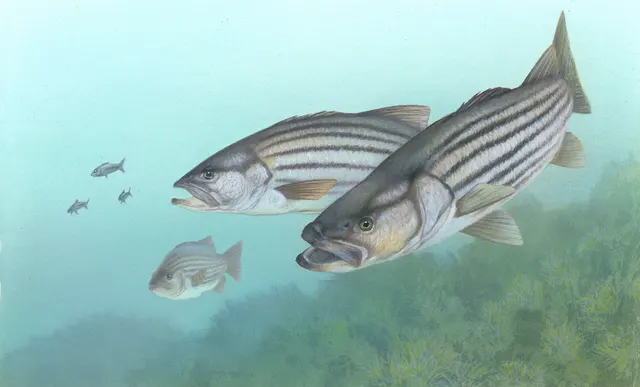 Striped bassA large anadromous predator of the North American Atlantic coast, fished from surf, rock, boat and river, and the subject of one of the better-known fishery recoveries.
Timothy Knepp — Public domain, via Wikimedia Commons
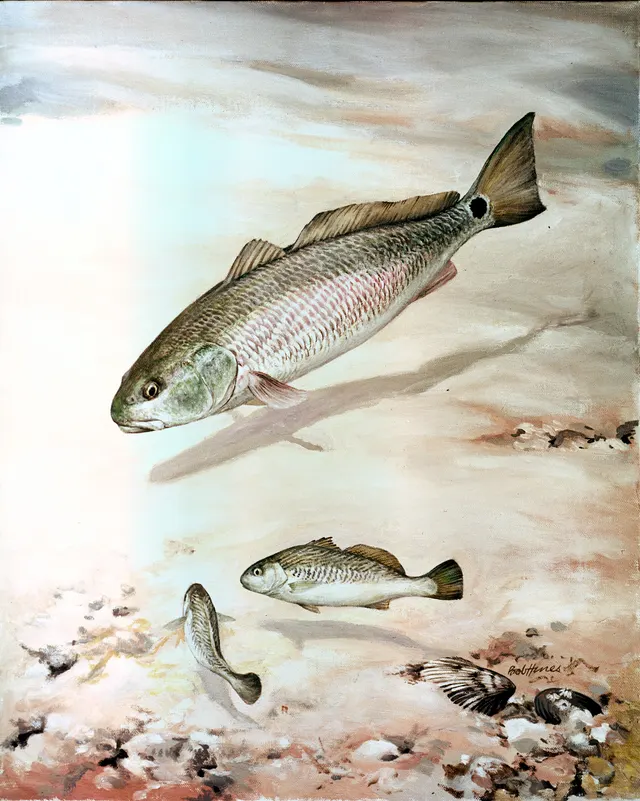 Red drumA copper-coloured inshore predator of the American south-east, marked with a false eyespot at the tail, fished on shallow flats where its tail breaks the surface as it feeds.
Hines, Robert W., Public domain, via Wikimedia Commons
Safety
Weather and lightning — Can cause serious injury or death
Afternoon thunderstorms across the south-east and Gulf develop rapidly and violently through the warm months, and lightning over open water is a leading cause of death among recreational boaters and shore anglers. Hurricane season adds a separate and larger risk.
What reduces it: Watch the forecast and the sky, leave the water at the first sign of building cloud rather than at the first thunder, and treat a small boat or an exposed pier as the worst possible place in a storm.
Worse when:
- Summer afternoons in Florida and the Gulf, where storms build almost daily
- Open water and exposed piers with no low ground nearby
Cliffs and rock platforms — Can cause serious injury or death
Sneaker waves on the Pacific coast arrive far larger than the preceding set, on days that appear calm, and sweep people from rocks, jetties and beaches. They are a documented and recurrent cause of death on that coast.
What reduces it: Never turn your back on the Pacific, watch any rock or jetty mark for a long period before committing, stay well back from the water's edge, and treat posted warnings as the local knowledge they represent.
Check the rules before you fish
Fishing laws, bylaws, access rules, seasons, bait restrictions and permitted methods vary by location and can change. Check the current rules from the relevant authority and the water you intend to fish before fishing.
Check with:
- Current national or regional law for where you are fishing
- Current local bylaws
- The relevant fisheries authority
- The landowner, club or fishery whose water it is
- Any restrictions specific to the species or the method you intend to use
Where to go next
What swims here
How people fish here
How this compares
- The Gulf of MexicoThe Gulf is the clearest single instance of the subtropical estuarine coast the overview describes, and of the regulatory complexity that goes with a shared stock across many states.
- The Pacific Northwest coastThe Pacific Northwest is the cold upwelling counterweight to the Gulf, on the same continent under the same federal system and with almost nothing else in common.
- United StatesThe national record sits inside a continental one, and the continental view is where the four coasts and the state-versus-federal complication are set out.
Sources and evidence
- NOAA National Ocean Service education on estuaries and the National Estuarine Research Reserve System — National Oceanic and Atmospheric Administration, United States (Government fisheries body)Relied on for: Public education on estuarine systems, their productivity and the species that depend on them.States this directlyCitation checked — the work exists and is described correctly
- FishBase: a global information system on fishes — Froese, R. and D. Pauly, eds. — FishBase Consortium (Scientific institute)Relied on for: Distribution, habitat association, life history and diet recorded for the species concerned.States this directlyPassage read and verified
- Good Fish Guide — Marine Conservation Society (Conservation authority)Relied on for: Synthesis of stock and gear information relating fishing methods to their effects on stocks and habitats.Background and mechanism onlyCitation checked — the work exists and is described correctly
Why the 6 connections on this page are here, and the sources
What swims here
Backed by research — 2 connections
Supported by peer-reviewed research or fisheries science. The sources are listed and can be checked.
Red drum
A distributional claim taken from reference sources on the species rather than from angling report. It states presence and asserts nothing about a fishery.
- FishBase: a global information system on fishes — Froese, R. and D. Pauly, eds. — FishBase Consortium (Scientific institute)Relied on for: Distribution, habitat association, depth range and life history recorded for the species concerned.States this directlyPassage read and verified
- The IUCN Red List of Threatened Species — International Union for Conservation of Nature (Conservation authority)Relied on for: Global distribution, population trend and extinction-risk assessment for the species concerned.States this directlyCitation checked — the work exists and is described correctly
Striped bass
A distributional claim taken from reference sources on the species rather than from angling report. It states presence and asserts nothing about a fishery.
- FishBase: a global information system on fishes — Froese, R. and D. Pauly, eds. — FishBase Consortium (Scientific institute)Relied on for: Distribution, habitat association, depth range and life history recorded for the species concerned.States this directlyPassage read and verified
- The IUCN Red List of Threatened Species — International Union for Conservation of Nature (Conservation authority)Relied on for: Global distribution, population trend and extinction-risk assessment for the species concerned.States this directlyCitation checked — the work exists and is described correctly
How people fish here
What experienced anglers do — 1 connection
Widely and independently recommended by experienced anglers and specialist sources. This is real angling knowledge, not proof: controlled evidence for it is limited, and FishingHQ records it as convention rather than as a demonstrated effect.
Sea fishing
Which branch of fishing dominates a region is a statement about practice rather than about the place, and is recorded as convention.
- FAO fishing gear types and fishing technology information — Food and Agriculture Organization of the United Nations (Scientific institute)Relied on for: Classification and description of world fishing gears and the regions in which each is used.States this directlyCitation checked — the work exists and is described correctly
- General angling website restatements of established technique — Various (Credible secondary source)Relied on for: Widely restated descriptions of regional angling practice, recorded as consensus rather than as scholarship.Background and mechanism onlyCitation checked — the work exists and is described correctly
How this compares
What experienced anglers do — 3 connections
Widely and independently recommended by experienced anglers and specialist sources. This is real angling knowledge, not proof: controlled evidence for it is limited, and FishingHQ records it as convention rather than as a demonstrated effect.
The Gulf of Mexico
A continental overview joined to a record it sits above, so that the synthesis and the detail are reachable from one another rather than duplicating each other.
- FAO fishing gear types and fishing technology information — Food and Agriculture Organization of the United Nations (Scientific institute)Relied on for: Classification and description of world fishing gears and the regions in which each is used.States this directlyCitation checked — the work exists and is described correctly
- General angling website restatements of established technique — Various (Credible secondary source)Relied on for: Widely restated descriptions of regional angling practice, recorded as consensus rather than as scholarship.Background and mechanism onlyCitation checked — the work exists and is described correctly
The Pacific Northwest coast
A continental overview joined to a record it sits above, so that the synthesis and the detail are reachable from one another rather than duplicating each other.
- FAO fishing gear types and fishing technology information — Food and Agriculture Organization of the United Nations (Scientific institute)Relied on for: Classification and description of world fishing gears and the regions in which each is used.States this directlyCitation checked — the work exists and is described correctly
- General angling website restatements of established technique — Various (Credible secondary source)Relied on for: Widely restated descriptions of regional angling practice, recorded as consensus rather than as scholarship.Background and mechanism onlyCitation checked — the work exists and is described correctly
United States
Two places or records a reader will hold together, joined where the comparison teaches something neither states alone.
- Sea Angler — Bauer Media (Specialist angling publication)Relied on for: Contemporary UK and European sea angling practice as reported by practitioners, including regional ground and species behaviour.States this directlyCitation checked — the work exists and is described correctly
- General angling website restatements of established technique — Various (Credible secondary source)Relied on for: Widely restated descriptions of regional angling practice, recorded as consensus rather than as scholarship.Background and mechanism onlyCitation checked — the work exists and is described correctly
How FishingHQ labels evidence is explained in the evidence policy.