Cutthroat trout
Fish · Last reviewed 2026-08-10
The native trout of western North America, named for a red slash under the jaw, and a species fragmented into subspecies that hybridise readily with introduced rainbows.
Safety: biosecurity and disease transfer — can cause serious injury or death. 5 more points apply here.
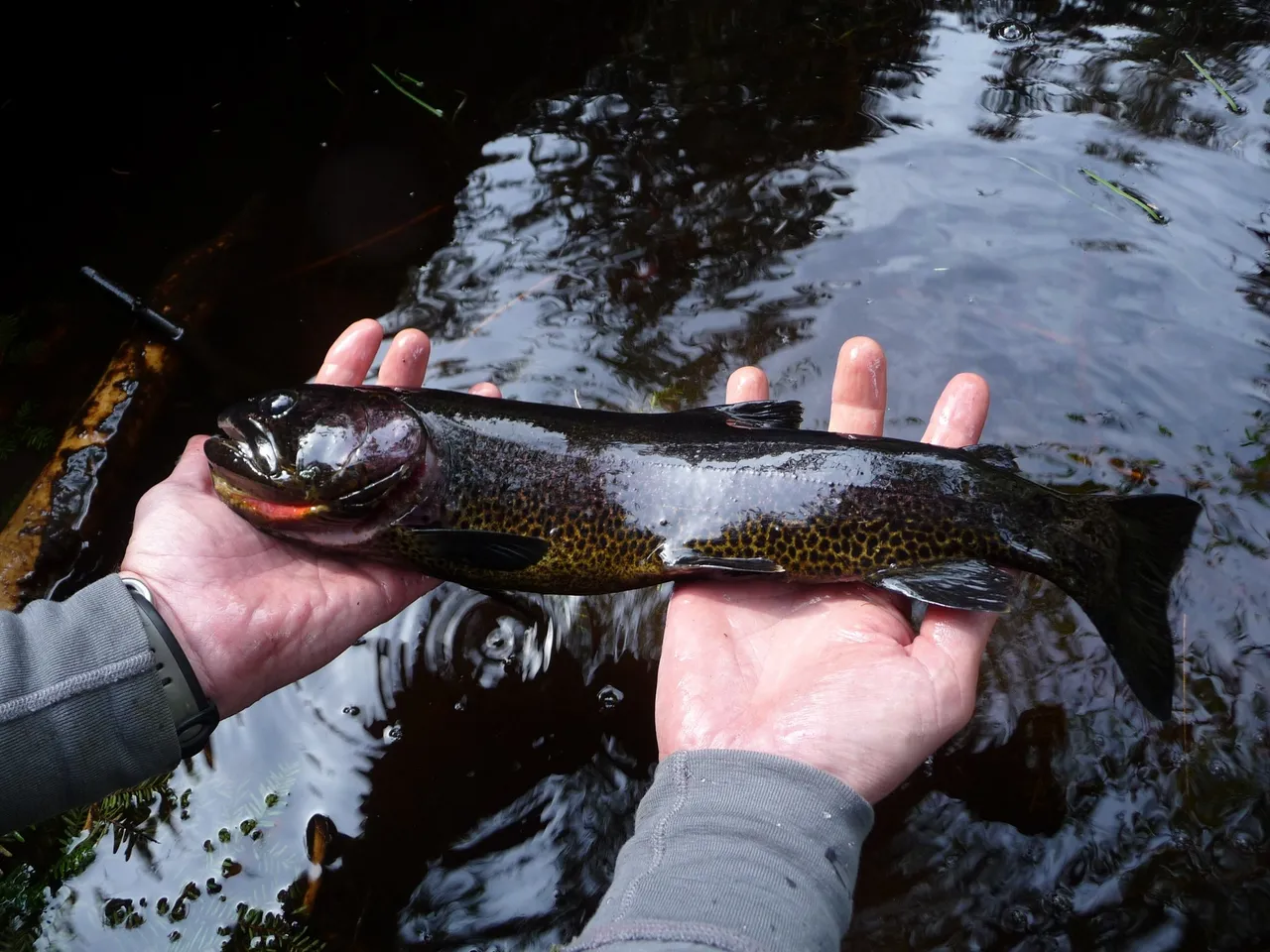
How this was identified, and who took it
Identified by: The character the species is named for is unmistakable here: a bright red-orange slash along the underside of the lower jaw on the near side. Supported by heavy dark spotting concentrated over the rear flank and caudal peduncle, an olive-gold ground and a well-developed adipose fin. Six agreeing identifications, none disagreeing.Bruce Deagle — CC BY, via iNaturalist — source, licenceCatching Cutthroat trout
Everything here on fishing for it. Each entry opens the page behind it.
The cutthroat trout is the trout that was in western North America before anything else was put there, and its story is largely about what happened next.
It is named for the red or orange slash along the underside of the lower jaw — a mark that is unmistakable when present and can be faint in some fish and some subspecies. And subspecies are the point: cutthroat trout are divided into a substantial number of geographically distinct forms, several of them restricted to single drainages, and a number of which are threatened or have already been lost.
The principal pressure is hybridisation. Cutthroat and rainbow trout interbreed readily and produce fertile offspring, so where rainbows have been introduced into cutthroat water — which is a great deal of the western United States — the native form is progressively genetically swamped rather than out-competed. That is a slower and less visible kind of extinction than predation, and it is much harder to reverse.
As a target it is the classic western fly-fishing fish: willing, often found in beautiful high country, and generally regarded as easier to catch than a brown trout. Much of the modern fishery is explicitly conservation-oriented, with native-strain populations managed carefully and fished on a release basis.
Gear for this fish
- Dry fliesCutthroat are noted for rising freely and unselectively to a well-presented dry, which is why they are the species most western dry-fly fishing is learned on.
- NymphsCutthroat feed on drifting invertebrates in the cold western rivers they are native to, and nymph fishing is the approach that matches their ordinary rather than their occasional feeding.
Identification
- Scientific name
- Oncorhynchus clarkii
- Family
- Salmonidae
- Water
- Freshwater, Brackish, Saltwater, Moves between fresh and salt water
- Conservation status
- Least Concern
- Regions
- North America, Arctic & Subarctic
- A red, orange or pink slash along the underside of each side of the lower jaw — the character the fish is named for, though it can be faint.
- Black spots over the body, generally more concentrated toward the tail than a rainbow's even spread.
- Basibranchial teeth present at the back of the tongue — a definitive character but one requiring the fish in hand and a careful look.
- Colour and pattern vary enormously between subspecies, from heavily spotted to almost plain and from silvery to deep gold.
- Hybrids with rainbow trout are common where both occur and are frequently impossible to identify by eye.
Size
- Typical
- 300–800 g (10 oz–1.8 lb)
- Large
- 1.5–3 kg (3.3–6.6 lb)
Exceptional: Over 5 kg (11 lb); maximum published weight 18.6 kg
Cold headwaters, and a species that exists as a dozen local forms
Cutthroat trout occupy cold western North American waters, and the honest habitat statement has to start with the fact that they are not one thing.
THE SPECIES COMPRISES MANY SUBSPECIES, each adapted to a particular basin — interior forms in high desert streams and lakes, coastal forms running to the sea, Rocky Mountain forms in cold headwaters. Their habitat requirements overlap but are not identical, and a general statement will be wrong somewhere.
COLD, CLEAN, WELL-OXYGENATED WATER IS COMMON TO ALL OF THEM, with most forms restricted to headwaters and high-elevation streams and lakes in the modern range.
STREAM FORMS USE POOL AND RIFFLE HABITAT with cover — undercut banks, woody debris, boulder — and are strongly associated with structurally complex reaches.
LAKE FORMS OCCUPY COLD OLIGOTROPHIC LAKES and spawn in inlet and outlet streams, so lake populations depend on tributary access.
THE COASTAL FORM IS ANADROMOUS, moving between small coastal streams, estuaries and nearshore marine water, and it uses estuarine habitat more heavily than most sea-run salmonids.
AND THE RANGE HAS CONTRACTED UPSTREAM for the same reasons everywhere: warming, sedimentation, and competition and hybridisation with introduced rainbow and brown trout. Many remaining populations are isolated above barriers, which protects them genetically and exposes them demographically.
Backed by research — why, and the sources (2)
Supported by peer-reviewed research or fisheries science. The sources are listed and can be checked.
- NASCO conservation and management of North Atlantic salmon — North Atlantic Salmon Conservation Organization (Government fisheries body)Relied on for: Anadromous salmonid biology, run timing, spawning habitat requirements and the management principles applied to them.States this directlyCitation checked — the work exists and is described correctly
- FishBase: a global information system on fishes — Froese, R. and D. Pauly, eds. — FishBase Consortium (Scientific institute)Relied on for: Distribution, habitat association, depth range, size, reproduction and life-history parameters recorded for the species.States this directlyPassage read and verified
A spring-spawning trout in water that is still melting
Cutthroat trout are spring spawners, and in their high-elevation habitat that puts reproduction into the snowmelt period.
SPAWNING IS IN SPRING AND EARLY SUMMER, triggered by rising water temperature and, in most of the range, coinciding with or following snowmelt. In high country that can mean early summer rather than spring in any calendar sense.
FLOW IS THE COMPLICATION. Spawning during or just after peak runoff means redds are cut in water that is high, cold and moving, and scouring flows can destroy them. Year-class strength therefore varies with the shape of the melt as much as with the number of spawners.
LAKE POPULATIONS RUN INTO TRIBUTARIES to spawn, so inlet and outlet stream access decides whether a lake population reproduces at all. Barriers on those streams sever it.
THE ANADROMOUS COASTAL FORM RETURNS TO SMALL COASTAL STREAMS and, unlike Pacific salmon, does not die after spawning — repeat spawning is normal.
MATURITY IS AT A FEW YEARS and varies substantially between forms and environments.
AND HYBRIDISATION IS THE CENTRAL REPRODUCTIVE THREAT. Cutthroat hybridise readily with introduced rainbow trout, producing fertile offspring, so the reproductive output is not lost but the genetic integrity of the population is. Genetically pure populations are now the conservation unit, and many survive only above barriers that keep rainbows out.
Backed by research — why, and the sources (2)
Supported by peer-reviewed research or fisheries science. The sources are listed and can be checked.
- NASCO conservation and management of North Atlantic salmon — North Atlantic Salmon Conservation Organization (Government fisheries body)Relied on for: Anadromous salmonid biology, run timing, spawning habitat requirements and the management principles applied to them.States this directlyCitation checked — the work exists and is described correctly
- FishBase: a global information system on fishes — Froese, R. and D. Pauly, eds. — FishBase Consortium (Scientific institute)Relied on for: Distribution, habitat association, depth range, size, reproduction and life-history parameters recorded for the species.States this directlyPassage read and verified
Thin margins in warm water, and a fish that is often the last of its kind locally
Cutthroat trout handling matters disproportionately because so many populations are small, isolated and genetically distinct, and because much of the fishing happens in exactly the conditions that make release survival worst.
THE TEMPERATURE PROBLEM IS THE CENTRAL ONE. Cutthroat occupy cold headwaters, and in late summer many of those waters approach the upper limit of what the species tolerates. A fish caught, fought and handled in water near that limit has very little physiological reserve, and mortality after release rises steeply with water temperature. Several fisheries now close or restrict angling above a stated temperature — the practice known as a hoot-owl restriction, limiting fishing to the cool early hours — and that restriction is the single most effective handling measure available.
SO THE FIRST DECISION IS WHETHER TO FISH. Carry a thermometer. If the water is warm, fish early or not at all.
THE HANDLING PROPER is standard salmonid practice done strictly: knotless rubber net, wet hands, barbless hooks, fish kept in the water, unhooked in the net, and returned without lifting where possible. Air exposure of even a few seconds measurably reduces survival in warm water.
THE FISH IS HARMLESS to a handler.
AND THE GENETIC CONTEXT IS THE REASON FOR THE CARE. Many cutthroat populations are remnant and isolated, several subspecies are of conservation concern, and hybridisation with introduced rainbow trout is a major threat. A local population may not be replaceable from anywhere. Cleaning and drying gear between waters is part of handling for the same reason.
Official guidance — why, and the sources (3)
Stated by a fisheries authority, scientific institute or recognised angling body. Authoritative, but summarising rather than demonstrating.
- The IUCN Red List of Threatened Species — International Union for Conservation of Nature (Conservation authority)Relied on for: Conservation status of cutthroat trout subspecies and the threats from hybridisation and habitat warming.Background and mechanism onlyCitation checked — the work exists and is described correctly
- Do we need species-specific guidelines for catch-and-release recreational angling? — Biodiversity and Conservation 14:1195–1209, 2005 (Scientific literature)Relied on for: That post-release mortality varies with species, capture depth, water temperature, air exposure and handling, and that species-specific guidance outperforms general guidance.States this directlyCitation checked — the work exists and is described correctly
- A review of catch-and-release angling mortality with implications for no-take reserves — Reviews in Fish Biology and Fisheries 15:129–154, 2005 (Scientific literature)Relied on for: Review of hooking and release mortality across fisheries, including the contribution of depth of capture and handling duration.States this directlyCitation checked — the work exists and is described correctly
Spring gravel, small tributaries, and a fish that hybridises itself out of existence
Cutthroat trout reproduction is a conventional salmonid strategy with one unconventional and serious problem attached, and the problem is genetic rather than physical.
THEY SPAWN IN SPRING, WHICH SEPARATES THEM FROM MOST TROUT. Cutthroat cut redds in gravel in small tributaries and headwater streams as flows drop and water warms after snowmelt, rather than in autumn as brown and brook trout do. Eggs incubate through late spring and early summer.
THE TRIBUTARY REQUIREMENT IS SPECIFIC AND FRAGILE. Cutthroat depend heavily on small, cold, clean headwater streams for spawning and early rearing, and connectivity from the main river or lake to those tributaries is essential. Culverts, diversions, dewatering and low-flow barriers cut populations off from their spawning water while leaving the adults apparently fine.
AND THE SPRING TIMING IS EXACTLY THE PROBLEM, because rainbow trout also spawn in spring. Where rainbows have been introduced into cutthroat water — which is across enormous parts of the western range — the two species hybridise readily and produce fertile offspring. The result is not a mixed population but a progressive genetic swamping, and pure cutthroat populations have been lost from vast areas without anybody removing a single fish.
WHICH MAKES THE CONSERVATION UNIT A POPULATION RATHER THAN A SPECIES. Cutthroat comprise a number of subspecies with restricted and in some cases very small ranges, and the surviving genetically pure populations are frequently confined to headwater reaches above a barrier that kept the rainbows out. A waterfall is, in this context, a conservation asset.
BROWN TROUT AND BROOK TROUT COMPETE RATHER THAN HYBRIDISE, and both displace cutthroat in parts of the range through competition and predation — a second and separate introduction problem.
RECRUITMENT DEPENDS ON SPRING AND SUMMER FLOWS, and warming, reduced snowpack and low summer flows all act on the incubation and early rearing period directly.
AND MANAGEMENT IS POPULATION-SPECIFIC, with closures, catch-and-release requirements and gear restrictions varying by water and by subspecies. The competent authority is the source.
Backed by research — why, and the sources (2)
Supported by peer-reviewed research or fisheries science. The sources are listed and can be checked.
- NASCO conservation and management of North Atlantic salmon — North Atlantic Salmon Conservation Organization (Government fisheries body)Relied on for: Freshwater and marine requirements of anadromous salmonids, run timing, the environmental cues governing migration, and the pressures on them.States this directlyCitation checked — the work exists and is described correctly
- FishBase: a global information system on fishes — Froese, R. and D. Pauly, eds. — FishBase Consortium (Scientific institute)Relied on for: Habitat association, spawning season, migratory behaviour and life-stage distribution for the species.Background and mechanism onlyPassage read and verified
Lifecycle and reproduction
Varies enormously between subspecies and life histories, which range from small resident stream fish maturing at two years to large lake-dwelling and sea-going forms. Spawns in spring in gravel, cutting a redd. Unlike Pacific salmon it does not necessarily die after spawning and may spawn repeatedly. The diversity of life histories within one species is a large part of what makes its conservation complicated.
Spring redd-spawning in gravel in flowing water. The critical reproductive issue is not the spawning itself but hybridisation: cutthroat and rainbow trout interbreed readily and produce fertile offspring, so introduced rainbows progressively swamp native cutthroat genetics rather than displacing the fish. Genetically pure populations are now restricted and are managed specifically as such.
Feeding and senses
Opportunistic, taking aquatic insect nymphs and adults, terrestrial insects, crustaceans and small fish, with larger lake and sea-going forms becoming substantially piscivorous. In small high-country streams the terrestrial insect component is unusually important, which is why hopper, ant and beetle patterns are so effective for the species.
Sight-dominant, and in the clear cold water of its native range extremely sensitive to movement on the bank. Cutthroat have a general reputation for being less selective and more willing than brown trout, which is genuinely observed rather than folklore, and which is part of why they are so vulnerable to fishing pressure in accessible water.
Through the year
Governed by water temperature and by flow. Spawning follows spring runoff; feeding is strongest in cool water and drops as summer water warms; autumn brings heavy feeding before winter. In high-country streams the season is short and intense. Introduced and coastal populations follow local conditions rather than a general calendar.
Distribution
Western North America: from Alaska south through British Columbia and the western United States to New Mexico, in coastal, inland and high-country drainages. Divided into numerous geographically distinct subspecies, several of them restricted to single drainages and some threatened or extinct.
This is a biological range — where the species occurs, not a prediction that you will catch one. To browse the fishing geography FishingHQ holds, start at fishing places.
Why anglers care
The classic native trout of western North American fly fishing, taken on dry fly, nymph, streamer and small lures. Much of the modern fishery is conservation-oriented, with native-strain populations identified, managed and fished on a strict release basis. Sea-run coastal cutthroat support a distinct and highly regarded fishery of their own.
Handling and returning
Wet hands, keep the fish in the water, use barbless hooks and release quickly — this is a species where a substantial part of the fishery exists specifically to conserve remnant native populations, and handling standards matter accordingly. As with all trout, warm water sharply reduces release survival, and the correct response to warm conditions is to stop rather than to fish carefully.
Going further
- What does cutthroat trout eat? — feeding biology, kept separate from what anglers infer from it.
- Cutthroat trout vs Rainbow trout — how to tell them apart.
Safety
Biosecurity and disease transfer — Can cause serious injury or death
Hybridisation with introduced rainbow trout is the principal threat to native cutthroat genetics, and moving fish or equipment between drainages spreads both fish and pathogens including whirling disease.
What reduces it: Never move live fish or water between waters. Clean, drain, dry and check equipment thoroughly between catchments — headwater drainages are exactly the isolated systems most damaged by an introduced pathogen or an introduced trout.
Fish welfare — Can cause injury needing treatment
Cutthroat are frequently fished in small high-country streams where populations are small, isolated and in several cases genetically distinctive, and where warm summer water reduces release survival.
What reduces it: Use barbless hooks, keep fish in the water, play them quickly and release immediately. Do not fish in warm water. Treat small isolated populations as finite, because they are.
Precautions that always apply here
- Wet your hands before touching a fish. Dry hands strip the protective mucus layer that keeps infection out.
- Support the fish's weight along its body, keep it out of the water for as short a time as possible, and hold it over something soft.
- Check, clean and dry your kit between different waters — the published guidance is 48 hours’ drying, in sunlight where possible, because a number of invasive species survive over two weeks in damp conditions. Nets, boots and wet mats move invasive species and disease more effectively than anything else anglers do.
- Never move live fish, live bait or water from one water to another.
Check the rules before you fish
Fishing laws, bylaws, access rules, seasons, bait restrictions and permitted methods vary by location and can change. Check the current rules from the relevant authority and the water you intend to fish before fishing.
Check with:
- Current national or regional law for where you are fishing
- Current local bylaws
- The relevant fisheries authority
- The landowner, club or fishery whose water it is
- Any restrictions specific to the species or the method you intend to use
Where to go next
Similar and related fish
Where you will find it
Understanding this fish
More fish
Not related to this page — just the rest of the section. There is little else joined to this subject yet, and a short page should still lead somewhere.
Sources and evidence
- FishBase: a global information system on fishes — Froese, R. and D. Pauly, eds. — FishBase Consortium (Scientific institute)Relied on for: Scientific name, family placement in the Salmonidae, a maximum length of 99.0 cm TL, a maximum published weight of 18.6 kg, a maximum reported age of 13 years.States this directlyPassage read and verified
- FishBase: a global information system on fishes — Froese, R. and D. Pauly, eds. — FishBase Consortium (Scientific institute)Relied on for: Environment, climate zone and depth range as recorded: Marine; freshwater; brackish; demersal; anadromous ; depth range 0 - 200 m . Temperate; ? - 23°C ; 61°N - 40°NStates this directlyPassage read and verified
- FishBase: a global information system on fishes — Froese, R. and D. Pauly, eds. — FishBase Consortium (Scientific institute)Relied on for: The IUCN Red List category for Oncorhynchus clarkii — Least Concern, assessed 23 July 2020 — as republished by FishBase, the Red List itself being unreachable during review.States this directlyPassage read and verified
- Check Clean Dry — biosecurity guidance for water users — GB Non-native Species Secretariat (Conservation authority)Relied on for: The framework by which introduced fish are assessed and managed, including hybridisation with native congeners as a recognised harm.FishingHQ's interpretation of what it saysPassage read and verified
- Understanding the Complexity of Catch-and-Release in Recreational Fishing — Reviews in Fisheries Science 15:75–167, 2007 (Scientific literature)Relied on for: That water temperature, hook type and handling materially affect the survival of released fish.States this directlyCitation checked — the work exists and is described correctly
Why the 6 connections on this page are here, and the sources
Similar and related fish
Backed by research — 1 connection
Supported by peer-reviewed research or fisheries science. The sources are listed and can be checked.
Rainbow trout
A comparison whose substance is the hybridisation, which is the species' principal conservation problem.
- FishBase: a global information system on fishes — Froese, R. and D. Pauly, eds. — FishBase Consortium (Scientific institute)Relied on for: That Oncorhynchus clarkii and Oncorhynchus mykiss are congeners in the genus Oncorhynchus with overlapping western North American ranges.States this directlyPassage read and verified
- Check Clean Dry — biosecurity guidance for water users — GB Non-native Species Secretariat (Conservation authority)Relied on for: That hybridisation with introduced congeners is a recognised harm in the assessment of non-native fish.FishingHQ's interpretation of what it saysPassage read and verified
How it is caught
What experienced anglers do — 1 connection
Widely and independently recommended by experienced anglers and specialist sources. This is real angling knowledge, not proof: controlled evidence for it is limited, and FishingHQ records it as convention rather than as a demonstrated effect.
Dry fly fishing
A practitioner claim about relative willingness, labelled as convention.
- Freshwater Fishing — Macdonald & Jane's, 1975 (Specialist angling publication)Relied on for: Practitioner treatment of dry fly technique and of variation in rise willingness between trout species.Citation checked — the work exists and is described correctly
- Trout & Salmon — Bauer Media (Specialist angling publication)Relied on for: Contemporary practitioner treatment of dry fly fishing for western North American trout.Citation checked — the work exists and is described correctly
Gear for this fish
What experienced anglers do — 2 connections
Widely and independently recommended by experienced anglers and specialist sources. This is real angling knowledge, not proof: controlled evidence for it is limited, and FishingHQ records it as convention rather than as a demonstrated effect.
Dry flies
A practitioner claim about which lure family answers this species' feeding or holding behaviour.
- Trout & Salmon — Bauer Media (Specialist angling publication)Relied on for: Fly categories and their application to salmonids in running and still water.States this directlyCitation checked — the work exists and is described correctly
- Still Water Fly-Fishing — Andre Deutsch, 1952 (Specialist angling publication)Relied on for: Still-water fly categories, and the feeding observations they are chosen from.Background and mechanism onlyCitation checked — the work exists and is described correctly
Nymphs
A practitioner claim about which lure family answers this species' feeding or holding behaviour.
- Trout & Salmon — Bauer Media (Specialist angling publication)Relied on for: Fly categories and their application to salmonids in running and still water.States this directlyCitation checked — the work exists and is described correctly
- Still Water Fly-Fishing — Andre Deutsch, 1952 (Specialist angling publication)Relied on for: Still-water fly categories, and the feeding observations they are chosen from.Background and mechanism onlyCitation checked — the work exists and is described correctly
Where you will find it
Backed by research — 1 connection
Supported by peer-reviewed research or fisheries science. The sources are listed and can be checked.
The Pacific Northwest coast
Occurrence of the species in this system or along this coast: a statement about the animal's distribution, not a venue recommendation.
- FishBase: a global information system on fishes — Froese, R. and D. Pauly, eds. — FishBase Consortium (Scientific institute)Relied on for: Distribution, salinity tolerance and habitat association recorded for the species, including its occurrence in this system.States this directlyPassage read and verified
- The IUCN Red List of Threatened Species — International Union for Conservation of Nature (Conservation authority)Relied on for: Assessment and range description for the species, including the waters in which it occurs.Background and mechanism onlyCitation checked — the work exists and is described correctly
Understanding this fish
Backed by research — 1 connection
Supported by peer-reviewed research or fisheries science. The sources are listed and can be checked.
Aquatic insect larvae as prey
Recorded diet evidence identifies mayfly, caddis and stonefly larvae as a food item of this predator at group level rather than to species. The edge points at the taxon record for that reason, and encoding it as a species-level claim would assert something the source does not.
- FishBase: a global information system on fishes — Froese, R. and D. Pauly, eds. — FishBase Consortium (Scientific institute)Relied on for: Food items recorded for this predator, given as mayfly, caddis and stonefly larvae.States this directlyPassage read and verified
- FAO Species Identification Guides for Fishery Purposes and the FAO Species Catalogues — Food and Agriculture Organization of the United Nations (Scientific institute)Relied on for: Species account describing this predator's diet, recorded at the level of mayfly, caddis and stonefly larvae.Background and mechanism onlyCitation checked — the work exists and is described correctly
How FishingHQ labels evidence is explained in the evidence policy.