How to identify cutthroat trout
Oncorhynchus clarkii · Salmonidae
The characters that identify cutthroat trout, ranked by how far each one can be trusted on its own.
Safety: biosecurity and disease transfer — can cause serious injury or death. One more point applies here.
How this was identified, and who took it
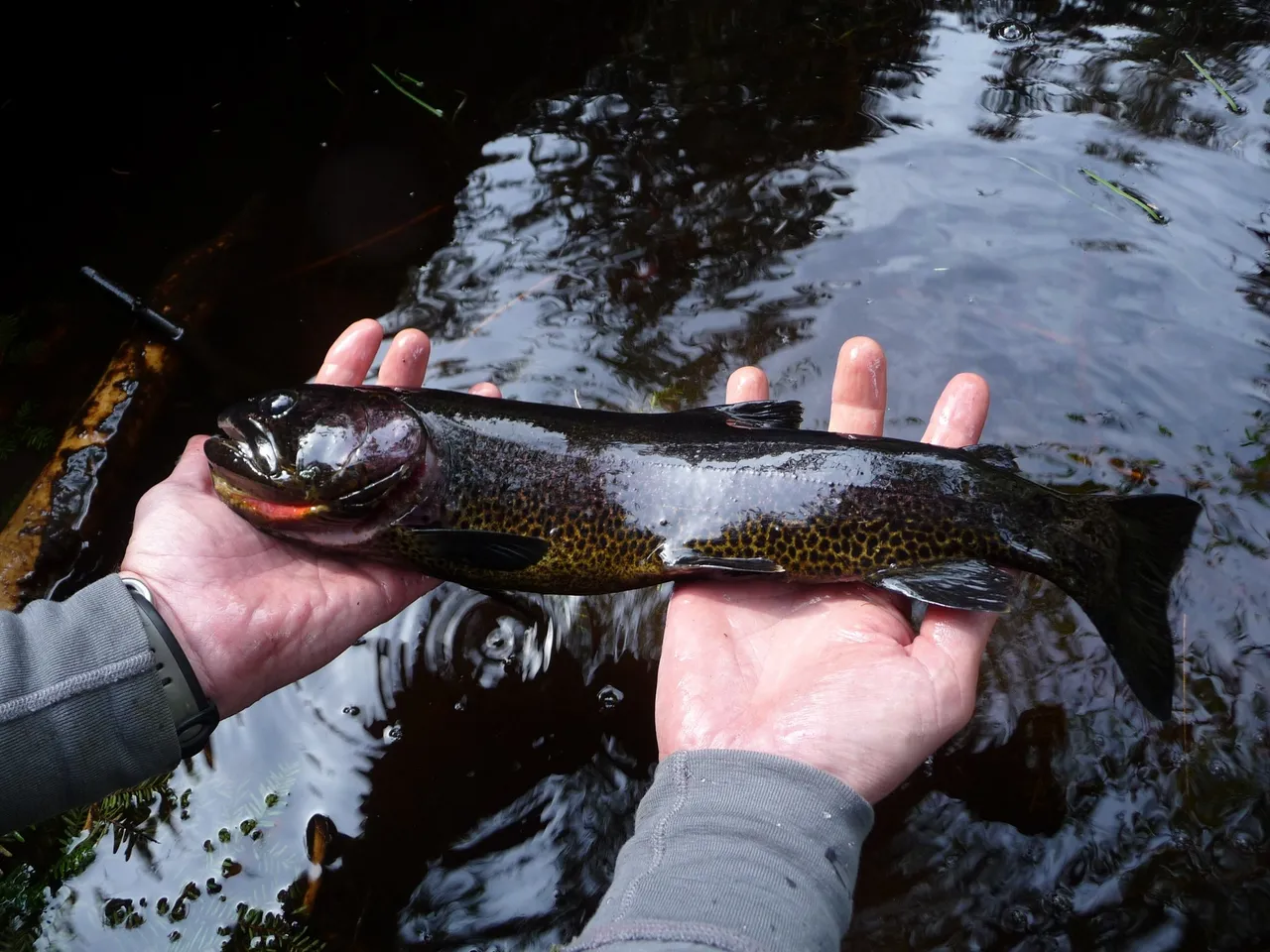
Identified by: The character the species is named for is unmistakable here: a bright red-orange slash along the underside of the lower jaw on the near side. Supported by heavy dark spotting concentrated over the rear flank and caudal peduncle, an olive-gold ground and a well-developed adipose fin. Six agreeing identifications, none disagreeing.Bruce Deagle — CC BY, via iNaturalist — source, licenceLook at this first
Tip the head back and look under the lower jaw for a red or orange slash on each side. It is the mark the fish is named for and it is the right place to start — but it can be faint, and hybrids carry it too, so treat finding it as the beginning of the question rather than the end.
Diagnostic — settles it on its own
Each of these settles the identification on its own. If one is clear, you have your answer.
Small teeth at the back of the tongue
There is a patch of tiny teeth on the floor of the mouth behind the tongue that a rainbow trout does not have. This is the character that actually settles the species, and it is included here honestly rather than usefully: it requires the fish in the hand, the mouth open, good light and a careful look, and it cannot be checked from any photograph. If an identification has to be right, this is what has to be done.
Supporting — use with other characters
Real characters that are not conclusive by themselves. Use two or three together.
A red or orange slash beneath the lower jaw
On each side of the underside of the lower jaw there is a slash of red, orange or pink running along the skin fold. On a fish in condition it is vivid; on a sea-run or winter fish it can be so faint that it takes the fish held into the light to see at all. Rank it as supporting rather than as proof, for one reason: rainbow-cutthroat hybrids frequently show it, and in a great deal of western water the hybrids outnumber anything else.
Spotting weighted towards the back half of the fish
Compare the density of black spots over the shoulder against the density over the tail. On a cutthroat the spots generally crowd towards the rear of the body and the caudal fin, leaving the forward flank comparatively clean. A rainbow tends to scatter them more evenly from head to tail. This is a pattern rather than a hue, so it holds under bad light, and it is a tendency rather than a rule, so it agrees with other characters rather than replacing them.
Where the fish came from
This is a western North American fish, split across drainages, with several forms confined to single systems and some of those managed as remnant native populations. Knowing which drainage a fish came from narrows the possibilities enormously and is often more informative than anything visible on the animal, particularly where a water is known to hold genetically pure fish or known not to.
Suggestive only — varies with condition
Hints only. These vary with condition, season, water and how long the fish has been out of it, and a fish that contradicts them is still the same species.
Enormous variation between populations
The species is split into many geographically separate forms, and they look markedly different from one another — heavily spotted to nearly plain, bright silver to deep gold and rose. A reader comparing a fish to a single photograph of a coastal fish from British Columbia may reject a perfectly good inland one. Expect the range of appearances to be wide, and weight structure and spot distribution over any impression of overall colour.
What it gets confused with
- Rainbow trout, and more importantly the fertile hybrids between the two, which are common wherever rainbows have been introduced into cutthroat water.
- Other cutthroat subspecies, which differ from one another far more than some of them differ from a rainbow, and which are separated by drainage rather than by appearance.
- Golden trout and redband forms in high-country water, which overlap in colour and spotting with several inland cutthroat forms.
- Brown trout in poor light, separated by having no jaw slash and by carrying red or orange spots with pale halos on the flank.
Side by side: Cutthroat trout vs Rainbow trout.
Where this stops working
This is a species where visual identification frequently cannot deliver an answer, and the page will not pretend otherwise. Cutthroat and rainbow trout interbreed readily and their offspring are fertile, so where both are present the population contains a continuous spectrum of intermediates rather than two clean types, and a hybrid may show a jaw slash, rear-weighted spotting and a convincing overall look. The tooth patch behind the tongue is the only character that separates them and it needs the specimen. Beyond that, several subspecies are restricted to single drainages and are told apart by locality, not appearance. Where the answer matters — a native-population survey, a translocation, a claim about purity — it is a genetic question and not a photographic one.
The full record
This page covers identification only. The Cutthroat trout record covers behaviour, lifecycle, distribution, handling and the sources behind all of it.
Reviewed 2026-08-16.
More about this fish
Telling it apart is one question. Here are the others.
Similar and related fish
How it is caught
Where you will find it
Why the 3 connections on this page are here, and the sources
Similar and related fish
Backed by research — 1 connection
Supported by peer-reviewed research or fisheries science. The sources are listed and can be checked.
Rainbow trout
A comparison whose substance is the hybridisation, which is the species' principal conservation problem.
- FishBase: a global information system on fishes — Froese, R. and D. Pauly, eds. — FishBase Consortium (Scientific institute)Relied on for: That Oncorhynchus clarkii and Oncorhynchus mykiss are congeners in the genus Oncorhynchus with overlapping western North American ranges.States this directlyPassage read and verified
- Check Clean Dry — biosecurity guidance for water users — GB Non-native Species Secretariat (Conservation authority)Relied on for: That hybridisation with introduced congeners is a recognised harm in the assessment of non-native fish.FishingHQ's interpretation of what it saysPassage read and verified
How it is caught
What experienced anglers do — 1 connection
Widely and independently recommended by experienced anglers and specialist sources. This is real angling knowledge, not proof: controlled evidence for it is limited, and FishingHQ records it as convention rather than as a demonstrated effect.
Dry fly fishing
A practitioner claim about relative willingness, labelled as convention.
- Freshwater Fishing — Macdonald & Jane's, 1975 (Specialist angling publication)Relied on for: Practitioner treatment of dry fly technique and of variation in rise willingness between trout species.Citation checked — the work exists and is described correctly
- Trout & Salmon — Bauer Media (Specialist angling publication)Relied on for: Contemporary practitioner treatment of dry fly fishing for western North American trout.Citation checked — the work exists and is described correctly
Where you will find it
Backed by research — 1 connection
Supported by peer-reviewed research or fisheries science. The sources are listed and can be checked.
The Pacific Northwest coast
Occurrence of the species in this system or along this coast: a statement about the animal's distribution, not a venue recommendation.
- FishBase: a global information system on fishes — Froese, R. and D. Pauly, eds. — FishBase Consortium (Scientific institute)Relied on for: Distribution, salinity tolerance and habitat association recorded for the species, including its occurrence in this system.States this directlyPassage read and verified
- The IUCN Red List of Threatened Species — International Union for Conservation of Nature (Conservation authority)Relied on for: Assessment and range description for the species, including the waters in which it occurs.Background and mechanism onlyCitation checked — the work exists and is described correctly
Safety
Biosecurity and disease transfer — Can cause serious injury or death
Hybridisation with introduced rainbow trout is the principal threat to native cutthroat genetics, and moving fish or equipment between drainages spreads both fish and pathogens including whirling disease.
What reduces it: Never move live fish or water between waters. Clean, drain, dry and check equipment thoroughly between catchments — headwater drainages are exactly the isolated systems most damaged by an introduced pathogen or an introduced trout.
Fish welfare — Can cause injury needing treatment
Cutthroat are frequently fished in small high-country streams where populations are small, isolated and in several cases genetically distinctive, and where warm summer water reduces release survival.
What reduces it: Use barbless hooks, keep fish in the water, play them quickly and release immediately. Do not fish in warm water. Treat small isolated populations as finite, because they are.