Black rockfish
Fish · Last reviewed 2026-08-10
A schooling Pacific rockfish taken close inshore over reef, long-lived and slow-growing, with venomous fin spines and a serious barotrauma problem.
Safety: barotrauma and pressure injury — can cause serious injury or death. One more point applies here.
Barotrauma and pressure injury — Can cause serious injury or death
Gas expansion from depth leaves the fish unable to submerge; a released fish floating at the surface will not survive.
What reduces it: Carry and use a descending device whenever fishing deep reef, and return fish promptly to the depth they came from.
Catching Black rockfish
Everything here on fishing for it. Each entry opens the page behind it.
Black rockfish is the most accessible of the Pacific rockfishes: a schooling, semi-pelagic Sebastes that holds over shallow reef, kelp and jetty structure well within reach of shore and small-boat anglers, rather than sitting on the deep ground most of its relatives occupy.
Like all rockfish it is long-lived — decades, not years — and slow-growing, which is the fact that governs how it should be fished. A population can be fished down far faster than it can rebuild, and the fish that recover a stock are the old large females.
The fin spines carry venom. It is not dangerous in the way a stonefish is, but a spine wound is painful out of proportion to its size and is easily underestimated.
How it is caught
- JiggingJigs and soft plastics fished off the bottom, since the species holds up in the water column.
- Reef spearfishingJigs and soft plastics fished off the bottom, since the species holds up in the water column.
- SpinningJigs and soft plastics fished off the bottom, since the species holds up in the water column.
Gear for this fish
Identification
No photograph of Black rockfish has passed identity review yet, so none is shown. A photograph is published only once somebody has checked the animal in it against the diagnostic features described on this page.
- Scientific name
- Sebastes melanops
- Family
- Sebastidae
- Water
- Saltwater
- Conservation status
- Not assessed
- Regions
- North America
- Dark grey to black body, often with a mottled or blotched pattern, over a paler belly.
- Spiny dorsal fin with a black blotch or dusky membrane between the spines.
- Large mouth with the lower jaw slightly projecting, and no obvious spines on the top of the head.
- Schooling and often taken well off the bottom, unlike most rockfishes.
Size
- Typical
- 0.7–2 kg (1.5–4.4 lb)
- Large
- 2.5–4 kg (5.5–8.8 lb)
Exceptional: FishBase records a maximum of 63 cm and 4.8 kg
How black rockfish are fished, and why
Rockfish are structure-bound ambush feeders on rocky inshore ground and kelp, and the methods reflect a fish that will not travel far to feed.
JIGGING works because the fish holds close to the bottom and to vertical structure, and a jig can be worked in a small area at a precise depth — which matters when the fish is sitting in a specific part of a reef rather than roaming.
SPINNING from shore or boat covers the shallower kelp margins, where rockfish move up to feed on small fish and crustaceans.
SPEARFISHING is a genuinely significant method for this species, because the fish holds still, is approachable, and is taken selectively — which matters for a slow-growing, long-lived, site-attached fish where the alternative methods struggle to avoid undersized individuals.
AND THE BIOLOGICAL POINT WORTH CARRYING. Long life, slow growth and strong site attachment mean local populations do not replace quickly. That is a fact about the fish rather than about the method, and it bears on all three.
What experienced anglers do — why, and the sources (2)
Widely and independently recommended by experienced anglers and specialist sources. This is real angling knowledge, not proof: controlled evidence for it is limited, and FishingHQ records it as convention rather than as a demonstrated effect.
- FishBase: a global information system on fishes — Froese, R. and D. Pauly, eds. — FishBase Consortium (Scientific institute)Relied on for: Habitat association, depth range, feeding ecology and prey of the species, from which the method association follows.Background and mechanism onlyPassage read and verified
- IGFA International Angling Rules and World Record Requirements — International Game Fish Association (Angling or fisheries organisation)Relied on for: Recognised angling methods and the tackle classes used for them internationally.Background and mechanism onlyPassage read and verified
Why a rockfish cannot swim back down, and what to do instead
Rockfish have a closed swim bladder — physoclistous, meaning there is no duct to the gut — and gas can only leave it through the bloodstream, slowly. Bring the fish up faster than that and the gas expands with the falling pressure until the bladder distends, the stomach is forced out through the mouth, the eyes bulge and the fish floats. This is barotrauma, it is a pressure injury rather than a wound, and by the time you see it the damage is done.
WHAT THE FLOATING FISH ACTUALLY IS. Not exhausted and not dying of the fight. It is buoyant, and it physically cannot swim down against that buoyancy. Released at the surface it will drift, and it will be taken by a gull or die of exposure. Survival at the surface is close to nil regardless of how gently it was handled.
DO NOT VENT UNLESS YOU KNOW THE JURISDICTION REQUIRES IT. Puncturing the bladder with a needle was standard advice for years and is now discouraged or prohibited in several fisheries in favour of recompression, because it is done wrong easily and because the evidence favours descending. Where venting is still the local instruction, it is a specific technique with a specific entry point, and doing it from memory does more harm than good.
USE A DESCENDING DEVICE. A weighted release device — an inverted barbless hook, a purpose-made clamp, a weighted crate — carries the fish back down to a depth where the gas recompresses, and the fish swims off. This works, it is now the default recommendation across the Pacific rockfish fisheries, and in several of them carrying a descender is a legal requirement. It works better the faster it is done: minimise the time the fish spends at the surface.
AND THE DECISION THAT PRECEDES ALL OF IT. If the fish is over the size or bag limit, or you are fishing deep for a species you intend to release, the honest answer is to stop fishing that depth. Rockfish are extremely long-lived — some species run to well over a century — and a released fish that dies is worse than one kept, because the population loses the fish either way and nobody eats it.
Backed by research — why, and the sources (2)
Supported by peer-reviewed research or fisheries science. The sources are listed and can be checked.
- Do we need species-specific guidelines for catch-and-release recreational angling? — Biodiversity and Conservation 14:1195–1209, 2005 (Scientific literature)Relied on for: That post-release mortality varies with species, capture depth, water temperature, air exposure and handling, and that species-specific guidance outperforms general guidance.States this directlyCitation checked — the work exists and is described correctly
- A review of catch-and-release angling mortality with implications for no-take reserves — Reviews in Fish Biology and Fisheries 15:129–154, 2005 (Scientific literature)Relied on for: Review of hooking and release mortality across fisheries, including the contribution of depth of capture and handling duration.States this directlyCitation checked — the work exists and is described correctly
Lifecycle and reproduction
Very slow-growing and long-lived, with individuals recorded into their fifties. Maturity is late, and reproductive output rises sharply with the size and age of a female, so the oldest fish matter far more than their numbers suggest.
Fertilisation is internal and the female releases live larvae rather than eggs — a trait shared across Sebastes and unusual among bony fishes. Larval release is seasonal and timed to plankton availability.
Feeding and senses
Takes small fish, krill and other crustaceans, feeding well up in the water column over reef rather than strictly on the bottom. Schools will rise to feed near the surface in the right conditions.
A daylight visual predator that hunts by sight over structure, which is why lures and shallow-worked baits are effective and why fishing slows markedly in poor light.
Through the year
Present inshore year-round in much of the range, moving with prey and with sea conditions rather than making long migrations. Rough winter seas restrict access more than the fish's behaviour does.
Distribution
Eastern Pacific: Amchitka Island, Aleutian Islands, Alaska to Paradise Cove, Baja California, Mexico
This is a biological range — where the species occurs, not a prediction that you will catch one. To browse the fishing geography FishingHQ holds, start at fishing places.
Why anglers care
A mainstay of Pacific shore, jetty and small-boat fishing, taken on jigs, soft plastics and bait over reef and kelp, and a common spearfishing target in the same ground. Its significance is accessibility: it is one of the few substantial Pacific reef fish an angler can reach without a boat. Rockfish management is unusually detailed for that reason, and area and depth rules change frequently.
Handling and returning
Barotrauma is the central issue: a rockfish brought up from depth cannot swim back down and must be returned with a weighted descending device. Handle by the body with wet hands, keeping clear of the venomous dorsal, anal and pelvic spines. Given the species' age structure, releasing large old fish properly matters more than releasing small ones.
Safety
Barotrauma and pressure injury is set out at the top of this page, where it cannot be missed.
Venomous and spined species — Can cause injury needing treatment
The dorsal, anal and pelvic spines carry venom. A puncture causes immediate sharp pain and swelling out of proportion to the wound, and can become infected.
What reduces it: Handle across the body clear of the fins, use gloves and pliers, and treat a puncture by immersing in water as hot as can be tolerated, then seek medical advice.
Where to go next
Similar and related fish
Where it lives
Where you will find it
Sources and evidence
- FishBase: a global information system on fishes — Froese, R. and D. Pauly, eds. — FishBase Consortium (Scientific institute)Relied on for: Family, maximum size, depth and environment, distribution and the IUCN assessment for Sebastes melanops.States this directlyPassage read and verified
- The IUCN Red List of Threatened Species — International Union for Conservation of Nature (Conservation authority)Relied on for: The Not Evaluated assessment for Sebastes melanops.States this directlyCitation checked — the work exists and is described correctly
Why the 10 connections on this page are here, and the sources
Similar and related fish
Backed by research — 2 connections
Supported by peer-reviewed research or fisheries science. The sources are listed and can be checked.
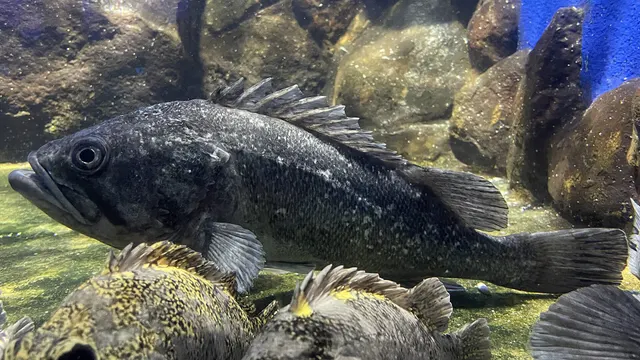
Korean rockfish
An identification comparison naming both binomials: Sebastes schlegelii and Sebastes melanops.
- FishBase: a global information system on fishes — Froese, R. and D. Pauly, eds. — FishBase Consortium (Scientific institute)Relied on for: Morphological and distributional data for Sebastes schlegelii and for Sebastes melanops.States this directlyPassage read and verified
- The IUCN Red List of Threatened Species — International Union for Conservation of Nature (Conservation authority)Relied on for: Separate assessments treating Sebastes schlegelii and Sebastes melanops as distinct species.States this directlyCitation checked — the work exists and is described correctly
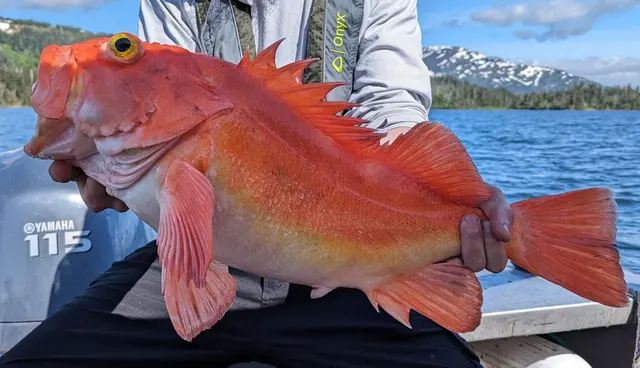
Yelloweye rockfish
An identification comparison naming both binomials: Sebastes melanops and Sebastes ruberrimus.
- FishBase: a global information system on fishes — Froese, R. and D. Pauly, eds. — FishBase Consortium (Scientific institute)Relied on for: Morphological and distributional data for Sebastes melanops and for Sebastes ruberrimus.States this directlyPassage read and verified
- The IUCN Red List of Threatened Species — International Union for Conservation of Nature (Conservation authority)Relied on for: Separate assessments treating Sebastes melanops and Sebastes ruberrimus as distinct species.States this directlyCitation checked — the work exists and is described correctly
How it is caught
What experienced anglers do — 3 connections
Widely and independently recommended by experienced anglers and specialist sources. This is real angling knowledge, not proof: controlled evidence for it is limited, and FishingHQ records it as convention rather than as a demonstrated effect.
Jigging
A practitioner claim about how Sebastes melanops is commonly fished, following from where and how it feeds.
- General angling website restatements of established technique — Various (Credible secondary source)Relied on for: Widely restated practitioner accounts of fishing for black rockfish.Citation checked — the work exists and is described correctly
- Sea Angler — Bauer Media (Specialist angling publication)Relied on for: Practitioner treatment of the methods used for black rockfish and comparable species.Citation checked — the work exists and is described correctly
Reef spearfishing
A practitioner claim about how Sebastes melanops is commonly fished, following from where and how it feeds.
- General angling website restatements of established technique — Various (Credible secondary source)Relied on for: Widely restated practitioner accounts of fishing for black rockfish.Citation checked — the work exists and is described correctly
- Sea Angler — Bauer Media (Specialist angling publication)Relied on for: Practitioner treatment of the methods used for black rockfish and comparable species.Citation checked — the work exists and is described correctly
Spinning
A practitioner claim about how Sebastes melanops is commonly fished, following from where and how it feeds.
- General angling website restatements of established technique — Various (Credible secondary source)Relied on for: Widely restated practitioner accounts of fishing for black rockfish.Citation checked — the work exists and is described correctly
- Sea Angler — Bauer Media (Specialist angling publication)Relied on for: Practitioner treatment of the methods used for black rockfish and comparable species.Citation checked — the work exists and is described correctly
Gear for this fish
What experienced anglers do — 2 connections
Widely and independently recommended by experienced anglers and specialist sources. This is real angling knowledge, not proof: controlled evidence for it is limited, and FishingHQ records it as convention rather than as a demonstrated effect.
Metal jigs
A practitioner claim about tackle commonly used for Sebastes melanops.
- General angling website restatements of established technique — Various (Credible secondary source)Relied on for: Widely restated practitioner accounts of this presentation for black rockfish.Citation checked — the work exists and is described correctly
- Angling Times — Bauer Media (Specialist angling publication)Relied on for: Practitioner treatment of comparable presentations for the species group.Citation checked — the work exists and is described correctly
Soft plastics
A practitioner claim about which lure family answers this species' feeding or holding behaviour.
- General angling website restatements of established technique — Various (Credible secondary source)Relied on for: Widely restated North American lure practice for this species.Background and mechanism onlyCitation checked — the work exists and is described correctly
- IGFA International Angling Rules and World Record Requirements — International Game Fish Association (Angling or fisheries organisation)Relied on for: Recognition of the species as an established sport fish taken on artificial lures, and the tackle conventions used for it.States this directlyPassage read and verified
Where it lives
Backed by research — 2 connections
Supported by peer-reviewed research or fisheries science. The sources are listed and can be checked.
Inshore ground
A habitat association for Sebastes melanops taken from the environment and distribution data on its FishBase summary.
- FishBase: a global information system on fishes — Froese, R. and D. Pauly, eds. — FishBase Consortium (Scientific institute)Relied on for: The environment, depth range and habitat description recorded for Sebastes melanops.States this directlyPassage read and verified
Kelp forest
A habitat association for Sebastes melanops taken from the environment and distribution data on its FishBase summary.
- FishBase: a global information system on fishes — Froese, R. and D. Pauly, eds. — FishBase Consortium (Scientific institute)Relied on for: The environment, depth range and habitat description recorded for Sebastes melanops.States this directlyPassage read and verified
Where you will find it
Backed by research — 1 connection
Supported by peer-reviewed research or fisheries science. The sources are listed and can be checked.
The Pacific Northwest coast
Occurrence of the species in this system or along this coast: a statement about the animal's distribution, not a venue recommendation.
- FishBase: a global information system on fishes — Froese, R. and D. Pauly, eds. — FishBase Consortium (Scientific institute)Relied on for: Distribution, salinity tolerance and habitat association recorded for the species, including its occurrence in this system.States this directlyPassage read and verified
- The IUCN Red List of Threatened Species — International Union for Conservation of Nature (Conservation authority)Relied on for: Assessment and range description for the species, including the waters in which it occurs.Background and mechanism onlyCitation checked — the work exists and is described correctly
How FishingHQ labels evidence is explained in the evidence policy.