Korean rockfish
Fish · Last reviewed 2026-08-10
The principal recreational and farmed rockfish of Korea, China and Japan, bearing live young and carrying venomous fin spines.
Safety: venomous and spined species — can cause injury needing treatment.
How this was identified, and who took it
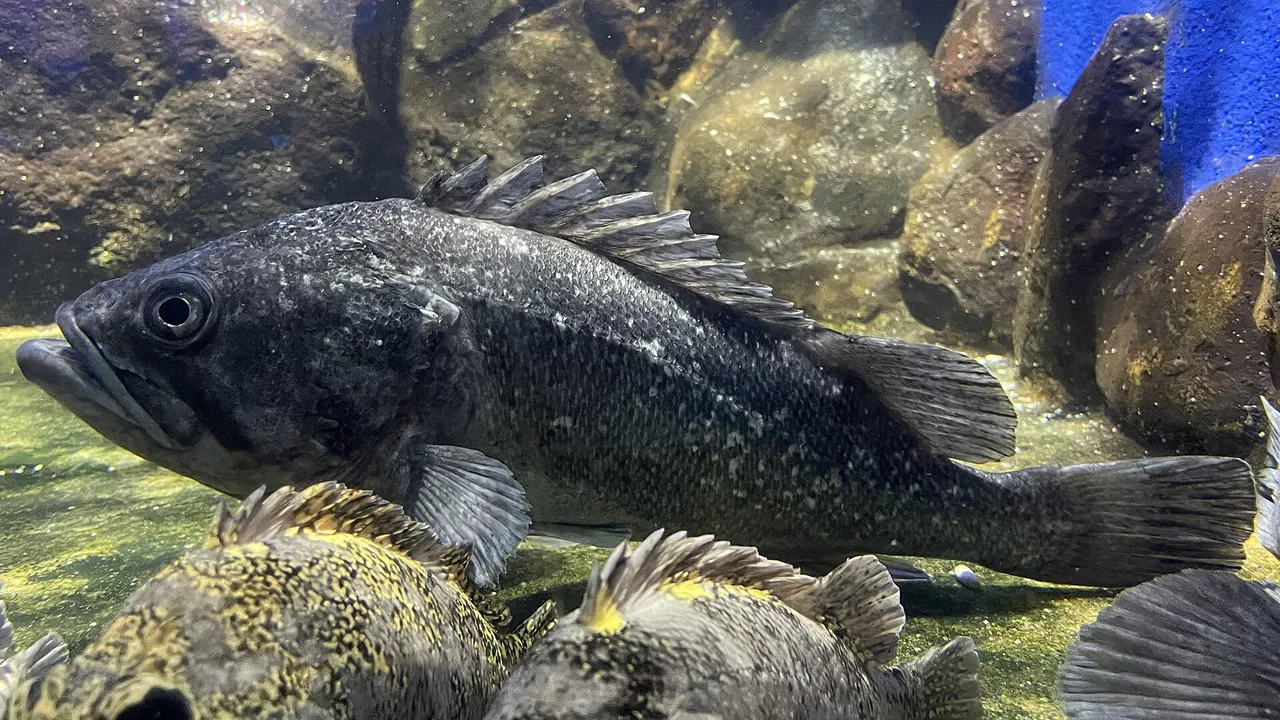
Identified by: The record's character is exactly what the frame shows: a heavy-bodied dark grey to black rockfish carrying irregular pale and dusky blotching over the flank, with a strong spinous dorsal, a large eye and a big oblique mouth in which the lower jaw projects. The Japanese common name in the source description, kurosoi, is unambiguous for Sebastes schlegelii.Totti — CC BY-SA 4.0, via Wikimedia Commons — source, licence
Catching Korean rockfish
Everything here on fishing for it. Each entry opens the page behind it.
Korean rockfish is the Sebastes of East Asian coasts — the equivalent, in importance, of black rockfish on the American Pacific coast. It is a heavy-bodied, dark, spiny fish of rocky ground, harbour structure and artificial reef, and it is both a mainstay of recreational sea angling in Korea and Japan and one of the most widely farmed marine fish in the region.
Like all rockfish it is viviparous, releasing live larvae rather than eggs, and it is slow-growing and long-lived relative to its size.
The fin spines are venomous. As with other rockfishes this is a painful rather than a dangerous envenomation, but it is consistently underestimated.
How it is caught
Identification
- Scientific name
- Sebastes schlegelii
- Family
- Sebastidae
- Water
- Saltwater
- Conservation status
- Not assessed
- Regions
- East Asia
- Heavy-bodied dark grey to black fish with irregular dusky blotching over the flank.
- Strong spines on the head and gill cover in addition to the spiny dorsal fin.
- Large mouth with a projecting lower jaw, and large eyes suited to low light.
- Rounded tail and a robust, deep body typical of Sebastes.
Size
- Typical
- 0.4–1.5 kg (14 oz–3.3 lb)
- Large
- 2–3.5 kg (4.4–7.7 lb)
Exceptional: FishBase records a maximum of 65 cm and 3.1 kg
How Korean rockfish are fished, and why
A structure-holding inshore fish taken from rock, harbour walls and small boats, and the methods reflect a fish that sits close to hard ground and feeds at short range.
LEDGERING puts a bait on the bottom where the fish feeds on crustaceans and small fish among rock and man-made structure.
JIGGING works vertically over the same ground, which is the standard boat approach and the one that suffers least from snagging.
FLOAT FISHING is the distinctive shore method — widely used in Korea and Japan, presenting a bait at a controlled depth just off the structure rather than on the bottom, which reaches fish holding in mid-water against a wall or reef edge without fishing into the rock itself.
WHAT GENERALISES. Where a fish holds against vertical structure rather than on open bottom, anglers consistently report that a suspended presentation works better than a bottom one, and it certainly costs less tackle.
What experienced anglers do — why, and the sources (2)
Widely and independently recommended by experienced anglers and specialist sources. This is real angling knowledge, not proof: controlled evidence for it is limited, and FishingHQ records it as convention rather than as a demonstrated effect.
- FishBase: a global information system on fishes — Froese, R. and D. Pauly, eds. — FishBase Consortium (Scientific institute)Relied on for: Habitat association, depth range, feeding ecology and prey of the species, from which the method association follows.Background and mechanism onlyPassage read and verified
- IGFA International Angling Rules and World Record Requirements — International Game Fish Association (Angling or fisheries organisation)Relied on for: Recognised angling methods and the tackle classes used for them internationally.Background and mechanism onlyPassage read and verified
Spines that hurt more than they should, and a fish that is usually alive in a tank
Korean rockfish carry the sebastid spine arrangement — stiff sharp dorsal spines, spines on the gill covers and at the front of the anal fin — and the wounds they produce are disproportionately painful relative to their size, which is characteristic of the family.
WHY IT HURTS SO MUCH. Sebastid spine injuries involve tissue associated with the spine base as well as the puncture itself, and the pain is out of proportion to the visible wound. It is not usually medically serious; it is memorable, and it lasts.
THE GRIP. From behind, with the dorsal folded flat under a gloved palm or a wet cloth, and fingers well clear of the gill covers. Never grip the head across the operculum on a sebastid.
AND THIS SPECIES HAS AN UNUSUAL SECOND CONTEXT. It is widely kept alive after capture and is an important aquaculture and live-market fish in its range, so anglers frequently handle it into a tank rather than onto ice. A fish destined to stay alive needs the same care as one being released — the spine wound risk to the handler is identical, and rough handling that damages the fish shows up later.
THE DEPTH QUESTION. Fish taken from deeper water show the barotrauma familiar from other rockfish. A fish that will not submerge has a pressure injury, and the response is recompression rather than a longer recovery at the surface.
What experienced anglers do — why, and the sources (2)
Widely and independently recommended by experienced anglers and specialist sources. This is real angling knowledge, not proof: controlled evidence for it is limited, and FishingHQ records it as convention rather than as a demonstrated effect.
- FishBase: a global information system on fishes — Froese, R. and D. Pauly, eds. — FishBase Consortium (Scientific institute)Relied on for: Dentition, fin and spine morphology, body form, air-breathing capability and distribution for the species, which are the anatomical facts the handling practice below follows from.States this directlyPassage read and verified
- General angling website restatements of established technique — Various (Credible secondary source)Relied on for: Widely restated angling practice for handling this species, recorded as practitioner consensus rather than as tested fact.Background and mechanism onlyCitation checked — the work exists and is described correctly
Lifecycle and reproduction
Slow-growing and long-lived, maturing after several years. Viviparous, with internal fertilisation and the release of live larvae, and heavily supplemented in some areas by hatchery release.
Fertilisation is internal and the female releases live larvae in spring. Reproductive output rises with female size, so large fish matter disproportionately.
Feeding and senses
Takes small fish, shrimp, crabs and other crustaceans around rock, structure and artificial reef, feeding most actively in low light.
A low-light ambush predator with large eyes, hunting close to structure at dusk and after dark rather than in bright conditions.
Through the year
Present on rocky ground and structure year-round, moving slightly with temperature. Winter fishing is significant in Korea and Japan, where the species remains catchable when little else is.
Distribution
Northwest Pacific: Japan, the Korean Peninsula and China
This is a biological range — where the species occurs, not a prediction that you will catch one. To browse the fishing geography FishingHQ holds, start at fishing places.
Why anglers care
A mainstay of Korean and Japanese sea angling from rock, harbour wall, breakwater and small boat, taken on bait, jigs and soft plastics fished close to structure, and a major species in the region's boat-fishing industry. Its significance is year-round accessibility from shore in heavily populated coastal regions, and it supports an enormous recreational effort.
Handling and returning
Venomous dorsal, anal and pelvic spines plus head and gill-cover spines make this an easy fish to be injured by. Handle across the body with gloves, use pliers, and never grip around the head. Fish from deeper water suffer barotrauma and need a descending device for release.
Safety
Venomous and spined species — Can cause injury needing treatment
The dorsal, anal and pelvic spines carry venom, and the head and gill cover bear additional sharp spines. Punctures cause immediate intense pain and swelling.
What reduces it: Wear gloves, handle across the body away from all fins, use pliers for unhooking, and treat a puncture by immersing in water as hot as can be tolerated and seeking medical advice.
Where to go next
Similar and related fish
Where it lives
Where you will find it
Sources and evidence
- FishBase: a global information system on fishes — Froese, R. and D. Pauly, eds. — FishBase Consortium (Scientific institute)Relied on for: Family, maximum size, depth and environment, distribution and the IUCN assessment for Sebastes schlegelii.States this directlyPassage read and verified
- The IUCN Red List of Threatened Species — International Union for Conservation of Nature (Conservation authority)Relied on for: The Not Evaluated assessment for Sebastes schlegelii.States this directlyCitation checked — the work exists and is described correctly
Why the 8 connections on this page are here, and the sources
Similar and related fish
Backed by research — 1 connection
Supported by peer-reviewed research or fisheries science. The sources are listed and can be checked.
Black rockfish
An identification comparison naming both binomials: Sebastes schlegelii and Sebastes melanops.
- FishBase: a global information system on fishes — Froese, R. and D. Pauly, eds. — FishBase Consortium (Scientific institute)Relied on for: Morphological and distributional data for Sebastes schlegelii and for Sebastes melanops.States this directlyPassage read and verified
- The IUCN Red List of Threatened Species — International Union for Conservation of Nature (Conservation authority)Relied on for: Separate assessments treating Sebastes schlegelii and Sebastes melanops as distinct species.States this directlyCitation checked — the work exists and is described correctly
How it is caught
What experienced anglers do — 3 connections
Widely and independently recommended by experienced anglers and specialist sources. This is real angling knowledge, not proof: controlled evidence for it is limited, and FishingHQ records it as convention rather than as a demonstrated effect.
Float fishing
A practitioner claim about how Sebastes schlegelii is commonly fished, following from where and how it feeds.
- General angling website restatements of established technique — Various (Credible secondary source)Relied on for: Widely restated practitioner accounts of fishing for korean rockfish.Citation checked — the work exists and is described correctly
- Sea Angler — Bauer Media (Specialist angling publication)Relied on for: Practitioner treatment of the methods used for korean rockfish and comparable species.Citation checked — the work exists and is described correctly
Jigging
A practitioner claim about how Sebastes schlegelii is commonly fished, following from where and how it feeds.
- General angling website restatements of established technique — Various (Credible secondary source)Relied on for: Widely restated practitioner accounts of fishing for korean rockfish.Citation checked — the work exists and is described correctly
- Sea Angler — Bauer Media (Specialist angling publication)Relied on for: Practitioner treatment of the methods used for korean rockfish and comparable species.Citation checked — the work exists and is described correctly
Ledgering
A practitioner claim about how Sebastes schlegelii is commonly fished, following from where and how it feeds.
- General angling website restatements of established technique — Various (Credible secondary source)Relied on for: Widely restated practitioner accounts of fishing for korean rockfish.Citation checked — the work exists and is described correctly
- Sea Angler — Bauer Media (Specialist angling publication)Relied on for: Practitioner treatment of the methods used for korean rockfish and comparable species.Citation checked — the work exists and is described correctly
Gear for this fish
What experienced anglers do — 1 connection
Widely and independently recommended by experienced anglers and specialist sources. This is real angling knowledge, not proof: controlled evidence for it is limited, and FishingHQ records it as convention rather than as a demonstrated effect.
Soft plastics
A practitioner claim about which lure family answers this species' feeding or holding behaviour.
- IGFA International Angling Rules and World Record Requirements — International Game Fish Association (Angling or fisheries organisation)Relied on for: Recognition of the species as an established sport fish taken on artificial lures, and the line and tackle classes used for it.States this directlyPassage read and verified
- General angling website restatements of established technique — Various (Credible secondary source)Relied on for: Widely restated lure practice for this species.Background and mechanism onlyCitation checked — the work exists and is described correctly
Where it lives
Backed by research — 2 connections
Supported by peer-reviewed research or fisheries science. The sources are listed and can be checked.
Harbours, piers and breakwaters
A habitat association for Sebastes schlegelii taken from the environment and distribution data on its FishBase summary.
- FishBase: a global information system on fishes — Froese, R. and D. Pauly, eds. — FishBase Consortium (Scientific institute)Relied on for: The environment, depth range and habitat description recorded for Sebastes schlegelii.States this directlyPassage read and verified
Rocky shores and reefs
A habitat association for Sebastes schlegelii taken from the environment and distribution data on its FishBase summary.
- FishBase: a global information system on fishes — Froese, R. and D. Pauly, eds. — FishBase Consortium (Scientific institute)Relied on for: The environment, depth range and habitat description recorded for Sebastes schlegelii.States this directlyPassage read and verified
Where you will find it
Backed by research — 1 connection
Supported by peer-reviewed research or fisheries science. The sources are listed and can be checked.
Korea
A distribution association between an animal and a kind of water, rather than a claim about any named mark.
- FishBase: a global information system on fishes — Froese, R. and D. Pauly, eds. — FishBase Consortium (Scientific institute)Relied on for: Distribution, habitat association and depth range recorded for the species, including its occurrence in the water body concerned.States this directlyPassage read and verified
- The IUCN Red List of Threatened Species — International Union for Conservation of Nature (Conservation authority)Relied on for: Assessment and range account for the species, including the systems and coasts it occupies.Background and mechanism onlyCitation checked — the work exists and is described correctly
How FishingHQ labels evidence is explained in the evidence policy.