Korea
Fishing regions · Last reviewed 2026-08-14
One peninsula between two seas that could hardly be less alike: a shallow, turbid, enormously tidal west coast and a deep, clear, current-fed east coast, with fishing cultures to match.
Safety: tides and being cut off — can cause serious injury or death. 2 more points apply here.
Being listed here is not permission to fish. What that meansClose
Access, fishing rights, seasons, licences, local bylaws and permitted methods vary and can change. Check current access, permission, local regulations, closures and restrictions before you travel or fish. FishingHQ describes what the ground is and names who holds the answer; it does not hold the answer itself.
Find the authority for a jurisdiction · What FishingHQ does and does not cover
Korea is a jurisdiction-tier record because the peninsula is a single administrative and cultural unit sitting between two seas that behave nothing like each other, and almost everything worth knowing about Korean fishing follows from that contrast.
THE WEST COAST IS A TIDAL SHELF SEA. The Yellow Sea is shallow, muddy, heavily silted by the great Chinese rivers, and carries one of the largest tidal ranges in the world along parts of the Korean shore — many metres, exposing vast intertidal flats twice a day. The fishing is turbid-water fishing: flatfish, croaker, gobies, blue crab, and an intertidal gathering culture on mudflats that has been worked for as long as anyone has lived there.
THE EAST COAST IS A DEEP CURRENT MARGIN. The East Sea, known internationally as the Sea of Japan, drops away steeply, has a negligible tidal range, and is fed by a warm current running north along the coast. The water is clear, the shore is rocky, and the fishery is rockfish, seabream, amberjack, squid and the pelagic species the current brings up.
THE SOUTH COAST IS THE MIXING ZONE and it is where most of the recreational boat fishing happens: a deeply indented ria coast with thousands of islands, sheltered water between them, and species from both sides overlapping.
AND SQUID IS THE NATIONAL CATCH IN A WAY NO EUROPEAN COUNTRY MATCHES. The winter squid fishery on the east coast is worked at night under lights bright enough to be visible from orbit, and squid is a mainstream recreational target rather than a specialist one — which matters for a guide that had to be reminded that catch is not only finfish.
RECREATIONAL SEA FISHING IS HUGE AND COMMERCIALLY ORGANISED, with a very large charter fleet, dense participation, and a domestic tackle industry of real sophistication. Freshwater fishing is dominated by reservoirs holding introduced largemouth bass and native crucian carp, the latter fished in a distinctive float style of its own.
What fishing here is like
A peninsula with three quite different fisheries. A shallow, turbid, hugely tidal west coast worked for flatfish, croaker and crab and gathered over on exposed mudflats; a deep, clear, tideless east coast of rocky shore, rockfish and a winter squid fishery of national importance; and an island-scattered southern ria coast where the two faunas overlap and most charter boat fishing happens. Participation is high, the charter fleet is large, and squid and shellfish are mainstream catch rather than curiosities.
What dominates
Boat and charter sea fishing, particularly from the south coast islands and the east coast ports. Rock and breakwater shore fishing for rockfish and seabream, a mainstream discipline with its own tackle conventions. Squid fishing with jigs, from boats at night under lights and from shore, at a scale that makes it a discipline rather than a technique. Intertidal gathering on the west coast mudflats for shellfish, crab and worm. Reservoir fishing for introduced largemouth bass, and a distinctive native crucian carp float fishery. Spearfishing and breath-hold gathering exist, the latter with a documented professional tradition among the haenyeo divers of Jeju.
The water available
Vast soft intertidal flats and turbid shallow shelf water on the west coast, with a tidal range among the largest anywhere; steep rocky shore, deep water close in and effectively no tide on the east coast, fed by a warm northward current; a heavily indented southern ria coast with several thousand islands and sheltered inter-island water; volcanic rocky shore and clear water around Jeju; and inland, large reservoirs and impounded river systems rather than natural lakes.
How the rules are structured
Marine and inland fisheries are administered nationally through the fisheries ministry, with implementation devolved to provincial and municipal authorities, so the applicable rule for a given piece of water frequently comes from a local ordinance rather than from a national one. Closed seasons and minimum sizes apply to a substantial list of species and are revised on scientific advice. Charter operation is separately licensed and carries its own safety requirements. Coastal fishing villages hold long-established communal rights over designated inshore grounds and intertidal areas, which is a genuine allocation of fishing rights rather than a courtesy and governs who may gather what on many shores. Marine protected areas and national parks carry their own rules. Recreational sea angling has historically been lightly licensed compared with Europe, which does not mean it is unregulated. FishingHQ does not state what any current rule is.
Who to ask
- The national fisheries ministry, for fisheries policy, closed seasons, size limits and the licensing of commercial and charter operations.
- The relevant provincial or metropolitan government, whose ordinances set much of what actually applies on a given stretch of coast.
- The local fishing village cooperative, which holds communal inshore and intertidal rights over designated grounds and is the body that governs gathering there.
- The national park or marine protected area authority where the water sits inside a designated area.
- The coastguard, for charter safety requirements, weather restrictions and small-boat operation.
Words you will meet
- Haenyeo
- The women breath-hold divers of Jeju, who harvest shellfish, abalone, sea urchin and seaweed without breathing apparatus. A documented occupational tradition with its own organisation, training and etiquette, now largely practised by older divers.
- Ureok
- Korean rockfish, Sebastes schlegelii. The mainstay of east and south coast rock and boat fishing and probably the single most-targeted recreational sea fish in the country.
- Gaetbeol
- The intertidal mudflats of the west coast, exposed over great distances at low water and worked for clams, crab, worm and octopus. A named landscape type rather than a general word for mud.
- Ojingeo
- Squid — in practice the Japanese flying squid of the east coast winter fishery, taken on jigs under lights at night and a staple food as well as a recreational target.
- Nakshi
- Rod-and-line angling generally. Compounds built on it distinguish the disciplines: sea, rock, boat and reservoir fishing are each named as their own thing.
Conditions and hazards
The two coasts fail differently. On the west coast the hazard is the tide, and it is severe: a range of many metres over flats that extend kilometres seaward means the water returns across level ground faster than a person can walk, and people are cut off on the gaetbeol every year. Fog is frequent and the flats offer no landmarks. On the east coast the hazard is swell and rock — a tideless shore lulls a visitor into standing low, and winter storms in the East Sea generate heavy seas onto steep ground. Breakwater tetrapods, which are the most-used shore platform in the country, are a specific and serious falling hazard: the gaps between them are deep, angular and unforgiving, and a fall into one is difficult to self-rescue from. Typhoons affect the peninsula between summer and early autumn. Water temperature is cold enough in winter on both coasts for cold-water shock to be the immediate danger after any immersion.
Two seas, one peninsula, and why the same fish are not in both
The single most useful thing to hold about Korean fishing is that the west and east coasts are different oceanographic worlds separated by about three hundred kilometres of land.
THE YELLOW SEA IS SHALLOW AND TURBID BECAUSE OF WHAT DRAINS INTO IT. It is a broad, shallow shelf sea receiving enormous sediment loads from the Chinese river systems, and it mixes vigorously under a very large tide. The result is water with little visibility, a soft bottom over much of its extent, and a fauna adapted to exactly that: flatfish, croakers and drums that hunt by sound and lateral line rather than sight, gobies, blue crab, and burrowing bivalves in quantity.
THE EAST SEA IS DEEP AND CLEAR BECAUSE ALMOST NOTHING DRAINS INTO IT AND THE SHELF IS NARROW. Depth increases quickly from the shore, the tidal range is a matter of tens of centimetres rather than metres, and a warm current runs north along the coast carrying subtropical species further north than the latitude would suggest. Clear water and hard ground produce a visual, structure-oriented fauna — rockfish, seabream, greenling, amberjack — and support a genuine offshore pelagic fishery close to land.
SO THE TRANSFERABLE SKILL IS SMALL. Bait, tackle, retrieve and reading of ground learned on one coast is of limited use on the other, and Korean anglers talk about west-coast and east-coast fishing as separate pursuits rather than as variants.
THE SOUTH COAST IS WHERE THEY MEET AND IT IS THE MOST PRODUCTIVE OF THE THREE. A drowned, deeply indented coastline with thousands of islands gives sheltered water, tidal flow between islands concentrating bait, and an overlap of the two faunas. It is where the charter fleet is concentrated and where most of the recreational boat effort goes.
AND JEJU IS A FOURTH CASE. A volcanic island well south of the mainland, ringed by rock and clear water, warmer than anywhere on the peninsula, with a subtropical component to its fauna and a breath-hold harvesting tradition that exists nowhere else on FishingHQ in the same form.
Backed by research — why, and the sources (2)
Supported by peer-reviewed research or fisheries science. The sources are listed and can be checked.
- FishBase: a global information system on fishes — Froese, R. and D. Pauly, eds. — FishBase Consortium (Scientific institute)Relied on for: Distribution, habitat association, depth range and life history recorded for the species occurring in the area.States this directlyPassage read and verified
- The IUCN Red List of Threatened Species — International Union for Conservation of Nature (Conservation authority)Relied on for: Assessment and range account for the species of the region, including the habitats they depend on and the pressures acting on them.States this directlyCitation checked — the work exists and is described correctly
What Korean anglers actually fish for, finfish and otherwise
The species list is genuinely different from a European one and it is worth naming rather than gesturing at.
ROCKFISH IS THE NATIONAL SEA FISH. Sebastes schlegelii — ureok — is a live-bearing, structure-holding, ambush-feeding rockfish taken from breakwaters, rock and boats along the east and south coasts, in winter as much as in summer. If a Korean angler says they are going sea fishing without qualifying it, this is the likely catch.
SEABREAM IS THE PRESTIGE FISH. Blackhead seabream and red seabream are pursued with a seriousness and a specialised tackle culture comparable to bass fishing in Britain or Japan's own seabream fisheries, and the techniques — long, fine, sensitive tackle and careful bait presentation over hard ground — are their own discipline.
JAPANESE SEA BASS OCCUPIES THE ESTUARY AND HARBOUR NICHE, taken on lures around structure and river mouths in a fishery that will look immediately familiar to a European lure angler chasing bass, and behaves in much the same way.
AMBERJACK AND OTHER PELAGICS ARRIVE WITH THE WARM CURRENT along the east coast and around Jeju, and support a jigging and casting fishery from small boats.
SQUID IS NOT A SIDE INTEREST. The east coast winter fishery for Japanese flying squid is worked commercially at night under banks of lights and recreationally on jigs from boats and shore. Squid appears on the same shelf as fish in the recreational tackle shop, and the technique FishingHQ holds as eging is ordinary practice rather than a niche import.
CRAB, SHELLFISH AND OCTOPUS COME OFF THE WEST COAST FLATS. Blue crab from the Yellow Sea is a major fishery. Clams, cockles and razor shells are dug on the gaetbeol, and small octopus are taken from burrows in the mud by hand and by hook — a gathering culture with its own tools, seasons and vocabulary.
INLAND, IT IS RESERVOIRS. Introduced largemouth bass support a substantial lure fishery, and native crucian carp are fished with a long float rod in a still, delicate style that is closer to Japanese herabuna fishing than to European coarse angling.
Backed by research — why, and the sources (2)
Supported by peer-reviewed research or fisheries science. The sources are listed and can be checked.
- FishBase: a global information system on fishes — Froese, R. and D. Pauly, eds. — FishBase Consortium (Scientific institute)Relied on for: Distribution, habitat association, depth range and life history recorded for the species occurring in the area.States this directlyPassage read and verified
- The IUCN Red List of Threatened Species — International Union for Conservation of Nature (Conservation authority)Relied on for: Assessment and range account for the species of the region, including the habitats they depend on and the pressures acting on them.States this directlyCitation checked — the work exists and is described correctly
The disciplines: breakwater, boat, jig and mudflat
Korean fishing is organised around a small number of dominant practices, and the shape of the coast decides which is available where.
BREAKWATER AND TETRAPOD FISHING IS THE MOST COMMON SHORE DISCIPLINE. Korea's coast is extensively engineered, and the concrete tetrapod armouring on harbour walls and sea defences is the standard shore platform: it holds rockfish and seabream in the voids beneath it, it reaches deep water quickly, and it is everywhere. A great deal of Korean shore tackle — short, stiff, direct rods and small high-geared reels — is shaped by fishing vertically into holes rather than casting across ground.
CHARTER BOAT FISHING IS INDUSTRIALISED AND CHEAP BY EUROPEAN STANDARDS. Large fleets operate from the south and east coasts, boats fish at anchor over marks or drift for pelagics, and the social form is a day trip rather than an expedition. This is where jigging, bottom fishing and squid fishing at night are practised.
JIGGING IN BOTH SENSES IS CENTRAL — metal jigs worked vertically for amberjack and bottom species, and squid jigs worked on a dropper or a rod for cephalopods. The squid version is closer to the practice FishingHQ calls eging, and the gear is manufactured domestically in enormous variety.
LURE FISHING FOR SEA BASS around river mouths and harbour lights is a modern, technically-minded discipline with a strong following, and the rod, line and lure conventions came from the same East Asian design tradition that produced Japan's.
INTERTIDAL GATHERING IS A DISTINCT DISCIPLINE AND NOT A CASUAL ONE. Working the west coast flats for clams, crab, worm and octopus uses purpose-made rakes, hooks and probes, follows the spring-tide cycle, and is subject to communal village rights over specific grounds. It is closer to a licensed craft than to a beach walk.
AND FRESHWATER SPLITS CLEANLY IN TWO: an American-derived bass lure fishery on reservoirs, and a native, slow, precise crucian carp float fishery that has nothing to do with it.
What experienced anglers do — why, and the sources (2)
Widely and independently recommended by experienced anglers and specialist sources. This is real angling knowledge, not proof: controlled evidence for it is limited, and FishingHQ records it as convention rather than as a demonstrated effect.
- FAO fishing gear types and fishing technology information — Food and Agriculture Organization of the United Nations (Scientific institute)Relied on for: Descriptions of fishing gear types and their operation, including the small-scale gears used in the region.States this directlyCitation checked — the work exists and is described correctly
- IGFA International Angling Rules and World Record Requirements — International Game Fish Association (Angling or fisheries organisation)Relied on for: International recreational angling practice, tackle categories and the conventions applied to recognised catches.Background and mechanism onlyPassage read and verified
A fishing year set by a current on one coast and a tide on the other
Korea has four sharp seasons and the fishing calendar follows them closely, but the two coasts respond to different drivers.
WINTER IS THE EAST COAST'S SEASON. Cold water concentrates rockfish, brings squid inshore in numbers, and produces the night squid fishery that is the most visible fishing activity in the country. Winter seabream fishing is a serious pursuit rather than a consolation. The counterintuitive point for a European reader is that this is a peak rather than a trough.
SPRING IS THE WEST COAST'S. As the shallow Yellow Sea warms, flatfish and croaker move inshore, blue crab season begins, and the spring tides expose the flats at their fullest. Spawning closures fall in this window for several species, which is a biological pattern rather than a rule this page states.
SUMMER IS WARM, WET AND INTERRUPTED. The East Asian monsoon brings a concentrated rainy period, and typhoons reach the peninsula from midsummer into early autumn. Offshore and island fishing is repeatedly cancelled, inshore water turns over, and the practical constraint on fishing is the weather rather than the fish. Warm-current pelagics push furthest north in this period and around Jeju the subtropical fishing is at its best.
AUTUMN IS THE BROADEST SEASON AND THE MOST POPULAR. Water is still warm, the storms have mostly passed, blue crab is at its heaviest, seabream feed hard before winter, and the south coast island fishery is at its most reliable. If there is a single month a visitor would want, it is in this stretch.
AND THE TIDE CYCLE MATTERS MORE ON THE WEST COAST THAN ALMOST ANYWHERE ELSE. With a range of many metres, the difference between spring and neap tides changes what is fishable, what is gatherable and what is dangerous, and the local tide tables are consulted as a matter of course rather than as a refinement.
Backed by research — why, and the sources (2)
Supported by peer-reviewed research or fisheries science. The sources are listed and can be checked.
- FishBase: a global information system on fishes — Froese, R. and D. Pauly, eds. — FishBase Consortium (Scientific institute)Relied on for: Distribution, habitat association, depth range and life history recorded for the species occurring in the area.States this directlyPassage read and verified
- The IUCN Red List of Threatened Species — International Union for Conservation of Nature (Conservation authority)Relied on for: Assessment and range account for the species of the region, including the habitats they depend on and the pressures acting on them.States this directlyCitation checked — the work exists and is described correctly
Village rights, ordinances and why the rule is usually local
Korean fisheries governance has a feature that most European anglers will not expect, and understanding it explains more than a list of limits would.
THE FISHING VILLAGE COOPERATIVE HOLDS REAL RIGHTS. Designated inshore grounds and intertidal areas are allocated to local fishing village cooperatives as communal fishery rights, and those rights cover the gathering of shellfish, seaweed and other sedentary resources. This is a legal allocation with a long history behind it, not a local convention. It means that on a great many shores the question of who may take what is answered by the cooperative rather than by a national rule, and a visitor gathering on a flat may be taking from a held resource without realising it.
ADMINISTRATION IS NATIONAL IN POLICY AND LOCAL IN PRACTICE. The fisheries ministry sets policy, closed seasons and size limits for a long list of species; provincial and municipal governments issue ordinances that determine much of what applies on a given stretch of coast. Two adjacent counties can differ.
CHARTER FISHING IS SEPARATELY LICENSED AND SAFETY-REGULATED, with coastguard requirements on lifejackets, passenger numbers and weather limits that were tightened after serious incidents. That is a framework fact rather than a current rule.
SPATIAL PROTECTION EXISTS AND IS EXPANDING, through marine protected areas, national park waters and fishery resource protection zones, each with its own conditions.
RECREATIONAL SEA ANGLING HAS NOT HISTORICALLY REQUIRED A GENERAL LICENCE in the way freshwater fishing does in much of Europe, which is a structural difference rather than an absence of regulation: seasons, sizes, gear and place-based restrictions still apply, and the enforcement route is different rather than missing.
WHAT THIS PAGE WILL NOT DO is tell a reader what any of that currently permits. Closed seasons and size limits here are revised on scientific advice, ordinances change locally, and cooperative rights are held privately. The authorities named above are the answer, and they stay the answer when the numbers change.
Official guidance — why, and the sources (2)
Stated by a fisheries authority, scientific institute or recognised angling body. Authoritative, but summarising rather than demonstrating.
- Good Fish Guide — Marine Conservation Society (Conservation authority)Relied on for: Assessment of fisheries and the management measures applied to them, including spatial protection and gear restriction.Background and mechanism onlyCitation checked — the work exists and is described correctly
- Code of Conduct for Responsible Fisheries — Food and Agriculture Organization of the United Nations, Rome, 1995 (Standards body)Relied on for: Principles for responsible fisheries management, precaution, and the treatment of small-scale and shared stocks.States this directlyCitation checked — the work exists and is described correctly
Words a visiting angler will meet and not recognise
Korean fishing vocabulary is compound and precise, and a few terms carry meaning that does not survive translation into English generic words.
NAKSHI IS ROD-AND-LINE FISHING, and the compounds built on it are the discipline names: sea fishing, rock fishing, boat fishing and reservoir fishing are each their own labelled activity rather than variants of one. Asking someone whether they fish is a less useful question here than asking which nakshi they do.
GAETBEOL IS THE WEST COAST MUDFLAT as a landscape and as a working place. It is not a synonym for mud or for estuary; it names the specific, enormous, tidally exposed soft-sediment flats of the Yellow Sea coast and everything culturally attached to them.
UREOK IS KOREAN ROCKFISH and it functions in conversation the way 'bass' does in Britain — the default sea fish, the one an unqualified plan implies.
OJINGEO IS SQUID, and its presence as an everyday food and everyday catch is why the word is more common in fishing talk here than any English equivalent would be.
HAENYEO NAMES THE WOMEN BREATH-HOLD DIVERS OF JEJU, an occupational group with its own training, hierarchy and etiquette, harvesting abalone, urchin, octopus and seaweed without breathing apparatus. It is a profession and a documented cultural tradition, not a description of anyone who dives.
AND THE TETRAPOD HAS NO GOOD ENGLISH NAME even though it is the most-used shore fishing platform in the country. The interlocking concrete armour units on breakwaters and sea walls are simply what shore fishing happens on, and Korean tackle design assumes it: a rod chosen for tetrapod fishing is a different object from one chosen for a beach.
What experienced anglers do — why, and the sources (2)
Widely and independently recommended by experienced anglers and specialist sources. This is real angling knowledge, not proof: controlled evidence for it is limited, and FishingHQ records it as convention rather than as a demonstrated effect.
- FAO fishing gear types and fishing technology information — Food and Agriculture Organization of the United Nations (Scientific institute)Relied on for: Descriptions of fishing gear types and their operation, including the small-scale gears used in the region.States this directlyCitation checked — the work exists and is described correctly
- IGFA International Angling Rules and World Record Requirements — International Game Fish Association (Angling or fisheries organisation)Relied on for: International recreational angling practice, tackle categories and the conventions applied to recognised catches.Background and mechanism onlyPassage read and verified
Mudflats, divers and a fishery that industrialised inside one lifetime
Korean fishing history is unusually compressed, and the compression is the interesting part.
THE INTERTIDAL GATHERING TRADITION IS ANCIENT AND CONTINUOUS. The west coast flats have been worked for shellfish, crab and worm for millennia, and the shell middens along that coast are among the archaeological evidence for it. The tools and the seasonal logic are recognisably old, and the communal rights structure that governs the flats today descends from that long occupation rather than from modern fisheries law.
THE HAENYEO ARE THE MOST DOCUMENTED SINGLE TRADITION. Breath-hold diving for shellfish and seaweed off Jeju became, over several centuries, a predominantly female occupation with its own guild-like organisation, apprenticeship, songs and safety practices. It is now recognised as intangible cultural heritage and is in decline for demographic reasons: the divers are mostly old, and few young people enter. FishingHQ records it as a documented occupational practice, which is what the public evidence supports, and does not speak for the community about its meaning.
THE COMMERCIAL FISHERY INDUSTRIALISED EXTREMELY FAST. Within a few decades of the mid-twentieth century, Korea went from a coastal artisanal fishery to a distant-water fishing power with a large ocean-going fleet, and then to a country whose domestic fisheries are constrained by depletion and by shared-stock politics in semi-enclosed seas. Both the Yellow Sea and the East Sea are shared with neighbours, and access is negotiated rather than sovereign.
RECREATIONAL SEA ANGLING GREW OUT OF THAT PROSPERITY, and it grew quickly. The charter fleet, the domestic tackle industry, the televised competition scene and the density of participation are all products of the last few decades rather than of a long amateur tradition, which is why Korean angling is technically modern and unsentimental in a way that British angling, with its Victorian literature, is not.
AND THE MUDFLATS ARE THE CONSERVATION STORY. Large areas of the west coast tidal flats were reclaimed for industry and agriculture in the twentieth century, and the losses were substantial. Parts of what remains are now protected and internationally recognised for their migratory bird and fishery nursery value, which is why the gathering culture and the conservation framework now sit directly on top of each other.
Official guidance — why, and the sources (2)
Stated by a fisheries authority, scientific institute or recognised angling body. Authoritative, but summarising rather than demonstrating.
- Good Fish Guide — Marine Conservation Society (Conservation authority)Relied on for: Assessment of fisheries and the management measures applied to them, including spatial protection and gear restriction.Background and mechanism onlyCitation checked — the work exists and is described correctly
- Code of Conduct for Responsible Fisheries — Food and Agriculture Organization of the United Nations, Rome, 1995 (Standards body)Relied on for: Principles for responsible fisheries management, precaution, and the treatment of small-scale and shared stocks.States this directlyCitation checked — the work exists and is described correctly
Charter decks, night lights and the sociability of Korean fishing
The culture is worth describing because it is genuinely unlike the northern European one, and a visitor who expects solitude will be surprised.
FISHING HERE IS SOCIABLE, CROWDED AND UNAPOLOGETIC ABOUT IT. Breakwaters on a good autumn weekend hold anglers at close intervals; charter boats fish full; the fishing is done alongside other people as a matter of course rather than in spite of them. The etiquette that results is about spacing, tangles and shared drift rather than about privacy.
THE CHARTER TRIP IS THE CENTRAL SOCIAL FORM. It is cheap enough to be ordinary, booked in groups, and organised around a target — squid tonight, rockfish tomorrow — with the skipper deciding the ground. That structure produces a fishing population that is very experienced at boat fishing and comparatively less invested in venue knowledge, which is the reverse of the British pattern.
EATING THE CATCH IS THE POINT MORE OFTEN THAN NOT. Hoe — raw fish prepared immediately — is the normal destination for a good sea fish, and the quality of the fish as food shapes which species are prized and how they are killed and handled on the boat. Careful immediate dispatch and bleeding are ordinary practice for that reason rather than as a welfare refinement, and the two happen to coincide.
THE NIGHT SQUID FISHERY IS A LANDSCAPE-SCALE CULTURAL FACT. Lines of boats working under banks of lamps off the east coast are bright enough to be a recognisable feature in satellite night imagery, and squid caught and dried on the quayside is a familiar sight rather than an exotic one.
COMPETITION AND MEDIA ARE STRONG. Televised and streamed fishing content, tournament bass fishing on the reservoirs, and a domestic tackle industry that iterates fast all feed each other, and the result is a technically restless angling culture that adopts new gear quickly.
AND THE FRESHWATER SIDE IS QUIETER AND OLDER IN FEEL. The crucian carp angler on a reservoir bank with a long float rod, watching a slim antenna for a lift, belongs to a slower tradition that sits comfortably alongside all of the above without much overlap in the people who do it.
What experienced anglers do — why, and the sources (2)
Widely and independently recommended by experienced anglers and specialist sources. This is real angling knowledge, not proof: controlled evidence for it is limited, and FishingHQ records it as convention rather than as a demonstrated effect.
- FAO fishing gear types and fishing technology information — Food and Agriculture Organization of the United Nations (Scientific institute)Relied on for: Descriptions of fishing gear types and their operation, including the small-scale gears used in the region.States this directlyCitation checked — the work exists and is described correctly
- IGFA International Angling Rules and World Record Requirements — International Game Fish Association (Angling or fisheries organisation)Relied on for: International recreational angling practice, tackle categories and the conventions applied to recognised catches.Background and mechanism onlyPassage read and verified
A ten-metre tide on one coast, no tide on the other, and tetrapods on both
This peninsula puts two coasts a few hours apart whose hazards are close to opposite, and then adds a third hazard that is common to both and is unlike anything in the rest of FishingHQ.
THE WEST COAST IS ABOUT THE TIDE AND THE SCALE IS HARD TO OVERSTATE. The range is among the largest in the world, and the flats — the gaetbeol — extend kilometres seaward. Across ground that level, a small vertical rise translates into an enormous horizontal advance, so the flood returns faster than a person can walk on soft ground. Worse, it does not arrive as a line from the sea: it fills the channels first and spreads outward from them, so water appears between a gatherer and the shore while the flat they are standing on is still dry. People are cut off on these flats every year.
FOG MAKES THE WEST COAST WORSE IN THE ONE WAY THAT MATTERS. There are no landmarks on a flat: a person who can see the shore can walk to it, and a person in fog on a featureless plain with water rising has lost their only navigation.
THE EAST COAST IS ALMOST TIDELESS AND THAT IS ITS TRAP. Without a tide there is no ground that covers, no cut-off, and no need for a tide table — so a visitor stands lower, closer, and more comfortably than they would on a tidal coast. Then a winter storm in the East Sea, which generates heavy seas with little warning ashore, delivers swell onto steep ground at somebody standing where a tidal coast would never have let them stand. The absence of one hazard has removed the habits that protect against another.
AND THE TETRAPODS ARE ON BOTH COASTS. Concrete armour units on breakwaters are the standard shore fishing platform here, and they are a specific falling hazard with no real equivalent elsewhere. The units are angular and interlocking, frequently wet and weeded, and the voids between them are deep and steep-sided. A fall into a gap injures on the way down, leaves a person out of sight of anybody above, and is very difficult to climb out of unaided — particularly with water rising into the void. Hidden, trapped and rising is why this is rated as it is.
WHICH GIVES A SPECIFIC INSTRUCTION: do not move about on tetrapods in the dark or the wet, do not fish them alone, wear footwear with real grip, and treat the gaps as holes rather than steps.
TYPHOONS REACH THE PENINSULA FROM MIDSUMMER INTO EARLY AUTUMN and are a stay-ashore decision rather than a fishing judgement. The concentrated summer rains raise rivers and reservoirs quickly.
AND THE WATER IS COLD ENOUGH IN WINTER ON BOTH COASTS for cold water shock to be the immediate danger after any immersion — the gasp response and the loss of breathing control in the first seconds, which is what decides the outcome. Check the current tide tables before going onto any western flat, know the exit and set a leaving time from the tide rather than from the fishing, and check current local rules with the authority for the water.
Official guidance — why, and the sources (3)
Stated by a fisheries authority, scientific institute or recognised angling body. Authoritative, but summarising rather than demonstrating.
- NOAA Ocean Service tides and water levels educational tutorial — National Oceanic and Atmospheric Administration, United States (Government fisheries body)Relied on for: How tides and tidal currents are generated, why range and stream speed vary so greatly between coasts, and how tidal predictions are produced and used.States this directlyPassage read and verified
- RNLI water safety guidance: cold water shock and Float to Live — Royal National Lifeboat Institution (Water-safety or diver-training authority)Relied on for: Cold water shock and the immersion response, and water-safety guidance for shore anglers and small-craft users.States this directlyPassage read and verified
- General angling website restatements of established technique — Various (Credible secondary source)Relied on for: Widely restated descriptions of regional angling practice and of the conditions under which it is undertaken, recorded as practitioner consensus rather than as scholarship.Background and mechanism onlyCitation checked — the work exists and is described correctly
Some of what lives here
Fish recorded here that FishingHQ holds a reviewed photograph of. It is not a complete list of what Korea holds, and it is not a prediction that you will catch any of them — it is a way in to the ones we can show you.
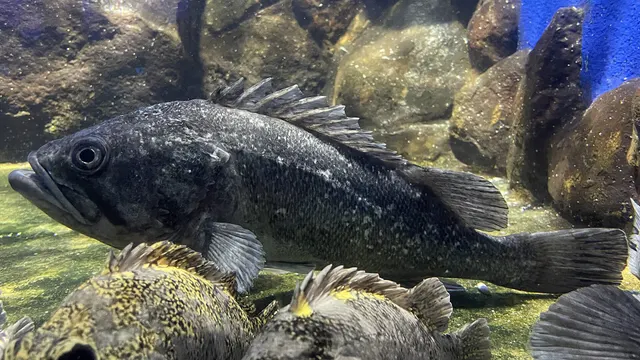 Korean rockfishThe principal recreational and farmed rockfish of Korea, China and Japan, bearing live young and carrying venomous fin spines.
Totti — CC BY-SA 4.0, via Wikimedia Commons
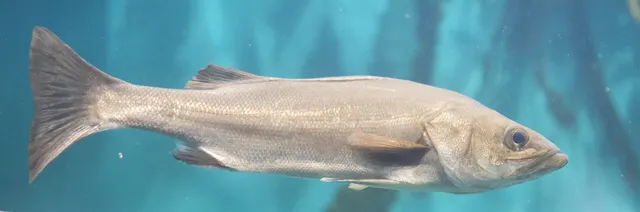 Japanese sea bassThe principal lure-fishing target of Japan, an estuary and coastal predator whose Japanese name changes with its size as it grows.
Kinori — CC0 1.0, via Wikimedia Commons
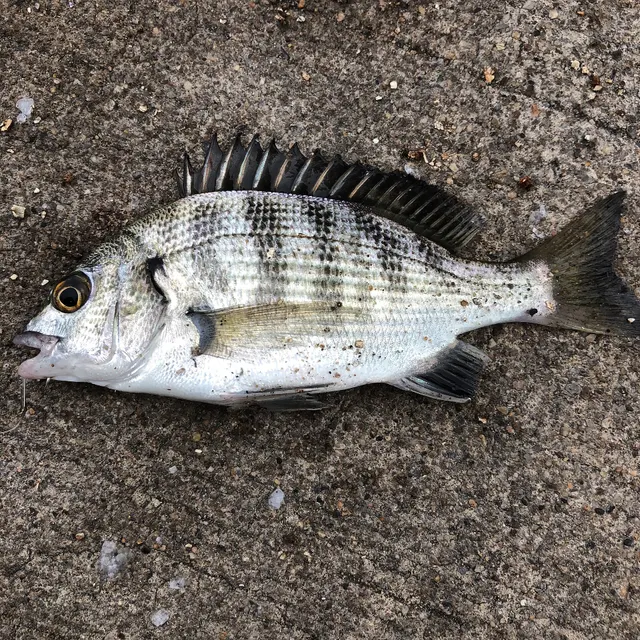 Blackhead seabreamA wary East Asian sparid of harbours and rocky shores, sex-changing as it grows, and the subject of an entire specialised Japanese angling discipline.
Rakurakuda — CC BY-SA 4.0, via Wikimedia Commons
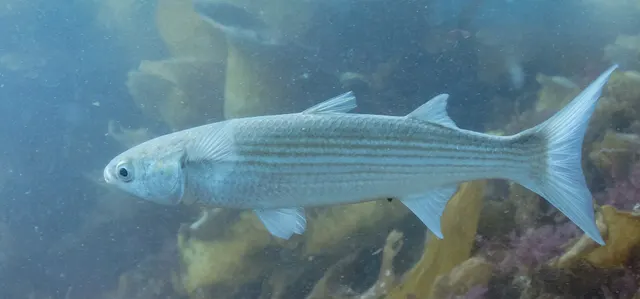 Flathead grey mulletThe most widely distributed mullet in the world, found on almost every warm and temperate coast, and a detritus feeder with a gizzard-like stomach.
Diego Delso, CC BY-SA 4.0, via Wikimedia Commons
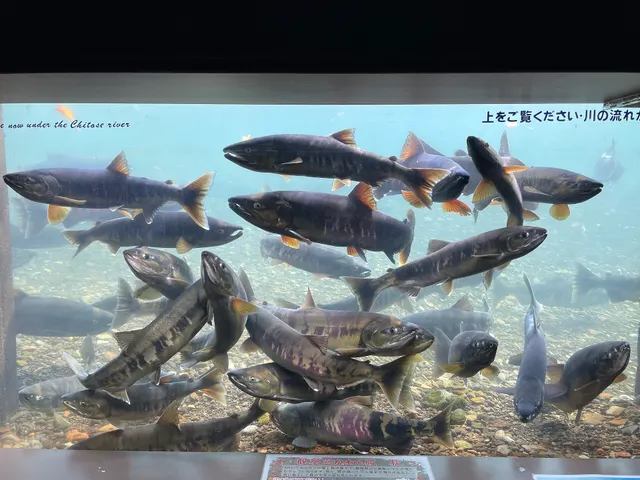 Chum salmonA large Pacific salmon without body spotting, developing striking purple calico bars and enlarged canine teeth at spawning, and the widest-ranging of its genus.
Totti — CC BY-SA 4.0, via Wikimedia Commons
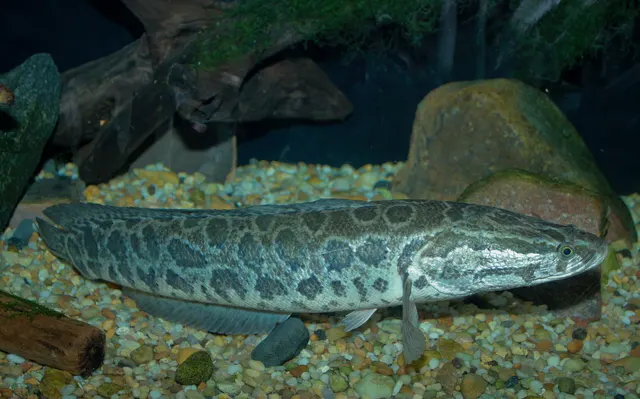 Northern snakeheadAn air-breathing East Asian predator, native and farmed in its home range, and a regulated invasive species in North America where introduced populations are established.
Brian Gratwicke — CC BY 2.0, via Wikimedia Commons
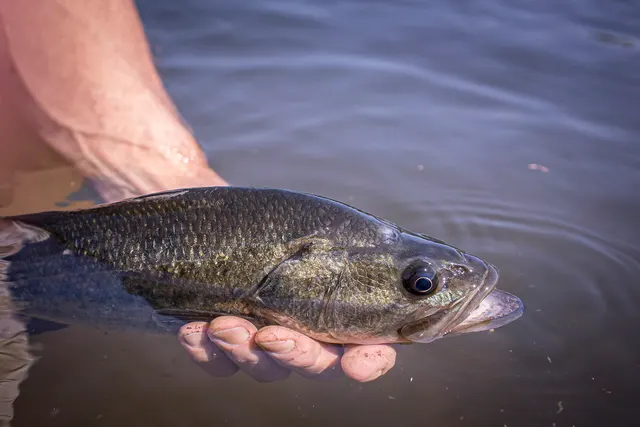 Largemouth bassThe most heavily fished freshwater sport species in the world: an ambush predator of warm, weedy, structured water.
USFWS Mountain Prairie, Public domain, via Wikimedia Commons
Safety
Tides and being cut off — Can cause serious injury or death
The west coast tidal range is among the largest in the world and the flats extend kilometres seaward. The flood returns across level ground faster than a person can walk out, channels fill behind you before the flat itself covers, and fog on the flats removes every landmark. People are cut off gathering on the gaetbeol every year.
What reduces it: Work the flats only on a falling tide with a known turn time, fix the route back before going out, and treat the filling of the channels behind you rather than the water at your feet as the signal to leave. Do not go out in fog. Carry a means of calling for help that survives immersion.
Worse when:
- Spring tides, when the flats expose furthest and the flood runs fastest.
- Fog, which is frequent on this coast and leaves no reference to walk back on.
- Soft ground, where wading out is far quicker than wading back.
Slips, trips and falls — Can cause serious injury or death
Concrete tetrapod armour on breakwaters is the standard shore fishing platform. The units are angular, frequently wet and weeded, and the voids between them are deep and irregular. A fall into a gap can cause serious injury, leaves a person out of sight, and is very difficult to climb out of unaided — particularly with a rising tide beneath.
What reduces it: Wear studded or spiked footwear, move on hands where the units are wet, never fish tetrapods alone, and treat the gaps rather than the outer edge as the main hazard. Keep a light and a phone on your body rather than in a bag left behind you.
Worse when:
- Wet or algae-covered units, particularly after rain or spray.
- Darkness, which is when much of the rockfish and squid fishing is done.
- A rising tide, which turns a fall into a gap into an immersion risk as well as an injury.
Weather and lightning — Can cause serious injury or death
Typhoons reach the peninsula from midsummer into early autumn, and the East Sea generates heavy winter storms with little warning ashore. Small boats and island trips are the exposed activity, and the concentrated summer rains raise rivers and reservoirs quickly.
What reduces it: Treat the marine forecast and typhoon warnings as the governing constraint rather than as advice, accept trip cancellations, and do not attempt island or offshore fishing on a deteriorating forecast. Ashore, leave rising water rather than working alongside it.
Further safety reading
- Cold water shock and immersion — Winter water temperatures on both coasts are low enough that immersion incapacitates quickly, which matters because much of the rockfish and squid fishing is a winter one.
- Shore entry and exit for divers — Concrete tetrapod armour is the standard shore platform here, and the deep angular voids between units are the specific falling hazard rather than the outer edge.
- Tides and being cut off — The west coast tidal range is among the largest in the world and the flats extend kilometres seaward, so the flood returns across level ground faster than a person can walk out.
- Weather, lightning and open water — Typhoons reach the peninsula from midsummer into early autumn and the East Sea generates heavy winter storms, both of which fall hardest on small-boat and island fishing.
Check the rules before you fish
Fishing laws, bylaws, access rules, seasons, bait restrictions and permitted methods vary by location and can change. Check the current rules from the relevant authority and the water you intend to fish before fishing.
Check with:
- Current national or regional law for where you are fishing
- Current local bylaws
- The relevant fisheries authority
- The landowner, club or fishery whose water it is
- Any restrictions specific to the species or the method you intend to use
Where to go next
What swims here
- Blackhead seabreamA hard-ground seabream of the south and east coasts, pursued with specialised light tackle and a serious technical following.
- Chum salmonRuns into a number of east coast rivers, at the southern edge of the species' range on this side of the Pacific.
- Flathead grey mulletWidespread in estuaries, harbours and the turbid west coast shallows, and one of the few species common to both of the peninsula's very different seas.
- Japanese amberjackArrives along the east coast and around Jeju with the warm current, supporting a jigging and casting fishery from small boats.
- Japanese anchovyA principal forage species of the surrounding seas and a major landing in its own right, dried and traded at scale.
- Japanese sea bassOccupies estuaries, harbours and river mouths around the peninsula, and is the principal target of the lure fishery around structure.
- Korean rockfishThe mainstay of east and south coast rock, breakwater and boat fishing, and probably the single most-targeted recreational sea fish on the peninsula.
- Largemouth bassIntroduced and established in reservoirs, where it supports a substantial and technically-minded lure fishery.
1 more
- Northern snakehead Fish
How people fish here
- Lure fishingLure fishing for rockfish, sea bass and amberjack is a developed technical discipline supported by a substantial domestic tackle industry.
- Sea fishingSea angling is a mainstream mass-participation activity here, with a very large charter fleet and dense shore fishing from engineered coast.
- Traps and potsPot and trap fishing for crab, octopus and shellfish is a significant inshore practice, much of it under communal village fishery rights.
How this compares
- East Asian fishingKorea shares the seas and much of the technique and administers them entirely differently, which is the clearest demonstration that there is no regional regulatory system here.
- JapanTwo neighbouring peninsular and island fisheries with overlapping species, shared gear traditions and quite different governance — the clearest available comparison for either.
Rules and access
- Licences and permissionCommunal fishing rights held by village cooperatives over designated inshore and intertidal grounds make permission a local question here rather than a national one.
- Taking crabs, lobsters, squid and shellfish: how the rules are structuredSquid, crab, octopus and shellfish are mainstream catch rather than curiosities, and the gathering of sedentary resources falls under cooperative rights as well as fisheries rules.
Environment and conservation
Sources and evidence
- FishBase: a global information system on fishes — Froese, R. and D. Pauly, eds. — FishBase Consortium (Scientific institute)Relied on for: Distribution, habitat association, depth range and life history recorded for the species occurring in the area.States this directlyPassage read and verified
- The IUCN Red List of Threatened Species — International Union for Conservation of Nature (Conservation authority)Relied on for: Assessment and range account for the species of the region, including the habitats they depend on and the pressures acting on them.States this directlyCitation checked — the work exists and is described correctly
- Good Fish Guide — Marine Conservation Society (Conservation authority)Relied on for: Assessment of fisheries and the management measures applied to them, including spatial protection and gear restriction.Background and mechanism onlyCitation checked — the work exists and is described correctly
- Code of Conduct for Responsible Fisheries — Food and Agriculture Organization of the United Nations, Rome, 1995 (Standards body)Relied on for: Principles for responsible fisheries management, precaution, and the treatment of small-scale and shared stocks.States this directlyCitation checked — the work exists and is described correctly
- Rock fishing safety and the declared lifejacket areas of New South Wales — NSW Department of Primary Industries and Surf Life Saving NSW (Water-safety or diver-training authority)Relied on for: Rock and ledge fishing hazards, the mechanism by which anglers are swept from exposed platforms, and the measures that reduce it.States this directlyCitation checked — the work exists and is described correctly
- United States Lifesaving Association public education on rip currents and the surf zone — United States Lifesaving Association (Water-safety or diver-training authority)Relied on for: Surf zone hazards, rip current formation and behaviour, and the circumstances in which people are carried offshore.States this directlyCitation checked — the work exists and is described correctly
Why the 21 connections on this page are here, and the sources
What swims here
Backed by research — 9 connections
Supported by peer-reviewed research or fisheries science. The sources are listed and can be checked.
Blackhead seabream
A distribution association between an animal and a kind of water, rather than a claim about any named mark.
- FishBase: a global information system on fishes — Froese, R. and D. Pauly, eds. — FishBase Consortium (Scientific institute)Relied on for: Distribution, habitat association and depth range recorded for the species, including its occurrence in the water body concerned.States this directlyPassage read and verified
- The IUCN Red List of Threatened Species — International Union for Conservation of Nature (Conservation authority)Relied on for: Assessment and range account for the species, including the systems and coasts it occupies.Background and mechanism onlyCitation checked — the work exists and is described correctly
Chum salmon
A distribution association between an animal and a kind of water, rather than a claim about any named mark.
- FishBase: a global information system on fishes — Froese, R. and D. Pauly, eds. — FishBase Consortium (Scientific institute)Relied on for: Distribution, habitat association and depth range recorded for the species, including its occurrence in the water body concerned.States this directlyPassage read and verified
- The IUCN Red List of Threatened Species — International Union for Conservation of Nature (Conservation authority)Relied on for: Assessment and range account for the species, including the systems and coasts it occupies.Background and mechanism onlyCitation checked — the work exists and is described correctly
Flathead grey mullet
A distribution association between an animal and a kind of water, rather than a claim about any named mark.
- FishBase: a global information system on fishes — Froese, R. and D. Pauly, eds. — FishBase Consortium (Scientific institute)Relied on for: Distribution, habitat association and depth range recorded for the species, including its occurrence in the water body concerned.States this directlyPassage read and verified
- The IUCN Red List of Threatened Species — International Union for Conservation of Nature (Conservation authority)Relied on for: Assessment and range account for the species, including the systems and coasts it occupies.Background and mechanism onlyCitation checked — the work exists and is described correctly
Japanese amberjack
A distribution association between an animal and a kind of water, rather than a claim about any named mark.
- FishBase: a global information system on fishes — Froese, R. and D. Pauly, eds. — FishBase Consortium (Scientific institute)Relied on for: Distribution, habitat association and depth range recorded for the species, including its occurrence in the water body concerned.States this directlyPassage read and verified
- The IUCN Red List of Threatened Species — International Union for Conservation of Nature (Conservation authority)Relied on for: Assessment and range account for the species, including the systems and coasts it occupies.Background and mechanism onlyCitation checked — the work exists and is described correctly
Japanese anchovy
A distribution association between an animal and a kind of water, rather than a claim about any named mark.
- FishBase: a global information system on fishes — Froese, R. and D. Pauly, eds. — FishBase Consortium (Scientific institute)Relied on for: Distribution, habitat association and depth range recorded for the species, including its occurrence in the water body concerned.States this directlyPassage read and verified
- The IUCN Red List of Threatened Species — International Union for Conservation of Nature (Conservation authority)Relied on for: Assessment and range account for the species, including the systems and coasts it occupies.Background and mechanism onlyCitation checked — the work exists and is described correctly
Japanese sea bass
A distribution association between an animal and a kind of water, rather than a claim about any named mark.
- FishBase: a global information system on fishes — Froese, R. and D. Pauly, eds. — FishBase Consortium (Scientific institute)Relied on for: Distribution, habitat association and depth range recorded for the species, including its occurrence in the water body concerned.States this directlyPassage read and verified
- The IUCN Red List of Threatened Species — International Union for Conservation of Nature (Conservation authority)Relied on for: Assessment and range account for the species, including the systems and coasts it occupies.Background and mechanism onlyCitation checked — the work exists and is described correctly
Korean rockfish
A distribution association between an animal and a kind of water, rather than a claim about any named mark.
- FishBase: a global information system on fishes — Froese, R. and D. Pauly, eds. — FishBase Consortium (Scientific institute)Relied on for: Distribution, habitat association and depth range recorded for the species, including its occurrence in the water body concerned.States this directlyPassage read and verified
- The IUCN Red List of Threatened Species — International Union for Conservation of Nature (Conservation authority)Relied on for: Assessment and range account for the species, including the systems and coasts it occupies.Background and mechanism onlyCitation checked — the work exists and is described correctly
Largemouth bass
A distribution association between an animal and a kind of water, rather than a claim about any named mark.
- FishBase: a global information system on fishes — Froese, R. and D. Pauly, eds. — FishBase Consortium (Scientific institute)Relied on for: Distribution, habitat association and depth range recorded for the species, including its occurrence in the water body concerned.States this directlyPassage read and verified
- The IUCN Red List of Threatened Species — International Union for Conservation of Nature (Conservation authority)Relied on for: Assessment and range account for the species, including the systems and coasts it occupies.Background and mechanism onlyCitation checked — the work exists and is described correctly
Northern snakehead
A distribution association between an animal and a kind of water, rather than a claim about any named mark.
- FishBase: a global information system on fishes — Froese, R. and D. Pauly, eds. — FishBase Consortium (Scientific institute)Relied on for: Distribution, habitat association and depth range recorded for the species, including its occurrence in the water body concerned.States this directlyPassage read and verified
- The IUCN Red List of Threatened Species — International Union for Conservation of Nature (Conservation authority)Relied on for: Assessment and range account for the species, including the systems and coasts it occupies.Background and mechanism onlyCitation checked — the work exists and is described correctly
How people fish here
What experienced anglers do — 3 connections
Widely and independently recommended by experienced anglers and specialist sources. This is real angling knowledge, not proof: controlled evidence for it is limited, and FishingHQ records it as convention rather than as a demonstrated effect.
Lure fishing
A discipline that is characteristic of the place rather than merely possible there, joined so a reader can move between the place and the practice.
- General angling website restatements of established technique — Various (Credible secondary source)Relied on for: Widely restated practice associating this discipline with this place, recorded as practitioner consensus rather than as tested fact.Background and mechanism onlyCitation checked — the work exists and is described correctly
- Fishers' Craft and Lettered Art: Tracts on Fishing from the End of the Middle Ages — University of Toronto Press, 1997 (Scientific literature)Relied on for: That fishing traditions develop around the water and fish available to them, and the historical method of reading such traditions.States this directlyCitation checked — the work exists and is described correctly
Sea fishing
A discipline that is characteristic of the place rather than merely possible there, joined so a reader can move between the place and the practice.
- General angling website restatements of established technique — Various (Credible secondary source)Relied on for: Widely restated practice associating this discipline with this place, recorded as practitioner consensus rather than as tested fact.Background and mechanism onlyCitation checked — the work exists and is described correctly
- Fishers' Craft and Lettered Art: Tracts on Fishing from the End of the Middle Ages — University of Toronto Press, 1997 (Scientific literature)Relied on for: That fishing traditions develop around the water and fish available to them, and the historical method of reading such traditions.States this directlyCitation checked — the work exists and is described correctly
Traps and pots
A discipline that is characteristic of the place rather than merely possible there, joined so a reader can move between the place and the practice.
- General angling website restatements of established technique — Various (Credible secondary source)Relied on for: Widely restated practice associating this discipline with this place, recorded as practitioner consensus rather than as tested fact.Background and mechanism onlyCitation checked — the work exists and is described correctly
- Fishers' Craft and Lettered Art: Tracts on Fishing from the End of the Middle Ages — University of Toronto Press, 1997 (Scientific literature)Relied on for: That fishing traditions develop around the water and fish available to them, and the historical method of reading such traditions.States this directlyCitation checked — the work exists and is described correctly
How this compares
What experienced anglers do — 2 connections
Widely and independently recommended by experienced anglers and specialist sources. This is real angling knowledge, not proof: controlled evidence for it is limited, and FishingHQ records it as convention rather than as a demonstrated effect.
East Asian fishing
A continental overview joined to a record it sits above, so that the synthesis and the detail are reachable from one another rather than duplicating each other.
- FAO fishing gear types and fishing technology information — Food and Agriculture Organization of the United Nations (Scientific institute)Relied on for: Classification and description of world fishing gears and the regions in which each is used.States this directlyCitation checked — the work exists and is described correctly
- General angling website restatements of established technique — Various (Credible secondary source)Relied on for: Widely restated descriptions of regional angling practice, recorded as consensus rather than as scholarship.Background and mechanism onlyCitation checked — the work exists and is described correctly
Japan
Two places a reader would reasonably weigh against one another, joined where the comparison teaches something about both. It is also how the larger geography is linked to what sits inside it.
- General angling website restatements of established technique — Various (Credible secondary source)Relied on for: Widely restated practice associating this discipline with this place, recorded as practitioner consensus rather than as tested fact.Background and mechanism onlyCitation checked — the work exists and is described correctly
- Fishers' Craft and Lettered Art: Tracts on Fishing from the End of the Middle Ages — University of Toronto Press, 1997 (Scientific literature)Relied on for: That fishing traditions develop around the water and fish available to them, and the historical method of reading such traditions.States this directlyCitation checked — the work exists and is described correctly
Safety reading
Official guidance — 4 connections
Stated by a fisheries authority, scientific institute or recognised angling body. Authoritative, but summarising rather than demonstrating.
Cold water shock and immersion
A place is joined to the safety topic that explains a hazard genuinely characteristic of it, so the mechanism is reachable rather than restated as a weak warning.
- RNLI water safety guidance: cold water shock and Float to Live — Royal National Lifeboat Institution (Water-safety or diver-training authority)Relied on for: Cold water shock and the immersion response, shore angling hazards, small-craft guidance and the circumstances in which water users are most often killed.States this directlyPassage read and verified
- RoSPA water safety information and UK accidental drowning statistics — Royal Society for the Prevention of Accidents (Water-safety or diver-training authority)Relied on for: Accidental drowning statistics and the circumstances in which recreational water users are most often killed.Background and mechanism onlyPassage read and verified
Shore entry and exit for divers
A place is joined to the safety topic that explains a hazard genuinely characteristic of it, so the mechanism is reachable rather than restated as a weak warning.
- Rock fishing safety and the declared lifejacket areas of New South Wales — NSW Department of Primary Industries and Surf Life Saving NSW (Water-safety or diver-training authority)Relied on for: Rock and ledge fishing hazards, the mechanism by which anglers are swept from exposed platforms, and the measures that reduce it.States this directlyCitation checked — the work exists and is described correctly
- United States Lifesaving Association public education on rip currents and the surf zone — United States Lifesaving Association (Water-safety or diver-training authority)Relied on for: Surf zone hazards, rip current formation and behaviour, and the circumstances in which people are carried offshore.States this directlyCitation checked — the work exists and is described correctly
Tides and being cut off
A place is joined to the safety topic that explains a hazard genuinely characteristic of it, so the mechanism is reachable rather than restated as a weak warning.
- RNLI water safety guidance: cold water shock and Float to Live — Royal National Lifeboat Institution (Water-safety or diver-training authority)Relied on for: Cold water shock and the immersion response, shore angling hazards, small-craft guidance and the circumstances in which water users are most often killed.States this directlyPassage read and verified
- RoSPA water safety information and UK accidental drowning statistics — Royal Society for the Prevention of Accidents (Water-safety or diver-training authority)Relied on for: Accidental drowning statistics and the circumstances in which recreational water users are most often killed.Background and mechanism onlyPassage read and verified
Weather, lightning and open water
A place is joined to the safety topic that explains a hazard genuinely characteristic of it, so the mechanism is reachable rather than restated as a weak warning.
- NOAA National Weather Service marine forecasts and marine weather services — National Oceanic and Atmospheric Administration, United States (Government fisheries body)Relied on for: Marine forecasting, tropical cyclone warning practice and the products issued for coastal and offshore waters.States this directlyCitation checked — the work exists and is described correctly
- NOAA Diving Manual: Diving for Science and Technology — National Oceanic and Atmospheric Administration, US Department of Commerce (Scientific institute)Relied on for: Diving and in-water hazards, including hazardous marine life, currents and the management of operations in remote locations.Background and mechanism onlyCitation checked — the work exists and is described correctly
Rules and access
Official guidance — 2 connections
Stated by a fisheries authority, scientific institute or recognised angling body. Authoritative, but summarising rather than demonstrating.
Licences and permission
A place joined to the regulatory concept whose structure it illustrates. The edge asserts that the concept applies here, never what any current rule says.
- Code of Conduct for Responsible Fisheries — Food and Agriculture Organization of the United Nations, Rome, 1995 (Standards body)Relied on for: Principles for the management of fisheries, including licensing, closed seasons, size limits and the treatment of small-scale and shared stocks.States this directlyCitation checked — the work exists and is described correctly
- Good Fish Guide — Marine Conservation Society (Conservation authority)Relied on for: Assessment of fisheries and the management measures applied to them, including the instruments used and their purpose.Background and mechanism onlyCitation checked — the work exists and is described correctly
Taking crabs, lobsters, squid and shellfish: how the rules are structured
A place joined to the regulatory concept whose structure it illustrates. The edge asserts that the concept applies here, never what any current rule says.
- Code of Conduct for Responsible Fisheries — Food and Agriculture Organization of the United Nations, Rome, 1995 (Standards body)Relied on for: Principles for the management of fisheries, including licensing, closed seasons, size limits and the treatment of small-scale and shared stocks.States this directlyCitation checked — the work exists and is described correctly
- Good Fish Guide — Marine Conservation Society (Conservation authority)Relied on for: Assessment of fisheries and the management measures applied to them, including the instruments used and their purpose.Background and mechanism onlyCitation checked — the work exists and is described correctly
Environment and conservation
Backed by research — 1 connection
Supported by peer-reviewed research or fisheries science. The sources are listed and can be checked.
Fish stocks and sustainability
An environmental pressure that is specific to this place rather than general to fishing, joined so the issue is anchored to a real example.
- The IUCN Red List of Threatened Species — International Union for Conservation of Nature (Conservation authority)Relied on for: Assessment of the species and habitats affected, and the pressures acting on them, including habitat change and exploitation.States this directlyCitation checked — the work exists and is described correctly
- Code of Conduct for Responsible Fisheries — Food and Agriculture Organization of the United Nations, Rome, 1995 (Standards body)Relied on for: Principles for responsible fisheries management, precaution, gear selectivity and the treatment of shared and small-scale fisheries.Background and mechanism onlyCitation checked — the work exists and is described correctly
How FishingHQ labels evidence is explained in the evidence policy.