Japanese sea bass
Fish · Last reviewed 2026-08-10
The principal lure-fishing target of Japan, an estuary and coastal predator whose Japanese name changes with its size as it grows.
Safety: injury while handling fish — minor injury.
How this was identified, and who took it
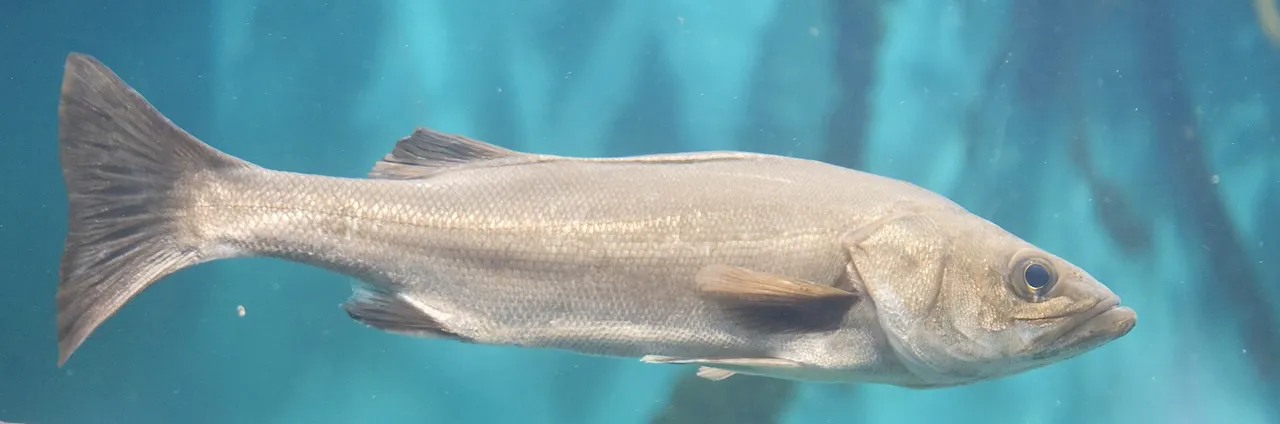
Identified by: A full lateral view of an adult against a plain ground. Slim silver body with a greenish-grey back, a pointed snout with a projecting lower jaw, a large oblique mouth, sharp-edged gill covers and a deeply forked tail. Spotting is absent, which agrees with the record's statement that it fades progressively in larger adults rather than contradicting it. The first dorsal is laid flat against the back, so the spiny fin reads as a ridge rather than a raised fan.Kinori — CC0 1.0, via Wikimedia Commons — source, licenceCatching Japanese sea bass
Everything here on fishing for it. Each entry opens the page behind it.
Japanese sea bass — suzuki — is the fish around which modern Japanese lure fishing was built, and a great deal of the world's lure design and technique traces back to fishing for it in Tokyo Bay and comparable estuaries.
It is a slim, silver, large-mouthed predator of estuaries, harbours, surf and river mouths, hunting at night and around tidal change. It runs well up into fresh water and is caught in city rivers as readily as on open coast.
It is a shussero-uo — a fish whose Japanese name changes as it grows, from seigo to fukko to suzuki — a naming convention that reflects genuine cultural importance rather than a curiosity, and one that FishingHQ records as terminology rather than as separate species.
How it is caught
Gear for this fish
- Soft plasticsSuzuki are fished with soft plastics and minnows around river mouths, harbour walls and current seams, and the Japanese lure practice around them is among the most developed in the world.
- JerkbaitsThe shallow suspending minnow is the archetypal seabass lure in Japan, drifted and twitched in current rather than retrieved steadily.
Identification
- Scientific name
- Lateolabrax japonicus
- Family
- Lateolabracidae
- Water
- Saltwater, Brackish, Freshwater
- Conservation status
- Least Concern
- Regions
- East Asia
- Slim silver body with a greenish-grey back and a large oblique mouth.
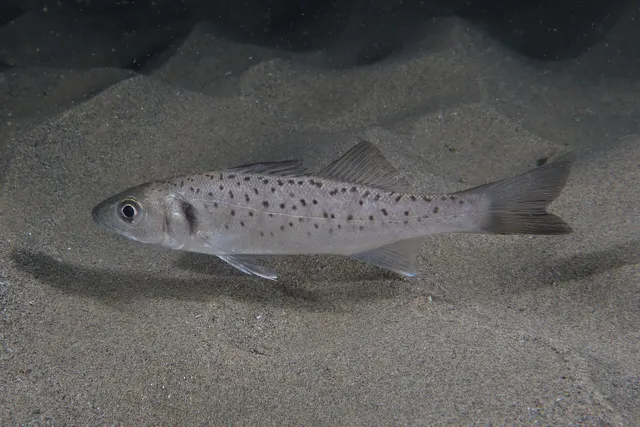
- Two dorsal fins, the first strongly spiny, with small dark spots on the back and first dorsal in younger fish.
- A pointed snout and a projecting lower jaw, with sharp-edged gill covers.
- Deeply forked tail; spotting fades progressively in larger adults.
Size
- Typical
- 1–3 kg (2.2–6.6 lb)
- Large
- 4–8 kg (8.8–18 lb)
Exceptional: FishBase records a maximum of 102 cm and 8.7 kg
An abrasive mouth and a gill cover that cuts, on a fish handled in the dark
Suzuki handling is decided by an asymmetry that catches people out: the part that looks dangerous is not, and the part that does not look dangerous is.
THE MOUTH IS LARGE AND LOOKS ALARMING and contains nothing that will cut. Japanese sea bass feed by engulfing prey whole with a large bucket mouth, and the grip surfaces inside it are rough, abrasive pads rather than teeth. A thumb in the mouth comes out roughened and intact, which is why lip gripping is the standard hold in this fishery.
THE GILL COVER IS THE HAZARD, and it is genuinely sharp — a hard plate with a fine trailing edge that slices deeply on a fish that is thrashing. The injury is a clean cut rather than a puncture, it happens to the hand supporting the body, and it happens because the natural place to put that hand is exactly where the operculum is.
WHICH MATTERS MORE THAN USUAL BECAUSE OF WHERE AND WHEN THIS FISHERY HAPPENS. Suzuki are fished at night, from harbour walls, tetrapods, river mouths and rock, in current, often alone, in low light. Everything about handling a strong fish is harder in those conditions, the footing is frequently poor, and a hand injury a long way from a road at two in the morning is a different proposition from the same injury in daylight.
SO: a lip grip takes the head, a wet hand under the belly takes the weight and stays forward of the gill covers, and the fish is supported horizontally rather than hung. Long pliers unhook it, which also keeps hands clear of the trebles this fishery uses.
AND THE RELEASE NORM IS STRONG. Lure anglers in Japan release suzuki as a matter of course, which makes handling the operative conservation measure for the species in that fishery — and means keeping the fish wet, minimising air time and returning it promptly are the substance rather than the courtesy.
What experienced anglers do — why, and the sources (2)
Widely and independently recommended by experienced anglers and specialist sources. This is real angling knowledge, not proof: controlled evidence for it is limited, and FishingHQ records it as convention rather than as a demonstrated effect.
- Sea Angler — Bauer Media (Specialist angling publication)Relied on for: Established boat and shore practice for handling and returning the species.States this directlyCitation checked — the work exists and is described correctly
- IGFA International Angling Rules and World Record Requirements — International Game Fish Association (Angling or fisheries organisation)Relied on for: Handling, release and tackle conventions in recognised sport fisheries for the species.Background and mechanism onlyPassage read and verified
Long casts, urban structure and current: tackle built for a lure at distance
Japanese sea bass tackle is specified by a fishery conducted largely at night, from banks and structure, casting light lures a long way into moving water — and every element follows from that.
CASTING DISTANCE IS THE FIRST REQUIREMENT AND IT SHAPES THE ROD. Much of this fishing happens from harbour walls, breakwaters, river mouths and bridges where the fish are beyond an ordinary cast, and the rods used are long by lure-fishing standards specifically to reach them. That length also helps keep line clear of structure below the angler, which is a second and less obvious job.
THE LURES ARE LIGHT AND THE CASTS ARE LONG, which is an awkward combination and is why the tackle is as specialised as it is. A rod that loads with a light minnow and still delivers distance is a genuine design problem, and it is the problem this fishery's tackle exists to solve.
CURRENT IS WHERE THE FISH ARE. Seabass hold in tidal flow around structure, bridge piers, river mouths and outfalls, ambushing what the water brings — the same hydraulic logic as European bass. So the retrieve is frequently a matter of controlling a lure in current rather than moving it, and the tackle must maintain contact through that.
STRUCTURE SETS THE LEADER. Concrete, rock armour, pilings and shell growth cut line, so a shock leader of heavier fluorocarbon between braid and lure is standard — doing abrasion work rather than concealment work, and joined with a knot that passes through the guides on a long cast.
THE FISH RUNS AND SHAKES ITS HEAD VIOLENTLY AT THE SURFACE, and the gill covers are sharp. A drag that yields smoothly and a leader that survives contact with the fish's own head are both part of the same problem.
AND LANDING FROM HEIGHT IS A REAL CONSTRAINT that visiting anglers overlook. From a harbour wall the fish must be lifted or netted several metres, and a drop net or a long-handled net is part of the outfit rather than an accessory — lifting a fish on the leader is how both fish and tackle are lost.
What experienced anglers do — why, and the sources (2)
Widely and independently recommended by experienced anglers and specialist sources. This is real angling knowledge, not proof: controlled evidence for it is limited, and FishingHQ records it as convention rather than as a demonstrated effect.
- Sea Angler — Bauer Media (Specialist angling publication)Relied on for: Established shore and boat angling practice, including tackle selection and the reasoning behind it.States this directlyCitation checked — the work exists and is described correctly
- General angling website restatements of established technique — Various (Credible secondary source)Relied on for: The widely restated tackle practice for this species, recorded as a consensus position rather than as an original observation.States this directlyCitation checked — the work exists and is described correctly
Working a lure in current at night, and letting the flow do the retrieving
Seabass lure fishing is largely a night fishery in moving water, and its central technique is one that feels wrong to anglers trained to retrieve.
THE FISH FEEDS ON WHAT THE CURRENT DELIVERS. Seabass hold in tidal flow around bridge piers, harbour walls, river mouths, outfalls and current seams, facing into the water and intercepting prey that the flow has already disoriented. A lure being dragged across that at speed does not look like anything the fish is waiting for.
SO THE PRODUCTIVE PRESENTATION IS FREQUENTLY A DRIFT WITH MINIMAL RETRIEVE. Casting up-current and letting the lure swing down and across at close to the speed of the water — a fly angler's swing, executed with a minnow — is the technique that consistently works, and the retrieve is doing little more than maintaining contact. Anglers who wind steadily catch a fraction of what the drift produces.
CURRENT SEAMS AND SHADOW LINES ARE WHERE TO PUT IT. The edge between fast and slow water, the eddy behind a pier, and the sharp line between lit and unlit water under a bridge are all places prey is concentrated and disoriented, and the fish sit on the dark side looking into the light.
WHICH MAKES ARTIFICIAL LIGHT PART OF THE FISHERY RATHER THAN AN INTRUSION. Harbour, bridge and street lighting concentrate baitfish and give an ambush predator a lit stage to hunt against, and much of this discipline's best fishing happens on structures nobody would describe as natural.
LURE SIZE FOLLOWS THE BAIT PRESENT rather than the fish, and matching the size of whatever is being pushed around by the current is more useful than matching a colour.
SURFACE AND SUB-SURFACE BOTH WORK IN SHALLOW WATER, and the choice is made by depth and by how much current there is — a shallow-running minnow held in flow is the workhorse, and heavier sinking lures reach fish in deeper channels.
AND THE FISH SHAKES ITS HEAD HARD AT THE SURFACE with sharp gill covers, which is why the record's tackle section specifies a leader that survives contact with the fish's own head rather than merely with the structure.
What experienced anglers do — why, and the sources (2)
Widely and independently recommended by experienced anglers and specialist sources. This is real angling knowledge, not proof: controlled evidence for it is limited, and FishingHQ records it as convention rather than as a demonstrated effect.
- Sea Angler — Bauer Media (Specialist angling publication)Relied on for: Established shore and boat angling practice, including method selection and the reasoning behind it.States this directlyCitation checked — the work exists and is described correctly
- General angling website restatements of established technique — Various (Credible secondary source)Relied on for: The widely restated practice for this species, recorded as a consensus position rather than as an original observation.States this directlyCitation checked — the work exists and is described correctly
Lifecycle and reproduction
Moderately long-lived, moving between estuarine, coastal and fresh water through life. Juveniles use estuaries and river mouths heavily, so the species is tied to estuarine condition.
Spawns offshore in winter in coastal waters, with juveniles moving into estuaries and rivers to grow. The seasonal shift between spawning grounds and estuarine habitat structures the fishing year.
Feeding and senses
Takes small fish, shrimp and crabs, ambushing prey around structure, current seams and the light lines cast by harbour and bridge lighting at night. It holds in the dark water at the edge of a lit area and takes prey silhouetted against the light, which is the basis of most night lure fishing for it.
Hunts in low light and at night, using sight around artificial light lines and lateral-line detection in current. Feeding concentrates on tidal change rather than on time of day alone.
Through the year
Moves offshore to spawn in winter and into estuaries, rivers and surf through the warmer months. Availability to shore anglers is highest outside the spawning period.
Distribution
Western Pacific: Japan to the South China Sea
This is a biological range — where the species occurs, not a prediction that you will catch one. To browse the fishing geography FishingHQ holds, start at fishing places.
Why anglers care
The central lure target of Japanese saltwater angling, taken on minnows, vibration lures, soft plastics and surface lures around harbour lights, river mouths and surf. Its significance to the wider sport is unusually large: much modern lure design, rod action and retrieve technique originated in this fishery and has since been exported worldwide.
Handling and returning
The gill covers are sharp enough to cut badly and the mouth, while large, has an abrasive rather than toothed grip surface. Use a lip grip or support the body, avoid the gill plates, and return fish promptly. Widely released in Japan by lure anglers.
Going further
- What does japanese sea bass eat? — feeding biology, kept separate from what anglers infer from it.
- Japanese sea bass vs European sea bass — how to tell them apart.
Safety
Injury while handling fish — Minor injury
The rear edges of the gill covers are sharp and cause deep cuts to hands during landing and unhooking.
What reduces it: Grip the lower jaw or support the body, and keep hands clear of the gill plate edges. Use a lip grip tool where available.
Where to go next
Similar and related fish

Where it lives
Where you will find it
Sources and evidence
- FishBase: a global information system on fishes — Froese, R. and D. Pauly, eds. — FishBase Consortium (Scientific institute)Relied on for: Family, maximum size, depth and environment, distribution and the IUCN assessment for Lateolabrax japonicus.States this directlyPassage read and verified
- The IUCN Red List of Threatened Species — International Union for Conservation of Nature (Conservation authority)Relied on for: The Least Concern assessment for Lateolabrax japonicus, assessed 09 January 2023.States this directlyCitation checked — the work exists and is described correctly
Why the 10 connections on this page are here, and the sources
Similar and related fish
Backed by research — 2 connections
Supported by peer-reviewed research or fisheries science. The sources are listed and can be checked.
European sea bass
An identification comparison naming both binomials: Lateolabrax japonicus and Dicentrarchus labrax.
- FishBase: a global information system on fishes — Froese, R. and D. Pauly, eds. — FishBase Consortium (Scientific institute)Relied on for: Morphological and distributional data for Lateolabrax japonicus and for Dicentrarchus labrax.States this directlyPassage read and verified
- The IUCN Red List of Threatened Species — International Union for Conservation of Nature (Conservation authority)Relied on for: Separate assessments treating Lateolabrax japonicus and Dicentrarchus labrax as distinct species.States this directlyCitation checked — the work exists and is described correctly
Japanese anchovy
Recorded diet evidence identifies Engraulis japonicus as a food item of this predator at species level. The edge is written at that granularity and no further.
- FishBase: a global information system on fishes — Froese, R. and D. Pauly, eds. — FishBase Consortium (Scientific institute)Relied on for: Food items recorded for this predator, including Engraulis japonicus.States this directlyPassage read and verified
- FAO Species Identification Guides for Fishery Purposes and the FAO Species Catalogues — Food and Agriculture Organization of the United Nations (Scientific institute)Relied on for: Species account describing the diet of this predator in the region where Engraulis japonicus occurs.Background and mechanism onlyCitation checked — the work exists and is described correctly
How it is caught
What experienced anglers do — 2 connections
Widely and independently recommended by experienced anglers and specialist sources. This is real angling knowledge, not proof: controlled evidence for it is limited, and FishingHQ records it as convention rather than as a demonstrated effect.
Popping and stickbaiting
A practitioner claim about how Lateolabrax japonicus is commonly fished, following from where and how it feeds.
- General angling website restatements of established technique — Various (Credible secondary source)Relied on for: Widely restated practitioner accounts of fishing for japanese sea bass.Citation checked — the work exists and is described correctly
- Sea Angler — Bauer Media (Specialist angling publication)Relied on for: Practitioner treatment of the methods used for japanese sea bass and comparable species.Citation checked — the work exists and is described correctly
Spinning
A practitioner claim about how Lateolabrax japonicus is commonly fished, following from where and how it feeds.
- General angling website restatements of established technique — Various (Credible secondary source)Relied on for: Widely restated practitioner accounts of fishing for japanese sea bass.Citation checked — the work exists and is described correctly
- Sea Angler — Bauer Media (Specialist angling publication)Relied on for: Practitioner treatment of the methods used for japanese sea bass and comparable species.Citation checked — the work exists and is described correctly
Gear for this fish
What experienced anglers do — 2 connections
Widely and independently recommended by experienced anglers and specialist sources. This is real angling knowledge, not proof: controlled evidence for it is limited, and FishingHQ records it as convention rather than as a demonstrated effect.
Soft plastics
A practitioner claim about tackle commonly used for Lateolabrax japonicus.
- General angling website restatements of established technique — Various (Credible secondary source)Relied on for: Widely restated practitioner accounts of this presentation for japanese sea bass.Citation checked — the work exists and is described correctly
- Angling Times — Bauer Media (Specialist angling publication)Relied on for: Practitioner treatment of comparable presentations for the species group.Citation checked — the work exists and is described correctly
A practitioner claim about which lure family answers this species' feeding or holding behaviour.
- IGFA International Angling Rules and World Record Requirements — International Game Fish Association (Angling or fisheries organisation)Relied on for: Recognition of the species as an established sport fish taken on artificial lures, and the line and tackle classes used for it.States this directlyPassage read and verified
- General angling website restatements of established technique — Various (Credible secondary source)Relied on for: Widely restated lure practice for this species.Background and mechanism onlyCitation checked — the work exists and is described correctly
Jerkbaits
A practitioner claim about which lure family answers this species' feeding or holding behaviour.
- IGFA International Angling Rules and World Record Requirements — International Game Fish Association (Angling or fisheries organisation)Relied on for: Recognition of the species as an established sport fish taken on artificial lures, and the line and tackle classes used for it.States this directlyPassage read and verified
- General angling website restatements of established technique — Various (Credible secondary source)Relied on for: Widely restated lure practice for this species.Background and mechanism onlyCitation checked — the work exists and is described correctly
Where it lives
Backed by research — 3 connections
Supported by peer-reviewed research or fisheries science. The sources are listed and can be checked.
Estuary
A habitat association for Lateolabrax japonicus taken from the environment and distribution data on its FishBase summary.
- FishBase: a global information system on fishes — Froese, R. and D. Pauly, eds. — FishBase Consortium (Scientific institute)Relied on for: The environment, depth range and habitat description recorded for Lateolabrax japonicus.States this directlyPassage read and verified
Harbours, piers and breakwaters
A habitat association for Lateolabrax japonicus taken from the environment and distribution data on its FishBase summary.
- FishBase: a global information system on fishes — Froese, R. and D. Pauly, eds. — FishBase Consortium (Scientific institute)Relied on for: The environment, depth range and habitat description recorded for Lateolabrax japonicus.States this directlyPassage read and verified
Surf beaches
A habitat association for Lateolabrax japonicus taken from the environment and distribution data on its FishBase summary.
- FishBase: a global information system on fishes — Froese, R. and D. Pauly, eds. — FishBase Consortium (Scientific institute)Relied on for: The environment, depth range and habitat description recorded for Lateolabrax japonicus.States this directlyPassage read and verified
Where you will find it
Backed by research — 1 connection
Supported by peer-reviewed research or fisheries science. The sources are listed and can be checked.
Korea
A distribution association between an animal and a kind of water, rather than a claim about any named mark.
- FishBase: a global information system on fishes — Froese, R. and D. Pauly, eds. — FishBase Consortium (Scientific institute)Relied on for: Distribution, habitat association and depth range recorded for the species, including its occurrence in the water body concerned.States this directlyPassage read and verified
- The IUCN Red List of Threatened Species — International Union for Conservation of Nature (Conservation authority)Relied on for: Assessment and range account for the species, including the systems and coasts it occupies.Background and mechanism onlyCitation checked — the work exists and is described correctly
How FishingHQ labels evidence is explained in the evidence policy.