What does japanese sea bass eat?
What is established about how japanese sea bass feeds, kept separate from what anglers infer from it.
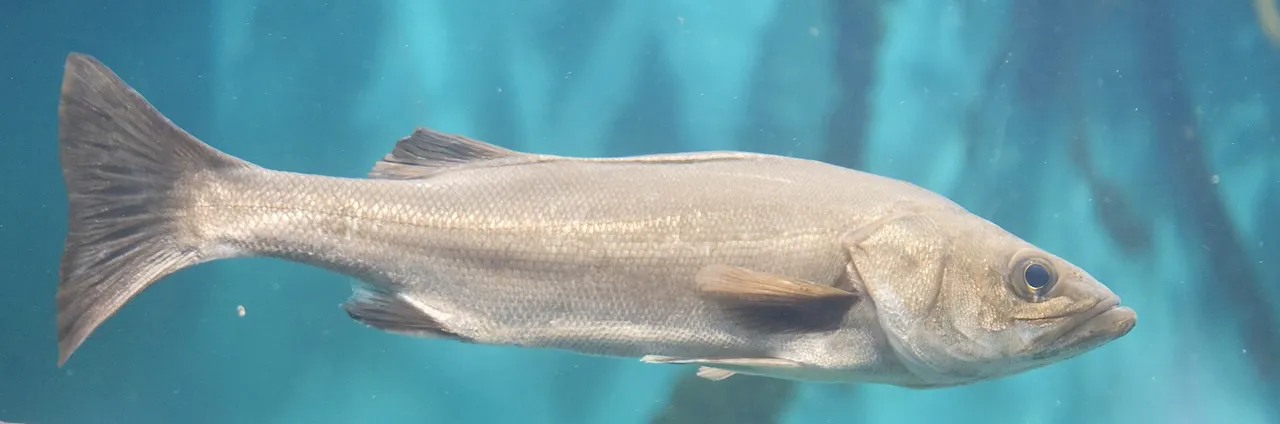
How this was identified, and who took it
Identified by: A full lateral view of an adult against a plain ground. Slim silver body with a greenish-grey back, a pointed snout with a projecting lower jaw, a large oblique mouth, sharp-edged gill covers and a deeply forked tail. Spotting is absent, which agrees with the record's statement that it fades progressively in larger adults rather than contradicting it. The first dorsal is laid flat against the back, so the spiny fin reads as a ridge rather than a raised fan.Kinori — CC0 1.0, via Wikimedia Commons — source, licenceWhat is known about how it feeds
The Japanese sea bass is a fish that has made a living out of artificial lighting.
It holds in the dark water at the edge of a lit area — harbour lights, bridge lights, the shadow line cast by any structure over water — and takes prey silhouetted against the illumination. The fish is in the dark; the prey is in the light; the edge between them is the feeding station. That is one of the most specific feeding behaviours on FishingHQ and it is entirely a response to human infrastructure.
The verified relationship is Japanese anchovy, the principal forage fish of the north-west Pacific coastal zone, and the species that the lights concentrate. Shrimp, crabs and other small fish feature alongside it.
The underlying mechanism is older than the lighting. Sea bass ambush around structure and current seams generally, orienting into flow and taking what is delivered past them; the light lines are simply the most reliable modern version of the same edge.
The species is catadromous in the loose sense, moving into brackish and fresh water and back, and it uses estuaries heavily.
The anchovy relationship carries the same decadal caveat as the other anchovy fisheries on FishingHQ: abundance swings on regime timescales, and what the fish is eating in one decade is not necessarily what it ate in the last.
The food
Prey with a verified dietary link to this fish. Each entry carries its own evidence, and each is written at the precision the source actually used: a named species where the source named one, a group or food category where it said “polychaetes”, “crustaceans” or “detritus” and meant it. That is why this list is shorter than the animal’s real diet rather than longer.
- Japanese anchovy — Engraulis japonicus
Anchovy are a principal prey of Japanese sea bass in coastal and estuarine water, and seasonal sea bass movements follow anchovy availability.
Food with no page of its own here yet
These are real components of the diet, listed as plain text because FishingHQ has no page for them yet. Inventing pages to make the list look fuller would be the fabrication this whole approach exists to prevent.
- shrimp and small crabs
- juvenile mullet
- gobies
- small squid
- sardine
What anglers do with this
Everything below is interpretation, not finding. It is what experienced anglers conclude from the biology above, and the reasoning is usually sound and almost never tested. It is separated from the biology deliberately.
The light-line behaviour is the location method and it is unusually precise: anglers fish the dark side of the edge and present into or across the lit water, which follows directly from where the fish holds.
The orientation into current converts into a presentation principle — deliver with the flow rather than against it — that is shared with every ambush predator in this file.
The anchovy relationship underlies the seasonal expectation that the fishery follows bait movements along the coast, and it is inference from documented forage behaviour.
What this does not establish
One relationship for a broader opportunistic diet including crustaceans and other fish. Composition varies between harbour, estuarine and coastal habitat and with season and fish size. Nothing here establishes proportions.
Where this connects
These are the baits, lures, methods and explainers FishingHQ already joins to this fish — which is why the list is sometimes short. They are not chosen for this page, and a link here means an evidenced relationship exists, not that it follows from the diet.
Lures recorded for this species
Methods used for it
Where it lives
This page covers feeding. The Japanese sea bass record covers identification, lifecycle, seasonal behaviour, handling and the sources behind all of it.
Reviewed 2026-08-12.