Northern snakehead
Fish · Last reviewed 2026-08-10
An air-breathing East Asian predator, native and farmed in its home range, and a regulated invasive species in North America where introduced populations are established.
Safety: injury while handling fish — can cause injury needing treatment.
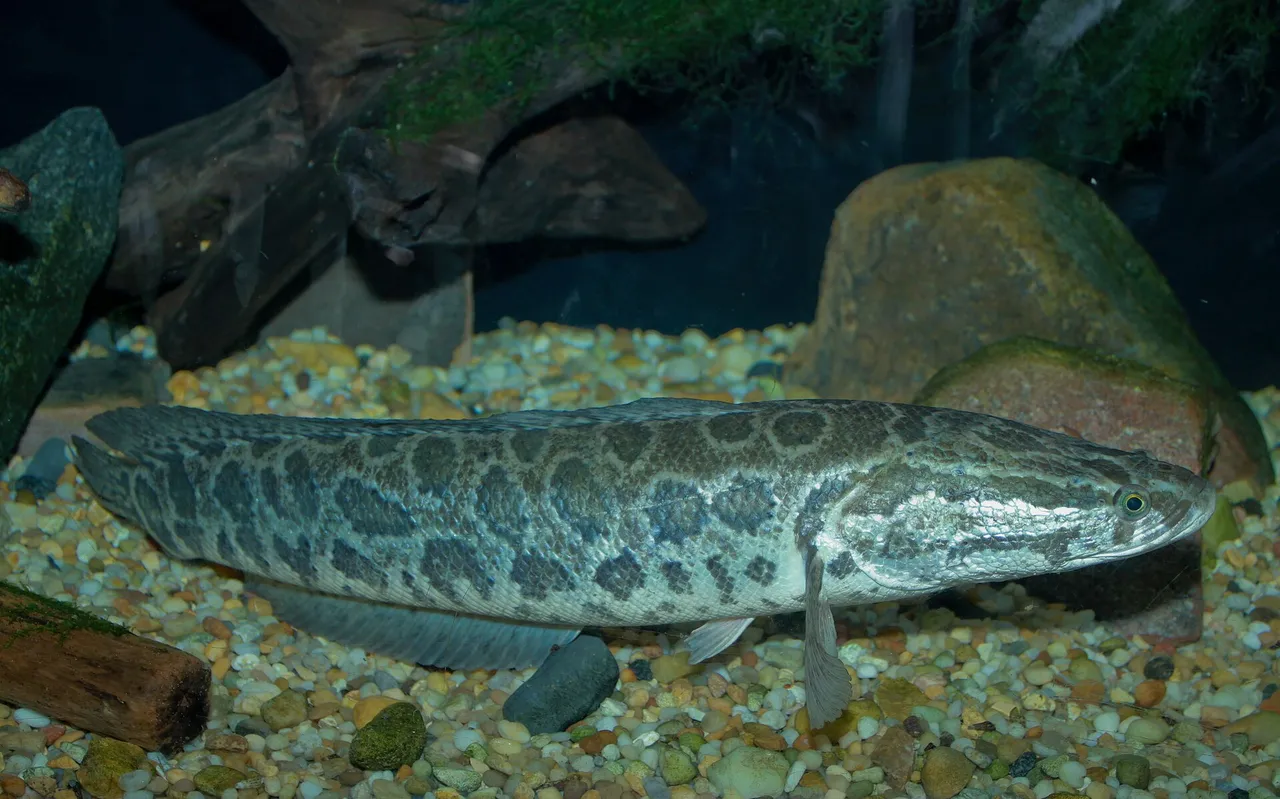
How this was identified, and who took it
Identified by: A full lateral view showing all four characters the page names: a long cylindrical body with very long-based dorsal and anal fins running most of its length and a rounded tail; a flattened snake-like head covered with large plate-like scales, with the eyes set well forward; dark irregular blotches over a tan to brown flank rather than the two clean bands of a giant snakehead; and a large mouth with a projecting lower jaw.Brian Gratwicke — CC BY 2.0, via Wikimedia Commons — source, licence
Catching Northern snakehead
Everything here on fishing for it. Each entry opens the page behind it.
- Ground
Northern snakehead is a genuine dual-status fish: a native and long-farmed food species across northern China, Korea and Russia, and an established invasive predator in parts of the eastern United States where it was introduced.
It can breathe air, tolerate low oxygen, survive out of water for extended periods in damp conditions, and move short distances over land. Combined with parental guarding of young and a broad predatory diet, that makes it an effective coloniser of the warm, weedy, low-oxygen waters where it establishes.
In its introduced range it is subject to strict rules — commonly a prohibition on live transport and often a requirement not to return it alive. Those rules vary and change; FishingHQ does not state what any of them are.
How it is caught
Identification
- Scientific name
- Channa argus
- Family
- Channidae
- Water
- Freshwater
- Conservation status
- Least Concern
- Regions
- East Asia, North America
- Long cylindrical body with very long-based dorsal and anal fins running most of its length, and a rounded tail.
- A flattened snake-like head covered with large plate-like scales, with the eyes set well forward.
- Dark irregular blotches over a tan to brown flank, unlike the two clean bands of a giant snakehead.
- A large mouth with a projecting lower jaw and small sharp teeth.
Size
- Typical
- 1–3 kg (2.2–6.6 lb)
- Large
- 4–7 kg (8.8–15 lb)
Exceptional: FishBase records a maximum of 100 cm and 8 kg
A fish that does not stop being a fish on the bank, and one you may not be allowed to return
Northern snakehead handling is unlike almost anything else on FishingHQ because two of the ordinary assumptions behind fish handling do not hold.
THE FIRST ASSUMPTION THAT FAILS: A LANDED FISH IS A DIMINISHING PROBLEM. Snakeheads breathe atmospheric air through a suprabranchial organ and survive out of water for extended periods — that is what lets them occupy the oxygen-poor swamps and backwaters they thrive in. A northern snakehead on a bank is not slowly running out of options. It remains fully capable, fully mobile, and fully willing, indefinitely by the standards of any other freshwater fish. It will move, and it will keep moving.
SO IT IS CONTROLLED BEFORE IT IS APPROACHED. The teeth are sharp and the jaws are strong and the fish bites deliberately rather than incidentally. Nobody lips a snakehead. The head is controlled from behind with a gloved grip or a wet cloth, the body is contained, and long pliers do the unhooking from outside the mouth.
THE SECOND ASSUMPTION THAT FAILS: A CAUGHT FISH GOES BACK. Where northern snakehead are non-native — which now includes substantial parts of eastern North America and elsewhere — they are among the most tightly regulated invasive freshwater fish anywhere. In many jurisdictions returning one to the water alive is prohibited outright, live possession and live transport are offences, and the required action is to kill the fish and report the capture to the fisheries authority.
AND THE MOST DAMAGING THING AN ANGLER CAN DO with this species is to move a live one — to another water, to a pond, to a tank. Essentially every established population outside the native range began with a deliberate introduction, and a single fish moved is a new population.
IN ITS NATIVE EAST ASIAN RANGE it is an ordinary, valued and long-cultivated food fish, and none of the above applies. There is no single correct answer to what to do with a snakehead, and establishing which situation you are in — before fishing, not after landing one — is the actual guidance.
Official guidance — why, and the sources (2)
Stated by a fisheries authority, scientific institute or recognised angling body. Authoritative, but summarising rather than demonstrating.
- Check Clean Dry — biosecurity guidance for water users — GB Non-native Species Secretariat (Conservation authority)Relied on for: Regulatory approach to high-risk invasive freshwater fish, including prohibitions on live possession, on return to the water and on movement between waters.States this directlyPassage read and verified
- JNCC species and habitat conservation advice — Joint Nature Conservation Committee (Conservation authority)Relied on for: Conservation advice on native species and the impact of introduced ones.Background and mechanism onlyCitation checked — the work exists and is described correctly
Lifecycle and reproduction
Fast-growing and reaching maturity within two to three years, with a long reproductive life. The combination of early maturity, repeated spawning and parental care of young is central to why introduced populations expand quickly.
Builds a nest in vegetation and both parents guard the eggs and the fry aggressively for an extended period. Multiple spawnings per season are possible in warm water.
Feeding and senses
A broadly opportunistic predator taking fish, amphibians, crustaceans and anything else it can engulf. Ambushes from cover in shallow weedy water.
Hunts by sight at close range in weedy shallow water, supported by an ability to remain active in oxygen-poor conditions that exclude competitors and restrict prey.
Through the year
Most active in warm months when it spawns and guards young; feeds through a wide temperature range and survives cold winters in its native northern range.
Distribution
Asia: Amur southward to Xi Jiang and Hainan Island, China . Introduced elsewhere. Japan and the USA report adverse ecological impact after introduction
This is a biological range — where the species occurs, not a prediction that you will catch one. To browse the fishing geography FishingHQ holds, start at fishing places.
Why anglers care
In its native East Asian range a long-established food and angling species. In North America it is deliberately targeted with topwater frogs, soft plastics and live bait in shallow weedy water, and the fishing is genuinely good — it strikes hard and fights strongly. The angling context is inseparable from the regulatory one: rules on handling, transport and release differ between jurisdictions and change, and must be checked with the responsible authority.
Handling and returning
It has sharp teeth, is extremely durable out of water, and thrashes hard. Use pliers and keep hands clear of the mouth. Where the species is non-native, never move a live fish between waters and follow the responsible authority's requirements for captured fish; releasing one into a new water is among the most damaging things an angler can do.
Going further
- Northern snakehead vs Striped snakehead — how to tell them apart.
- Northern snakehead vs Bowfin — how to tell them apart.
Safety
Injury while handling fish — Can cause injury needing treatment
The mouth carries sharp teeth and the fish is powerful and persistent out of water, thrashing long after landing.
What reduces it: Never place fingers in the mouth. Use long pliers, control the body firmly, and keep the fish contained.
Where to go next
Similar and related fish
Where it lives
Where you will find it
Told apart from
Sources and evidence
- FishBase: a global information system on fishes — Froese, R. and D. Pauly, eds. — FishBase Consortium (Scientific institute)Relied on for: Family, maximum size, depth and environment, distribution and the IUCN assessment for Channa argus.States this directlyPassage read and verified
- The IUCN Red List of Threatened Species — International Union for Conservation of Nature (Conservation authority)Relied on for: The Least Concern assessment for Channa argus, assessed 24 February 2020.States this directlyCitation checked — the work exists and is described correctly
Why the 7 connections on this page are here, and the sources
Similar and related fish
Backed by research — 1 connection
Supported by peer-reviewed research or fisheries science. The sources are listed and can be checked.
Striped snakehead
An identification comparison naming both binomials: Channa argus and Channa striata.
- FishBase: a global information system on fishes — Froese, R. and D. Pauly, eds. — FishBase Consortium (Scientific institute)Relied on for: Morphological and distributional data for Channa argus and for Channa striata.States this directlyPassage read and verified
- The IUCN Red List of Threatened Species — International Union for Conservation of Nature (Conservation authority)Relied on for: Separate assessments treating Channa argus and Channa striata as distinct species.States this directlyCitation checked — the work exists and is described correctly
How it is caught
What experienced anglers do — 2 connections
Widely and independently recommended by experienced anglers and specialist sources. This is real angling knowledge, not proof: controlled evidence for it is limited, and FishingHQ records it as convention rather than as a demonstrated effect.
Livebaiting
A practitioner claim about how Channa argus is commonly fished, following from where and how it feeds.
- General angling website restatements of established technique — Various (Credible secondary source)Relied on for: Widely restated practitioner accounts of fishing for northern snakehead.Citation checked — the work exists and is described correctly
- Sea Angler — Bauer Media (Specialist angling publication)Relied on for: Practitioner treatment of the methods used for northern snakehead and comparable species.Citation checked — the work exists and is described correctly
Spinning
A practitioner claim about how Channa argus is commonly fished, following from where and how it feeds.
- General angling website restatements of established technique — Various (Credible secondary source)Relied on for: Widely restated practitioner accounts of fishing for northern snakehead.Citation checked — the work exists and is described correctly
- Sea Angler — Bauer Media (Specialist angling publication)Relied on for: Practitioner treatment of the methods used for northern snakehead and comparable species.Citation checked — the work exists and is described correctly
Gear for this fish
What experienced anglers do — 1 connection
Widely and independently recommended by experienced anglers and specialist sources. This is real angling knowledge, not proof: controlled evidence for it is limited, and FishingHQ records it as convention rather than as a demonstrated effect.
Surface lures
A practitioner claim about which lure family answers this species' feeding or holding behaviour.
- General angling website restatements of established technique — Various (Credible secondary source)Relied on for: Widely restated North American lure practice for this species.Background and mechanism onlyCitation checked — the work exists and is described correctly
- IGFA International Angling Rules and World Record Requirements — International Game Fish Association (Angling or fisheries organisation)Relied on for: Recognition of the species as an established sport fish taken on artificial lures, and the tackle conventions used for it.States this directlyPassage read and verified
Where it lives
Backed by research — 1 connection
Supported by peer-reviewed research or fisheries science. The sources are listed and can be checked.
Lowland stillwaters
A habitat association for Channa argus taken from the environment and distribution data on its FishBase summary.
- FishBase: a global information system on fishes — Froese, R. and D. Pauly, eds. — FishBase Consortium (Scientific institute)Relied on for: The environment, depth range and habitat description recorded for Channa argus.States this directlyPassage read and verified
Where you will find it
Backed by research — 1 connection
Supported by peer-reviewed research or fisheries science. The sources are listed and can be checked.
Korea
A distribution association between an animal and a kind of water, rather than a claim about any named mark.
- FishBase: a global information system on fishes — Froese, R. and D. Pauly, eds. — FishBase Consortium (Scientific institute)Relied on for: Distribution, habitat association and depth range recorded for the species, including its occurrence in the water body concerned.States this directlyPassage read and verified
- The IUCN Red List of Threatened Species — International Union for Conservation of Nature (Conservation authority)Relied on for: Assessment and range account for the species, including the systems and coasts it occupies.Background and mechanism onlyCitation checked — the work exists and is described correctly
Told apart from
Backed by research — 1 connection
Supported by peer-reviewed research or fisheries science. The sources are listed and can be checked.
Bowfin
An identification comparison naming both binomials: Amia calva and Channa argus.
- FishBase: a global information system on fishes — Froese, R. and D. Pauly, eds. — FishBase Consortium (Scientific institute)Relied on for: Morphological and distributional data for Amia calva and for Channa argus.States this directlyPassage read and verified
- The IUCN Red List of Threatened Species — International Union for Conservation of Nature (Conservation authority)Relied on for: Separate assessments treating Amia calva and Channa argus as distinct species.States this directlyCitation checked — the work exists and is described correctly
An identification link between two species readers genuinely mistake for one another, resting on published morphological characters rather than on angling lore, and naming the character that separates them.
- FishBase: a global information system on fishes — Froese, R. and D. Pauly, eds. — FishBase Consortium (Scientific institute)Relied on for: Morphological description, meristic counts, family placement, distribution and environment of the species named.States this directlyPassage read and verified
- FAO Species Identification Guides for Fishery Purposes and the FAO Species Catalogues — Food and Agriculture Organization of the United Nations (Scientific institute)Relied on for: Identification characters and distribution for inland and coastal fishes, from regional identification guides prepared for fishery purposes.States this directlyCitation checked — the work exists and is described correctly
How FishingHQ labels evidence is explained in the evidence policy.