Bowfin vs Northern snakehead
How to tell them apart, and what follows from getting it right.
Why they get confused
This confusion has consequences beyond a misnamed photograph. Native bowfin are killed on sight in parts of North America by anglers who believe they have caught an invasive snakehead. Both are long, mottled, air-breathing predators of warm weedy water with long fins and a large mouth, and the resemblance is genuinely close at a glance.
Bowfin
Amia calva — Amiidae
No photograph of Bowfin has passed identity review yet, so none is shown. A photograph is published only once somebody has checked the animal in it against the diagnostic features described on this page.
Northern snakehead
Channa argus — Channidae
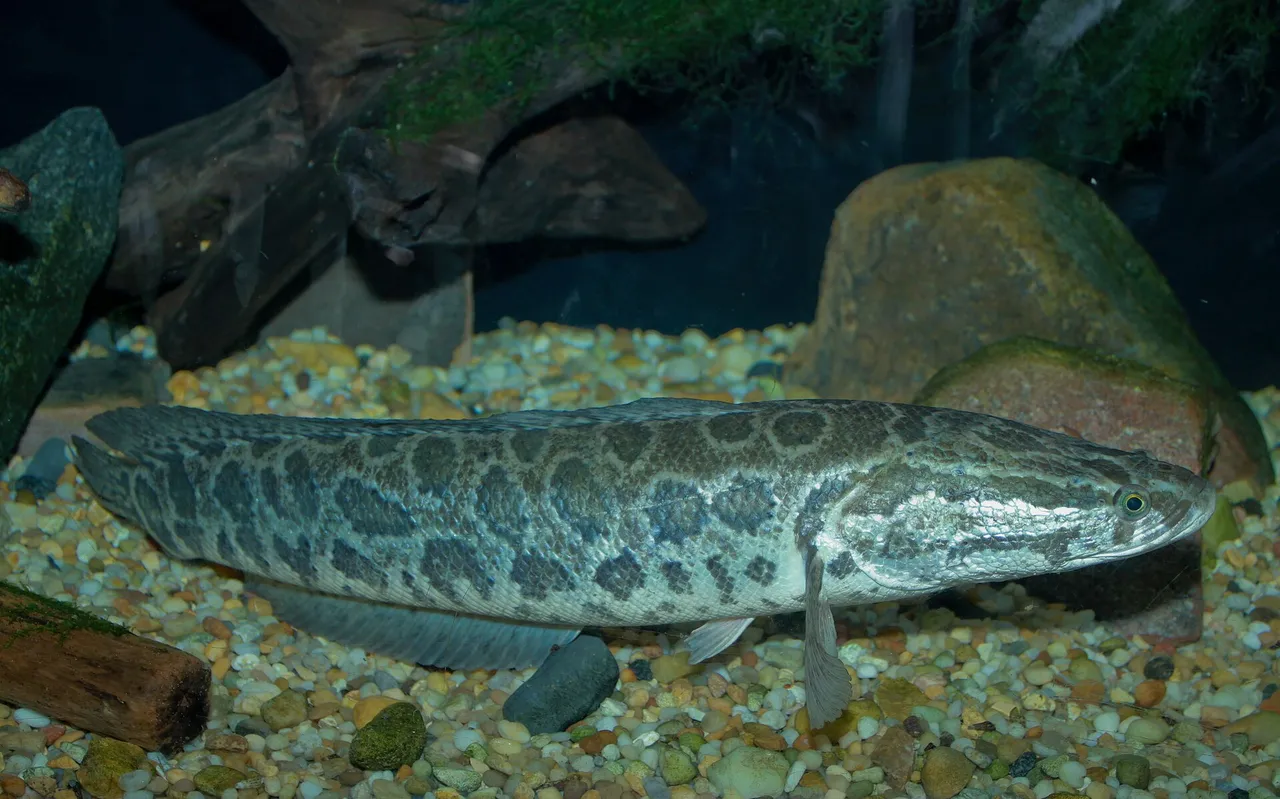

The differences
Each difference is marked with how far it can be trusted on its own. A single diagnostic character settles the identification; suggestive ones only narrow it.
| Character | Bowfin | Northern snakehead | Reliability |
|---|---|---|---|
| The anal finIdentification | Short anal fin, occupying only a small part of the underside. | Very long anal fin running most of the length of the underside, roughly mirroring the dorsal. | Diagnostic on its own |
| Gular plateIdentification | A bony gular plate between the two halves of the lower jaw, visible from beneath. | No gular plate — the underside of the lower jaw is plain. | Diagnostic on its own |
| Tail markingIdentification | Males carry a black eyespot ringed with orange at the base of the rounded tail. | No ringed eyespot at the tail base; markings are irregular dark blotches along the flank. | Supporting — use with others |
| Native statusRange | Native to North America, and the sole survivor of an ancient lineage. | Native to East Asia; established in parts of eastern North America as an introduction. | Supporting — use with others |
Why it matters
Getting this wrong kills native fish. Check the anal fin before acting on any assumption about what you have caught, and follow the responsible authority's guidance on what to do with a fish you believe is non-native rather than deciding at the bank.
The full records
This page compares two species. Each of them has a complete record covering biology, behaviour, handling and the evidence behind all of it.
More about bowfin
Where it lives, how it is caught, and what else it is confused with.
How it is caught
Gear for this fish
Where it lives
Why the 5 connections on this page are here, and the sources
How it is caught
What experienced anglers do — 2 connections
Widely and independently recommended by experienced anglers and specialist sources. This is real angling knowledge, not proof: controlled evidence for it is limited, and FishingHQ records it as convention rather than as a demonstrated effect.
Deadbaiting
A practitioner claim about how Amia calva is commonly fished, following from where and how it feeds.
- General angling website restatements of established technique — Various (Credible secondary source)Relied on for: Widely restated practitioner accounts of fishing for bowfin.Citation checked — the work exists and is described correctly
- Sea Angler — Bauer Media (Specialist angling publication)Relied on for: Practitioner treatment of the methods used for bowfin and comparable species.Citation checked — the work exists and is described correctly
Spinning
A practitioner claim about how Amia calva is commonly fished, following from where and how it feeds.
- General angling website restatements of established technique — Various (Credible secondary source)Relied on for: Widely restated practitioner accounts of fishing for bowfin.Citation checked — the work exists and is described correctly
- Sea Angler — Bauer Media (Specialist angling publication)Relied on for: Practitioner treatment of the methods used for bowfin and comparable species.Citation checked — the work exists and is described correctly
Gear for this fish
What experienced anglers do — 1 connection
Widely and independently recommended by experienced anglers and specialist sources. This is real angling knowledge, not proof: controlled evidence for it is limited, and FishingHQ records it as convention rather than as a demonstrated effect.
Swimbaits
A practitioner claim about which lure family answers this species' feeding or holding behaviour.
- General angling website restatements of established technique — Various (Credible secondary source)Relied on for: Widely restated North American lure practice for this species.Background and mechanism onlyCitation checked — the work exists and is described correctly
- IGFA International Angling Rules and World Record Requirements — International Game Fish Association (Angling or fisheries organisation)Relied on for: Recognition of the species as an established sport fish taken on artificial lures, and the tackle conventions used for it.States this directlyPassage read and verified
Where it lives
Backed by research — 2 connections
Supported by peer-reviewed research or fisheries science. The sources are listed and can be checked.
Lowland rivers
A habitat association for Amia calva taken from the environment and distribution data on its FishBase summary.
- FishBase: a global information system on fishes — Froese, R. and D. Pauly, eds. — FishBase Consortium (Scientific institute)Relied on for: The environment, depth range and habitat description recorded for Amia calva.States this directlyPassage read and verified
Lowland stillwaters
A habitat association for Amia calva taken from the environment and distribution data on its FishBase summary.
- FishBase: a global information system on fishes — Froese, R. and D. Pauly, eds. — FishBase Consortium (Scientific institute)Relied on for: The environment, depth range and habitat description recorded for Amia calva.States this directlyPassage read and verified
Reviewed 2026-08-10. FishingHQ does not state what any rule is or where any rule applies. Where this page says the two species are managed differently, that is a reason to check the authority for the water you are on — not a statement of what it requires.