Striped snakehead
Fish · Last reviewed 2026-08-10
The most widely distributed and most farmed Asian snakehead, air-breathing, able to survive in mud through dry seasons, and a staple food fish across the region.
Safety: injury while handling fish — minor injury.
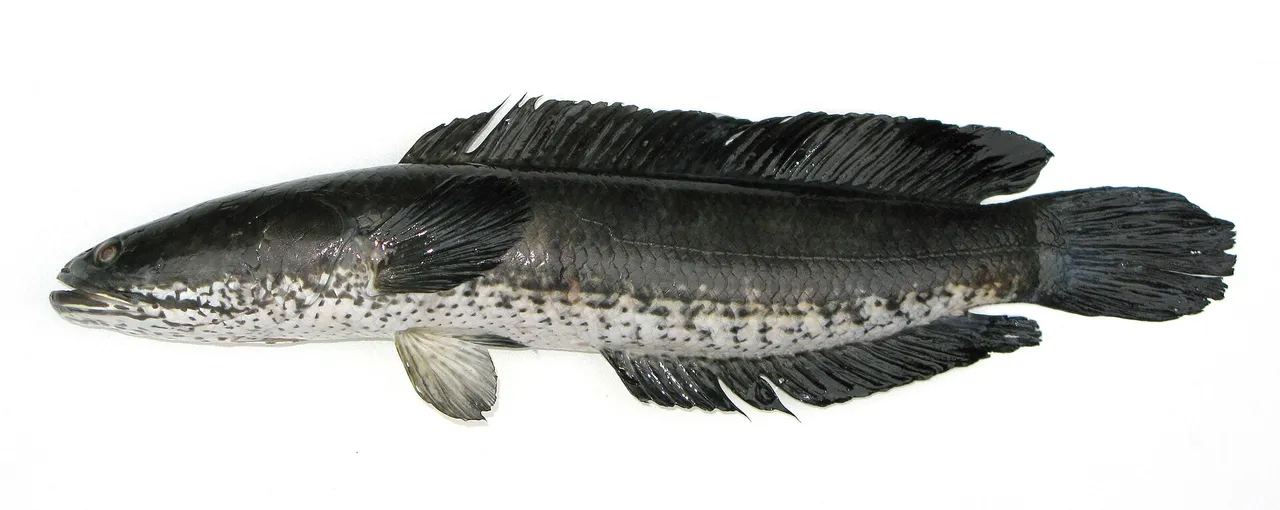
How this was identified, and who took it
Identified by: The dark chevron blotching along the lower flank is the character separating Channa striata from its congeners, and it is unambiguous here. The long spineless dorsal and anal fins, the rounded tail and the flattened head plated with enlarged scales place the fish in Channa; the absence of a caudal ocellus rules out great snakehead.Reyes, R.B., CC BY 4.0, via Wikimedia Commons — source, licenceCatching Striped snakehead
Everything here on fishing for it. Each entry opens the page behind it.
- Ground
Striped snakehead is the everyday snakehead of Asia — smaller than the giant and great snakeheads, far more numerous, and of enormous food importance across South and Southeast Asia where it is both wild-caught and extensively farmed.
Its survival abilities are exceptional even by snakehead standards. It breathes air, tolerates very low oxygen, and can aestivate in mud through a dry season, emerging when water returns. That makes it a reliable food fish in seasonal wetlands and rice-field systems where nothing else persists.
It is also of genuine cultural and medicinal significance in several countries, where it is traditionally eaten during recovery from illness or surgery.
How it is caught
Identification
- Scientific name
- Channa striata
- Family
- Channidae
- Water
- Freshwater
- Conservation status
- Least Concern
- Regions
- South Asia, South-East Asia
- Long cylindrical body with long-based dorsal and anal fins and a rounded tail.
- Oblique dark bars or chevrons pointing forward along the flank over a dark brown to black back.
- Flattened head with large scales and a projecting lower jaw.
- Smaller and more slender than the giant or great snakeheads, without their bold banding or tail eyespot.
Size
- Typical
- 0.3–1 kg (10 oz–2.2 lb)
- Large
- 1.5–3 kg (3.3–6.6 lb)
Exceptional: FishBase records a maximum of 100 cm and 3 kg
Lifecycle and reproduction
Fast-growing and early-maturing, with a long reproductive season in warm water. Its combination of air breathing, aestivation and parental care makes it exceptionally persistent in seasonal habitat.
Builds a nest in vegetation in shallow water and both parents guard eggs and fry. Breeding is repeated through the warm season, which is why populations rebuild quickly after a dry period.
Feeding and senses
Takes fish, frogs, crustaceans and insects in shallow weedy water, ambushing prey from cover at very close range. Its tolerance of low oxygen lets it hunt in conditions where prey species are already stressed and slow, which is a substantial part of why it succeeds where it does.
Hunts by sight at very close range in shallow, often turbid water, aided by tolerance of conditions its prey finds stressful.
Through the year
Governed by the wet and dry cycle: breeding and heavy feeding in the wet season, aestivation in mud where waters dry, and rapid re-emergence when flooding returns.
Distribution
Asia: Pakistan to Thailand and south China. Several countries report adverse ecological impact after introduction
This is a biological range — where the species occurs, not a prediction that you will catch one. To browse the fishing geography FishingHQ holds, start at fishing places.
Why anglers care
A widespread and accessible lure and bait target across South and Southeast Asia, taken on small frogs, spinners and live bait in ponds, canals, rice-field channels and floodplain waters. Its significance is primarily as a subsistence and market food fish, with recreational angling a secondary but growing use. It is a non-native of concern in several countries outside its range.
Handling and returning
Sharp teeth and a very durable fish out of water. Use pliers, avoid the mouth, and handle firmly. Where the species is non-native, do not move live fish between waters.
Going further
- Striped snakehead vs Northern snakehead — how to tell them apart.
Safety
Injury while handling fish — Minor injury
Snakehead teeth are small but sharp and the fish remains active and strong out of water for a long time.
What reduces it: Use pliers rather than fingers, and control the fish against a soft surface.
Where to go next
Similar and related fish
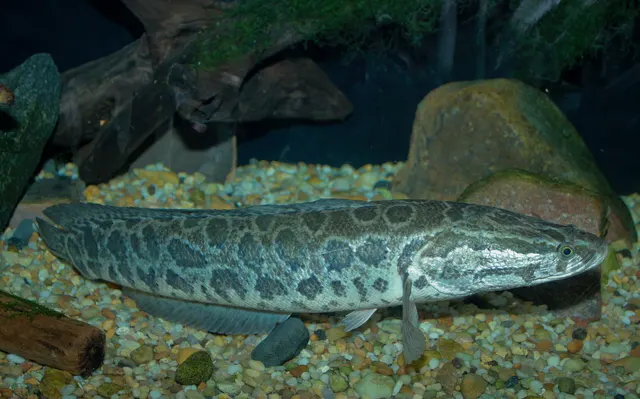

Where it lives
Where you will find it
Understanding this fish
Environment and conservation
Sources and evidence
- FishBase: a global information system on fishes — Froese, R. and D. Pauly, eds. — FishBase Consortium (Scientific institute)Relied on for: Family, maximum size, depth and environment, distribution and the IUCN assessment for Channa striata.States this directlyPassage read and verified
- The IUCN Red List of Threatened Species — International Union for Conservation of Nature (Conservation authority)Relied on for: The Least Concern assessment for Channa striata, assessed 11 August 2019.States this directlyCitation checked — the work exists and is described correctly
Why the 8 connections on this page are here, and the sources
Similar and related fish
Backed by research — 2 connections
Supported by peer-reviewed research or fisheries science. The sources are listed and can be checked.
Great snakehead
An identification comparison naming both binomials: Channa striata and Channa marulius.
- FishBase: a global information system on fishes — Froese, R. and D. Pauly, eds. — FishBase Consortium (Scientific institute)Relied on for: Morphological and distributional data for Channa striata and for Channa marulius.States this directlyPassage read and verified
- The IUCN Red List of Threatened Species — International Union for Conservation of Nature (Conservation authority)Relied on for: Separate assessments treating Channa striata and Channa marulius as distinct species.States this directlyCitation checked — the work exists and is described correctly
Northern snakehead
An identification comparison naming both binomials: Channa argus and Channa striata.
- FishBase: a global information system on fishes — Froese, R. and D. Pauly, eds. — FishBase Consortium (Scientific institute)Relied on for: Morphological and distributional data for Channa argus and for Channa striata.States this directlyPassage read and verified
- The IUCN Red List of Threatened Species — International Union for Conservation of Nature (Conservation authority)Relied on for: Separate assessments treating Channa argus and Channa striata as distinct species.States this directlyCitation checked — the work exists and is described correctly
How it is caught
What experienced anglers do — 2 connections
Widely and independently recommended by experienced anglers and specialist sources. This is real angling knowledge, not proof: controlled evidence for it is limited, and FishingHQ records it as convention rather than as a demonstrated effect.
Float fishing
A practitioner claim about how Channa striata is commonly fished, following from where and how it feeds.
- General angling website restatements of established technique — Various (Credible secondary source)Relied on for: Widely restated practitioner accounts of fishing for striped snakehead.Citation checked — the work exists and is described correctly
- Sea Angler — Bauer Media (Specialist angling publication)Relied on for: Practitioner treatment of the methods used for striped snakehead and comparable species.Citation checked — the work exists and is described correctly
Spinning
A practitioner claim about how Channa striata is commonly fished, following from where and how it feeds.
- General angling website restatements of established technique — Various (Credible secondary source)Relied on for: Widely restated practitioner accounts of fishing for striped snakehead.Citation checked — the work exists and is described correctly
- Sea Angler — Bauer Media (Specialist angling publication)Relied on for: Practitioner treatment of the methods used for striped snakehead and comparable species.Citation checked — the work exists and is described correctly
Where it lives
Backed by research — 1 connection
Supported by peer-reviewed research or fisheries science. The sources are listed and can be checked.
Lowland stillwaters
A habitat association for Channa striata taken from the environment and distribution data on its FishBase summary.
- FishBase: a global information system on fishes — Froese, R. and D. Pauly, eds. — FishBase Consortium (Scientific institute)Relied on for: The environment, depth range and habitat description recorded for Channa striata.States this directlyPassage read and verified
Where you will find it
Backed by research — 1 connection
Supported by peer-reviewed research or fisheries science. The sources are listed and can be checked.
The Mekong system
A distribution association between an animal and a kind of water, rather than a claim about any named mark.
- The IUCN Red List of Threatened Species — International Union for Conservation of Nature (Conservation authority)Relied on for: Assessment and habitat account for the species, including the river or lake system it occupies and the pressures acting on it.States this directlyCitation checked — the work exists and is described correctly
- FishBase: a global information system on fishes — Froese, R. and D. Pauly, eds. — FishBase Consortium (Scientific institute)Relied on for: Distribution, habitat association, size and life history recorded for the species in the system concerned.States this directlyPassage read and verified
Understanding this fish
Backed by research — 1 connection
Supported by peer-reviewed research or fisheries science. The sources are listed and can be checked.
How fish breathe
A species joined to the mechanism it is a worked example of, written only where the species demonstrates the mechanism unusually clearly rather than where it is merely subject to it.
- FishBase: a global information system on fishes — Froese, R. and D. Pauly, eds. — FishBase Consortium (Scientific institute)Relied on for: Recorded environment, respiration, oxygen tolerance, feeding biology, growth, longevity and distribution of the species named.States this directlyPassage read and verified
- The IUCN Red List of Threatened Species — International Union for Conservation of Nature (Conservation authority)Relied on for: Conservation assessment, recorded threats and population trend of the species named.States this directlyCitation checked — the work exists and is described correctly
Environment and conservation
Backed by research — 1 connection
Supported by peer-reviewed research or fisheries science. The sources are listed and can be checked.
Invasive species and biosecurity
A species joined to the environmental issue it is a worked example of. `explained_by` cannot carry these — its object must be a `concept` and these are `environment` records — and the distinction is real rather than bureaucratic: an environmental issue is something a species CAUSES or is subject to, not a mechanism that explains it.
- Check Clean Dry — biosecurity guidance for water users — GB Non-native Species Secretariat (Conservation authority)Relied on for: Biosecurity guidance for water users and the pathways by which aquatic non-native species are moved between catchments.States this directlyPassage read and verified
- The IUCN Red List of Threatened Species — International Union for Conservation of Nature (Conservation authority)Relied on for: Conservation assessment and recorded threats, including the impact of introduced species on native populations.States this directlyCitation checked — the work exists and is described correctly
How FishingHQ labels evidence is explained in the evidence policy.