Great snakehead
Fish · Last reviewed 2026-08-10
A large South Asian snakehead with a distinctive orange-ringed eyespot at the tail base, guarding its young in shallow water and taken on topwater lures.
Safety: injury while handling fish — can cause injury needing treatment.
Catching Great snakehead
Everything here on fishing for it. Each entry opens the page behind it.
Great snakehead is the largest of the South Asian snakeheads and among the most sought-after freshwater lure targets in India, Sri Lanka and mainland Southeast Asia. It is a long, cylindrical, air-breathing predator with a broad flattened head, and it carries a clear identifying mark: a black eyespot ringed with orange at the base of the tail.
Like all Channa it guards its young. A pair will herd a dense ball of orange fry in shallow water and attack anything that approaches, which makes the fish both easy to locate and easy to exploit — a genuine ethical consideration in the fishery, since a guarding parent removed leaves the brood to fail.
It takes surface lures with real violence, which is the basis of its reputation.
How it is caught
Gear for this fish
Identification
No photograph of Great snakehead has passed identity review yet, so none is shown. A photograph is published only once somebody has checked the animal in it against the diagnostic features described on this page.
- Scientific name
- Channa marulius
- Family
- Channidae
- Water
- Freshwater
- Conservation status
- Least Concern
- Regions
- South Asia, South-East Asia
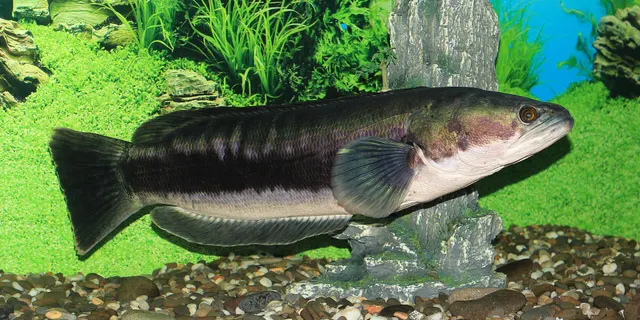
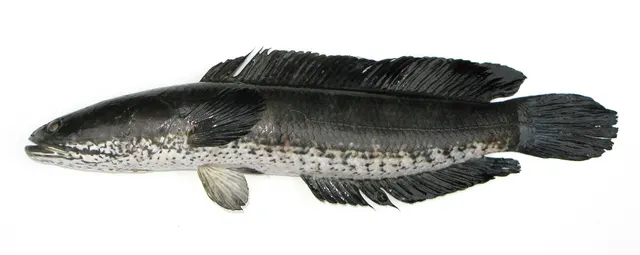
- A black eyespot ringed with orange or white at the base of the caudal fin — the clearest identifying mark.
- Long cylindrical body with very long-based dorsal and anal fins and a rounded tail.
- Broad flattened head covered with large plate-like scales, with the eyes set well forward.
- Dark blotched or marbled pattern over an olive-brown flank, with orange tones in adults.
Size
- Typical
- 1.5–5 kg (3.3–11 lb)
- Large
- 7–12 kg (15–26 lb)
Exceptional: FishBase records a maximum of 183 cm and 30 kg
A large air-breather with real teeth, and a parent that may be guarding a brood
Great snakehead handling combines the general snakehead problem with a specific behavioural one that decides when the fish is most catchable.
THE GENERAL PROBLEM: IT DOES NOT TIRE OUT OF WATER. Like every channid, this species breathes atmospheric air through a suprabranchial organ, and a large one laid on a bank remains fully capable and mobile for a long time. Nothing about a landed snakehead is winding down. It thrashes hard, it moves, and it does so with a mouth carrying numerous sharp conical teeth in strong jaws, on a fish that reaches a serious size.
SO NOBODY PUTS A HAND IN THE MOUTH, ever, and nobody lips one. The head is controlled from behind — a gloved grip or a wet cloth across the back of the skull — the body is supported along its length, and long pliers do the unhooking from outside. A fish this size that is not properly controlled will injure somebody.
THE BEHAVIOURAL PROBLEM IS THE ONE WORTH THINKING ABOUT. Great snakehead are intense parental guarders: a pair holds station over a dense mass of fry, drives off anything that approaches, and will attack a lure worked near the brood as a threat rather than as food. That aggression is exactly why the fishery works during the guarding period, and it means the fish caught then are guarding parents. Fry left unguarded in tropical water are eaten within minutes.
WHICH MAKES THE MINIMUM STANDARD SPECIFIC: if such a fish is caught at all, it is unhooked immediately and returned to the same spot, not carried to a better photograph position and not held while somebody finds a camera. Whether to fish over guarded broods at all is a judgement, and it is a more honest question than it is usually treated as.
AND WHERE THE SPECIES IS INTRODUCED rather than native, the return itself may be prohibited and the required action set by the local authority. In its native South and Southeast Asian range it is an ordinary and important food fish.
What experienced anglers do — why, and the sources (4)
Widely and independently recommended by experienced anglers and specialist sources. This is real angling knowledge, not proof: controlled evidence for it is limited, and FishingHQ records it as convention rather than as a demonstrated effect.
- FishBase: a global information system on fishes — Froese, R. and D. Pauly, eds. — FishBase Consortium (Scientific institute)Relied on for: Morphology, dentition, spination, thermal tolerance, reproductive strategy and depth range recorded for the species.States this directlyPassage read and verified
- The IUCN Red List of Threatened Species — International Union for Conservation of Nature (Conservation authority)Relied on for: Assessment, population trend and the life-history traits — longevity, growth rate, sex structure — that determine a population's sensitivity to the removal of large individuals.Background and mechanism onlyCitation checked — the work exists and is described correctly
- Check Clean Dry — biosecurity guidance for water users — GB Non-native Species Secretariat (Conservation authority)Relied on for: Regulatory approach to high-risk invasive freshwater fish, including prohibitions on live possession, on return to the water and on movement between waters.States this directlyPassage read and verified
- JNCC species and habitat conservation advice — Joint Nature Conservation Committee (Conservation authority)Relied on for: Conservation advice on native species and the impact of introduced ones.Background and mechanism onlyCitation checked — the work exists and is described correctly
A guarded nest in vegetation, and parents that stay with the young for weeks
Great snakehead reproduction combines nest building with extended parental care to a degree that very few fish on FishingHQ match, and it explains why the species establishes so effectively.
THE PARENTS BUILD A NEST IN VEGETATION. Snakeheads clear a roughly circular area within dense aquatic plants in shallow warm water, and the female releases buoyant eggs into it. The nest is an actual constructed structure rather than a cleaned surface, and it is defended from the moment it exists.
BOTH PARENTS GUARD, AND THEY GUARD FOR A LONG TIME. Adults remain with the eggs and then with the shoal of young for weeks, keeping the fry as a dense mass near the surface and attacking anything that approaches. The aggression is genuine and snakeheads guarding fry will strike at large intruders, which is the origin of most reports of the species being dangerous.
THE FRY SHOAL IS VISIBLE AND THAT IS THE PRACTICAL POINT. A bright cloud of young snakeheads at the surface with adults beneath it is unmistakable, and it is both the easiest fishing available and the point at which the population is most exposed.
AIR BREATHING MAKES THE STRATEGY WORK IN WATER THAT WOULD OTHERWISE FAIL. The record's habitat section explains that these fish breathe atmospheric air; so do the young, and a nest in warm, stagnant, deoxygenated vegetation — lethal to most fry — is perfectly viable for them. That combination of a protected nest in water competitors cannot use, plus extended parental defence, produces very high survival per spawning.
WHICH IS WHY THE SPECIES IS SO CONSEQUENTIAL WHERE IT IS INTRODUCED. High offspring survival, a tolerant adult, and a capacity to occupy waters nothing else can is a formidable combination, and it is the reason snakeheads are regulated as they are in many jurisdictions.
TEMPERATURE TRIGGERS THE SEASON, with spawning through the warm months and repeated within a season where conditions permit.
AND WHAT MAY BE DONE WITH A CAPTURED FISH — kept, moved, returned — differs sharply between jurisdictions and is frequently the opposite of what the angler assumes. That is a matter for the competent authority.
Backed by research — why, and the sources (2)
Supported by peer-reviewed research or fisheries science. The sources are listed and can be checked.
- FishBase: a global information system on fishes — Froese, R. and D. Pauly, eds. — FishBase Consortium (Scientific institute)Relied on for: Habitat association, depth range, salinity tolerance, temperature range, spawning season and reproductive mode recorded for the species.States this directlyPassage read and verified
- The IUCN Red List of Threatened Species — International Union for Conservation of Nature (Conservation authority)Relied on for: Assessment and life-history account, including the habitats the species depends on and the pressures on them.Background and mechanism onlyCitation checked — the work exists and is described correctly
Lifecycle and reproduction
Fast-growing and long-lived for a freshwater predator, with strong parental investment in each brood. Populations are resilient where habitat persists but are affected by wetland drainage and by intensive netting.
Builds a nest in vegetation in shallow water; both parents guard the eggs and then the dense ball of orange fry for weeks, attacking intruders. That behaviour is why guarding fish are so catchable and why targeting them deliberately is questioned by many anglers.
Feeding and senses
An ambush predator taking fish, frogs and crustaceans from cover in shallow weedy water, striking hard at the surface. It engulfs prey with a rapid lunge rather than pursuing it, and adults guarding fry will attack objects far too large to eat, which is a defensive response rather than feeding.
Hunts by sight at close range in shallow water, supported by an ability to stay active in oxygen-poor conditions where prey is stressed and competitors absent.
Through the year
Most active in warm months, with spawning and fry-guarding through the warm season and reduced activity in cooler periods.
Distribution
Asia: India to China, south to Thailand and Cambodia and Pakistan
This is a biological range — where the species occurs, not a prediction that you will catch one. To browse the fishing geography FishingHQ holds, start at fishing places.
Why anglers care
A prime lure target in India, Sri Lanka, Thailand and neighbouring countries, taken on frogs, poppers and soft plastics worked over weed and shallow cover. Its significance is the quality of the surface strike and its accessibility in ordinary village and irrigation waters. Practitioner opinion is genuinely divided on fishing to guarding parents, and FishingHQ records that division rather than resolving it.
Handling and returning
Sharp teeth, powerful jaws and a fish that is very durable out of water and thrashes hard. Use long pliers, keep hands clear of the mouth, and support the body. Where fish are guarding fry, returning the parent immediately and to the same spot is the minimum requirement if it is caught at all.
Safety
Injury while handling fish — Can cause injury needing treatment
Snakeheads have well-developed teeth and strong jaws, and remain vigorous out of water for a long time.
What reduces it: Never place fingers in the mouth. Use long pliers or a dehooker and control the body firmly against a soft surface.
Where to go next
Similar and related fish
Where it lives
Where you will find it
Sources and evidence
- FishBase: a global information system on fishes — Froese, R. and D. Pauly, eds. — FishBase Consortium (Scientific institute)Relied on for: Family, maximum size, depth and environment, distribution and the IUCN assessment for Channa marulius.States this directlyPassage read and verified
- The IUCN Red List of Threatened Species — International Union for Conservation of Nature (Conservation authority)Relied on for: The Least Concern assessment for Channa marulius, assessed 06 October 2009.States this directlyCitation checked — the work exists and is described correctly
Why the 9 connections on this page are here, and the sources
Similar and related fish
Backed by research — 2 connections
Supported by peer-reviewed research or fisheries science. The sources are listed and can be checked.
Giant snakehead
An identification comparison naming both binomials: Channa marulius and Channa micropeltes.
- FishBase: a global information system on fishes — Froese, R. and D. Pauly, eds. — FishBase Consortium (Scientific institute)Relied on for: Morphological and distributional data for Channa marulius and for Channa micropeltes.States this directlyPassage read and verified
- The IUCN Red List of Threatened Species — International Union for Conservation of Nature (Conservation authority)Relied on for: Separate assessments treating Channa marulius and Channa micropeltes as distinct species.States this directlyCitation checked — the work exists and is described correctly
Striped snakehead
An identification comparison naming both binomials: Channa striata and Channa marulius.
- FishBase: a global information system on fishes — Froese, R. and D. Pauly, eds. — FishBase Consortium (Scientific institute)Relied on for: Morphological and distributional data for Channa striata and for Channa marulius.States this directlyPassage read and verified
- The IUCN Red List of Threatened Species — International Union for Conservation of Nature (Conservation authority)Relied on for: Separate assessments treating Channa striata and Channa marulius as distinct species.States this directlyCitation checked — the work exists and is described correctly
How it is caught
What experienced anglers do — 2 connections
Widely and independently recommended by experienced anglers and specialist sources. This is real angling knowledge, not proof: controlled evidence for it is limited, and FishingHQ records it as convention rather than as a demonstrated effect.
Livebaiting
A practitioner claim about how Channa marulius is commonly fished, following from where and how it feeds.
- General angling website restatements of established technique — Various (Credible secondary source)Relied on for: Widely restated practitioner accounts of fishing for great snakehead.Citation checked — the work exists and is described correctly
- Sea Angler — Bauer Media (Specialist angling publication)Relied on for: Practitioner treatment of the methods used for great snakehead and comparable species.Citation checked — the work exists and is described correctly
Spinning
A practitioner claim about how Channa marulius is commonly fished, following from where and how it feeds.
- General angling website restatements of established technique — Various (Credible secondary source)Relied on for: Widely restated practitioner accounts of fishing for great snakehead.Citation checked — the work exists and is described correctly
- Sea Angler — Bauer Media (Specialist angling publication)Relied on for: Practitioner treatment of the methods used for great snakehead and comparable species.Citation checked — the work exists and is described correctly
Gear for this fish
What experienced anglers do — 2 connections
Widely and independently recommended by experienced anglers and specialist sources. This is real angling knowledge, not proof: controlled evidence for it is limited, and FishingHQ records it as convention rather than as a demonstrated effect.
Jerkbaits
A practitioner claim about which lure family answers this species' feeding or holding behaviour.
- IGFA International Angling Rules and World Record Requirements — International Game Fish Association (Angling or fisheries organisation)Relied on for: Recognition of the species as an established sport fish taken on artificial lures, and the line and tackle classes used for it.States this directlyPassage read and verified
- General angling website restatements of established technique — Various (Credible secondary source)Relied on for: Widely restated lure practice for this species.Background and mechanism onlyCitation checked — the work exists and is described correctly
Surface lures
A practitioner claim about tackle commonly used for Channa marulius.
- General angling website restatements of established technique — Various (Credible secondary source)Relied on for: Widely restated practitioner accounts of this presentation for great snakehead.Citation checked — the work exists and is described correctly
- Angling Times — Bauer Media (Specialist angling publication)Relied on for: Practitioner treatment of comparable presentations for the species group.Citation checked — the work exists and is described correctly
Where it lives
Backed by research — 2 connections
Supported by peer-reviewed research or fisheries science. The sources are listed and can be checked.
Lowland rivers
A habitat association for Channa marulius taken from the environment and distribution data on its FishBase summary.
- FishBase: a global information system on fishes — Froese, R. and D. Pauly, eds. — FishBase Consortium (Scientific institute)Relied on for: The environment, depth range and habitat description recorded for Channa marulius.States this directlyPassage read and verified
Lowland stillwaters
A habitat association for Channa marulius taken from the environment and distribution data on its FishBase summary.
- FishBase: a global information system on fishes — Froese, R. and D. Pauly, eds. — FishBase Consortium (Scientific institute)Relied on for: The environment, depth range and habitat description recorded for Channa marulius.States this directlyPassage read and verified
Where you will find it
Backed by research — 1 connection
Supported by peer-reviewed research or fisheries science. The sources are listed and can be checked.
The Mekong system
A distribution association between an animal and a kind of water, rather than a claim about any named mark.
- The IUCN Red List of Threatened Species — International Union for Conservation of Nature (Conservation authority)Relied on for: Assessment and habitat account for the species, including the river or lake system it occupies and the pressures acting on it.States this directlyCitation checked — the work exists and is described correctly
- FishBase: a global information system on fishes — Froese, R. and D. Pauly, eds. — FishBase Consortium (Scientific institute)Relied on for: Distribution, habitat association, size and life history recorded for the species in the system concerned.States this directlyPassage read and verified
How FishingHQ labels evidence is explained in the evidence policy.