Northern snakehead vs Striped snakehead
How to tell them apart, and what follows from getting it right.
Why they get confused
Both are Channa: long cylindrical fish with dorsal and anal fins running most of the body, flattened plate-scaled heads and rounded tails. To anybody meeting the family for the first time they are the same animal at different sizes. Their ranges meet in Asia and both have been introduced outside them, so a fish out of an unfamiliar water can genuinely be either. Neither carries the bold banding or the caudal eyespot that make the giant and great snakeheads easy.
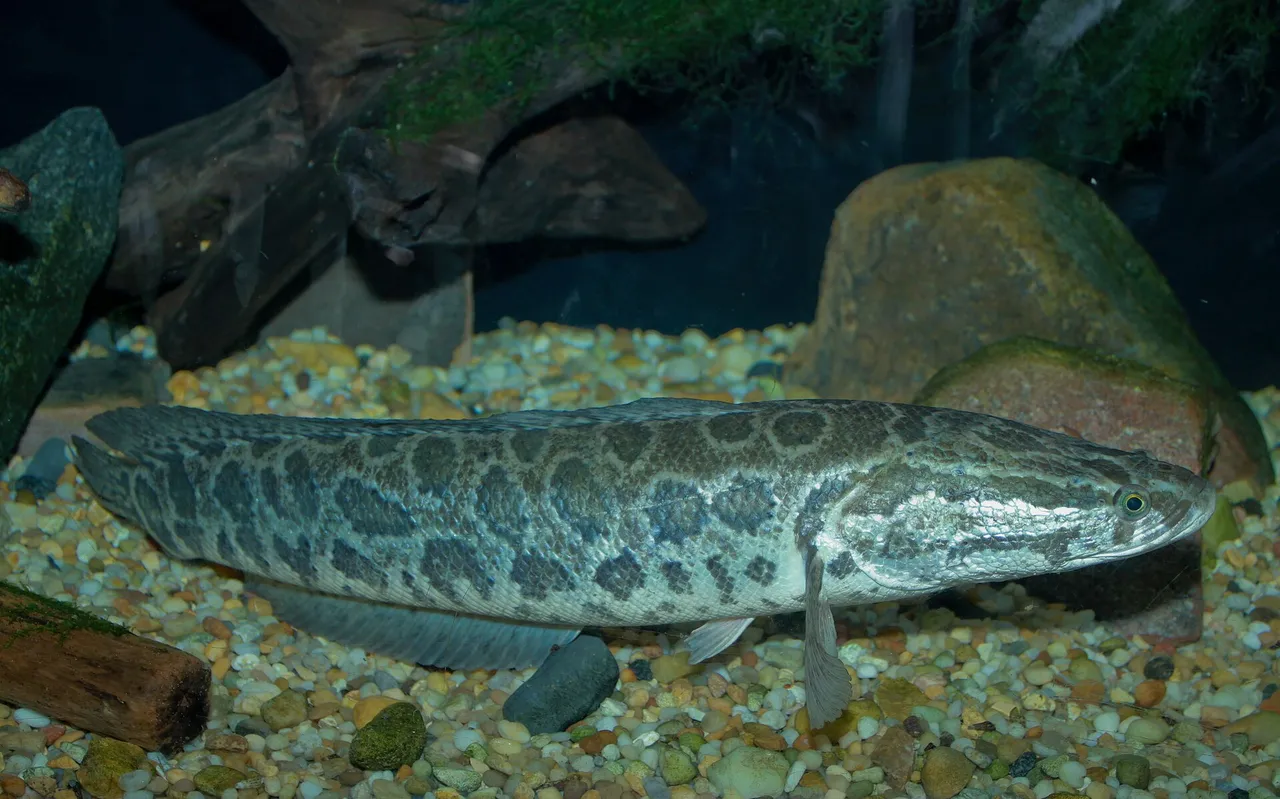
Northern snakehead
Channa argus — Channidae

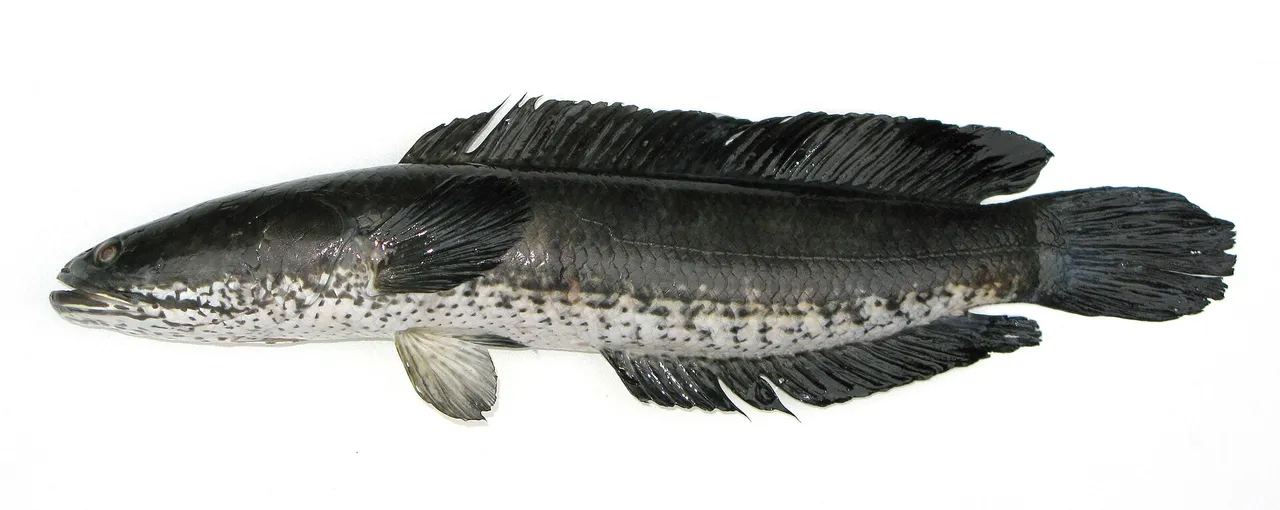
Striped snakehead
Channa striata — Channidae

The differences
Each difference is marked with how far it can be trusted on its own. A single diagnostic character settles the identification; suggestive ones only narrow it.
| Character | Northern snakehead | Striped snakehead | Reliability |
|---|---|---|---|
| How the flank marks are organisedIdentification | Irregular dark blotches with soft edges scattered over a tan to brown flank in no regular sequence. | Oblique bars or forward-pointing chevrons arranged in a regular series along the flank over a dark brown to black back. | Diagnostic on its own |
| BuildIdentification | Heavier through the body, reaching a metre and eight kilos. | Smaller and distinctly more slender, most fish under a kilo and a maximum around three. | Supporting — use with others |
| Head and jawIdentification | Broad flattened head with large plate-like scales, eyes set well forward, and a large mouth with a projecting lower jaw and small sharp teeth. | The same flattened plate-scaled head and projecting jaw, on a proportionally smaller head. The family character rather than a separator. | Supporting — use with others |
| The size you are likely to be holdingSize | Commonly 1–3 kg, with good fish 4–7 kg. | Commonly 0.3–1 kg, with good fish 1.5–3 kg. A snakehead over about four kilos is not this species. | Supporting — use with others |
| Where each is nativeRange | The Amur south to the Xi Jiang and Hainan, in China and adjoining Russia; introduced and invasive in Japan and the United States. | Pakistan east to Thailand and southern China; introduced and recorded as ecologically damaging in several countries. | Supporting — use with others |
| Handling either of themHandling | Sharp teeth, extremely durable out of water, and thrashes hard. Use pliers and keep hands clear of the mouth. | The same, at smaller scale. Both survive out of water for long periods, which is exactly why a live one must never be moved. | Supporting — use with others |
Why it matters
Where either is non-native the response is a matter for the responsible authority and frequently involves mandatory reporting, mandatory retention or a prohibition on returning the fish alive — and those requirements differ between jurisdictions and between the two species. Never transport a live snakehead anywhere: the capacity to survive out of water that is the family's most famous trait is precisely what makes moving one so damaging. In eastern North America the opposite error is worth naming — native bowfin are regularly killed by anglers who believe they have a snakehead, and bowfin's short anal fin settles that in one look.
The full records
This page compares two species. Each of them has a complete record covering biology, behaviour, handling and the evidence behind all of it.
More about northern snakehead
Where it lives, how it is caught, and what else it is confused with.
Similar and related fish
How it is caught
Gear for this fish
Where it lives
Why the 5 connections on this page are here, and the sources
Similar and related fish
Backed by research — 1 connection
Supported by peer-reviewed research or fisheries science. The sources are listed and can be checked.
Striped snakehead
An identification comparison naming both binomials: Channa argus and Channa striata.
- FishBase: a global information system on fishes — Froese, R. and D. Pauly, eds. — FishBase Consortium (Scientific institute)Relied on for: Morphological and distributional data for Channa argus and for Channa striata.States this directlyPassage read and verified
- The IUCN Red List of Threatened Species — International Union for Conservation of Nature (Conservation authority)Relied on for: Separate assessments treating Channa argus and Channa striata as distinct species.States this directlyCitation checked — the work exists and is described correctly
How it is caught
What experienced anglers do — 2 connections
Widely and independently recommended by experienced anglers and specialist sources. This is real angling knowledge, not proof: controlled evidence for it is limited, and FishingHQ records it as convention rather than as a demonstrated effect.
Livebaiting
A practitioner claim about how Channa argus is commonly fished, following from where and how it feeds.
- General angling website restatements of established technique — Various (Credible secondary source)Relied on for: Widely restated practitioner accounts of fishing for northern snakehead.Citation checked — the work exists and is described correctly
- Sea Angler — Bauer Media (Specialist angling publication)Relied on for: Practitioner treatment of the methods used for northern snakehead and comparable species.Citation checked — the work exists and is described correctly
Spinning
A practitioner claim about how Channa argus is commonly fished, following from where and how it feeds.
- General angling website restatements of established technique — Various (Credible secondary source)Relied on for: Widely restated practitioner accounts of fishing for northern snakehead.Citation checked — the work exists and is described correctly
- Sea Angler — Bauer Media (Specialist angling publication)Relied on for: Practitioner treatment of the methods used for northern snakehead and comparable species.Citation checked — the work exists and is described correctly
Gear for this fish
What experienced anglers do — 1 connection
Widely and independently recommended by experienced anglers and specialist sources. This is real angling knowledge, not proof: controlled evidence for it is limited, and FishingHQ records it as convention rather than as a demonstrated effect.
Surface lures
A practitioner claim about which lure family answers this species' feeding or holding behaviour.
- General angling website restatements of established technique — Various (Credible secondary source)Relied on for: Widely restated North American lure practice for this species.Background and mechanism onlyCitation checked — the work exists and is described correctly
- IGFA International Angling Rules and World Record Requirements — International Game Fish Association (Angling or fisheries organisation)Relied on for: Recognition of the species as an established sport fish taken on artificial lures, and the tackle conventions used for it.States this directlyPassage read and verified
Where it lives
Backed by research — 1 connection
Supported by peer-reviewed research or fisheries science. The sources are listed and can be checked.
Lowland stillwaters
A habitat association for Channa argus taken from the environment and distribution data on its FishBase summary.
- FishBase: a global information system on fishes — Froese, R. and D. Pauly, eds. — FishBase Consortium (Scientific institute)Relied on for: The environment, depth range and habitat description recorded for Channa argus.States this directlyPassage read and verified
Reviewed 2026-08-15. FishingHQ does not state what any rule is or where any rule applies. Where this page says the two species are managed differently, that is a reason to check the authority for the water you are on — not a statement of what it requires.