How to identify striped snakehead
Channa striata · Channidae
The characters that identify striped snakehead, ranked by how far each one can be trusted on its own.
Safety: injury while handling fish — minor injury.
How this was identified, and who took it
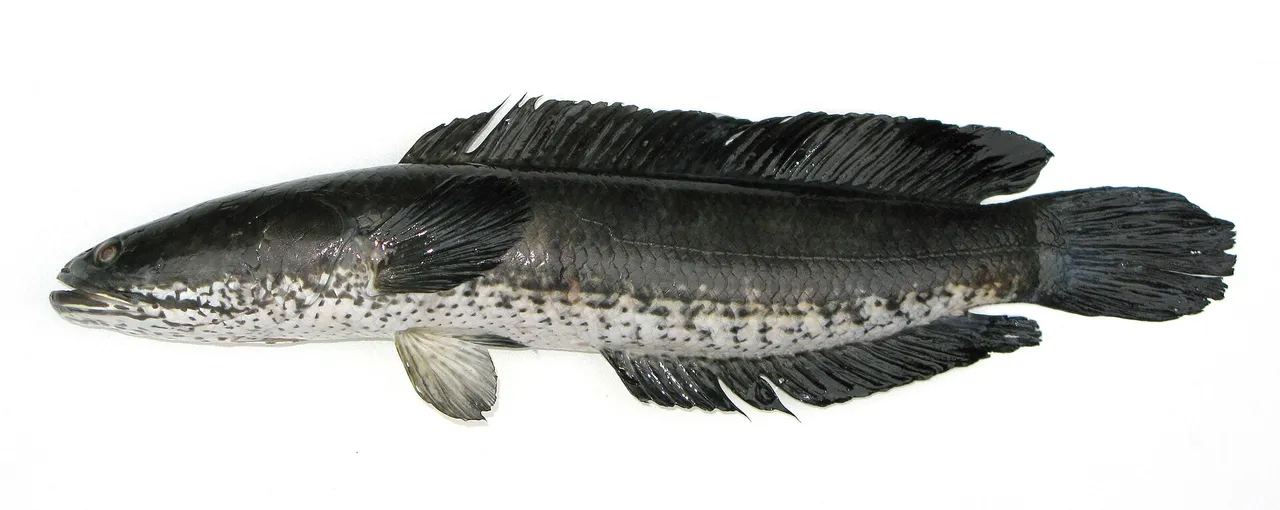
Identified by: The dark chevron blotching along the lower flank is the character separating Channa striata from its congeners, and it is unambiguous here. The long spineless dorsal and anal fins, the rounded tail and the flattened head plated with enlarged scales place the fish in Channa; the absence of a caudal ocellus rules out great snakehead.Reyes, R.B., CC BY 4.0, via Wikimedia Commons — source, licenceLook at this first
Turn the fish so you can see below the lateral line. Striped snakehead carries dark chevrons along the lower flank, pointing forward towards the head. Great snakehead has an eyespot at the tail instead, and giant snakehead has two bold bands down the side.
Diagnostic — settles it on its own
Each of these settles the identification on its own. If one is clear, you have your answer.
Forward-pointing chevrons on the lower flank
Oblique dark bars angled towards the head, running along the belly side of the lateral line. It is the pattern that separates this species from the other Channa likely to be in the same water, and it is legible on a fish of almost any size.
Supporting — use with other characters
Real characters that are not conclusive by themselves. Use two or three together.
No eyespot at the base of the tail
Great snakehead carries a conspicuous ringed ocellus there and this species does not. An absence, and a useful one, because the two overlap across much of South and South-East Asia.
Long spineless dorsal and anal fins on a cylindrical body
Both fins run most of the body length and neither carries a spine. This establishes the genus before any species character is applied, and it rules out the eels and elongate catfish that share the same swamps.
Build and maximum size
More slender and considerably smaller than giant or great snakehead. A very large snakehead in the same water is probably one of those two rather than this one — a probability rather than a determination.
What it gets confused with
- Great snakehead, separated by the caudal eyespot and by size.
- Giant snakehead, which as an adult carries two bold dark bands along the flank.
- Other Channa across South and South-East Asia, several of which are separated on scale and fin ray counts rather than on pattern.
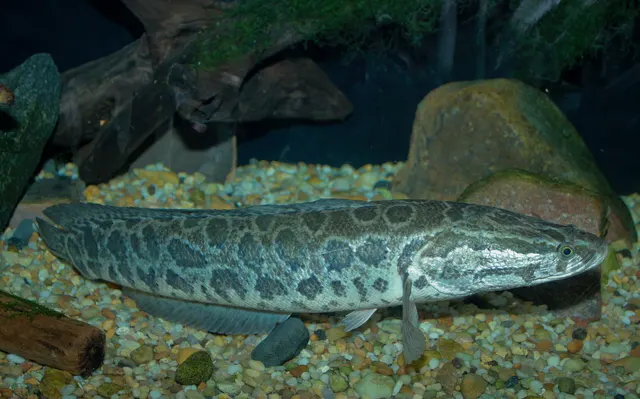
Side by side: Striped snakehead vs Northern snakehead.
Where this stops working
Channa is a large and taxonomically active genus, and several species are separated on counts that a photograph cannot supply. Juveniles of several snakeheads converge in appearance. Where the fish is outside its native range the identification carries an obligation rather than only an interest: introduced snakeheads establish readily, and their air-breathing lets them survive transport in a way most fish cannot.
The full record
This page covers identification only. The Striped snakehead record covers behaviour, lifecycle, distribution, handling and the sources behind all of it.
Reviewed 2026-08-14.
More about this fish
Telling it apart is one question. Here are the others.
Similar and related fish
How it is caught
Where it lives
Where you will find it
Why the 6 connections on this page are here, and the sources
Similar and related fish
Backed by research — 2 connections
Supported by peer-reviewed research or fisheries science. The sources are listed and can be checked.
Great snakehead
An identification comparison naming both binomials: Channa striata and Channa marulius.
- FishBase: a global information system on fishes — Froese, R. and D. Pauly, eds. — FishBase Consortium (Scientific institute)Relied on for: Morphological and distributional data for Channa striata and for Channa marulius.States this directlyPassage read and verified
- The IUCN Red List of Threatened Species — International Union for Conservation of Nature (Conservation authority)Relied on for: Separate assessments treating Channa striata and Channa marulius as distinct species.States this directlyCitation checked — the work exists and is described correctly
Northern snakehead
An identification comparison naming both binomials: Channa argus and Channa striata.
- FishBase: a global information system on fishes — Froese, R. and D. Pauly, eds. — FishBase Consortium (Scientific institute)Relied on for: Morphological and distributional data for Channa argus and for Channa striata.States this directlyPassage read and verified
- The IUCN Red List of Threatened Species — International Union for Conservation of Nature (Conservation authority)Relied on for: Separate assessments treating Channa argus and Channa striata as distinct species.States this directlyCitation checked — the work exists and is described correctly
How it is caught
What experienced anglers do — 2 connections
Widely and independently recommended by experienced anglers and specialist sources. This is real angling knowledge, not proof: controlled evidence for it is limited, and FishingHQ records it as convention rather than as a demonstrated effect.
Float fishing
A practitioner claim about how Channa striata is commonly fished, following from where and how it feeds.
- General angling website restatements of established technique — Various (Credible secondary source)Relied on for: Widely restated practitioner accounts of fishing for striped snakehead.Citation checked — the work exists and is described correctly
- Sea Angler — Bauer Media (Specialist angling publication)Relied on for: Practitioner treatment of the methods used for striped snakehead and comparable species.Citation checked — the work exists and is described correctly
Spinning
A practitioner claim about how Channa striata is commonly fished, following from where and how it feeds.
- General angling website restatements of established technique — Various (Credible secondary source)Relied on for: Widely restated practitioner accounts of fishing for striped snakehead.Citation checked — the work exists and is described correctly
- Sea Angler — Bauer Media (Specialist angling publication)Relied on for: Practitioner treatment of the methods used for striped snakehead and comparable species.Citation checked — the work exists and is described correctly
Where it lives
Backed by research — 1 connection
Supported by peer-reviewed research or fisheries science. The sources are listed and can be checked.
Lowland stillwaters
A habitat association for Channa striata taken from the environment and distribution data on its FishBase summary.
- FishBase: a global information system on fishes — Froese, R. and D. Pauly, eds. — FishBase Consortium (Scientific institute)Relied on for: The environment, depth range and habitat description recorded for Channa striata.States this directlyPassage read and verified
Where you will find it
Backed by research — 1 connection
Supported by peer-reviewed research or fisheries science. The sources are listed and can be checked.
The Mekong system
A distribution association between an animal and a kind of water, rather than a claim about any named mark.
- The IUCN Red List of Threatened Species — International Union for Conservation of Nature (Conservation authority)Relied on for: Assessment and habitat account for the species, including the river or lake system it occupies and the pressures acting on it.States this directlyCitation checked — the work exists and is described correctly
- FishBase: a global information system on fishes — Froese, R. and D. Pauly, eds. — FishBase Consortium (Scientific institute)Relied on for: Distribution, habitat association, size and life history recorded for the species in the system concerned.States this directlyPassage read and verified
Safety
Injury while handling fish — Minor injury
Snakehead teeth are small but sharp and the fish remains active and strong out of water for a long time.
What reduces it: Use pliers rather than fingers, and control the fish against a soft surface.