Flathead grey mullet
Fish · Last reviewed 2026-08-10
The most widely distributed mullet in the world, found on almost every warm and temperate coast, and a detritus feeder with a gizzard-like stomach.
Safety: tides and being cut off — can cause injury needing treatment. 5 more points apply here.
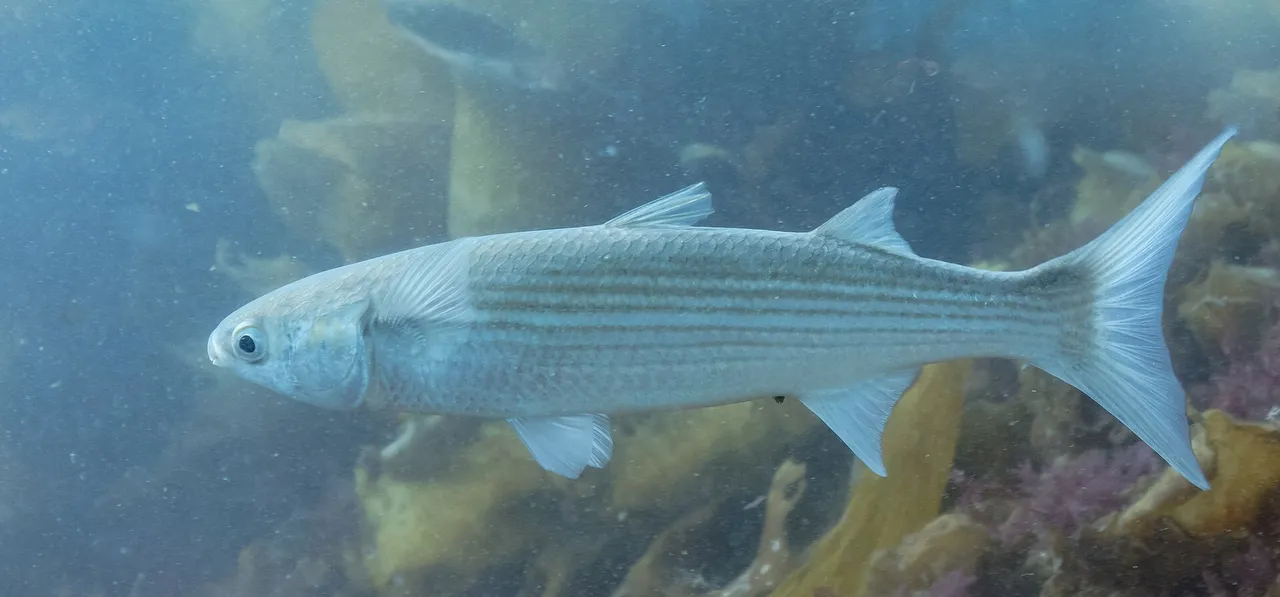
How this was identified, and who took it
Identified by: The adipose eyelid — the pale fatty tissue encroaching over the front and back of the eye — is visible, and it is the character that separates Mugil cephalus from Chelon and Liza. The upper lip is narrow, which rules out thick-lipped grey mullet, the species FishingHQ already holds. Both dorsal fins, the forked tail and the striped flank are in frame.Diego Delso, CC BY-SA 4.0, via Wikimedia Commons — source, licence,_Parque_natural_de_la_Arr%C3%A1bida,_Portugal,_2021-09-09,_DD_25.jpg)
Catching Flathead grey mullet
Everything here on fishing for it. Each entry opens the page behind it.
- Where
- 6 places FishingHQ documents — strongest claim anywhere: regular local target · From the shore
The flathead grey mullet is one of the most widely distributed coastal fish on Earth, present on almost every tropical and temperate coast, and it is the species most people mean by grey mullet outside northern Europe.
What makes it unusual is its diet. Adult mullet feed largely on detritus, microalgae and the organic film on sediment, taking in sand and mud along with the food and grinding it in a muscular gizzard-like section of the stomach — an arrangement more like a bird's than a fish's. That is why they are so difficult to catch on conventional baits: a fish that eats sediment film is not looking for a lugworm.
It is also strikingly tolerant. Flathead grey mullet move freely between full seawater, brackish lagoons and fresh water, and are found in harbours, estuaries and river mouths in numbers that make them among the most visible and least caught fish in many places.
Anglers who succeed with them generally do so by matching what the fish are actually eating — bread and algae-based baits in harbours, tiny hooks and fine tackle — or by targeting the more predatory feeding that occurs where food is concentrated. It is a specialist pursuit with a devoted following precisely because it is difficult.
How it is caught
- Cast nettingMullet are the cast net's archetypal catch across the warm temperate and tropical world. They shoal densely in shallow, clear, hard-bottomed water — estuary margins, harbour edges, sand flats — where a thrown net can be seen to land and can enclose a whole shoal, and they are almost impossible to take in numbers any other way because of how selectively they feed.
- Float fishingMullet feed on fine particles and surface film in harbours and estuaries and refuse anything presented crudely, so a light float outfit fished with tiny hooks is the approach that the fish's caution rather than its habitat dictates.
Where Flathead grey mullet is documented
Places where public sources describe this species as fished, with how it is fished and how strongly the evidence supports it. This is not a range map and it is not a recommendation — it is what has been written down about a fishery rather than a record of any individual catch, and being listed is never permission to fish.
Portugal
3 documented places
Estuary
Recorded here
From the shore
Estuary
Recorded here
From the shore
Tidal channel
Recorded here
From the shore
What these strengths mean
- Regular local target
- Fishing sources describe this as a normal local target here, not merely as caught.
- Recorded here
- At least one credible public account of this species being caught here. That is all it means.
Identification
- Scientific name
- Mugil cephalus
- Family
- Mugilidae
- Water
- Saltwater, Brackish, Freshwater
- Conservation status
- Least Concern
- Regions
- Global, Mediterranean, Western Europe, Britain & Ireland, North America, Caribbean, East & Southern Africa, South Asia, South-East Asia, Australia, East Asia, Central & South America
- Blunt flattened head with a small terminal mouth and thin lips — the mouth is the key: small, without teeth of consequence, and adapted to grazing rather than seizing.
- Two widely separated dorsal fins, the first with four spines.
- Silvery-grey with faint darker longitudinal stripes along the flank; a dark spot at the base of the pectoral fin in most individuals.
- A well-developed adipose eyelid partly covering the eye — a distinctive character of this species.
- Several mullet species overlap; lip structure, the adipose eyelid and the pectoral spot separate them rather than colour.
Size
- Typical
- 0.5–1.5 kg (1–3.3 lb)
- Large
- 2.5–4 kg (5.5–9 lb)
Exceptional: Over 5 kg (11 lb); maximum published length 120 cm
A fish caught on tackle far too light for it, and a mouth that was never built to be pulled
Mullet handling is decided by a mismatch that is inherent to the fishery rather than incidental to it: a large, powerful fish caught on the finest tackle in sea angling, with a mouth designed for grazing.
WHY THE TACKLE IS SO LIGHT. Mullet feed on fine organic material, algae, detritus and the film on hard surfaces, and they inspect what they are eating closely in clear, shallow, often very calm harbour water. Anything crude is refused. So the fishery uses tiny hooks, fine line and soft rods — not for sport, but because nothing heavier catches anything.
WHAT THAT MEANS WHEN THE FISH IS HOOKED. A small hook in a soft mouth, attached to a fish that is fast, strong and frequently over two kilos, is a hold that survives only if nothing sudden happens. The soft rod exists to prevent exactly that, and the long fights this fishery is known for are a function of the tackle rather than of the fish being played badly.
AND THE HANDLING FOLLOWS DIRECTLY. The mouth cannot carry the fish's weight — the lips are soft and the jaw is not a lifting structure — so a mullet is netted rather than lifted, and supported under the body rather than held by the head. The hook is small and frequently well in, which makes forceps rather than fingers the tool.
THE WATER IS THE OTHER HALF OF THE PROBLEM. Mullet are caught in harbours, marinas and estuary creeks — shallow, sun-warmed, sometimes poorly flushed water with low dissolved oxygen — after a long fight. That combination produces the slowest recovery of almost any British sea fish, and a mullet released the moment it is unhooked frequently turns on its side. It needs to be held upright, in the deepest and coolest water reachable, until it swims away rather than drifts away, and on a hot afternoon that can take several minutes.
What experienced anglers do — why, and the sources (4)
Widely and independently recommended by experienced anglers and specialist sources. This is real angling knowledge, not proof: controlled evidence for it is limited, and FishingHQ records it as convention rather than as a demonstrated effect.
- Sea Angler — Bauer Media (Specialist angling publication)Relied on for: Established boat and shore practice for handling and returning the species.States this directlyCitation checked — the work exists and is described correctly
- IGFA International Angling Rules and World Record Requirements — International Game Fish Association (Angling or fisheries organisation)Relied on for: Handling, release and tackle conventions in recognised sport fisheries for the species.Background and mechanism onlyPassage read and verified
- Understanding the Complexity of Catch-and-Release in Recreational Fishing — Reviews in Fisheries Science 15:75–167, 2007 (Scientific literature)Relied on for: The determinants of catch-and-release outcome in recreational fisheries, and the gap between angler belief and measured survival.States this directlyCitation checked — the work exists and is described correctly
- Do we need species-specific guidelines for catch-and-release recreational angling? — Biodiversity and Conservation 14:1195–1209, 2005 (Scientific literature)Relied on for: That air exposure, handling duration and water temperature are the dominant modifiable determinants of post-release survival.States this directlyCitation checked — the work exists and is described correctly
A fish that leaves when the water cools, and comes back when it does not
Grey mullet seasonality is one of the sharpest temperature signals on a temperate coast, and it explains an absence that anglers routinely misread as a decline.
THE PATTERN IS ARRIVAL AND DEPARTURE, NOT ACTIVITY. Flathead grey mullet are a warm-water fish at the northern edge of their range in north-west Europe. They move into estuaries, harbours, creeks and shallow coastal water as it warms through spring, remain through the warm months feeding heavily, and leave for deeper and warmer offshore water as it cools in autumn. In the colder part of the year they are simply not there, and no amount of good fishing will produce one.
WHICH MAKES THE THRESHOLD MORE USEFUL THAN THE MONTH. The arrival tracks water temperature crossing a threshold rather than a date, so a warm spring brings them in weeks early and a cold one delays them; a mild autumn holds them into the season and a cold snap empties a harbour in a few days. Anybody fishing for them is better served by watching sea temperature than a calendar, and the difference between coasts a hundred miles apart can be substantial.
FEEDING IS ALSO SEASONAL AND IT IS THE OTHER HALF OF THE ANSWER. Mullet graze algae, detritus, and the biofilm on hard surfaces, and all of that is a productive-season resource. Warm water means more algal growth, more organic material, more of the fine food this fish's gut is built for. Their feeding intensity therefore rises and falls with the productivity of the shallow water they occupy, not just with their presence in it.
SPAWNING HAPPENS OFFSHORE AND IN THE COLDER MONTHS in most of the range, which is why it is invisible from the shore and why the fish disappear so completely. This is a species whose reproductive life happens somewhere anglers never see.
THE SOUTHERN END OF THE RANGE HAS A DIFFERENT YEAR. In the Mediterranean and in warmer Atlantic waters, mullet are present year-round and the seasonality is a matter of movement between lagoons, estuaries and the sea rather than of arrival and departure. A seasonal account written for a British estuary does not describe a Portuguese one.
AND WHAT MAY BE FISHED FOR, WHERE AND WHEN IS A SEPARATE MATTER ENTIRELY, with local answers that have no necessary relationship to the biological pattern above.
Backed by research — why, and the sources (2)
Supported by peer-reviewed research or fisheries science. The sources are listed and can be checked.
- The Fishes of the British Isles and North-West Europe — Macmillan, 1969 (Reference work)Relied on for: Seasonal occurrence, movement and spawning period of fishes in British and north-west European waters.States this directlyCitation checked — the work exists and is described correctly
- FishBase: a global information system on fishes — Froese, R. and D. Pauly, eds. — FishBase Consortium (Scientific institute)Relied on for: Spawning season, temperature preference and seasonal distribution for the species.States this directlyPassage read and verified
Out to sea to spawn, and a larva that comes back into brackish water to grow
Grey mullet reproduction happens entirely out of sight of the estuaries and harbours where the fish is familiar, which is why it is so widely misunderstood.
SPAWNING IS OFFSHORE AND MARINE. Despite living much of their lives in estuaries, lagoons, harbours and even fresh water, flathead grey mullet migrate out to sea to spawn, gathering in coastal and offshore waters and releasing buoyant eggs into the water column. They do not spawn in the brackish water they feed in, and no amount of watching an estuary will show it happening.
WHICH MAKES THE SPECIES CATADROMOUS IN HABIT if not in the strict sense — feeding and growing in low-salinity water, reproducing in full salinity. The migration is a genuine one and it is why mullet disappear from estuaries at particular times in ways that have nothing to do with feeding conditions.
THE LARVAE AND JUVENILES RETURN, AND THAT RETURN IS THE BOTTLENECK. Post-larval mullet arrive at coasts and enter estuaries, lagoons and creeks in large numbers to grow in warm, productive, sheltered brackish water. Access to those nurseries — through sluices, barrages, tidal gates and modified estuary mouths — governs how many make it, and it is a habitat problem that occurs at a specific size and season.
FECUNDITY IS HIGH AND MATURITY IS REACHED AT SEVERAL YEARS, so the species has some reproductive resilience, but a mullet is a slow-growing fish and the large ones seen in a harbour are considerably older than they look.
SPAWNING TIMING IS SEASONAL AND VARIES WITH LATITUDE, running through the cooler months in warm parts of the range and shifting through the year across the species' very wide distribution. A schedule from one coast does not transfer.
AND THE SPECIES IS FARMED AND ROE-HARVESTED IN SEVERAL REGIONS, which means local populations may be affected by fisheries targeting fish specifically for their ovaries at the pre-spawning stage — a reproductive pressure of a very particular kind. Where and whether that occurs, and what recreational rules apply, are matters for the competent authority.
Backed by research — why, and the sources (2)
Supported by peer-reviewed research or fisheries science. The sources are listed and can be checked.
- FishBase: a global information system on fishes — Froese, R. and D. Pauly, eds. — FishBase Consortium (Scientific institute)Relied on for: Reproductive mode, spawning season, fecundity, size and age at maturity, and larval development recorded for the species.States this directlyPassage read and verified
- The IUCN Red List of Threatened Species — International Union for Conservation of Nature (Conservation authority)Relied on for: Assessment and life-history account, including reproductive biology and the pressures acting on recruitment.Background and mechanism onlyCitation checked — the work exists and is described correctly
Lifecycle and reproduction
Grows moderately and lives to around sixteen years. Spawns at sea, sometimes well offshore, with pelagic eggs and larvae that move inshore to shallow coastal and estuarine habitat as juveniles. Adults move freely between marine, brackish and fresh water. The catadromous tendency — feeding in low-salinity water and spawning at sea — links the species to estuarine and lagoon health.
Broadcast spawning at sea in the cooler months, with adults aggregating and moving offshore to spawn, producing pelagic eggs and larvae. Juveniles recruit into very shallow inshore and estuarine habitat. The species is farmed widely, particularly for its roe, which is the basis of bottarga and a substantial regional food industry in the Mediterranean.
Feeding and senses
Feeds principally on detritus, microalgae and the organic film on sediment surfaces, ingesting sand and mud with the food and grinding it in a muscular gizzard-like portion of the stomach. Juveniles take zooplankton. The detritus diet is the single most useful fact about the species: it explains both the difficulty of catching them on conventional baits and the effectiveness of bread and algae-based approaches.
Sight matters in the clear shallow water they frequent, and mullet are notoriously wary of movement on a bank or quay — they will empty a harbour corner at a footfall. In turbid estuarine water taste and the lateral line carry more of the load. The wariness is why very fine tackle and long, careful approaches are conventional for them.
Through the year
Moves inshore into harbours, estuaries and lagoons in the warmer months and offshore to deeper water and to spawn as it cools; in the northern part of the range mullet are a summer visitor and largely absent in winter. Present year-round in the tropics. Tide governs the daily fishing, particularly in harbours where the flood brings both fish and food.
Distribution
Cosmopolitan in tropical, subtropical and temperate coastal waters worldwide, in seas, estuaries, lagoons and fresh water. One of the most widely distributed coastal fish in the world.
This is a biological range — where the species occurs, not a prediction that you will catch one. To browse the fishing geography FishingHQ holds, start at fishing places.
Why anglers care
A specialist target with a devoted following, fished with bread, algae-based baits, tiny hooks and very fine tackle in harbours, estuaries and lagoons, and on fly where the fish are feeding visibly. Also a major food and aquaculture species worldwide, particularly for its roe. Its abundance and visibility combined with its difficulty make it one of the most rewarding species to learn.
Handling and returning
Soft-mouthed and easily damaged; use fine hooks and a soft rod, and support the fish rather than lifting it by the jaw. Wet hands and minimise air time. Mullet are frequently caught in warm shallow harbour water where recovery is slow, so revive properly and return them promptly.
Going further
- What does flathead grey mullet eat? — feeding biology, kept separate from what anglers infer from it.
- Flathead grey mullet vs Thick-lipped grey mullet — how to tell them apart.
Safety
Tides and being cut off — Can cause injury needing treatment
Much of the fishery is in harbours, estuaries and on lagoon edges fished on a rising tide, which is classic cut-off ground and is fished with attention on the fish rather than the water.
What reduces it: Check the tide times and height, identify the exit before going out, and leave on a set clock time.
Drowning and immersion — Can cause injury needing treatment
Harbour walls and quays present a vertical drop into deep water with no gradual entry and frequently no ladder.
What reduces it: Wear a buoyancy aid. Know where the ladders and lifebuoys are before you need them. Stay back from the edge, particularly when landing a fish.
Precautions that always apply here
- Wet your hands before touching a fish. Dry hands strip the protective mucus layer that keeps infection out.
- Check the tide before you go and know your exit route. Being cut off is the commonest way a shore session becomes a rescue.
- Wear a buoyancy aid or lifejacket. Cold water incapacitates strong swimmers within a minute, long before swimming ability matters.
- Support the fish's weight along its body, keep it out of the water for as short a time as possible, and hold it over something soft.
Check the rules before you fish
Fishing laws, bylaws, access rules, seasons, bait restrictions and permitted methods vary by location and can change. Check the current rules from the relevant authority and the water you intend to fish before fishing.
Check with:
- Current national or regional law for where you are fishing
- Current local bylaws
- The relevant fisheries authority
- The landowner, club or fishery whose water it is
- Any restrictions specific to the species or the method you intend to use
Where to go next
Similar and related fish
Where you will find it
- Galicia and the Iberian ria coastUses the harbours, ria heads and river mouths in numbers, feeding on fine material in exactly the sheltered productive water the rias provide.
- KoreaWidespread in estuaries, harbours and the turbid west coast shallows, and one of the few species common to both of the peninsula's very different seas.
- LanzaroteOccupies harbours, sheltered bays and the island's limited brackish and shallow water, grazing the biofilm on hard surfaces.
- PortugalUses the harbours, estuaries and lagoon systems in numbers, feeding on fine material in the sheltered productive water they provide.
- The Aegean and CreteIn the harbours, moles and shallow bays where organic material accumulates, which in an oligotrophic sea makes the working harbour one of the more productive pieces of water available.
- The Indian subcontinent coastsWidespread in estuaries, backwaters and lagoon systems along both seaboards.
- The Strait of GibraltarOccupies the harbours and sheltered margins on both sides of the strait.
- The Strait of MessinaOccupies the harbours and sheltered margins on both sides of the strait.
1 more
- The western Indian Ocean coast Fishing regions
Understanding this fish
- Algae and biofilm as foodMicroalgae and the surface film are taken alongside the sediment itself, and no diet study separates the two cleanly because the fish does not either.
- Organic detritus as foodThe mullet ingests sand and mud along with the organic film on it and grinds the mixture in a muscular gizzard-like stomach region, which is the anatomical signature of a detritivore rather than of a predator.
Told apart from
Sources and evidence
- FishBase: a global information system on fishes — Froese, R. and D. Pauly, eds. — FishBase Consortium (Scientific institute)Relied on for: Scientific name, family placement in the Mugilidae, a maximum length of 100.0 cm SL, a maximum reported age of 16 years.States this directlyPassage read and verified
- FishBase: a global information system on fishes — Froese, R. and D. Pauly, eds. — FishBase Consortium (Scientific institute)Relied on for: Environment, climate zone and depth range as recorded: Marine; freshwater; brackish; benthopelagic; catadromous ; depth range 0 - 120 m , usually 0 - 10 m. Subtropical; 8°C - 24°C ; 62°N - 57°S, 180°W - 180°EStates this directlyPassage read and verified
- FishBase: a global information system on fishes — Froese, R. and D. Pauly, eds. — FishBase Consortium (Scientific institute)Relied on for: The IUCN Red List category for Mugil cephalus — Least Concern, assessed 30 May 2022 — as republished by FishBase, the Red List itself being unreachable during review.States this directlyPassage read and verified
- The Fishes of the British Isles and North-West Europe — Macmillan, 1969 (Reference work)Relied on for: The feeding apparatus and detritus-based diet of grey mullet, and their estuarine and brackish habitat use.States this directlyCitation checked — the work exists and is described correctly
Why the 15 connections on this page are here, and the sources
Similar and related fish
Backed by research — 1 connection
Supported by peer-reviewed research or fisheries science. The sources are listed and can be checked.
Thick-lipped grey mullet
A comparison resting on shared family and feeding ecology, naming both binomials.
- FishBase: a global information system on fishes — Froese, R. and D. Pauly, eds. — FishBase Consortium (Scientific institute)Relied on for: That Mugil cephalus and Chelon labrosus are both Mugilidae feeding on detritus and organic material in coastal and estuarine water.States this directlyPassage read and verified
How it is caught
What experienced anglers do — 2 connections
Widely and independently recommended by experienced anglers and specialist sources. This is real angling knowledge, not proof: controlled evidence for it is limited, and FishingHQ records it as convention rather than as a demonstrated effect.
Cast netting
Established angling practice for this species, recorded as convention. The note states the property of the animal or its water that makes the method the answer.
- Fishers' Craft and Lettered Art: Tracts on Fishing from the End of the Middle Ages — University of Toronto Press, 1997 (Scientific literature)Relied on for: That fishing practices develop around the fish and water available to them, and the historical method of reading such traditions.Background and mechanism onlyCitation checked — the work exists and is described correctly
- FAO fishing gear types and fishing technology information — Food and Agriculture Organization of the United Nations (Scientific institute)Relied on for: Classification and operation of the gear type described.States this directlyCitation checked — the work exists and is described correctly
Float fishing
Established angling practice for this species, recorded as convention. The note states the property of the animal or its water that makes the method the answer.
- Sea Angler — Bauer Media (Specialist angling publication)Relied on for: Established sea-angling technique and its application to this species.States this directlyCitation checked — the work exists and is described correctly
- General angling website restatements of established technique — Various (Credible secondary source)Relied on for: Widely restated practice connecting this species and method.Background and mechanism onlyCitation checked — the work exists and is described correctly
Where you will find it
Backed by research — 9 connections
Supported by peer-reviewed research or fisheries science. The sources are listed and can be checked.
Galicia and the Iberian ria coast
Occurrence of the species in this system or along this coast: a statement about the animal's distribution, not a venue recommendation.
- The Fishes of the British Isles and North-West Europe — Macmillan, 1969 (Reference work)Relied on for: Distribution and habitat association of fishes in British and north-west European waters.States this directlyCitation checked — the work exists and is described correctly
- FishBase: a global information system on fishes — Froese, R. and D. Pauly, eds. — FishBase Consortium (Scientific institute)Relied on for: Distribution, depth range and habitat association recorded for the species.States this directlyPassage read and verified
Korea
A distribution association between an animal and a kind of water, rather than a claim about any named mark.
- FishBase: a global information system on fishes — Froese, R. and D. Pauly, eds. — FishBase Consortium (Scientific institute)Relied on for: Distribution, habitat association and depth range recorded for the species, including its occurrence in the water body concerned.States this directlyPassage read and verified
- The IUCN Red List of Threatened Species — International Union for Conservation of Nature (Conservation authority)Relied on for: Assessment and range account for the species, including the systems and coasts it occupies.Background and mechanism onlyCitation checked — the work exists and is described correctly
Lanzarote
A distribution association between an animal and a kind of water, rather than a claim about any named mark.
- FishBase: a global information system on fishes — Froese, R. and D. Pauly, eds. — FishBase Consortium (Scientific institute)Relied on for: Distribution, habitat association and depth range recorded for the species, including its occurrence in the water body concerned.States this directlyPassage read and verified
- The IUCN Red List of Threatened Species — International Union for Conservation of Nature (Conservation authority)Relied on for: Assessment and range account for the species, including the systems and coasts it occupies.Background and mechanism onlyCitation checked — the work exists and is described correctly
Portugal
Occurrence of the species in these waters: a statement about the animal's distribution, not a venue recommendation.
- The Fishes of the British Isles and North-West Europe — Macmillan, 1969 (Reference work)Relied on for: Distribution and habitat association of fishes in north-west European and eastern Atlantic waters.States this directlyCitation checked — the work exists and is described correctly
- FishBase: a global information system on fishes — Froese, R. and D. Pauly, eds. — FishBase Consortium (Scientific institute)Relied on for: Distribution, depth range and habitat association recorded for the species.States this directlyPassage read and verified
The Aegean and Crete
A claim that a place contains the ground, water and seasonal conditions the species is associated with. It is a distributional statement about the world, it rests on the regional reference literature, and it deliberately asserts nothing about access, permission or catch.
- FishBase: a global information system on fishes — Froese, R. and D. Pauly, eds. — FishBase Consortium (Scientific institute)Relied on for: Recorded distribution, depth range and habitat association for the Mediterranean species named.States this directlyPassage read and verified
- FAO Species Identification Guides for Fishery Purposes and the FAO Species Catalogues — Food and Agriculture Organization of the United Nations (Scientific institute)Relied on for: Regional species identification and distribution for the Mediterranean and eastern Atlantic, including habitat association.States this directlyCitation checked — the work exists and is described correctly
The Indian subcontinent coasts
A distribution association between an animal and a kind of water, rather than a claim about any named mark.
- FAO Species Identification Guides for Fishery Purposes and the FAO Species Catalogues — Food and Agriculture Organization of the United Nations (Scientific institute)Relied on for: Distribution, habitat, depth and fishery accounts for the species in the FAO regional identification guides for the ocean area concerned.States this directlyCitation checked — the work exists and is described correctly
- FishBase: a global information system on fishes — Froese, R. and D. Pauly, eds. — FishBase Consortium (Scientific institute)Relied on for: Distribution, habitat association and depth range recorded for the species.States this directlyPassage read and verified
The Strait of Gibraltar
A distribution association between an animal and a kind of water, rather than a claim about any named mark.
- FAO Species Identification Guides for Fishery Purposes and the FAO Species Catalogues — Food and Agriculture Organization of the United Nations (Scientific institute)Relied on for: Distribution, habitat, depth and fishery accounts for the species of the eastern central Atlantic and Mediterranean in the FAO regional identification guides.States this directlyCitation checked — the work exists and is described correctly
- FishBase: a global information system on fishes — Froese, R. and D. Pauly, eds. — FishBase Consortium (Scientific institute)Relied on for: Distribution, habitat association and depth range recorded for the species.States this directlyPassage read and verified
The Strait of Messina
A distribution association between an animal and a kind of water, rather than a claim about any named mark.
- FishBase: a global information system on fishes — Froese, R. and D. Pauly, eds. — FishBase Consortium (Scientific institute)Relied on for: Distribution, habitat association and depth range recorded for the species, including its occurrence in the water body concerned.States this directlyPassage read and verified
- The IUCN Red List of Threatened Species — International Union for Conservation of Nature (Conservation authority)Relied on for: Assessment and range account for the species, including the systems and coasts it occupies.Background and mechanism onlyCitation checked — the work exists and is described correctly
The western Indian Ocean coast
A distribution association between an animal and a kind of water, rather than a claim about any named mark.
- FAO Species Identification Guides for Fishery Purposes and the FAO Species Catalogues — Food and Agriculture Organization of the United Nations (Scientific institute)Relied on for: Distribution, habitat, depth and fishery accounts for the species in the FAO regional identification guides for the ocean area concerned.States this directlyCitation checked — the work exists and is described correctly
- FishBase: a global information system on fishes — Froese, R. and D. Pauly, eds. — FishBase Consortium (Scientific institute)Relied on for: Distribution, habitat association and depth range recorded for the species.States this directlyPassage read and verified
Understanding this fish
Backed by research — 2 connections
Supported by peer-reviewed research or fisheries science. The sources are listed and can be checked.
Algae and biofilm as food
Recorded diet evidence identifies microalgae and the organic film on sediment surfaces as food for this species, at group level rather than as a named organism. The edge uses `consumes` rather than `preys_on` because nothing here is hunted, and it points at the category record so the granularity is visible.
- FishBase: a global information system on fishes — Froese, R. and D. Pauly, eds. — FishBase Consortium (Scientific institute)Relied on for: Food items recorded for this species, given as microalgae and the organic film on sediment surfaces.States this directlyPassage read and verified
- FAO Species Identification Guides for Fishery Purposes and the FAO Species Catalogues — Food and Agriculture Organization of the United Nations (Scientific institute)Relied on for: Species account describing this species' feeding, recorded as microalgae and the organic film on sediment surfaces.Background and mechanism onlyCitation checked — the work exists and is described correctly
Organic detritus as food
Recorded diet evidence identifies organic detritus and sediment organic matter as food for this species, at group level rather than as a named organism. The edge uses `consumes` rather than `preys_on` because nothing here is hunted, and it points at the category record so the granularity is visible.
- FishBase: a global information system on fishes — Froese, R. and D. Pauly, eds. — FishBase Consortium (Scientific institute)Relied on for: Food items recorded for this species, given as organic detritus and sediment organic matter.States this directlyPassage read and verified
- FAO Species Identification Guides for Fishery Purposes and the FAO Species Catalogues — Food and Agriculture Organization of the United Nations (Scientific institute)Relied on for: Species account describing this species' feeding, recorded as organic detritus and sediment organic matter.Background and mechanism onlyCitation checked — the work exists and is described correctly
Told apart from
What experienced anglers do — 1 connection
Widely and independently recommended by experienced anglers and specialist sources. This is real angling knowledge, not proof: controlled evidence for it is limited, and FishingHQ records it as convention rather than as a demonstrated effect.
Thin-lipped grey mullet
A comparison a reader with the animal or the decision in front of them actually needs, joining two records that resolve one another.
- The Fishes of the British Isles and North-West Europe — Macmillan, 1969 (Reference work)Relied on for: Distribution, habitat association, identification and biology of the fishes and inshore fauna of the British Isles and north-west Europe.States this directlyCitation checked — the work exists and is described correctly
- FAO Species Identification Guides for Fishery Purposes and the FAO Species Catalogues — Food and Agriculture Organization of the United Nations (Scientific institute)Relied on for: Diagnostic characters, family placement, habitat and depth range as set out in the FAO species identification sheets for the eastern Atlantic and Mediterranean.States this directlyCitation checked — the work exists and is described correctly
How FishingHQ labels evidence is explained in the evidence policy.